

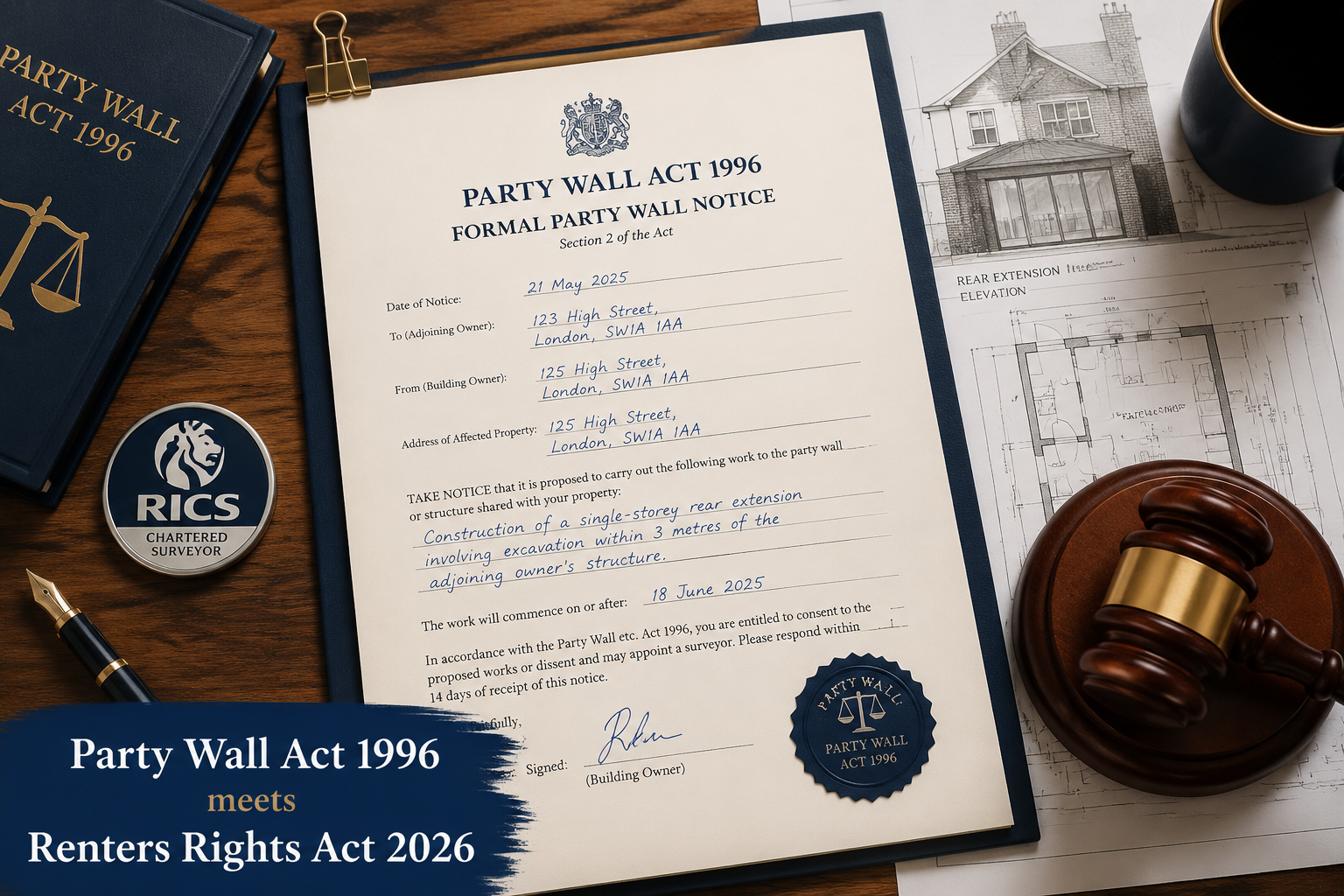
Roughly 11 million private renters in England now live under a fundamentally different legal framework following the commencement of the Renters' Rights Act 2026 on 1 May 2026 [2]. For landlords planning rear extensions, loft conversions, or basement works on tenanted properties, this shift is not merely administrative. It directly intersects with the Party Wall etc. Act 1996 in ways that most building owners and their surveyors have not yet fully mapped. Understanding how Party Wall Surveys Under Renters' Rights Act 2026: Managing Landlord Extensions with New Tenant Protections interact is now a compliance necessity, not an optional consideration.
Key Takeaways
- The Renters' Rights Act 2026 abolished Section 21 no-fault evictions from 1 May 2026, converting all assured shorthold tenancies to assured periodic tenancies and significantly limiting a landlord's ability to decant tenants during building works.
- Party wall notices must still comply fully with the Party Wall etc. Act 1996, but landlords now face additional obligations when those works affect occupied tenanted properties.
- Tenant protections around rent increases, advance payments, and possession grounds create practical constraints on how landlords manage construction programmes.
- A properly commissioned Schedule of Condition report is the single most important protective document for both landlords and tenants before any notifiable works begin.
- RICS-compliant notice strategies that account for both pieces of legislation reduce dispute risk and protect landlords from ombudsman referrals.
How the Renters' Rights Act 2026 Changes the Landlord Extension Landscape
Before May 2026, a landlord planning a significant rear extension could, in theory, serve a Section 21 notice to recover vacant possession, carry out works without an occupying tenant, and then re-let at a higher rent. That route is now closed [1]. The abolition of no-fault evictions means that any landlord wishing to carry out notifiable party wall works while a tenant remains in occupation must plan construction programmes around a legally protected occupier.
The Shift to Assured Periodic Tenancies
All assured shorthold tenancies automatically converted to assured periodic tenancies on 1 May 2026 [2]. New tenancies signed after that date are also assured periodic tenancies, with no fixed-term end date. This has a direct consequence for party wall programmes: there is no natural tenancy expiry point at which a landlord can guarantee vacant possession. Possession can now only be recovered using specific mandatory or discretionary grounds under Section 8 of the Housing Act 1988 [1].
The grounds most relevant to extension works are:
| Ground | Type | Relevance to Building Works |
|---|---|---|
| Ground 6 (demolition/reconstruction) | Mandatory | Applies where works cannot reasonably be done with tenant in occupation |
| Ground 1 (landlord occupation) | Mandatory | Applies where landlord intends to occupy as principal home |
| Ground 8 (substantial rent arrears) | Mandatory | Not directly related to works |
Ground 6 is the most significant for party wall scenarios. However, Baker McKenzie's analysis of the Act notes that specific notice periods and conditions apply, and courts will scrutinise whether works genuinely require vacant possession [4]. Landlords who cannot satisfy Ground 6 must manage party wall works around an occupied tenancy.
Rent Controls and Construction Timelines
The Act restricts landlords to one rent increase per year, with no increase permitted within the first 12 months of a new tenancy [2]. Any proposed increase must use Form 4A with at least two months' notice. Tenants may challenge increases exceeding market rates.
This matters for party wall programmes because landlords sometimes factor in a post-works rent uplift as part of the financial justification for an extension. That uplift is now constrained and challengeable. Landlords should ensure that party wall survey costs and construction disruption are not informally passed to tenants through accelerated rent increases, as this creates ombudsman exposure.
Party Wall Surveys Under Renters' Rights Act 2026: Core Legal Obligations for Landlords

The Party Wall etc. Act 1996 operates independently of tenancy law, but the two frameworks interact in practice. For a comprehensive overview of how party wall legislation works, the party wall matters guidance provides a solid foundation. The key obligations under the 1996 Act remain unchanged: landlords must serve valid notices, allow adjoining owners to respond, and in the event of dissent, appoint surveyors to produce a Party Wall Award.
What Triggers a Party Wall Notice on a Tenanted Property
The most common triggers for landlord extension projects are:
- Rear extensions that involve building on or adjacent to a party wall or party fence wall
- Loft conversions that require cutting into or raising a party wall
- Basement excavations within 3 or 6 metres of a neighbouring structure, depending on depth
The Party Wall Act 3-metre rule is particularly relevant for rear extensions that involve new foundations. Where excavation is required, a party wall excavation notice must also be served. These obligations apply regardless of whether the building owner's property is owner-occupied or tenanted.
The Schedule of Condition: Non-Negotiable in 2026
Under the new tenant protection framework, the Schedule of Condition has become more important than ever. A Schedule of Condition report records the pre-works condition of the adjoining property in photographic and written detail. Where that adjoining property is also a rented home, the Schedule of Condition protects:
- The adjoining tenant from being held liable for construction damage
- The adjoining landlord from inflated damage claims
- The building owner's landlord from disputes about what damage existed before works began
"A Schedule of Condition is not a luxury add-on. In an occupied tenanted property affected by party wall works, it is the primary evidence document if a dispute arises about damage."
The Renters' Rights Act 2026 creates a more litigious environment for landlords. Tenants now have stronger grounds to remain in occupation and more routes to challenge landlord conduct. A well-prepared Schedule of Condition, incorporated into the Party Wall Award, significantly reduces the risk of damage to property in party wall disputes escalating into ombudsman complaints or county court claims.
RICS-Compliant Notice Strategies for Occupied Properties
Serving party wall notices on a property where the adjoining owner is also a landlord with tenants in occupation requires careful sequencing. The RICS guidance on party wall matters recommends the following approach:
- Identify all adjoining owners and occupiers before serving any notice. Under the 1996 Act, the notice is served on the owner, not the tenant. However, where the adjoining property is tenanted, the surveyor should be aware that access for inspection may require tenant cooperation.
- Serve notices with adequate lead time. The standard one or two months' notice period should be extended informally where possible to allow adjoining landlords to communicate with their tenants about access.
- Agree a surveyor early. Where both building owner and adjoining owner are landlords, using a single party wall agreed surveyor can reduce costs and speed up the Award process.
- Incorporate tenant access provisions into the Award. The Party Wall Award can specify working hours, dust and noise controls, and notification requirements that protect occupying tenants on both sides of the wall.
- Document all communications. Under the Renters' Rights Act 2026, landlords must provide tenants with written information about matters affecting their tenancy [6]. Construction works that affect habitability or quiet enjoyment should be communicated in writing.
Managing Tenant Protections During Active Party Wall Works
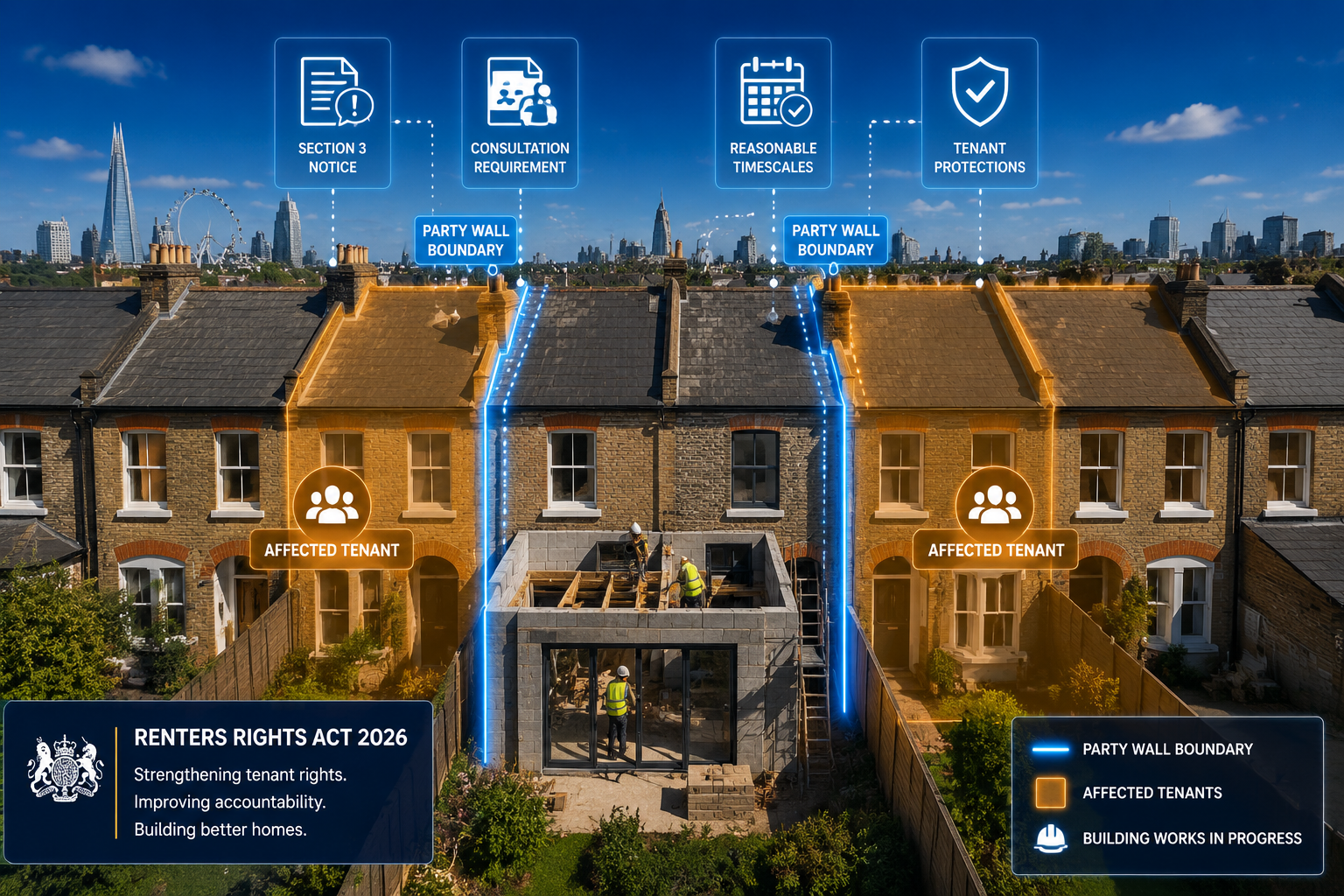
The practical management of an extension project on a tenanted property has become considerably more complex in 2026. Several specific provisions of the Renters' Rights Act create friction points with typical construction programmes.
Pet Rights and Construction Disruption
One of the more unexpected intersections involves the Act's new pet rights provisions. Tenants can now request permission to keep pets, and landlords must consider such requests and provide valid reasons for refusal [2]. Where a tenant has a pet and party wall works create significant noise, vibration, or dust, the landlord may face complaints about habitability that are harder to dismiss under the new framework. Construction programmes should account for this by:
- Scheduling the noisiest works during agreed hours communicated in advance
- Providing tenants with written notice of particularly disruptive work phases
- Considering whether temporary alternative accommodation is appropriate for extended high-impact phases
Advance Rent and Deposit Restrictions
The Act limits landlords to requesting a maximum of one month's rent in advance once a tenancy agreement is signed, and prohibits requesting advance rent before signing [2]. This affects landlords who might otherwise seek to restructure tenancy arrangements around a construction programme. It also means that landlords cannot use financial incentives such as rent-free periods during works as a mechanism to offset disruption, without careful legal advice on how this interacts with the rent increase restrictions.
The New Ombudsman Regime and Party Wall Disputes
The Renters' Rights Act 2026 introduces a mandatory landlord ombudsman scheme. This creates a new escalation route for tenants who believe their landlord has failed to manage construction works responsibly. A tenant in an adjoining property affected by party wall works who believes the building owner's landlord has not followed the Party Wall Award could potentially raise a complaint through this route.
For landlords carrying out extension works, this means that compliance with the party wall agreement and the resulting Award is not merely a legal technicality. It is a conduct matter that can be scrutinised by the ombudsman. Landlords should retain copies of all notices, Awards, and correspondence as part of their compliance records.
Possession Grounds and Construction Phasing
Where a landlord genuinely cannot carry out works with a tenant in occupation and seeks to use Ground 6, the Act requires that specific conditions are met [4]. The landlord must demonstrate that:
- The works cannot reasonably be carried out with the tenant in occupation
- The landlord intends to return the property to the rental market after works (with restrictions on re-letting timelines)
- Proper notice has been served
This creates a significant planning burden. Landlords should obtain written advice from both their party wall surveyor and a housing solicitor before serving any possession notice connected to building works. The interaction between Ground 6 and party wall notice timelines means that the two legal processes must be sequenced carefully to avoid a situation where possession is recovered before the Party Wall Award is in place, leaving the landlord exposed to injunctions.
Costs and the Party Wall Award
Party wall surveyor costs are borne by the building owner in most cases. Under the new framework, landlords should budget for:
- Party wall surveyor fees (both own surveyor and adjoining owner's surveyor if separate)
- Schedule of Condition preparation
- Any additional access or notification requirements imposed by the Award
- Potential remediation costs if damage occurs to an occupied adjoining property
Where the adjoining property is tenanted, damage claims may be more complex because the tenant may have their own claim for disruption to quiet enjoyment, separate from the landlord's structural damage claim. A robust party wall award that addresses both structural and occupier impacts is the most effective way to manage this risk.
Practical Steps for Landlords Planning Extensions in 2026
The convergence of party wall legislation and the Renters' Rights Act 2026 demands a more structured pre-works process. The following checklist summarises the key actions:
Before Serving Any Notice
- Confirm the tenancy type and whether the tenant has an assured periodic tenancy
- Assess whether works can be carried out with the tenant in occupation
- Instruct a chartered surveyor to assess party wall obligations
- Commission a Schedule of Condition for all potentially affected properties
During the Notice Period
- Serve party wall notices in compliance with the 1996 Act
- Provide tenants with written information about planned works and their likely impact
- Respond to any dissent promptly and appoint surveyors within the statutory timeframe
- Do not serve any rent increase notice during the notice period unless legally required
During Works
- Comply strictly with the Party Wall Award's working hour and notification provisions
- Keep a written log of all tenant communications about works
- Address any damage claims promptly and in writing
- Do not attempt to recover possession on grounds unrelated to the works
After Works
- Carry out a post-works inspection against the Schedule of Condition
- Resolve any damage claims before the Award is closed
- Retain all documentation for ombudsman compliance purposes
Conclusion
Party Wall Surveys Under Renters' Rights Act 2026: Managing Landlord Extensions with New Tenant Protections is not a niche compliance topic. It sits at the intersection of two significant legal frameworks that together govern how millions of properties in England can be developed and occupied. The abolition of Section 21 evictions, the transition to assured periodic tenancies, and the new ombudsman regime have collectively raised the stakes for any landlord who wants to extend or alter a tenanted property [1][2][5].
The practical path forward requires early engagement with a qualified party wall surveyor, a RICS-compliant notice strategy that accounts for occupied tenancies, and a Schedule of Condition that protects all parties. Landlords who treat party wall compliance as a box-ticking exercise in 2026 face a materially higher risk of disputes, ombudsman referrals, and court proceedings than those who invest in proper professional advice from the outset.
Actionable next steps:
- Contact a chartered party wall surveyor before any design work is finalised to identify notice obligations early
- Review all tenancy agreements to confirm their status under the Renters' Rights Act 2026
- Instruct a Schedule of Condition survey for all adjoining properties before works begin
- Obtain written legal advice on the interaction between Ground 6 possession and party wall notice timelines if vacant possession is needed
- Keep comprehensive written records of all tenant communications throughout the construction programme
References
[1] Renters Rights Act An Overview For Landlords – https://www.gov.uk/guidance/renters-rights-act-an-overview-for-landlords
[2] Renters Rights Act Overview For Tenants – https://www.gov.uk/guidance/renters-rights-act-overview-for-tenants
[3] The Renters Rights Act Information Sheet 2026 – https://www.gov.uk/government/publications/the-renters-rights-act-information-sheet-2026
[4] United Kingdom Renters Rights Act 2025 – https://www.bakermckenzie.com/en/insight/publications/2026/01/united-kingdom-renters-rights-act-2025
[5] Renters Rights Act – https://www.wigan.gov.uk/Resident/Housing/Private-Sector-Housing/Tenants/Renters-Rights-Act.aspx
[6] Renters Rights Act 2025 Landlords Guide Compliance – https://www.york.gov.uk/private-landlords-tenants/renters-rights-act-2025-landlords-guide-compliance