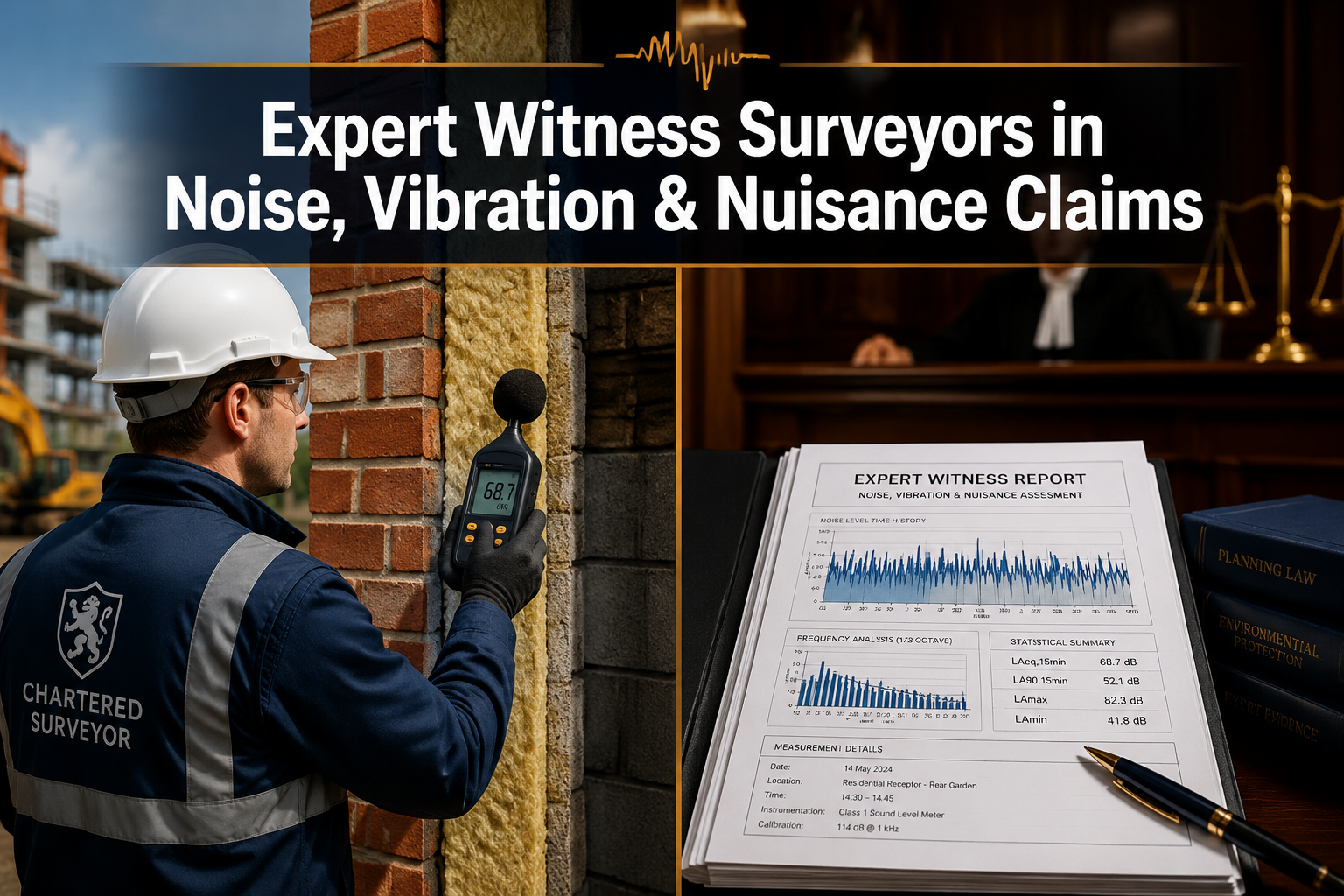

Noise and vibration disputes account for a significant proportion of neighbour and property litigation in England and Wales, yet fewer than one in three claimants enters proceedings with technically robust evidence. That gap between lived experience and legally admissible proof is precisely where expert witness surveyors in noise, vibration and nuisance claims earn their value — translating decibel readings, peak particle velocities, and building fabric assessments into clear, court-ready reports that can determine the outcome of a case.
Key Takeaways
- Expert witness surveyors in noise, vibration and nuisance claims convert raw acoustic and vibration measurements into structured, legally admissible evidence.
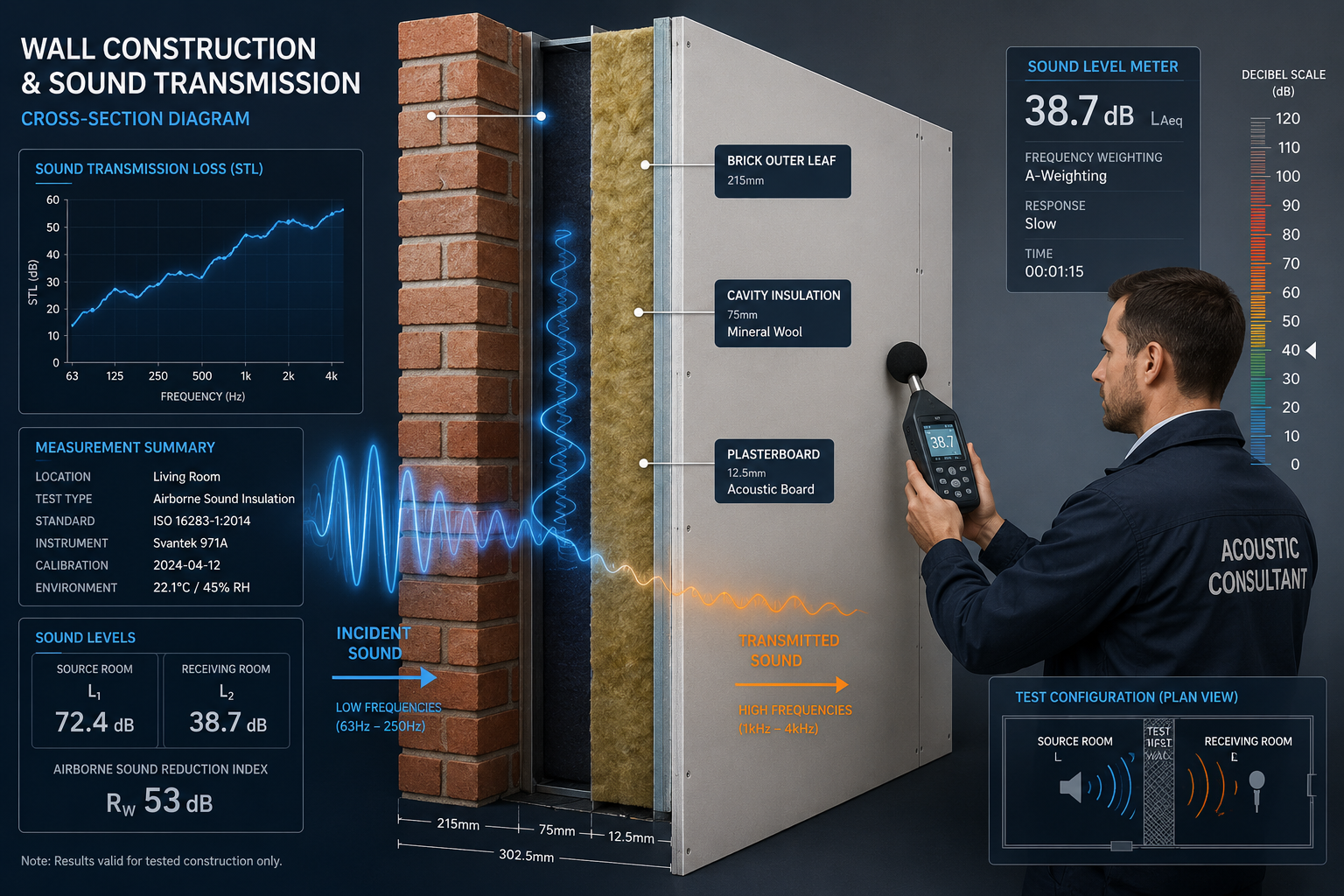
- Building fabric — walls, floors, ceilings, and their construction details — directly determines how sound and vibration travel between properties and must be assessed on site.
- Structure-borne noise from trains, heavy vehicles, and construction plant requires different measurement protocols than airborne noise.
- An expert witness report must be impartial, methodology-transparent, and compliant with Civil Procedure Rules (CPR) Part 35 to withstand cross-examination.
- Early instruction of a qualified surveyor can prevent disputes from escalating and supports both claimants and defendants in reaching proportionate settlements.
What Expert Witness Surveyors Do in Noise and Nuisance Claims
An expert witness surveyor occupies a unique dual role: technical specialist and officer of the court. Under CPR Part 35, their primary duty is to the court — not to the instructing party — which demands objectivity above all else. In noise, vibration, and nuisance matters, that objectivity must be grounded in measurable, reproducible data.
The scope of instruction typically covers three broad areas:
| Area | Typical Issues | Key Standards |
|---|---|---|
| Airborne noise | Music, speech, mechanical plant | BS 8233, BS EN ISO 10140 |
| Structure-borne noise | Footfall, trains, heavy vehicles | BS 6472, BS EN ISO 16283 |
| Ground-borne vibration | Construction, piling, blasting | BS 7385, BS 5228-2 |
Surveyors operating in this field draw on expertise in building pathology, acoustic measurement, and an understanding of how construction details affect sound transmission. The UK Register of Expert Witnesses lists a range of professionals specialising in exactly these nuisance categories, reflecting the breadth of dispute types that reach tribunal or court [8].
For context on the broader surveying services that underpin this work, the chartered surveyors in London page outlines the range of technical disciplines available to property owners and legal teams.
How Building Fabric Shapes the Evidence
Why Construction Details Matter
The physical make-up of a building — its walls, floors, junctions, and finishes — is not merely a backdrop to a noise dispute. It is often the central evidence. A Victorian terrace with single-leaf brick party walls performs very differently from a 1970s concrete-frame flat or a modern timber-frame new-build. Each construction type has a characteristic sound reduction index, and deviations from that expected performance can indicate defects, unauthorised alterations, or simply inadequate original specification.
Research published in the Proceedings of the Institute of Acoustics demonstrates that in-situ measurement of sound absorption characteristics in existing building fabrics can differ substantially from laboratory predictions, making site-specific assessment essential rather than optional [4]. An expert relying solely on published data without visiting the property risks producing an opinion that opposing counsel can readily challenge.
What Surveyors Examine On Site
A thorough building fabric inspection for a noise or nuisance claim will typically include:
- Wall construction: leaf thickness, cavity width, presence of insulation, tie condition, and any breaches
- Floor build-up: screed type, resilient layer presence, floating floor condition, and junction detailing at perimeter
- Ceiling systems: suspended ceiling depth, absorbent infill, and fixings that could create flanking paths
- Penetrations and services: pipe runs, electrical back-boxes, and ductwork that bypass acoustic barriers
- Windows and doors: frame seals, glazing specification, and trickle ventilator positioning
Flanking transmission — sound travelling around a partition rather than through it — is a common finding in older converted properties and can explain why measured performance falls well below the notional standard even where the main separating element appears intact.
For properties undergoing significant alteration, a licence to alter process should address acoustic performance requirements at the design stage, long before disputes arise.
Structure-Borne Noise and Vibration: The Measurement Protocols
Understanding Structure-Borne Pathways
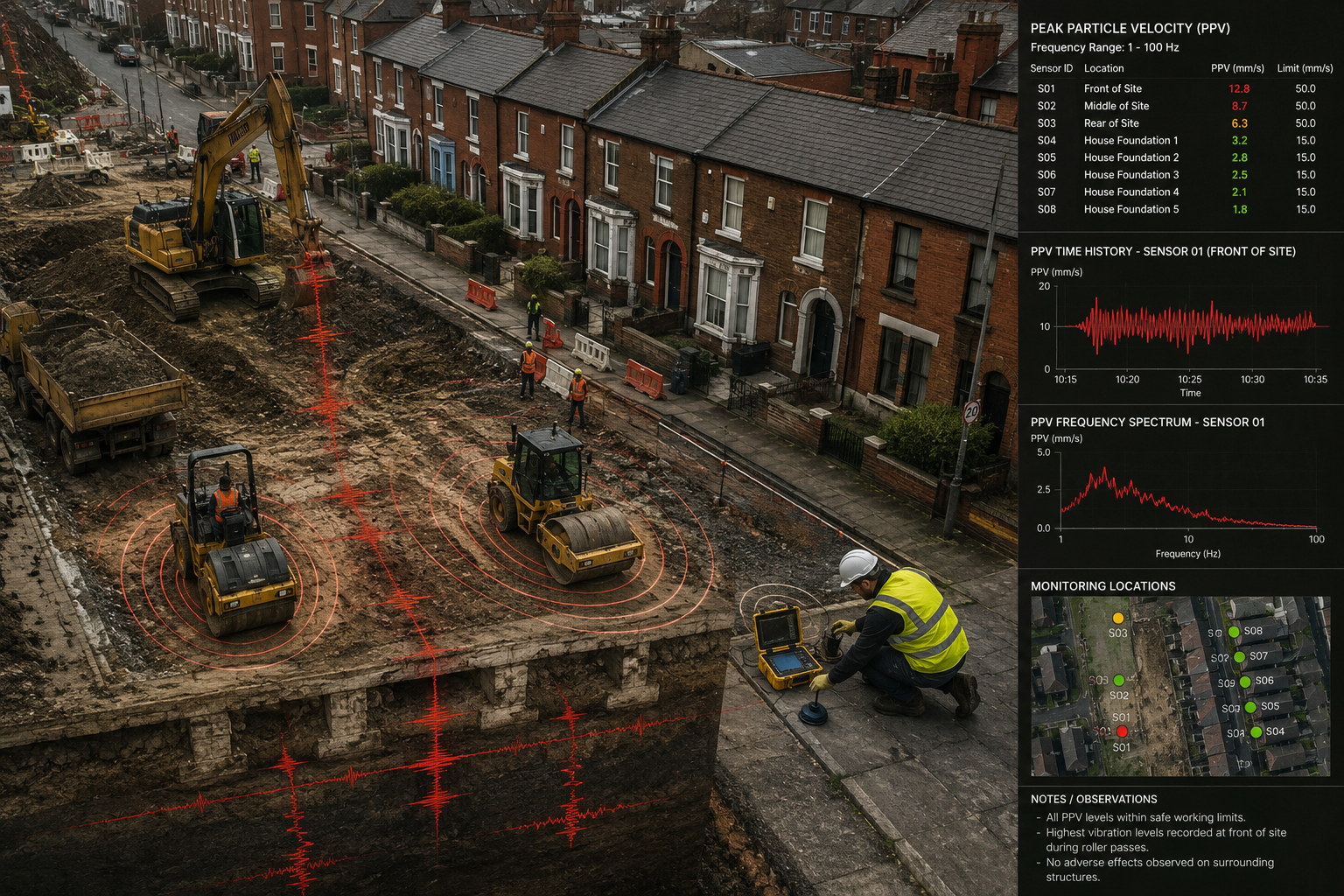
Structure-borne noise is transmitted as mechanical energy through solid elements — foundations, columns, slabs, and walls — before radiating as audible sound within a receiving room. Common sources include:
- Underground and overground railways: wheel-rail interaction generates broadband vibration that propagates through soil and into building foundations
- Heavy road vehicles: lorries and buses create low-frequency ground vibration, particularly on routes with poor road surfaces
- Construction plant: piling rigs, compactors, and demolition equipment produce impulsive vibration events that can cause both nuisance and structural damage
Forensic engineers assessing construction-related vibration damage typically follow a structured methodology: establishing pre-construction baseline conditions, monitoring vibration during works using calibrated geophones, and comparing post-construction structural surveys to identify any new cracking or settlement [3]. This before-and-after approach is critical because it separates pre-existing defects from works-related damage — a distinction that is frequently contested in litigation.
Key Measurement Parameters
Expert witness surveyors in noise, vibration and nuisance claims rely on specific metrics that carry recognised legal and regulatory weight:
For vibration:
- Peak Particle Velocity (PPV): the standard metric under BS 7385-2 for assessing cosmetic and structural damage risk
- Vibration Dose Value (VDV): used under BS 6472 to assess human response to vibration in buildings
- Weighted acceleration (a_w): relevant where occupant health and comfort are in dispute
For noise:
- L_Aeq (equivalent continuous sound level): the primary metric for steady-state and intermittent sources
- L_Amax and L_AFmax: used for impulsive events such as door slams or impact noise
- Octave and third-octave band analysis: essential for identifying low-frequency content that weighted averages can mask
Cerjan Acoustics, whose principal consultant has provided expert testimony in civil trials on traffic and industrial noise, emphasises that sound propagation modelling must be validated against measured data rather than substituted for it [2]. Courts have become increasingly sceptical of purely theoretical assessments unsupported by site measurements.
Vibration expert witnesses also bring expertise in mechanical engineering and structural dynamics, helping courts understand not just whether vibration levels were excessive but why — and what remediation is proportionate [6].
Converting Technical Findings into Admissible Expert Evidence
The Structure of a Compliant Expert Witness Report
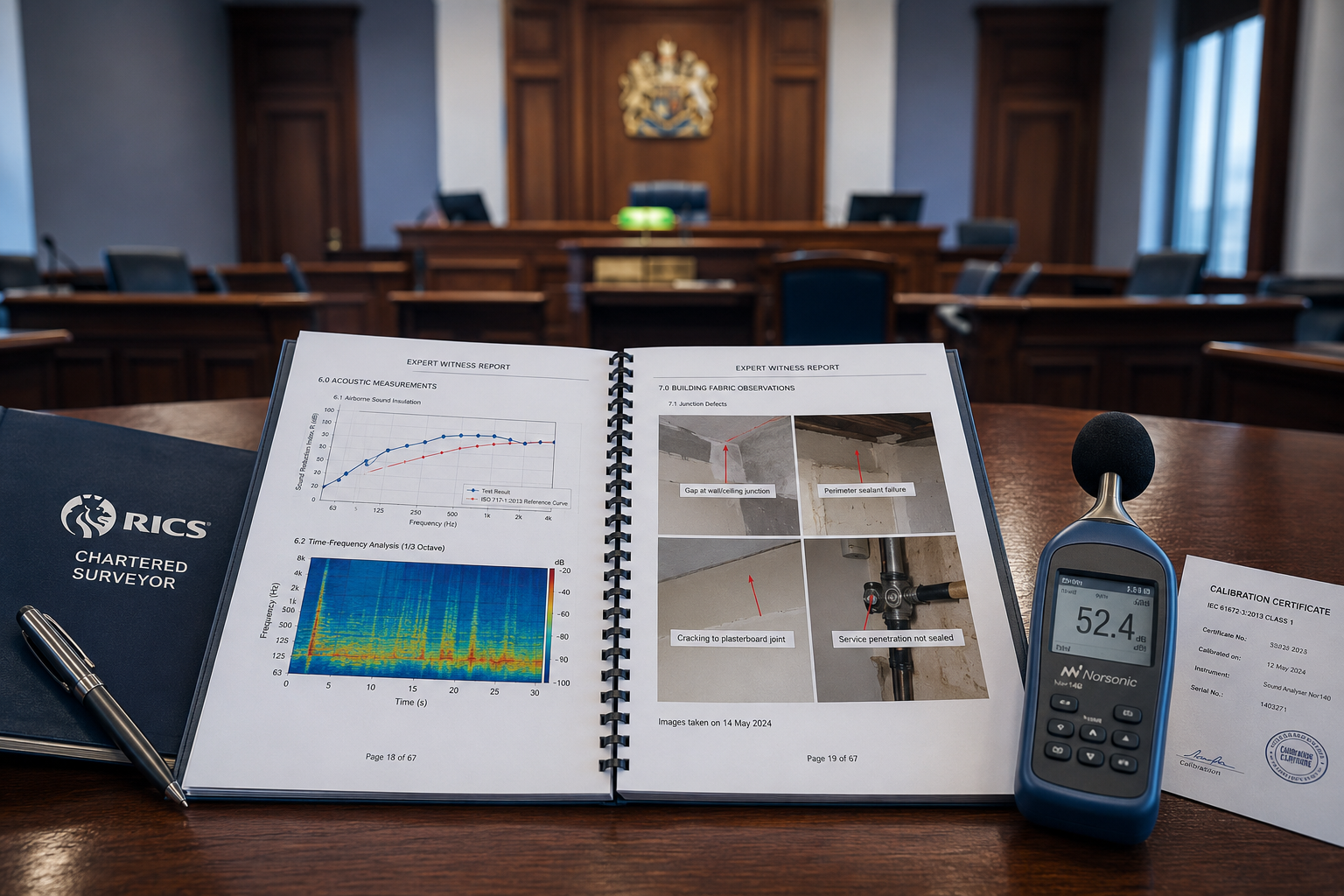
An expert witness report in noise and nuisance proceedings must satisfy CPR Part 35 and the associated Practice Direction. Beyond the legal formalities — the statement of truth, confirmation of duty to the court, and declaration of instructions — the technical content must be structured so that a non-specialist judge can follow the reasoning without losing the scientific rigour that gives the opinion its weight.
A well-constructed report typically follows this sequence:
- Summary of instructions and issues in dispute
- Description of the property and its construction
- Methodology and equipment used (including calibration certificates)
- Measured data with annotated time histories or spectrograms
- Comparison against applicable standards and benchmarks
- Analysis of causation (source, pathway, receiver)
- Opinions on liability, impact, and remediation
- Appendices: raw data, photographs, equipment specifications
Wilson Ihrig, Inc., a firm with extensive forensic acoustics experience, notes that documenting noise and vibration levels contemporaneously — ideally before litigation is contemplated — produces far stronger evidence than retrospective measurement, because it captures conditions as they existed rather than as they may have been modified [7].
Impartiality and the Duty to the Court
The single most common ground on which expert evidence is challenged is perceived partiality. An expert who adopts the language of an advocate, selects only data that supports the instructing party, or fails to address contrary evidence will be exposed in cross-examination and may have their evidence given little weight.
Hawkins, a forensic investigation firm active in built environment acoustics, structures its expert witness services around documented methodology and compliance testing, ensuring that the measurement process itself is beyond reproach before any opinion is expressed [1]. This approach — methodology first, opinion second — is the hallmark of evidence that survives judicial scrutiny.
ForensisGroup's directory of noise control expert witnesses highlights the importance of background in building acoustics specifically, as distinct from environmental or industrial noise, because the building fabric variables require a different analytical framework [5].
Practical Applications: From Party Wall Disputes to Statutory Nuisance
Party Wall and Neighbour Disputes
Many noise nuisance claims arise from construction works carried out under the Party Wall etc. Act 1996. Piling, underpinning, and structural alterations to shared walls generate both airborne and structure-borne noise that can affect adjoining occupiers for months. A party wall dispute that escalates to litigation will almost always require an expert witness to quantify the impact and attribute causation.
Pre-construction schedules of condition, prepared by a surveyor before works begin, provide the evidential baseline against which any alleged damage or nuisance can be measured. Without this baseline, claimants face the difficult task of proving that cracks or acoustic degradation were caused by the works rather than pre-existing. For properties in areas with high construction activity, understanding party wall agreements and their acoustic provisions is an important first step.
Dilapidations and Commercial Disputes
In commercial leasehold contexts, noise and vibration issues can form part of a broader dilapidations claim. A tenant who has installed mechanical plant, partitions, or floor finishes that degrade the acoustic performance of the demise may face liability at lease end. Expert evidence quantifying the acoustic impact of those alterations — and the cost of reinstatement — is increasingly sought in dilapidations disputes.
Subsidence and Structural Damage Claims
Construction vibration can cause or accelerate subsidence, particularly in properties with shallow foundations or on shrinkable clay soils. Where vibration is alleged to have contributed to structural movement, the expert witness surveyor may work alongside a structural engineer, combining vibration measurement data with subsidence survey findings to present a coherent causation narrative to the court.
Statutory Nuisance Proceedings
Local authorities can serve abatement notices under the Environmental Protection Act 1990 where noise or vibration amounts to a statutory nuisance. Expert evidence is frequently required both to support and to defend such notices. The expert must demonstrate not only that levels exceed relevant criteria but that the source, pathway, and receiver have been correctly identified — a task that requires the same building fabric analysis and measurement rigour as civil proceedings.
Selecting the Right Expert: Qualifications and Competencies
Not every surveyor is equipped to act as an expert witness in noise and vibration claims. The following competencies should be verified before instruction:
- Professional membership: MRICS or FRICS, ideally with an acoustic or building surveying specialism
- Acoustic qualifications: membership of the Institute of Acoustics (IOA) or equivalent
- Measurement experience: demonstrable use of Type 1 sound level meters and calibrated vibration monitoring equipment
- Expert witness training: completion of a recognised expert witness training programme
- Court experience: previous instruction in civil, tribunal, or planning proceedings
- Geographic reach: ability to attend the property and, if required, the court
For disputes in London and the surrounding region, structural survey services in London and specific defect reports can complement acoustic expert evidence by addressing the physical condition of the building fabric in parallel.
Solicitors instructing experts should also consider whether a single joint expert (SJE) appointment is appropriate. In lower-value disputes, courts increasingly direct parties to share a single expert, which places even greater emphasis on the expert's demonstrable impartiality.
Conclusion
Expert witness surveyors in noise, vibration and nuisance claims perform a function that is both technically demanding and legally precise. The strength of a noise or vibration case rests not on the volume of the complaint but on the quality of the evidence — the calibration records behind each measurement, the construction details that explain why sound travels where it does, and the impartial analysis that connects cause to effect in terms a court can act upon.
Actionable next steps for those involved in a noise or vibration dispute:
- Instruct a qualified surveyor early — before conditions change, before works conclude, and before limitation periods become a concern.
- Commission a baseline survey if construction works are planned or underway nearby, to establish pre-works conditions as a reference point.
- Preserve all evidence of the nuisance: date-stamped recordings, diary entries, and any communications with the source party.
- Check the expert's credentials against the IOA register and RICS directory before instruction.
- Discuss the proportionality of expert evidence with your solicitor — in some cases, a well-structured acoustic report can resolve a dispute before proceedings are issued.
For property owners and legal teams across London and the South East, working with chartered surveyors in Surrey or other regionally based experts ensures that site attendance is practical and that local construction and environmental context is well understood. The bridge between a noisy experience and a winning legal argument is built measurement by measurement, and it requires the right expert to lay each plank.
References
[1] Acoustics Vibration – https://www.hawkins.biz/forensic-investigation/built-environment/acoustics-vibration/?utm_source=openai
[2] Expert Witness – https://www.cerjan.com/expert-witness/?utm_source=openai
[3] How Forensic Engineers Assess Construction Vibration Damage To Nearby Structures – https://www.envistaforensics.com/knowledge-center/insights/articles/how-forensic-engineers-assess-construction-vibration-damage-to-nearby-structures/?utm_source=openai
[4] 288565652 In Situ Measurement Of The Sound Absorption Characteristics Of Existing Building Fabrics – https://www.researchgate.net/publication/288565652_In_situ_measurement_of_the_sound_absorption_characteristics_of_existing_building_fabrics?utm_source=openai
[5] Noise Control – https://www.forensisgroup.com/forensis-expert-witness/expertise/noise-control?utm_source=openai
[6] Vibration Expert Witnesses – https://www.roundtablegroup.com/expert-witness-field/vibration-expert-witnesses/?utm_source=openai
[7] Forensic – https://www.wilsonihrig.com/forensic/?utm_source=openai
[8] Nuisance – https://www.jspubs.com/expert-witness/si/n/nuisance/?utm_source=openai