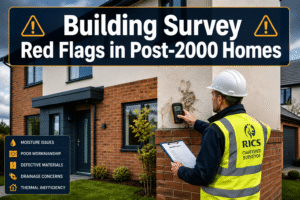

Fewer than one in five property damage claims that reach dispute resolution are settled without a challenge to the valuation methodology. That single statistic explains why Expert Witness Valuation Reports: How Surveyors Justify Adjustments for Repairs, Risk, and Marketability have become one of the most scrutinised documents in property litigation. A figure written into a report without a transparent, step-by-step rationale will not survive cross-examination. Courts, arbitrators, and opposing experts will probe every assumption, every comparable, and every discount applied. The surveyor's job is not simply to reach a number — it is to construct a defensible analytical chain that a non-specialist tribunal can follow and trust.
Key Takeaways
- Expert witness valuation reports must demonstrate a clear, reproducible methodology — not just a conclusion.
- The diminution approach (value "as-is" versus value "as-if" properly constructed or repaired) is the primary framework courts expect.
- Cost-to-cure figures and market diminution are related but rarely identical; conflating them is a common and costly error.
- Stigma discounts of 5% to 20% can persist even after full, high-quality repairs, particularly for structural damage.
- Transparent comparables selection, explicit time adjustments, and documented assumptions are the three pillars of a report that withstands rebuttal.
The Analytical Framework Behind Defensible Valuation Reports
Starting With the "Before and After" Baseline
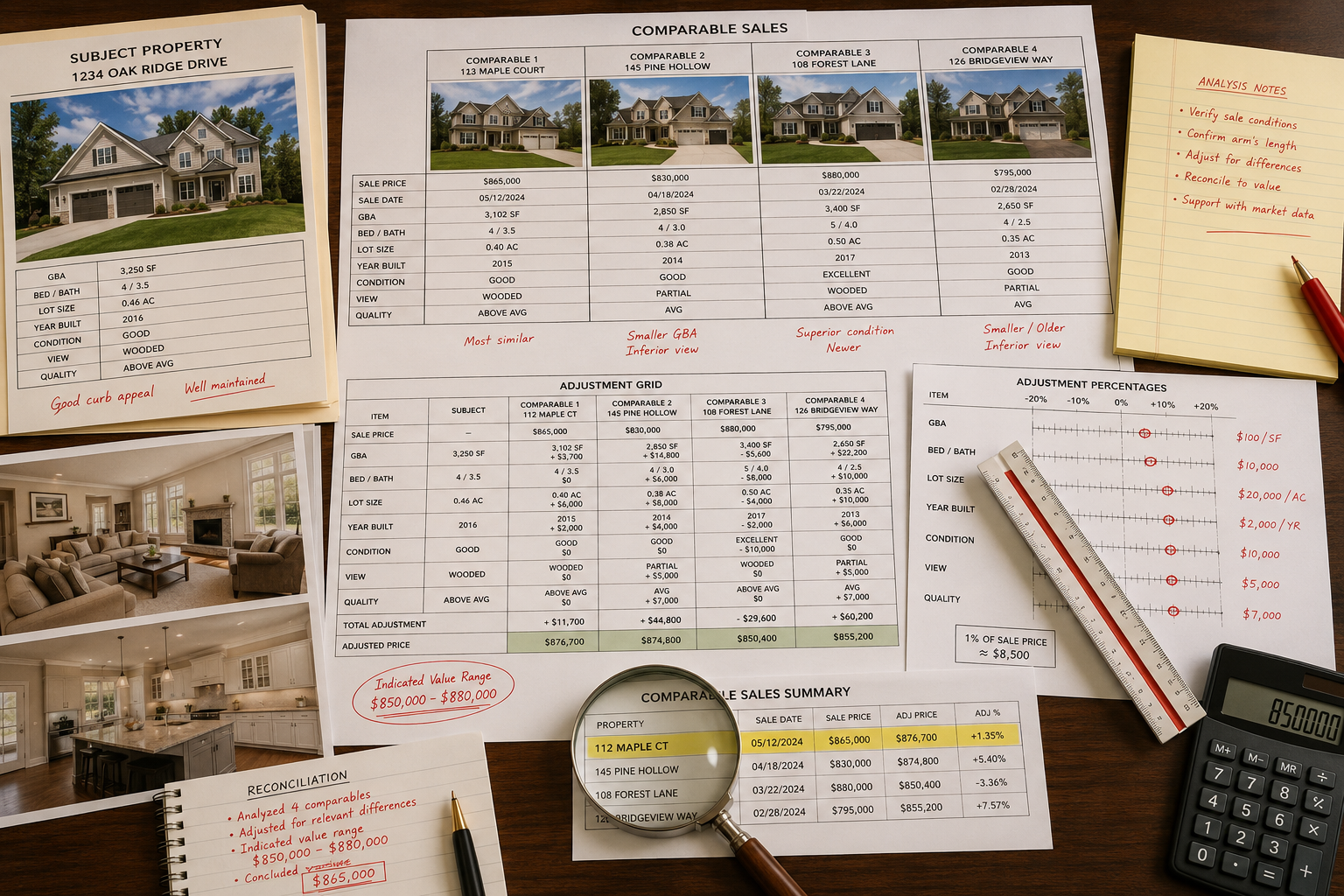
Every credible expert witness valuation begins with a clear baseline question: what was the property worth without the defect, and what is it worth with it? This comparative diminution approach — assessing a property in its defective state against its value if properly constructed or undamaged — forms the structural spine of the report [1].
Establishing the "as-if" value requires the surveyor to identify genuine market comparables: properties of similar type, age, location, and condition that transacted at arm's length. The selection process is not passive. The surveyor must actively document why each comparable was chosen or rejected, what adjustments were applied to account for differences in size, specification, or timing, and how those adjustments were derived.
In stabilising interest rate environments such as those seen in 2026, transaction volumes can fluctuate, producing a comparables pool that is larger but less internally consistent [4]. This makes disciplined selection more important, not less. Extending the search period and applying explicit time adjustments — rather than assuming the market has been static — is a professional obligation, not an optional refinement.
Selecting and Adjusting Comparables
The following table outlines the principal adjustment categories surveyors apply when calibrating comparables to the subject property:
| Adjustment Category | Typical Method | Common Pitfalls |
|---|---|---|
| Time (market movement) | Index-linked or paired sales | Using stale indices without local calibration |
| Size and configuration | Price per square foot analysis | Ignoring layout efficiency differences |
| Location and micro-market | Proximity weighting | Treating postcode as a proxy for street-level value |
| Condition and specification | Paired sales or cost-based | Conflating repair cost with market perception |
| Tenure and legal encumbrances | Leasehold/freehold differential | Overlooking short-lease stigma |
Each adjustment must be quantified, not merely described. A report that states "a downward adjustment was applied for condition" without specifying the quantum and its evidential basis will be vulnerable to challenge [5].
"Comprehensive documentation, transparent assumptions, and consistent methodology are essential for defensible positions in any valuation dispute."
The Role of Multiple Valuation Methods
Courts increasingly expect surveyors to cross-check their primary conclusion using at least one secondary method. RICS standards support the use of multiple approaches — comparable method, income approach, cost approach, and residual method — to establish baseline valuations in uncertain markets [7]. Where methods diverge, the report must explain why the primary method was preferred and what the secondary analysis reveals about the reliability of the conclusion.
For properties with income-generating potential, the income approach provides an independent check. For development land or properties with significant repair requirements, the residual method can illuminate the relationship between remediation costs and residual market value. Using only one method without acknowledging alternatives is a gap that opposing experts will exploit.
Justifying Adjustments for Repairs, Risk, and Marketability in Expert Witness Valuation Reports
Repair Costs Versus Market Diminution: A Critical Distinction
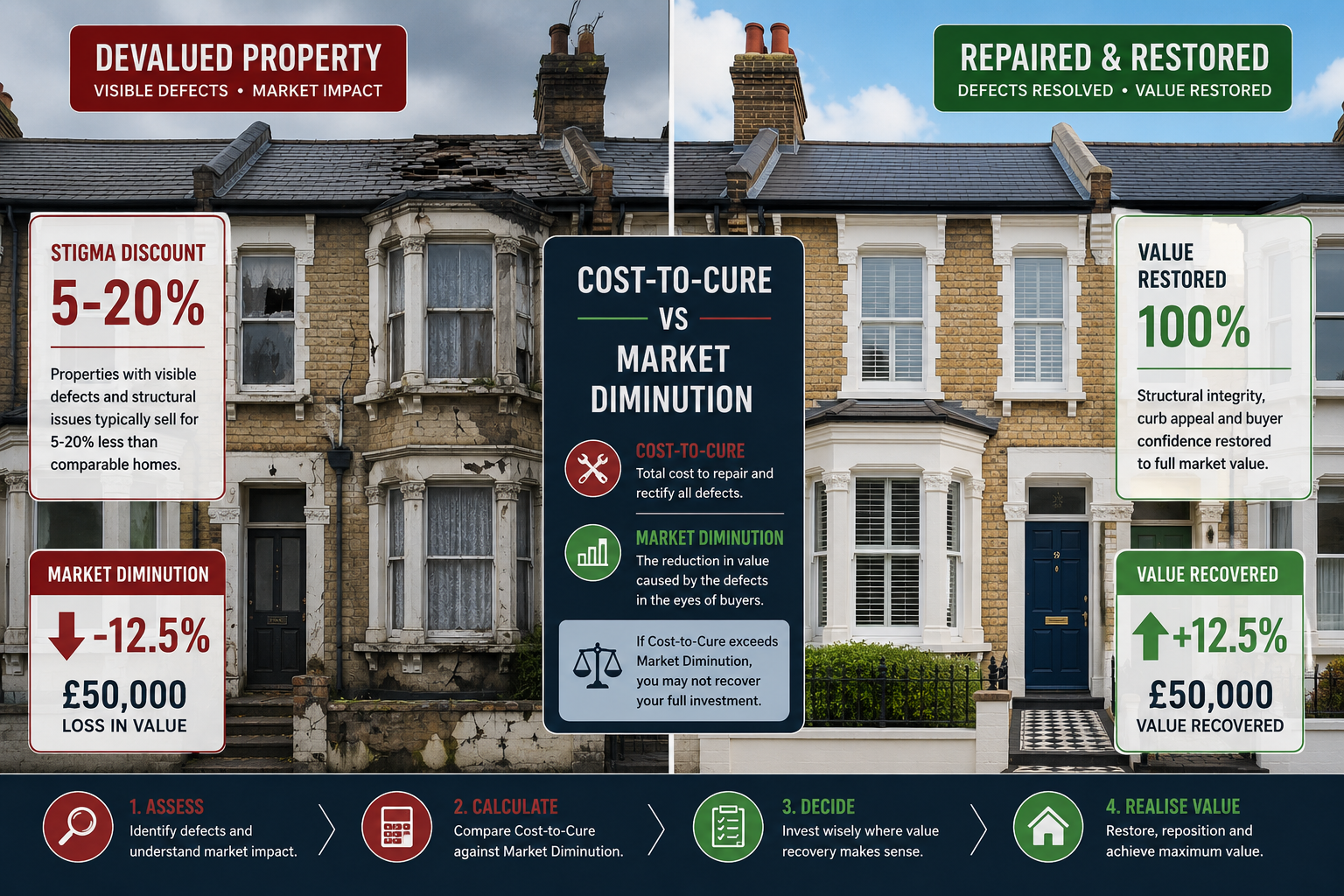
One of the most persistent errors in property damage claims is treating the cost to cure a defect as equivalent to the diminution in market value. These two figures are related but rarely identical, and conflating them can undermine an entire case [1].
Consider a property where remediation of structural damage costs £40,000. In a buoyant local market, a well-informed buyer might accept a £25,000 discount, reasoning that the repair is straightforward and the location is desirable. In a cautious market, the same buyer might demand a £55,000 reduction, factoring in the inconvenience, the perceived risk of hidden secondary damage, and the difficulty of obtaining a mortgage on a property with a known structural history. The surveyor's role is to evidence which scenario applies, using market data rather than assumption.
Unrepaired foundation damage, for example, can reduce a property's sale price by 10% to 15% or more [3]. Professionally completed repairs with supporting documentation — warranties, engineer sign-off, photographic records — can substantially narrow this gap. The quality and completeness of the remediation record directly influences the size of the residual discount.
Quantifying Stigma: The Persistent Discount
Stigma is the market's residual reluctance to pay full value for a property that has suffered significant damage, even after that damage has been fully repaired. It is not irrational sentiment; it reflects genuine uncertainty about hidden secondary defects, future insurance costs, and resale difficulty.
Research consistently shows that properties which have suffered significant structural damage — subsidence, fire, or flooding — may attract a market discount of 5% to 20% even after full repair [2]. The surveyor must:
- Identify comparable sales of properties with a disclosed damage history in the same or analogous market
- Distinguish between the discount applied to unrepaired properties and the residual stigma applied post-repair
- Assess whether the quality of repairs and the completeness of documentation reduces stigma materially
High-quality repairs with full documentation and warranties can substantially reduce the stigma associated with defects, whereas poor-quality remediation amplifies diminution [2]. This means the surveyor cannot simply apply a standard percentage; the discount must be calibrated to the specific repair record of the subject property.
Marketability Adjustments: Beyond the Headline Price
A property's marketability is distinct from its headline value. Even where a buyer can be found at a given price, the conditions under which that transaction occurs matter enormously to the expert witness analysis. In markets experiencing modest growth, properties with disclosed defects may face:
- Extended marketing periods, increasing holding costs for the vendor
- A reduced pool of eligible buyers, particularly where mortgage lenders apply additional restrictions
- Price negotiation disadvantages, as buyers use disclosed defects as leverage
- Financing complications, where surveyors acting for lenders apply additional retentions or decline to value [1]
Each of these factors can be quantified. Extended marketing periods can be evidenced through listing history data. Reduced buyer pools can be demonstrated by reference to lender criteria. Financing complications can be supported by correspondence from mortgage valuers. A well-constructed expert witness report will address each dimension, not simply the final agreed price.
Assessing Risk: Uncertainty Adjustments in Litigation Contexts
Where the full extent of defects is uncertain at the time of the valuation — as is often the case in ongoing litigation — the surveyor must address the risk premium a hypothetical buyer would demand. This requires explicit reasoning about:
- The probability that additional defects exist beyond those already identified
- The likely cost range of remediation under different scenarios
- The market's appetite for residual risk in the subject location and property type
This is particularly relevant in expert witness reports for London properties, where high values mean that even small percentage adjustments represent significant sums in dispute. The surveyor must be prepared to defend not just the central estimate but the range of outcomes and the reasoning behind the chosen point within that range.

Building a Report That Withstands Cross-Examination
Documentation Standards and RICS Compliance
Courts require that expert witness testimony on diminution of value be reliable and supported by market comparisons and a sufficiently reliable methodology [6]. RICS members are bound by the Red Book (RICS Valuation — Global Standards) and, in litigation contexts, by the requirements of the relevant court's expert witness rules. In England and Wales, CPR Part 35 governs the duties of expert witnesses, requiring that the report be addressed to the court, not the instructing party.
Practical documentation requirements include:
- A clear statement of instructions and the questions the expert has been asked to address
- Full disclosure of the comparables considered, with reasons for inclusion or exclusion
- Explicit quantification of every adjustment, with evidential support
- A statement of the expert's qualifications and any limitations on the opinion
- Confirmation that the expert understands and has complied with their duty to the court
For properties with complex structural histories, integrating a detailed building condition assessment into the valuation report strengthens the evidential foundation considerably [9]. Where dilapidations are in dispute, a schedule of dilapidations provides the quantified repair schedule that underpins the cost-to-cure analysis.
Handling Rebuttal Reports
In contested litigation, the opposing party will typically instruct their own expert. Rebuttal reports challenge the assumptions, data selections, analytical methods, and conclusions of the opposing expert, while providing independent analysis to assist the court [8]. A surveyor preparing an initial report must therefore anticipate the most likely lines of attack.
Common challenges include:
- Data recency: Is the comparables pool sufficiently current given market movement?
- Regional applicability: Are comparables drawn from genuinely comparable micro-markets?
- Adjustment methodology: Are adjustments derived from market evidence or professional judgment alone?
- Alternative valuations: Does the opposing expert's figure reflect a plausible alternative reading of the same data?
- Professional bias: Has the expert maintained independence from the instructing party's preferred outcome? [5]
Addressing these points proactively — rather than waiting for the rebuttal — is the mark of a senior expert witness. Where a retrospective valuation is required, the challenge of data recency is compounded by the need to reconstruct market conditions at a historical date, making contemporaneous evidence and archived comparable data essential.
Specific Defects and Their Valuation Implications
Different defect types carry different market perceptions, and the expert witness report must reflect this nuance. The table below summarises typical diminution ranges by defect category, based on current market evidence:
| Defect Type | Typical Diminution Range | Key Variables |
|---|---|---|
| Subsidence (repaired, with warranty) | 5% – 15% | Cause, repair method, insurance availability |
| Flood damage (post-remediation) | 8% – 20% | Flood zone designation, recurrence risk |
| Fire damage (fully restored) | 5% – 12% | Extent of original damage, quality of rebuild |
| Foundation issues (professionally repaired) | 10% – 15% | Documentation quality, structural engineer sign-off |
| New build defects (remediated) | 3% – 10% | Developer reputation, warranty coverage [1] |
These ranges are starting points, not conclusions. Each case requires the surveyor to locate the subject property within the range using specific market evidence, not generic assumptions.
The Importance of Local Market Knowledge
A surveyor instructed as an expert witness must demonstrate genuine familiarity with the subject property's local market. Generic national data is insufficient. This is why firms with deep regional expertise — whether covering South West London, Surrey, or Sussex — bring a material advantage to valuation disputes. Local knowledge informs comparables selection, micro-market adjustment, and the assessment of buyer sentiment in a way that imported data cannot replicate.
Where boundary or party wall disputes intersect with valuation questions, understanding the boundary dispute landscape in the relevant area adds further depth to the expert's analysis.
Conclusion
Expert Witness Valuation Reports: How Surveyors Justify Adjustments for Repairs, Risk, and Marketability represent one of the most technically demanding outputs in the surveying profession. The analytical chain — from comparables selection through condition assessment, stigma quantification, and marketability adjustment — must be transparent, evidence-based, and reproducible. A figure without a methodology is an opinion; a figure with a documented, RICS-compliant methodology is evidence.
Actionable next steps for those involved in property valuation disputes:
- Instruct a RICS-registered expert witness with demonstrable experience in the specific defect type and local market — not simply the nearest available valuer.
- Gather all repair documentation before the valuation: warranties, contractor invoices, structural engineer sign-off, and photographic records. These directly reduce stigma adjustments.
- Request that the expert address cost-to-cure and market diminution separately in the report, with explicit reasoning where the two figures diverge.
- Anticipate the rebuttal: ask the expert to identify the three most likely challenges to their methodology and address them proactively in the initial report.
- Where the defect history is complex, commission a full structural survey to provide the building condition foundation that the valuation analysis requires.
The difference between a report that settles a dispute and one that prolongs it almost always comes down to the quality of the analytical justification, not the size of the number.
References
[1] Expert Witness Valuations For New Build Defects Rics Standards In 2026s 2 5 Price Growth Era – https://www.canterburysurveyors.com/blog/expert-witness-valuations-for-new-build-defects-rics-standards-in-2026s-2-5-price-growth-era/?utm_source=openai
[2] Diminution In Value Calculations Expert Witness Reports For Property Damage Claims – https://www.canterburysurveyors.com/blog/diminution-in-value-calculations-expert-witness-reports-for-property-damage-claims/?utm_source=openai
[3] Does Foundation Repair Affect Home Value And Resale – https://legalclarity.org/does-foundation-repair-affect-home-value-and-resale/?utm_source=openai
[4] Expert Witness Preparation For Mortgage Valuation Challenges Navigating Stabilising Rates In 2026 – https://www.canterburysurveyors.com/blog/expert-witness-preparation-for-mortgage-valuation-challenges-navigating-stabilising-rates-in-2026/?utm_source=openai
[5] Expert Witness Valuations In Recovering 2026 Markets Building Robust Cases With Regional Data And Stabilising Prices – https://nottinghillsurveyors.com/blog/expert-witness-valuations-in-recovering-2026-markets-building-robust-cases-with-regional-data-and-stabilising-prices?utm_source=openai
[6] Diminution In Value Assessments By Expert Witnesses Surveyor Strategies For Property Damage Claims In 2026 – https://manchestersurveyors.com/diminution-in-value-assessments-by-expert-witnesses-surveyor-strategies-for-property-damage-claims-in-2026/?utm_source=openai
[7] Expert Witness Valuations In Stabilising Markets Rics Evidence Standards For 2026 Price Recovery Disputes – https://www.canterburysurveyors.com/blog/expert-witness-valuations-in-stabilising-markets-rics-evidence-standards-for-2026-price-recovery-disputes/?utm_source=openai
[8] Expert Witness Business Valuation Rebuttal Reports Best Practices – https://www.vallitadvisors.com/news/2026/06/expert-witness-business-valuation-rebuttal-reports-best-practices/?utm_source=openai
[9] Expert Witness Valuations For 2026 Northern Ireland Surge Building Cases In Outperforming Markets – https://wimbledonsurveyors.com/expert-witness-valuations-for-2026-northern-ireland-surge-building-cases-in-outperforming-markets/?utm_source=openai