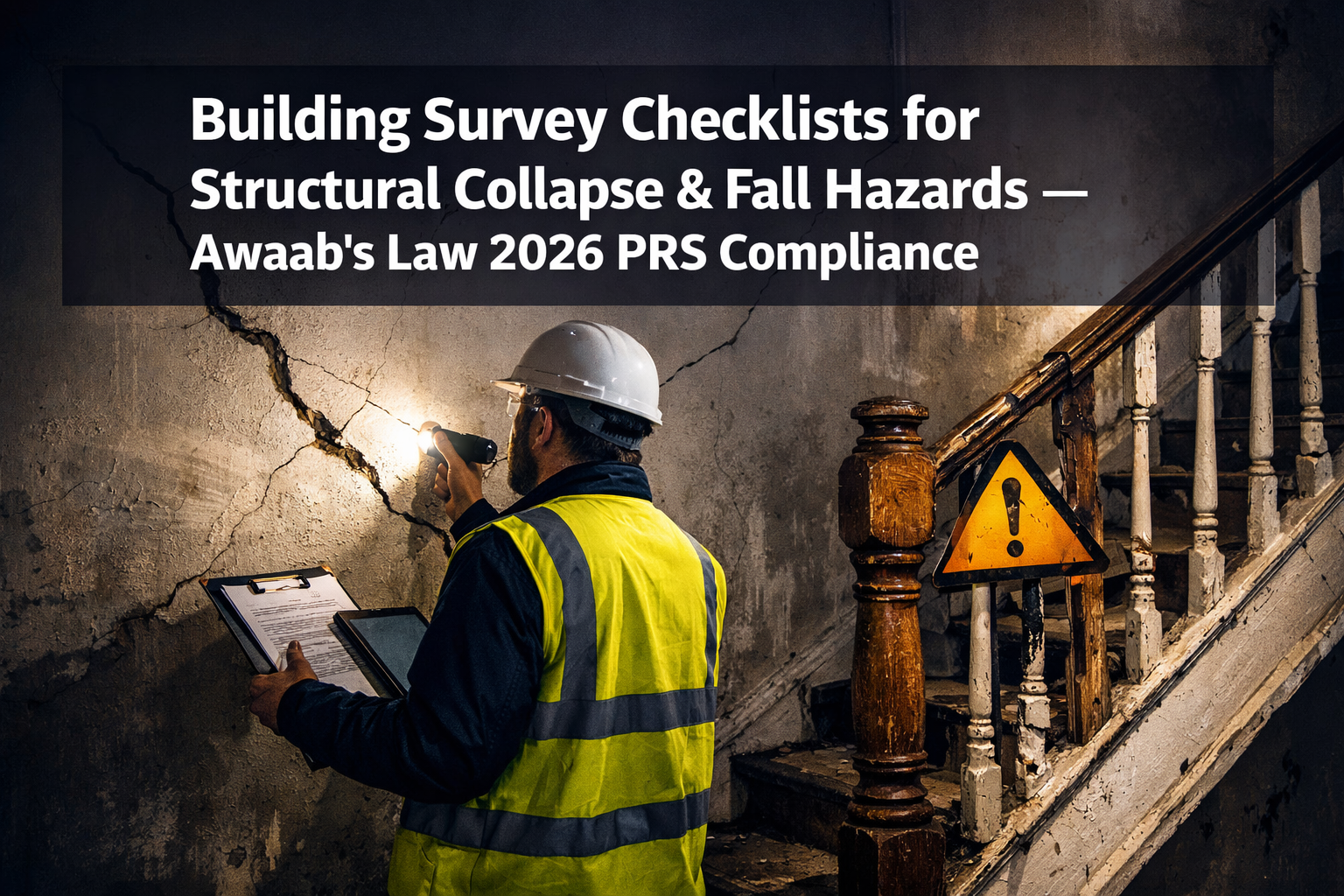
Every year, thousands of tenants in the private rented sector (PRS) live above cracked foundations, beside crumbling stair rails, and next to bath surrounds that have quietly become serious fall hazards. Until recently, landlords faced few enforceable deadlines to fix them. That changes in 2026.
The 2026 expansion of Awaab's Law brings structural collapse and a defined set of fall hazards into the scope of prescribed hazards for private rented properties. These sit alongside the damp and mould provisions that came into force on 27 October 2025 under Phase 1 [1]. For surveyors, landlords, and letting agents, this means one thing: a new generation of structured building survey checklists for structural collapse and fall hazards under Awaab's Law 2026 is now essential for PRS compliance assessments. This article sets out exactly what those checklists must cover, what timelines apply, and how remediation costs should be quantified.
Key Takeaways 📋
- Phase 2 of Awaab's Law (2026) adds structural collapse and four fall hazard categories — baths, level surfaces, stairs, and between levels — as prescribed hazards in the PRS.
- Emergency structural hazards must be investigated within 24 hours of landlord awareness, with safety works completed within 24 hours or alternative accommodation provided.
- Significant (non-emergency) hazards require investigation within 10 working days, with written remediation plans to follow.
- Survey checklists must cover foundation movement, cracking patterns, load-bearing integrity, and all four fall hazard zones.
- Remediation cost quantification is now a core output of any PRS compliance assessment — not an optional add-on.
What Awaab's Law Phase 2 Actually Covers in 2026
Awaab's Law was named after Awaab Ishak, a two-year-old boy who died in 2020 as a direct result of mould exposure in a social housing flat. The law was initially enacted to prevent similar tragedies in social housing, but its extension to the PRS marks a significant regulatory shift [2].
Phase 1 (October 2025) focused on damp and mould. Phase 2 (2026) expands the prescribed hazard categories to include:
- 🏗️ Structural collapse — covering failure or risk of failure of structural elements
- 🛁 Falls associated with baths — slip and fall risks in bathroom environments
- 🚶 Falls on level surfaces — trip hazards on floors and flat walkways
- 🪜 Falls on stairs — staircase structural integrity and balustrade safety
- ⬇️ Falls between levels — open drops, mezzanines, and unguarded voids [1]
"The Phase 2 expansion transforms Awaab's Law from a damp-and-mould measure into a comprehensive structural safety framework for private rented homes."
This is not simply a checklist update. It is a fundamental change to how PRS properties must be assessed, documented, and remediated. Surveyors who rely on generic inspection templates will find them inadequate. Purpose-built building survey checklists for structural collapse and fall hazards under Awaab's Law 2026 are now a professional necessity.
Understanding the Compliance Timelines That Drive Survey Urgency
Before examining what goes on a checklist, surveyors and landlords must understand the legal timelines that determine how urgently each hazard must be addressed [3].
Emergency Hazard Protocol (24-Hour Rule)
| Trigger | Required Action | Deadline |
|---|---|---|
| Landlord becomes aware of emergency structural hazard | Investigate the hazard | Within 24 hours |
| Emergency confirmed after investigation | Complete safety works OR provide alternative accommodation at landlord's expense | Within 24 hours of confirmation |
An emergency structural hazard is one that poses an immediate risk of harm — for example, a visibly failing load-bearing wall, a collapsed ceiling, or a staircase with a fractured newel post and missing balusters.
Significant Hazard Protocol (10 Working Days)
For hazards that are serious but not immediately dangerous:
- Investigation must begin within 10 working days of discovery
- A written remediation plan must follow the investigation
- Works must be completed within a defined, reasonable timeframe [4]
These timelines make the survey report a legal trigger document. The moment a surveyor identifies and documents a hazard, the clock starts. This is why accurate, dated, and detailed checklists are critical — not just for compliance, but for managing landlord liability.
Building Survey Checklists for Structural Collapse and Fall Hazards Under Awaab's Law 2026: The Structural Assessment Framework
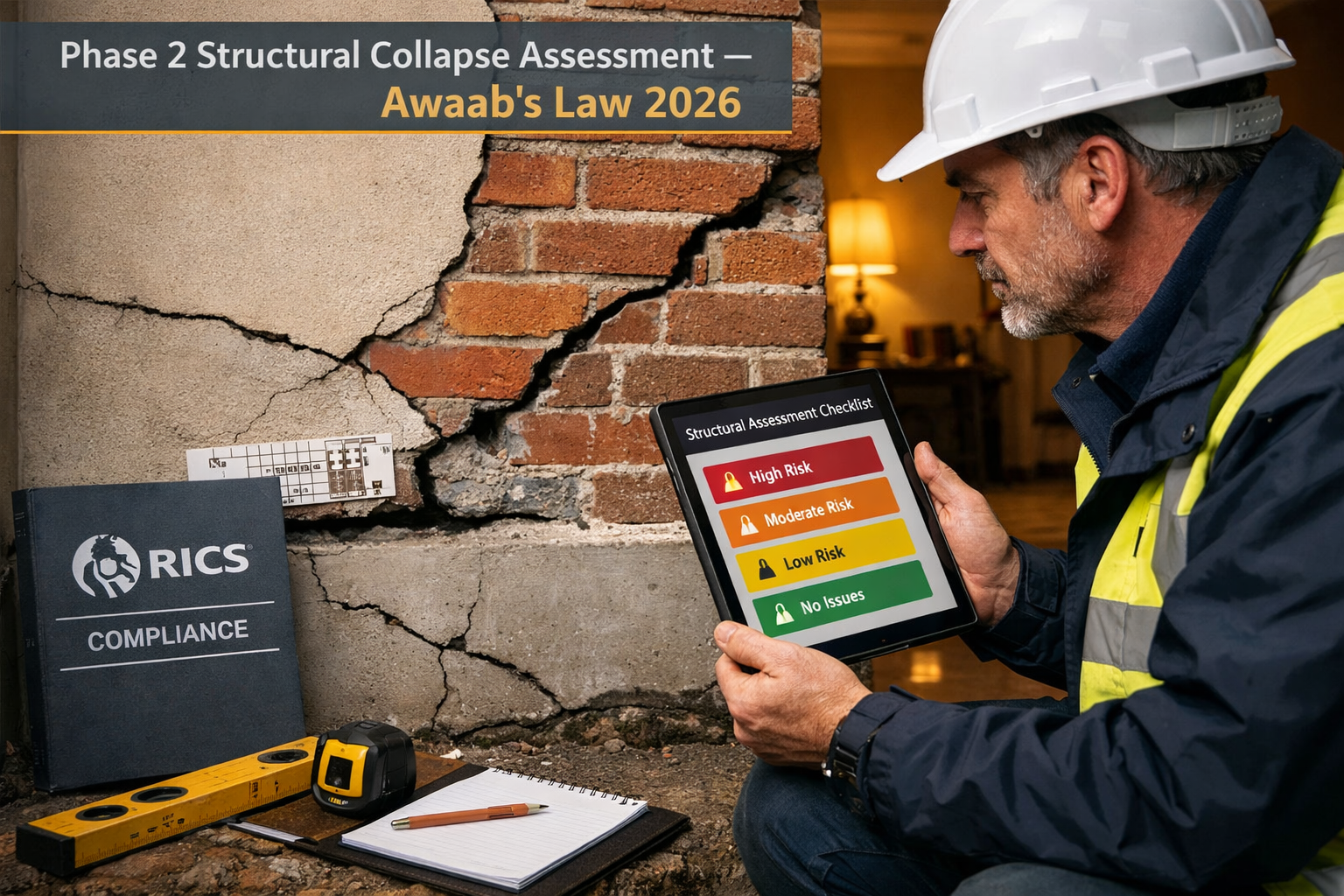
A compliant structural collapse assessment for PRS properties under the 2026 framework must evaluate three primary domains: foundation and substructure, superstructure integrity, and roof and upper-level structural elements.
1. Foundation and Substructure Checklist
✅ Foundation Movement Indicators
- Evidence of differential settlement (uneven floor levels, door/window distortion)
- Subsidence cracking — typically diagonal cracks at corners of openings
- Heave indicators — upward movement of floors or ground-level walls
- Tree proximity and root influence on foundations
- Evidence of previous underpinning or repair
✅ Damp-Related Structural Degradation
- Failed or absent damp proof course
- Rising damp penetrating masonry at foundation level
- Timber ground floor joist decay caused by moisture ingress
For properties showing signs of ground movement, a subsidence survey provides the specialist depth of investigation that a standard inspection cannot.
2. Superstructure and Load-Bearing Element Checklist
✅ Wall and Beam Integrity
- Identification of all load-bearing walls (internal and external)
- Cracking classification: hairline (<0.1mm), fine (0.1–1mm), moderate (1–5mm), severe (>5mm), very severe (>15mm with displacement)
- Evidence of bulging, bowing, or leaning in masonry walls
- Lintel condition over openings — deflection, corrosion, or cracking
- Steel beam condition where visible — rust, deflection, or connection failure
- Evidence of unauthorised structural alterations or removed load-bearing elements
For properties where alterations have been made, a specific defect report can isolate and document individual structural concerns with the precision needed for remediation costing.
✅ Floor Structure Assessment
- Timber floor joist condition — decay, insect damage, notching, or overspan
- Concrete floor integrity — cracking, delamination, or hollow spots
- Floor deflection under load — excessive bounce or movement
3. Roof Structure Checklist
✅ Roof and Upper-Level Structural Elements
- Rafter and purlin condition — splitting, decay, or inadequate bearing
- Ridge board integrity
- Evidence of spread — outward movement of roof feet pushing walls apart
- Ceiling joist condition and tie function
- Water ingress damage to structural timbers
A roof survey — including drone inspection where access is restricted — provides the detailed evidence base needed to classify roof structure hazards under the Phase 2 framework. Drone roof surveys are particularly valuable for multi-storey PRS properties where traditional access is difficult.
Building Survey Checklists for Structural Collapse and Fall Hazards Under Awaab's Law 2026: The Fall Hazard Assessment Framework
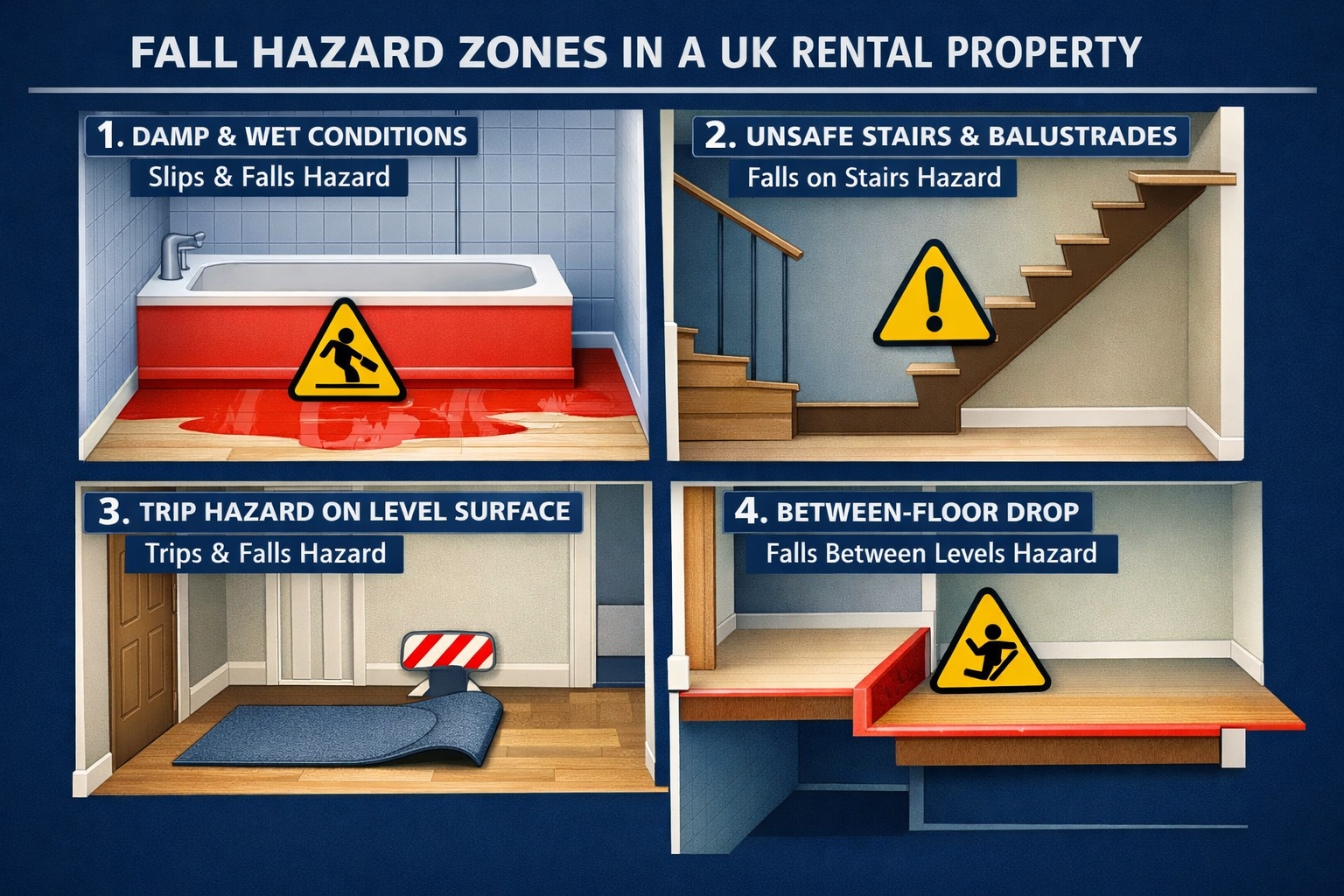
The four fall hazard categories introduced under Phase 2 each require distinct assessment criteria. A robust PRS compliance assessment must address all four systematically.
Fall Hazard Category 1: Falls Associated with Baths 🛁
| Checklist Item | Pass | Fail | Action Required |
|---|---|---|---|
| Bath panel secure and stable | ☐ | ☐ | — |
| Bath surround — no loose or cracked tiles | ☐ | ☐ | — |
| Non-slip surface or mat provision | ☐ | ☐ | — |
| Grab rail present where bath height >450mm | ☐ | ☐ | — |
| Floor surface adjacent to bath — non-slip | ☐ | ☐ | — |
| Bath feet/support structure intact | ☐ | ☐ | — |
Fall Hazard Category 2: Falls on Level Surfaces 🚶
Key inspection points:
- Floor coverings — loose, torn, or curling edges that create trip hazards
- Threshold transitions between rooms — height differences >6mm without chamfer
- Wet room and kitchen floor surfaces — slip resistance rating
- External paths and steps within the curtilage of the rental property
- Adequate lighting to all floor areas (absence of lighting is a contributory hazard)
Fall Hazard Category 3: Falls on Stairs 🪜
This category carries some of the highest risk weighting in the Phase 2 framework, given that stair falls are among the most common causes of serious injury in residential properties [4].
✅ Stair Structural Checklist
- Tread condition — no broken, loose, or excessively worn treads
- Riser condition — consistent height (max variation 5mm across flight)
- String integrity — no cracking, splitting, or detachment from wall
- Newel post — secure at base and head
- Balustrade/handrail — continuous, secure, at correct height (900mm–1000mm)
- Baluster spacing — no gaps exceeding 100mm (child safety standard)
- Stair pitch — not excessively steep (>42° is a concern)
- Adequate lighting to full stair flight
Fall Hazard Category 4: Falls Between Levels ⬇️
- Open voids or mezzanine edges — guarding present and at correct height
- Loft hatch — secure, with fixed ladder where regular access is required
- Juliet balcony railings — structural integrity and height compliance
- Window openings at height — restrictors fitted to prevent falls
- External balconies — structural condition and balustrade integrity
Quantifying Remediation Costs for PRS Compliance Valuations
A building survey checklist for structural collapse and fall hazards under Awaab's Law 2026 is only half the job. The PRS compliance assessment must also quantify the cost of remediation — both for landlord budgeting and for any valuation impact assessment [5].
Remediation Cost Framework
Structural Collapse Hazards — Indicative Cost Ranges (2026)
| Defect Type | Indicative Cost Range |
|---|---|
| Foundation underpinning (per metre run) | £1,500 – £3,500 |
| Load-bearing wall crack repair (minor) | £500 – £2,000 |
| Load-bearing wall rebuild (section) | £5,000 – £20,000+ |
| Lintel replacement | £800 – £3,000 |
| Roof structure repair (partial) | £3,000 – £15,000 |
| Floor joist replacement (per room) | £2,500 – £8,000 |
Fall Hazard Remediation — Indicative Cost Ranges (2026)
| Defect Type | Indicative Cost Range |
|---|---|
| Stair balustrade replacement | £800 – £3,500 |
| Full stair replacement | £3,000 – £10,000 |
| Bathroom grab rail installation | £150 – £400 |
| Non-slip floor surface treatment | £200 – £1,500 |
| Window restrictor installation (per window) | £80 – £250 |
| Balcony structural repair | £2,000 – £15,000+ |
"Remediation cost quantification is no longer optional in PRS assessments — it is the mechanism by which landlords demonstrate a credible compliance pathway under Awaab's Law."
For landlords managing multiple properties, a schedule of dilapidations provides a structured, legally recognised format for documenting defects and their associated remediation costs across a portfolio.
Valuation Impact Considerations
When structural collapse or fall hazards are identified, surveyors must consider their impact on:
- Rental value — properties with unresolved prescribed hazards may be unlettable
- Capital value — significant structural defects affect open market value
- Insurance — undisclosed structural hazards may void landlord insurance policies
- Mortgage compliance — lenders may require hazard remediation before advancing funds
For landlords uncertain about which level of survey is appropriate for their property, the homebuyer report vs building survey comparison provides useful guidance on matching survey depth to property risk profile.
Documentation Standards for Awaab's Law PRS Compliance Reports
The survey report itself must meet specific documentation standards to function as a compliance record [7].
Minimum Report Components
1. Hazard Identification Section
- Precise location of each hazard (room, element, grid reference if applicable)
- Photographic evidence with date/time stamp
- Hazard classification: emergency or significant
- HHSRS (Housing Health and Safety Rating System) category cross-reference
2. Timeline Trigger Documentation
- Date and time surveyor identified hazard
- Date landlord was notified (triggers the legal clock)
- Recommended investigation deadline based on hazard classification
3. Remediation Schedule
- Recommended works in priority order
- Indicative cost for each item
- Recommended contractor type (structural engineer, specialist contractor, etc.)
- Estimated programme duration
4. Compliance Sign-Off
- Surveyor credentials and RICS membership number
- Professional indemnity confirmation
- Re-inspection recommendation date
For properties requiring specialist structural input beyond the scope of a standard building survey, engaging residential structural engineers ensures that the technical depth of the assessment meets the evidential standard required under Awaab's Law enforcement [8].
Practical Implementation: Getting Your PRS Portfolio Survey-Ready in 2026
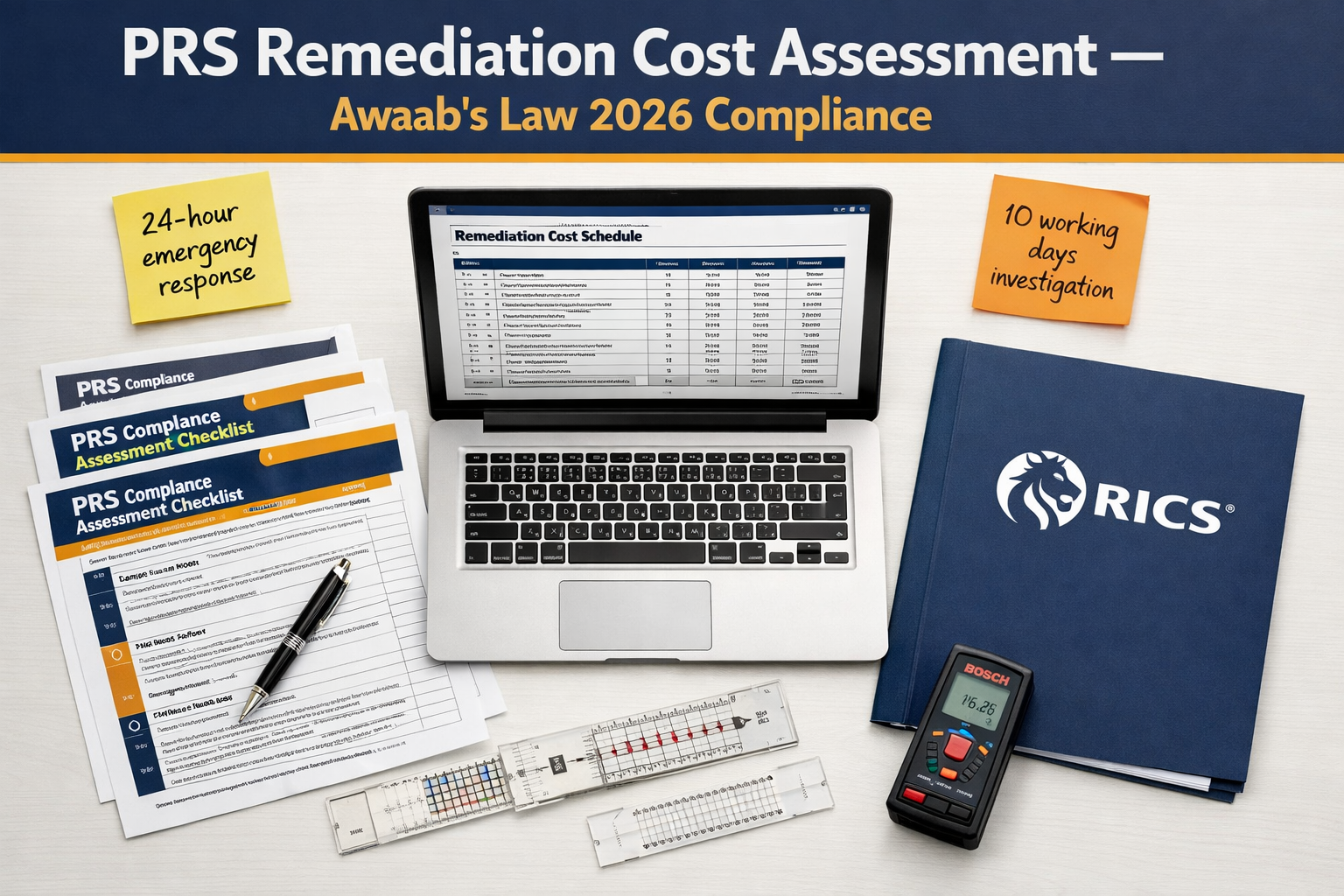
For landlords and managing agents with multiple PRS properties, a phased approach to compliance assessment is the most practical strategy.
Step-by-Step Portfolio Assessment Plan
Step 1 — Triage Existing Properties
Use a rapid desktop review to identify properties most likely to carry structural or fall hazard risk:
- Properties built pre-1919 (solid wall, shallow foundations)
- Properties with known maintenance backlogs
- Properties with recent tenant complaints about structural issues
- Properties with previous damp survey findings (often co-present with structural issues)
Step 2 — Commission Full Building Surveys
For high-risk properties, commission a full building survey that explicitly covers the Phase 2 hazard categories. Ensure the surveyor is briefed on Awaab's Law 2026 requirements.
Step 3 — Prioritise by Hazard Classification
- Emergency hazards → immediate action (24-hour protocol)
- Significant hazards → remediation plan within 10 working days
- Lower-risk findings → scheduled maintenance programme
Step 4 — Document Everything
Maintain a dated compliance file for each property. This is your primary defence in any enforcement action.
Step 5 — Schedule Re-Inspections
Awaab's Law compliance is not a one-time exercise. Build annual or biennial re-inspection into property management protocols.
Conclusion: Actionable Next Steps for Surveyors and Landlords
The 2026 expansion of Awaab's Law is not a distant regulatory concern — it is an active compliance obligation that requires immediate action from anyone involved in the private rented sector. Building survey checklists for structural collapse and fall hazards under Awaab's Law 2026 are now a core professional tool, not a supplementary document.
Immediate Actions to Take Now ✅
-
Audit your current survey templates — do they cover all four fall hazard categories and the full structural collapse checklist? If not, update them before conducting any PRS assessment.
-
Brief your clients — landlords need to understand the 24-hour emergency and 10-working-day significant hazard timelines. Ignorance of these deadlines is not a legal defence.
-
Commission specialist surveys for high-risk properties — older stock, properties with known defects, and those with previous damp findings should be prioritised for full structural assessment.
-
Build remediation cost schedules into every PRS report — compliance without a costed remediation pathway is incomplete under the 2026 framework.
-
Document landlord notification dates precisely — the legal clock starts the moment awareness is established. Accurate dating of every communication is essential.
The consequences of non-compliance — enforcement action, civil liability, and reputational damage — are significant. The investment in a thorough, well-documented PRS compliance assessment is modest by comparison. Act now, before the Phase 2 provisions are tested in enforcement proceedings.
References
[1] Awaabs Law Comes Into Force What Does It Mean For Construction – https://www.trowers.com/insights/2025/november/awaabs-law-comes-into-force-what-does-it-mean-for-construction
[2] Awaabs Law Guide – https://wordnerds.ai/awaabs-law-guide
[3] Awaabs Law Is Here The Surveyors Guide For Compliance – https://www.surventrix.com/blog/awaabs-law-is-here-the-surveyors-guide-for-compliance
[4] Awaabs Law Extensions To Prs In 2026 Party Wall And Building Survey Protocols For New Hazard Categories – https://nottinghillsurveyors.com/blog/awaabs-law-extensions-to-prs-in-2026-party-wall-and-building-survey-protocols-for-new-hazard-categories
[5] Compliance Checklist – https://hazardclock.co.uk/tools/compliance-checklist/
[6] Building Inspection Checklist Comprehensive Template 2026 – https://oxmaint.com/industries/facility-management/building-inspection-checklist-comprehensive-template-2026
[7] Building Survey Defect Documentation Under Awaabs Law 2026 Fire Electrical And Structural Hazard Protocols For Prs Properties – https://nottinghillsurveyors.com/blog/building-survey-defect-documentation-under-awaabs-law-2026-fire-electrical-and-structural-hazard-protocols-for-prs-properties
[8] Building Survey Checklists For Awaabs Law Compliance 2026 Rental Health And Safety Mandates For Landlords – https://nottinghillsurveyors.com/blog/building-survey-checklists-for-awaabs-law-compliance-2026-rental-health-and-safety-mandates-for-landlords