Over 11 million people in England rent privately — yet until now, no single mandatory redress body has held landlords to account for property condition failures, disputed rent increases, or hazard remediation costs. That changes in 2026. The arrival of the Private Rented Sector (PRS) Landlord Ombudsman reshapes the dispute resolution landscape entirely, and with it comes an urgent need for clear, defensible standards around valuation adjustments for Private Rented Sector Landlord Ombudsman disputes: expert witness evidence standards in 2026.
For surveyors, landlords, and tenants alike, understanding how property valuations feed into ombudsman cases is no longer optional — it is a professional necessity.
Key Takeaways 📋
- All private landlords in England must join the PRS Ombudsman by 2028, with the scheme expected to launch in late 2026 [1][4]
- Ombudsman awards are binding — landlords who fail to comply face penalties [1]
- Valuation evidence must meet RICS Red Book standards to be accepted as credible expert witness testimony
- Property condition, maintenance costs, and hazard remediation are the primary valuation adjustment triggers in ombudsman disputes
- Paper trails and communication records are as important as the valuation figures themselves [3]
Why the PRS Ombudsman Changes Everything for Valuers
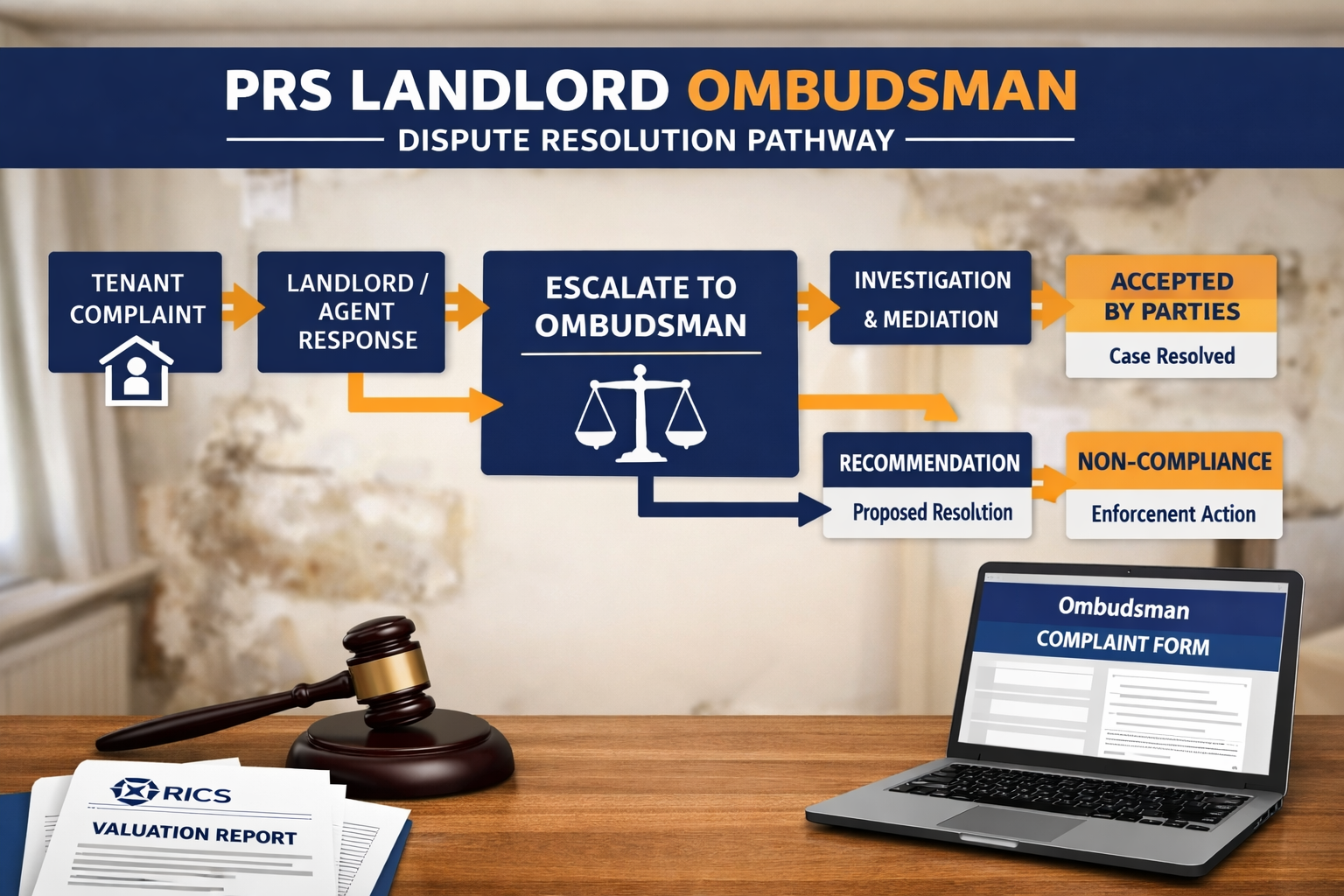
The Renters' Rights Act introduces a mandatory PRS Landlord Ombudsman, scheduled for rollout in late 2026 [1]. Unlike previous voluntary redress schemes, every private landlord in England must join — whether they self-manage or use a letting agent — with full mandatory membership required by 2028 [4].
This is not a minor administrative change. The ombudsman holds genuine enforcement power: it can make binding awards, require specific remedies, and impose penalties on landlords who refuse to comply [1]. Complaints will be assessed against whether landlords acted reasonably, responded appropriately, and handled issues in a fair and timely manner [3].
💡 "The ombudsman's assessment framework places conduct and communication at the centre — but property condition disputes will almost always require independent valuation evidence to resolve fairly."
Dispute categories include:
- 🏠 Rent increase challenges — where market value evidence is essential
- 🔧 Maintenance and repair failures — requiring cost and condition assessments
- ⚠️ Hazard remediation disputes — where HHSRS (Housing Health and Safety Rating System) scoring intersects with financial loss
- 📋 Communication and conduct complaints — where documentary evidence supports or undermines a landlord's position [4]
For RICS-registered valuers in London and across England, this creates a new and growing market for expert witness work — but only if the evidence meets the standards the ombudsman expects.
Understanding Valuation Adjustments for Private Rented Sector Landlord Ombudsman Disputes: Expert Witness Evidence Standards in 2026
What Is a Valuation Adjustment in This Context?
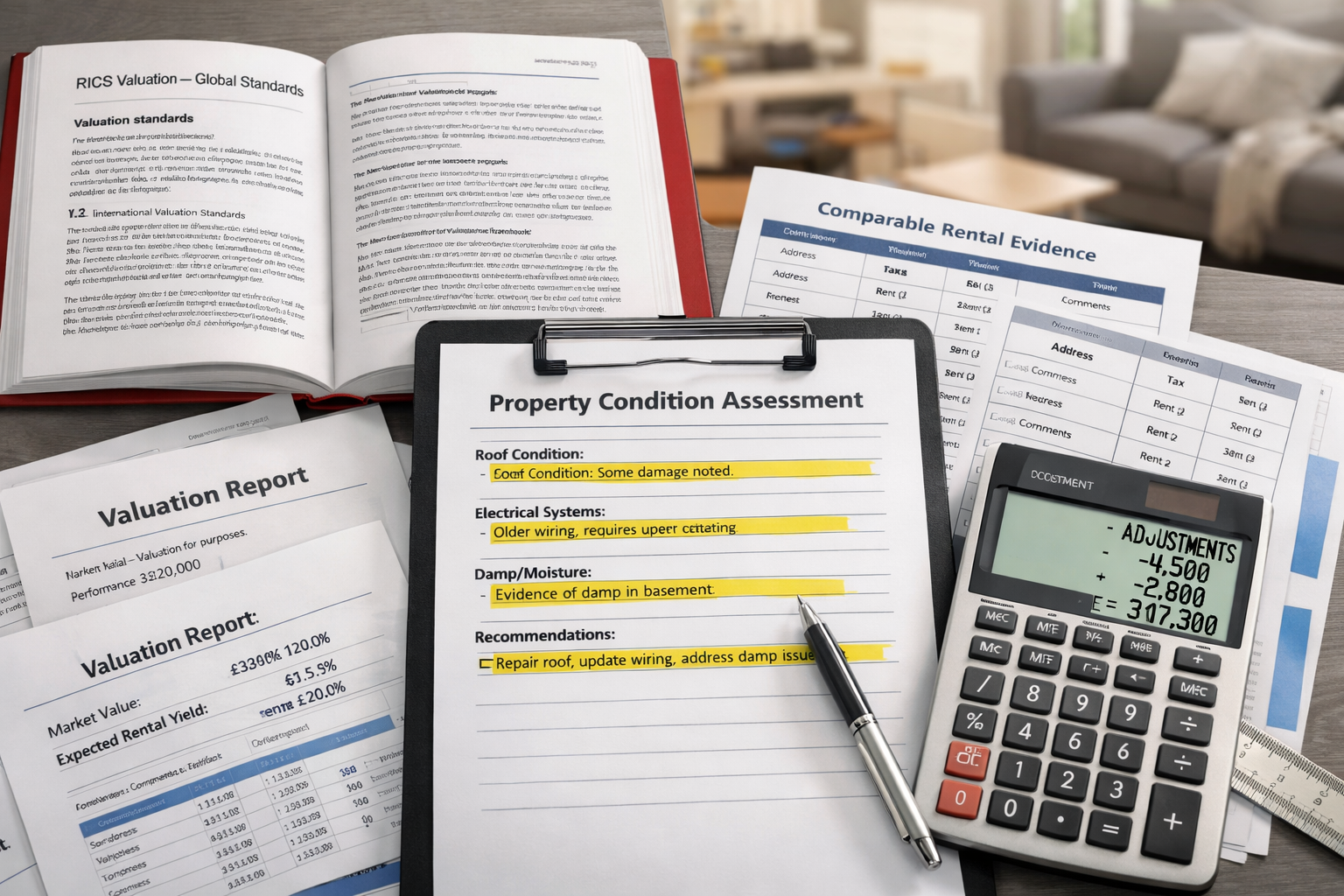
A valuation adjustment is a quantified modification to a baseline property value or rental figure, applied to reflect specific factors that affect market worth. In ombudsman disputes, adjustments typically arise in three core scenarios:
| Dispute Type | Valuation Adjustment Required | Key Evidence Needed |
|---|---|---|
| Disputed rent increase | Market rent comparables + condition discount | Local rental evidence, condition report |
| Disrepair claim | Cost of remediation + loss of amenity | Schedule of condition, contractor quotes |
| Hazard remediation | HHSRS risk score + cost to remedy | Specialist survey, remediation costings |
| Uninhabitable period | Rental void value + alternative accommodation | Market evidence, timeline documentation |
Each adjustment must be independently verifiable, methodologically sound, and proportionate to the dispute at hand.
The RICS Red Book Framework
Expert witness surveyors operating in ombudsman cases must anchor their evidence to RICS Valuation – Global Standards (the Red Book). Key principles include:
- Market Value definition: The estimated amount for which a property would exchange on the valuation date between a willing buyer and seller
- Basis of value: Must be clearly stated — market rent, market value, or depreciated replacement cost depending on the dispute
- Independence and objectivity: The expert's duty is to the tribunal, not the instructing party
For expert witness reports in London and beyond, this means the valuation must stand alone as a document — it should be comprehensible to a non-specialist ombudsman adjudicator without requiring the expert to be present to explain it.
Condition-Based Adjustments: The Core Challenge
Property condition is the most contested area in PRS ombudsman disputes. A landlord may argue that a property was let in good condition; a tenant may argue the opposite. The expert witness surveyor must:
- Establish a baseline condition — ideally from a schedule of condition report prepared at the start of the tenancy
- Quantify deterioration — distinguishing fair wear and tear from disrepair
- Apply a market-tested adjustment — using comparable evidence to demonstrate the rental or capital impact of the condition issue
Without a pre-tenancy schedule of condition, establishing the baseline becomes a matter of inference — and inference is a weak foundation for ombudsman evidence.
Building Defensible Expert Witness Evidence: Practical Standards
The Five Pillars of Credible Ombudsman Valuation Evidence
Experienced expert witnesses structure their reports around five non-negotiable pillars:
1. 📐 Methodological Transparency
Every adjustment must be explained step by step. If a 12% rental discount is applied for damp penetration, the report must show why 12% — not 8% or 15%. Comparable evidence from similar properties with similar defects is essential.
2. 📊 Comparable Market Evidence
The best London property valuation guide principles apply equally here: adjustments must be grounded in actual market transactions, not theoretical estimates. At least three to five comparables should be cited, with adjustments explained for location, size, and condition differences.
3. 🏗️ Remediation Cost Evidence
Where a dispute involves maintenance failures, the expert must provide realistic remediation costings — not worst-case or best-case figures. Contractor quotes, BCIS (Building Cost Information Service) data, or reinstatement cost valuations provide the evidential anchor.
4. ⏱️ Timeline Documentation
The ombudsman assesses whether landlords acted in a fair and timely manner [3]. Expert evidence should map the timeline of reported defects against the timeline of remediation — or lack thereof. This contextualises the financial adjustment within the conduct assessment.
5. 📝 Plain English Presentation
Ombudsman adjudicators are not surveyors. Reports must translate technical findings into clear, accessible language. Jargon should be defined; conclusions should be stated plainly.
Common Pitfalls to Avoid ⚠️
- Overstating adjustments: Inflated figures undermine credibility and may result in the entire report being discounted
- Ignoring countervailing evidence: A robust expert report acknowledges and addresses the opposing case
- Conflating capital value and rental value: These are distinct bases of value and must not be mixed without clear explanation
- Failing to inspect: Desktop valuations carry significantly less weight than those based on physical inspection
- Missing the instruction: The report must answer the specific question posed — not a broader valuation exercise
Rent Increase Disputes: Applying Valuation Adjustments for Private Rented Sector Landlord Ombudsman Disputes: Expert Witness Evidence Standards in 2026

Rent increase disputes are among the most common complaint categories expected to reach the PRS Ombudsman [4]. Under the Renters' Rights Act framework, landlords can only increase rent once per year and must use the Section 13 notice process. Tenants can challenge increases they believe exceed market rent.
The Expert's Role in Rent Increase Challenges
When a tenant challenges a rent increase, the ombudsman must determine whether the proposed rent reflects genuine market value. This requires:
- A market rent assessment based on comparable lettings in the same locality
- Adjustment for any condition factors that would affect a hypothetical tenant's willingness to pay
- Evidence of local rental trends — particularly relevant in areas of rapid price movement
For landlords and tenants in London, working with chartered surveyors in London who understand hyper-local rental markets is critical. A valuation based on comparables from the wrong postcode — or from a different property type — will not withstand scrutiny.
Condition Discounts in Rent Assessments
A property with unresolved maintenance issues cannot command the same market rent as an equivalent well-maintained property. The expert witness must:
- Identify and categorise defects (cosmetic, functional, structural, hazardous)
- Apply a condition discount to the gross market rent
- Support the discount with evidence — either comparable lettings of similarly affected properties, or a reasoned analysis of the impact on tenant demand
A useful cross-reference here is the approach used in valuation reports in London for other dispute contexts, such as matrimonial or probate cases, where condition adjustments follow similar methodological principles.
Hazard Remediation and HHSRS: The Intersection of Safety and Value
The Housing Health and Safety Rating System (HHSRS) provides a risk-based framework for assessing property hazards. In ombudsman disputes involving hazards — damp and mould, electrical faults, structural instability — the expert witness must bridge the gap between safety assessment and financial quantification.
Translating HHSRS Scores into Valuation Adjustments
| HHSRS Category | Risk Level | Typical Valuation Impact |
|---|---|---|
| Category 1 Hazard | Serious and immediate | Significant rental discount; potential void period claim |
| Category 2 Hazard | Less serious | Moderate discount; remediation cost claim |
| No hazard identified | Acceptable condition | No adjustment warranted |
The expert must be clear that HHSRS scoring is not itself a valuation tool — it is a risk assessment framework. The financial adjustment must still be derived from market evidence, with the HHSRS score providing the factual foundation for the condition assessment.
For complex cases involving structural issues, a structural survey in London may be required alongside the valuation evidence to establish the full extent of the defect.
Documentation Standards: What the Ombudsman Expects
The ombudsman's assessment framework places heavy emphasis on paper trails and communication records [3]. For expert witnesses, this means the valuation evidence must be supported by — and consistent with — the documentary record of the dispute.
Essential Documentation Checklist ✅
- Tenancy agreement and inventory
- Schedule of condition report at tenancy commencement
- Maintenance request records (emails, texts, portal messages)
- Landlord response records and timelines
- Contractor quotes and completion certificates
- Photographic evidence with dates and metadata
- Rent payment history
- Any previous inspection reports
When the documentary record is incomplete, the expert witness should note the gap explicitly — and explain how it affects the reliability of the valuation adjustment.
Preparing for the 2026 Landscape: Actionable Steps
The PRS Ombudsman's arrival in late 2026 [1] is not a distant regulatory abstraction. Cases will begin flowing through the system quickly, and the quality of expert witness evidence will determine outcomes for landlords and tenants alike.
For landlords:
- Commission a schedule of condition report at every new tenancy
- Maintain comprehensive maintenance records
- Respond to repair requests in writing, with timelines
- Understand the valuation factors that affect your property's rental market position
For expert witness surveyors:
- Ensure RICS Red Book compliance in all ombudsman-related reports
- Develop a clear methodology for condition-based rental adjustments
- Build a library of local comparable evidence
- Structure reports for a non-specialist audience
For tenants:
- Keep records of all communications with landlords
- Document property conditions with dated photographs
- Seek independent valuation advice before challenging a rent increase
Conclusion: A New Standard for a New Dispute Resolution Era
The launch of the PRS Landlord Ombudsman in 2026 marks a genuine turning point for the private rented sector. With binding enforcement powers [1], mandatory membership for all landlords [4], and a complaints framework focused on reasonableness and conduct [3], the ombudsman will generate a significant volume of disputes requiring professional valuation evidence.
Valuation adjustments for Private Rented Sector Landlord Ombudsman disputes: expert witness evidence standards in 2026 are not simply a technical exercise — they are the mechanism by which fair outcomes are achieved. A well-constructed expert witness report, grounded in RICS methodology, supported by comparable market evidence, and presented in accessible language, can be the difference between a just resolution and an arbitrary one.
The surveyors and valuers who invest now in understanding the ombudsman framework, refining their evidence standards, and building robust documentation practices will be best placed to serve clients — and the wider public interest — as this new era begins.
🔑 Next steps: Commission a pre-tenancy schedule of condition, engage a RICS-registered valuer familiar with ombudsman evidence standards, and review your documentation practices before the ombudsman scheme goes live.
References
[1] Private Rental Sector Changes 2026 – https://purseglove.co.uk/private-rental-sector-changes-2026/
[2] Renters Rights Act 2026 Guide – https://helpland.co.uk/the-landlords-ledger/renters-rights-act-2026-guide
[3] Prs Reform For Landlords In 2026 The Ombudsman The Prs Database And How To Avoid The Most Common Complaint Triggers – https://www.lovelle.co.uk/guides/landlord/prs-reform-for-landlords-in-2026-the-ombudsman-the-prs-database-and-how-to-avoid-the-most-common-complaint-triggers/
[4] Prs Landlord Ombudsman – https://www.augustapp.com/blog/prs-landlord-ombudsman
[5] Renters Rights Bill A Letting Agents Guide – https://blog.goodlord.co/renters-rights-bill-a-letting-agents-guide