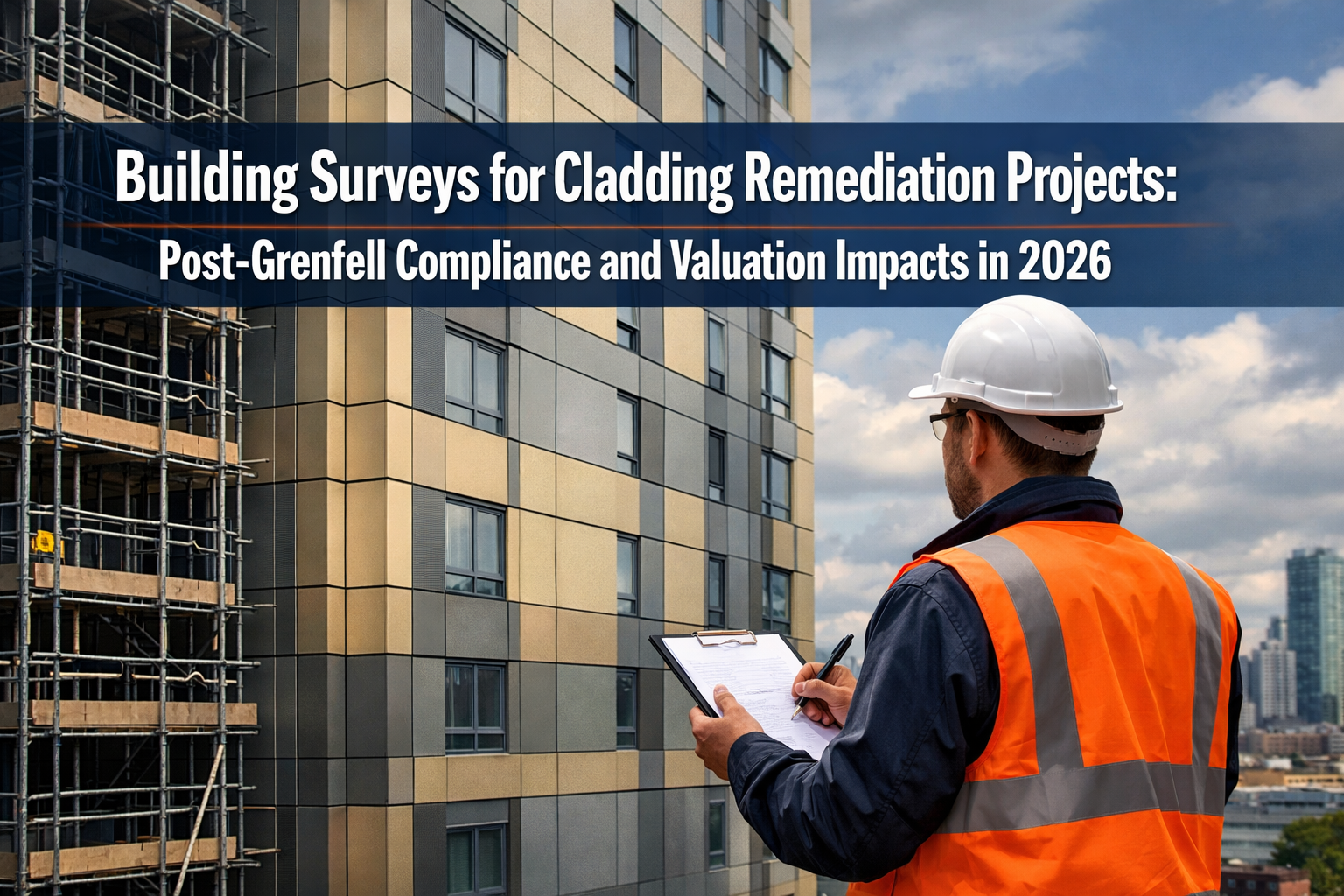
More than 4,310 residential buildings across the UK require urgent cladding remediation, yet only 35% have completed the necessary safety works as of February 2026 [1]. This ongoing crisis continues to devastate property values, paralyze mortgage lending, and trap thousands of leaseholders in unsellable homes nearly nine years after the Grenfell Tower tragedy.
Building Surveys for Cladding Remediation Projects: Post-Grenfell Compliance and Valuation Impacts in 2026 have become essential tools for property owners, investors, and lenders navigating this complex landscape. The intersection of building safety regulations, remediation funding schemes, and property valuation has created unprecedented challenges requiring specialized surveying expertise and comprehensive assessment protocols.
Key Takeaways
- RICS Level 3 surveys now include mandatory cladding assessments for buildings over 11 metres, with specific defect identification protocols for ACM and HPL materials
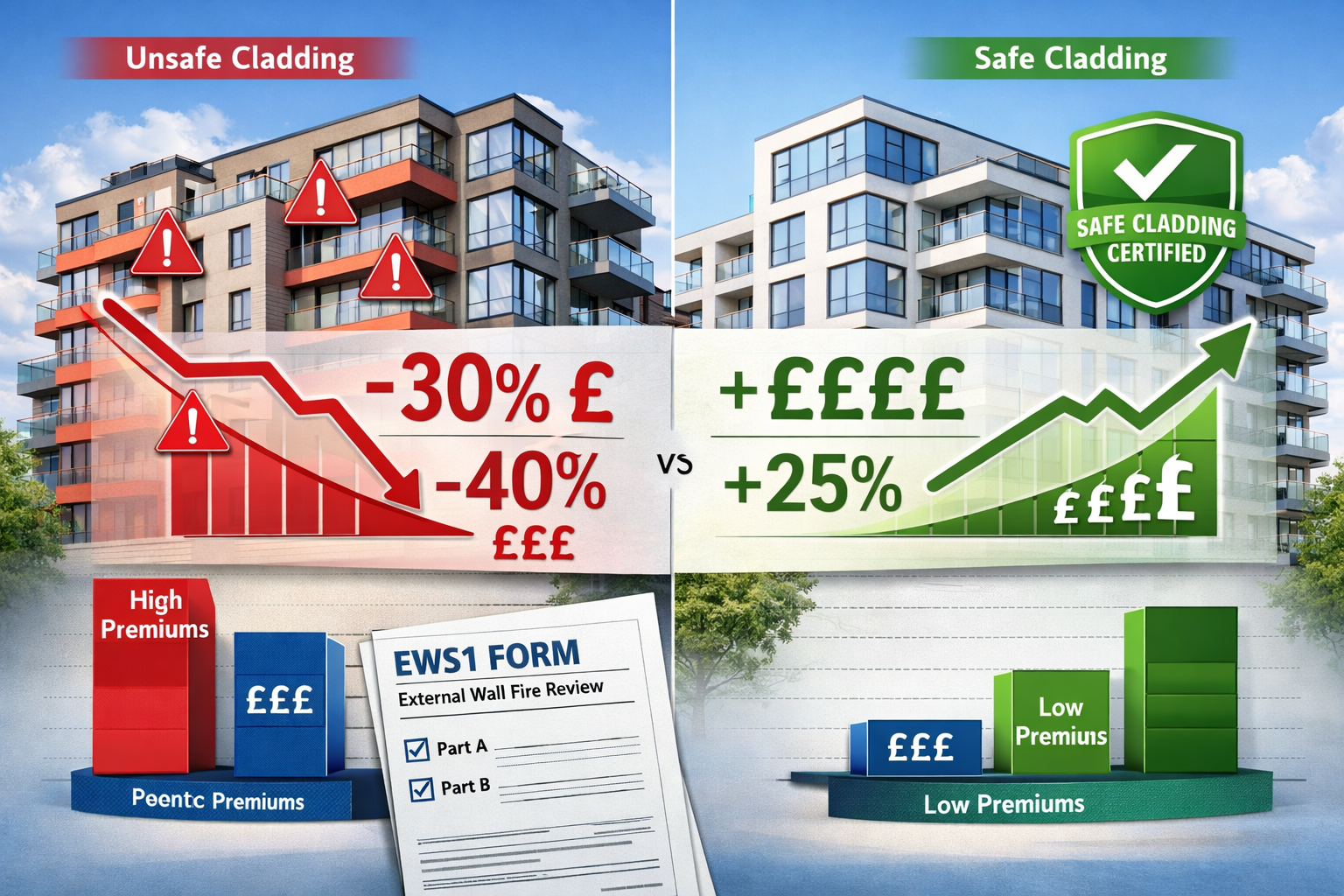
- Property valuations for buildings with unsafe cladding typically decrease by 20-40% until remediation completes, with insurance premiums increasing by 300-500%
- Government funding schemes (Building Safety Fund and Cladding Safety Scheme) cover different building heights, but only 53% of identified buildings have started remediation work [1]
- EWS1 forms remain critical for mortgage lending decisions, requiring qualified fire engineers or building control surveyors to assess external wall systems
- Remediation timelines now face strict government deadlines, with mid-rise buildings showing significantly slower progress (only 22% started work) [1]
Understanding Building Surveys for Cladding Remediation Projects: Post-Grenfell Compliance Requirements
The regulatory landscape surrounding cladding safety has evolved dramatically since 2017. Building surveys for cladding remediation projects must now address multiple compliance frameworks simultaneously, including the Building Safety Act 2022, updated Approved Document B fire safety guidance, and specific requirements from government funding schemes.
The Scale of the Cladding Crisis in 2026
Current government data reveals the magnitude of ongoing remediation needs:
- 4,310 buildings over 11 metres identified with unsafe cladding requiring remediation [1]
- 1,521 buildings (35%) have completed remediation works [1]
- An estimated 1,400-4,300 additional buildings remain unconfirmed for eligibility assessment [1]
- 1,146 buildings assessed as eligible for the Cladding Safety Scheme for mid-rise properties [1]
The slower progress in mid-rise buildings (11-18 metres) presents particular concern. Only 7% of Cladding Safety Scheme-eligible buildings have completed remediation [1], compared to higher completion rates for taller buildings covered by the Building Safety Fund.
RICS Level 3 Survey Requirements for Cladding Assessment
Professional building surveys addressing cladding concerns require comprehensive Level 3 (Building Survey) assessments that extend beyond traditional structural evaluations. Chartered surveyors conducting these specialized inspections must follow enhanced protocols:
Essential Survey Components:
✅ External Wall System Identification – Document all cladding materials, including ACM (Aluminium Composite Material), HPL (High-Pressure Laminate), timber, and render systems
✅ Fire Safety Assessment – Evaluate cavity barriers, fire stops, compartmentation integrity, and compliance with current Building Regulations
✅ Structural Fixings Inspection – Assess cladding attachment methods, bracket systems, and structural adequacy of supporting frameworks
✅ Moisture Ingress Evaluation – Identify water penetration risks, failed seals, and potential internal damage from cladding system failures
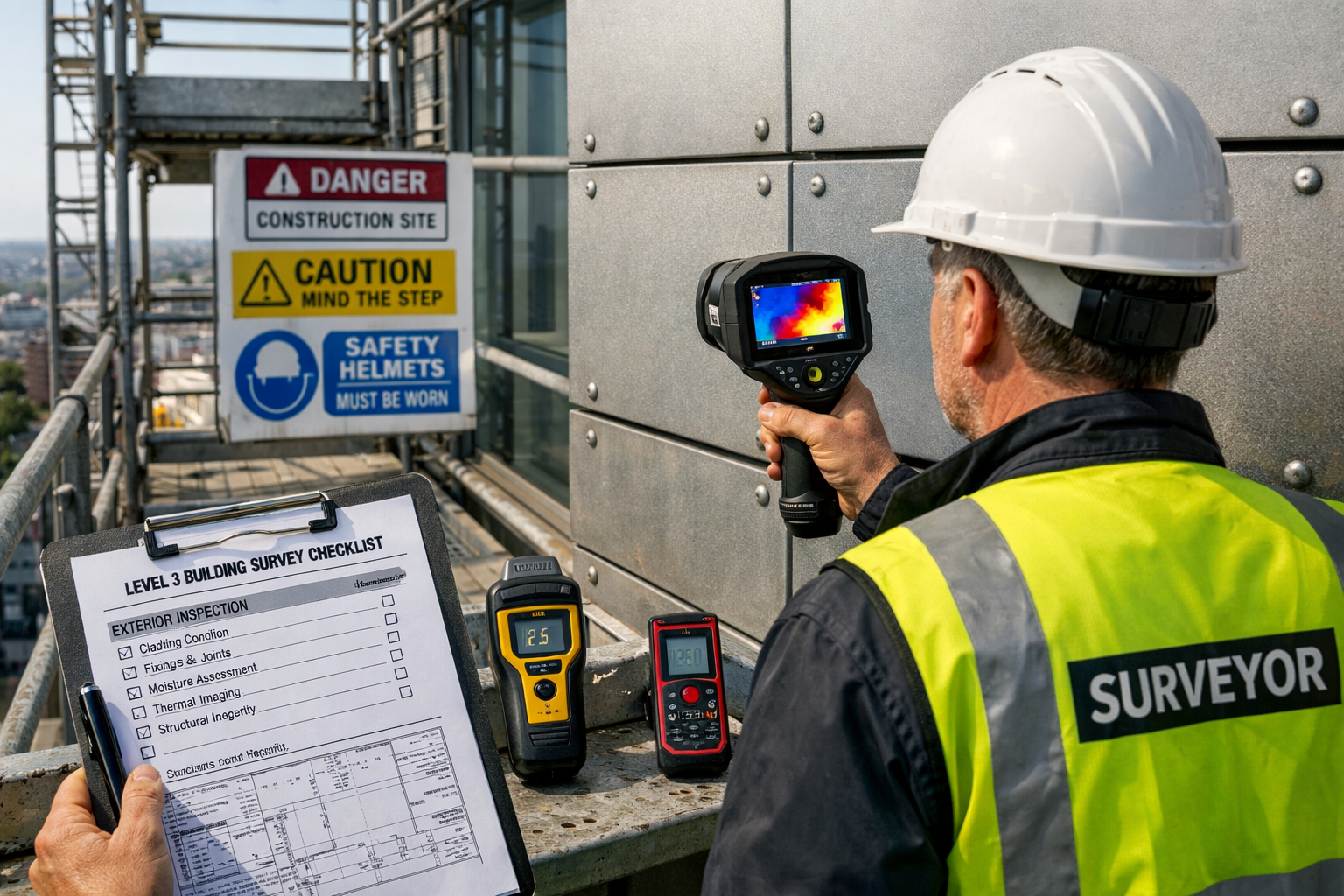
✅ Thermal Imaging Analysis – Use infrared technology to detect hidden defects, insulation gaps, and moisture accumulation behind cladding panels
✅ Documentation Review – Examine building control certificates, fire risk assessments, and any existing EWS1 forms or fire engineer reports
Government Funding Scheme Eligibility Assessment
Understanding which remediation funding route applies requires careful building classification. Surveyors must accurately determine:
| Building Height | Funding Scheme | Coverage Details |
|---|---|---|
| Over 18 metres | Building Safety Fund | Residential buildings 6+ storeys, ACM and non-ACM cladding systems |
| 11-18 metres | Cladding Safety Scheme | Mid-rise residential, expanded coverage for life safety risks [5] |
| Under 11 metres | Cladding Safety Scheme (exceptional cases) | Only where no alternative funding exists and significant safety risk identified [5] |
The remediation process typically follows a structured timeline requiring multiple survey stages [5]:
- Initial identification – Building owner or managing agent identifies potential cladding safety concerns
- Intrusive investigation – Specialist contractors conduct detailed material sampling and testing
- Fire risk assessment – Qualified fire engineer evaluates building-specific risks
- Remediation design – Architects and building safety consultants develop compliant solutions
- Funding application – Documentation submitted to appropriate government scheme
- Works execution – Approved contractors complete remediation under building control supervision
- Certification – Building control sign-off and updated EWS1 form issued
Valuation Impacts and Insurance Premium Challenges for Properties Requiring Cladding Remediation
The financial consequences of cladding safety issues extend far beyond remediation costs. Property valuations, mortgage lending availability, and insurance premiums have all been severely affected, creating a complex landscape for valuation reports and property transactions.
Property Valuation Adjustments for Cladding Defects
Buildings identified with unsafe cladding experience significant valuation reductions until remediation completes. Professional valuers must consider multiple factors when assessing properties affected by cladding concerns:
Primary Valuation Adjustment Factors:
🏢 Marketability Impact – Properties without valid EWS1 forms or with identified cladding defects become effectively unsellable in many cases, as mortgage lenders refuse financing
💷 Direct Cost Deductions – Estimated remediation costs (often £20,000-£100,000+ per flat) directly reduce property values, even when government funding may eventually cover expenses
📉 Market Stigma – Buildings with cladding history experience lasting negative perception, reducing values by 10-15% even post-remediation
⏰ Timeline Uncertainty – Extended remediation periods (averaging 2-4 years) create holding costs and opportunity losses affecting valuation calculations
🔒 Leasehold Complications – Service charge disputes, freeholder insolvency risks, and legal uncertainties further depress values
Typical valuation reductions range from 20-40% for properties with confirmed unsafe cladding requiring remediation. Properties in buildings where cladding status remains unconfirmed may see 10-20% reductions due to uncertainty and mortgage lending restrictions.
For professional valuations addressing these complex scenarios, Red Book valuation services following RICS standards provide the necessary rigor for legal, financial, and transactional purposes.
Insurance Premium Increases and Coverage Limitations
Building insurance for properties with cladding concerns has become increasingly problematic. Insurance providers have responded to heightened fire risks with dramatic premium increases and coverage restrictions:
Insurance Market Challenges:
- Premium increases of 300-500% for buildings with identified cladding safety issues
- Coverage exclusions for fire damage related to external wall systems in some policies
- Building insurance unavailability for properties without valid EWS1 forms or confirmed remediation plans
- Waking watch costs (24-hour fire patrols) adding £200-500+ monthly per flat until remediation completes [3]
These insurance challenges create additional valuation considerations. When conducting insurance reinstatement valuations, surveyors must account for both the increased replacement costs associated with compliant cladding systems and the practical difficulties in obtaining adequate coverage.
EWS1 Forms and Their Impact on Mortgage Lending
The External Wall System (EWS1) form remains central to property transactions involving buildings over 11 metres or those under 11 metres with specific risk factors. This form requires assessment by a qualified professional (typically a building control surveyor or fire engineer) who evaluates the external wall construction and assigns a rating:
- A1/A2 – No ACM present, limited combustible materials
- A3 – ACM present but meets safety standards
- B1 – Remediation works underway or planned
- B2 – Unsafe materials identified, no remediation plan yet established
Properties rated B2 become virtually unmortgageable, while even B1 ratings create significant lending restrictions and valuation impacts. The absence of an EWS1 form for eligible buildings similarly prevents most mortgage lending.
Remediation Cost Implications for Different Building Types
The financial burden of cladding remediation varies substantially based on building characteristics:
| Building Type | Average Cost Per Unit | Total Project Cost Range |
|---|---|---|
| High-rise (18m+) | £40,000-£100,000 | £5-25 million+ |
| Mid-rise (11-18m) | £20,000-£60,000 | £1-8 million |
| Low-rise exceptional cases | £15,000-£40,000 | £500,000-£3 million |
While government funding schemes aim to protect leaseholders from these costs, significant gaps remain. Buildings owned by developers who have dissolved their companies, properties with complex ownership structures, and buildings requiring additional non-cladding fire safety works often face funding shortfalls that impact property values [4].
Conducting Comprehensive Building Surveys for Cladding Remediation Projects: Post-Grenfell Compliance Checklists
Professional surveyors conducting cladding-focused building surveys must employ systematic methodologies that address both immediate safety concerns and long-term compliance requirements. The following comprehensive checklists provide frameworks for thorough assessments.
Pre-Survey Documentation and Desktop Research
Before conducting site inspections, surveyors should compile essential background information:
Required Documentation Review:
- Building control completion certificates and approved building regulation drawings
- Original architectural specifications and cladding system installation details
- Previous fire risk assessments and any existing EWS1 forms
- Building insurance policies and claims history
- Service charge accounts showing any interim safety measure costs
- Planning permission records and any subsequent building alterations
- Lease documents defining repair and maintenance responsibilities
This documentation review often reveals critical information about cladding systems, installation dates, and compliance history that informs the physical survey approach.
External Envelope Inspection Checklist
The external survey requires systematic evaluation of all building facades:
Visual Inspection Points:
-
Cladding Material Identification
- Document all external wall materials by elevation
- Photograph representative sections of each material type
- Note manufacturer marks, product codes, or identifying features
- Assess material condition, deterioration, and weathering patterns
-
Panel System Assessment
- Examine panel joints, seals, and gasket conditions
- Identify signs of movement, distortion, or fixing failures
- Document any missing, damaged, or replaced panels
- Assess consistency of installation quality across elevations
-
Fixings and Support Structure
- Evaluate visible bracket systems and attachment points
- Identify corrosion, deterioration, or inadequate fixings
- Assess load paths and structural adequacy
- Document any modifications or repairs to support systems
-
Fire Safety Features
- Identify cavity barrier locations (where visible externally)
- Assess compartmentation at floor levels and building junctions
- Document fire stopping around service penetrations
- Evaluate balcony separation and spandrel panel adequacy
For buildings requiring access to upper levels, drone roof survey technology provides safe, cost-effective inspection capabilities for otherwise inaccessible areas.
Internal Assessment and Compartmentation Review
Internal inspections complement external surveys by evaluating:
Internal Inspection Focus Areas:
- Common areas – Stairwells, corridors, and lobbies for fire door integrity and compartmentation breaches
- Riser cupboards – Service penetrations through floors and walls, adequacy of fire stopping
- Sample flat inspections – Window reveals, internal wall conditions adjacent to external cladding
- Roof space access – Cavity barrier installation at roof level, insulation materials, fire separation
- Plant rooms – Mechanical penetrations through external walls, fire safety provisions
Intrusive Investigation Requirements
Surface inspections alone cannot definitively identify cladding materials or assess hidden construction details. Intrusive investigations typically include:
Sampling and Testing Protocols:
🔬 Material sampling – Small cladding samples sent to laboratories for composition analysis and fire performance testing
🔍 Opening-up works – Selective removal of cladding panels to examine cavity construction, insulation materials, and barrier installations
📸 Borescope inspection – Camera insertion through small drill holes to view cavity conditions without extensive dismantling
🌡️ Thermal imaging – Infrared surveys identifying insulation defects, moisture accumulation, and hidden structural concerns
These intrusive investigations require specialist contractors and must be carefully coordinated to maintain building weathertightness and minimize disruption to residents [6].
Fire Engineering Assessment Integration
Building surveys for cladding remediation must integrate findings with qualified fire engineering assessments. Fire engineers evaluate:
- Fire initiation risks – Likelihood of fire starting in or spreading to external wall systems
- Fire spread mechanisms – Potential for vertical and horizontal fire propagation via cladding
- Building-specific factors – Occupancy patterns, evacuation strategies, fire service access
- Compensatory measures – Effectiveness of interim safety measures like waking watches or enhanced detection systems
The surveyor's documentation provides essential input for fire engineering analysis, while fire engineer conclusions inform remediation design and valuation impacts [9].
Compliance Verification Against Current Standards
Survey findings must be evaluated against current regulatory standards:
Key Compliance Benchmarks:
- Building Regulations Approved Document B (2019 amendments) – Prohibits combustible materials in external walls of buildings over 18 metres
- BS 9414:2022 – Fire door installation standard applicable to compartmentation elements
- BS 8414 fire testing – Large-scale fire test standard for external wall systems
- Government guidance – Consolidated advice notes on building safety and fire safety matters
Properties requiring specific defect reports benefit from focused assessments addressing particular compliance concerns identified during initial surveys.
Survey Reporting and Recommendations
Comprehensive survey reports for cladding remediation projects should include:
Essential Report Components:
- Executive summary – Clear statement of key findings, safety concerns, and priority recommendations
- Building description – Detailed documentation of construction, age, height, and occupancy
- Cladding system analysis – Material identification, construction details, and condition assessment
- Defect schedule – Categorized listing of all identified defects with photographic evidence
- Compliance evaluation – Assessment against current regulations and guidance
- Remediation options – Alternative approaches with comparative cost estimates
- Funding route analysis – Eligibility assessment for government schemes
- Valuation impact statement – Current market value implications and post-remediation projections
- Priority action plan – Immediate safety measures and medium-term remediation timeline
These reports serve multiple purposes: informing building owners and residents, supporting funding applications, guiding remediation contractors, and providing essential documentation for property valuations and transactions.
Post-Remediation Verification Surveys
Following remediation completion, verification surveys confirm:
- Works completion – All specified remediation works properly executed
- Building control compliance – Final inspections passed and completion certificates issued
- Fire safety certification – Updated fire risk assessments and EWS1 forms reflecting compliant systems
- Warranty documentation – Contractor guarantees and material warranties properly transferred
- Defects identification – Any snagging items requiring contractor attention
This verification process enables updated valuation reports reflecting restored property values and marketability.
Government Deadlines and Enforcement Mechanisms in 2026
The UK government has established firm remediation deadlines to accelerate progress on cladding safety. Building owners face significant penalties for non-compliance:
Current Enforcement Framework:
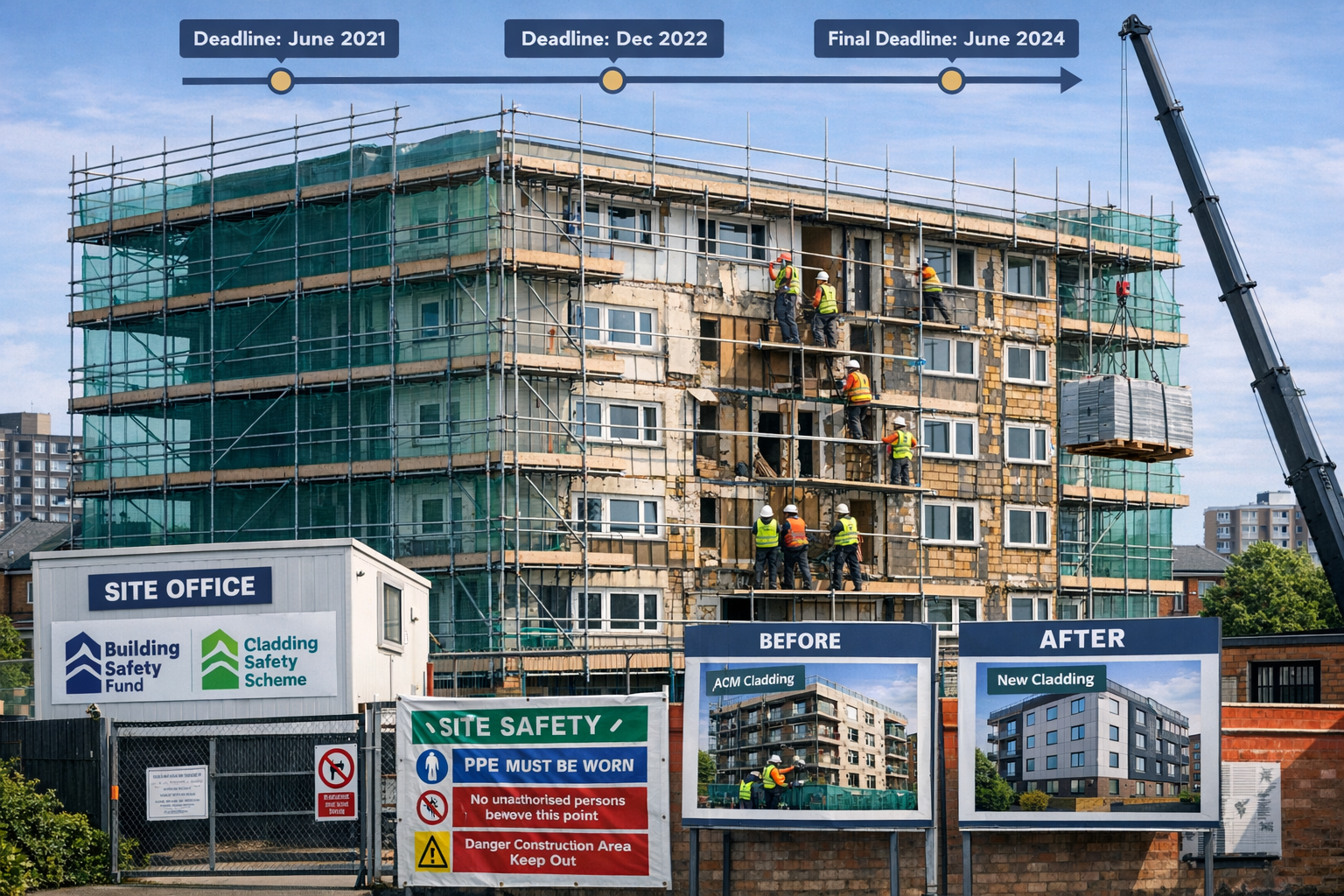
- March 2029 deadline – All high-rise residential buildings must complete cladding remediation [2]
- Building Safety Regulator powers – Authority to issue compliance notices and impose financial penalties
- Developer responsibility – Legal obligations for original developers to fund remediation for buildings they constructed in past 30 years
- Leaseholder protections – Caps on leaseholder contributions (£10,000-£15,000 maximum depending on property value) [2]
Progress monitoring continues through monthly government data releases, maintaining pressure on building owners and developers to meet deadlines [1].
Conclusion: Navigating Building Surveys for Cladding Remediation Projects in 2026
Building Surveys for Cladding Remediation Projects: Post-Grenfell Compliance and Valuation Impacts in 2026 represent one of the most complex challenges in UK property surveying. The intersection of building safety regulations, government funding schemes, mortgage lending restrictions, and property valuation uncertainties requires specialized expertise and comprehensive assessment methodologies.
Nearly nine years after Grenfell, significant work remains. With 65% of identified buildings yet to complete remediation and thousands more buildings awaiting assessment, the cladding crisis continues to affect property markets, leaseholder finances, and building safety across the UK [1].
Actionable Next Steps for Property Stakeholders
For Building Owners and Managing Agents:
- Commission comprehensive RICS Level 3 building surveys from qualified chartered surveyors with cladding remediation experience
- Obtain fire engineering assessments and EWS1 forms to clarify building status
- Apply promptly to appropriate government funding schemes (Building Safety Fund or Cladding Safety Scheme)
- Implement interim safety measures while awaiting remediation
- Maintain transparent communication with leaseholders throughout the process
For Property Buyers and Investors:
- Request EWS1 forms and recent fire risk assessments before making offers on flats in buildings over 11 metres
- Obtain professional valuations accounting for cladding-related risks and remediation timelines
- Verify building eligibility for government funding and remediation progress status
- Assess insurance availability and premium costs before committing to purchases
- Consider legal protections in contracts addressing cladding-related value risks
For Mortgage Lenders and Valuers:
- Apply consistent EWS1 requirements based on building height and risk factors
- Commission specialist valuation reports for properties with identified cladding concerns
- Monitor government remediation progress data to assess timeline risks
- Develop valuation methodologies reflecting remediation funding sources and completion stages
- Maintain updated guidance on lending criteria for cladding-affected properties
The path to resolving the UK's cladding crisis requires continued government pressure, adequate funding, professional surveying expertise, and realistic valuation practices. As remediation work accelerates toward 2029 deadlines, comprehensive building surveys remain essential tools for protecting safety, enabling informed decisions, and restoring confidence in affected property markets.
References
[1] Building Safety Remediation Monthly Data Release February 2026 – https://www.gov.uk/government/publications/building-safety-remediation-monthly-data-release-february-2026/building-safety-remediation-monthly-data-release-february-2026
[2] New Government Cladding Deadlines August 2025 Update – https://hartdixon.com/new-government-cladding-deadlines-august-2025-update/
[3] Cladding Remediation How To Mitigate Risks And Delay 2 – https://ridge.co.uk/insights/cladding-remediation-how-to-mitigate-risks-and-delay-2/
[4] Remediation Projects Through The Cladding Safety Scheme – https://frconsultants.co.uk/services/remediation-projects-through-the-cladding-safety-scheme/
[5] The Cladding Remediation Process A Guide For Customers – https://www.riverside.org.uk/you-your-home/safety-support/building-safety/cladding/the-cladding-remediation-process-a-guide-for-customers/
[6] Cladding Remediation Surveys – https://www.asesltd.com/services/cladding-remediation-surveys
[9] Building Safety And Cladding Remediation – https://ecda.co.uk/how-we-work/building-safety-and-cladding-remediation/