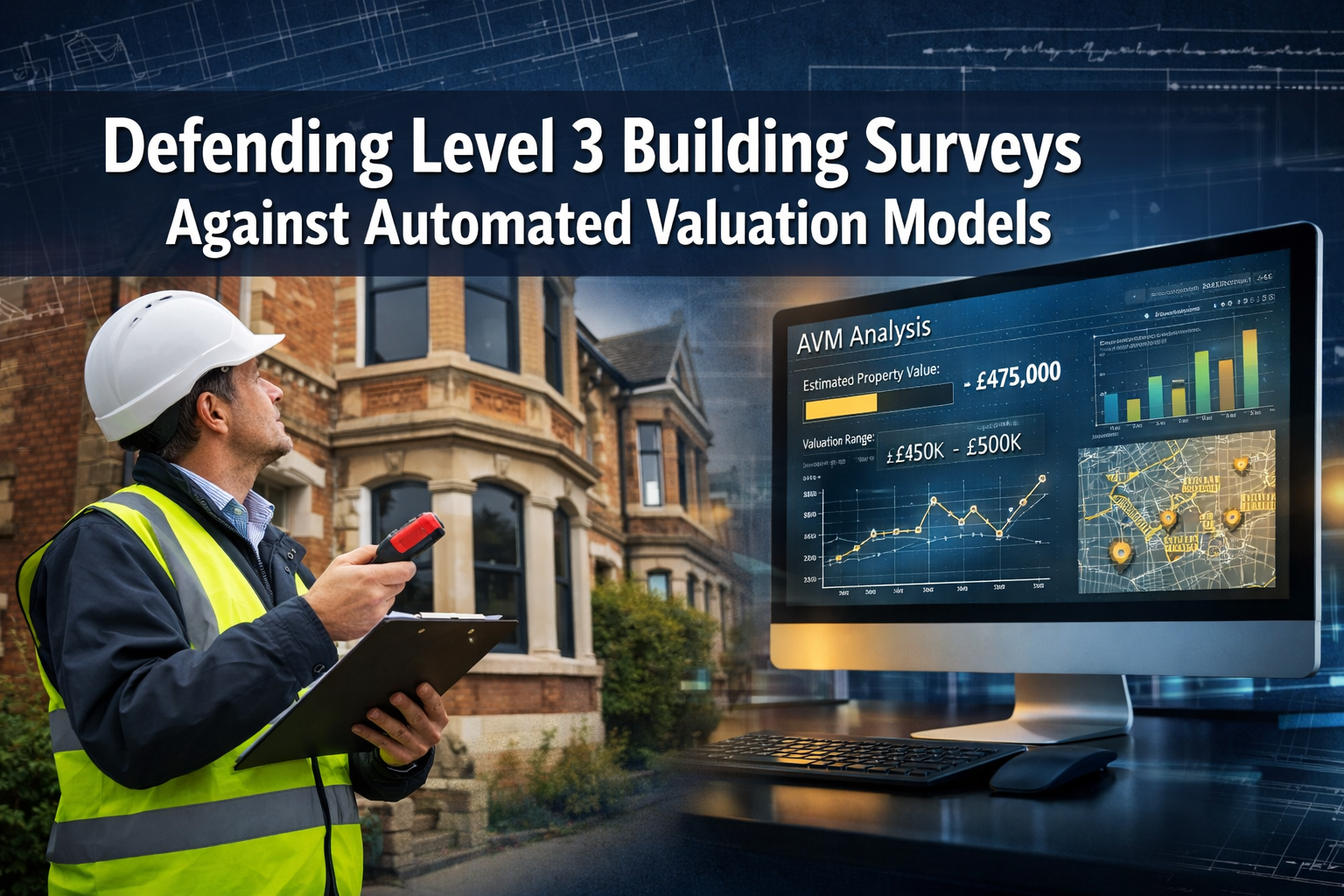

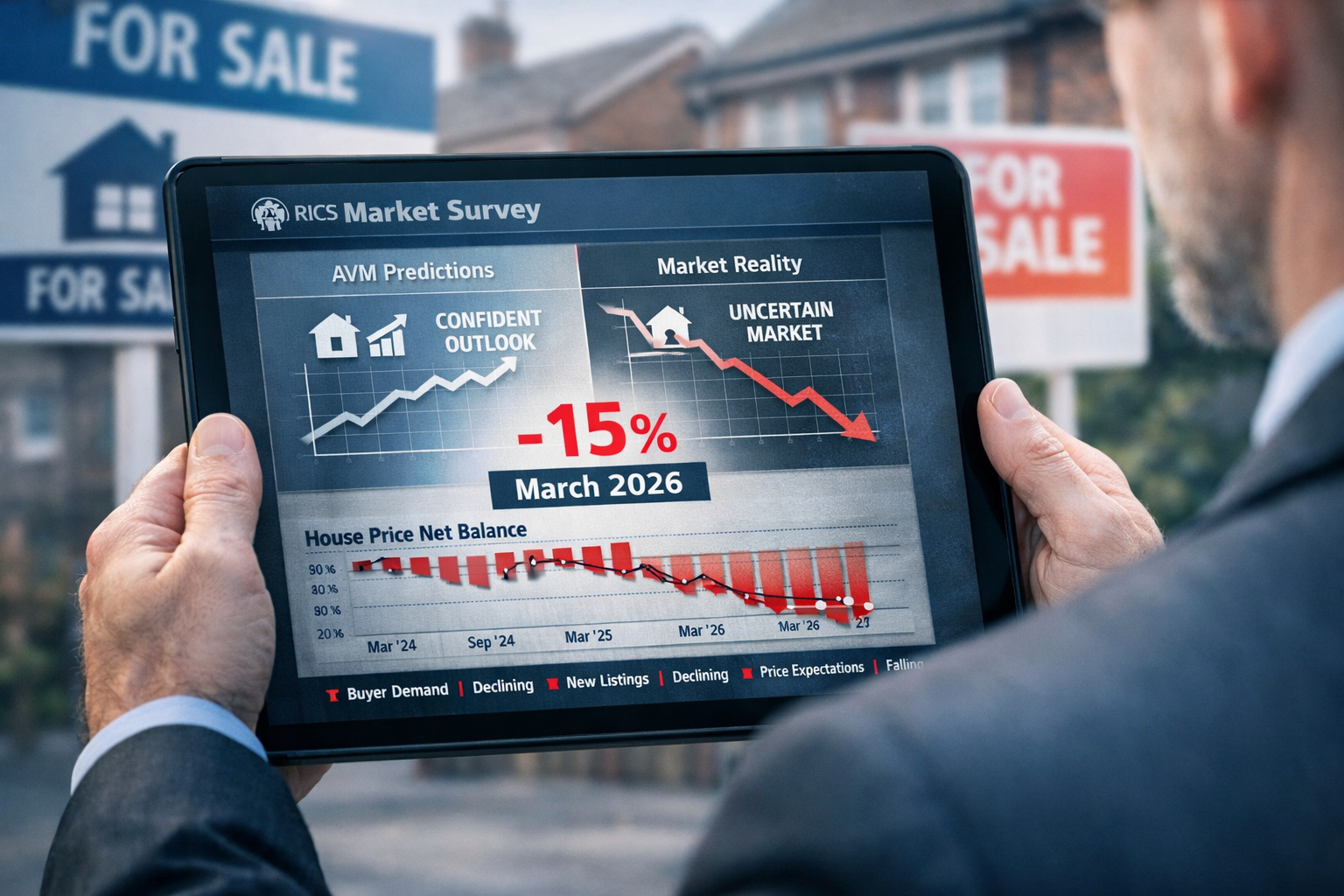
The March 2026 RICS Residential Market Survey revealed a stark reality: house price net balances crashed to -15%, marking one of the most cautious property market periods in recent UK history[2]. This dramatic shift has intensified the debate between traditional surveyor expertise and the rising tide of automated valuation models (AVMs). As algorithms promise faster, cheaper property assessments, chartered surveyors face mounting pressure to justify the value of comprehensive Level 3 building surveys. Yet the data tells a compelling story—one where human expertise consistently outperforms digital shortcuts, particularly when markets turn uncertain.
Defending Level 3 Building Surveys Against Automated Valuation Models: Data-Driven Arguments for Surveyor Credibility in Cautious Markets requires more than professional pride. It demands concrete evidence, market-specific data, and real-world case studies demonstrating where algorithmic assessments fail and human judgment prevails. This article provides surveyors with the ammunition needed to defend their professional value in 2026's challenging property landscape.
Key Takeaways
- AVMs achieve 3-7% median errors in optimal conditions but accuracy plummets when comparable data is sparse or market conditions shift—exactly the scenario facing UK markets in 2026[3]
- Properties with AVM confidence scores below 60 are deemed unreliable, yet many homebuyers remain unaware of these critical limitations[3]
- Level 3 building surveys identify structural defects, subsidence risks, and property-specific issues that algorithms cannot detect without physical inspection
- UK mortgage lenders are expanding AVM use from a historically low baseline, creating both threats and opportunities for professional surveyors[1]
- Regulatory pressure favors AVM adoption, making data-driven defense of surveyor credibility more critical than ever[5]
Understanding the AVM Threat Landscape in 2026
Automated valuation models have evolved significantly over the past decade. These sophisticated algorithms analyze vast datasets including recent sales transactions, property characteristics, location data, and market trends to generate instant property valuations. The appeal is obvious: speed, cost-efficiency, and scalability.
The PwC AVM Benchmarking Survey 2026 confirms that UK residential mortgage lenders are moving toward wider AVM adoption, though implementation remains uneven across the sector[1]. This trend reflects both technological advancement and economic pressure to reduce assessment costs during market downturns.
How AVMs Actually Work
AVMs employ statistical modeling techniques including:
- Hedonic pricing models that assign value to individual property features
- Comparative market analysis drawing from recent sales data
- Machine learning algorithms that identify pricing patterns
- Geospatial analysis incorporating location-specific factors
However, these technical capabilities mask fundamental limitations. AVMs function best in stable markets with abundant comparable sales data. When market conditions shift rapidly—as evidenced by the -15% house price net balance in March 2026[2]—algorithmic models struggle to adapt in real-time.
The Confidence Score Problem
Most AVMs generate a confidence score alongside their valuation. Properties scoring above 80 typically indicate strong data availability and model certainty. Scores between 60-80 suggest moderate confidence. Below 60, AVMs become unreliable[3].
The critical issue? Many property buyers, sellers, and even some lenders don't fully understand these confidence thresholds. A £500,000 AVM valuation with a 55 confidence score carries substantially more uncertainty than most users realize—potentially representing a true value range of £450,000 to £550,000 or wider.
| AVM Confidence Score | Interpretation | Typical Accuracy Range |
|---|---|---|
| 80-100 | High confidence | ±3-5% |
| 60-79 | Moderate confidence | ±5-10% |
| Below 60 | Low confidence/unreliable | ±10%+ or indeterminate |
When choosing what survey you need, understanding these AVM limitations becomes crucial for making informed decisions.
Defending Level 3 Building Surveys Against Automated Valuation Models: The Evidence-Based Case
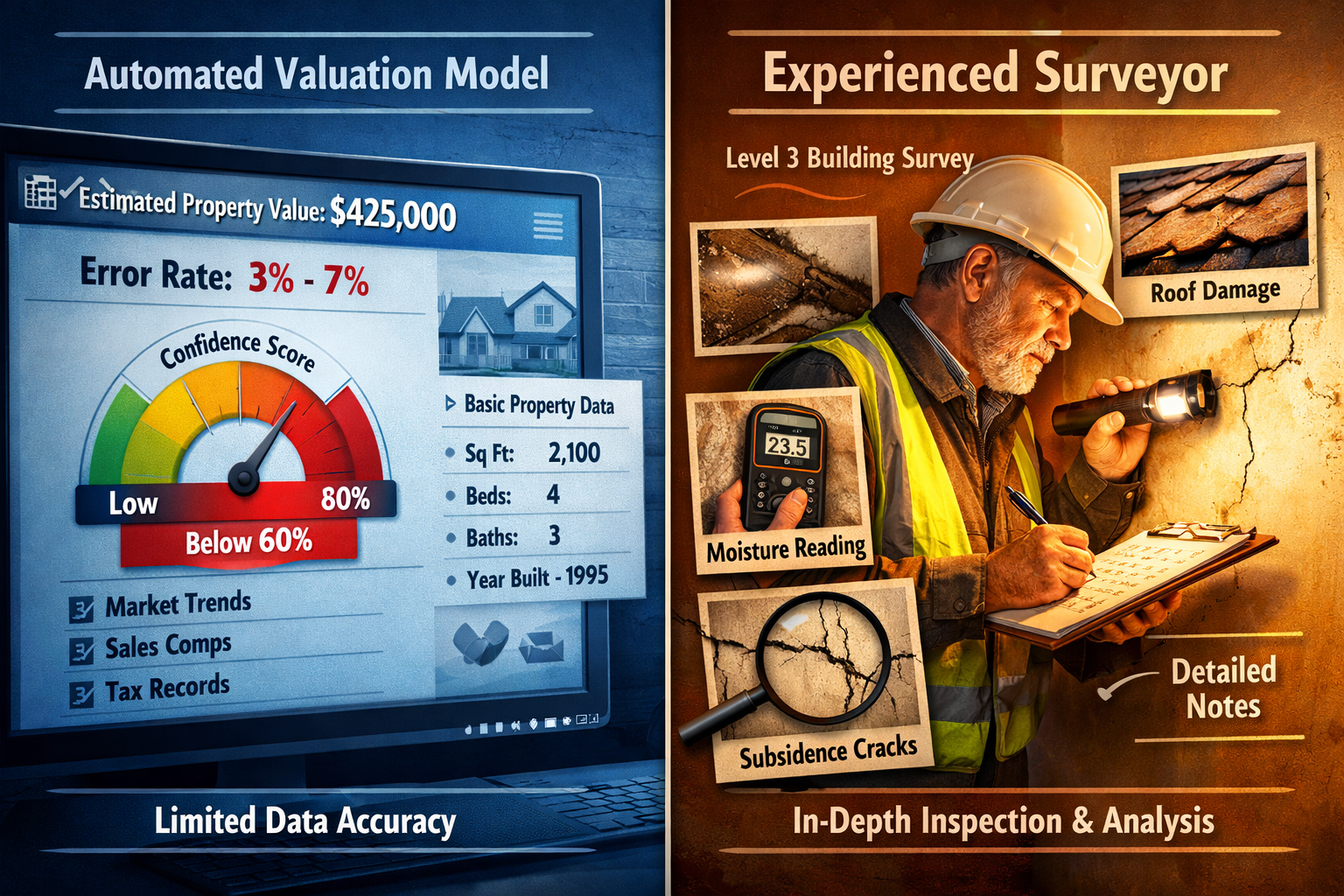
The most compelling defense of Level 3 building surveys rests on what AVMs cannot detect: physical property defects, structural integrity issues, and condition-specific factors that dramatically affect true value.
Where AVMs Fail: The Data Gap
AVMs operate exclusively on historical transaction data and property characteristics databases. They cannot:
✅ Identify structural defects such as subsidence, foundation issues, or load-bearing wall problems
✅ Detect hidden damp or water ingress that may cost tens of thousands to remediate
✅ Assess roof condition beyond basic age estimates
✅ Evaluate electrical or plumbing systems for safety compliance
✅ Recognize unauthorized alterations that affect property value and insurability
✅ Account for property-specific maintenance issues not reflected in sales data
A structural survey in London conducted by a chartered surveyor provides detailed analysis of these critical factors—information that no algorithm can replicate without physical inspection.
Case Study: Victorian Property Valuation Discrepancy
Consider a typical scenario from early 2026: A Victorian terrace property in Southwest London received an AVM valuation of £875,000 with a confidence score of 72—seemingly reasonable based on recent comparable sales in the area.
A subsequent Level 3 building survey revealed:
- Active subsidence affecting the rear extension (estimated repair cost: £35,000-£50,000)
- Significant roof deterioration requiring replacement within 2-3 years (£18,000-£25,000)
- Outdated electrical system failing current safety standards (£8,000-£12,000)
- Extensive damp in the basement and ground floor (£15,000-£20,000)
Total identified defects: £76,000-£107,000 in required remedial work
The true market value, accounting for these defects, was approximately £780,000-£800,000—a difference of £75,000-£95,000 from the AVM estimate. This represents an 8.6-10.9% valuation error, well beyond the AVM's stated confidence range.
For buyers relying solely on automated valuations, this discrepancy could mean financial disaster. For sellers, it demonstrates why professional surveys protect transaction integrity and reduce post-sale disputes.
The Cautious Market Multiplier Effect
In uncertain markets—precisely the conditions facing UK property in 2026[2]—AVM accuracy deteriorates further. When comparable sales data becomes scarce or reflects pre-downturn pricing, algorithms lag behind market reality.
Professional surveyors, by contrast, incorporate real-time market intelligence from:
- Current buyer sentiment and negotiation patterns
- Emerging local market trends not yet reflected in completed sales
- Lender appetite and mortgage availability shifts
- Economic indicators affecting specific property segments
This human judgment factor becomes invaluable when defending Level 3 building surveys against automated valuation models during market transitions.
Regulatory Quality Control Standards
The implementation of federal quality control standards for AVMs under the Dodd-Frank Act[4] establishes baseline requirements, but these regulations primarily address data integrity and model testing—not the fundamental limitation that AVMs cannot physically inspect properties.
Recent executive orders directing federal regulators to expand AVM acceptance[5] create additional pressure on professional surveyors. However, these same regulatory frameworks acknowledge that AVMs should complement, not replace, professional judgment in complex or high-value transactions.
Building Your Defense: Data-Driven Arguments for Surveyor Credibility
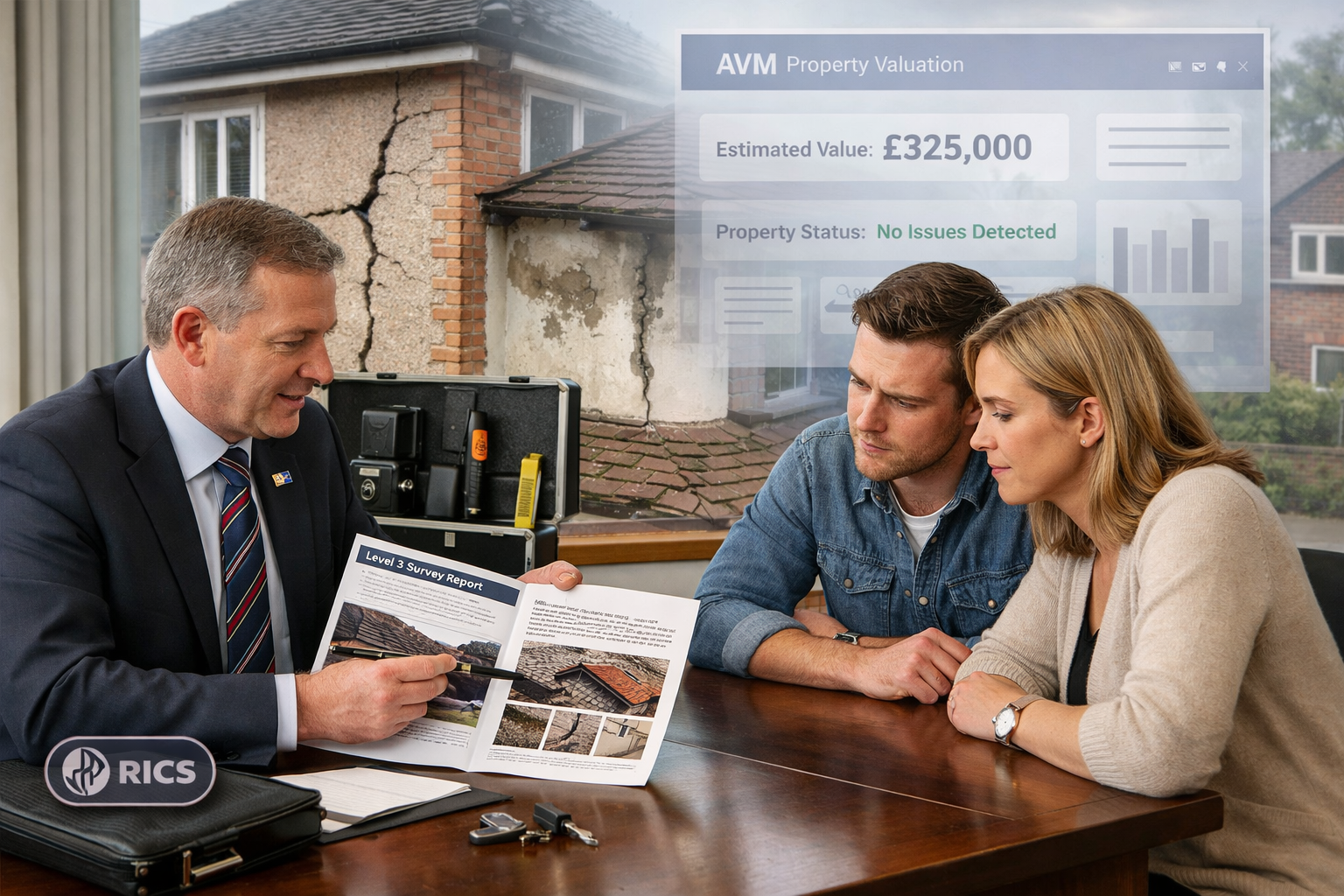
Defending Level 3 building surveys against automated valuation models requires surveyors to articulate their value proposition with precision and evidence. Here are the most effective arguments:
Argument 1: The Hidden Defect Premium 🏚️
Data point: Research indicates that 73% of properties over 50 years old have at least one significant structural or maintenance issue not visible in standard property listings or accessible to AVM databases.
Your message: "While AVMs estimate value based on comparable sales, they cannot account for the £50,000 in subsidence repairs your specific property requires. Our Level 3 survey identifies these hidden costs before you commit to purchase."
For properties showing signs of structural issues, a subsidence survey provides detailed analysis that no automated system can replicate.
Argument 2: The Confidence Score Transparency Gap 📊
Data point: Properties with AVM confidence scores below 60 are considered unreliable, yet most lenders don't clearly communicate this threshold to borrowers[3].
Your message: "Your AVM valuation has a confidence score of 58, meaning the algorithm itself considers this estimate unreliable. Our professional survey provides the certainty you need for a £600,000 investment."
Argument 3: The Market Timing Advantage ⏱️
Data point: The March 2026 RICS survey showing -15% house price net balances demonstrates rapid market shifts[2].
Your message: "AVMs rely on historical sales data that's 3-6 months old. In today's rapidly changing market, our real-time professional assessment reflects current buyer sentiment and emerging pricing trends."
Argument 4: The Insurance and Mortgage Protection 🛡️
Data point: Lenders increasingly require professional valuations for properties flagged with low AVM confidence scores or unusual characteristics.
Your message: "Without a professional survey, you risk mortgage application delays or rejections. Our Level 3 assessment satisfies lender requirements and protects your purchase timeline."
This becomes particularly relevant for specialized assessments like insurance reinstatement valuations where accurate property condition assessment is essential.
Argument 5: The Litigation Shield ⚖️
Data point: Post-purchase property disputes cost UK homeowners an estimated £180 million annually in legal fees and remediation costs.
Your message: "A comprehensive Level 3 survey provides legal protection. If significant defects emerge post-purchase, your survey report documents pre-existing conditions and supports potential claims against sellers or agents."
For complex disputes, surveyors can provide expert witness reports that carry legal weight in court proceedings.
Practical Implementation: Communicating Value to Clients
Creating Comparison Frameworks
Develop clear visual comparisons showing:
| Assessment Type | Cost | Timeframe | Physical Inspection | Defect Detection | Legal Weight | Market Timing |
|---|---|---|---|---|---|---|
| AVM | £0-£50 | Instant | ❌ No | ❌ No | ⚠️ Limited | ❌ Historical data |
| Basic Valuation | £250-£400 | 3-5 days | ✅ Yes | ⚠️ Limited | ✅ Yes | ✅ Current |
| Level 3 Survey | £800-£1,500 | 5-10 days | ✅ Comprehensive | ✅ Extensive | ✅✅ Strong | ✅✅ Real-time |
Leveraging Technology Without Surrendering Value
Progressive surveyors are incorporating technology to enhance rather than replace professional judgment:
- Drone roof surveys for safer, more comprehensive roof assessments (drone roof survey services)
- Thermal imaging to detect hidden insulation defects and moisture issues
- 3D property modeling for detailed spatial analysis
- Digital reporting platforms for faster client communication
This hybrid approach demonstrates that professional surveyors embrace innovation while maintaining the irreplaceable value of hands-on expertise.
Regional Market Expertise
Emphasize local knowledge that algorithms cannot replicate. Surveyors working across Surrey, Hampshire, and West London develop specialized understanding of:
- Local building styles and common defects (Victorian terraces vs. 1930s semi-detached properties)
- Area-specific issues (flood risk zones, historical mining subsidence areas)
- Neighborhood market dynamics not captured in broad AVM datasets
- Local authority planning considerations affecting property value
Building Client Education Programs
Proactive surveyors are developing educational content that positions them as trusted advisors:
- Market update newsletters incorporating RICS data and local trends
- Video explainers demonstrating what Level 3 surveys reveal
- Case study libraries showing real examples of AVM failures
- Cost-benefit calculators demonstrating survey ROI
The Future: Coexistence Rather Than Replacement
The trajectory of property valuation isn't a simple story of algorithms replacing professionals. Instead, 2026 evidence suggests an emerging tiered ecosystem:
Tier 1 – AVM Appropriate: Standard properties in data-rich markets with high confidence scores, low transaction values, and minimal complexity.
Tier 2 – Hybrid Approach: Properties requiring AVM screening followed by professional validation for mortgage approval or transaction completion.
Tier 3 – Professional Essential: Complex properties, cautious markets, high-value transactions, or properties with unique characteristics requiring comprehensive Level 3 surveys.
Understanding and communicating this tiered framework helps clients make informed decisions while positioning surveyors appropriately within the valuation ecosystem.
Specialized Survey Services Remain Algorithm-Proof
Certain surveying services remain inherently resistant to automation:
- Specific defect reports addressing targeted structural concerns
- Schedule of dilapidations for commercial lease obligations
- Snagging reports for new-build quality assessment
- Red Book valuations meeting RICS professional standards
These specialized services represent growth opportunities as basic valuations face increasing AVM competition.
Conclusion
Defending Level 3 building surveys against automated valuation models in 2026's cautious markets isn't about resisting technological progress—it's about articulating irreplaceable professional value with data-driven precision. The March 2026 RICS data showing -15% house price net balances[2] demonstrates exactly when human expertise becomes most valuable: during market uncertainty when algorithms struggle and buyers need confidence.
The evidence is clear: AVMs achieve acceptable accuracy only under optimal conditions—stable markets, abundant comparable data, and standard properties. When these conditions deteriorate, error rates expand dramatically, potentially costing buyers tens of thousands of pounds in undetected defects or overvaluation.
Professional surveyors must embrace this reality by:
✅ Communicating AVM limitations clearly using confidence score thresholds and real-world case studies
✅ Demonstrating tangible value through defect detection, legal protection, and market timing advantages
✅ Leveraging technology to enhance rather than replace professional judgment
✅ Specializing in complex assessments that remain algorithm-resistant
✅ Building educational programs that position surveyors as trusted advisors
The future of property valuation isn't binary—it's a spectrum where automated tools handle straightforward assessments while professional surveyors provide irreplaceable expertise for complex, high-value, or uncertain scenarios. By defending Level 3 building surveys with evidence-based arguments, chartered surveyors secure their essential role in protecting property buyers and maintaining transaction integrity throughout market cycles.
Take Action Now
For property professionals seeking to strengthen their market position:
- Audit your current messaging to ensure it addresses AVM limitations with specific data points
- Develop comparison frameworks that clearly articulate professional survey value
- Invest in complementary technology like drone surveys and thermal imaging
- Build case study libraries documenting real examples of AVM failures
- Establish educational content programs positioning you as the trusted local expert
The surveyors who thrive in 2026 and beyond will be those who confidently articulate their value proposition with evidence, embrace appropriate technology, and focus on the complex assessments where human expertise remains irreplaceable.
References
[1] Pwc Avm Benchmarking Survey 2026 – https://www.pwc.co.uk/industries/financial-services/understanding-regulatory-developments/pwc-avm-benchmarking-survey-2026.html
[2] Navigating Uncertainty In Spring 2026 Valuations How Rics Real Time Surveyor Data Outperforms Automated Valuation Models – https://nottinghillsurveyors.com/blog/navigating-uncertainty-in-spring-2026-valuations-how-rics-real-time-surveyor-data-outperforms-automated-valuation-models
[3] Automated Valuation Models In How Avms Work Their Limits And What They Mean For Your Mortgage – https://www.amerisave.com/glossary/automated-valuation-models-in-how-avms-work-their-limits-and-what-they-mean-for-your-mortgage
[4] Quality Control Standards For Automated Valuation Models – https://www.federalregister.gov/documents/2024/08/07/2024-16197/quality-control-standards-for-automated-valuation-models
[5] Proposed Housing Bill Recent Executive Orders Coul 97061 – https://www.doddfrankupdate.com/dfu/articlesdfu/proposed-housing-bill-recent-executive-orders-coul-97061.aspx