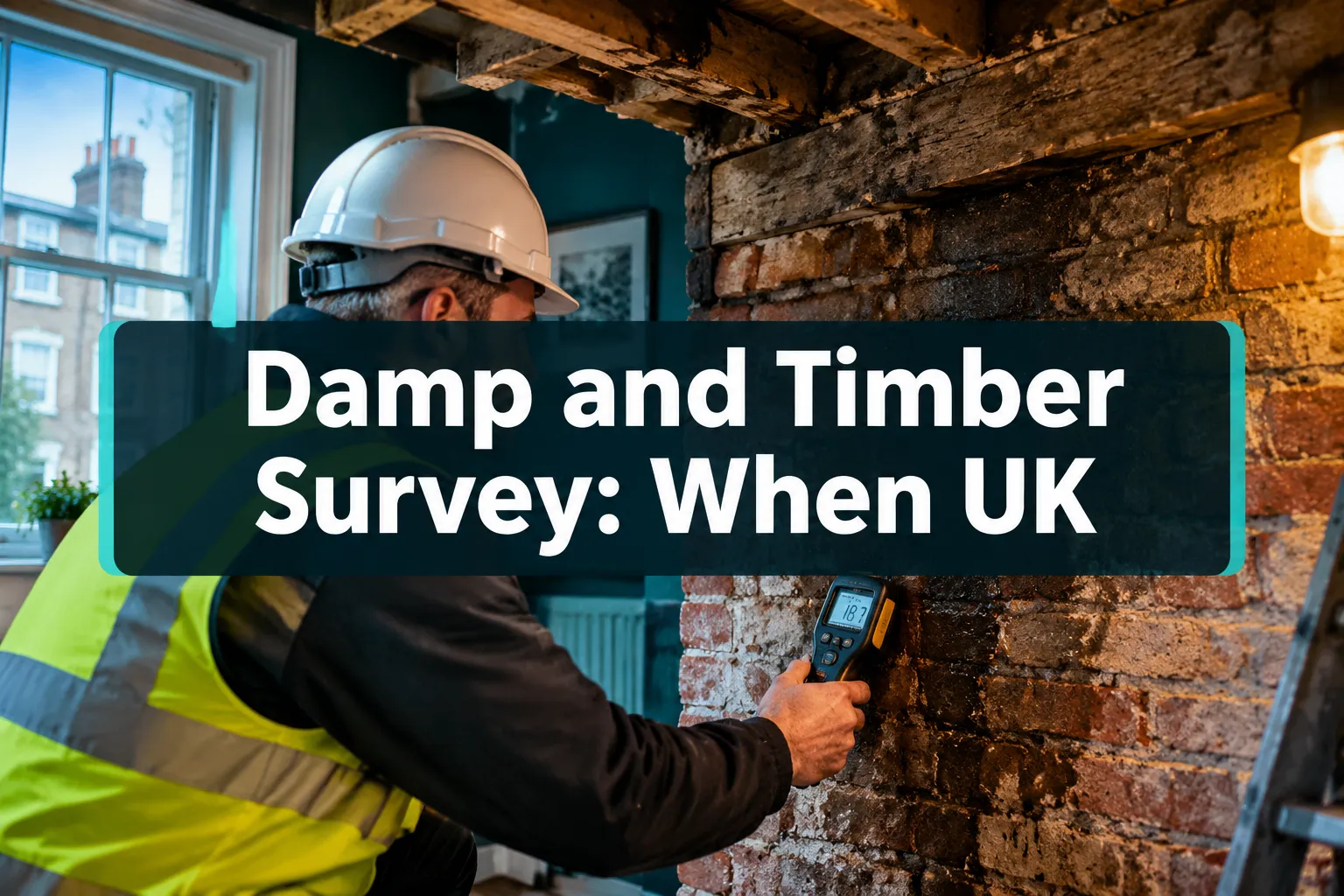
Nearly one in five UK homebuyers who commission a standard survey are subsequently advised to arrange further specialist investigations before proceeding, and damp-related defects are among the most common triggers. Yet many buyers still exchange contracts without understanding what a dedicated damp and timber survey actually covers, why the two assessments are routinely combined, or what the legal and financial consequences of skipping them can be. This article explains the technical relationship between moisture and timber decay, the limitations of standard surveys, the regulatory context shaping practice in 2026, and the precise point in the conveyancing process when a combined damp and timber survey: when UK homebuyers need both assessments before exchanging contracts becomes not just advisable but essential.
Key Takeaways
- A standard RICS Level 2 HomeBuyer Report is a visual inspection only; it flags potential damp risk but does not diagnose its cause or assess timber damage in detail.
- Damp and timber surveys are closely linked because sustained moisture is the primary catalyst for wet rot, dry rot, and wood-boring insect infestations in structural timber.
- The legally binding commitment in England and Wales crystallises at exchange of contracts, so all specialist investigations must be completed beforehand to preserve negotiating leverage.
- A combined pre-purchase damp and timber survey typically costs between £350 and £450, a modest sum compared with remediation bills that can run into tens of thousands of pounds.
- Lenders, solicitors, and surveyors increasingly require specialist damp and timber reports for older or higher-risk properties before mortgage funds are released.
Why Damp and Timber Defects Cannot Be Assessed in Isolation
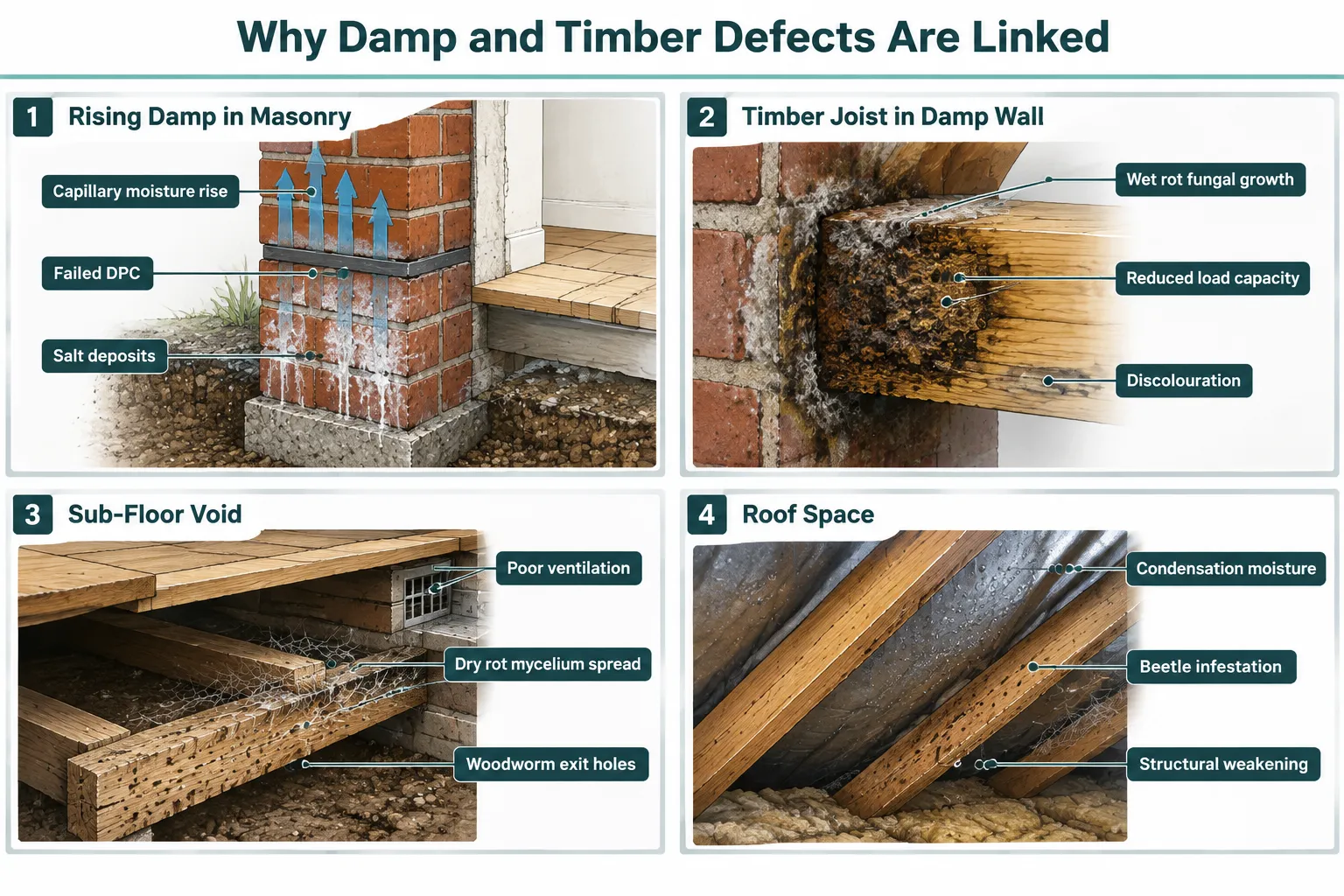
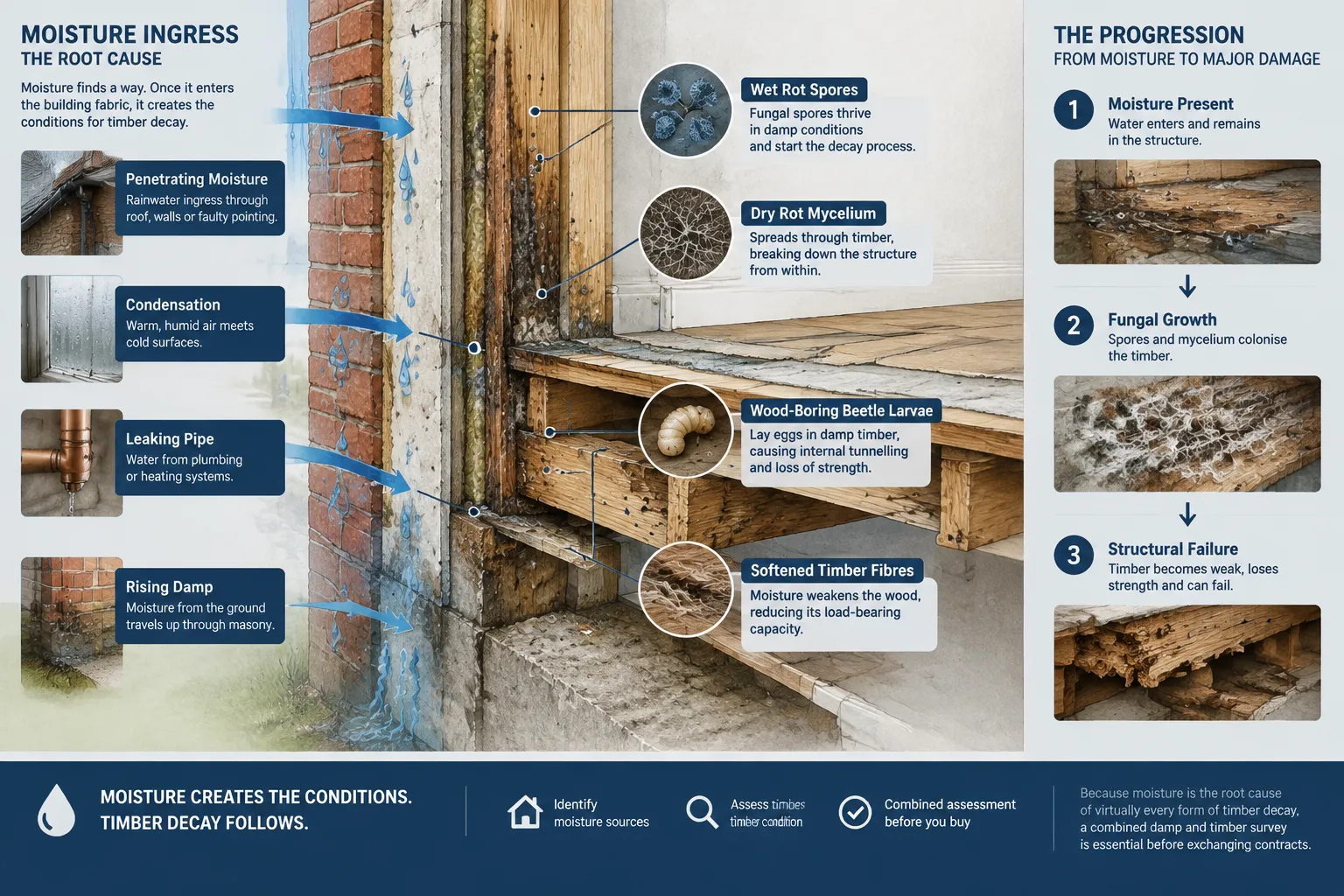
The technical reason that damp and timber surveys are almost always performed together is straightforward: moisture is the root cause of virtually every form of timber decay found in UK residential buildings [3]. Understanding this relationship is the foundation for understanding why a combined assessment is the most reliable form of pre-purchase due diligence.
The Moisture-Decay Chain
When water penetrates a building's fabric, whether through rising damp, penetrating damp, or condensation, it raises the moisture content of nearby structural timber above the critical threshold of approximately 20%. At that point, the conditions for fungal colonisation are met.
Wet rot (most commonly Coniophora puteana) develops in timber that is repeatedly wetted and dried. It causes localised softening, darkening, and longitudinal cracking. While wet rot does not spread beyond the damp zone, it can severely compromise the structural capacity of floor joists, window frames, and roof timbers in the affected area.
Dry rot (Serpula lacrymans) is considerably more serious. Despite its name, it requires an initial moisture source to establish, but once active it can transport water through its mycelium strands and spread across dry masonry into adjacent structural elements. A single damp wall can, over time, allow dry rot to colonise floor plates, ceiling joists, and even partition walls in rooms that appear perfectly dry [5]. The remediation costs for established dry rot are substantial: affected timber must be cut back well beyond the visible growth, masonry must be sterilised, and all replacement materials must be treated.
Wood-boring insects, principally the common furniture beetle (Anobium punctatum), the deathwatch beetle (Xestobium rufovillosum), and the house longhorn beetle (Hylotrupes bajulus), are strongly associated with damp or previously damp timber. Their larvae thrive in softened wood, and exit holes are often the only visible sign of an infestation that may have been active for years [9].
Because all three forms of timber damage share moisture as a precondition, a damp survey that identifies the moisture source and a timber survey that assesses the resulting structural impact are, in practice, two halves of the same investigation [3]. Commissioning one without the other leaves a critical gap in the buyer's knowledge.
What Standard Surveys Miss, and Why Specialist Reports Fill the Gap
The RICS Level 2 HomeBuyer Report and the Level 3 Building Survey are visual inspections. Surveyors conducting these assessments do not lift carpets or floorboards, do not open up concealed voids, and are not expected to perform invasive moisture testing unless separately instructed [4]. Where dampness or timber defects are suspected, standard practice is to note the risk and recommend further specialist investigation, which is precisely the trigger for a dedicated combined assessment.
For a detailed overview of what a Level 3 assessment covers, see the Level 3 Survey: What Does It Cover guide.
The Limitations of Meter Readings Alone
A basic damp survey using only a pin-type or capacitance moisture meter can produce misleading results. High readings may reflect salt contamination rather than active moisture, while low readings taken at the surface may miss elevated moisture levels deeper in the wall or beneath floor coverings. The Joint Position Statement on moisture in traditional buildings, produced jointly by RICS, the Property Care Association, and Historic England, sets out a staged investigation protocol: non-invasive assessment first, followed by targeted invasive investigation where the evidence warrants it [14]. This approach, increasingly referred to as JPS22-compliant inspection, is now the benchmark for credible moisture diagnosis in older properties.
What a Specialist Combined Survey Actually Covers
A thorough pre-purchase damp and timber survey typically includes:
- Full moisture profiling of walls, floors, and ceilings using calibrated instruments
- Sub-floor void inspection where access is available, checking for inadequate ventilation, standing water, and timber condition
- Roof space inspection examining rafters, purlins, and wall plates for rot and insect damage
- Assessment of existing damp-proofing and timber treatments, including the validity of any guarantees
- Identification of penetrating damp sources including defective pointing, failed flashings, and blocked gutters
- Diagnosis of rising damp where present, distinguishing true rising damp from condensation or lateral moisture transfer
- Written repair schedule with indicative remediation costs [12][5]
This level of detail is simply not available from a standard visual survey, and it is precisely the information buyers need to make an informed decision before exchange.
For a broader understanding of survey costs before instructing any specialist, the Complete Guide to Damp Survey Cost provides a useful benchmark.
The Legal Case for Acting Before Exchange of Contracts
In England and Wales, the legal commitment to purchase crystallises at exchange of contracts. Before that point, either party can withdraw without penalty (subject to any lock-in agreements). After exchange, the buyer is legally bound to complete the purchase regardless of any defects subsequently discovered [11].
"A buyer who discovered penetrating and rising damp, wet and dry rot, and timber decay after exchange of contracts was unable to back out of the purchase.", conveyancing case highlighted by solicitors [11]
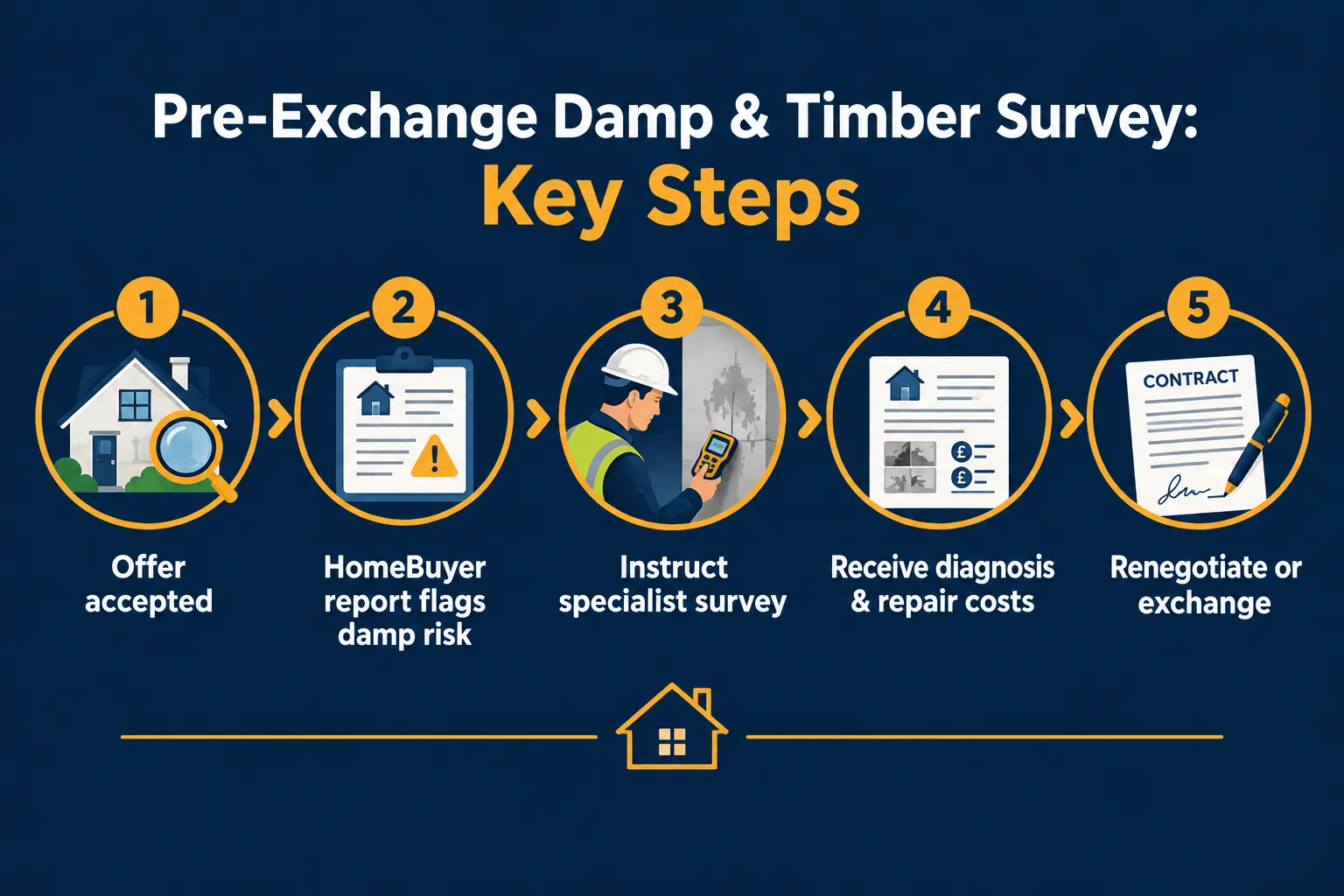
This is not an edge case. It is the standard legal position, and it is the reason that the timing of a damp and timber survey: when UK homebuyers need both assessments before exchanging contracts is so critical. The recommended window is after an offer is accepted but before exchange, when the buyer retains full negotiating leverage and the option to withdraw [7].
Practical Negotiating Power
A specialist report does more than protect buyers from a bad purchase. It provides written, costed evidence that is difficult for sellers to dismiss. When a surveyor diagnoses active dry rot in the sub-floor void and provides a remediation estimate, the buyer can:
- Request that the seller carries out the works before completion
- Negotiate a reduction in the agreed purchase price
- Withdraw from the purchase if the defects are too severe
Without a specialist report, the buyer's only leverage is the general concern flagged in a HomeBuyer report, which sellers can, and routinely do, minimise [1][7].
Lender and Solicitor Requirements
The requirement for specialist reports is increasingly being driven not just by buyer caution but by lender and solicitor requirements. Mortgage underwriters for older properties, particularly Victorian and Edwardian terraces, pre-war semis, and period flats, regularly require a specialist damp and timber report before releasing funds [8][9]. Solicitors acting for buyers may also recommend or require such reports when a HomeBuyer report or valuation notes possible damp, woodworm, or rot [8].
Pre-purchase damp and timber surveys are specifically designed to satisfy these requirements, providing clear diagnoses and repair recommendations in a format that mortgage underwriters and legal advisers can act on [8][5].
The Regulatory Context Driving More Thorough Assessments in 2026
The regulatory environment around damp and moisture in UK housing has tightened considerably. From 23 June 2026, the Housing Health and Safety Rating System (HHSRS) in England was simplified from 29 hazards to 21, with damp and mould retained and reframed as a key health hazard [2]. This change has practical implications for buyers with any intention of letting the property, since local authority enforcement action can now be triggered more readily where damp and mould are identified.
Combined with high-profile health cases linking damp and mould to respiratory illness, this regulatory focus is driving more thorough moisture and timber assessments, not just for landlords, but for any buyer who wants a clear picture of the property's condition and future liability [2][15].
For buyers considering properties in London and the surrounding area, Chartered Surveyors London can advise on the appropriate level of investigation for specific property types and ages.
Older Housing Stock and Regional Risk
The need for combined assessments is particularly acute in:
| Property Type | Primary Risk Factors |
|---|---|
| Victorian and Edwardian terraces | Failed DPCs, solid wall construction, original timber floors |
| Pre-war semi-detached | Cavity wall bridging, aging roof timbers, sub-floor voids |
| Converted period flats | Shared drainage, condensation, basement damp |
| Coastal and rural properties | Driving rain penetration, high ambient humidity |
| Properties with previous damp-proofing | Questionable guarantees, reoccurrence risk |
Properties in areas with older housing stock, including much of inner and outer London, the Home Counties, and coastal towns, carry a statistically higher risk of damp-related timber damage, making the combined assessment particularly valuable [3][5].
Buyers in specific locations can find local expertise through resources such as Chartered Surveyors Richmond, Chartered Surveyors Berkshire, and Chartered Surveyors Hampshire.
Understanding the Cost and Value of Combined Assessments
A comprehensive pre-purchase damp survey starts from around £234 including VAT in parts of the South East, while combined pre-purchase damp and timber surveys more commonly range from £350 to £450 depending on property size [6][13]. These figures should be set against the cost of the defects they identify.
Wet rot remediation for a single floor void can cost £1,500 to £4,000. Dry rot treatment in a Victorian terrace, involving removal of affected timber, masonry sterilisation, and structural reinstatement, routinely runs to £10,000 or more, and can exceed £30,000 in severe cases. Wood-boring insect treatment across a roof space typically costs £800 to £2,500 [1][5].
The arithmetic is clear: a combined survey costing £400 that identifies £15,000 of concealed rot either saves the buyer that sum through renegotiation or prevents them from unknowingly purchasing a property with a serious structural liability [1][6].
For a broader understanding of how building survey costs compare, the How Much Does a Building Survey Cost? guide provides current UK pricing across survey levels.
How to Instruct a Damp and Timber Survey Before Exchange
Buyers who have received a HomeBuyer report or building survey flagging damp or timber concerns should act promptly. The process is straightforward:
- Identify a qualified specialist, look for membership of the Property Care Association (PCA) or a surveyor with demonstrable building pathology experience. RICS guidance recommends requesting JPS22-compliant inspections for traditional buildings [14][15].
- Instruct the survey promptly, specialist firms can typically attend within one to two weeks, and reports are usually delivered within a few days of inspection.
- Share the report with solicitors and lender, if the report identifies significant defects, the solicitor can advise on the appropriate legal mechanism for renegotiation or withdrawal.
- Obtain remediation quotes, use the survey's repair schedule to obtain at least two independent contractor quotes before agreeing any price reduction with the seller.
- Review guarantees carefully, any existing damp-proofing or timber treatment guarantees should be checked for transferability and the credibility of the issuing company [12][5].
For buyers who are uncertain about who is responsible for arranging surveys during a purchase, Who Organises the Survey When Buying a House? provides a clear explanation of roles and responsibilities.
Conclusion
The case for a combined damp and timber survey before exchanging contracts rests on three pillars: technical necessity, legal timing, and financial prudence. Damp and timber defects are causally linked, moisture creates the conditions for rot and infestation, and assessing one without the other leaves a buyer with an incomplete picture of structural risk. Standard RICS surveys are visual inspections that identify risk but do not diagnose it; specialist combined assessments fill that gap with evidence-based, costed findings. And in England and Wales, the window for acting on those findings closes permanently at exchange of contracts.
Actionable next steps for buyers in 2026:
- If a HomeBuyer report or building survey flags any damp, rot, or timber concern, instruct a specialist combined assessment immediately, do not wait until after exchange.
- Choose a surveyor or specialist firm with PCA membership or demonstrable building pathology experience, and request a JPS22-compliant inspection for any pre-1919 property.
- Use the written report as a negotiating tool: a costed repair schedule gives buyers concrete grounds to seek a price reduction or require works before completion.
- Factor survey costs into the overall purchase budget, the £350 to £450 investment is one of the lowest-risk expenditures in the entire buying process.
- For properties in London and the South East, consult local chartered surveyors familiar with the specific construction types and moisture risks in the area.
The damp and timber survey: when UK homebuyers need both assessments before exchanging contracts is not a precaution for cautious buyers alone, it is standard due diligence for anyone purchasing a property with any history of moisture risk, any period construction, or any lender requirement for specialist investigation.
References
[1] Damp And Timber Reports – surveymerchant.com
[2] Blog – survey-mate.co.uk
[3] Timber Survey For House Purchase In Dover The 2026 Homebuyers Guide – smartpropertycare.co.uk
[4] Rics%20structural%20survey%20practice 0 – bathnes.gov.uk
[5] dampserve – dampserve.com
[6] Pre Purchase Damp Survey – timberanddamp.co.uk
[7] Buying Or Selling A Home Dont Overlook The Damp Survey – speedwaymedia.com
[8] Pre Purchase Mortgage Report – dampserve.com
[9] House Survey – rentokil.co.uk
[10] Sample Rics Homebuyers Report Level 2 – coseyhomes.co.uk