Fewer than one in three homeowners planning a rear extension, loft conversion, or basement dig correctly estimate how long the Party Wall Act process will take, and that miscalculation routinely pushes construction start dates back by weeks or even months. Understanding the Party Wall Act timeline: from notice to award and final inspection in typical UK projects is not just useful background knowledge; it is the difference between a project that runs smoothly and one that stalls before a single brick is moved.
This guide maps every stage of the statutory process in plain language, with realistic timescales for three common project types, and highlights the most frequent causes of delay.
Key Takeaways
- The Party Wall Act 1996 requires formal notice to be served before most notifiable works begin, with statutory minimum notice periods of one or two months depending on the work type.
- Neighbours have 14 days to respond to a notice; failure to respond triggers a deemed dissent, which starts the surveyor appointment process.
- A Party Wall Award is typically prepared within two to eight weeks of surveyor appointment, though complex projects can take longer.
- The full process from serving the first notice to receiving the award generally takes six to ten weeks on straightforward projects.
- A schedule of condition and a final inspection are integral parts of the process and protect both the building owner and the adjoining owner.
Understanding the Statutory Framework Before the Clock Starts
Before mapping timescales, it helps to understand what the Party Wall etc. Act 1996 actually requires. The Act applies in England and Wales and governs three categories of work: work on or to an existing party wall or party structure, new building at or astride the boundary line, and excavations within three or six metres of a neighbouring building [2]. If any of those triggers apply, the building owner must serve formal written notice before work begins.
To understand whether the Act applies to a specific project, the starting point is clarifying whether a party wall agreement is needed and which sections of the Act are engaged. The legal requirements for party walls are non-negotiable: serving notice is not optional, and starting notifiable works without one can expose a building owner to injunctions and damages claims.
Two notice periods apply under the Act:
| Work Type | Statutory Notice Period |
|---|---|
| Party structure works (Section 2) | Two calendar months |
| New building on or at the boundary (Section 1) | One calendar month |
| Excavation within 3 or 6 metres (Section 6) | One calendar month |
These periods are minimums. In practice, factoring in surveyor appointment, award preparation, and scheduling, the total lead time before tools can go in the ground is typically three to four months from the decision to proceed.
"The notice period clock starts only when the notice is properly served, not when it is drafted or posted." [3]
Government guidance updated in August 2026 confirmed that electronic service of party wall notices is now widely accepted where the adjoining owner has agreed to receive documents electronically, streamlining the process slightly for cooperative neighbours [1].
Stage-by-Stage Party Wall Act Timeline: From Notice to Award and Final Inspection
The following breakdown treats each stage as a distinct phase with its own realistic duration. These figures are drawn from current practice guidance and align with the statutory provisions of the Act [2][7].
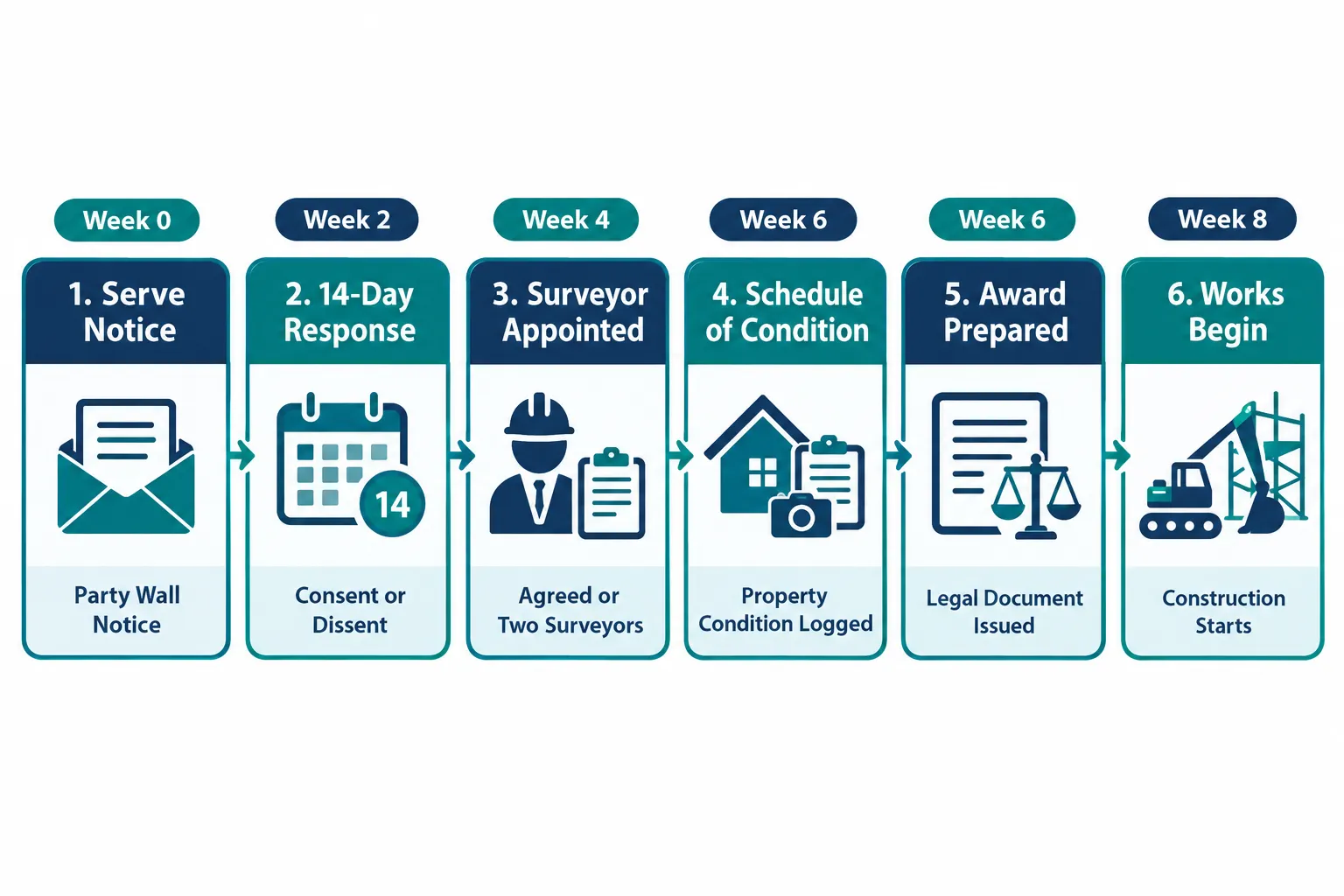
Stage 1, Serving the Notice (Day 0)
The building owner (or their surveyor acting on their behalf) serves written notice on every adjoining owner. The notice must state the nature of the proposed works, the address of the building, and the planned start date. For Section 2 party structure works, this triggers a two-month countdown. For Section 1 and Section 6 works, the countdown is one month.
Common delays at this stage:
- Incorrect identification of adjoining owners (tenants versus freeholders)
- Missing details on the notice form invalidating service
- Serving notice too close to the intended start date
Stage 2, The Response Window (Days 1 to 14)
Once notice is served, the adjoining owner has 14 days to respond in writing [3]. Three outcomes are possible:
- Consent, The adjoining owner agrees to the works. No award is required, though a schedule of condition is still strongly advisable.
- Dissent and appointment of a surveyor, The adjoining owner disagrees or raises concerns, triggering the formal award process.
- No response, Silence after 14 days is treated as a deemed dissent under Section 5 of the Act, which also triggers the award process [2].
A deemed dissent is one of the most common causes of timeline extension. Neighbours who are simply on holiday or slow to open post can inadvertently push a project into the formal award route without any genuine objection.
Stage 3, Surveyor Appointment (Days 14 to 21)
Once dissent is recorded, the building owner must formally invite the adjoining owner to appoint a surveyor within ten days. Both parties may agree to use a single party wall agreed surveyor, which is generally faster and cheaper. If they cannot agree, each appoints their own surveyor, who together select a third surveyor in case of deadlock [6].
Surveyor appointment typically adds three to seven days to the timeline in cooperative cases. In contentious situations, where an adjoining owner delays appointing their surveyor, the building owner's surveyor can make the appointment on their behalf after ten days, a statutory safeguard that prevents indefinite stalling.
Stage 4, Schedule of Condition (Weeks 2 to 4)
Before the award is finalised, surveyors typically prepare a party wall schedule of condition. This is a detailed photographic and written record of the adjoining property's current state, cracks, settlement, existing damage, finishes, taken before any works begin.
The schedule protects both parties. If damage is later alleged, the schedule provides an objective baseline. Without it, disputes about pre-existing versus construction-caused damage become extremely difficult to resolve. A thorough schedule can take several days to prepare and agree, particularly for properties with complex layouts or where access is restricted.
Stage 5, Award Preparation and Service (Weeks 3 to 8)
The Party Wall Award is the central legal document of the process. It sets out what works are permitted, how and when they may be carried out, hours of working, protective measures, insurance requirements, and the rights of surveyors to access the site [5]. For details on what a completed award covers in London and Surrey, the party wall award guidance for London and Surrey provides a useful practical reference.
Award preparation timescales vary considerably:
- Fast-track (well-prepared projects): As little as one week where both surveyors are experienced, the works are straightforward, and all documentation is in order [4].
- Typical residential project: Two to four weeks.
- Complex or contentious cases: Six to eight weeks or longer, particularly where the adjoining owner raises objections or requests additional protective measures.
Once the award is served on both parties, a 14-day appeal window opens. Either party may appeal to the County Court within that period [2]. In practice, appeals are rare, but the possibility adds a further two weeks of potential delay to the timeline.
The award remains valid for 12 months. Works must commence within that window, or the award lapses and the process must begin again [3].
Realistic Timelines for Three Common UK Project Types
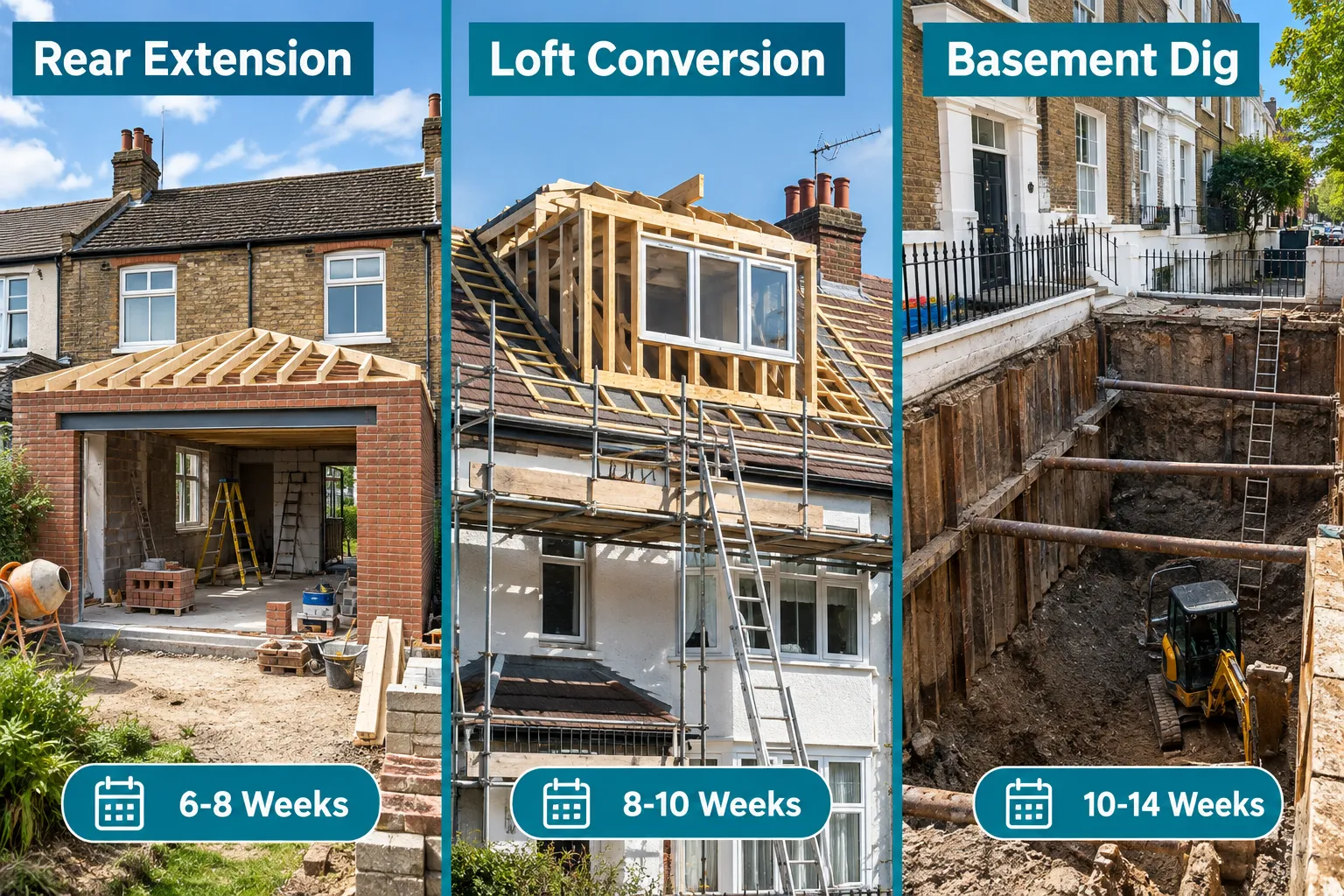
The following examples illustrate how the Party Wall Act timeline: from notice to award and final inspection plays out differently depending on project complexity.
Rear Extension (Single Storey)
A standard single-storey rear extension on a mid-terrace house typically engages Section 2 (party wall works) and sometimes Section 6 (excavation near the neighbour's foundations).
Typical timeline:
| Phase | Duration |
|---|---|
| Notice served (Section 2) | Day 0 |
| Statutory notice period | 2 months |
| Neighbour response | 14 days (within notice period) |
| Surveyor appointment | 1 week |
| Schedule of condition | 1 week |
| Award preparation | 2 to 3 weeks |
| Total before works begin | Approximately 10 to 12 weeks |
If the neighbour consents promptly and both parties use an agreed surveyor, this can compress to around six to eight weeks. The party wall process for loft conversions follows a broadly similar pattern, though roof-level works add specific technical considerations.
Loft Conversion
Loft conversions on semi-detached or terraced properties typically engage Section 2 where steel beams are to be inserted into or alongside the party wall, or where the roof structure is shared.
Typical timeline: 8 to 10 weeks from first notice to award, assuming a cooperative neighbour. Where the loft involves a shared chimney stack, additional complexity arises, the party wall shared chimneys considerations can add surveyor negotiation time of one to two weeks.
Basement Dig
Basement excavations are the most time-intensive projects under the Act. They almost always engage Section 6 (excavation within three metres of an adjoining structure) and frequently Section 2 as well. The structural risks are higher, surveyors require more detailed engineering information, and adjoining owners are more likely to instruct their own independent surveyor rather than agree to a single agreed surveyor.
Typical timeline: 10 to 14 weeks from first notice to award. Structural engineer input, additional monitoring requirements, and detailed protective works schedules all extend award preparation time. In contentious basement cases, timelines of four to six months are not unusual [7].
Common Causes of Delay in the Party Wall Act Process
Even well-planned projects encounter delays. The most frequent causes are:
- Inadequate notice, Notices that omit required information or are served on the wrong person must be reissued, restarting the statutory clock.
- Neighbour non-engagement, While deemed dissent prevents indefinite blocking, an uncooperative neighbour who repeatedly fails to engage slows surveyor communication and award drafting.
- Delayed surveyor appointment, An adjoining owner who takes the full ten days to appoint their surveyor, then requests additional time, can add two to three weeks.
- Disputed schedule of condition, Where an adjoining owner disputes the accuracy of the schedule, revisions and re-inspection add time.
- Late engineering information, Awards cannot be finalised without adequate structural drawings. Delays from the building owner's architect or engineer are a common bottleneck.
- Appeals, Although rare, a County Court appeal against the award adds a minimum of several weeks and potentially months to the process [2].
Understanding party wall disputes and how they are resolved is valuable for any building owner who anticipates resistance from a neighbour.
The Final Inspection: Closing the Party Wall Act Process
The Party Wall Act timeline does not end when works begin. The final inspection is the closing stage of the process and is often overlooked in planning.
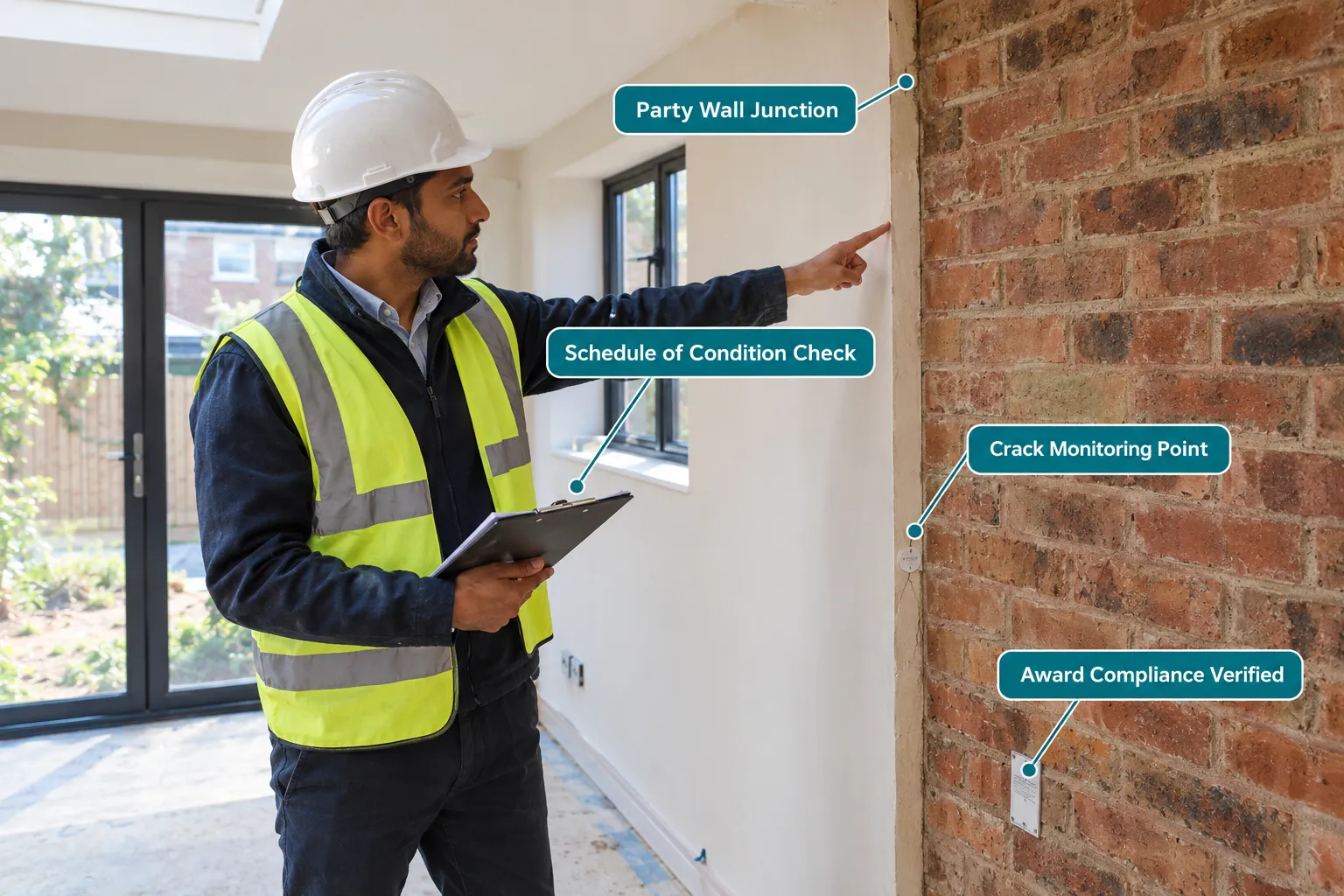
Once construction is complete, the party wall surveyor, or surveyors, returns to the adjoining property to compare its current condition against the pre-works schedule of condition. This inspection serves several purposes:
- Identifying any new cracks, settlement, or damage that was not present before works began
- Confirming that protective measures specified in the award were followed
- Providing a basis for any compensation claim if damage has occurred
If damage is found, the Act provides a clear mechanism for resolution. The damage to property in party wall situations process allows the adjoining owner to seek remedy without resorting to litigation, provided the damage is documented and linked to the notifiable works.
Final inspection timing depends on the nature of the works. For a rear extension, a single post-completion inspection is typical. For a basement dig, interim inspections during construction may be specified in the award, with a final inspection once all structural works are complete and any temporary propping has been removed.
The final inspection formally closes the party wall surveyor's involvement, though the award itself continues to provide a legal record of the works for the lifetime of the property.
Conclusion
The Party Wall Act timeline: from notice to award and final inspection in typical UK projects is rarely as simple as a single document and a handshake. For a rear extension, allow ten to twelve weeks from serving notice to starting on site. For a loft conversion, eight to ten weeks is realistic. For a basement dig, plan for a minimum of twelve weeks and budget for longer if the project is complex or the neighbour is cautious.
Actionable next steps for building owners in 2026:
- Identify all notifiable works early, consult a qualified party wall surveyor before finalising construction drawings to confirm which sections of the Act apply.
- Serve notice as early as possible, the statutory notice period cannot be shortened, so early service is the single most effective way to protect your programme.
- Commission a schedule of condition before works begin, even where a neighbour consents, a documented baseline protects against future disputes.
- Use an agreed surveyor where possible, a single agreed surveyor is faster and less expensive than two separate appointments.
- Build contingency into your programme, even straightforward projects can encounter delays; a four-week contingency buffer is prudent.
The Act exists to protect both building owners and their neighbours. Working with it efficiently, rather than treating it as an obstacle, is the mark of a well-managed project.
References
[1] Preventing And Resolving Disputes In Relation To Party Walls – gov.uk
[2] Party Wall Etc. Act 1996 – legislation.gov.uk
[3] The Party Wall Etc Act 1996 Explanatory Booklet – gov.uk
[4] The Party Wall Surveyors 2025 Guide – simplesurvey.co.uk
[5] Party Wall Award – partywallsurveyorlondon.uk
[6] Party Wall Etc. Act 1996, Section 10 – legislation.gov.uk
[7] Party Wall Act How Long Does The Process Take – charrettelaw.co.uk