

Fewer than one in three commercial tenants commission a Schedule of Condition at lease commencement — a decision that routinely costs them tens of thousands of pounds at lease end. As commercial property activity continues to recover across the UK, the stakes attached to dilapidations disputes have risen sharply. Dilapidations Valuations in Commercial Leases: RICS Strategies for Building Surveyors in 2026 sits at the intersection of technical surveying practice, property law, and negotiation strategy, and getting any one of these elements wrong can expose landlords or tenants to significant financial loss.
This article breaks down the core protocols building surveyors must follow in 2026 — from Schedule of Condition best practice to quantum assessment and the expert witness tactics that determine outcomes in terminal schedule negotiations.
Key Takeaways
- A Schedule of Condition prepared at lease commencement remains the single most effective tool for limiting a tenant's dilapidations liability.
- The Section 18(1) cap on recoverable damages is determined by a diminution valuation, not simply the cost of remedial works.
- The RICS 7th edition professional standard (updated February 2024) sets the procedural framework all surveyors must follow. [1]
- Distinct surveyor roles — building surveyor and valuation surveyor — must be clearly defined to ensure accurate quantum assessment. [6]
- Green dilapidations principles are reshaping reinstatement obligations, with sustainability now a material factor in lease-end negotiations. [3]

Schedule of Condition Protocols: The Foundation of Every Dilapidations Claim
A Schedule of Condition is a detailed photographic and written record of a property's state at the point a lease is granted. Its purpose is straightforward: it limits a tenant's repairing obligations to restoring the property to no better condition than it was at the start of the term. Without one, a tenant may face liability for defects that pre-existed their occupation.
Despite this, many commercial leases are still executed without a properly prepared schedule. Building surveyors advising clients in 2026 should treat the absence of a Schedule of Condition as a material risk that must be flagged before heads of terms are agreed.
What a Robust Schedule Must Include
A professionally prepared schedule should contain:
- Dated, high-resolution photographs of every element of the building fabric — walls, ceilings, floors, roof, services, and external areas
- Written narrative descriptions cross-referenced to each photograph
- Clear identification of pre-existing defects, including cracking, damp, deterioration of finishes, and mechanical or electrical deficiencies
- Agreement and signature from both parties or their representatives, confirming the schedule is an accurate record
For properties with complex building fabric — such as older commercial units with exposed brickwork, flat roofs, or ageing M&E installations — a roof survey and structural assessment should be incorporated into the schedule preparation process to ensure pre-existing defects are fully documented.
Incorporating the Schedule into the Lease
The schedule must be formally annexed to the lease and referenced in the repairing covenants. A schedule that exists as a standalone document but is not contractually incorporated provides limited protection. Surveyors should confirm with the instructing solicitor that the lease wording explicitly qualifies the tenant's repairing obligations by reference to the schedule.
For a deeper understanding of what a well-structured schedule looks like in practice, the guide to Schedule of Condition reports provides a useful reference point for both landlord and tenant advisors.
Quantum Assessment and Diminution Valuations: The RICS Framework in 2026
The financial heart of any dilapidations dispute is quantum — how much is the landlord actually entitled to recover? This question is governed by Section 18(1) of the Landlord and Tenant Act 1927, which imposes two critical limitations on recoverable damages:
- The cost of remedial works — damages cannot exceed the reasonable cost of putting the property into the condition required by the lease.
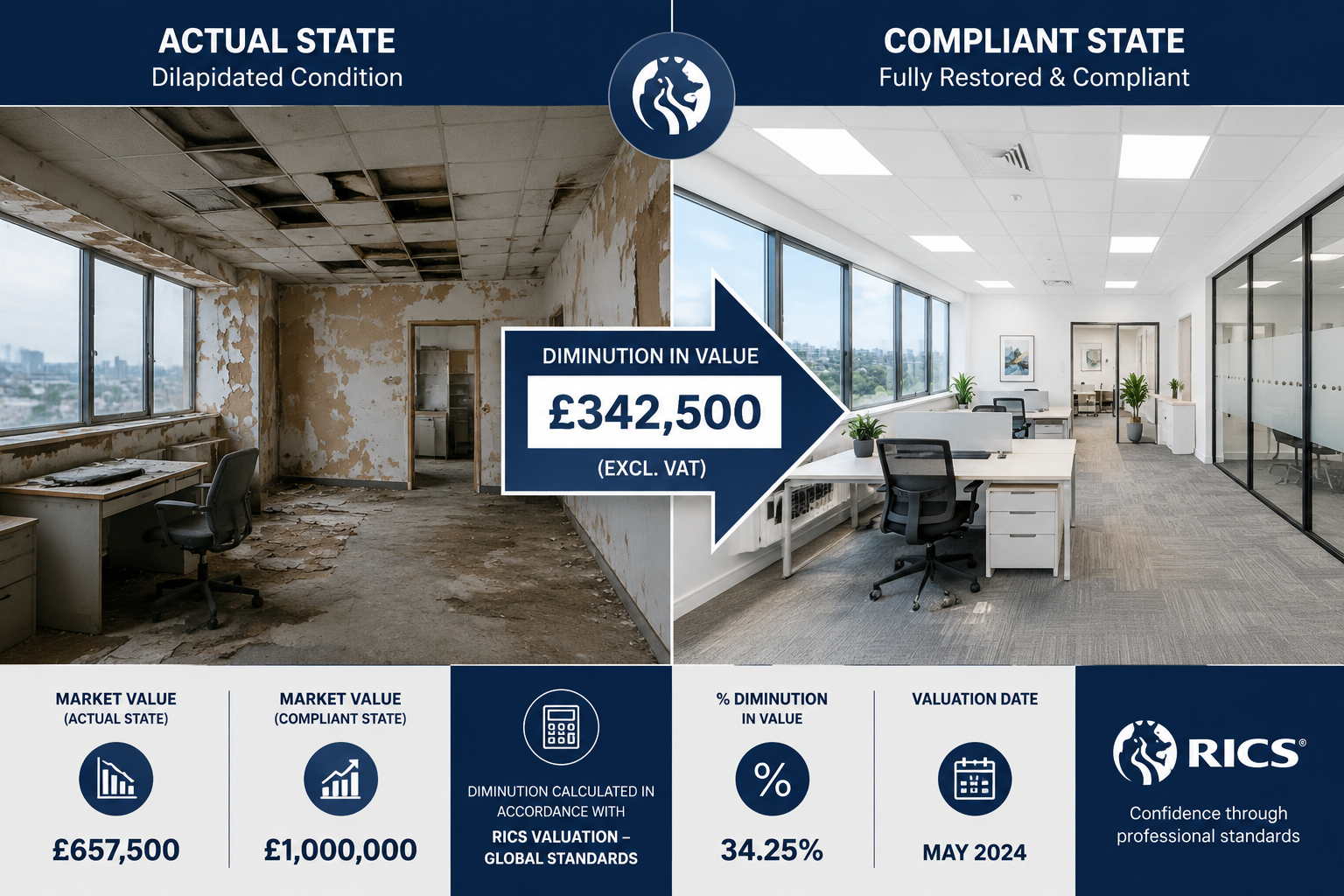
- The diminution cap — damages cannot exceed the reduction in the market value of the landlord's reversion caused by the tenant's breaches.
The second limb is where dilapidations valuations become decisive. The RICS professional standard emphasises that diminution valuations must be prepared by a valuation surveyor with genuine market knowledge, not simply derived from the schedule of works costs. [2]
The Dual Hypothetical Auction Method
The most technically rigorous approach to determining the Section 18(1) cap is the dual hypothetical auction method. This involves two separate valuations:
| Valuation | Description |
|---|---|
| Valuation A | The property in its actual dilapidated state at lease expiry |
| Valuation B | The property as if all tenant covenants had been fully complied with |
The difference between Valuation B and Valuation A represents the maximum recoverable damages under Section 18(1). [7]
This method requires the valuation surveyor to have a thorough understanding of the local occupier market. If comparable evidence shows that incoming tenants routinely strip out and refurbish commercial space regardless of its condition, the diminution figure may be significantly lower than the cost of remedial works — or even nil. [2]
"The diminution valuation is not a theoretical exercise. It requires real market evidence and a surveyor who understands how purchasers and tenants actually behave in that specific market at that specific time." [7]
Quantified Demands and Responses
Under the RICS professional standard and the Pre-Action Protocol for Claims for Damages in Relation to the Physical State of Commercial Property at Termination of a Tenancy (the Dilapidations Protocol), landlords must serve a Quantified Demand alongside or shortly after the Schedule of Dilapidations. [1] This document sets out:
- Each alleged breach
- The proposed remedial works
- The estimated cost of those works
- Any VAT implications
- Any claim for loss of rent or other consequential losses
Tenants' surveyors must then prepare a formal Response, addressing each item in the Quantified Demand and setting out any areas of agreement or dispute. The RICS standard requires both parties to act in a proportionate and professional manner throughout this process. [1]
Landlords who fail to commission a diminution valuation before issuing proceedings risk cost sanctions from the court, as the Protocol requires evidence that the diminution cap has been properly considered before litigation is commenced. [7]
For commercial property owners and investors seeking to understand how valuation methodology affects their overall asset position, the RICS valuation cost guide and the RICS registered valuers in London resource offer practical context.
Distinct Surveyor Roles, Expert Witness Tactics, and Negotiation Strategy
One of the most persistent sources of error in dilapidations disputes is the blurring of professional roles. The RICS is explicit on this point: building surveyors and valuation surveyors perform fundamentally different functions, and conflating them undermines the integrity of the claim or defence. [6]
The Building Surveyor's Role
The building surveyor's primary responsibilities in a dilapidations dispute are:
- Inspecting the property and identifying breaches of the repairing, decorating, and reinstatement covenants
- Preparing or responding to the Schedule of Dilapidations
- Pricing the remedial works using current market rates
- Preparing or reviewing the Scott Schedule — the document used in litigation to set out each item in dispute alongside the parties' respective positions
The building surveyor must have a thorough understanding of construction costs, building pathology, and the specific obligations contained in the lease. They are not, however, the appropriate professional to determine the Section 18(1) cap — that requires a valuation surveyor. [6]
The Valuation Surveyor's Role
The valuation surveyor's function is to assess the impact of the tenant's breaches on the market value of the landlord's interest. This requires:
- Detailed knowledge of the local occupier and investment market
- Access to comparable transaction evidence
- Understanding of how the specific property type and location affect buyer and tenant behaviour
- Ability to present findings clearly in expert witness format if the dispute proceeds to litigation
Commercial property surveyors in London with experience in both building surveying and valuation are well placed to advise clients on how these two functions interact — but the formal opinions on breach and on value should remain clearly separated in any expert report.
Expert Witness Obligations
Where a dilapidations dispute proceeds to the Property Chamber of the First-tier Tribunal or to the County Court, both building surveyors and valuation surveyors may be required to act as expert witnesses. The Civil Procedure Rules Part 35 impose strict obligations on experts:
- The expert's overriding duty is to the court, not to the instructing party
- Opinions must be independent and based on the expert's own analysis
- Any areas of uncertainty must be clearly acknowledged
- Joint statements between opposing experts are commonly ordered to narrow the issues in dispute
Surveyors who have not previously acted as expert witnesses should seek training before accepting such instructions. The RICS provides guidance on expert witness obligations, and failure to comply with CPR Part 35 can result in evidence being excluded or adverse cost orders. [7]
Negotiation Skills and Collaborative Resolution
The RICS emphasises that the majority of dilapidations disputes are resolved through negotiation rather than litigation. [8] Effective negotiation in this context requires:
- Technical credibility — the opposing surveyor must believe that your pricing and valuation evidence is robust
- Commercial awareness — understanding what outcome the client actually needs, which may differ from their stated opening position
- Proportionality — recognising when the cost of pursuing every item in dispute exceeds the likely recovery
- Willingness to engage early — surveyors who refuse to negotiate until proceedings are imminent typically achieve worse outcomes for their clients
A collaborative approach throughout the lease cycle — not just at expiry — significantly improves outcomes for both landlords and tenants. [5] This means building surveyors should be advising clients on their dilapidations exposure from the point of lease commencement, not only when a terminal schedule arrives.
Green Dilapidations and Specialist Property Types
The Rise of Green Dilapidations
Sustainability has become a material consideration in dilapidations negotiations. The concept of "green dilapidations" challenges the traditional assumption that tenants must always strip out their fit-out and restore the property to a bare shell. [3]
Where a tenant's fit-out includes energy-efficient lighting, improved insulation, or upgraded mechanical and electrical systems, enforcing a full reinstatement obligation may actually reduce the property's value and increase its carbon footprint. Landlords and their surveyors are increasingly asked to consider:
- Whether retaining the fit-out serves the landlord's letting strategy
- The embodied carbon implications of unnecessary demolition and reinstatement
- Whether a "green premium" applies to the retained fit-out that affects the diminution valuation
The RICS has been explicit that green dilapidations principles align with net-zero carbon goals and should be considered as part of any proportionate approach to end-of-lease obligations. [3] Building surveyors who can advise clients on these issues add significant value beyond traditional schedule preparation.
Laboratory and Specialist Spaces
The growth of life sciences and laboratory occupiers in the UK commercial property market has created a distinct set of dilapidations challenges. Laboratory fit-outs are highly specialised — they include fume extraction, enhanced power supplies, specialist flooring, and containment systems that are expensive to install and expensive to remove. [4]
The RICS recommends that surveyors advising on laboratory dilapidations consider carefully whether enforcing reinstatement obligations serves the landlord's genuine interests. In many cases, retaining the laboratory fit-out makes the property significantly more attractive to the next occupier and reduces the landlord's void period. [4] This is a clear example of where the diminution valuation methodology produces a more commercially rational outcome than a simple cost-of-works approach.

Practical Strategies for Building Surveyors in 2026
The following checklist summarises the key actions building surveyors should take at each stage of the lease cycle to manage dilapidations risk effectively.
At Lease Commencement
- Prepare a detailed Schedule of Condition and ensure it is annexed to the lease
- Advise the client on the repairing, decorating, and reinstatement obligations in the lease
- Identify any unusual or onerous provisions — particularly full FRI obligations in older buildings [9]
- Flag any pre-existing structural or building fabric issues that should be excluded from the tenant's liability
During the Lease Term
- Conduct periodic dilapidations liability reviews, particularly before rent reviews or lease renewals
- Advise tenants on the implications of any alterations or fit-out works, including reinstatement obligations
- Advise landlords on the condition of the property during any access inspections
At Lease Expiry
- Inspect the property promptly after expiry and prepare a Schedule of Dilapidations in accordance with the RICS professional standard [1]
- Serve a Quantified Demand in compliance with the Dilapidations Protocol
- Commission a diminution valuation from a qualified valuation surveyor before initiating proceedings
- Engage constructively with the tenant's surveyor to identify areas of agreement and narrow the issues in dispute
For clients requiring valuation reports in London as part of the dilapidations process, or those seeking specialist advice on freehold valuation where the landlord's reversionary interest is being assessed, instructing an RICS-registered valuer with relevant commercial experience is essential.
Building surveyors working across London and the wider South East — including those providing building surveyor services in commercial property — should ensure their dilapidations practice is fully aligned with the 2024 RICS professional standard and the current Dilapidations Protocol requirements.
Conclusion
Dilapidations Valuations in Commercial Leases: RICS Strategies for Building Surveyors in 2026 demands a multi-disciplinary approach that combines building pathology, property valuation, legal compliance, and negotiation skill. The financial consequences of getting it wrong — whether through an inadequately prepared Schedule of Condition, a failure to commission a diminution valuation, or a poorly conducted expert witness report — can be severe for both landlords and tenants.
Actionable next steps for building surveyors:
- Review your Schedule of Condition templates against the RICS 7th edition professional standard and update your methodology where required.
- Build a working relationship with a qualified valuation surveyor so that diminution valuations can be commissioned promptly when terminal schedules are served.
- Develop your understanding of green dilapidations principles — this is no longer a niche consideration but a mainstream part of end-of-lease negotiations.
- If you are likely to act as an expert witness, complete CPR Part 35 training before accepting instructions.
- Advise clients on their dilapidations exposure from day one of the lease, not only when the end of the term approaches.
The commercial property market in 2026 rewards surveyors who can demonstrate both technical rigour and commercial pragmatism. Dilapidations practice, handled well, is one of the most valuable services a building surveyor can offer.
References
[1] Dilapidations In England And Wales – https://www.rics.org/profession-standards/rics-standards-and-guidance/sector-standards/building-surveying-standards/dilapidations-in-england-and-wales?utm_source=openai
[2] September 2016 Dilapidations In England And Wales 7th Edition – https://www.rics.org/content/dam/ricsglobal/documents/standards/September_2016_Dilapidations_In_England_And_Wales_7th_Edition.pdf?utm_source=openai
[3] The Role Of Green Dilapidations In Transforming The Commercial Property Space – https://www.rics.org/news-insights/the-role-of-green-dilapidations-in-transforming-the-commercial-property-space?utm_source=openai
[4] Laboratory Dilapidations Tenants Landlords – https://ww3.rics.org/uk/en/journals/built-environment-journal/laboratory-dilapidations-tenants-landlords.html?utm_source=openai
[5] Dilapidations Strategies To Help Clients – https://ww3.rics.org/uk/en/journals/built-environment-journal/dilapidations-strategies-to-help-clients.html?utm_source=openai
[6] Different Surveyor Roles In Dilapidations – https://ww3.rics.org/uk/en/journals/property-journal/different-suveyor-roles-in-dilapidations.html?utm_source=openai
[7] Dilapidations Valuations In Commercial Leases Expert Witness Tactics For Terminal Schedule Negotiations 2026 – https://www.canterburysurveyors.com/blog/dilapidations-valuations-in-commercial-leases-expert-witness-tactics-for-terminal-schedule-negotiations-2026/?utm_source=openai
[8] Negotiating Dilapidations – https://ww3.rics.org/uk/en/journals/built-environment-journal/negotiating-dilapidations.html?utm_source=openai
[9] Commercial Dilapidations – https://www.dilapsolutions.com/services/commercial-dilapidations/?utm_source=openai