
Right of light litigation has surged by 340% since 2020, transforming once-obscure easement law into a battleground where property developers, homeowners, and commercial landlords clash over diminished natural light. As urban densification accelerates across London and major UK cities in 2026, building surveyors find themselves increasingly called to courtrooms, tasked with producing impartial valuation evidence that withstands rigorous cross-examination under Civil Procedure Rules Part 35. The stakes are substantial: a single right of light injunction can halt multi-million-pound developments or trigger compensation awards that fundamentally alter project viability.
Understanding how to craft defensible Expert Witness Valuation Reports for Right of Light Disputes: RICS Protocols and Courtroom Strategies in 2026 has become essential for surveyors operating in contested property markets. This comprehensive guide explores the technical frameworks, regulatory standards, and tactical approaches that distinguish credible expert testimony from inadmissible opinion.
Key Takeaways
- 🏛️ CPR Part 35 compliance forms the legal foundation for all expert witness testimony, requiring surveyors to prioritize duty to the court over client interests
- 📊 RICS valuation standards mandate specific methodologies for quantifying diminution in property value caused by right of light infringement
- ⚖️ 2026 market data integration demands expert witnesses incorporate regional property variations and stabilized pricing trends into compensation calculations
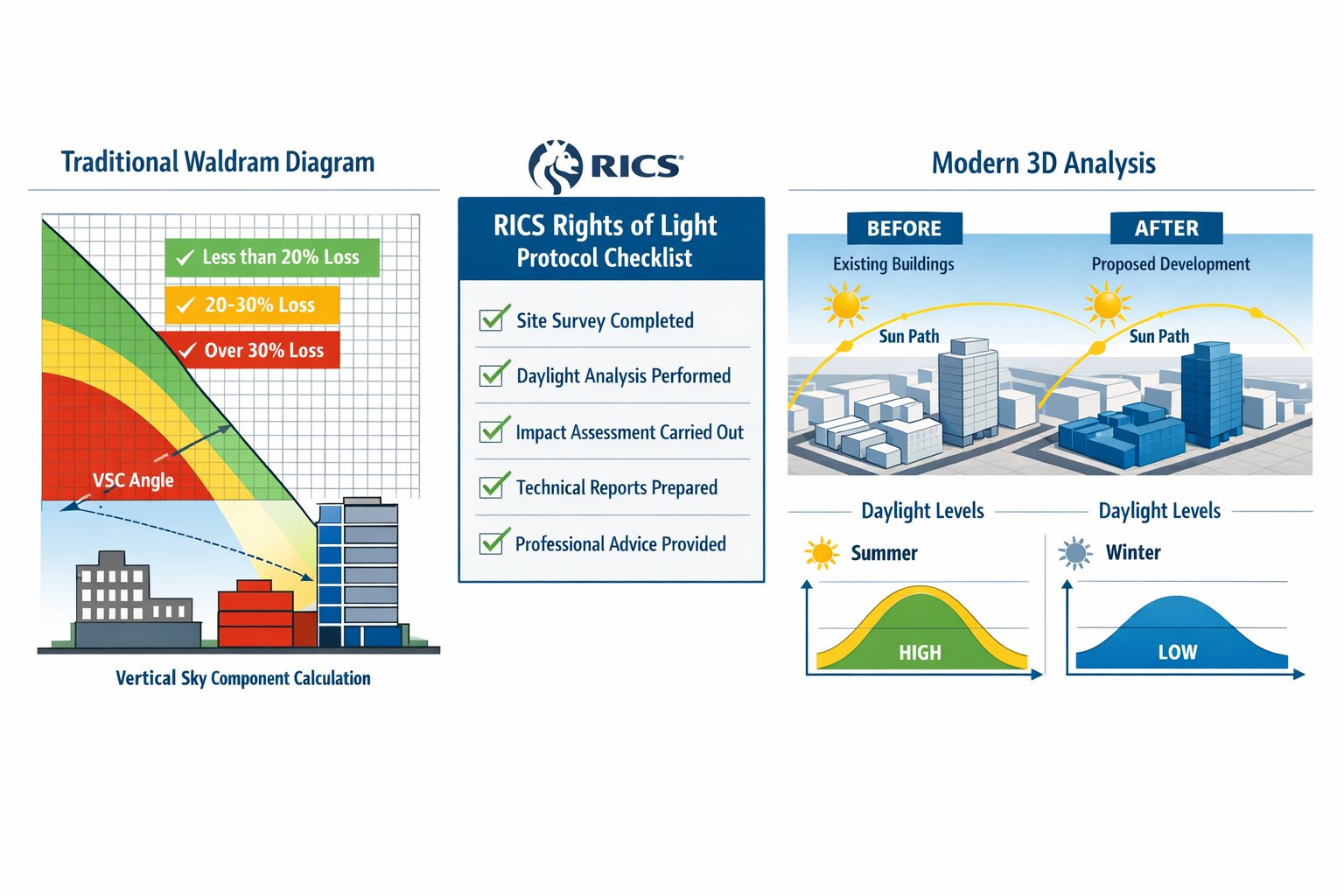
- 🔍 Technical light assessment protocols including Waldram diagrams and vertical sky component analysis provide the evidential basis for valuation adjustments
- 💼 Courtroom presentation strategies require clear communication of complex surveying concepts to non-technical judges and legal professionals
Understanding Right of Light Disputes and Valuation Requirements
Right of light represents an ancient easement that protects property owners' entitlement to receive natural illumination through defined apertures—typically windows that have enjoyed uninterrupted light for 20 years or more. When neighboring development threatens this established right, affected parties may seek injunctive relief or monetary compensation, creating the need for expert valuation evidence.
The Royal Institution of Chartered Surveyors (RICS) has established comprehensive guidance for surveyors engaging with rights of light matters[3]. This specialist sub-sector demands technical proficiency in light measurement, legal understanding of easement principles, and valuation expertise to quantify financial impacts.
The Legal Framework Governing Expert Evidence
Under CPR Part 35, expert witnesses owe their primary duty to the court rather than the instructing party—a fundamental principle that shapes every aspect of report preparation and testimony. RICS has developed specific standards for surveyors acting as expert witnesses that align with these civil procedure requirements[4].
Key obligations include:
- Independence and impartiality: Opinions must be formed objectively, regardless of which party provides instruction
- Competence verification: Experts must only opine within their demonstrated area of expertise
- Factual foundation: All conclusions must be supported by verifiable evidence and transparent methodology
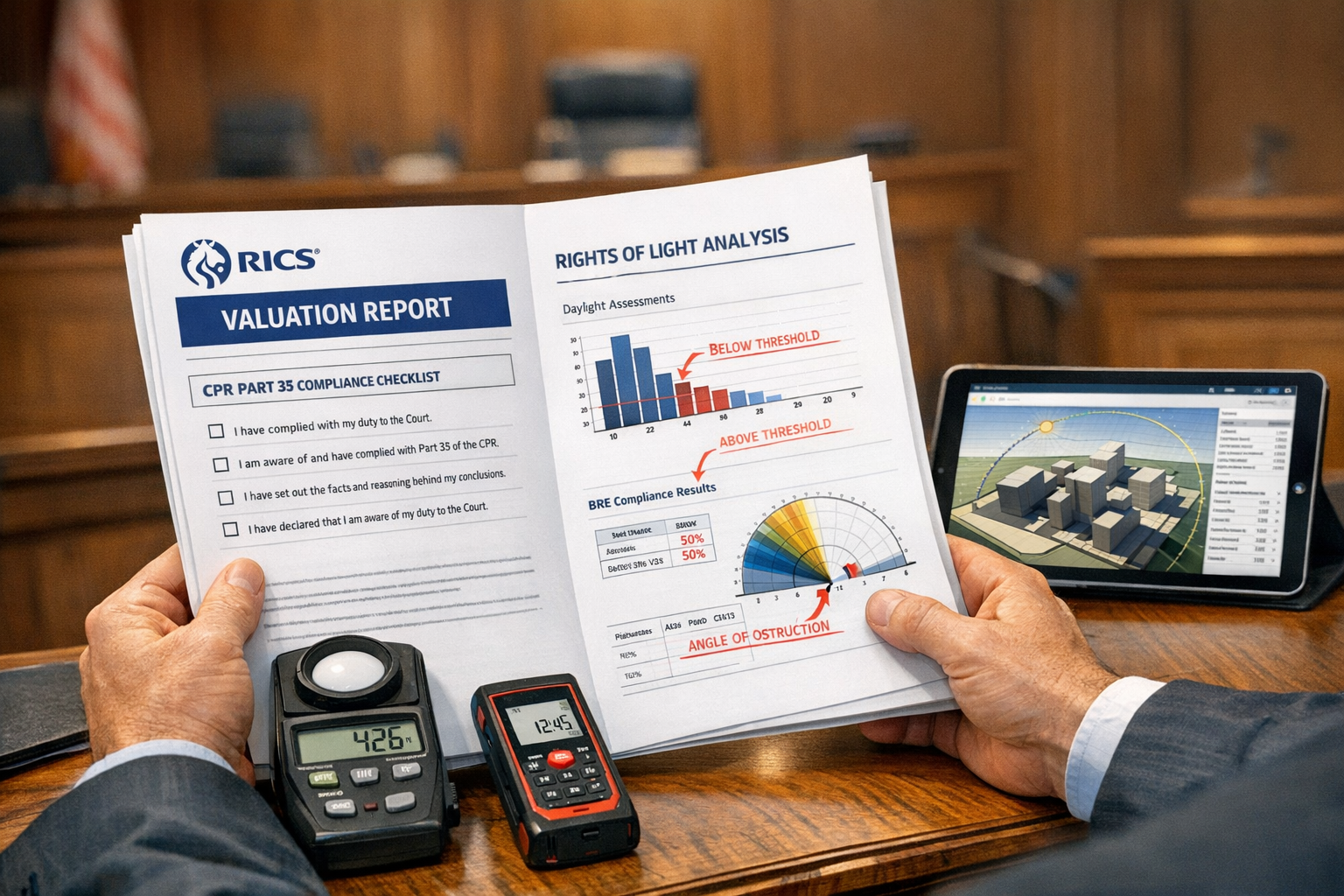
- Statement of truth: Reports must include declarations confirming compliance with CPR Part 35
For surveyors providing RICS registered valuation services, these standards create a rigorous framework that distinguishes expert witness work from standard valuation assignments.
Types of Right of Light Valuation Scenarios
Expert witness valuation reports for right of light disputes typically address three distinct scenarios:
- Pre-development assessment: Quantifying potential compensation before construction commences
- Post-infringement valuation: Calculating diminution in value after neighboring development has reduced light levels
- Retrospective analysis: Determining historical value impacts for retrospective valuation purposes
Each scenario requires different evidentiary approaches and market data applications, with 2026 presenting unique challenges related to regional property market variations[1].
RICS Protocols for Expert Witness Valuation Reports in Right of Light Disputes
The preparation of defensible expert witness valuation reports demands adherence to multiple RICS standards, creating a comprehensive framework that ensures methodological rigor and professional credibility.
Red Book Valuation Standards and Right of Light
RICS Valuation – Global Standards (the "Red Book") establishes the foundational principles for all professional valuations. When preparing expert witness reports for right of light disputes, surveyors must comply with these standards while adapting them to litigation-specific requirements.
The Red Book valuation framework requires:
- Clear identification of purpose: Expert witness reports must explicitly state their intended use in legal proceedings
- Appropriate basis of value: Typically market value, but potentially investment value or special value depending on circumstances
- Assumption transparency: All assumptions regarding light loss, property use, and market conditions must be explicitly stated
- Limitations disclosure: Any constraints on inspection access, data availability, or analytical scope require clear documentation
Understanding valuation factors becomes particularly critical when isolating the specific impact of light diminution from other value influences.
Technical Light Assessment Methodologies
Before quantifying financial impact, expert witnesses must establish the extent of light infringement using recognized technical methodologies:
Vertical Sky Component (VSC) Analysis 📐
- Measures percentage of sky visible from a reference point on a window
- Benchmark: 27% VSC represents adequate natural light under planning guidelines
- Reductions below 0.8 times former value (or below 27% absolute) indicate actionable loss
Waldram Diagram Assessment 📊
- Graphical representation showing proportion of sky visible through windows
- Compares pre-development and post-development scenarios
- Quantifies percentage reduction in available light across room depth
Annual Probable Sunlight Hours (APSH) ☀️
- Relevant for living rooms, conservatories, and amenity spaces
- Measures direct sunlight availability throughout the year
- Significant for properties where sunlight access creates premium value
These technical assessments provide the evidential foundation upon which valuation adjustments rest. Expert witnesses must demonstrate competence in both conducting these analyses and explaining their implications to non-technical audiences.
Quantifying Diminution in Property Value
The central challenge in right of light valuation involves translating technical light loss measurements into credible financial impacts. Several methodological approaches exist:
| Valuation Method | Application | Strengths | Limitations |
|---|---|---|---|
| Comparable Sales Analysis | Residential properties | Market-based, empirically grounded | Limited comparables with identical light loss scenarios |
| Before-and-After Method | All property types | Clear conceptual framework | Requires hypothetical market assumptions |
| Capitalization of Rental Loss | Investment properties | Reflects income impact | Dependent on rental market evidence |
| Cost of Mitigation | Commercial premises | Tangible expenditure basis | May not reflect full amenity loss |
For 2026 valuations, expert witnesses must incorporate current market data reflecting the stabilized national property environment while accounting for significant regional variations[1]. Properties in areas experiencing price growth require different analytical treatment than those in declining markets.
The best practices for London property valuation emphasize the importance of location-specific market knowledge when preparing expert reports.
Report Structure and Content Requirements
RICS guidance for expert witnesses establishes specific structural requirements that ensure reports meet legal admissibility standards:
Essential Report Components:
- Executive Summary: Concise overview of instructions, methodology, and conclusions
- Expert's Declaration: Statement of compliance with CPR Part 35 and acknowledgment of duty to court
- Qualifications and Experience: Detailed CV demonstrating relevant expertise
- Instructions Received: Verbatim reproduction of instruction letter and subsequent clarifications
- Factual Background: Property description, planning context, development details
- Technical Light Assessment: Methodology, measurements, analysis, and conclusions regarding light loss
- Valuation Methodology: Detailed explanation of approach, comparable evidence, and calculations
- Market Context: 2026 property market conditions, regional trends, and relevant transaction evidence
- Conclusions: Clear statement of diminution in value with supporting rationale
- Statement of Truth: Formal declaration and signature
The cost of RICS valuation services for expert witness work typically reflects the substantial time investment required to meet these comprehensive documentation standards.
Maintaining Independence and Managing Client Expectations
A critical tension exists in expert witness work: clients engage surveyors hoping for favorable opinions, yet CPR Part 35 demands complete independence. Successful expert witnesses navigate this challenge through:
- Early expectation management: Explaining the duty to court and potential for unfavorable conclusions during initial engagement
- Transparent methodology: Ensuring clients understand how conclusions are derived before report finalization
- Resistance to pressure: Declining requests to modify conclusions for tactical advantage
- Documentation of independence: Maintaining contemporaneous records of all communications and instructions
This independence requirement distinguishes expert witness work from other valuation contexts such as matrimonial valuation or probate valuation, where surveyors act as advocates for specific parties.
Courtroom Strategies for Presenting Right of Light Valuation Evidence in 2026
Preparing a technically sound report represents only half the expert witness challenge. Effective courtroom presentation requires distinct skills that transform complex surveying analysis into persuasive, comprehensible testimony.
Pre-Trial Preparation and Expert Meetings
Modern civil litigation increasingly emphasizes pre-trial resolution, with courts directing opposing experts to meet and identify areas of agreement and disagreement. These "without prejudice" discussions serve several purposes:
- Narrowing issues: Eliminating disputes on uncontroversial technical matters
- Clarifying positions: Ensuring each expert understands the opposing methodology
- Facilitating settlement: Highlighting the range of reasonable opinions that might inform negotiation
Successful expert witnesses approach these meetings collaboratively rather than adversarially, recognizing that demonstrating reasonableness enhances rather than diminishes credibility.
The joint statement produced from expert meetings must clearly delineate:
✅ Points of agreement: Technical facts, market conditions, and methodological principles accepted by both experts
⚠️ Points of disagreement: Specific valuation conclusions, assumption differences, or interpretive disputes
📝 Reasons for disagreement: Concise explanation of why experts reached different conclusions
This process mirrors approaches used in other property disputes, including party wall disputes where surveyors must balance advocacy with professional objectivity.
Effective Communication of Technical Concepts
Judges, barristers, and juries typically lack surveying expertise, creating a fundamental communication challenge. Expert witnesses must translate technical concepts without oversimplification or condescension.
Successful strategies include:
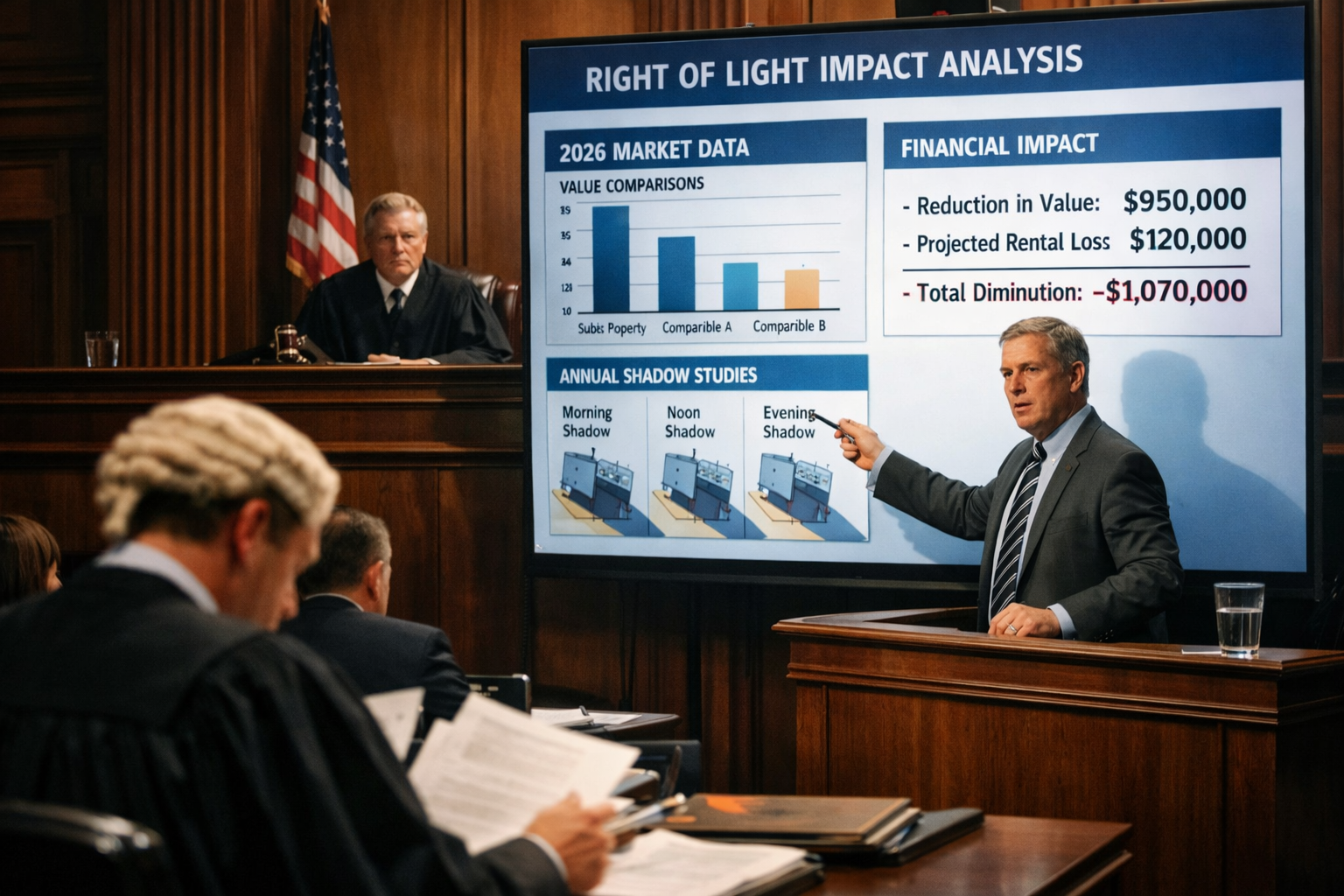
🎯 Visual aids: Photographs, diagrams, and annotated plans that illustrate light loss impacts more effectively than verbal description
📊 Incremental explanation: Building understanding progressively from basic principles to complex conclusions
🏠 Relatable analogies: Comparing technical measurements to everyday experiences (e.g., "equivalent to the difference between a bright office and a north-facing corridor")
📱 Technology integration: Using 3D modeling and before-after simulations to demonstrate development impacts
The ability to explain why a 0.6 VSC reduction matters more than abstract percentages distinguishes compelling testimony from forgettable technical recitation.
Handling Cross-Examination
Cross-examination represents the most challenging aspect of expert witness work, where opposing counsel attempts to undermine credibility, expose methodological weaknesses, or elicit concessions that support alternative narratives.
Preparation strategies:
- Anticipate challenges: Identify potential vulnerabilities in methodology, assumptions, or comparable selection
- Know the report intimately: Ensure immediate recall of all data, calculations, and reasoning
- Review opposing expert's report: Understand alternative perspectives and prepare responses
- Practice testimony: Conduct mock cross-examinations to develop composure and clarity
During cross-examination:
- Answer only the question asked: Avoid volunteering additional information that creates new lines of attack
- Acknowledge limitations: Admitting uncertainty where appropriate enhances rather than diminishes credibility
- Maintain composure: Responding to aggressive questioning with calm professionalism demonstrates expertise
- Seek clarification: Request rephrasing of ambiguous or compound questions
- Take time: Pausing before answering demonstrates thoughtfulness rather than hesitation
These courtroom skills complement technical expertise, transforming surveyors into effective advocates for their professional opinions.
Addressing 2026 Market Conditions in Testimony
The property valuation landscape in 2026 presents unique challenges for expert witnesses. While national house prices have stabilized, significant regional variations create complexity for right of light compensation calculations[1].
Key considerations for 2026 testimony:
📈 Regional market differentiation: London and Southeast markets show different trajectories than Northern regions, requiring location-specific analysis
🏘️ Urban densification pressures: Increased development activity in city centers elevates right of light dispute frequency
💰 Interest rate environment: Stabilized borrowing costs influence investment property valuations differently than residential owner-occupied properties
🌍 ESG considerations: Growing emphasis on natural light as sustainability factor may enhance compensation for light loss
Expert witnesses must demonstrate current market knowledge, supported by recent transaction evidence and professional market reports. Relying on outdated comparables or failing to acknowledge 2026-specific conditions undermines credibility.
The principles applied in commercial property valuation become particularly relevant when addressing investment properties affected by right of light infringement.
Ethical Considerations and Professional Standards
Beyond technical competence and communication skills, expert witnesses must navigate complex ethical terrain. RICS professional standards establish clear expectations:
Prohibited conduct:
- ❌ Accepting contingency fee arrangements based on case outcomes
- ❌ Allowing clients to draft or substantially edit expert opinions
- ❌ Withholding unfavorable information from opposing parties
- ❌ Overstating certainty or expertise beyond demonstrable competence
Required conduct:
- ✅ Disclosing all material facts, even those unfavorable to instructing party
- ✅ Correcting errors or updating opinions when new information emerges
- ✅ Maintaining professional indemnity insurance adequate for expert witness work
- ✅ Continuing professional development in both technical and legal aspects
Violations of these standards can result in disciplinary action, professional sanctions, and exclusion from future expert witness work. The reputational risks associated with ethical breaches far exceed any short-term benefits from client accommodation.
Post-Judgment Responsibilities
Expert witness obligations extend beyond trial conclusion. Surveyors may be required to:
- Clarify testimony: Respond to judicial requests for additional explanation
- Assist with remedies: Provide guidance on implementing court-ordered compensation or mitigation measures
- Update opinions: Revise conclusions if appeals or changed circumstances require reassessment
Maintaining professional relationships with instructing solicitors while preserving independence ensures continued access to expert witness opportunities in this specialized practice area.
Integrating Right of Light Expertise with Broader Surveying Practice
Expert witness work for right of light disputes represents a specialized subset of broader surveying practice, yet it intersects with numerous other professional services. Understanding these connections enhances both technical competence and business development opportunities.
Relationship to Party Wall Matters
Right of light disputes frequently arise alongside party wall matters, particularly when neighboring development involves excavation or structural alterations near shared boundaries. Surveyors who understand both frameworks provide more comprehensive advice.
Key intersections include:
- Combined notices: Developments triggering both Party Wall Act procedures and right of light concerns
- Damage assessment: Distinguishing structural damage from light loss impacts
- Dispute resolution: Applying similar negotiation principles across both contexts
The guide to boundary dispute and party wall surveyors provides context for understanding these overlapping practice areas.
Application Across Property Types
While residential right of light disputes receive significant attention, expert witness valuation skills apply across diverse property sectors:
Residential Properties 🏘️
- Highest volume of disputes
- Emphasis on amenity value and quality of life impacts
- Comparable sales methodology typically most appropriate
Commercial Offices 🏢
- Focus on rental value impacts and tenant retention
- Natural light increasingly valued for employee wellbeing
- Investment valuation approaches predominate
Retail Premises 🛍️
- Window display visibility concerns
- Customer experience and trading potential impacts
- Specialized comparable evidence required
Industrial Properties 🏭
- Generally lower sensitivity to light loss
- Specific use requirements may create exceptions
- Mitigation costs often relevant
Understanding sector-specific valuation nuances strengthens expert witness credibility across instruction types.
Technology and Innovation in 2026 Practice
The expert witness landscape continues evolving with technological advancement. Surveyors practicing in 2026 increasingly leverage:
Advanced Modeling Software 💻
- Real-time shadow analysis with seasonal variations
- Virtual reality presentations for courtroom demonstration
- Automated VSC and APSH calculations with accuracy verification
Drone Technology 🚁
- Detailed facade surveys without scaffolding access
- Photographic evidence of existing conditions
- Verification of as-built development compliance
Big Data Analytics 📊
- Comprehensive comparable evidence databases
- Market trend analysis with regional granularity
- Predictive modeling for future value impacts
Digital Evidence Management 📱
- Secure document repositories for litigation files
- Audit trails demonstrating methodology transparency
- Efficient collaboration with legal teams
These technological tools enhance rather than replace professional judgment, providing expert witnesses with more robust evidential foundations.
Building an Expert Witness Practice
Developing expertise in right of light valuation requires deliberate professional development:
- Technical foundation: Master light measurement methodologies and valuation principles
- Legal knowledge: Understand easement law, CPR Part 35 requirements, and litigation procedures
- Market expertise: Maintain current knowledge of property markets and transaction evidence
- Communication skills: Develop ability to explain complex concepts to non-technical audiences
- Reputation building: Establish track record through smaller cases before pursuing high-value instructions
Many surveyors complement expert witness work with related services including valuation for various purposes, creating diversified practice portfolios.
Conclusion
Expert Witness Valuation Reports for Right of Light Disputes: RICS Protocols and Courtroom Strategies in 2026 represents a sophisticated intersection of technical surveying competence, legal knowledge, and communication expertise. As urban development intensifies and property owners become increasingly aware of their rights, demand for qualified expert witnesses continues growing.
Success in this specialized field requires:
✅ Rigorous adherence to RICS standards and CPR Part 35 requirements that prioritize duty to court over client preferences
✅ Technical mastery of light assessment methodologies including VSC analysis, Waldram diagrams, and APSH calculations
✅ Valuation expertise capable of translating technical light loss measurements into credible financial impact assessments
✅ Market knowledge reflecting 2026 conditions, including regional variations and stabilized pricing environments
✅ Courtroom skills that transform complex surveying concepts into persuasive, comprehensible testimony
✅ Ethical integrity that maintains professional standards even under client pressure or adversarial challenge
For surveyors seeking to develop expert witness capabilities, the path forward involves continuous professional development, careful case selection to build experience, and unwavering commitment to independence and impartiality. The financial rewards and professional recognition associated with expert witness work reflect the substantial expertise and reputational risk involved.
Property owners, developers, and legal professionals seeking expert witness services should prioritize RICS registered valuers with demonstrated experience in right of light matters, courtroom testimony, and the specific property sector relevant to their dispute. The quality of expert evidence frequently determines litigation outcomes, making expert selection a critical strategic decision.
As the built environment continues densifying and property values remain substantial, right of light disputes will persist as a significant area of property litigation. Expert witnesses who master the technical, legal, and communication dimensions of this specialized practice will find sustained demand for their services throughout 2026 and beyond.
Next Steps
For Surveyors:
- Pursue CPD in light assessment methodologies and expert witness procedures
- Seek mentorship from experienced expert witnesses
- Consider RICS expert witness accreditation
- Build technical competence through non-contentious right of light assessments
For Property Owners:
- Engage expert advice early when development threatens light access
- Select experts with relevant sector experience and courtroom track record
- Understand that independence requirements may produce unfavorable opinions
- Consider alternative dispute resolution before litigation
For Developers:
- Commission right of light assessments during planning stages
- Budget for potential compensation based on expert valuation evidence
- Engage constructively with affected neighbors to minimize litigation risk
- Maintain comprehensive documentation of light impact mitigation efforts
The intersection of property rights, technical assessment, and legal proceedings creates complexity, but also opportunity for surveyors who invest in developing comprehensive expertise across all dimensions of expert witness practice.
References
[1] Expert Witness Testimonies In 2026 Valuation Disputes Rics Strategies Amid Stabilising House Prices And Regional Divides – https://nottinghillsurveyors.com/blog/expert-witness-testimonies-in-2026-valuation-disputes-rics-strategies-amid-stabilising-house-prices-and-regional-divides
[2] Expert Witness Valuations In 2026s Stabilizing Market Rics Standards For Mortgage Disputes And Property Disagreements – https://nottinghillsurveyors.com/blog/expert-witness-valuations-in-2026s-stabilizing-market-rics-standards-for-mortgage-disputes-and-property-disagreements
[3] Rights Of Light – https://www.rics.org/profession-standards/rics-standards-and-guidance/sector-standards/building-surveying-standards/rights-of-light
[4] Surveyors Acting As Expert Witnesses – https://www.rics.org/profession-standards/rics-standards-and-guidance/sector-standards/dispute-resolution-standards/surveyors-acting-as-expert-witnesses