Over 40 new hyperscale data centres are currently planned or under construction across the UK — many of them sharing boundary walls with existing industrial, commercial, and even residential neighbours. The sheer power density of these facilities, some drawing over 100MW per site, creates vibration, thermal stress, and ground movement risks that most party wall frameworks were never designed to address. Party Wall Surveys for Data Centre Boom: RICS Protocols for High-Density Power Infrastructure Risks in 2026 has become one of the most urgent and underexplored topics in British surveying practice.
With AI-driven data centre expansions surging across UK industrial zones, party wall surveyors must now adapt their protocols for challenges that simply did not exist a decade ago — including continuous vibration from cooling systems, electromagnetic interference near shared utilities, and boundary encroachments driven by power infrastructure upgrades. RICS is actively updating its guidance frameworks [1], and the profession is responding, but many adjoining owners remain exposed.
Key Takeaways 📌
- Data centre construction triggers the Party Wall etc. Act 1996 in most scenarios involving shared or adjacent walls, excavations near boundaries, or new builds close to neighbouring structures.
- Vibration from cooling and power systems is an emerging risk category that requires specialist monitoring as part of a robust party wall schedule of condition.
- RICS is consulting on updated party wall guidance (8th edition), which is expected to address modern construction complexities including high-density infrastructure. [1]
- A thorough pre-construction schedule of condition is the single most important protective document for neighbouring property owners.
- Appointing an agreed surveyor or separate surveyors early is critical — disputes in data centre projects can be technically complex and extremely costly to resolve.
Why Data Centres Create Unique Party Wall Challenges
The UK data centre market is not slowing down. Demand driven by AI workloads, cloud computing, and digital infrastructure investment has triggered what analysts are calling a 2026 construction boom across industrial corridors in London, the Home Counties, and regional tech hubs. [3]
Traditional party wall scenarios — a homeowner digging a basement extension, a developer building upward — involve relatively predictable risks. Data centre construction is different in almost every dimension:
The Scale of Structural Intervention
Data centres require:
- Deep reinforced concrete foundations capable of bearing enormous equipment loads
- Extensive underground cable and pipe networks that can cross or approach party boundaries
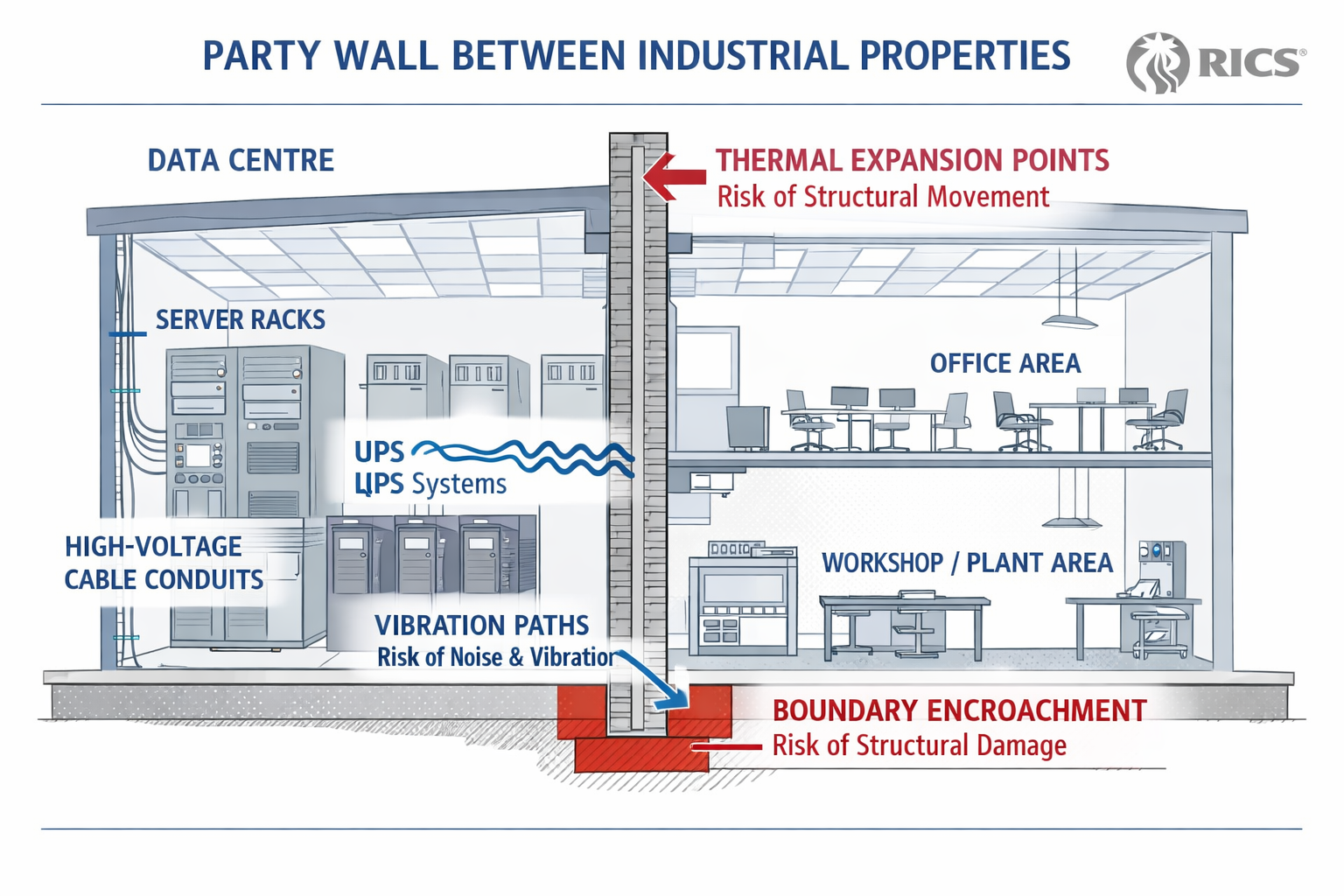
- Large cooling plant installations — chillers, cooling towers, and air handling units — often positioned close to boundary walls
- High-voltage transformer and switchgear rooms that generate both electromagnetic fields and thermal output
Each of these elements can affect neighbouring structures in ways that a standard party wall notice and basic schedule of condition may not fully capture.
Vibration: The Hidden Risk 🔊
Perhaps the most underappreciated risk in data centre party wall cases is continuous, low-frequency vibration. Unlike construction vibration — which is temporary — the operational vibration from large cooling systems and diesel generator sets runs 24 hours a day, 365 days a year.
"Continuous low-frequency vibration from operational plant is categorically different from construction-phase vibration. It can cause progressive micro-cracking in masonry over months or years — damage that is very difficult to attribute retrospectively without a pre-construction baseline."
This is why a detailed party wall schedule of condition — completed before any construction begins — is not just advisable but essential. Without a documented baseline, adjoining owners have almost no evidential basis for a damage to property claim under the Party Wall Act.

RICS Protocols for High-Density Power Infrastructure Risks in 2026
RICS has launched a consultation on the draft 8th edition of Party Wall Legislation and Procedure, seeking input from surveyors, legal professionals, and stakeholders across England and Wales. [1] While the final edition is still in development, the direction of travel is clear: the profession needs more robust, technically detailed frameworks for complex construction scenarios.
What the Updated RICS Guidance Is Expected to Address
The consultation process reflects a recognition that the existing guidance — last substantially updated in the 7th edition — was written for a construction landscape that has changed dramatically. Key areas under review include:
| Area of Guidance | Relevance to Data Centre Projects |
|---|---|
| Scope of party wall notices | Clarifying when data centre infrastructure triggers the Act |
| Schedule of condition standards | Minimum documentation requirements for complex sites |
| Vibration monitoring protocols | Baseline and ongoing measurement standards |
| Dispute resolution procedures | Faster pathways for technically complex disagreements |
| Surveyor competency requirements | Specialist knowledge for industrial and infrastructure projects |
RICS is also piloting a new Data, Analytics and Intelligence pathway in 2026, which includes digital resilience and data competency components. [2] While this pathway is broader than data centre-specific surveying, it signals that RICS-accredited professionals are expected to become more technically literate about the digital infrastructure sector they are increasingly called upon to assess.
The Party Wall Act 1996: Which Sections Apply?
Understanding which parts of the Party Wall etc. Act 1996 are triggered by data centre construction is the starting point for any surveyor or adjoining owner.
Section 1 — New walls on or at the boundary line. Relevant where data centre boundary walls or security perimeters are being constructed.
Section 2 — Works to existing party walls. Directly triggered if the data centre developer needs to cut into, underpin, or raise a shared wall.
Section 6 — Excavations within 3 metres (or 6 metres for deeper excavations) of a neighbouring structure. This is frequently triggered by data centre foundation work. The Party Wall Act 3-metre rule is one of the most commonly misunderstood provisions, and data centre developers — often focused on speed — sometimes fail to serve proper notices.
Practical Steps for Adjoining Owners and Surveyors
Whether acting for a data centre developer or a neighbouring property owner, the process for managing Party Wall Surveys for Data Centre Boom: RICS Protocols for High-Density Power Infrastructure Risks in 2026 follows a structured sequence — but with additional technical layers compared to standard residential cases.
Step 1: Identify Whether the Act Is Triggered
Not every data centre project will trigger the Party Wall Act. The key questions are:
- Does the proposed work involve a party wall, party fence wall, or party structure?
- Does it involve excavation within 3 or 6 metres of an adjoining owner's building?
- Does it involve construction of a new wall at or astride the boundary?
If the answer to any of these is yes, the building owner must serve a party wall notice. Understanding the full scope of party wall matters before construction begins prevents costly disputes later.
Step 2: Serve Proper Notices
Notices must be served within the correct timeframes:
- Party structure notices: at least 2 months before work begins
- Line of junction notices: at least 1 month before work begins
- Section 6 notices: at least 1 month before excavation begins
In data centre projects, notices are often complex because multiple sections of the Act may be triggered simultaneously. Developers should seek specialist advice on party wall consent procedures at the earliest stage of project planning.
Step 3: Appoint Surveyors
Once an adjoining owner dissents (or fails to consent within 14 days), the dispute resolution mechanism under the Act is activated. Both parties can agree to use a single party wall agreed surveyor — often the most cost-effective route — or each party appoints their own surveyor, who together select a third surveyor if needed.
For data centre projects, surveyor selection should consider:
- ✅ Experience with industrial and infrastructure construction
- ✅ Familiarity with vibration monitoring and structural dynamics
- ✅ Knowledge of high-voltage electrical infrastructure risks
- ✅ Ability to interpret geotechnical and structural engineering reports
Step 4: Commission a Specialist Schedule of Condition
This is non-negotiable. A standard photographic schedule of condition is insufficient for data centre adjacencies. A robust schedule should include:
- Photographic and video documentation of all accessible surfaces
- Crack monitoring gauge installation at identified vulnerable points
- Pre-construction vibration baseline measurements using calibrated accelerometers
- Thermal imaging where cooling plant will be installed near shared walls
- Ground settlement monitoring points for excavation-adjacent structures
The party wall schedule of condition serves as the evidential foundation for any future claim. In data centre cases, it may need to be supplemented by a structural survey of the adjoining building.
Dispute Resolution in Data Centre Party Wall Cases
Despite best efforts, party wall disputes do arise — and in data centre projects, they tend to be technically complex and financially significant.
Common Dispute Triggers in Data Centre Projects 🚨
- Vibration damage claims — cracks or settlement attributed to cooling plant or construction activity
- Boundary encroachment — underground power cables or drainage crossing the party boundary without consent
- Notice failures — developer proceeding without serving adequate notice
- Scope disputes — disagreements about whether specific works fall within the Act
- Compensation disagreements — disputes over the value of disturbance or damage
When disputes cannot be resolved between appointed surveyors, the matter proceeds to a party wall award — a binding document that sets out the rights and obligations of both parties. In technically complex cases, the award may need to incorporate specialist engineering reports, vibration monitoring protocols, and post-construction monitoring requirements.
For cases that escalate beyond the award process, expert witness reports from qualified surveyors or structural engineers may be required for court proceedings.
The Importance of Early Engagement
The single most effective way to avoid costly disputes is early engagement. Developers who engage with adjoining owners before serving notices — explaining the project, sharing technical information, and addressing concerns proactively — consistently achieve faster, less contentious outcomes.
"In data centre projects, the technical complexity means that disputes which could have been resolved in weeks can drag on for months if the parties become entrenched. Early, transparent engagement is not just good practice — it is commercially essential."
Emerging Risks Specific to High-Density Power Infrastructure
Beyond the standard party wall framework, data centre projects introduce several risk categories that surveyors and adjoining owners should be aware of in 2026.
Electromagnetic Interference (EMI)
High-voltage transformers and switchgear generate electromagnetic fields that can, in rare cases, affect sensitive electronic equipment in neighbouring buildings. While this is not a structural risk in the traditional sense, it can constitute a legal nuisance and may need to be addressed in the party wall award or through separate legal channels.
Thermal Expansion and Contraction
Data centre cooling systems create significant thermal gradients near boundary walls. Repeated thermal cycling can accelerate deterioration of masonry mortar joints and cause differential movement in structures. Surveyors should document the thermal environment as part of the pre-construction baseline.
Utility Corridor Conflicts
Data centres require enormous power supplies — often requiring new high-voltage substations and underground cable routes. These cable routes can conflict with existing shared drainage, gas mains, or other utilities running along or near party boundaries. Resolving these conflicts requires coordination between the party wall process and statutory utility frameworks.
Ground Contamination and Remediation
Many data centres are being built on previously industrial land. Remediation works — particularly soil excavation and treatment — can affect adjacent structures and may trigger the Act's provisions on excavation near buildings. Subsidence surveys of neighbouring properties are increasingly being commissioned as part of the pre-construction due diligence process.

What Neighbouring Property Owners Should Do Right Now
If a data centre is being planned or constructed near your property in 2026, the following steps are strongly recommended:
Immediate Actions ✅
- Check whether you have received a party wall notice. If construction has started without one and the Act applies, you may have grounds for an injunction.
- Do not ignore a party wall notice. Consenting without conditions may limit your future options. Seek professional advice before responding.
- Commission an independent schedule of condition before any construction work begins — even if the developer's surveyor has already prepared one.
- Keep records of any unusual vibration, cracking, or settlement from the date construction commences.
Longer-Term Protections
- Request that the party wall award includes post-construction monitoring obligations for the developer.
- Ensure the award specifies vibration limits during construction and, where appropriate, during operation of cooling plant.
- Consider whether a dilapidation survey of your property would provide additional protection if you are a commercial tenant or landlord.
Conclusion: Adapting Party Wall Practice for the Data Centre Era
The data centre construction wave reshaping the UK's industrial landscape in 2026 demands a corresponding evolution in party wall surveying practice. Party Wall Surveys for Data Centre Boom: RICS Protocols for High-Density Power Infrastructure Risks in 2026 is not a niche concern — it is a mainstream challenge that will affect thousands of adjoining owners, developers, and surveyors over the coming years. [3]
RICS is moving in the right direction with its updated guidance consultation [1] and new professional pathways [2], but the profession cannot wait for formal guidance to catch up with construction reality. Surveyors working on data centre adjacencies need to upskill now — in vibration dynamics, high-voltage infrastructure risks, and the technical demands of high-density power environments.
Actionable Next Steps
- Developers: Engage party wall surveyors with relevant industrial experience at the earliest stage of project planning — before planning permission is granted if possible.
- Adjoining owners: Do not assume that a standard party wall notice process will adequately protect your interests. Commission independent advice and a specialist schedule of condition.
- Surveyors: Review the RICS consultation on the 8th edition of Party Wall Legislation and Procedure and engage with the emerging technical literature on vibration and thermal risks in data centre adjacencies.
- All parties: Prioritise early, transparent communication. The complexity of data centre projects makes disputes disproportionately expensive — prevention is always cheaper than resolution.
The Party Wall etc. Act 1996 remains a powerful and effective framework. Applied with the technical rigour that data centre projects demand, it can protect all parties fairly. The key is ensuring that the professionals involved are equipped for the challenge.
References
[1] Rics Launches Consultation On Updated Party Wall Practice Guidance – https://www.rics.org/news-insights/rics-launches-consultation-on-updated-party-wall-practice-guidance
[2] Rics Calls For Expressions Of Interest In New Data Analytics And Intelligence Pathway – https://www.rics.org/news-insights/rics-calls-for-expressions-of-interest-in-new-data-analytics-and-intelligence-pathway
[3] Party Wall Surveys Amid 2026 Construction Boom Handling Disputes In High Demand Uk Housing Markets – https://nottinghillsurveyors.com/blog/party-wall-surveys-amid-2026-construction-boom-handling-disputes-in-high-demand-uk-housing-markets
[4] Home Survey Standard 2nd Edition April 2026 Update – https://www.rics.org/news-insights/home-survey-standard-2nd-edition-april-2026-update