
Roughly one in five UK homes sits on shrink-swell clay soil, making seasonal ground movement one of the most common, and most misread, property concerns in the country. Yet the vast majority of cracks that appear in British homes each year are cosmetic, caused by normal thermal expansion, drying shrinkage, or minor initial settlement rather than dangerous structural failure. The challenge for homeowners, buyers, and surveyors alike lies in distinguishing the two. Understanding shrinking and settlement in UK homes, and the surveyor strategies for monitoring minor movement before it becomes structural, is not just useful knowledge, in 2026, with climate-driven soil movement intensifying, it is essential.
Key Takeaways
- Most cracks in UK homes are caused by normal shrinkage or initial settlement and do not indicate structural danger.
- Surveyors use crack width, pattern, location, and direction to classify movement and decide whether monitoring or intervention is needed.
- The 3 mm threshold is a widely recognised benchmark: cracks below this width are generally cosmetic; those above warrant professional assessment.
- A minimum monitoring period of 12 months, covering at least two seasons, is recommended before drawing conclusions about active movement.
- Early professional assessment is far less costly than remediation after movement becomes structural.
Understanding Shrinkage and Settlement: What Is Actually Happening in Your Walls
Before any monitoring strategy can be applied, it helps to understand what causes minor movement in the first place. Shrinkage and settlement are distinct processes, though they often occur together and produce similar visible symptoms.
Initial settlement is the natural compression of a building's foundations and substructure under load. In new builds, this process can continue for two to three years after construction. In older properties, it typically stabilised decades ago, which is why a crack that has been present and unchanged for thirty years is rarely a cause for alarm [5].
Thermal movement occurs as building materials expand in summer heat and contract in winter cold. Brick, mortar, timber, and concrete all move at different rates. This differential movement is responsible for a large proportion of the fine cracks seen around door frames, window reveals, and ceiling-wall junctions in UK homes.
Shrink-swell movement is driven by the moisture content of clay soils. During dry summers, clay shrinks and the ground subsides slightly. During wet winters, it swells and partially recovers. The prolonged dry summers of recent years have intensified this cycle considerably, with insurer guidance in summer 2026 highlighting elevated shrink-swell risk across much of southern England [7].
Drying shrinkage in new plaster, render, and concrete is another common source of fine cracking. This is a material property rather than a structural issue and typically stabilises once the building fabric reaches equilibrium moisture content [2].
Understanding these mechanisms allows surveyors, and informed homeowners, to read cracks as evidence of a process rather than simply as damage. The question is always: what is driving this movement, and is it ongoing?
How Surveyors Classify Cracks: The Benchmarks That Matter
The classification of cracks is one of the most important skills in building surveying. A crack is not simply a crack: its width, orientation, location, depth, and pattern all carry diagnostic information [1].
Crack Width Thresholds
The most widely used classification framework in the UK assigns cracks to categories based on width and associated repair needs:
| Category | Crack Width | Description |
|---|---|---|
| 0 | Hairline (< 0.1 mm) | Negligible; decorative only |
| 1 | Up to 1 mm | Fine; easily filled |
| 2 | 1 mm, 5 mm | Slight; requires monitoring |
| 3 | 5 mm, 15 mm | Moderate; investigation needed |
| 4 | 15 mm, 25 mm | Severe; structural concern |
| 5 | > 25 mm | Very severe; urgent action required |
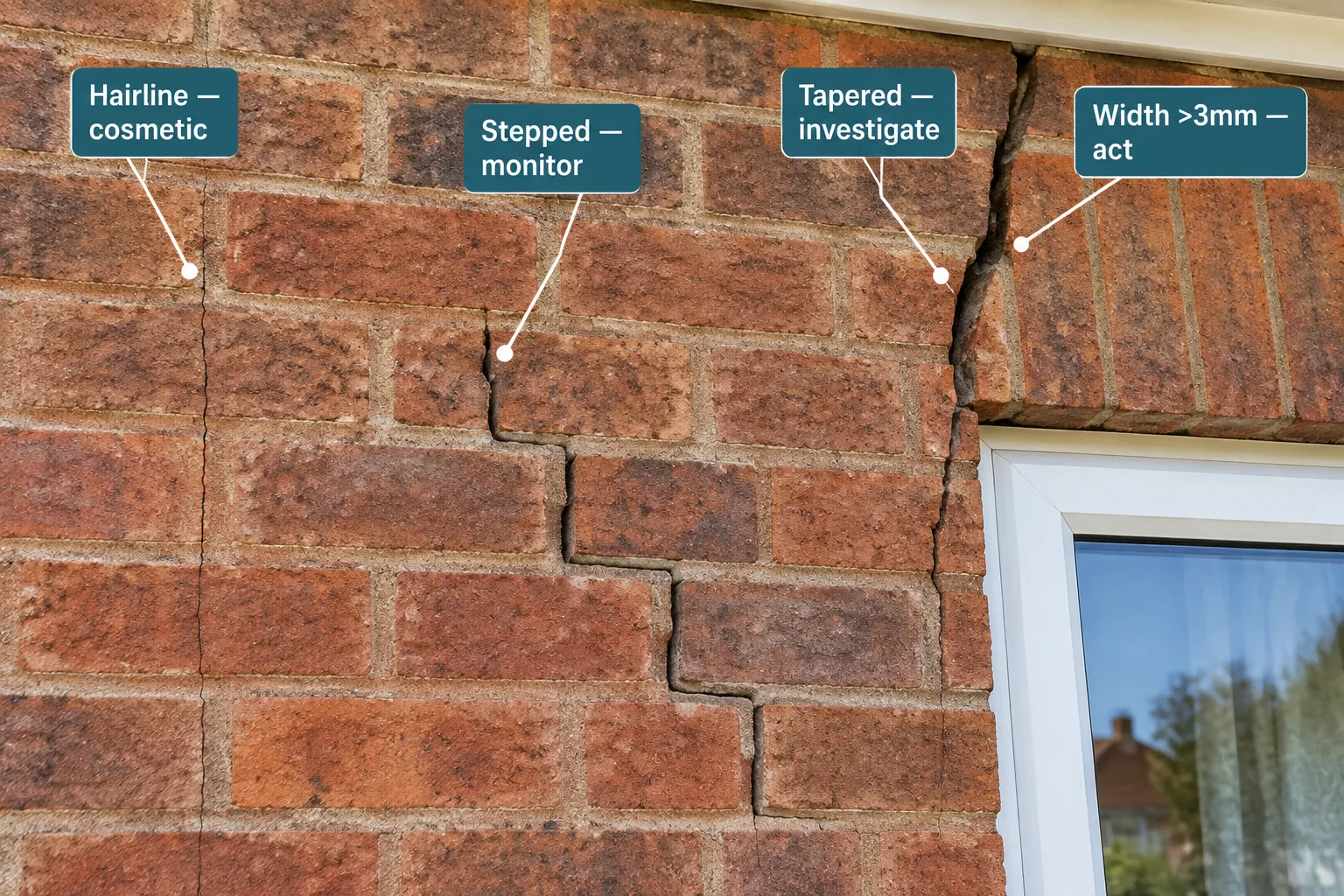
For practical purposes in the field, the 3 mm "coin test" is a useful rule of thumb: if a standard 2p coin fits into a crack, the crack is at or above the threshold where professional assessment becomes advisable [3]. Cracks below this width, particularly those that are uniform in width along their length, are generally cosmetic.
Pattern and Direction
Pattern matters as much as width. Key diagnostic indicators include:
- Diagonal cracks running from the corners of window or door openings are extremely common and often reflect differential thermal movement or minor settlement rather than active subsidence [10].
- Stepped cracks following mortar joints in brickwork suggest differential movement between sections of masonry, worth monitoring but not automatically structural.
- Vertical cracks in the centre of a wall can indicate differential settlement between two parts of a foundation.
- Horizontal cracks in a retaining wall or basement are among the most serious, as they can indicate lateral earth pressure.
- Tapered cracks, wider at one end than the other, are more significant than parallel-sided cracks of the same maximum width, as they suggest rotation or differential movement [2].
Location and Context
A crack above a door in a Victorian terrace is far less alarming than the same crack in a post-war concrete-frame building. Surveyors always read cracks in context: the age and construction type of the building, the local geology, recent weather patterns, and the history of the property all inform the interpretation [5].
For a detailed assessment of crack severity in London properties, the Structural Crack Assessment London service provides professional diagnosis and monitoring recommendations. Homeowners who want broader guidance on when cracks become a concern can also consult the surveyor's guide to cracks in walls: when to worry.
Surveyor Strategies for Monitoring Minor Movement Before It Becomes Structural
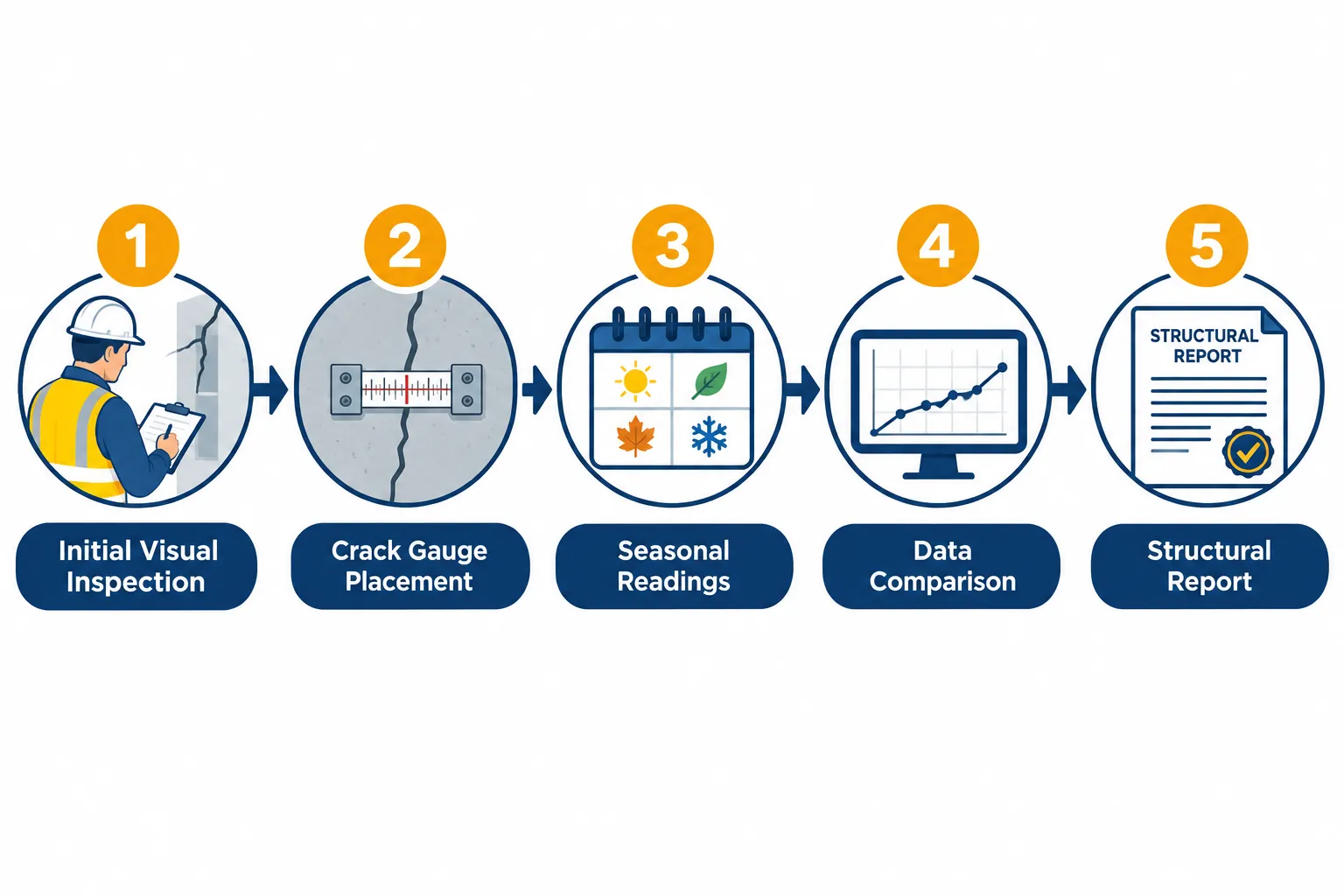
The core principle of professional monitoring is straightforward: a single observation tells you very little; a series of observations over time tells you a great deal. Shrinking and settlement in UK homes, and the surveyor strategies for monitoring minor movement before it becomes structural, are grounded in this time-based approach [6].
Low-Tech Monitoring Methods
These methods are inexpensive, reliable, and widely used by both surveyors and homeowners:
Tell-tale gauges (crack monitors): Plastic or glass tell-tale monitors are fixed across a crack with adhesive. Any movement causes visible displacement of the two halves. They are available for a few pounds each and provide a clear, permanent record of change. Readings should be taken and photographed at regular intervals, ideally monthly.
Pencil dating: The simplest possible method. Mark the ends of a crack with a pencil line and date it. If the crack extends beyond the mark, it is growing. If it does not, it has stabilised.
Vernier gauge measurements: A more precise version of the pencil method. A surveyor uses a calibrated gauge to measure crack width at a fixed point, recording the measurement and date. This produces a quantitative dataset rather than a visual record.
Spirit level and plumb bob checks: Used to monitor whether walls, floors, or door frames are moving out of true. A door that progressively sticks, or a floor that develops a noticeable slope, can indicate ongoing movement even where crack widths appear stable.
Recommended Monitoring Periods
"A monitoring period of at least 12 months, covering at least two full seasonal cycles, is the minimum required to distinguish active movement from stabilised historic cracking."
This is not an arbitrary timeframe. Clay soils in the UK typically reach their driest point in late summer and their wettest in late winter. A monitoring programme that captures both extremes provides the data needed to determine whether movement is seasonal (and therefore likely self-limiting) or progressive (and therefore requiring intervention) [4].
For properties where movement appears more pronounced, surveyors may recommend an extended monitoring period of 18 to 24 months before drawing conclusions. This is particularly relevant for properties on shrink-swell clay soils in southern England, where the 2026 summer drought conditions have produced ground movement readings at the higher end of historical ranges [4].
Professional Structural Monitoring Services
Where low-tech methods are insufficient, for example, where movement appears rapid, where the property is being sold, or where insurers require formal evidence, professional structural monitoring services provide a higher level of assurance [9].
These services typically include:
- Precise crack-width measurement using calibrated digital gauges
- Optical levelling surveys to detect differential settlement across the building footprint
- Inclinometer readings for walls or structures showing signs of rotation
- Automated sensor systems that log movement data continuously and can alert the surveyor to threshold exceedances in real time
The adoption of automated sensors and real-time movement tracking has accelerated significantly in 2026. Wireless crack sensors and tilt sensors can now be installed for relatively modest cost and monitored remotely, providing a continuous data stream rather than periodic snapshots [6]. This is particularly valuable for properties where access is limited or where movement is suspected to be rapid.
Typical costs for professional structural monitoring in the UK in 2026 range from around £300 to £800 for an initial installation and baseline survey, with ongoing monitoring packages available from approximately £150 to £400 per quarter depending on the number of sensors and reporting requirements [6].
For homeowners and buyers who want to understand the full scope of professional assessment options, the What Do Chartered Surveyors Do? Building Surveyor Guide provides a useful overview of surveyor roles and capabilities. Those comparing survey types before a purchase can also review the HomeBuyers Report vs Building Survey: Which Do You Need? comparison.
Climate Risk, Insurer Guidance, and the 2026 Context
The relationship between climate change and building movement in the UK has moved from theoretical concern to documented reality. The prolonged dry summers of recent years have produced ground shrinkage events that would previously have been considered exceptional but are now increasingly routine [7].
Shrink-Swell Clay: The Growing Risk
Approximately 40% of England is underlain by clay soils with significant shrink-swell potential. The areas of highest risk include much of London, the Thames Valley, Essex, Kent, and parts of the East Midlands. In these areas, the combination of drier summers and wetter winters creates a more pronounced annual movement cycle than was typical in previous decades [5].
The Q2 2026 CREST settlement monitoring dataset recorded movement readings across clay-soil sites in southern England that were, on average, 15% higher than the equivalent period in 2022, a finding consistent with broader trends in climate-driven ground movement [4]. For homeowners in affected areas, this makes proactive monitoring more important than ever.
Insurer Implications
Insurance claims related to subsidence and ground movement are among the most expensive and contentious in the UK residential market. Insurers increasingly require documented evidence of monitoring before accepting or settling claims. A homeowner who can demonstrate a 12-month record of stable crack widths is in a significantly stronger position than one presenting a single photograph taken after a crack appeared [7].
Conversely, a homeowner who has ignored progressive movement for several years may find that their insurer disputes the claim on the grounds of failure to mitigate. Early professional assessment, and documented monitoring, is therefore both a technical and a financial protection.
Surveyor Strategies for Homebuyers
For buyers, shrinking and settlement in UK homes, and the surveyor strategies for monitoring minor movement before it becomes structural, are directly relevant to the pre-purchase survey process. A Level 3 Building Survey (formerly the Full Structural Survey) will assess visible cracks, comment on their likely cause, and recommend further investigation or monitoring where appropriate [1].
Buyers should ask surveyors specifically about:
- The history of any visible cracking and whether it appears active or historic
- The local geology and associated shrink-swell risk
- Whether any previous remedial work (such as underpinning) has been carried out
- Whether a specialist structural engineer's report is recommended
Understanding how much a structural survey costs before commissioning one helps buyers budget appropriately and avoid being deterred by cost from obtaining the level of assessment the property genuinely requires. For buyers uncertain which survey level is appropriate, the guide to which survey you need: Level 2 vs Level 3 explained provides clear practical guidance.
When Minor Movement Becomes a Structural Concern
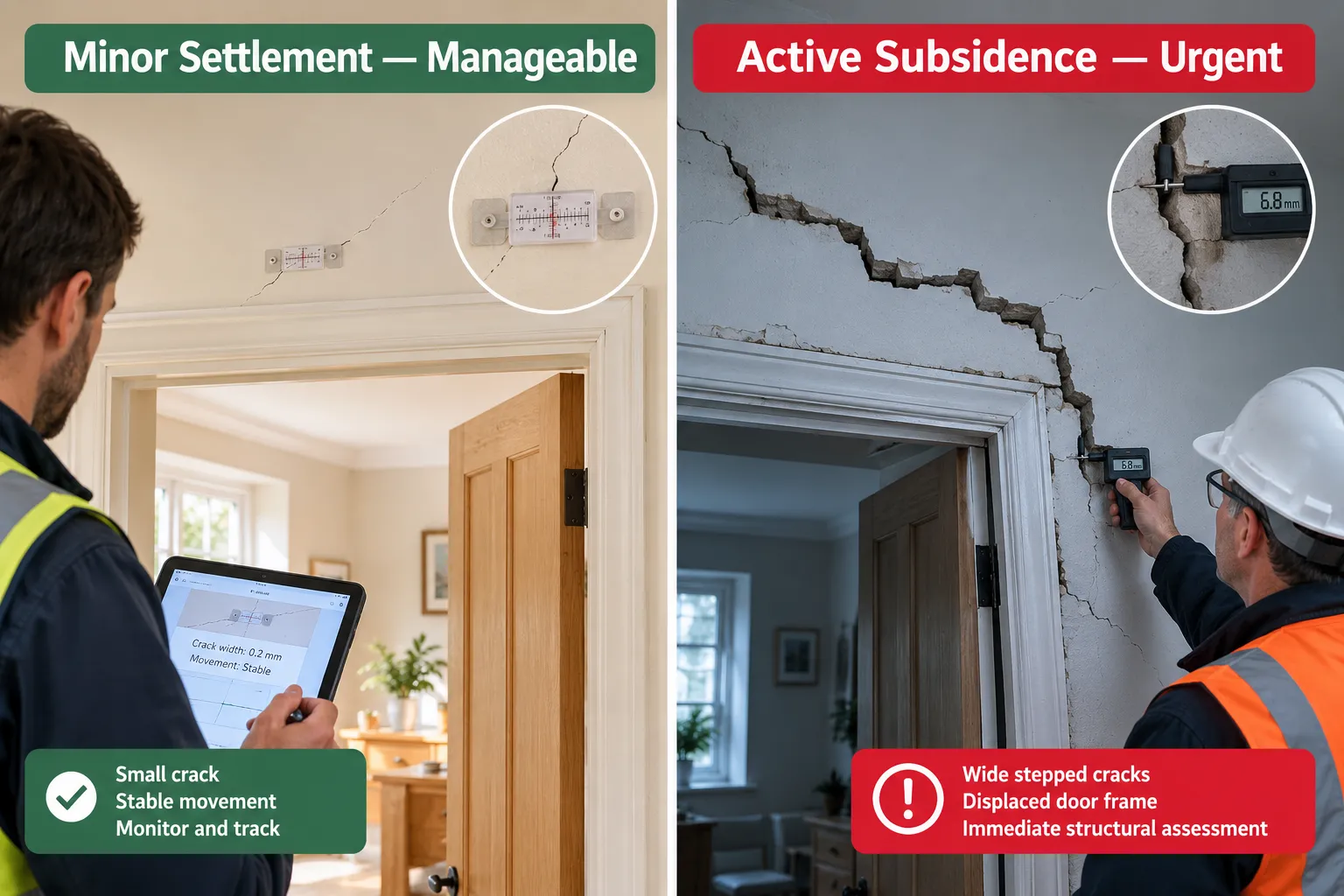
Not all movement stabilises. The following indicators should prompt immediate referral to a structural engineer rather than continued monitoring:
- Crack widths exceeding 5 mm (Category 3 or above)
- Rapid progression of crack width, measurable change within days or weeks
- Horizontal cracking in external walls
- Doors or windows that have become impossible to open or close within a short period
- Visible bulging, bowing, or leaning of walls
- Cracks accompanied by significant floor slope or differential settlement visible to the naked eye
- Any cracking in a property known to have been underpinned previously
The presence of one or more of these indicators does not automatically mean catastrophic failure is imminent, but it does mean that monitoring alone is insufficient. A structural engineer's assessment should be commissioned without delay.
It is also worth noting that some of the most common property defects found in UK building surveys relate to exactly this area, the 10 most common property defects found in a building survey include movement-related issues alongside damp, roof defects, and drainage problems.
The Outlook for 2026 and Beyond
Expert consensus in 2026 points firmly toward more monitoring, not less. The combination of an ageing housing stock, intensifying climate variability, and growing awareness of ground movement risk is driving increased adoption of both low-tech and sensor-based monitoring across the UK residential sector [6].
Several trends are worth noting:
- Sensor costs are falling. Wireless crack monitors and tilt sensors that cost several hundred pounds per unit five years ago are now available for a fraction of that price, making continuous monitoring accessible to a wider range of homeowners and landlords.
- Data benchmarking is improving. Datasets such as the CREST Q2 2026 settlement monitoring records allow surveyors to compare observed movement against regional norms, providing a more objective basis for risk assessment [4].
- Insurer requirements are tightening. More policies now include explicit requirements for documented monitoring as a condition of cover in high-risk areas.
- Pre-purchase surveys are evolving. There is growing expectation that Level 3 surveys will include explicit commentary on shrink-swell risk and monitoring recommendations, not just crack description.
For homeowners in areas of elevated clay-soil risk, the practical implication is clear: install tell-tale monitors on any cracks wider than 1 mm, photograph them monthly, and commission a professional assessment if any change is detected within a 12-month period.
Conclusion
The gap between a cosmetic crack and a structural problem is not always obvious, but it is navigable with the right approach. Shrinking and settlement in UK homes, and the surveyor strategies for monitoring minor movement before it becomes structural, rest on three foundations: accurate classification of what is observed, systematic monitoring over an adequate time period, and prompt escalation when the evidence demands it.
Actionable next steps for homeowners and buyers:
- Inspect and document all visible cracks, noting their width, pattern, and location. Photograph each one with a scale reference.
- Install tell-tale monitors on any crack wider than 1 mm and record readings monthly for at least 12 months.
- Commission a professional survey if any crack exceeds 3 mm, shows rapid progression, or is accompanied by door/window distortion or floor slope.
- Check local geology using the British Geological Survey's interactive shrink-swell map to understand the baseline risk for your property's location.
- Engage a RICS-qualified surveyor for a Level 2 or Level 3 survey before purchasing any property where visible cracking is present.
Early action is always less expensive than late remediation. A tell-tale monitor costs a few pounds; underpinning can cost tens of thousands. The investment in professional monitoring is, in almost every case, the most cost-effective decision a homeowner can make.
References
[1] RICS Standards – isurv.com
[2] Signs Of Subsidence Inside House – corinthiansurveyorslondon.co.uk
[3] How To Spot Structural Movement – southsurveyors.co.uk
[4] Q2 2026 Settlement Monitoring Data – acceleratedsettlement.co.uk
[5] RICS Consumer Guide Subsidence – rics.org
[6] Structural Monitoring Survey Company UK And London Guide – icelabz.co.uk
[7] Subsidence – rics.org
[9] Structural Monitoring Solutions – intersectsurveys.co.uk
[10] Cracks In Walls Of House – corinthiansurveyorslondon.co.uk