
A single rule change introduced on 6 August 2026 made biodiversity a hard cost line in every UK development appraisal, not an aspiration, not a planning condition to be negotiated away, but a statutory obligation that now directly reduces residual land values for thousands of sites across England. For small developers and landowners trying to understand why their viability numbers have shifted, the answer increasingly lies in the intersection of BNG and property valuations: how biodiversity net gain rules now affect UK land and development appraisals is no longer a niche environmental question, it is a mainstream financial one.
The Environment Act 2021 mandated a minimum 10% biodiversity net gain for most new developments in England. Since then, the regulatory framework has been refined repeatedly, and the August 2026 amendments represent the most significant recalibration yet. Understanding which sites are now exempt, which face higher costs than before, and how surveyors are expected to reflect these obligations in formal valuations is essential for anyone buying, selling, or appraising development land in 2026.
Key Takeaways
- From 6 August 2026, development sites of 0.2 hectares or less with no impact on priority habitat are exempt from mandatory BNG requirements.
- Certain temporary developments of up to five years are also exempt, improving viability for meanwhile uses and short-duration infrastructure.
- The previous self-build and custom-build exemption has been removed or substantially altered, exposing many small schemes to full BNG compliance costs.
- Off-site BNG unit prices are running at approximately £24,000,£25,000 per unit as of mid-2026, making habitat procurement a material cost in residual land value calculations.
- Nationally significant infrastructure projects (NSIPs) face mandatory BNG from 2 November 2026, adding a new cost dimension to strategic corridor and infrastructure land.
What Biodiversity Net Gain Actually Requires
Before examining how BNG reshapes valuations, it is worth establishing exactly what the obligation entails. Under the mandatory BNG regime, developers must demonstrate that their project delivers at least 10% more biodiversity value after completion than existed on the site before development. This is measured using Natural England's Biodiversity Metric 4.0, which assigns unit values to different habitat types based on their area, condition, and distinctiveness [4].
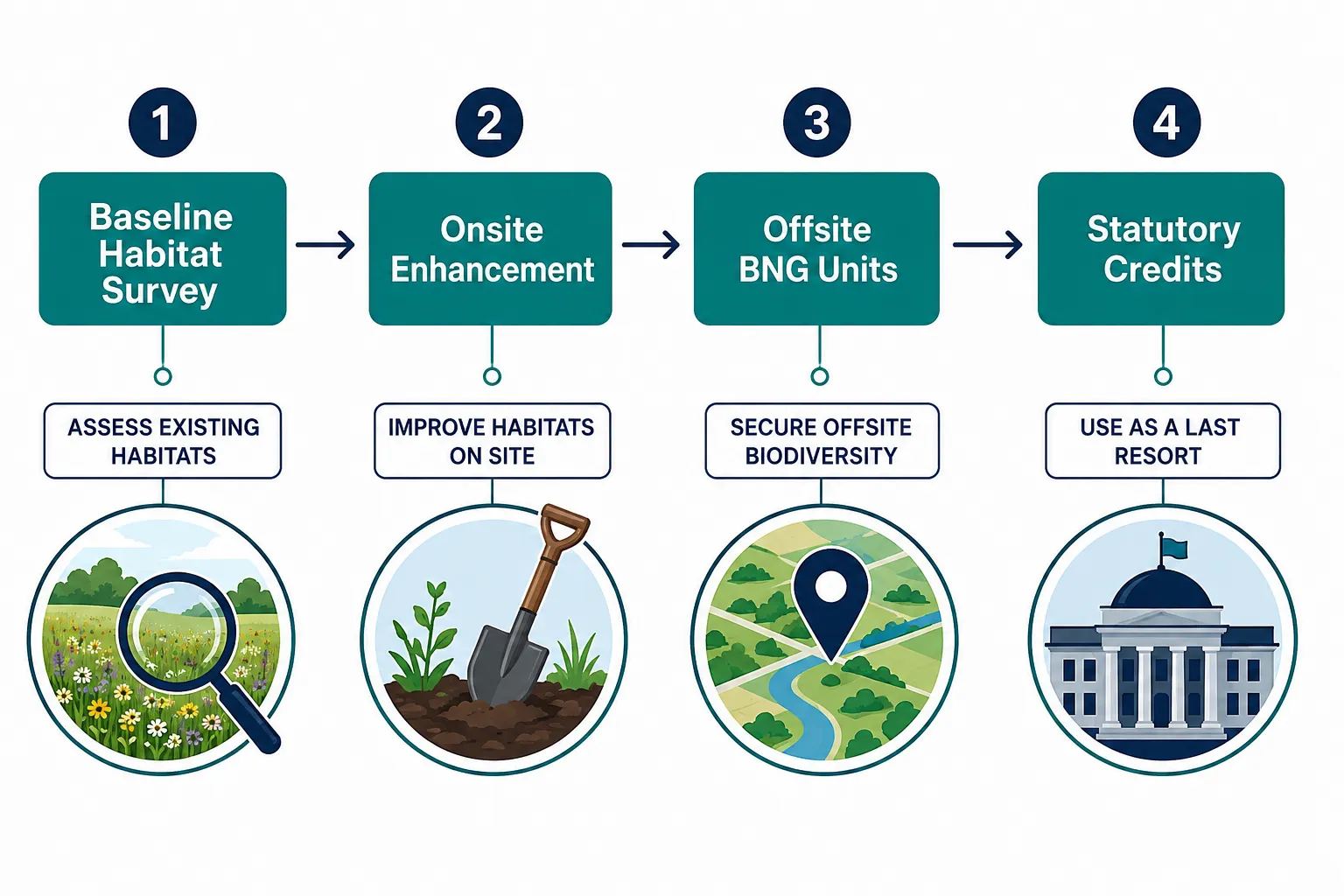
The delivery hierarchy works as follows. Developers must first seek to create or enhance habitat onsite. If that is insufficient to reach the 10% target, they can purchase off-site biodiversity units from a registered habitat bank. If neither option is available or viable, they may purchase statutory biodiversity credits directly from the government as a last resort [4]. Each step in this hierarchy carries a different cost profile, and those cost profiles feed directly into development feasibility assessments.
What this means in practice:
- A greenfield site with species-rich grassland will have a higher baseline biodiversity value, making the 10% uplift harder and more expensive to achieve.
- A brownfield site with low ecological value may reach the 10% target more easily through modest onsite planting.
- Sites requiring off-site unit procurement face a variable and location-sensitive cost that must be modelled explicitly.
The official BNG guidance collection for developers, land managers, and local authorities, last updated on 27 August 2026, provides the most authoritative statement of measurement rules, exemptions, and biodiversity gain plan requirements that valuers and appraisers are expected to follow [9].
The August 2026 Rule Changes: What Shifted and Why It Matters for Valuations
The Biodiversity Gain (Town and Country Planning) (Amendments and Transitional Provisions) (England) Regulations 2026, which took effect on 6 August 2026, introduced several changes that directly alter the cost and risk profile of different site types [1].
The 0.2-Hectare Exemption
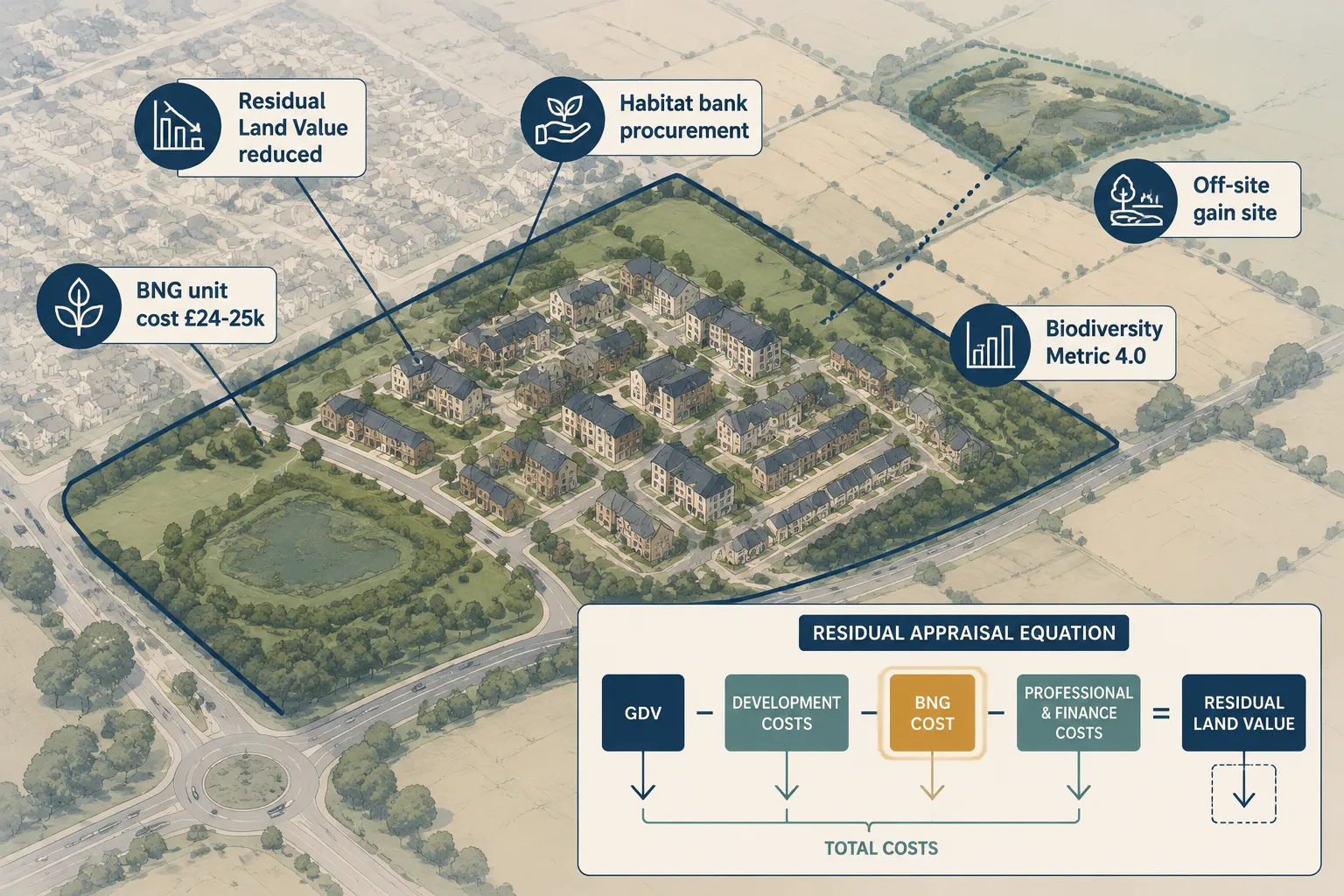
The most commercially significant change is the new exemption for development sites with an area no larger than 0.2 hectares, provided the development has no impact on onsite priority habitat. This applies only to planning applications submitted on or after 6 August 2026 [1] [4] [11].
For context, 0.2 hectares is approximately 2,000 square metres, roughly the footprint of three to four standard detached houses. Analysis of small-site development patterns suggests this exemption could affect around 12,500 homes per year nationally [11]. For landowners with micro-plots, this exemption is a direct uplift in land value: the BNG compliance cost, which could otherwise run to tens of thousands of pounds, is simply removed from the appraisal.
"The 0.2-hectare threshold is not just an environmental policy decision, it is a land value event for micro-site owners who previously faced the same BNG burden as large housebuilders."
However, the exemption is conditional. If any part of the site contains or impacts priority habitat, such as ancient woodland, species-rich grassland, or lowland fen, the exemption does not apply regardless of site size [1]. Surveyors and valuers must therefore confirm habitat status before assuming an exemption applies. A Phase 1 habitat survey is now a prerequisite for accurate valuation of any sub-0.2-hectare plot.
Temporary Development Exemption
From 6 August 2026, certain temporary developments of up to five years, where removal and reinstatement are secured by planning condition, are also exempt from BNG requirements [1] [7]. This is commercially relevant for:
- Temporary infrastructure compounds supporting larger construction projects
- Meanwhile uses such as pop-up markets, temporary car parks, or short-term community facilities
- Construction-phase site offices and welfare facilities
For appraisers working on mixed-use regeneration schemes or phased infrastructure projects, this exemption can materially improve the viability of interim uses that would otherwise carry a BNG cost.
The Self-Build and Custom-Build Change
Perhaps the most consequential change for individual landowners is the removal or substantial alteration of the previous separate exemption for self-build and custom-build housing for applications made on or after 6 August 2026 [1] [3]. Self-build schemes that previously sat outside the BNG regime now face full compliance costs unless they qualify under the 0.2-hectare or temporary exemptions.
For a single self-build plot larger than 0.2 hectares, which describes the majority of rural self-build projects, this means BNG costs must now be fully costed into the land acquisition price. A plot that appeared viable under the old rules may require a price renegotiation to reflect this new obligation.
The Flattened Minor Development Hierarchy
For non-major (minor) development, the August 2026 amendments flatten the statutory BNG hierarchy. Onsite habitat creation and the use of registered off-site biodiversity gain units are now treated at the same level of preference [1] [4] [6]. Government guidance confirms that minor schemes can proceed directly to off-site delivery without first exhausting onsite options [1].
This is a practical improvement for small developers who lack the site area to achieve meaningful onsite biodiversity gain. It also means that the cost of off-site BNG units becomes the primary variable in small-site appraisals, rather than a fallback option.
How BNG Costs Feed Into Residual Land Value Calculations
The residual land value method, the standard approach to development land appraisal, works by subtracting all development costs and developer profit from the gross development value (GDV). What remains is the maximum price a developer can rationally pay for the land. BNG costs enter this calculation as an additional cost line, reducing residual land value pound for pound unless offset elsewhere [12].
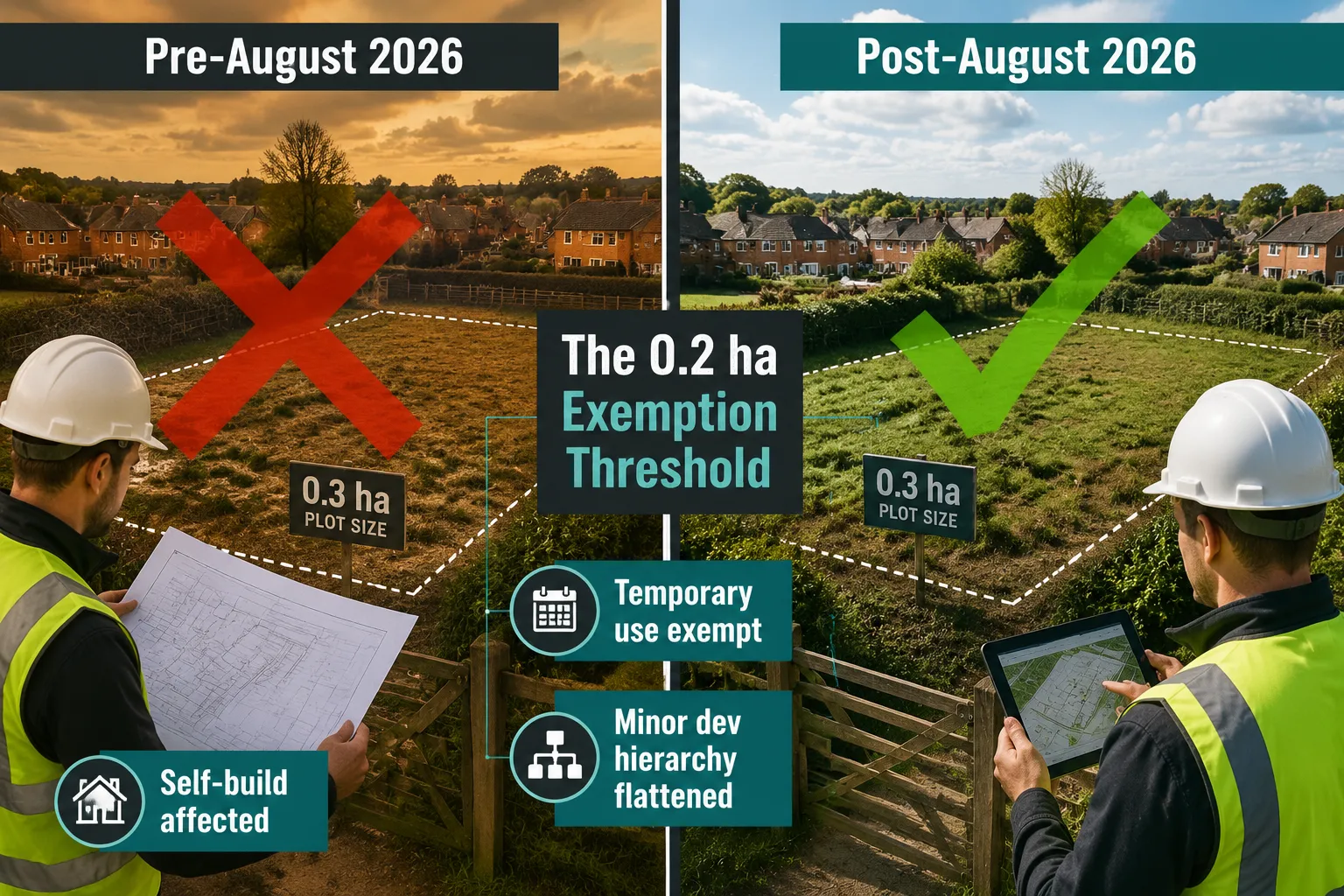
Key cost variables that valuers must now model:
| Cost Variable | Current Market Position (2026) |
|---|---|
| Off-site BNG unit price (other neutral grassland) | Approximately £24,000,£25,000 per unit |
| Earlier regional estimates | £27,825,£28,875 per unit |
| Registered gain sites on Natural England's register | Approximately 197 sites |
| Total biodiversity units available | More than 28,000 units |
| Estimated total unit value on the register | Approximately £93 million |
Sources: [6] [14] [15]
The emerging regional differentiation in unit prices is particularly important. A development in a region with limited habitat bank supply may face unit costs significantly above the national average, while a scheme near an established gain site network may secure units at a discount. Commercial property surveyors in London and other high-demand urban markets are already factoring this regional variation into appraisal assumptions.
BNG as a Form of Land Value Capture
Industry analysis from Carter Jonas frames mandatory BNG as a form of land value capture: it functions as an additional developer contribution that tends to push down land prices unless offset by reduced obligations elsewhere or by monetisable amenity value from enhanced biodiversity [12]. This framing is increasingly reflected in negotiated land deals, where vendors and purchasers are explicitly allocating BNG risk between themselves in heads of terms.
For a commercial valuation in London or any major urban centre, the BNG cost may be relatively small as a proportion of GDV. For a rural residential scheme where land values are lower and habitat baselines are higher, BNG can represent a significant proportion of the residual land value, in some cases making a scheme unviable at the vendor's asking price.
Practical Appraisal Adjustments
Valuers and surveyors working on development land appraisals in 2026 are expected to:
- Confirm exemption status, verify site area, habitat type, and application date to determine whether the 0.2-hectare or temporary exemption applies.
- Commission a baseline habitat survey, the Biodiversity Metric 4.0 calculation cannot be completed without an accurate habitat baseline, and this cost should be reflected in the appraisal.
- Model onsite and offsite BNG delivery costs separately, given the flattened hierarchy for minor development, both routes should be costed and the cheaper option selected.
- Source current off-site unit prices, unit prices are market-driven and vary by region and habitat type; using outdated estimates will produce inaccurate residual land values.
- Flag BNG risk in valuation reports, where habitat status is uncertain or off-site unit supply is limited, this should be identified as a material risk affecting value.
Those involved in development monitoring in London and other complex urban schemes will also need to track BNG compliance through the construction and post-completion phases, as the biodiversity gain plan must be submitted and approved before development commences.
BNG for Nationally Significant Infrastructure Projects
From 2 November 2026, biodiversity net gain becomes mandatory for nationally significant infrastructure projects (NSIPs), the large-scale energy, transport, water, and waste projects that are consented through the Development Consent Order (DCO) process rather than the standard planning system [2] [8].
NSIP developers will be required to deliver at least 10% net gain in biodiversity as part of their DCO applications [2] [10]. This adds a new, quantifiable environmental cost line into strategic land and corridor valuations. For landowners whose land sits within or adjacent to proposed NSIP corridors, including energy transmission routes, road schemes, and reservoir sites, understanding how BNG obligations will be allocated between the infrastructure promoter and affected landowners is now a material valuation question.
Government guidance published on 27 August 2026 sets out the specific requirements for NSIP BNG, including how the biodiversity metric is applied to linear infrastructure and how off-site delivery will be managed for projects spanning multiple local authority areas [2] [9].
For those holding land near proposed NSIP routes, professional advice on how BNG affects both compulsory purchase compensation and voluntary land sales is increasingly important. A capital gains tax valuation for land disposed of in connection with an NSIP scheme will need to reflect the BNG obligations attached to the site at the valuation date.
Surveyor Recommendations for Landowners and Small Developers
The combined effect of the August 2026 amendments is that BNG compliance is no longer a uniform obligation, it is a segmented one, with materially different implications depending on site size, habitat status, development type, and application timing. The following practical steps are recommended.
For landowners considering a sale:
- Obtain a Phase 1 habitat survey before marketing any development land. The presence or absence of priority habitat determines whether the 0.2-hectare exemption applies and directly affects the price a developer can pay.
- Understand that BNG costs are now routinely deducted from land offers. A vendor who has already quantified and priced the BNG obligation is in a stronger negotiating position than one who leaves it as an unknown.
- For sites above 0.2 hectares, consider whether any part of the site could be retained or managed as a biodiversity gain area, potentially generating off-site unit income rather than simply incurring a compliance cost.
For small developers:
- Build BNG costs into feasibility assessments from day one, not as a late-stage adjustment. The off-site unit market is active, with approximately 197 registered gain sites and more than 28,000 units available nationally, but prices and availability vary [6].
- For minor developments, take advantage of the flattened hierarchy to go directly to off-site procurement if onsite options are limited or costly.
- Check whether the self-build exemption previously applied to your scheme and whether the August 2026 changes affect your planning application timeline.
For appraisers and surveyors:
- Segment land portfolios and pipeline schemes by size, duration, and habitat status when modelling BNG's impact on value [1] [7].
- Use current off-site unit prices sourced from the Natural England register and active habitat bank operators, not generic estimates.
- Ensure that BNG risk is explicitly addressed in RICS Red Book compliant valuation reports where it is material to value.
Those seeking a desktop valuation in London for development land should confirm with their surveyor that BNG obligations have been considered as part of the appraisal assumptions, even where a full site inspection has not been carried out.
Conclusion
BNG and property valuations: how biodiversity net gain rules now affect UK land and development appraisals is a question that every landowner, developer, and surveyor in England needs to answer with precision in 2026. The August 2026 regulatory amendments have created a more differentiated landscape, one where micro-sites and temporary uses gain meaningful cost relief, while self-build schemes and larger plots face the full weight of mandatory compliance.
The financial stakes are real. Off-site BNG units are trading at approximately £24,000,£25,000 each, the off-site market now holds an estimated £93 million in registered unit value, and NSIP BNG obligations come into force in November 2026 [2] [6]. These are not marginal adjustments, they are material inputs into residual land value calculations that can determine whether a scheme is viable or not.
Actionable next steps:
- Commission a Phase 1 habitat survey for any development land being marketed or appraised, regardless of site size.
- Verify application date and site area against the 6 August 2026 exemption thresholds before assuming BNG costs apply or do not apply.
- Source current off-site BNG unit prices from the Natural England register for any appraisal where off-site delivery is the likely route.
- Engage a RICS-qualified surveyor with BNG experience to ensure that biodiversity obligations are properly reflected in formal valuations and development appraisals.
- For NSIP-adjacent land, seek specialist advice on how the November 2026 NSIP BNG requirements affect both voluntary sales and compulsory purchase compensation.
The biodiversity net gain framework is maturing rapidly. Landowners and developers who treat it as a core financial variable, rather than an environmental afterthought, will be better positioned to negotiate, appraise, and deliver viable schemes in the years ahead.
References
[1] BNG Changes From 6 August 2026 – wealden.gov.uk
[2] Biodiversity Net Gain For Major Infrastructure Projects New Guidance – defraenvironment.blog.gov.uk
[3] Biodiversity Net Gain Whats Changing And What It Means For You – defraenvironment.blog.gov.uk
[4] Understanding Biodiversity Net Gain – gov.uk
[6] BNG Habitat Bank Supply August 2026: 197 Registered Gain Sites, 28000 Units And What UK Developer Procurement Looks Like Now – biodiversitysurveyors.com
[7] Environmental Policy Updates August 2026 – clearriskmanagement.com
[8] Biodiversity Net Gain Nationally Significant Infrastructure Projects – gov.uk
[9] Biodiversity Net Gain Guidance For Developers Land Managers And Authorities – gov.uk
[10] Key Changes Confirmed To Biodiversity Net Gain – cla.org.uk