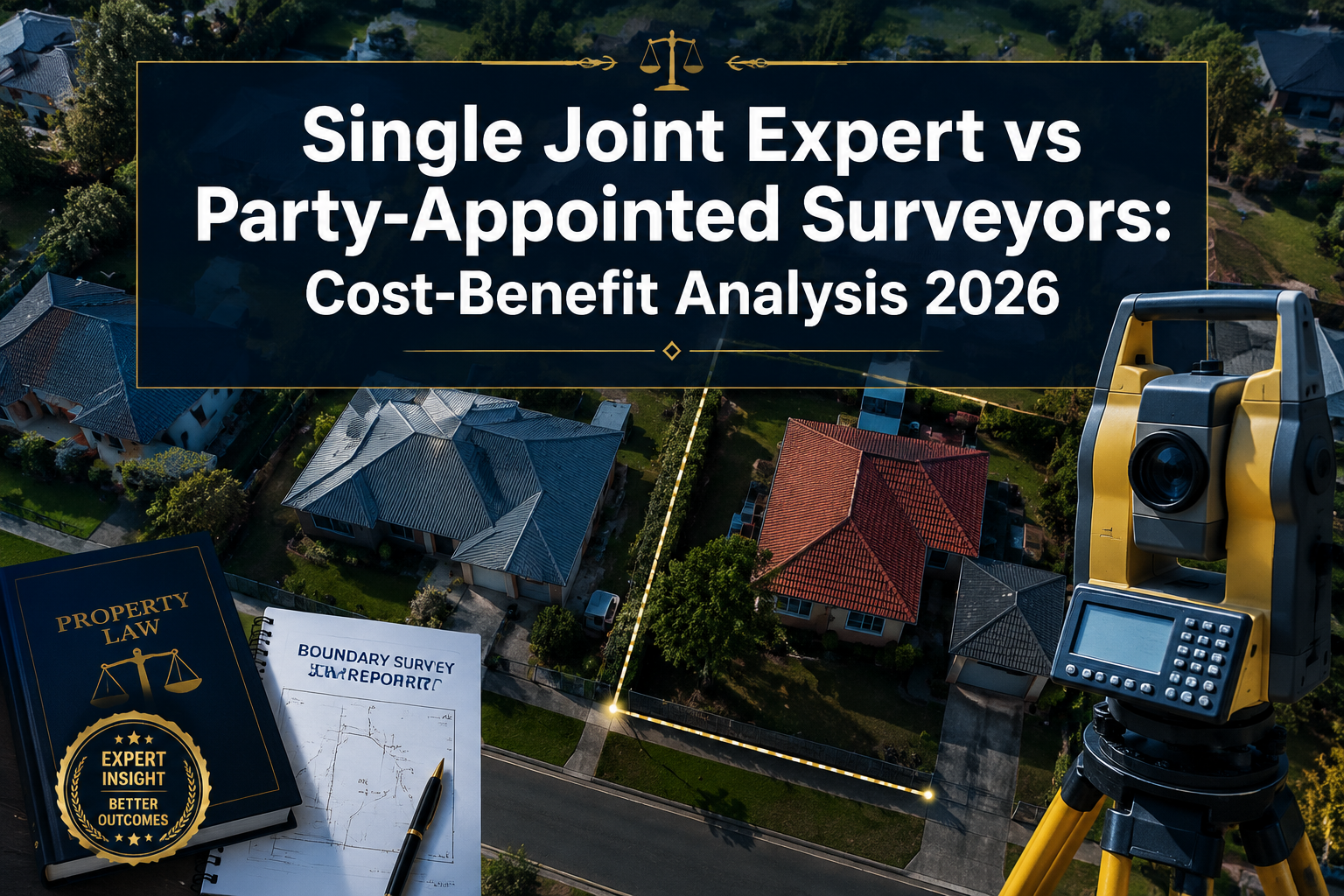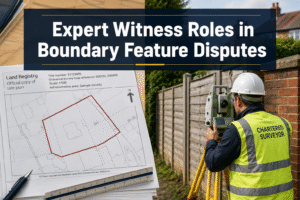

Boundary disputes in England and Wales are rising sharply. Land Registry data shows that title plan ambiguities affect hundreds of thousands of registered titles, and neighbour conflicts over fences, walls, and encroachments now rank among the most litigated property matters in the county courts. Against this backdrop, the choice between a Single Joint Expert (SJE) and party-appointed surveyors has never carried greater financial and strategic weight. This article delivers a rigorous cost-benefit analysis for 2026 resolutions, examining how each model performs under Civil Procedure Rules (CPR), what the real numbers look like, and which route gives property owners the best chance of a fast, affordable outcome.
Key Takeaways
- A Single Joint Expert typically costs 40-60% less than two party-appointed surveyors combined, making SJE the default preference of the courts in lower-value boundary disputes.
- Party-appointed surveyors offer stronger advocacy and tactical flexibility but almost always increase total dispute costs and timelines.
- CPR Part 35 governs expert evidence in civil proceedings; non-compliance with its protocols can result in evidence being excluded or costs sanctions applied.
- Land Registry title plans are drawn to a scale that cannot definitively fix boundaries — independent expert measurement is almost always required regardless of the model chosen.
- The right choice depends on dispute complexity, the value of land at stake, and whether the parties are willing to cooperate on a shared instruction.
Understanding the Two Expert Models in Boundary Disputes
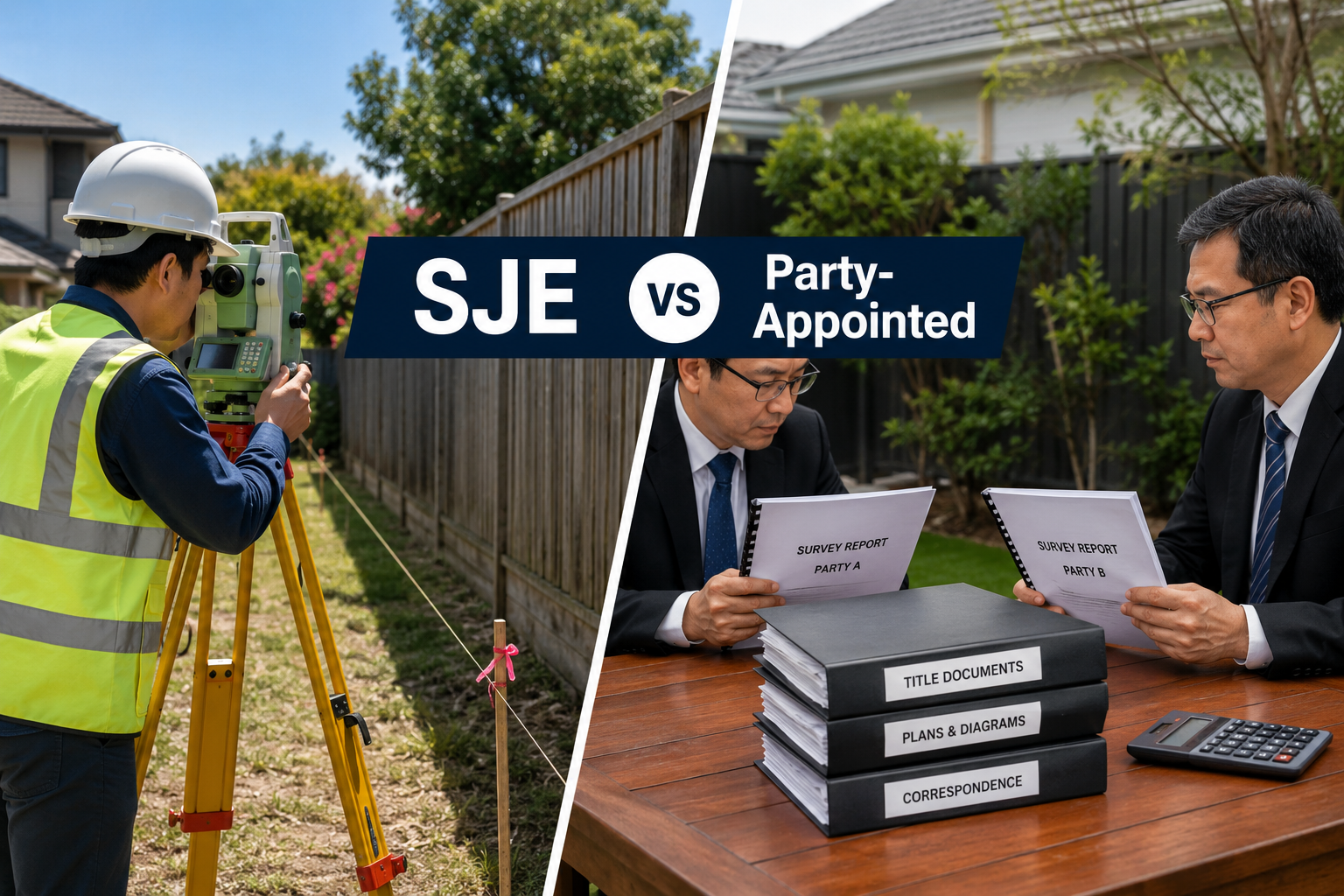
Before any cost-benefit analysis of Single Joint Expert vs Party-Appointed Surveyors in Boundary Disputes can be meaningful, it is essential to understand what each model actually involves and the legal framework that governs both.
What Is a Single Joint Expert?
A Single Joint Expert is one independent surveyor instructed jointly by both parties to a dispute. The SJE owes a duty to the court rather than to either party. Under CPR Part 35.7, courts actively encourage — and in many cases direct — the use of a single joint expert where the dispute turns on a question of fact that an expert can resolve without partisan input.
In a boundary context, the SJE will:
- Examine the title deeds and Land Registry title plans for both properties
- Carry out a measured survey of the physical boundary features
- Review historical maps, Ordnance Survey data, and aerial photography
- Produce a CPR-compliant expert report setting out findings and conclusions
The SJE's report is shared with both parties simultaneously. Neither side can instruct the expert privately without the other's knowledge.
What Are Party-Appointed Surveyors?
Each party instructs their own chartered surveyor to investigate the boundary and produce a report supporting that party's position. Both experts are still bound by CPR Part 35 duties — their overriding obligation is to the court, not the client — but in practice, party-appointed experts tend to present evidence in the most favourable light for the party who instructed them.
Where the two reports conflict, the court may:
- Order a joint meeting of experts to narrow the issues (CPR 35.12)
- Appoint an SJE to resolve the remaining disagreement
- Hear oral evidence from both experts at trial
For a broader understanding of how surveying expertise applies to neighbour-related property matters, the guide to boundary dispute and party wall surveyors in London provides useful context on how professionals approach these cases.
The Real Cost Comparison: SJE vs Dual Expert Instruction in 2026
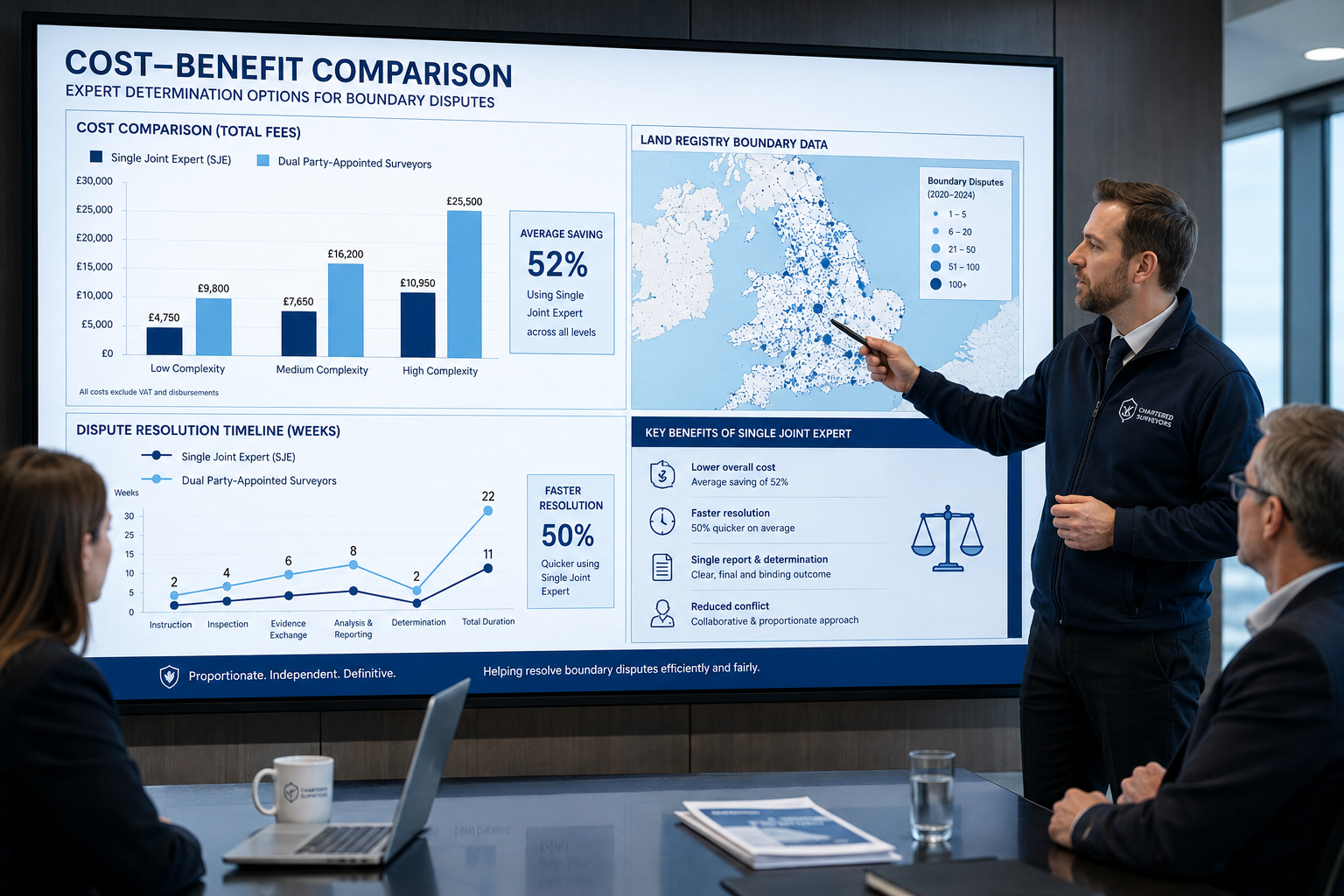
This is where the Single Joint Expert vs Party-Appointed Surveyors in Boundary Disputes: Cost-Benefit Analysis for 2026 Resolutions becomes concrete. The table below sets out realistic cost ranges based on current market rates for chartered surveyors in England and Wales.
Estimated Cost Breakdown (2026 Market Rates)
| Cost Element | Single Joint Expert | Party-Appointed (Each Party) |
|---|---|---|
| Initial site inspection | £800 – £1,500 | £800 – £1,500 per expert |
| Measured boundary survey | £1,200 – £2,500 | £1,200 – £2,500 per expert |
| CPR-compliant expert report | £1,500 – £3,000 | £1,500 – £3,000 per expert |
| Joint meeting / discussion | Included | £500 – £1,200 per expert |
| Attendance at trial | £1,500 – £3,500 | £1,500 – £3,500 per expert |
| Total (approximate) | £5,000 – £10,500 | £5,500 – £11,200 per party |
Key finding: Where both parties instruct separate experts and the dispute reaches trial, combined expert costs alone can reach £20,000 to £30,000 — before solicitor fees, court fees, and counsel costs are added. The SJE model caps the shared expert cost at roughly one-third of that figure.
Hidden Costs That Favour the SJE Model
Beyond the headline fees, party-appointed expert disputes carry several hidden cost drivers:
- Prolonged timelines. Coordinating two separate reports, arranging a joint meeting, and managing conflicting evidence typically adds three to six months to a dispute.
- Costs sanctions. Courts increasingly penalise parties who refuse a reasonable offer to appoint an SJE without good reason. A costs order can wipe out any tactical advantage gained.
- Increased solicitor time. Managing two expert witnesses, reviewing conflicting reports, and preparing cross-examination questions generates significant legal fees.
For property owners concerned about the financial exposure of a boundary dispute, understanding party wall surveyor costs provides a useful parallel, since the cost structures share many similarities.
When Party-Appointed Surveyors Justify the Extra Cost
Despite the cost premium, party-appointed surveyors are sometimes the right choice. The additional expense may be justified when:
- The land at stake has a high monetary value (typically above £50,000)
- The dispute involves complex historical title evidence requiring detailed expert interpretation
- One party has already commissioned a report that the other party disputes
- The case is likely to proceed to a full trial where cross-examination of experts is expected
- There is a significant imbalance of knowledge or resources between the parties
CPR Compliance, Land Registry Data, and Report Quality in 2026
The legal framework for expert evidence in boundary disputes is not optional. CPR Part 35 and the accompanying Practice Direction set mandatory standards that every expert report must meet, regardless of whether the expert is jointly or separately instructed.
What CPR Part 35 Requires
A compliant expert report in a boundary dispute must include:
- A statement of the expert's qualifications and relevant experience
- A clear statement of the facts and assumptions on which the opinion is based
- The methodology used to reach conclusions (survey methods, equipment, datum points)
- A statement of truth confirming the expert understands their duty to the court
- A declaration that the expert has not been influenced by the pressuring party
Non-compliant reports risk exclusion. Courts have struck out expert evidence that failed to meet CPR Part 35 standards, leaving the relevant party without expert support at trial.
For those dealing with related structural or construction matters alongside a boundary dispute, an expert witness report prepared to CPR standards is an essential component of any litigation strategy.
The Land Registry Title Plan Problem
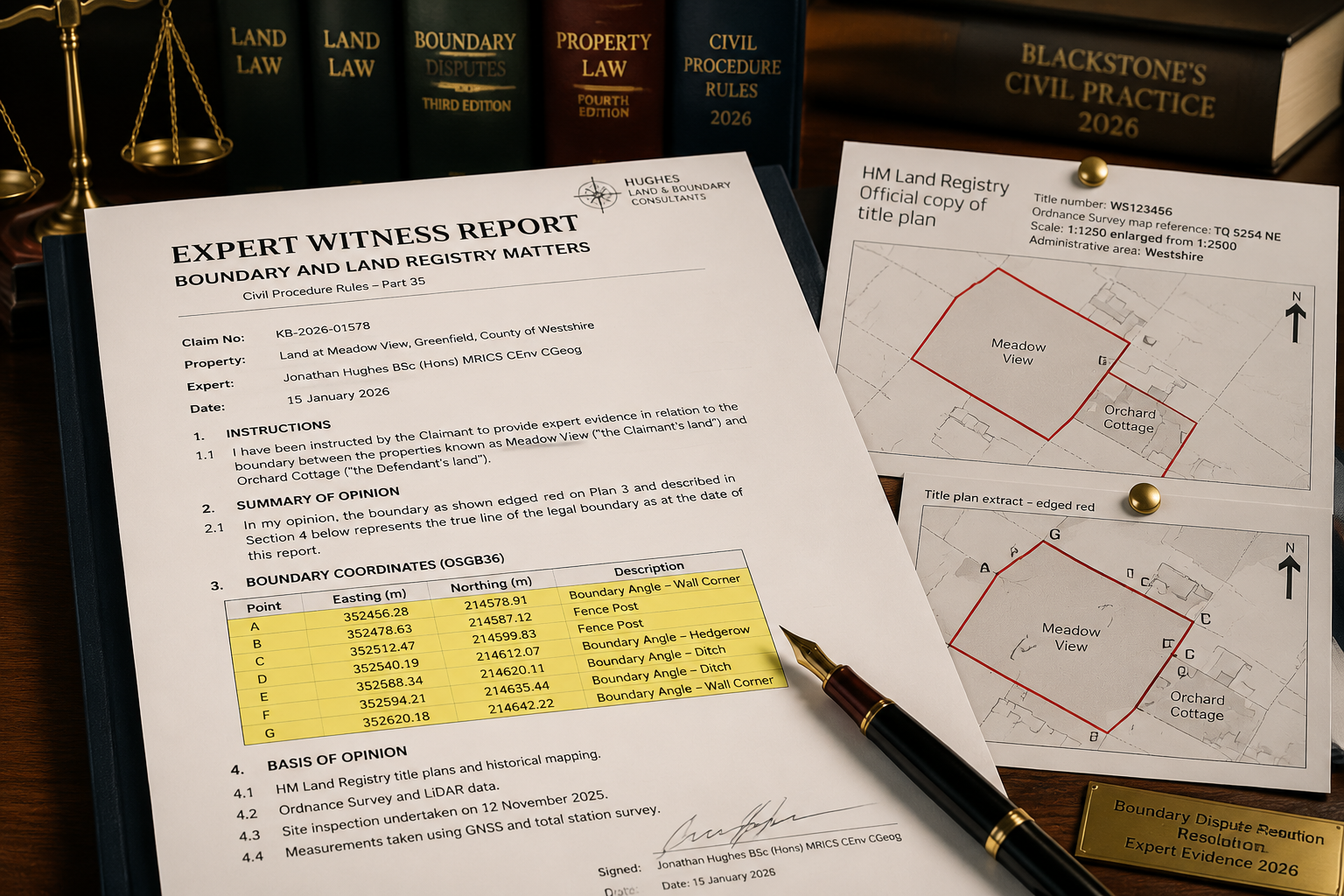
A persistent source of confusion in boundary disputes is the reliance on Land Registry title plans as definitive boundary evidence. They are not. The Land Registry's own guidance confirms that title plans are based on Ordnance Survey mapping drawn to scales of 1:1250 (urban) and 1:2500 (rural). At these scales, a line width on the plan can represent 500mm or more on the ground — enough to encompass an entire garden path.
This means:
- Title plans show the general position of boundaries, not their precise legal line
- The exact boundary must be determined by reference to the title deeds, conveyancing history, and physical features on the ground
- Expert measurement is almost always necessary to resolve a genuine dispute
Both SJEs and party-appointed surveyors must address this limitation in their reports. The SJE model has an advantage here: a single expert applying a consistent methodology avoids the scenario where two surveyors use different datum points or measurement conventions and reach contradictory conclusions for that reason alone.
CPR-Compliant Report Templates: What to Expect in 2026
Courts are increasingly scrutinising the structure of expert reports. A well-structured boundary dispute report in 2026 should follow this framework:
- Executive summary — key findings in plain language
- Instructions received — verbatim or summarised joint letter of instruction
- Documents reviewed — title deeds, Land Registry entries, historical maps, photographs
- Site inspection methodology — equipment used, survey control, datum references
- Findings — measured positions of boundary features with annotated plans
- Opinion — where the expert believes the legal boundary lies and why
- Areas of uncertainty — honest acknowledgement of limitations
- Statement of truth and CPR declaration
For disputes that also engage party wall legislation — which frequently overlaps with boundary questions — understanding what a party wall dispute involves helps clarify whether the boundary issue and the party wall issue need to be addressed separately or together.
Strategic Decision Framework: Choosing the Right Model for Your 2026 Dispute
The Single Joint Expert vs Party-Appointed Surveyors in Boundary Disputes: Cost-Benefit Analysis for 2026 Resolutions ultimately comes down to a structured decision based on four variables: dispute complexity, land value, relationship dynamics, and litigation risk appetite.
Decision Matrix
| Factor | Favours SJE | Favours Party-Appointed |
|---|---|---|
| Land value at stake | Below £30,000 | Above £50,000 |
| Dispute complexity | Straightforward title ambiguity | Complex historical or legal title issues |
| Party relationship | Willing to cooperate | Adversarial, no trust |
| Court direction | Court has ordered SJE | No court direction yet |
| Budget | Limited | Substantial |
| Timeline priority | Fast resolution needed | Prepared for extended litigation |
Practical Steps Before Instructing Any Expert
Step 1: Commission a professional boundary survey. Before engaging solicitors or experts, a measured survey of the disputed area gives both parties a factual baseline. This often resolves disputes without litigation. Detailed boundary surveys in London and surrounding areas provide this foundation.
Step 2: Check whether a party wall issue is also present. Many boundary disputes involve a shared wall or structure. If so, the party wall agreement process may need to run alongside the boundary resolution.
Step 3: Review the title deeds carefully. The conveyancing documents — not just the Land Registry plan — often contain boundary descriptions, references to physical features, or historical plans that resolve the question without expert evidence.
Step 4: Explore mediation. Courts expect parties to attempt alternative dispute resolution before issuing proceedings. A jointly instructed SJE can often support a mediated settlement without the need for any court involvement at all.
Step 5: If litigation is unavoidable, seek early directions. Apply to the court for case management directions at the earliest opportunity. Courts will typically direct whether an SJE or party-appointed experts are appropriate based on the value and complexity of the case.
The Role of Agreed Surveyors
In party wall matters that run alongside boundary disputes, the concept of an agreed surveyor is closely analogous to the SJE model. One surveyor acts for both parties, reducing cost and delay. The same logic applies in pure boundary cases where both parties are willing to cooperate.
For those navigating construction disputes resolution that have a boundary dimension — such as encroachment by a new structure — the choice of expert model is particularly important because construction cases often involve multiple expert disciplines and the boundary question may be just one of several contested issues.
Common Mistakes That Increase Costs in Boundary Disputes
Even with the right expert model in place, parties frequently make avoidable errors that drive up costs:
- Instructing an expert before reviewing the title deeds. Expert fees are wasted if the deeds contain a clear answer.
- Failing to agree a joint letter of instruction for an SJE. Poorly drafted instructions lead to reports that do not address the real issues.
- Ignoring CPR pre-action protocols. Jumping to litigation without following the pre-action protocol for property disputes can result in costs penalties even if the claim succeeds.
- Treating the Land Registry title plan as definitive. As noted above, this is a fundamental error that experienced surveyors frequently encounter.
- Choosing party-appointed experts for a low-value dispute. The combined expert costs can easily exceed the value of the land in dispute.
Conclusion
The choice between a Single Joint Expert and party-appointed surveyors is one of the most consequential decisions in any boundary dispute. For the majority of cases reaching resolution in 2026, the SJE model offers a compelling combination of lower cost, faster timelines, and court-preferred compliance with CPR Part 35. Party-appointed experts remain appropriate for high-value, high-complexity disputes where advocacy and detailed scrutiny of competing evidence justify the additional expense.
Actionable next steps for property owners facing a boundary dispute in 2026:
- Obtain a professional measured boundary survey before taking any legal steps.
- Review all title deeds and conveyancing documents with a solicitor experienced in property disputes.
- Propose a jointly instructed SJE to the other party at the earliest opportunity — courts will expect this.
- Ensure any expert instructed is a chartered surveyor with demonstrable CPR Part 35 compliance experience.
- Consider mediation supported by an SJE report as a cost-effective alternative to full litigation.
- If the dispute also involves a party wall, address both issues concurrently to avoid duplication of expert costs.
Taking these steps systematically gives property owners the best chance of a fair, affordable, and durable resolution — without the financial and emotional toll of protracted litigation.