The property surveying landscape is experiencing its most significant transformation in decades. As homebuyers increasingly demand transparency and accountability, the Royal Institution of Chartered Surveyors (RICS) has launched comprehensive initiatives to strengthen building survey quality standards, fundamentally reshaping how practitioners deliver services and manage client expectations in 2026.
Building Survey Quality Standards in 2026: RICS' New Strengthening Initiative and Practitioner Implementation represents more than regulatory updates—it signals a paradigm shift toward enhanced professional accountability, technological integration, and consumer protection. With the Home Survey Standard 2nd Edition undergoing extensive review and new AI standards taking effect this March, surveyors face both challenges and opportunities in adapting to these elevated benchmarks.
This transformation arrives at a critical juncture. Property transactions involve substantial financial commitments, and survey quality directly impacts buyer confidence, lender security, and market stability. The initiatives RICS has introduced address longstanding industry concerns about consistency, clarity, and professional competence while positioning the profession for future challenges.
Key Takeaways
- 📋 RICS Home Survey Standard 2nd Edition is undergoing comprehensive review through mid-2026, with enhanced clarity between mandatory requirements and recommended practices
- 🤖 New AI Standards become mandatory March 9, 2026, establishing global requirements for responsible artificial intelligence use across all surveying disciplines
- 📚 Revised CPD Framework launched January 2026, emphasizing outcomes-based learning in AI, sustainability, and evolving client needs
- ⚖️ Enhanced liability considerations emerge as quality standards strengthen, requiring surveyors to demonstrate compliance with more prescriptive requirements
- 🏘️ Expanded regulatory coverage includes Awaab's Law hazard requirements and new Residential Stock Condition Survey standards affecting housing sector practitioners
Understanding the RICS Quality Standards Strengthening Initiative
The Home Survey Standard 2nd Edition Review Process
The RICS Home Survey Standard serves as the foundational framework governing residential property surveys across the United Kingdom. In 2026, this critical standard is undergoing its most comprehensive review since implementation, driven by extensive stakeholder feedback and evolving market needs[1].
A project lead with over 20 years of surveying experience joined RICS in December 2025 specifically to guide the standard through its critical next phase. This appointment underscores the institution's commitment to ensuring the updated standard serves both public and professional interests effectively[1].
The review process prioritizes several key objectives:
Clarity Between Requirements and Recommendations
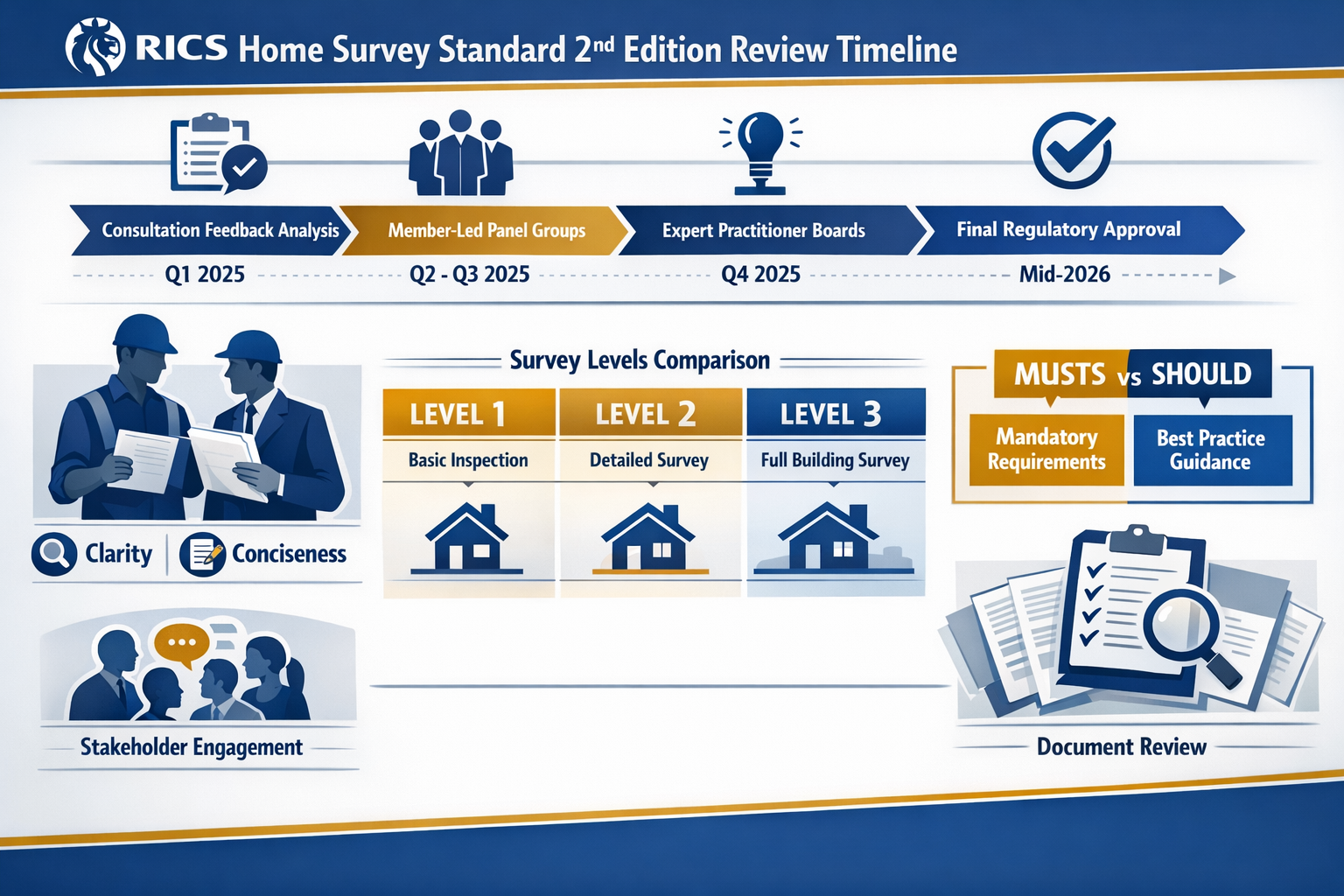
One of the most significant challenges practitioners have faced involves distinguishing mandatory requirements ('musts') from recommended best practices ('shoulds'). The updated standard will provide explicit guidance on these distinctions, reducing ambiguity and supporting more consistent service delivery[1].
Conciseness Without Compromising Comprehensiveness
Consultation feedback consistently highlighted the need for clearer, more concise requirements. RICS is carefully balancing prescriptiveness with surveyor competitiveness and accessibility for both practitioners and the public[1]. This balance proves particularly challenging—overly prescriptive standards may stifle professional judgment, while insufficient guidance can lead to inconsistent quality.
Multi-Stage Validation Through Professional Panels
Following consultation response analysis, the updated Home Survey Standard will proceed through member-led professional panel groups and expert practitioner boards before final regulatory approval. This lengthy process, extending through mid-2026, ensures thorough vetting and broad professional consensus[1].
For chartered surveyors in London and throughout the UK, these developments require proactive engagement. Understanding the evolving requirements positions practitioners to adapt procedures, update documentation, and communicate changes to clients effectively.
Why Quality Standards Matter More Than Ever
Building survey quality directly impacts multiple stakeholders:
- Homebuyers rely on surveys to make informed purchasing decisions, often representing their largest financial commitment
- Lenders require accurate property assessments to manage lending risk appropriately
- Sellers benefit from transparent, consistent survey practices that facilitate smoother transactions
- Surveyors need clear standards to demonstrate professional competence and manage liability exposure
The strengthened standards reflect recognition that today's property market demands enhanced transparency and accountability. As building surveying has adapted significantly in recent years, RICS has reinforced its commitment to professional standards emphasizing technical competence and ethical conduct[2].
Building Survey Quality Standards in 2026: Key Components of the Strengthening Initiative
The Three-Tier Survey Framework Enhancement
RICS maintains a three-tier framework for residential surveys, each designed for specific property types and client needs. The 2026 strengthening initiative enhances requirements across all levels:
| Survey Level | Primary Purpose | 2026 Enhancements |
|---|---|---|
| Level 1 (Condition Report) | Basic condition overview for conventional properties | Clearer scope limitations, enhanced defect categorization |
| Level 2 (HomeBuyer Report) | Detailed inspection for standard properties | Expanded reporting requirements, improved client communication protocols |
| Level 3 (Building Survey) | Comprehensive examination for complex/older properties | Enhanced thoroughness expectations, expanded advisory role clarification |
Level 3 Surveys: The Gold Standard
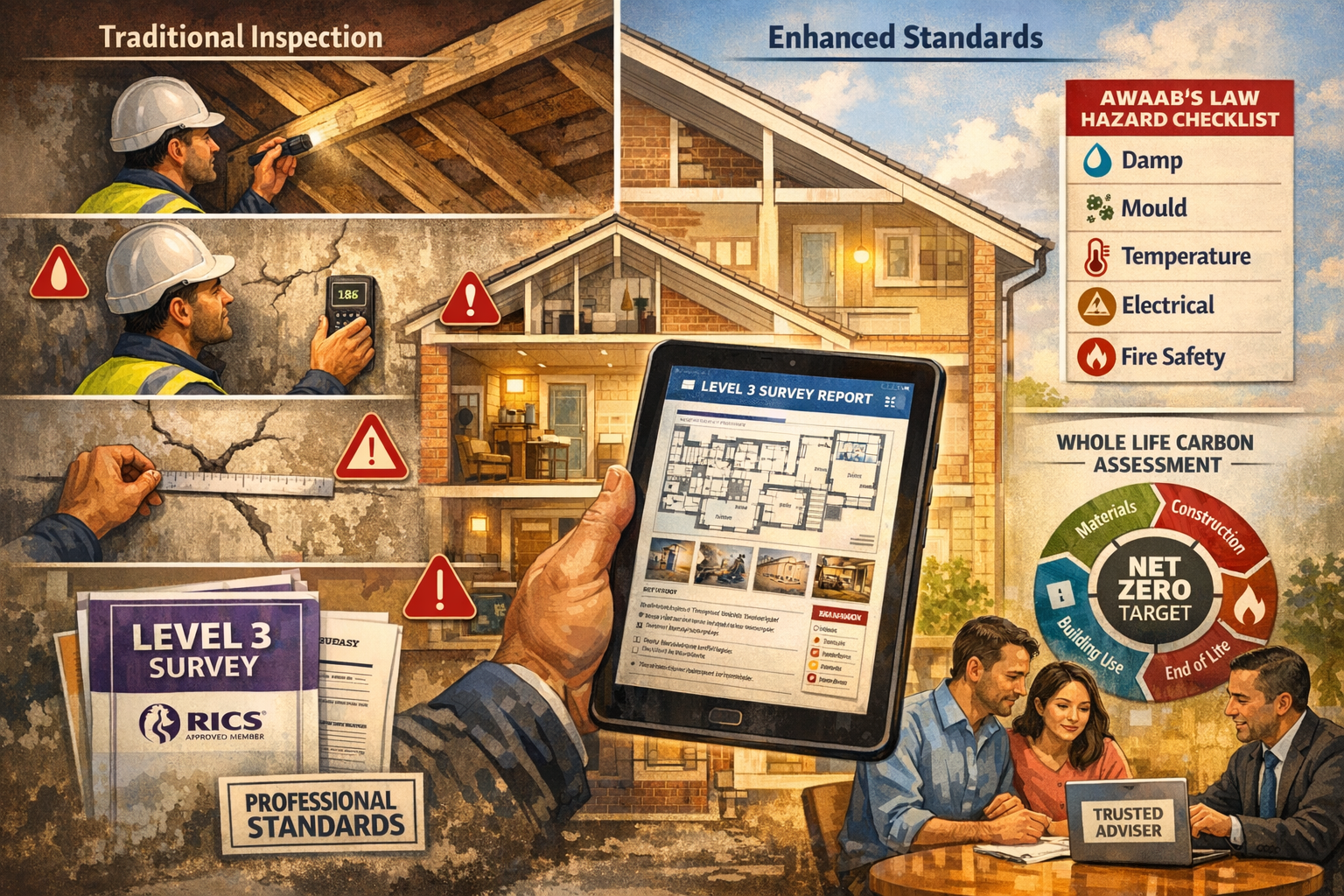
Following RICS standard updates, today's home surveys are significantly more comprehensive, with Level 3 surveys providing the most detailed property examinations available. Surveyors now function as trusted advisers who engage strategically with client needs beyond basic property inspection[2].
For those considering homebuyer report vs building survey options, understanding these enhanced standards helps match survey type to property complexity and risk tolerance.
Mandatory AI Standards Implementation
Perhaps the most transformative element of Building Survey Quality Standards in 2026: RICS' New Strengthening Initiative and Practitioner Implementation involves artificial intelligence integration. RICS has published the first global professional standard for responsible AI use in surveying practice, establishing mandatory requirements effective March 9, 2026[4][7].
Global Scope and Application
This standard applies worldwide across valuation, construction, infrastructure, and land services—not limited to valuations alone. The comprehensive scope reflects AI's expanding role throughout surveying disciplines[4][7].
Key Requirements Include:
✅ Transparency – Clear disclosure when AI tools contribute to survey analysis or conclusions
✅ Competence – Demonstrated understanding of AI tools' capabilities and limitations
✅ Data Quality – Ensuring AI systems utilize accurate, representative data sets
✅ Human Oversight – Maintaining professional judgment as the final authority
✅ Client Communication – Explaining AI's role in service delivery appropriately
Compliance Preparation Timeline
Surveying firms are advised to begin preparing policies and procedures immediately ahead of the March 9, 2026 implementation date. Early compliance offers competitive advantage with clients, enhanced professional risk protection, and stronger regulatory compliance records[4].
Practitioners conducting structural surveys in London and elsewhere must evaluate current workflows, identify AI integration points, and establish governance frameworks before the mandatory deadline.
The Revised CPD Framework
RICS implemented a redesigned Continuing Professional Development (CPD) framework in January 2026, shaped by widespread member consultation and approved by the RICS Standards and Regulation Board[5].
Outcomes-Based Approach
The new framework shifts from activity-based logging to outcomes-focused development, emphasizing:
- Artificial Intelligence competency development
- Environmental Sustainability knowledge and application
- Evolving Client Needs responsiveness and service innovation
- Professional Ethics reinforcement
- Technical Excellence maintenance and enhancement
Practical Implementation
Rather than simply accumulating hours, surveyors must demonstrate how professional development activities enhance competence and service quality. This outcomes-based approach aligns CPD more closely with actual practice improvement and client benefit[5].
The framework includes a new app facilitating easier tracking and documentation, reducing administrative burden while improving compliance monitoring.
Practitioner Implementation: Adapting to Enhanced Quality Standards
Operational Changes Required
Implementing Building Survey Quality Standards in 2026: RICS' New Strengthening Initiative and Practitioner Implementation requires systematic operational adjustments across surveying practices:
1. Documentation and Reporting Protocols
Enhanced standards demand more rigorous documentation practices:
- Standardized Templates aligned with updated Home Survey Standard requirements
- Enhanced Defect Categorization using consistent terminology and severity classifications
- Client Communication Protocols ensuring accessibility for non-technical audiences
- Quality Assurance Checklists verifying compliance with mandatory requirements
Practices offering snagging reports in London and comprehensive building surveys must review templates against updated standards, ensuring all mandatory elements receive appropriate coverage.
2. Technology Integration and AI Governance
The March 2026 AI standards necessitate formal technology governance:
- AI Tool Inventory documenting all artificial intelligence applications in survey workflows
- Competence Assessment ensuring staff understand AI capabilities and limitations
- Disclosure Protocols establishing when and how AI use is communicated to clients
- Quality Control Procedures maintaining human oversight of AI-generated insights
- Data Management Policies governing AI training data quality and representativeness
3. Staff Training and Development
Enhanced standards require corresponding competence development:
- Standard-Specific Training on updated Home Survey Standard requirements
- AI Literacy Programs building understanding of responsible AI use
- Sustainability Competence addressing Whole Life Carbon Assessment and environmental considerations
- Regulatory Updates covering Awaab's Law, Renters' Rights Act 2026, and related legislation
- Client Communication Skills enhancing ability to explain complex technical findings accessibly
Managing Liability in the Enhanced Standards Environment
Strengthened quality standards inevitably affect professional liability considerations. As requirements become more prescriptive and client expectations rise, surveyors must proactively manage risk exposure.
Enhanced Standard of Care
Courts and arbitration panels assess surveyor performance against prevailing professional standards. As RICS standards strengthen, the baseline for acceptable practice rises correspondingly. What might have been considered adequate five years ago may fall short of 2026 expectations.
Documentation as Protection
Comprehensive documentation serves dual purposes:
- Quality Assurance – Ensuring thorough, consistent service delivery
- Liability Defense – Demonstrating compliance with professional standards if disputes arise
Surveyors should maintain detailed records showing:
- Scope agreement and client instructions
- Inspection methodology and areas examined
- Limitations encountered and communicated
- Analysis supporting conclusions and recommendations
- Compliance with mandatory standard requirements
Professional Indemnity Insurance Considerations
Insurers increasingly scrutinize compliance with professional standards when underwriting policies and assessing claims. Demonstrating systematic compliance with Building Survey Quality Standards in 2026: RICS' New Strengthening Initiative and Practitioner Implementation may positively influence:
- Premium rates
- Coverage terms
- Claims defense support
- Policy renewal negotiations
Client Communication and Expectation Management
Enhanced standards create opportunities to strengthen client relationships through improved transparency and service quality.
Setting Appropriate Expectations
Clients selecting survey types need clear guidance matching property characteristics to appropriate survey levels. The question "what survey do you need" becomes more nuanced as standards evolve and survey comprehensiveness increases.
Explaining Value Proposition
As survey thoroughness and reporting detail increase, fees may adjust accordingly. Effective communication helps clients understand:
- The enhanced scope and depth of modern surveys
- How strengthened standards protect their interests
- The professional competence and accountability underlying service delivery
- The relationship between survey investment and informed decision-making
Transparency About AI Use
The new AI standards require appropriate disclosure when artificial intelligence contributes to survey analysis. Rather than viewing this as a compliance burden, forward-thinking practitioners can position AI integration as a value enhancement:
- Improved defect detection through thermal imaging analysis
- Enhanced data accuracy through automated measurement systems
- More comprehensive risk assessment through pattern recognition
- Faster turnaround without compromising thoroughness
Building Survey Quality Standards in 2026: Sector-Specific Implications
Residential Stock Condition Surveys
RICS has proposed a draft Residential Stock Condition Survey Code of Practice providing guidance standards and best practices for stock condition survey preparation and delivery in the housing sector[6]. This development particularly affects:
Social Housing Providers
Housing associations and local authorities managing substantial residential portfolios require systematic condition assessment to:
- Plan maintenance and capital investment programs
- Demonstrate regulatory compliance
- Support funding applications
- Ensure tenant safety and property standards
Property Management Companies
Organizations managing multiple residential properties benefit from standardized stock condition assessment approaches ensuring consistency and reliability.
Awaab's Law Compliance Requirements
Social landlords face phased regulatory expansion addressing hazardous property conditions. By 2026, hazard regulations extend beyond emergency damp and mould issues to include excess temperatures, falls, structural collapse, explosions, fire, electrical hazards, and domestic hygiene concerns. In 2027, coverage expands further to encompass remaining Housing Health & Safety Rating System (HHSRS) hazards except overcrowding[3].
Surveyors conducting stock condition assessments must ensure competence across this expanding hazard scope, with particular attention to:
- Damp and Mould Assessment – Identifying moisture sources and ventilation deficiencies
- Temperature Regulation – Evaluating heating systems and thermal performance
- Structural Safety – Assessing load-bearing elements and stability
- Fire Safety – Examining compartmentation, escape routes, and detection systems
- Electrical Safety – Identifying wiring hazards and installation deficiencies
Commercial and Specialized Survey Applications
While residential surveys receive primary focus in the Home Survey Standard review, enhanced quality expectations extend across surveying disciplines:
Dilapidations Surveys
Commercial property dilapidations surveys require meticulous documentation of lease compliance and property condition. Enhanced standards support more defensible assessments in what can become contentious negotiations.
Specific Defect Investigations
When clients require specific defect reports addressing particular concerns like subsidence or structural movement, enhanced standards ensure thorough investigation and clear reporting supporting informed decision-making.
Boundary Surveys
Boundary surveys in London and throughout the UK benefit from standardized approaches ensuring consistent quality and defensibility when disputes arise.
Environmental Sustainability and Whole Life Carbon Assessment

The 2nd Edition Standard and PAS 2080:2023
RICS strengthened its decarbonization commitment through the Professional Standard Whole Life Carbon Assessment for the Built Environment (2nd Edition) and adoption of PAS 2080:2023. These frameworks enable data-driven decisions from design through end-of-life, aligning with International Cost Management Standards (ICMS) 3rd Edition for global applicability[3].
Surveyor Implications
While whole life carbon assessment primarily affects design and construction professionals, building surveyors increasingly encounter sustainability considerations:
- Retrofit Assessment – Evaluating existing buildings for energy efficiency improvements
- Embodied Carbon – Understanding carbon implications of repair and replacement recommendations
- Lifecycle Planning – Advising clients on sustainable maintenance and upgrade strategies
- EPC Compliance – Ensuring recommendations support energy performance objectives
Integration with Survey Practice
Forward-thinking practitioners are incorporating sustainability considerations into survey reporting:
- Identifying opportunities for energy efficiency improvements
- Highlighting sustainable material alternatives for repairs
- Recommending renewable energy integration possibilities
- Supporting clients' environmental objectives alongside traditional survey functions
This expanded advisory role aligns with the enhanced "trusted adviser" concept emphasized in updated standards[2].
The Five Priority Topics for Spring 2026
The surveying profession is focusing on five critical areas that intersect with Building Survey Quality Standards in 2026: RICS' New Strengthening Initiative and Practitioner Implementation[3]:
1. RICS Professional Standard: Responsible Use of AI in Surveying Practice
As discussed extensively above, the March 9, 2026 implementation represents a watershed moment requiring immediate practitioner action.
2. Renters' Rights Act 2026
This legislation introduces significant changes affecting rental property standards and landlord obligations. Surveyors advising landlords or conducting rental property assessments must understand:
- Enhanced property condition requirements
- Tenant protection provisions
- Landlord compliance obligations
- Survey implications for rental property transactions
3. Awaab's Law Updates
The phased expansion of hazard coverage requires surveyors to develop competence across broadening risk categories, particularly those conducting social housing inspections or stock condition assessments.
4. Whole Life Carbon Assessment for the Built Environment (2nd Edition) with PAS 2080:2023
Environmental sustainability increasingly influences property valuation, investment decisions, and regulatory compliance, requiring surveyor awareness and competence.
5. RICS Sustainability Report 2025
This report establishes sustainability priorities and expectations affecting professional practice across surveying disciplines.
Competitive Advantage Through Quality Excellence
Differentiating Through Standards Compliance
As Building Survey Quality Standards in 2026: RICS' New Strengthening Initiative and Practitioner Implementation raises the professional baseline, early adopters gain competitive advantages:
Client Confidence
Demonstrating compliance with the latest standards signals:
- Professional competence and commitment to excellence
- Reduced risk of inadequate or incomplete surveys
- Enhanced reliability of findings and recommendations
- Alignment with best practices and regulatory expectations
Lender and Professional Relationships
Mortgage lenders, solicitors, and estate agents prefer working with surveyors demonstrating consistent quality and standards compliance. Strong professional relationships drive referral business and market reputation.
Reduced Complaint and Claim Exposure
Systematic compliance with enhanced standards reduces the likelihood of:
- Client complaints about service quality or thoroughness
- Professional negligence claims
- Regulatory investigations
- Reputational damage
Marketing Quality Excellence
Practices that invest in standards compliance can communicate this commitment through:
- Website Content – Explaining adherence to latest RICS standards and quality frameworks
- Client Communications – Highlighting enhanced survey thoroughness and reporting quality
- Professional Credentials – Showcasing CPD investment and technical competence
- Case Studies – Demonstrating value delivered through comprehensive, standards-compliant surveys
For chartered surveyors in Kingston, Richmond, and throughout the region, quality differentiation becomes increasingly important in competitive markets.
Practical Implementation Roadmap
Immediate Actions (Q1-Q2 2026)
Before March 9, 2026:
✅ Complete AI standards compliance preparation
✅ Document all AI tools used in survey workflows
✅ Establish disclosure protocols for AI use
✅ Train staff on responsible AI implementation
✅ Update client engagement documentation
Q2 2026:
✅ Review survey templates against draft Home Survey Standard updates
✅ Implement enhanced CPD tracking using new outcomes-based framework
✅ Assess staff competence gaps related to new standards
✅ Update quality assurance procedures
✅ Review professional indemnity insurance coverage
Medium-Term Actions (Q3-Q4 2026)
✅ Finalize template updates following Home Survey Standard publication
✅ Complete staff training on updated standard requirements
✅ Implement enhanced documentation protocols
✅ Develop sustainability competence for whole life carbon considerations
✅ Review and update fee structures reflecting enhanced service delivery
✅ Strengthen client communication materials explaining quality enhancements
Long-Term Strategic Positioning (2027 and Beyond)
✅ Establish reputation for quality excellence and standards leadership
✅ Develop specialized expertise in emerging areas (AI, sustainability, stock condition)
✅ Build strong professional networks supporting referral business
✅ Maintain proactive engagement with evolving RICS standards
✅ Invest in technology and training supporting continued excellence
Challenges and Opportunities
Implementation Challenges
Resource Investment Requirements
Enhanced standards require investment in:
- Staff training and development
- Technology and AI governance systems
- Documentation and quality assurance infrastructure
- Professional development and CPD activities
Smaller practices may find resource requirements challenging, though the investment ultimately supports risk reduction and competitive positioning.
Balancing Prescription with Professional Judgment
As standards become more prescriptive, surveyors must maintain appropriate professional judgment. The art of surveying involves interpreting findings in context—overly rigid adherence to checklists risks missing nuanced issues requiring experienced assessment.
Managing Client Expectations and Fees
Enhanced thoroughness and reporting quality may necessitate fee adjustments. Communicating value effectively while remaining competitive requires skillful client relationship management.
Strategic Opportunities
Market Leadership Positioning
Practices embracing enhanced standards early can establish market leadership, building reputation for quality excellence that drives long-term business development.
Service Expansion
New standards create opportunities for specialized services:
- AI-enhanced survey analysis
- Sustainability and carbon assessment integration
- Awaab's Law compliance surveys for social housing
- Stock condition assessment for property portfolios
- Enhanced advisory services leveraging "trusted adviser" role
Professional Development and Career Advancement
Surveyors investing in competence development aligned with enhanced standards position themselves for career advancement and professional recognition.
Conclusion: Embracing Quality Excellence in 2026 and Beyond
Building Survey Quality Standards in 2026: RICS' New Strengthening Initiative and Practitioner Implementation represents a defining moment for the surveying profession. The comprehensive initiatives RICS has launched—from Home Survey Standard updates to mandatory AI standards and revised CPD frameworks—collectively elevate professional expectations and service quality across the industry.
For practitioners, these changes require proactive engagement, systematic implementation, and sustained commitment to excellence. The challenges are real: resource investment, operational adjustments, and enhanced accountability all demand attention and effort. However, the opportunities are equally significant: competitive differentiation, reduced liability exposure, enhanced client relationships, and professional advancement all flow from quality excellence.
The strengthened standards ultimately serve the public interest by ensuring consistent, competent, and ethical survey practice. As trusted advisers guiding clients through significant property decisions, surveyors bear substantial responsibility. Enhanced standards provide the framework supporting that responsibility effectively.
Actionable Next Steps
For Individual Surveyors:
- Review the AI Standards before the March 9, 2026 deadline and ensure personal compliance
- Engage with CPD Requirements using the new outcomes-based framework to develop competence in priority areas
- Monitor Home Survey Standard Updates and prepare to implement changes as finalized
- Assess Personal Competence Gaps particularly regarding AI, sustainability, and expanding hazard categories
- Invest in Professional Development aligned with evolving standards and client needs
For Surveying Practices:
- Conduct Comprehensive Standards Audit identifying gaps between current operations and enhanced requirements
- Develop Implementation Roadmap with clear timelines, responsibilities, and resource allocation
- Invest in Staff Training ensuring team-wide competence with new standards
- Update Documentation and Procedures aligning templates, checklists, and protocols with enhanced requirements
- Communicate Quality Commitment to clients, professional contacts, and the market
- Review Insurance Coverage ensuring professional indemnity policies reflect enhanced service delivery
For Clients and Property Professionals:
- Understand Enhanced Standards and how they protect your interests
- Select Surveyors Demonstrating Standards Compliance and quality commitment
- Engage with Survey Findings asking questions and seeking clarification as needed
- Recognize Survey Value as informed decision-making support, not mere compliance exercise
The journey toward enhanced quality standards continues throughout 2026 and beyond. Those who embrace this evolution position themselves for success in an increasingly professional, accountable, and client-focused surveying landscape. The strengthening initiative RICS has launched ultimately benefits everyone: surveyors gain clearer guidance and professional credibility, clients receive more reliable and comprehensive services, and the property market operates with enhanced transparency and confidence.
Quality excellence is not a destination but a continuous journey. Building Survey Quality Standards in 2026: RICS' New Strengthening Initiative and Practitioner Implementation provides the roadmap—now comes the commitment to follow it with diligence, integrity, and professional pride. 🏗️✨
References
[1] Home Survey Standard 2nd Edition A Progress Update – https://www.rics.org/news-insights/home-survey-standard-2nd-edition-a-progress-update
[2] Things About Building Surveying You Need To Know In 2026 – https://mcessex.co.uk/2026/01/23/things-about-building-surveying-you-need-to-know-in-2026/
[3] pbctoday.co.uk – https://www.pbctoday.co.uk/news/planning-construction-news/five-hot-topics-for-surveyors-spring-2026/158511/
[4] Rics Ai Standards For Surveyors – https://goreport.com/rics-ai-standards-for-surveyors/
[5] Revised Cpd Framework Effective 2026 New App – https://www.rics.org/news-insights/revised-cpd-framework-effective-2026-new-app
[6] Update From Justin Young Rics Ceo January 2026 – https://www.rics.org/news-insights/update-from-justin-young-rics-ceo-january-2026
[7] Rics Launches Landmark Global Standard On Responsible Use Of Ai In Surveying – https://www.rics.org/news-insights/rics-launches-landmark-global-standard-on-responsible-use-of-ai-in-surveying