

{"cover":"Professional landscape format (1536x1024) hero image featuring bold text overlay 'Party Wall Act Essentials for 2026 EV Charger and Heat Pump Retrofits on Shared Boundaries' in extra large 72pt white sans-serif font with dark shadow effect, positioned in upper third with perfect alignment. Background shows modern semi-detached UK terraced houses with visible shared party wall boundary line, one side displaying wall-mounted EV charger and external heat pump unit on exterior wall near property line. Foreground includes architectural blueprints, surveyor's measuring tools, and Party Wall notice documents. Color scheme: deep navy blue, bright electric green accents, white text. High contrast, magazine cover quality, editorial photography style with professional lighting. Rule of thirds composition, visually balanced with technical accuracy representing 2026 net zero retrofit challenges.","content":["Detailed landscape format (1536x1024) illustration showing cross-section technical diagram of UK terraced house party wall with labeled components: shared brick boundary wall, neighboring properties on each side, wall-mounted EV charging point installation with electrical conduit running through party wall structure, technical annotations showing drilling points and cable routes. Include surveyor's clipboard with Party Wall notice form in foreground, measuring tape across wall thickness, and calendar showing 2-month notice period timeline. Color-coded sections highlighting affected party wall areas in yellow, work zones in orange. Professional architectural drawing style with clean lines, measurements in millimeters, British building regulations aesthetic, informational infographic quality.","Comprehensive landscape format (1536x1024) visual comparison chart showing two scenarios side-by-side: LEFT panel displays 'Heat Pump Installation - Party Wall Considerations' with external air source heat pump unit mounted on shared boundary wall, foundation excavation for ground loops near party wall, technical specifications overlay. RIGHT panel shows 'EV Charger Installation - Boundary Work Requirements' with wall-mounted charging unit, electrical supply routing through party structure, cable management systems. Both panels include surveyor figures with hard hats inspecting work, Party Wall Award documents, and timeline indicators. Split-screen infographic style with clear labels, measurement callouts, British Standard compliance badges, professional construction photography aesthetic with technical diagram overlays.","Detailed landscape format (1536x1024) office scene photograph showing professional party wall surveyor consultation meeting: large desk with spread documents including Party Wall notice templates, Schedule of Condition reports, Award agreements, and dispute resolution paperwork. Background wall displays flowchart poster showing complete Party Wall Act process from initial notice through to Award completion, with timeline markers for 1-month and 2-month notice periods clearly visible. Foreground shows surveyor's hands pointing to cost breakdown spreadsheet displaying £750-£1,800 fee ranges, neighboring property diagrams, and 2026 calendar highlighting key dates. Modern British surveyor office interior, natural lighting, professional business aesthetic, document-focused composition with clear readable text on forms, RICS certification visible on wall."]}

As the UK accelerates toward net zero targets in 2026, homeowners and property developers face a critical challenge: installing EV chargers and heat pumps while navigating the complex requirements of the Party Wall Act. Understanding the Party Wall Act Essentials for 2026 EV Charger and Heat Pump Retrofits on Shared Boundaries has never been more important, especially as renewable energy installations increasingly involve work on or near shared property lines.
The intersection of green technology mandates and century-old boundary legislation creates unique compliance challenges. Whether you're mounting an air source heat pump on a shared wall or running electrical conduit for an EV charging point through party structures, the legal framework governing these installations demands careful attention. ⚡
Key Takeaways
- Notice periods matter: You must serve a Party Wall notice 2 months before building on/at boundaries, or 1 month for work on existing party walls[2]
- Surveyor costs add up: Expect £750–£1,800 per affected neighbour for your surveyor, plus potential costs for dissenting neighbours' surveyors, totaling £1,500–£3,600 per neighbour in London[2]
- Silence triggers formal process: If neighbours don't respond within 14 days, it's deemed dissent and requires a formal Party Wall Award[2]
- The Act applies separately from planning: Even Permitted Development renewable installations need Party Wall compliance when affecting shared boundaries[2]
- Timeline planning is critical: The complete process takes 2–4 months minimum from notice to Award, delaying your net zero retrofit[2]
Understanding the Party Wall Act Framework for Green Retrofits
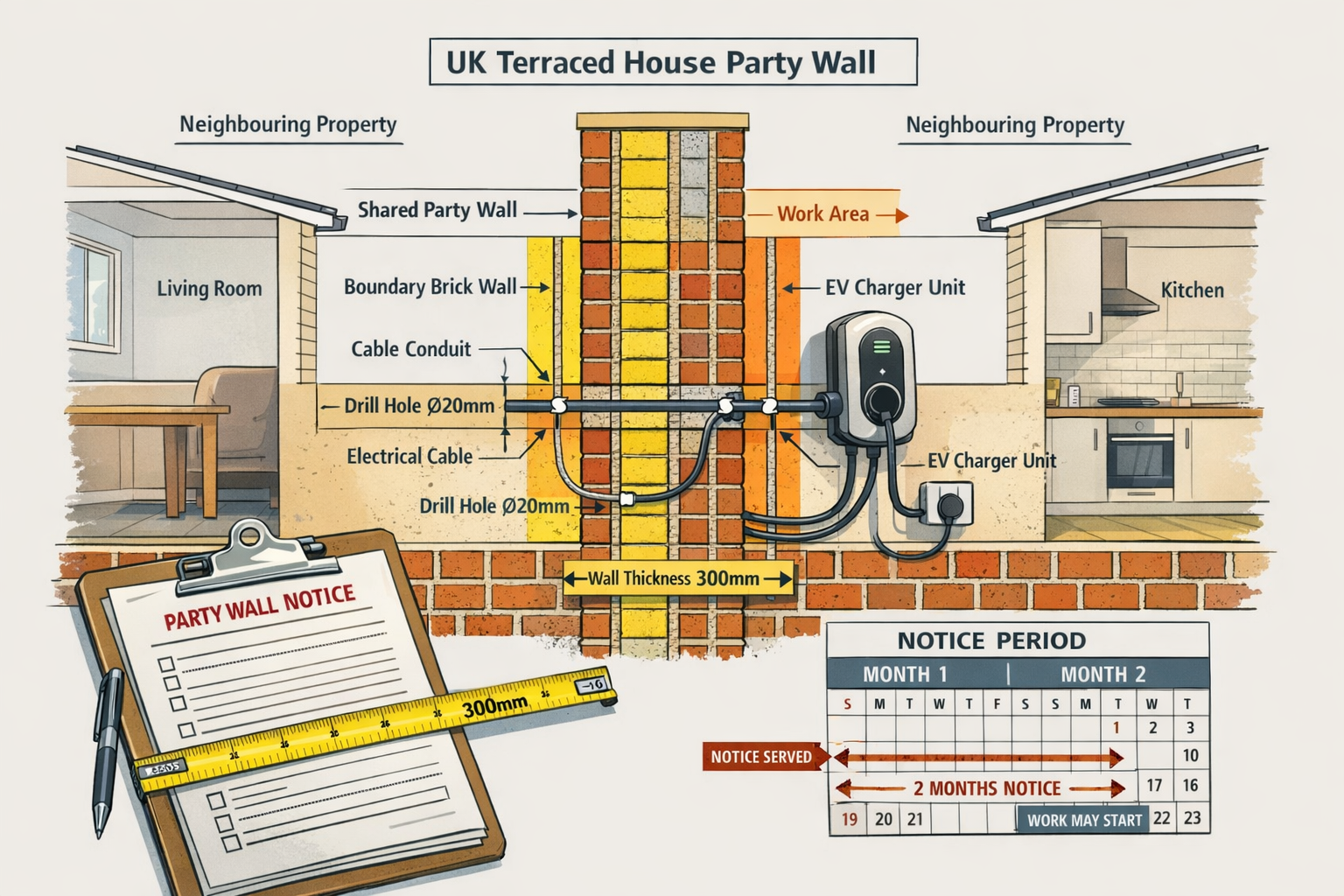
The Party Wall etc. Act 1996 applies exclusively to England and Wales, establishing the legal framework for work affecting shared walls, boundary structures, and excavations near neighbouring properties[1]. While originally designed for traditional building extensions and structural alterations, this legislation now governs the installation of renewable energy systems that interact with party boundaries.
What Constitutes Party Wall Work in 2026 Renewable Installations?
For EV charger and heat pump retrofits, Party Wall Act compliance becomes necessary when:
- Drilling or cutting into party walls to install mounting brackets, electrical conduits, or refrigerant pipes
- Building new structures on boundary lines, such as standalone charging station enclosures or heat pump housing
- Excavating within 3-6 meters of neighbouring buildings for ground source heat pump loops or underground electrical supply
- Installing insulation on party walls to improve thermal efficiency around heat pump installations
The rise in party wall insulation projects demonstrates how energy efficiency work increasingly intersects with boundary legislation.
Types of Party Wall Notices Required
Understanding which notice applies to your specific renewable installation determines your timeline and compliance pathway:
| Notice Type | Application | Notice Period | Common Green Retrofit Scenarios |
|---|---|---|---|
| Line of Junction Notice | Building new walls on/at boundary | 2 months | Standalone EV charging stations, heat pump enclosures |
| Party Structure Notice | Work to existing party walls | 2 months | Mounting heat pumps on shared walls, running conduit through party structures |
| 3-Meter/6-Meter Notice | Excavation near boundaries | 1 month | Ground source heat pump loops, underground electrical supply |
Each notice must contain specific technical details about the proposed work, including precise locations, depths, materials, and construction methods[2]. For complex installations involving multiple notice types, professional surveyor guidance becomes essential.
Party Wall Act Essentials for 2026 EV Charger Installations on Boundaries
Electric vehicle charging infrastructure presents unique Party Wall challenges, particularly in densely populated urban areas where properties share walls and boundaries. The government's push for widespread EV adoption by 2030 means thousands of charging points will require installation in terraced houses, semi-detached properties, and converted flats—all scenarios involving party boundaries.
When EV Charger Work Triggers Party Wall Requirements
Wall-mounted chargers are the most common installation type, and they trigger Party Wall procedures when:
- The mounting wall is a party wall shared with a neighbour
- Electrical supply routing requires drilling through party structures
- Foundation work is needed for supporting posts near the boundary line
- Cable trenches run within 3 meters of neighbouring foundations
Even if your EV charger qualifies as Permitted Development under planning regulations, you still must comply with Party Wall legislation if the installation affects shared boundaries[2]. These are separate legal frameworks with distinct requirements.
Technical Considerations for Boundary EV Installations
Modern EV chargers typically require 7kW to 22kW power supplies, necessitating substantial electrical work. When this infrastructure crosses party boundaries, surveyors must assess:
- Structural impact of drilling for cable routes through party walls
- Vibration and noise from electrical equipment affecting neighbours
- Fire safety considerations for electrical installations on shared structures
- Access rights for ongoing maintenance and future upgrades
A comprehensive Party Wall agreement should specify exactly where cables penetrate party structures, the diameter of drilled holes, fire-stopping materials, and maintenance access provisions.
Cost Implications and Timeline Planning
For a typical terraced house EV charger installation affecting one party wall:
Direct costs:
- Your appointed surveyor: £750–£1,800
- Neighbour's surveyor (if they dissent): £750–£1,800 (you pay both)
- Total surveyor fees: £1,500–£3,600 per affected neighbour[2]
Timeline:
- Party Structure Notice: 2 months before work begins
- Neighbour response period: 14 days
- Award preparation (if dissent): 4–8 weeks
- Total minimum timeline: 3–4 months
Understanding party wall surveyor costs helps budget accurately for the complete installation project, not just the charging equipment itself.
Heat Pump Retrofits and Party Wall Act Essentials for Shared Boundaries
Air source heat pumps (ASHPs) and ground source heat pumps (GSHPs) represent the government's preferred residential heating solution for achieving net zero targets. However, their installation often creates more complex Party Wall scenarios than EV chargers due to their size, foundation requirements, and operational characteristics.
Air Source Heat Pump Installations on Party Boundaries
ASHPs typically mount on external walls or stand on ground-level pads. Party Wall considerations include:
Mounting on party walls:
- Bracket fixings penetrating shared masonry
- Weight loading on party structures (units weigh 40–120kg)
- Vibration transmission through party walls during operation
- Condensate drainage affecting shared foundations
Ground-mounted units near boundaries:
- Concrete pad foundations within 3 meters of neighbour's building
- Excavation for electrical and refrigerant line burial
- Noise impact on adjoining properties (units operate at 40–60 decibels)
The Permitted Development rights for heat pumps (introduced to accelerate adoption) do not exempt installations from Party Wall requirements. A common misconception causes costly delays when homeowners discover they need both planning compliance AND Party Wall procedures[5].
Ground Source Heat Pump Excavation Requirements
GSHPs involve the most extensive Party Wall implications due to significant excavation:
Horizontal loop systems:
- Trenches 1.5–2 meters deep across large garden areas
- Potential excavation within 3 meters of neighbouring structures
- Soil removal and replacement affecting ground stability
Vertical borehole systems:
- Drilling 70–200 meters deep, potentially affecting neighbouring foundations
- Specialist geological surveys required
- More expensive but smaller surface footprint
For any excavation within 3 meters of a neighbouring building's foundation (or 6 meters if going deeper than the neighbour's foundation), you must serve a 3-Meter or 6-Meter Notice one month before work begins[2].
Managing Noise and Vibration Disputes
Heat pumps operate continuously during heating seasons, creating potential for party wall disputes related to:
- Low-frequency vibration transmitted through party structures
- Operational noise during night-time heating cycles
- Compressor cycling creating intermittent disturbance
A thorough Party Wall Schedule of Condition documenting the pre-installation state of neighbouring properties protects both parties. This photographic and written record establishes baseline conditions for any future damage claims.
Combining Heat Pump and Insulation Projects
Many 2026 retrofits combine heat pump installation with enhanced wall insulation to maximize efficiency. When adding external wall insulation (EWI) or internal wall insulation (IWI) to party walls, additional Party Wall considerations emerge:
- Thickness changes affecting boundary positions
- Fixings penetrating party structures
- Moisture barrier installations affecting shared walls
- Fire resistance modifications to party wall construction
These combined projects require comprehensive Party Structure Notices covering all aspects of the work.
Navigating the Party Wall Notice and Award Process for 2026 Retrofits
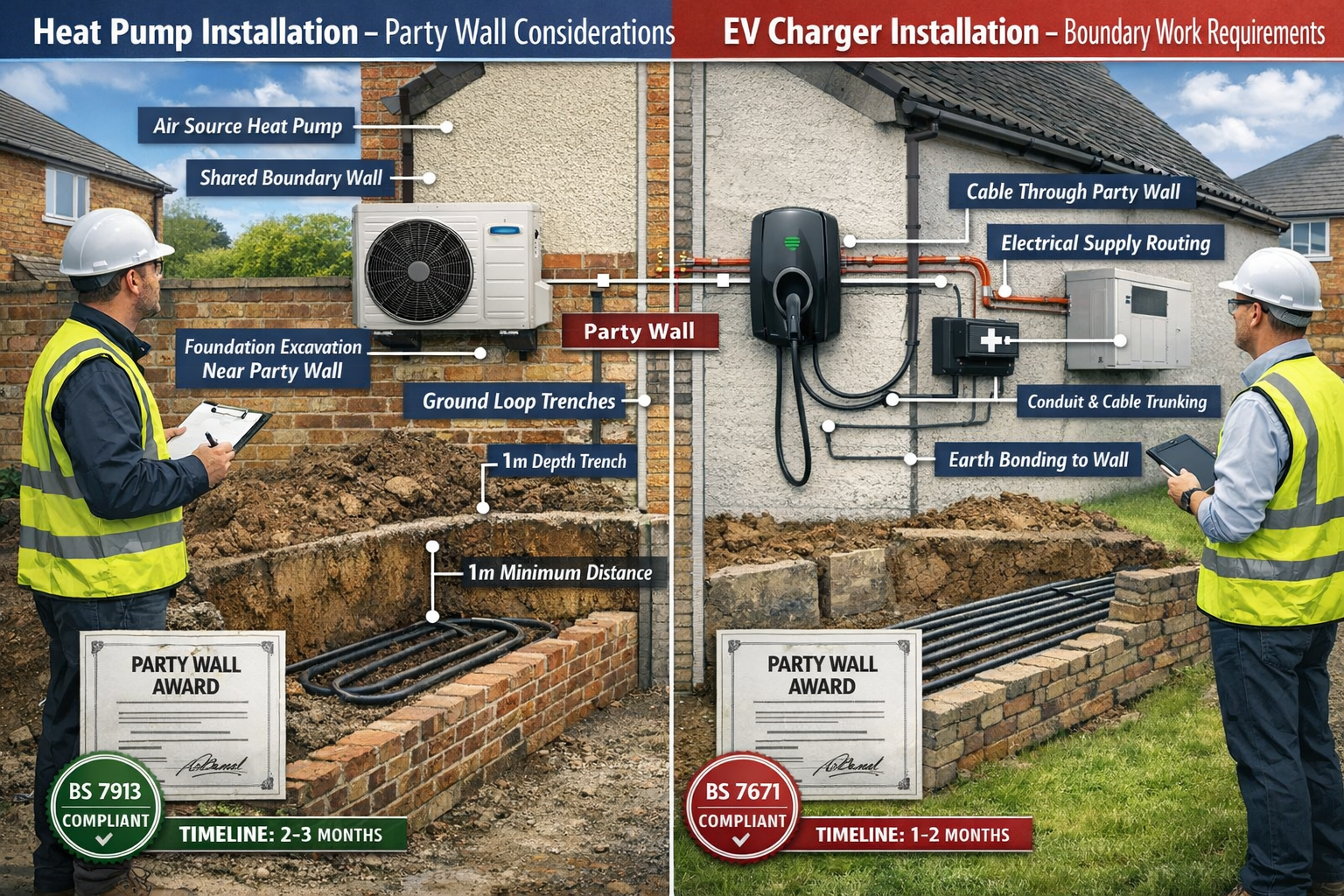
Successfully managing Party Wall Act Essentials for 2026 EV Charger and Heat Pump Retrofits on Shared Boundaries requires understanding the formal procedural steps and potential complications.
Step 1: Determine Notice Requirements
Before serving any notice, conduct a thorough assessment:
- Identify all affected neighbours (not just immediately adjacent properties)
- Classify the work type (building on boundary, party structure work, or excavation)
- Measure distances from boundaries and neighbouring foundations accurately
- Document existing conditions through photographs and notes
Professional surveyors often discover that renewable installations affect multiple neighbours, each requiring separate notices and potentially separate Awards.
Step 2: Prepare and Serve Formal Notices
Party Wall notices must contain specific information mandated by the Act[1]:
Essential notice contents:
- Your name and address as the building owner
- Precise description of the proposed work
- Technical drawings showing locations and dimensions
- Proposed start date (respecting minimum notice periods)
- Statement of the neighbour's rights under the Act
Notices must be served in writing to all affected adjoining owners. Electronic service is increasingly accepted but physical delivery via recorded post provides better evidence of compliance.
Step 3: Neighbour Response and Consent
After receiving your notice, neighbours have 14 days to respond in one of three ways:
✅ Consent in writing – Work can proceed without an Award (rare for significant installations)
❌ Dissent or raise concerns – Triggers formal Award process requiring surveyors
⏱️ No response – Deemed dissent after 14 days, requiring Award process[2]
Understanding party wall consent procedures helps set realistic expectations. In practice, most neighbours either don't respond or dissent, especially for substantial renewable installations.
Step 4: Appointing Surveyors
When neighbours dissent or don't respond, the Act requires surveyor appointment:
Three surveyor options:
- Agreed Surveyor – One surveyor acts for both parties (cost-effective but requires cooperation)
- Two Surveyors – Each party appoints their own surveyor (most common approach)
- Three Surveyors – Two party-appointed surveyors plus a third independent surveyor (for complex disputes)
You, as the building owner, bear all surveyor costs for both sides[2]. This includes your surveyor's fees AND your neighbour's surveyor's fees, making budgeting essential.
For guidance on this process, review information about party wall agreed surveyors.
Step 5: Award Preparation and Agreement
Appointed surveyors will:
- Inspect both properties to document existing conditions
- Review technical plans for the EV charger or heat pump installation
- Negotiate protective measures such as vibration isolation or noise barriers
- Prepare the Award – a legally binding document setting out:
- Detailed work descriptions
- Working hours and access arrangements
- Protective measures and construction methods
- Dispute resolution procedures
- Cost allocation
The Award process typically takes 4–8 weeks once surveyors are appointed, adding to your overall project timeline[2].
Step 6: Commencing Work and Ongoing Compliance
Once the Award is issued, you can legally begin work, but must:
- Adhere strictly to Award conditions and specifications
- Provide access for the neighbour's surveyor to monitor progress
- Document compliance through photographs and progress reports
- Address any damage to neighbouring property promptly
Failure to comply with Award terms can result in injunctions halting your renewable installation mid-project, creating expensive delays and potential legal liability.
Common Pitfalls and How to Avoid Them in 2026 Green Retrofits
Pitfall 1: Assuming Permitted Development Exempts Party Wall Compliance
The mistake: Homeowners believe that because heat pumps and EV chargers qualify as Permitted Development, they don't need Party Wall procedures.
The reality: Planning permission and Party Wall legislation are completely separate legal frameworks[2]. Even if your installation doesn't require planning approval, it still triggers Party Wall requirements when affecting shared boundaries.
The solution: Always assess Party Wall implications independently from planning considerations, consulting specialists in both areas.
Pitfall 2: Underestimating Costs and Timelines
The mistake: Budgeting only for equipment and installation, ignoring surveyor fees and delay costs.
The reality: Party Wall surveyor fees of £1,500–£3,600 per neighbour can exceed the cost of the EV charger itself. Timeline delays of 2–4 months can push installations past grant deadlines or seasonal weather windows[2].
The solution: Include comprehensive Party Wall costs and timelines in initial project planning, with contingency buffers for complications.
Pitfall 3: Poor Communication with Neighbours
The mistake: Serving formal notices without prior informal discussion, creating adversarial relationships.
The reality: While formal notices are legally required, advance communication often secures cooperation and reduces dissent rates.
The solution: Discuss your renewable installation plans with neighbours before serving formal notices, explaining benefits and addressing concerns proactively.
Pitfall 4: Inadequate Pre-Work Documentation
The mistake: Failing to comprehensively document existing conditions before installation begins.
The reality: Without thorough pre-work records, you may face unfounded damage claims or inability to prove pre-existing conditions.
The solution: Commission professional Schedule of Condition surveys documenting neighbouring properties in detail before any work commences.
Pitfall 5: DIY Notice Preparation
The mistake: Using template notices without professional review or customization for specific installations.
The reality: Incorrectly prepared notices may be invalid, requiring re-service and restarting notice periods, adding months to timelines.
The solution: Engage experienced party wall surveyors to prepare and serve notices correctly the first time, especially for complex renewable installations.
Strategic Recommendations for Surveyors and Property Professionals
For surveyors guiding clients through Party Wall Act Essentials for 2026 EV Charger and Heat Pump Retrofits on Shared Boundaries, consider these professional strategies:
1. Develop Renewable Installation Expertise 🔧
The surge in green retrofit demand creates opportunities for surveyors who understand both Party Wall legislation and renewable technology specifications. Familiarize yourself with:
- Standard EV charger mounting requirements and electrical specifications
- Heat pump installation best practices and noise mitigation techniques
- British Standards for renewable installations (MCS standards)
- Building Regulations Part L (conservation of fuel and power)
This technical knowledge enables more accurate Awards and better client service.
2. Create Standardized Assessment Protocols
Develop systematic checklists for evaluating renewable installations:
- Boundary proximity measurements using laser distance tools
- Party wall identification through title deed review and site inspection
- Neighbour identification from Land Registry records
- Notice type determination based on work classification
- Risk assessment for potential disputes or complications
Standardization improves consistency and reduces oversight errors.
3. Build Relationships with Renewable Installers
Establish partnerships with reputable heat pump and EV charger installation companies. These relationships enable:
- Early project involvement before installation contracts are signed
- Technical collaboration on Award specifications and protective measures
- Streamlined communication during installation monitoring
- Referral networks benefiting both surveying and installation businesses
Installers increasingly recognize that Party Wall compliance expertise adds value to their service offerings.
4. Leverage Technology for Efficiency
Modern surveying tools accelerate Party Wall processes:
- Digital notice templates customized for renewable installations
- Photographic documentation apps with GPS tagging and timestamps
- 3D modeling software visualizing installations in relation to boundaries
- Project management platforms tracking notice periods and response deadlines
Technology investment improves service delivery and client satisfaction.
5. Educate Clients Proactively
Provide clear, accessible guidance on Party Wall requirements:
- Informational handouts explaining the process in plain language
- Timeline visualizations showing notice periods and Award preparation
- Cost breakdowns with realistic ranges for different scenarios
- FAQ resources addressing common concerns and misconceptions
Well-informed clients make better decisions and experience less anxiety during the process.
The Future of Party Wall Act Application in Net Zero Britain
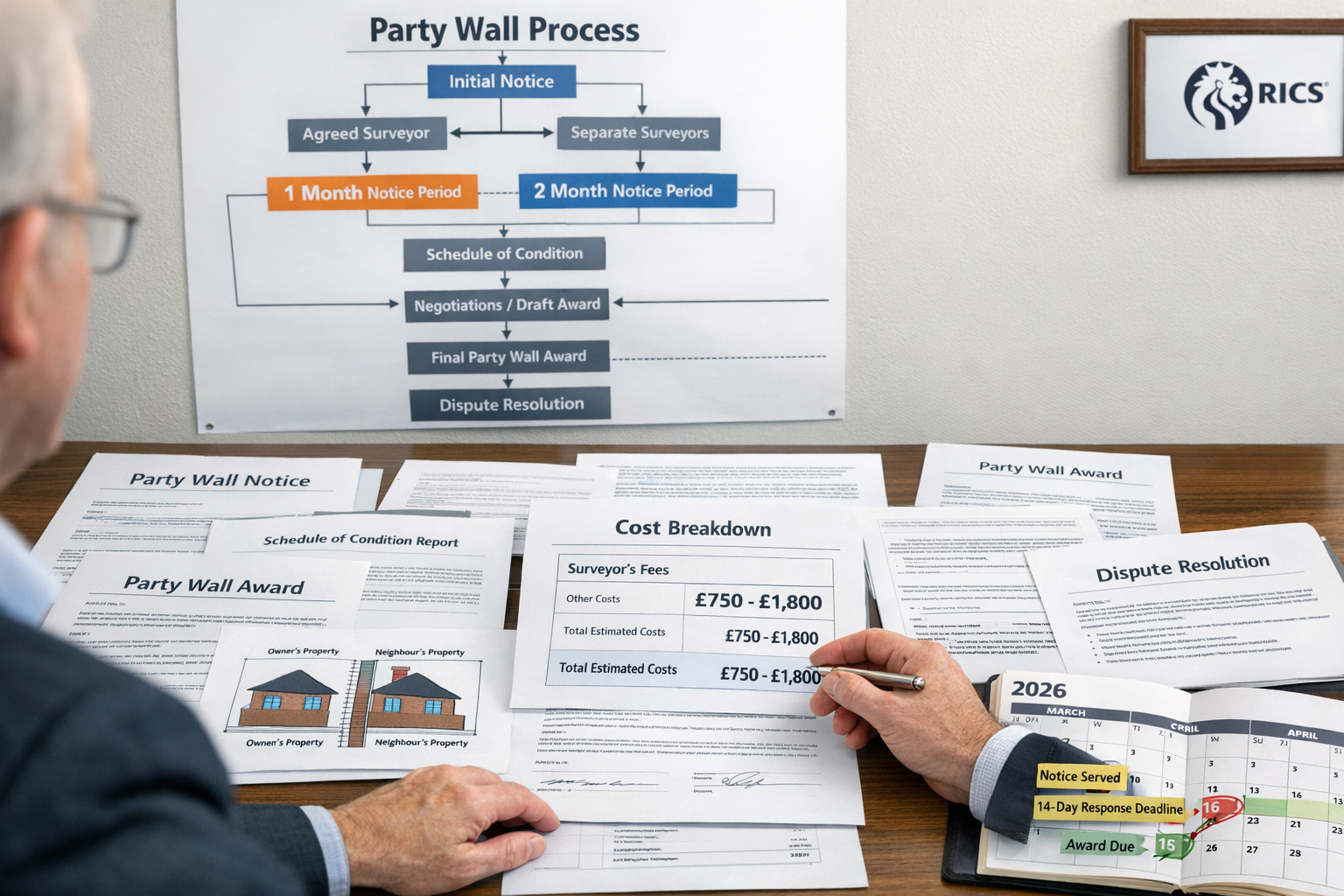
As the UK progresses toward 2030 net zero targets, the volume of renewable installations affecting party boundaries will continue growing exponentially. Industry observers anticipate several developments:
Legislative Modernization Potential
The Party Wall etc. Act 1996 predates modern renewable technology by decades. Potential reforms under discussion include:
- Streamlined procedures specifically for low-impact renewable installations
- Digital notice service as standard rather than exception
- Standardized Awards for common installation types
- Reduced notice periods for pre-approved renewable technologies
However, any legislative changes require Parliamentary time and stakeholder consensus, making near-term reform uncertain[4].
Professional Standards Evolution
Professional bodies like RICS (Royal Institution of Chartered Surveyors) are developing:
- Specialized guidance for renewable installation Party Wall work
- Continuing professional development courses on green retrofit compliance
- Best practice protocols balancing neighbour protection with net zero urgency
These evolving standards will shape how surveyors approach Party Wall Act Essentials for 2026 EV Charger and Heat Pump Retrofits on Shared Boundaries in coming years.
Dispute Resolution Innovation
The construction boom of 2026 has increased demand for efficient dispute resolution mechanisms[4]. Innovations include:
- Mediation services specializing in renewable installation disputes
- Online dispute resolution platforms reducing costs and delays
- Technical arbitration panels with renewable energy expertise
These alternatives to traditional court proceedings offer faster, more cost-effective resolution when neighbours and building owners cannot reach agreement.
Conclusion
Navigating Party Wall Act Essentials for 2026 EV Charger and Heat Pump Retrofits on Shared Boundaries requires careful planning, professional expertise, and proactive communication. The intersection of century-old boundary legislation with urgent net zero mandates creates complexity, but understanding the framework enables successful renewable installations that protect both property owners and their neighbours.
Key action steps for property owners planning renewable installations:
- Assess Party Wall implications early – before purchasing equipment or booking installers
- Budget comprehensively – including surveyor fees of £1,500–£3,600 per affected neighbour
- Allow adequate time – minimum 2–4 months from notice to Award completion
- Engage professional surveyors – especially for complex installations or multiple neighbours
- Communicate proactively – with neighbours before serving formal notices
- Document thoroughly – through Schedule of Condition surveys before work begins
For surveyors and property professionals:
- Develop specialized expertise in renewable installation Party Wall work
- Build partnerships with reputable EV charger and heat pump installers
- Invest in technology and standardized protocols for efficiency
- Educate clients proactively about requirements, costs, and timelines
- Stay informed about evolving best practices and potential legislative changes
The transition to net zero Britain depends on millions of successful renewable installations in properties with shared boundaries. By understanding and properly applying Party Wall legislation, surveyors play a crucial role in enabling this transformation while protecting property rights and neighbourly relationships.
For properties with complex boundary situations or multiple affected neighbours, professional guidance becomes essential. Don't let Party Wall complications derail your renewable energy plans – engage experienced surveyors who understand both the legislation and the technology to ensure smooth, compliant installations that contribute to Britain's sustainable future. 🌱
Whether you're installing your first EV charger or managing large-scale heat pump retrofit programs, mastering these Party Wall essentials protects your investment, maintains positive neighbour relations, and accelerates the UK's journey toward carbon neutrality.
References
[1] Party Wall Agreement – https://hoa.org.uk/advice/guides-for-homeowners/i-am-improving/party-wall-agreement/
[2] Party Wall Agreement London 2026 – https://www.mayfairstudio.co.uk/blog/party-wall-agreement-london-2026
[3] Letter From Lord Hanson And Baroness Levitt To Lord Davies Detailing Government Amendments For Lords Report Stage 23 February 2026 – https://www.gov.uk/government/publications/crime-and-policing-bill-government-amendments-for-committee/letter-from-lord-hanson-and-baroness-levitt-to-lord-davies-detailing-government-amendments-for-lords-report-stage-23-february-2026
[4] Party Wall Surveys Amid 2026 Construction Boom Handling Disputes In High Demand Uk Housing Markets – https://nottinghillsurveyors.com/blog/party-wall-surveys-amid-2026-construction-boom-handling-disputes-in-high-demand-uk-housing-markets
[5] What London Property Developers Need To Know About The Party Wall Act Before They Break Ground – https://dailybusinessgroup.co.uk/2026/02/what-london-property-developers-need-to-know-about-the-party-wall-act-before-they-break-ground/