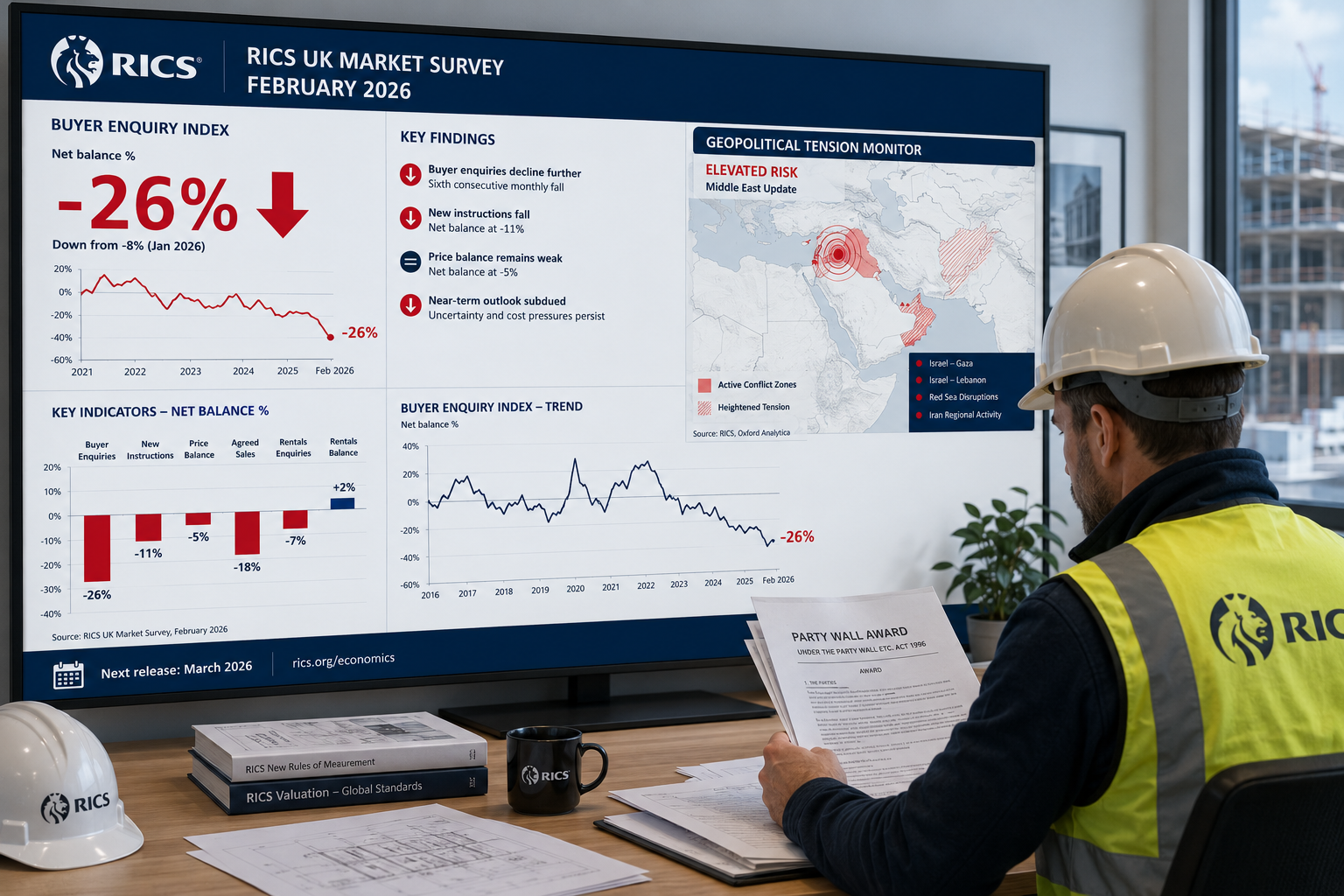
RICS February 2026 data recorded buyer enquiries at -26% — a figure not seen since the post-pandemic correction — driven largely by escalating Middle East tensions, persistent inflation fears, and a sharp pullback in investor confidence across UK residential and commercial property markets [3]. For party wall surveyors, that number is not just a macroeconomic footnote. It is a direct threat to the enforceability of awards, the recovery of professional fees, and the timely completion of notifiable works.
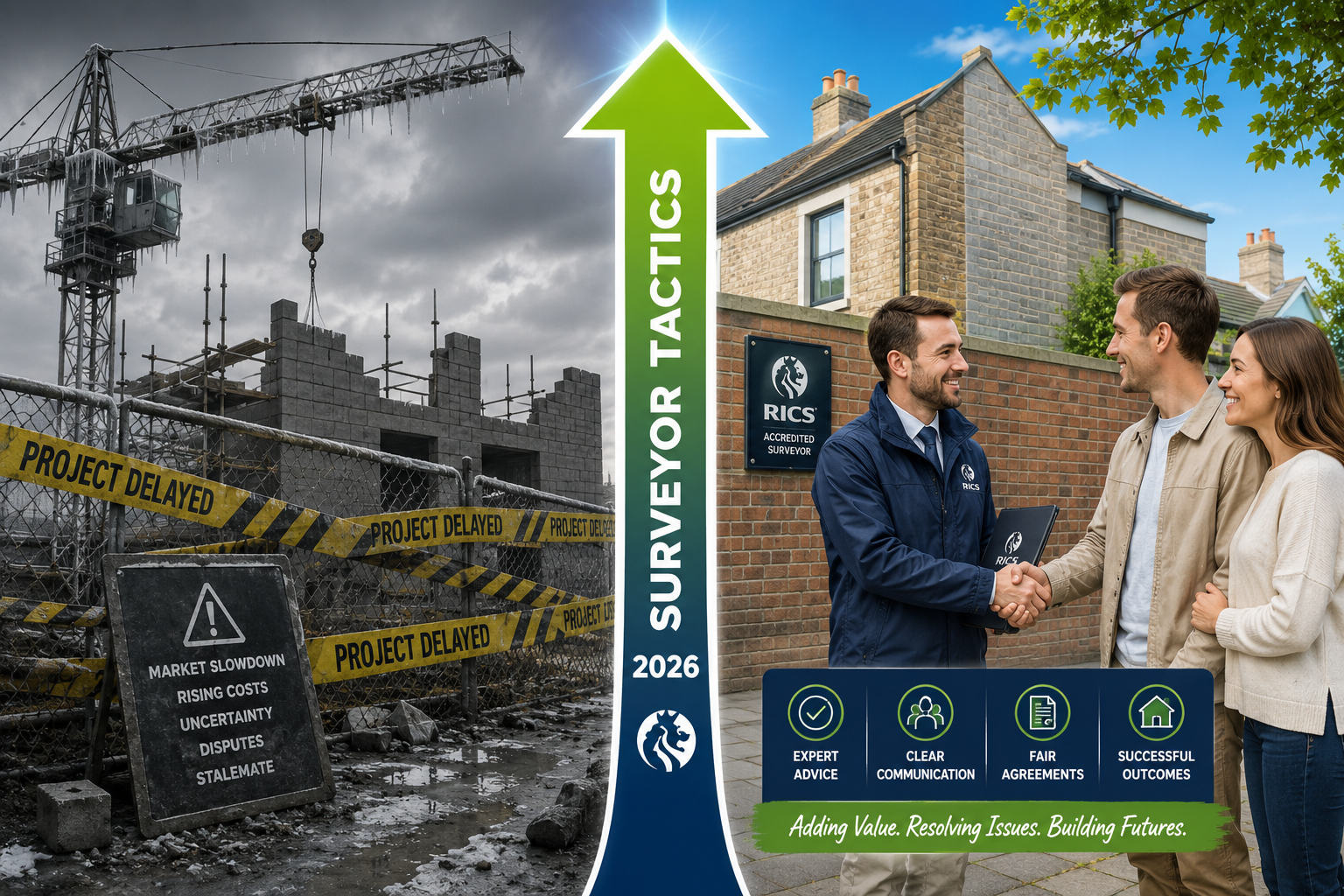
This article examines how defending party wall awards in geopolitical market slowdowns: surveyor tactics from RICS February 2026 data can be approached practically, legally, and commercially. Whether acting as agreed surveyor, building owner's surveyor, or adjoining owner's surveyor, the strategies below are drawn from current RICS consultation guidance, February 2026 market intelligence, and frontline practitioner insight.
Key Takeaways 📌
- RICS February 2026 buyer enquiry data sits at -26%, signalling a subdued market where project delays and abandoned developments are increasingly common.
- Party wall awards remain legally binding regardless of market conditions — but enforcing them requires proactive documentation and communication.
- RICS is consulting on the 8th edition of "Party Wall Legislation and Procedure", introducing updated competence and consistency standards that directly affect how awards are drafted and defended [2].
- Fee recovery risk rises sharply in slow markets — surveyors must build robust cost justification into every award from day one.
- Geopolitical uncertainty does not suspend statutory obligations under the Party Wall etc. Act 1996, but it does change the practical landscape surveyors must navigate.
What the RICS February 2026 Data Tells Surveyors About Market Risk
The February 2026 RICS UK Residential Survey painted a stark picture. Beyond the headline -26% buyer enquiry net balance, the data showed:
| Indicator | February 2026 Net Balance |
|---|---|
| New Buyer Enquiries | -26% |
| Agreed Sales | -18% |
| Price Expectations (3-month) | -14% |
| New Instructions | +4% |
| Surveyor Sentiment (12-month) | Cautiously negative |
Source: RICS February 2026 UK Residential Market Survey [3]
These figures reflect a market where geopolitical caution — specifically linked to Middle East conflict escalation and its knock-on effects on energy prices and mortgage rates — is causing buyers, developers, and investors to pause or withdraw entirely [3].
For party wall practitioners, this creates a specific cluster of risks:
- 🔴 Project abandonment mid-award process — building owners halt works after a notice has been served but before or during the award stage.
- 🔴 Fee disputes escalate — adjoining owners, already anxious about property values, challenge surveyor fees more aggressively.
- 🔴 Delays trigger award expiry concerns — statutory timeframes become harder to manage when contractors and developers are pausing works.
- 🔴 Reduced access cooperation — adjoining owners in uncertain markets become more resistant to granting access for schedule of condition surveys.
Understanding these pressure points is the first step toward defending party wall awards effectively when the wider market is contracting.
💬 "Geopolitical uncertainty does not dissolve statutory duties. It amplifies the need for precision in how awards are drafted, communicated, and enforced." — Practitioner commentary, 2026 [7]
Defending Party Wall Awards in Geopolitical Market Slowdowns: The Legal Framework That Holds
Regardless of what RICS market data shows, the Party Wall etc. Act 1996 does not contain a "market conditions" exemption. Awards made under the Act are legally enforceable instruments. Surveyors defending them in a slowdown must anchor every decision to this statutory bedrock.
The Award as a Binding Instrument
A party wall agreement — more precisely, the party wall award — sets out the rights and obligations of both the building owner and the adjoining owner. Once made, it binds both parties and their successors in title. In a market slowdown, three specific clauses become especially important to draft with precision:
- Commencement and completion windows — specify realistic timeframes that account for potential contractor delays, rather than optimistic build programmes.
- Security for expenses provisions — under Section 12 of the Act, adjoining owners can request security for expenses. In a volatile market, surveyors should actively advise adjoining owners of this right.
- Access rights and notice periods — clearly defined access provisions reduce the risk of disputes arising when projects are paused and restarted.
For a deeper understanding of party wall disputes and how they escalate during project delays, reviewing the statutory framework alongside current RICS guidance is essential.
RICS 8th Edition Consultation: What's Changing
RICS launched a formal consultation on the draft 8th edition of "Party Wall Legislation and Procedure" in April–May 2026, running for approximately eight weeks [2]. The stated aim is to update practice guidance to "support competence and consistency" in party wall work [1].
Key areas under review include:
- Clearer guidance on surveyor selection and appointment procedures
- Updated standards for schedule of condition reports
- Revised commentary on fee justification and transparency
- Enhanced guidance on handling disputes between surveyors (the third surveyor mechanism)
Surveyors who engage with this consultation — and align their current practice with the emerging 8th edition standards — will be better positioned to defend awards challenged on procedural grounds [10].
Surveyor Tactics from RICS February 2026 Data: Practical Strategies for Award Defence
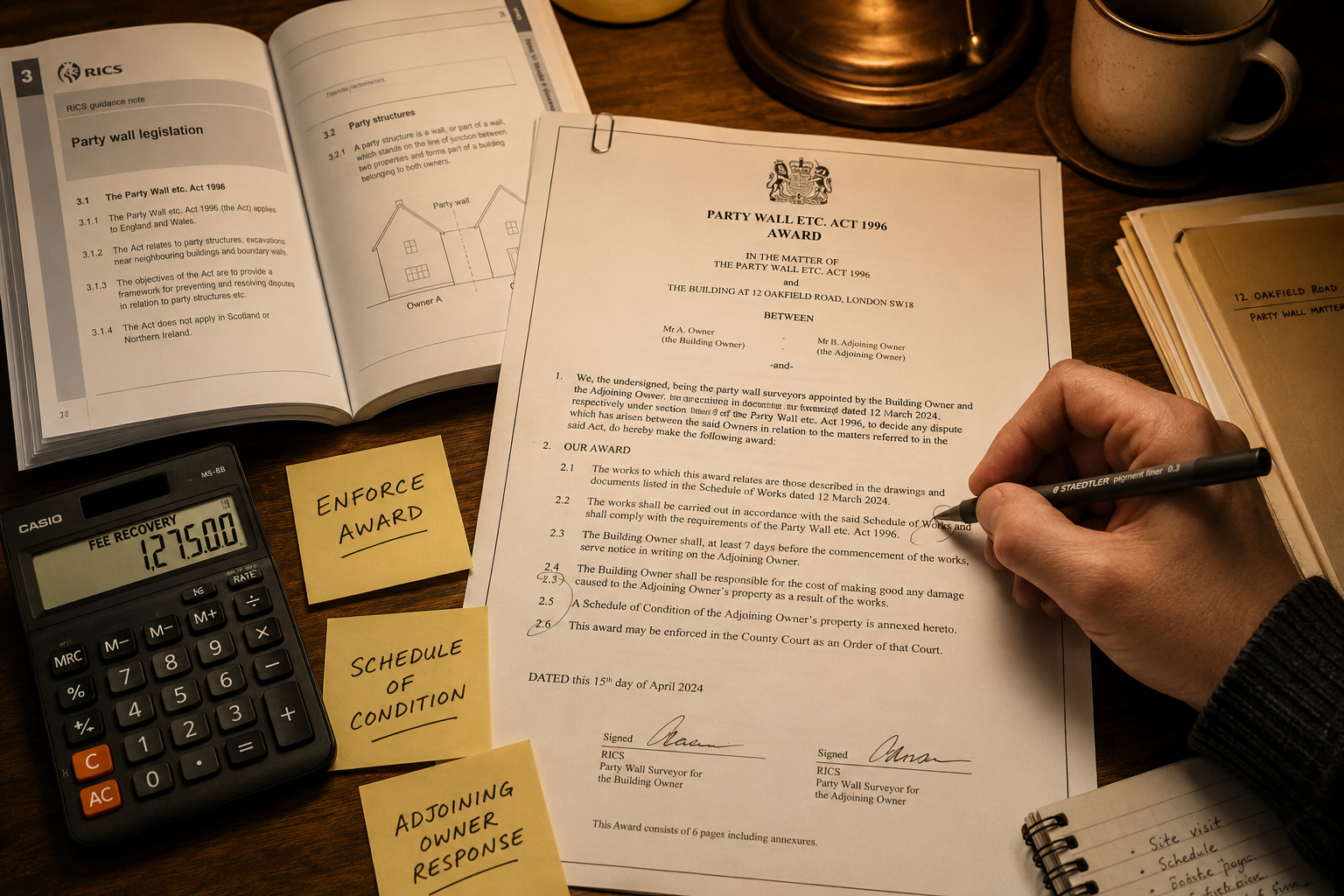
The core challenge of defending party wall awards in geopolitical market slowdowns: surveyor tactics from RICS February 2026 data is translating macroeconomic awareness into micro-level procedural discipline. The following tactics address the most common vulnerabilities.
Tactic 1: Bulletproof the Schedule of Condition 📋
In a falling market, adjoining owners are acutely sensitive to any perceived reduction in their property's value. A robust schedule of condition report — completed before works commence — is the single most effective defence against inflated damage claims.
Best practice in 2026:
- Use photographic and video evidence with timestamped metadata
- Include drone imagery for roof and upper-floor elements where accessible
- Reference specific structural elements likely to be affected by the notifiable works
- Obtain the adjoining owner's written acknowledgement of the schedule
Tactic 2: Build Fee Justification Into the Award From Day One 💷
RICS February 2026 data shows that in subdued markets, fee disputes become more frequent as parties look to reduce costs wherever possible [7]. Surveyors acting under the Act are entitled to reasonable fees — but "reasonable" must be demonstrable.
Practical steps include:
- Itemise time spent at each stage: notice review, site inspection, award drafting, correspondence
- Reference RICS fee guidance explicitly within the award documentation
- Agree a fee schedule in writing with the appointing party before commencing work
- Document all additional work triggered by project delays or scope changes
Understanding party wall surveyor costs and how to justify them transparently is increasingly important as market pressures intensify scrutiny on professional fees.
Tactic 3: Anticipate and Document Project Delays
When a building owner pauses works due to market conditions — contractor unavailability, financing withdrawal, or simply geopolitical anxiety — the party wall process does not automatically pause with it. Surveyors should:
- Issue a formal written note to both parties when works are suspended beyond a reasonable period
- Confirm whether the award remains operative or whether a fresh notice will be required
- Review whether any security for expenses provisions should be activated
- Keep a contemporaneous file note of all communications
This documentation discipline is critical if the award is later challenged or if fee recovery becomes contentious.
Tactic 4: Use the Third Surveyor Mechanism Proactively
In a market slowdown, tensions between surveyors representing opposing parties can escalate. The third surveyor mechanism — often treated as a last resort — should be viewed as a professional tool for resolving genuine impasses efficiently, rather than an admission of failure.
RICS guidance consistently supports early referral to the third surveyor where:
- There is a genuine dispute about the scope of works in the award
- Fee disagreements cannot be resolved bilaterally
- One surveyor believes the other is acting outside their statutory role
For complex party wall matters involving multiple adjoining owners or phased developments, having a third surveyor agreed and named early in the process reduces delay risk significantly.
Tactic 5: Advise Clients on Party Wall Consent Timing ⏱️
One underappreciated tactic in slow markets is advising building owners to serve notices earlier than they might otherwise consider necessary. With contractor programmes increasingly uncertain, the statutory notice periods under the Act (1–2 months depending on work type) can become bottlenecks.
Proactive party wall consent management — including advising on the difference between consent and dissent, and the implications of each — helps building owners maintain programme flexibility even when the wider market is contracting.
Fee Recovery and Commercial Resilience in a Subdued Market
The commercial reality for party wall surveyors in 2026 is that fee recovery risk is materially higher than in a buoyant market. When projects stall or are abandoned, surveyors who have already invested significant time in award preparation face the prospect of unpaid fees.
Protective Measures for Surveyors
| Risk | Protective Measure |
|---|---|
| Project abandoned post-notice | Agree a minimum fee for notice review and initial advice |
| Award challenged on procedural grounds | Align drafting with RICS 8th edition consultation standards [2] |
| Adjoining owner refuses to pay surveyor's fees | Document statutory basis for fee entitlement in award |
| Building owner disputes fee quantum | Provide itemised time records from project outset |
| Delay causes scope creep | Issue variation notes and update fee estimate in writing |
Surveyors working across London and the South East — where the February 2026 market data shows the sharpest buyer enquiry declines — should consider whether their standard terms of engagement adequately address project suspension scenarios [3].
For those working in specific locations, resources such as guidance for chartered surveyors in London or West London surveyors can provide regionally relevant context.
Defending Party Wall Awards in Geopolitical Market Slowdowns: Surveyor Tactics from RICS February 2026 Data — Regional Considerations
The impact of geopolitical market slowdowns is not uniform across the UK. RICS February 2026 data suggests that prime London markets and commuter belt areas are experiencing the sharpest sentiment declines, while some regional markets remain relatively stable [3].
For party wall surveyors, this regional variation matters because:
- Higher-value properties in prime areas generate larger and more complex party wall awards — and more contentious fee disputes
- Permitted development activity (loft conversions, basement works, extensions) is more concentrated in urban areas where party wall obligations are most frequent
- Developer-led projects in London and the South East are most exposed to financing withdrawal in a geopolitical slowdown
Surveyors operating in these markets should be especially rigorous in applying the tactics outlined above. The construction uptick seen in parts of the market during early 2026 — driven by homeowners investing in existing properties rather than moving — means that party wall work volumes remain significant even as transaction numbers fall [9].
💬 "When transactions slow, renovation activity often accelerates. Party wall surveyors in urban markets should expect sustained workloads even as the wider property market contracts." — Industry commentary, 2026 [9]
The RICS Competence Framework and Award Integrity
The RICS consultation on the 8th edition of "Party Wall Legislation and Procedure" signals a broader shift toward competence-based accountability in party wall practice [1][10]. For surveyors defending awards in challenging market conditions, this framework provides both a standard to meet and a shield against challenge.
Key competence areas relevant to award defence include:
- Technical knowledge of the Party Wall etc. Act 1996 and its procedural requirements
- Communication skills — particularly in managing expectations of both building and adjoining owners during project delays
- Impartiality — surveyors must be seen to act independently, especially when market pressures create financial incentives to favour one party
- Documentation discipline — the ability to produce a contemporaneous, well-organised file is the foundation of any successful award defence
Surveyors who hold or are working toward RICS accreditation should engage with the consultation process directly, as the 8th edition will set the benchmark against which future award challenges are assessed [2].
For those exploring the role of the party wall agreed surveyor — a single surveyor appointed by both parties — the competence framework is particularly relevant, as this role carries heightened obligations of impartiality and transparency.
Conclusion: Actionable Next Steps for Party Wall Surveyors in 2026
Defending party wall awards in geopolitical market slowdowns: surveyor tactics from RICS February 2026 data is not a theoretical exercise. With buyer enquiries at -26% and geopolitical uncertainty showing no sign of rapid resolution, party wall surveyors across the UK face a sustained period of heightened challenge [3].
The good news is that the statutory framework remains robust, and surveyors who apply disciplined practice will find that awards hold up under scrutiny. The RICS 8th edition consultation provides a timely opportunity to align current practice with emerging standards [2][10].
✅ Actionable Next Steps
- Review your standard award template against the RICS 8th edition consultation draft — update commencement windows, security provisions, and fee clauses to reflect 2026 market realities.
- Upgrade your schedule of condition process — invest in timestamped photographic records and consider drone surveys for complex properties.
- Itemise fee justification from day one — build a contemporaneous time record into every instruction, regardless of project size.
- Engage with the RICS consultation — responses to the 8th edition draft help shape the standards that will govern award challenges for the next decade.
- Advise clients proactively on notice timing — in an uncertain market, early notice service protects programme flexibility and reduces the risk of rushed or defective awards.
- Revisit terms of engagement — ensure your standard contract addresses project suspension, abandonment, and minimum fee provisions explicitly.
The market will recover. The awards made during this period of geopolitical uncertainty will be scrutinised long after confidence returns. Surveyors who build defensible, well-documented awards now will protect both their clients and their professional reputations.
References
[1] James Kavanagh – RICS Launches Consultation On Updated Party Activity – https://www.linkedin.com/posts/james-kavanagh-65448b17_rics-launches-consultation-on-updated-party-activity-7448044807869988865-vPZF
[2] RICS Launches Consultation On Party Wall Guidance – https://thenegotiator.co.uk/news/regulation-law-news/rics-launches-consultation-on-party-wall-guidance/
[3] Valuation Adjustments From February 2026 RICS Survey Countering Geopolitical Caution In Buyer Enquiries And Price Expectations – https://wimbledonsurveyors.com/valuation-adjustments-from-february-2026-rics-survey-countering-geopolitical-caution-in-buyer-enquiries-and-price-expectations/
[7] Party Wall Awards By Chartered Building Surveyors RICS Services Fee Structures And Case Studies For 2026 – https://manchestersurveyors.com/party-wall-awards-by-chartered-building-surveyors-rics-services-fee-structures-and-case-studies-for-2026/
[9] Party Wall Agreements For 2026 Renovation Surge Managing Notices As Buyer Confidence Returns – https://princesurveyors.co.uk/blog/party-wall-agreements-for-2026-renovation-surge-managing-notices-as-buyer-confidence-returns/
[10] RICS Consults On Updated Party Wall Practice Guidance – https://www.lexisnexis.co.uk/legal/news/rics-consults-on-updated-party-wall-practice-guidance