
Around 20% of England's housing stock was built before 1919, according to the Office for National Statistics. That is roughly five million homes constructed using solid masonry walls, lime mortar, timber floors and roof structures that behave very differently from modern cavity-wall construction. Choosing the best survey before buying a period home, whether a Level 3 Building Survey, a specialist timber report or a structural investigation, is one of the most consequential decisions a buyer will make before exchange.
Get it wrong and the consequences range from an unwelcome repair bill after completion to a mortgage retention, a collapsed transaction or, in the worst cases, structural work running into six figures.
This article sets out a clear decision framework so buyers, solicitors and agents can match the right survey type to the property in front of them.
Key Takeaways
- A Level 3 Building Survey is the default recommendation for most pre-1919 homes, extended or altered properties, and all listed buildings.
- A specialist damp and timber report is a follow-up inspection, not a replacement for a Level 3 survey; it is triggered when the main survey flags moisture or decay.
- A structural investigation by a chartered structural engineer is appropriate when the Level 3 survey identifies significant movement, cracking or foundation concerns that exceed the surveyor's scope.
- The RICS Home Survey Standard (2nd edition, updated September 2026) requires surveyors to choose a survey level appropriate to the building's age, complexity and condition. [7][9]
- Buyers of listed buildings should prioritise a surveyor with formal conservation or historic-building accreditation. [2][12]
Understanding the Three Main Options
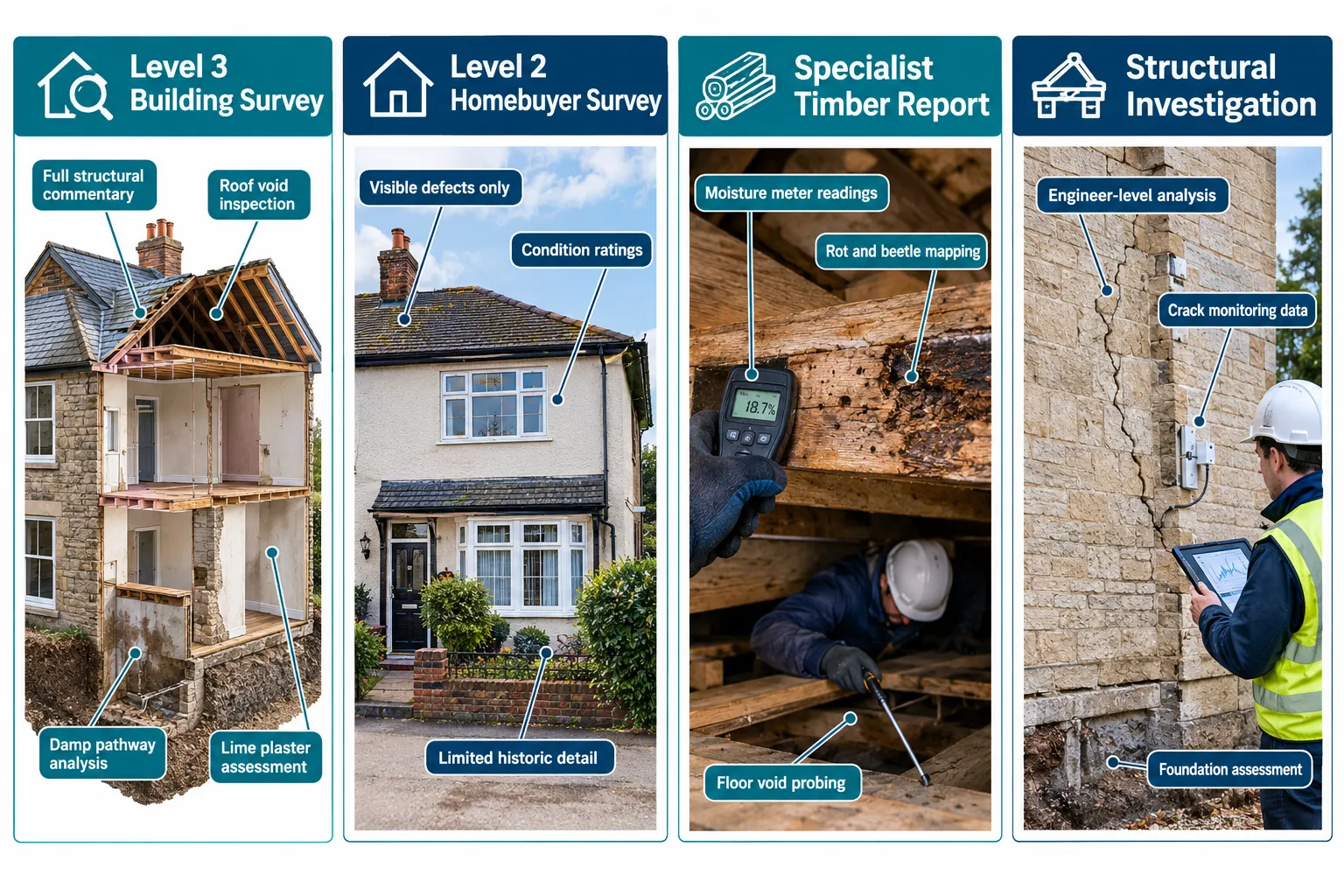
Before reaching for a decision matrix, it helps to understand what each survey type actually delivers and what it does not.
Level 3 Building Survey (formerly Full Structural Survey)
A Level 3 Building Survey is the most detailed residential inspection available under the RICS Home Survey Standard. [9] It is designed for older, altered or structurally complex buildings where a shorter inspection would leave significant risks unexamined. [9][11]
A well-executed Level 3 report on a period home will cover:
- Roof structure and coverings, including any areas of the void that can be safely accessed
- Wall construction, solid brick, stone, earth or timber frame, and any signs of movement or water ingress
- Damp pathways, distinguishing between rising damp, penetrating damp and condensation
- Historic and active cracking, with commentary on likely cause and monitoring recommendations
- Chimneys, fireplaces and flues
- Internal finishes, including lime plaster, cornices and decorative joinery
- Traditional joinery such as sash windows, panelled doors and timber staircases [4]
This breadth of inspection is not routinely provided in a Level 2 Homebuyer Report, which is better suited to smaller, well-maintained period homes with limited alteration. [4][11]
For listed buildings, the bar is higher still. A surveyor carrying out a Level 3 inspection on a listed property must understand heritage legislation, traditional materials and the constraints that listing places on repair and alteration. [14] RICS building surveying competency guidance published in December 2025 explicitly includes understanding of historic buildings, their construction and fabric, and the factors affecting their performance. [2]
Buyers considering a building survey in London or elsewhere in the UK should confirm that the surveyor has direct experience with the construction type in question, Georgian brick, Victorian terrace, Edwardian semi or pre-1700 timber frame each presents different risks.
Specialist Damp and Timber Report
A specialist damp and timber report is a targeted inspection, not a general survey. It focuses on moisture-related defects and the condition of structural and decorative timber. [6]
The inspection typically covers:
- Roof spaces and any accessible ceiling voids
- Suspended timber ground floors and any accessible floor voids
- Staircases, skirtings, door frames and exposed joinery
- Basement or cellar walls and floors where present
- Any areas flagged as at risk by the main survey
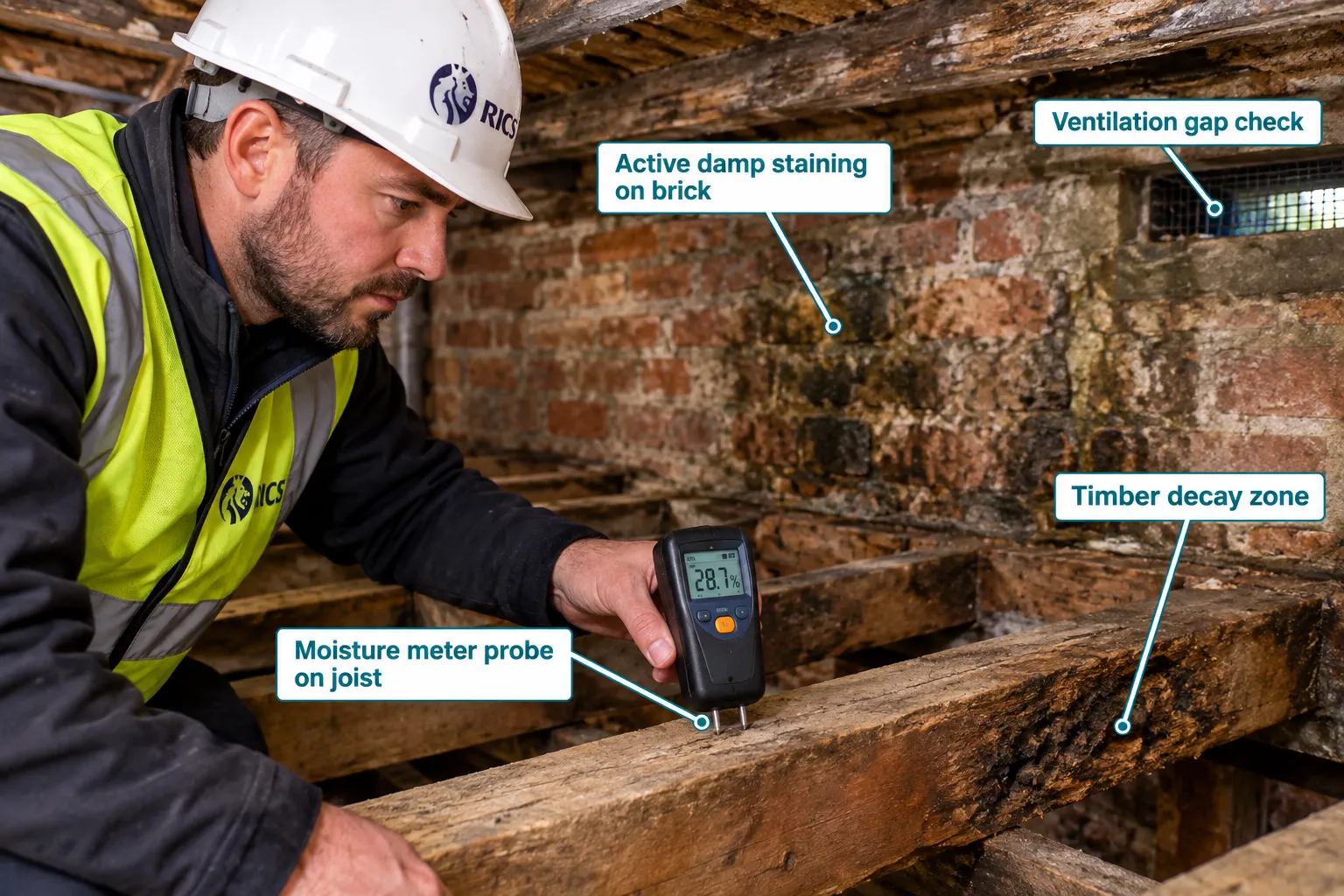
Surveyors use calibrated moisture meters and, in some cases, timber-strength probes to assess whether damp is active or historic and whether timber decay is cosmetic, a maintenance concern or a structural risk. [3][6] Findings are mapped, photographed and graded so that buyers, lenders and contractors can make informed decisions about remedial works. [13]
The critical point is that a damp and timber report sits alongside a Level 2 or Level 3 survey; it does not replace it. [6] For a detailed comparison of these two inspection types, the article on damp survey vs damp and timber report sets out the differences clearly.
Lenders frequently require a specialist damp and timber report when a valuation or homebuyer's survey mentions timber decay, and may withhold funds until recommended works are confirmed as complete. [15][6] Neglecting early rot can allow decay to progress from a localised defect to a genuine structural risk in floors or roofs. [15]
Structural Investigation
A structural investigation goes beyond the scope of any residential survey. It is carried out by, or in close collaboration with, a chartered structural engineer and is appropriate when a Level 3 survey identifies movement, cracking or foundation concerns that require engineering analysis rather than surveying commentary alone.
Typical triggers include:
- Significant diagonal cracking in external masonry, particularly around openings
- Evidence of differential settlement or subsidence
- Bulging or leaning walls
- Structural alterations, removed chimney breasts, knocked-through walls, without evidence of adequate support
- Properties in areas with known ground movement, mining activity or high-shrinkage clay soils
A structural crack assessment will establish whether cracking is historic and stable, active but benign, or indicative of ongoing movement requiring engineering intervention. The outcome may include a recommendation for crack monitoring over a defined period, or for intrusive investigation such as trial pits to examine foundations.
For buyers who proceed to extension or alteration work after purchase, structural calculations will be needed regardless of survey findings.
The Decision Matrix: Matching Survey Type to Property
The table below sets out the recommended survey approach based on six key property characteristics. These are not rigid rules, a surveyor's professional judgement on site always takes precedence, but they provide a reliable starting point.
| Property Characteristic | Level 2 Sufficient? | Level 3 Recommended? | Specialist Timber Report? | Structural Investigation? |
|---|---|---|---|---|
| Pre-1919, unaltered, good condition | Possibly | Preferred | If damp flagged | Rarely |
| Pre-1919, extended or altered | No | Yes | If damp or decay flagged | If movement noted |
| Listed building (any grade) | No | Yes, conservation surveyor | Often advisable | If movement noted |
| Visibly damp or basement present | No | Yes | Yes | Only if structural risk |
| Significant cracking visible | No | Yes | Only if decay also present | Yes |
| Neglected or long-vacant | No | Yes | Yes | Consider |
| Pre-1850, substantial original fabric | No | Yes, conservation surveyor | Often advisable | If movement noted |
When a Level 3 Survey Should Trigger a Specialist Follow-Up
A Level 3 Building Survey is the starting point, not always the finishing point. The surveyor's report will typically recommend further specialist investigations where findings exceed the scope of a visual inspection. Common triggers include:
Damp and timber follow-up warranted when:
- Moisture meter readings above 20% in timber or elevated readings in masonry
- Visual evidence of fungal growth, discolouration or softness in floor joists, roof timbers or stud walls
- Suspected dry rot, identified by its distinctive fruiting bodies or characteristic cracking pattern in timber
- Access limitations (sealed floor voids, boarded loft) that prevented full inspection
Structural investigation warranted when:
- Diagonal cracking wider than approximately 5mm at the widest point, particularly in stepped or tapered patterns
- Evidence of differential settlement between original structure and an extension
- Removed chimney breasts without visible evidence of adequate support above
- Bulging or out-of-plumb external walls
- Properties on shrinkable clay soils (much of London and the South East) with mature trees nearby
The 10 most common property defects found in a building survey on London properties gives a useful reference point for what Level 3 reports most frequently uncover in the capital's period housing stock.
Costs, Timescales and What to Expect in the Report
Buyers should budget for the possibility of layered costs if the main survey triggers specialist follow-ups. The table below gives indicative ranges for 2026; actual fees vary by property size, location and surveyor.
| Survey Type | Typical Fee Range (2026) | Turnaround |
|---|---|---|
| Level 2 Homebuyer Report | £400, £700 | 3-5 working days |
| Level 3 Building Survey | £600, £1,500+ | 5-10 working days |
| Specialist Damp and Timber Report | £200, £500 | 2-5 working days |
| Structural Investigation / Engineer’s Report | £500, £1,500+ | 5-14 working days |
For detailed fee breakdowns, the articles on how much a building survey costs and how much a structural survey costs provide current market data.
What a Good Report Looks Like
Regardless of survey type, a report worth relying on will:
- State clearly what was and was not inspected, and why
- Use plain English to describe defects, their likely cause and their probable consequences if left unaddressed
- Grade defects by urgency, immediate action, short-term maintenance, monitor, rather than listing everything as equally serious
- Provide photographs with annotations, not just text descriptions
- Give clear recommendations for further investigation where the inspection was limited by access or by the complexity of the defect
A report that simply lists observations without prioritisation or context gives buyers little basis for negotiation or decision-making. Buyers should ask to see a sample report before instructing a surveyor.
The Mortgage Angle
Lenders do not carry out a building survey on the buyer's behalf. A mortgage valuation tells the lender whether the property provides adequate security for the loan; it says nothing meaningful about the building's condition. [6] The article on mortgage valuation vs full building survey explains why relying on the lender's figure is a significant risk for period-property buyers.
Where a valuation or homebuyer's report flags damp or timber decay, lenders may impose a retention, withholding part of the mortgage advance until remedial works are confirmed. Commissioning a specialist damp and timber report early in the transaction can prevent this from derailing completion. [6][15]
Choosing the Right Surveyor for a Period Home
The RICS Home Survey Standard requires surveyors to choose a survey level appropriate to the building's age, complexity and condition. [7][9] For genuinely historic homes, that means the surveyor must understand traditional construction, lime mortar, solid-wall thermal behaviour, timber-frame movement, the difference between active and historic damp in old masonry, rather than assessing a period home against modern building standards.
RICS operates a Building Conservation Accreditation Scheme, and the Institute of Historic Building Conservation publishes guidance on heritage skills. [12][1] Both organisations support the case for prioritising a surveyor with formal accreditation or demonstrable competence in conservation work when instructing a Level 3 survey on a significant period home.
A June 2025 RICS Built Environment Journal article also noted updates to RdSAP (the energy assessment methodology) allowing surveyors to record solid-wall thickness in older properties, a reminder that period homes require surveyors who understand traditional construction rather than applying modern-building assumptions. [5]
Buyers in specific areas can find chartered surveyors with period-property experience across a range of locations, including chartered surveyors in Hampshire, chartered surveyors in Buckinghamshire and chartered surveyors in North London.
Frequently Asked Questions
Do I need a Level 3 survey on every period home?
Not necessarily. A small, well-maintained Victorian terrace in good condition with no visible defects and no significant alterations may be adequately covered by a Level 2 Homebuyer Report. However, for most pre-1919 homes, particularly those that have been extended, altered, neglected or are listed, a Level 3 Building Survey is the appropriate choice. [4][11]
Can a damp and timber report replace a building survey?
No. A specialist damp and timber report examines moisture and timber condition in detail but does not cover the structural, roofing, drainage or general condition matters addressed by a Level 2 or Level 3 survey. The two reports serve different purposes and are most effective when used together. [6]
Who carries out a structural investigation, a surveyor or an engineer?
A Level 3 Building Survey is carried out by a chartered building surveyor. Where that survey identifies significant movement or structural concerns, a chartered structural engineer is usually instructed to carry out a structural investigation. The two professionals have complementary but distinct competencies.
Will a damp and timber report satisfy my mortgage lender?
It depends on the lender and the specific condition noted in the valuation. Most lenders who impose a retention for damp or timber decay will require a specialist report confirming the extent of the problem and, in some cases, evidence that recommended works have been completed before releasing retained funds. [6][15]
How long does the whole survey process take for a period home?
A Level 3 Building Survey typically takes five to ten working days from inspection to report. If a specialist damp and timber report or structural investigation is then needed, allow a further two to fourteen working days depending on the complexity of the follow-up. Buyers should factor this into their transaction timetable.
What is the difference between a structural survey and a structural investigation?
In common usage, "structural survey" is an informal term that most buyers use to mean a Level 3 Building Survey. A structural investigation is a separate, more targeted exercise carried out by a structural engineer when specific structural concerns need engineering analysis. The two are not interchangeable.
Are there additional surveys to consider for period homes?
Depending on the property, buyers may also want to consider a drone roof survey where the roof is inaccessible, or a schedule of condition if they are taking on a lease. A drone roof survey in London can provide detailed imagery of roof coverings, chimney stacks and parapet walls without the cost of scaffold access.
Conclusion
The best survey before buying a period home is rarely a single document. For most pre-1919 properties, and for all listed buildings, a Level 3 Building Survey by a surveyor with genuine experience of traditional construction is the correct starting point. [9][4][14]
Where that survey flags moisture, timber decay, significant cracking or structural alterations, it should trigger targeted specialist follow-up: a damp and timber report, a structural investigation, or both. The decision matrix in this article provides a practical framework for making that call before instruction, not after completion.
Practical next steps:
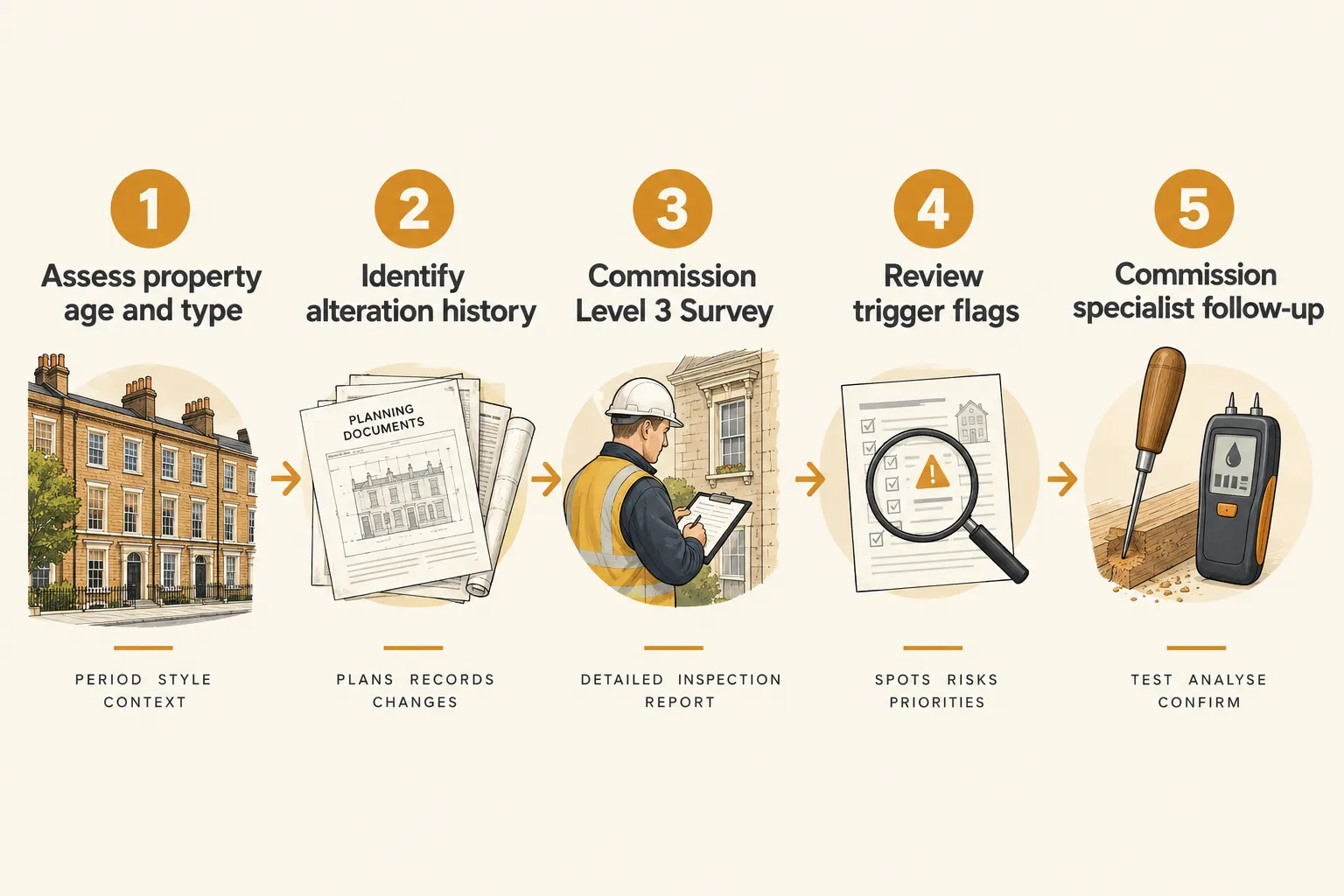
- Confirm the property's age, listing status and alteration history before instructing any surveyor.
- Use the decision matrix above to identify which survey level and specialist follow-ups are likely to be needed.
- Instruct a RICS-regulated Level 3 surveyor with demonstrable experience of the relevant construction type.
- Read the report carefully and ask the surveyor to clarify any recommendations for further investigation before exchange.
- Commission specialist follow-up reports promptly, delays can cost time in the transaction and, in a competitive market, may affect your negotiating position.
A well-chosen survey is not an overhead; it is the most reliable source of information a buyer has about what they are actually purchasing.
References
[1] Index – ihbc.org.uk
[2] Building Surveying December 2025 – rics.org
[3] dampserve – dampserve.com
[4] Buying A Period Property What To Check Before You Commit – hfwjsurveyors.com
[5] Historic Buildings Energy Performance Measurement – ww3.rics.org
[6] Damp And Timber Reports – surveymerchant.com
[7] rics – rics.org
[9] Building Surveying Standards – rics.org