
A property can lose tens of thousands of pounds in market value because of building defects, yet the repair bill and the value loss are rarely the same figure. Courts and insurers need someone who can bridge that gap. Understanding how expert witness surveyors assess loss of property value after building defects matters whether you are a homeowner pursuing a negligence claim, a solicitor instructing an expert, or a landlord facing a dilapidations dispute.
This article traces the full route: from first inspection and defect diagnosis, through repair costing and comparable market evidence, to the quantified diminution-in-value opinion that stands up in negotiation or court.
Key Takeaways
- The repair cost and the loss of value are two separate figures; courts expect both to be addressed.
- Expert witness surveyors use a two-scenario valuation, what the property would be worth without the defect versus its actual value, to quantify diminution in value.
- Residual stigma can justify an ongoing reduction in value even after repairs are complete.
- A robust expert report separates the building surveyor's diagnosis from the valuer's opinion; sometimes one RICS member covers both, sometimes a multi-disciplinary team is needed.
- Civil Procedure Rules Part 35 governs expert evidence in England and Wales; the surveyor's duty is to the court, not the instructing party.
From Defect to Courtroom: The Expert's Role
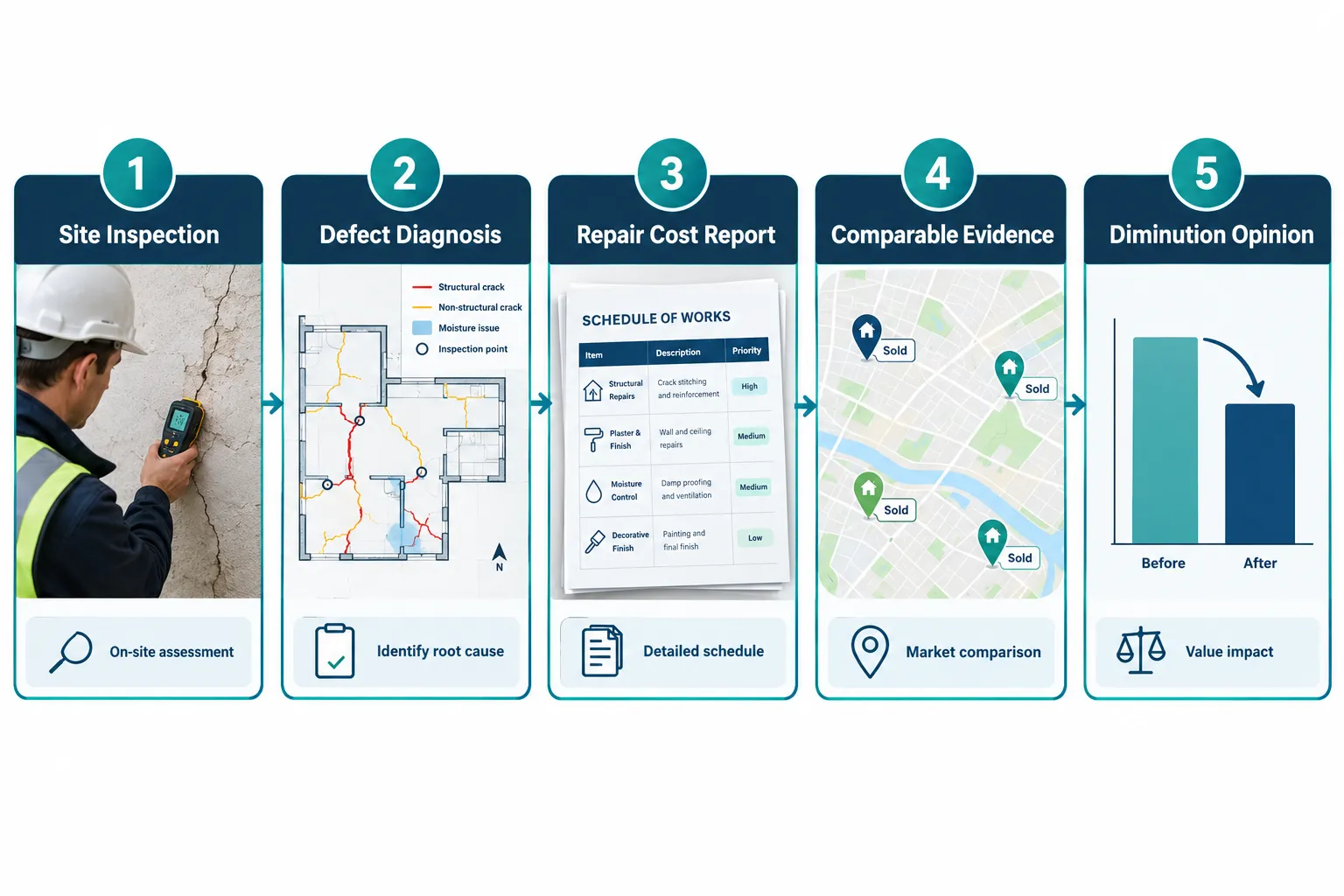
Building defects generate disputes across a wide range of contexts: new-build construction claims, surveyor negligence actions, landlord and tenant dilapidations, party wall damage, and latent defect insurance claims. In each case, the claimant must prove not only that a defect exists but that it has caused a measurable financial loss [3].
Courts rely primarily on expert testimony to establish that loss. A generalist building survey can identify what is wrong; it takes a separate valuation opinion, grounded in market evidence, to translate the defect into pounds and pence. This is why the expert witness role in property disputes increasingly requires either a dual-qualified RICS member or a team where a building surveyor and a valuer work alongside each other [4].
The surveyor's overriding duty under Civil Procedure Rules Part 35 is to the court, not to the client who pays the fee. That duty shapes every stage of the assessment, from the language used in the report to the way conflicting evidence is handled.
The two core questions every expert must answer:
- What is the property worth in its defective state?
- What would it be worth if the defect did not exist?
The difference between those two figures is the diminution in value.
The Assessment Process: Stage by Stage
Stage 1, Site Inspection and Defect Diagnosis
The expert's first task is a thorough physical inspection. For structural defects this typically means crack mapping, damp readings, drainage surveys, and, where roof access is difficult, a drone roof survey to gather photographic evidence without disturbing the fabric.
The inspection produces a schedule of defects: a factual record of what was found, where, and to what extent. This document is distinct from the valuation opinion and must be capable of standing alone as evidence of condition.
Common defect categories that generate expert witness instructions include:
| Defect Type | Typical Claim Context |
|---|---|
| Structural cracking and subsidence | New-build latent defect; surveyor negligence |
| Penetrating and rising damp | Landlord repair obligation; pre-purchase survey negligence |
| Roof failure | Dilapidations; insurance subrogation |
| Party wall damage | Party Wall etc. Act 1996 compensation |
| Defective drainage | Developer liability; shared services disputes |
| Contamination or Japanese knotweed | Pre-purchase survey negligence |
For a detailed breakdown of the defects most frequently identified in London properties, see the 10 most common property defects found in a building survey on London properties.
Stage 2, Establishing Causation
Identifying a defect is not the same as proving causation. The expert must form an opinion on why the defect arose and who is responsible. This matters because the scope of the defendant's liability, and therefore the measure of loss, depends on it.
Where structural movement is involved, the surveyor may need to consider shrinkage and settlement patterns alongside evidence from soil investigation reports and drainage records. A structural crack assessment will distinguish between active and historic movement, which directly affects the repair specification and therefore the cost.
Stage 3, Costing the Repair
The schedule of works and the associated cost estimate are produced at this stage. The expert must be clear that the repair cost is not automatically the measure of loss; it is one input into the valuation exercise [2].
RICS dilapidations guidance confirms that the appropriate measure of loss is the diminution in value of the claimant's interest, not the cost of repair, unless the cost of repair is a reasonable proxy for that loss [1]. Where the repair cost exceeds the increase in value that repair would produce, the courts may cap the award at the lower figure.
Cost-to-cure evidence remains relevant where direct comparable sales of defective properties are hard to find, which is common for unusual defects or specialist property types.
Quantifying Diminution in Value: The Two-Scenario Approach
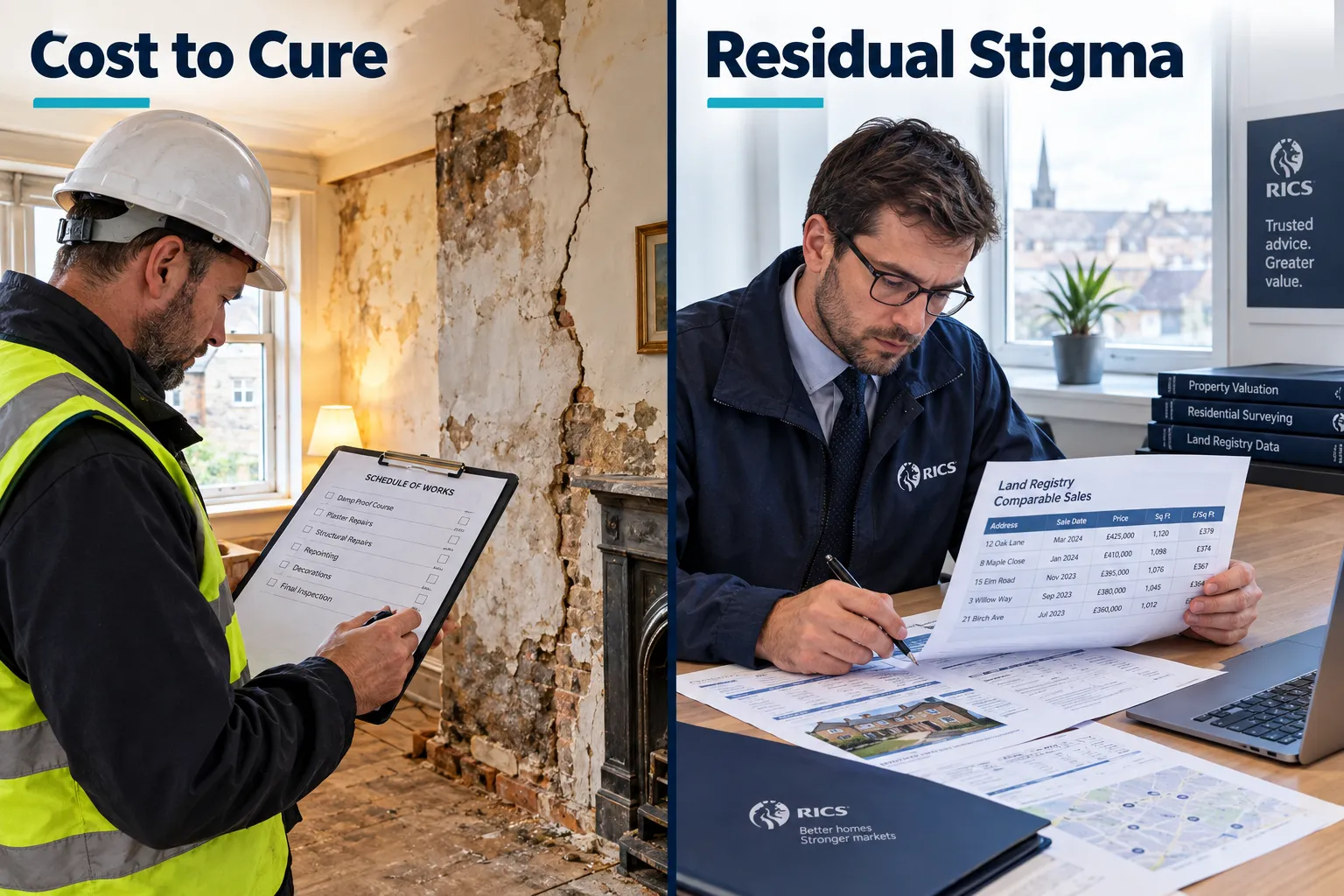
The two-scenario valuation is the standard methodology for how expert witness surveyors assess loss of property value after building defects. The expert values the property twice:
- Scenario A (unaffected value): What the property would sell for on the open market if the defect had never occurred, or had been fully and properly remediated.
- Scenario B (actual value): What the property is actually worth in its current defective state, or in its post-repair state where residual stigma remains.
The gap between Scenario A and Scenario B is the diminution in value.
Comparable Sales Evidence
Valuation opinions must be anchored in market evidence. The expert searches for comparable sales of similar properties, ideally some with and some without the relevant defect, and analyses the price differential. Land Registry sold prices, estate agent evidence, and auction results all contribute.
Where direct comparables are scarce, the expert may rely on:
- Percentage adjustments derived from published research on specific defect types (e.g., Japanese knotweed proximity, flood risk, overhead power lines)
- Surveyor and estate agent opinion evidence gathered through structured enquiries
- Cost-to-cure as a proxy, with a reasoned explanation of why it reflects market behaviour
For context on how chartered surveyors approach valuation methodology more broadly, the article on professional versus DIY valuation tools sets out why market-based evidence consistently outperforms automated estimates in contested situations.
Residual Stigma
Stigma is the discount a buyer applies even after repairs are complete, because the history of the defect remains known or discoverable. It is a recognised head of loss in English property law.
An expert must address whether stigma applies and, if so, for how long. Relevant factors include:
- Whether the defect is visible in title documents or Land Registry records
- Whether it will appear in future building surveys
- The severity and nature of the original defect
- Local market sensitivity (a structural defect in a high-value London street may carry a longer stigma period than the same defect in a lower-value market)
Partial repairs can also sustain a diminution claim. If the works carried out do not fully restore the property to its pre-defect condition, the residual physical shortfall supports an ongoing value reduction.
Date of Assessment
English courts generally assess loss at the date of breach or the date when the claimant first suffered the loss, though the precise date can be argued. Case law from comparable jurisdictions reaffirms that damages in construction defect cases should be calculated as of the date of breach, not a later date when values may have moved [9]. The expert must state clearly which date has been used and why.
What Makes an Expert Report Robust
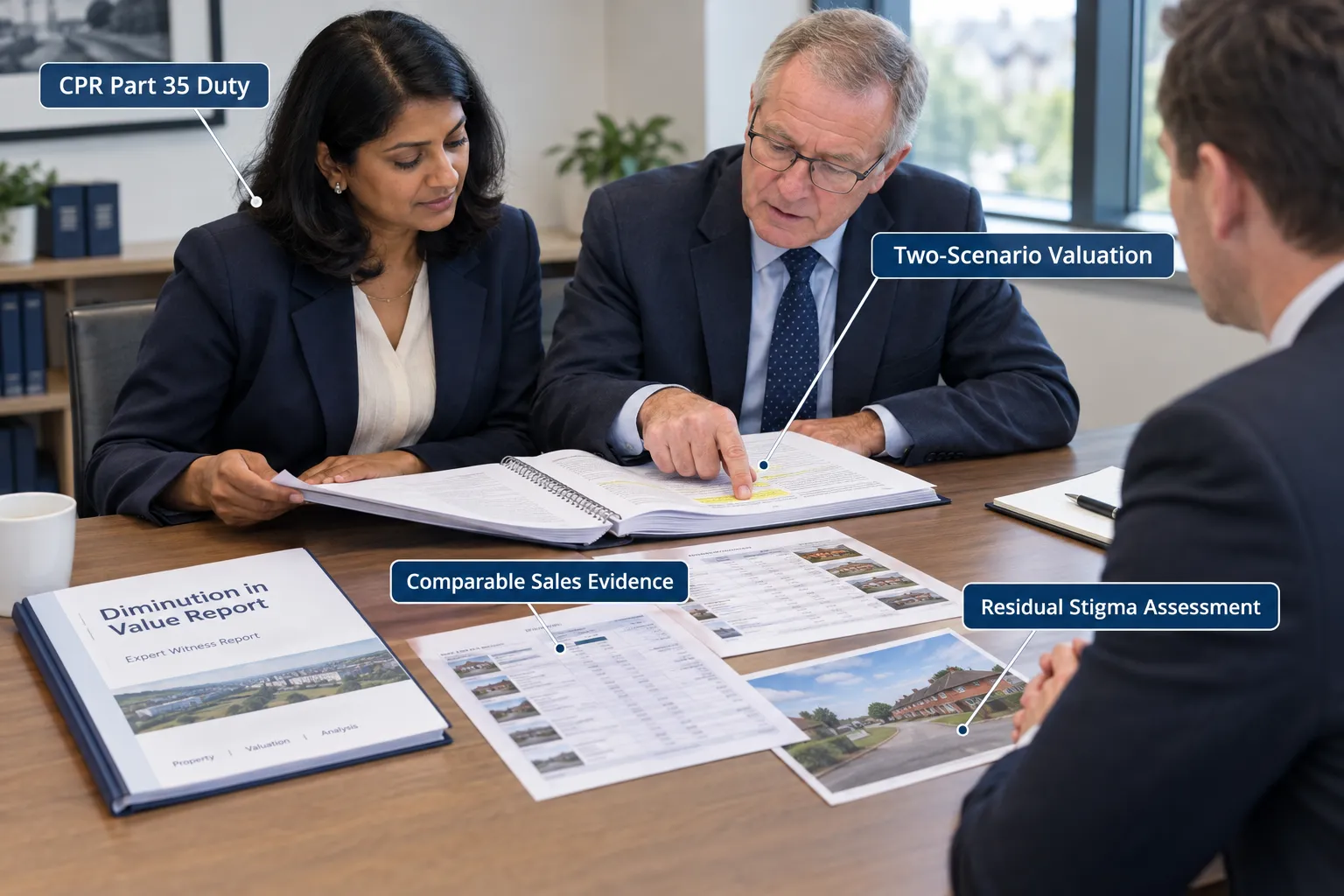
Understanding how expert witness surveyors assess loss of property value after building defects is only half the picture. The opinion must also survive scrutiny, from the opposing expert, from counsel, and from the court.
The following table sets out the standard contents of a well-constructed diminution-in-value expert report in 2026 practice:
| Section | Purpose |
|---|---|
| Instructions and scope | Defines what the expert was asked to do and by whom |
| Qualifications and independence declaration | Confirms RICS membership, relevant experience, CPR Part 35 compliance |
| Inspection record | Dates, access, limitations, photographic schedule |
| Schedule of defects | Factual, referenced to inspection findings |
| Causation opinion | Reasoned, distinguishes fact from inference |
| Repair specification and cost | Sourced from contractor quotes or published price guides |
| Valuation methodology | States the approach, the date of valuation, and the basis of value |
| Comparable evidence | Tabulated, with adjustments explained |
| Diminution opinion | Scenario A vs Scenario B, with a stated figure or range |
| Residual stigma assessment | Addressed even if the conclusion is nil |
| Statement of truth | Mandatory under CPR Part 35 |
A report that conflates the building surveyor's factual findings with the valuer's opinion, or that states a loss figure without showing the workings, will be vulnerable to challenge [4].
Multi-Disciplinary Teams
Complex claims increasingly involve a team rather than a single expert. A structural engineer may address causation; a building surveyor quantifies repair costs; a RICS-registered valuer produces the diminution opinion. The valuer must not simply adopt the engineer's conclusions without independent scrutiny, but the disciplines must be consistent with each other [8].
Where party wall damage is in dispute, the assessment overlaps with the compensation provisions of the Party Wall etc. Act 1996. Guidance on how that framework operates in practice is covered in the article on damage to property in party wall matters.
Single Joint Expert Appointments
Courts sometimes direct that a single joint expert (SJE) be appointed rather than allowing each party to instruct their own. An SJE must answer questions from both parties impartially. The instruction letter, the questions posed, and the expert's responses all form part of the evidence. Solicitors instructing an SJE should ensure the expert has both building survey and valuation competence, or that the appointment covers both disciplines.
Landlord, Tenant and Leasehold Contexts
Dilapidations disputes between commercial landlords and tenants require the same two-stage analysis: what is the cost of repair, and does that cost represent the true measure of loss to the landlord? Section 18 of the Landlord and Tenant Act 1927 caps a landlord's dilapidations claim at the diminution in value of the reversion, which means a valuation opinion is required in virtually every contested case [2].
RICS dilapidations guidance formalises this valuation-based approach and sets out the methodology a surveyor should follow when preparing a Section 18 diminution valuation [1]. Leaseholders facing dilapidations claims at lease end should consider instructing a surveyor to challenge both the schedule of works and the valuation cap. Further detail on managing those costs is available in the article on dilapidation surveys for commercial tenants.
In residential leasehold, defects in common parts or structural elements can reduce the value of individual flats. The expert must identify the correct interest being valued, the long leasehold, not the freehold, and apply the appropriate methodology. For context on how leasehold valuations are structured, the article on lease extension valuation versus buying the freehold explains how surveyors calculate premiums for different leasehold interests.
Frequently Asked Questions
Is the cost of repair always the same as the loss of value?
No. The cost of repair and the diminution in value are separate figures. Courts use the lower of the two as the measure of loss where they diverge, unless there is a good reason to award the higher figure. A RICS valuer must address both [1].
Can a property lose value even after repairs are completed?
Yes. Residual stigma, the discount buyers apply because of the known history of a defect, is a recognised head of loss. The expert must assess whether it applies and for how long.
What qualifications should an expert witness surveyor hold?
RICS membership is the standard benchmark in England and Wales. The surveyor should hold a relevant specialism, typically Valuation or Building Surveying, and be able to demonstrate experience of the defect type and property sector in question. Compliance with CPR Part 35 and the RICS Expert Witness Practice Statement is mandatory.
How long does an expert witness report take to prepare?
Timescales vary with complexity, but a straightforward residential diminution report typically takes four to eight weeks from inspection to delivery. Complex structural cases involving multi-disciplinary teams can take considerably longer.
Can the same surveyor act as both building expert and valuation expert?
A dual-qualified RICS member can address both disciplines in a single report, provided the factual findings and the valuation opinion are clearly separated. Courts are alert to reports that blur the two roles.
What is the difference between a single joint expert and a party-appointed expert?
A party-appointed expert is instructed by one side and owes their primary duty to the court, not the instructing party. A single joint expert is appointed by agreement of both parties (or by court direction) and answers questions from both sides. Both are bound by CPR Part 35.
Does diminution in value apply in surveyor negligence claims?
Yes. Where a surveyor fails to identify a defect that a competent surveyor would have found, the measure of loss is typically the difference between the price paid and the price the buyer would have paid had the defect been disclosed, which is a diminution-in-value calculation [5].
Conclusion
The route from a cracked wall or a damp ceiling to a quantified, court-ready loss figure is methodical and evidence-based. How expert witness surveyors assess loss of property value after building defects involves four distinct tasks: diagnosing the defect, establishing causation, costing the repair, and then, separately, valuing the property with and without the defect to produce a defensible diminution opinion.
The repair cost is a starting point, not an answer. Residual stigma, the date of assessment, the quality of comparable evidence, and the clarity of the expert's reasoning all determine whether the opinion holds up under cross-examination.
Practical next steps:
- If you are a homeowner or leaseholder with a suspected defect, commission a Level 3 building survey before instructing an expert witness, so the factual baseline is established independently.
- If you are a solicitor, instruct a RICS-qualified surveyor with demonstrable experience in both building pathology and valuation for the relevant property type.
- Ensure the expert's report separates factual findings from opinion, addresses both the cost-to-cure and the diminution in value, and includes a residual stigma assessment even where the conclusion is nil.
- Check that the instruction letter complies with CPR Part 35 requirements before the report is filed.
Early, well-structured expert evidence reduces the risk of late amendments, joint statement difficulties, and adverse costs orders, and gives the best prospect of a negotiated settlement before trial.
References
[1] Dilapidations Rebrand 2024 – rics.org
[2] September 2016 Dilapidations In England And Wales 7th Edition – rics.org
[3] Property Dispute – forensisgroup.com
[4] Building Survey Expertise In Construction Defect Litigation From Diagnosis To Quantum Valuation In Expert Reports – canterburysurveyors.com
[5] Expert Witness Services – gibsons-surveyors.ltd
[8] Expert Witness – res-prop.com
[9] Florida Courts Reaffirm Damages Must Be Calculated As Of Date Of Breach In Construction Defect Cases – marshalldennehey.com