
Roughly one in five UK homes sold each year has had some form of extension or alteration, and a significant proportion of those lack complete planning or building-regulation records. That gap in paperwork sits at the centre of one of the most common friction points between buyers, lenders and RICS surveyors: can a surveyor value a property with an unregistered extension, and what evidence, assumptions and risk does that process involve?
The short answer is yes, a qualified surveyor can and regularly does value such properties. What changes is the framework of assumptions the surveyor must state, the evidence they need to examine, and the risk that lenders may not accept the figure on the terms offered.
Key Takeaways
- A RICS surveyor can value a property with an unregistered extension, but must declare explicit assumptions about its planning and building-regulation status.
- Missing completion certificates, absent planning records and undocumented structural work each affect valuation methodology and lender confidence.
- Surveyors often apply a discount to the extension's floor area or treat its value as conditional pending further evidence.
- Lenders may impose retentions, request specialist reports or decline the security entirely where documentation gaps are material.
- Front-loading the evidence, gathering planning and building-regulation records before marketing, reduces the risk of a down-valuation or abortive transaction.
What "Unregistered Extension" Actually Means
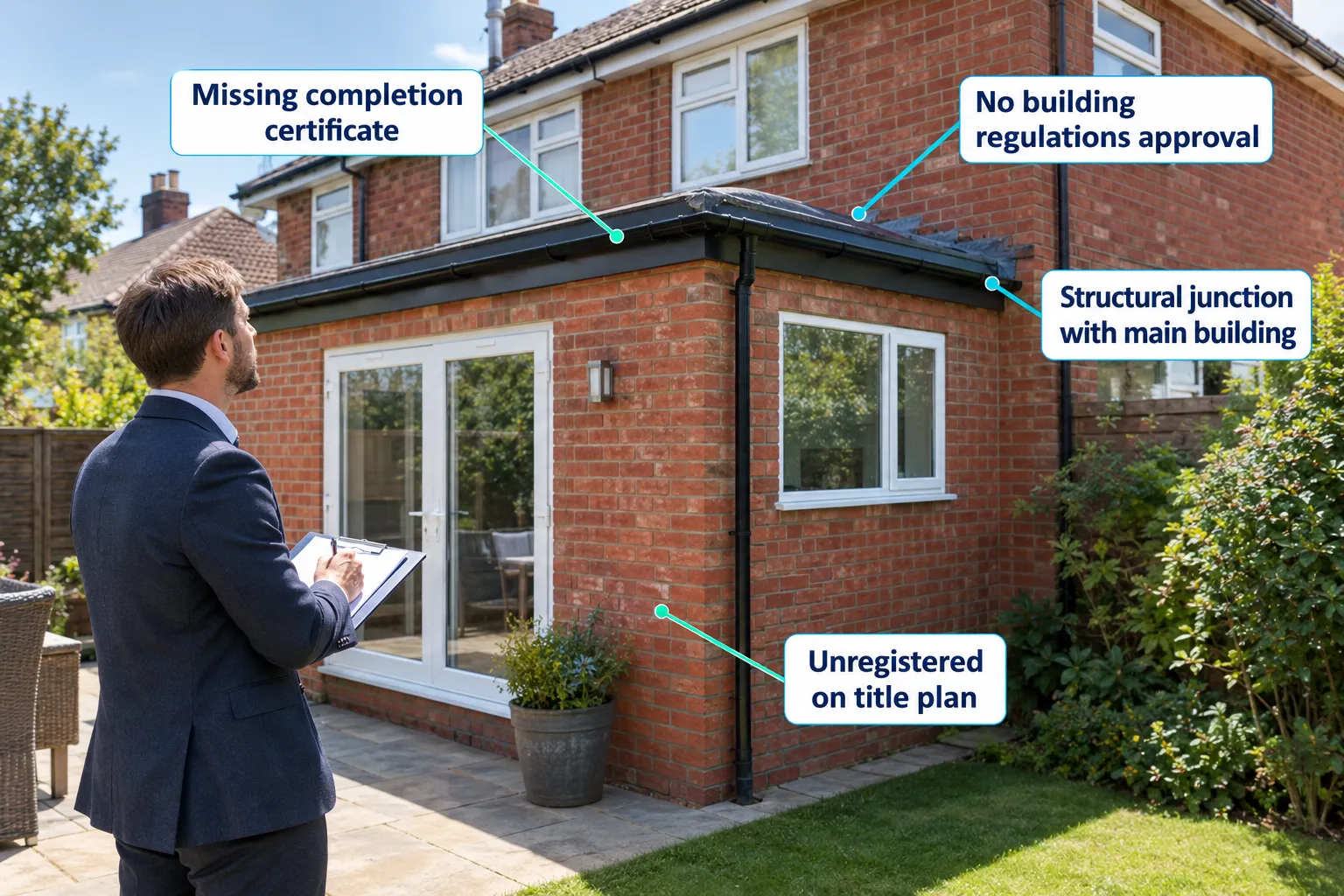
The phrase "unregistered extension" covers several distinct situations, and a surveyor will distinguish between them during inspection.
Planning permission not obtained. The extension was built without the required consent, or permitted development limits were exceeded. The local authority could, in theory, serve an enforcement notice, though this right expires after four years for most residential extensions built after 1 April 2023 (previously the limit was four years for operational development; the Levelling-up and Regeneration Act 2023 changes apply here).
Building regulations approval not sought. The works went ahead without a building notice or full plans application. There is no completion certificate, and the structural adequacy, fire separation, insulation and drainage of the extension are unverified by a building control body.
Not reflected in the title register. The Land Registry title plan may show the original footprint only. This is common where extensions predate digital mapping updates or where the owner never notified their conveyancer.
Each scenario carries a different risk profile, and the surveyor's report should identify which applies.
How RICS Standards Shape the Valuation Process
RICS valuation standards, the "Red Book", require surveyors to identify and report on any factor that could materially affect value. An unregistered extension is precisely such a factor. [7]
The Red Book framework distinguishes between assumptions (matters the valuer accepts as true without verification) and special assumptions (matters accepted as true that differ from the facts known at the date of valuation). Where an extension lacks building-regulation sign-off, the surveyor faces a choice:
- Value on the special assumption that all necessary consents exist and the works comply with current standards, producing a higher, conditional figure.
- Value as inspected, discounting the extension's contribution to floor area and value to reflect the risk that enforcement or remediation costs may arise.
RICS guidance on valuing change reinforces the principle that undocumented alterations require explicit disclosure of the basis on which the valuation proceeds. [1] [4] The surveyor cannot simply ignore the extension or treat it as equivalent to a fully consented addition.
For mortgage valuations specifically, RICS guidance on residential leasehold and secured-lending work requires the valuer to make specific enquiries about alterations and to report material gaps to the lender. [10] Lenders' own instructions, typically issued through their panel management systems, often go further, requiring the surveyor to flag any extension built without evidence of building-regulation completion.
The updated RICS Home Survey Standard, which came into effect in 2026, means more surveyors now include a valuation figure within their survey report. That convergence increases the importance of how they handle unapproved or undocumented extensions, because the same document now carries both condition findings and a market value opinion. [8]
For a broader view of how professional valuations differ from automated tools, see why chartered surveyor valuations still matter in UK property decisions.
Evidence the Surveyor Will Look For
A surveyor attending a property with an extension will seek documentary evidence before forming a view on value. The absence of any of the following will be noted in the report.
| Document | What it confirms | Risk if absent |
|---|---|---|
| Planning permission or permitted development confirmation (LDC) | Extension was lawfully authorised | Potential enforcement; buyer liability |
| Building regulations approval (full plans or building notice) | Works were inspected during construction | Structural, fire and insulation compliance unknown |
| Completion certificate | Final inspection passed | Lender may refuse security; insurer may not pay out |
| Structural engineer's certificate | Foundation and structural adequacy confirmed | Down-valuation; retention likely |
| Indemnity insurance policy | Covers cost of enforcement or remediation | Acceptable to some lenders; does not cure the defect |
| Updated title plan | Extension reflected in registered extent | Conveyancing clarity |
Where a completion certificate is missing, the surveyor cannot assume the works meet building regulations. The RICS guidance on valuing new build homes provides a useful parallel: even for newly constructed properties, the absence of a completion certificate is treated as a material risk requiring disclosure. [6]
Surveyors are also expected to look at physical evidence during inspection. Crack patterns at the junction between the original building and the extension, differential settlement, poor weatherproofing details and substandard roof construction can all indicate that building-regulation standards were not met. For guidance on reading structural evidence, see how surveyors read crack patterns in UK homes.
Assumptions, Discounts and Conditional Values
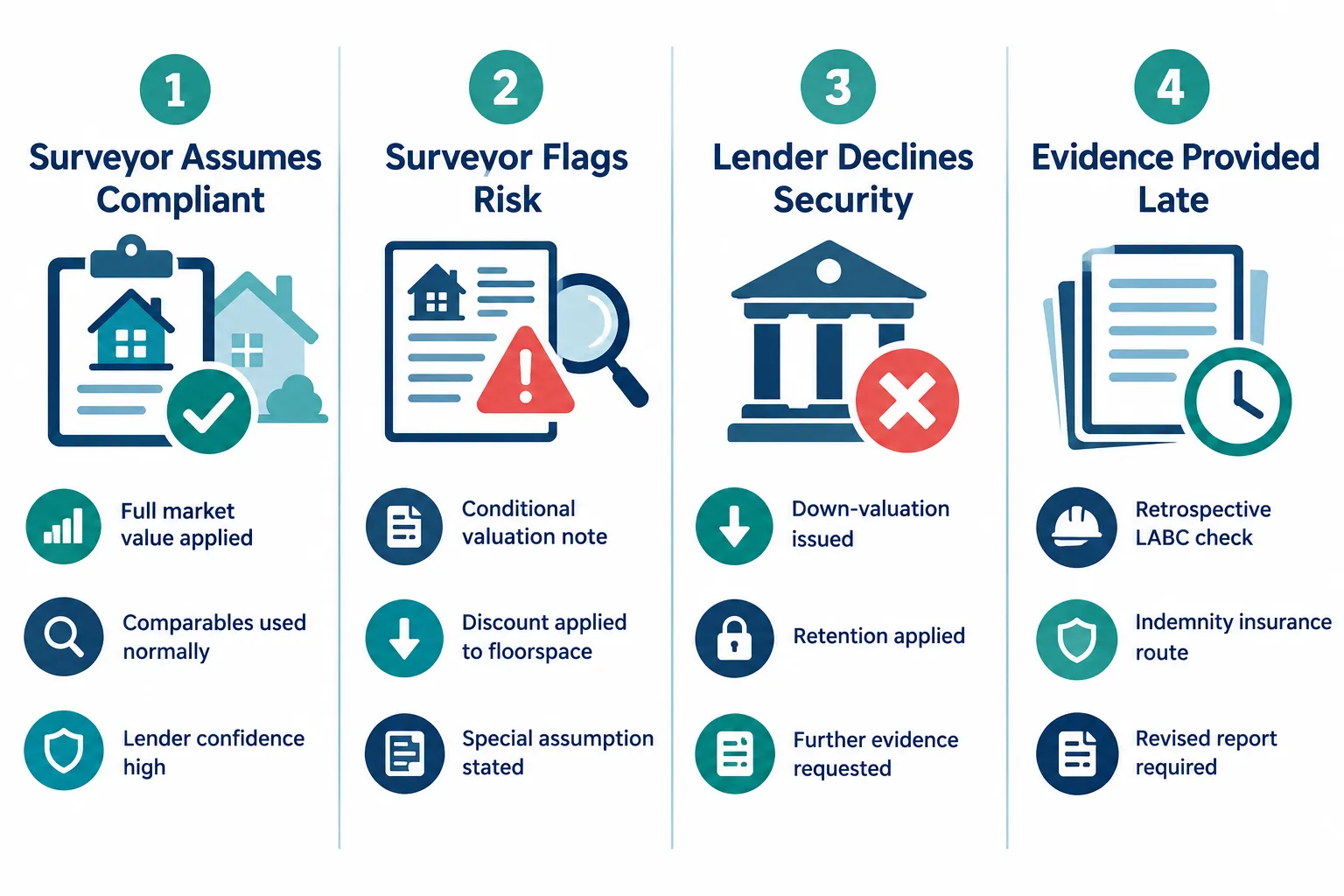
When a surveyor proceeds to value a property despite documentation gaps, the report must be explicit about the basis adopted. Three approaches are common in practice.
1. Valuation subject to special assumption
The surveyor values the property on the assumption that all necessary consents exist and the extension complies with current building regulations. The report states clearly that this is a special assumption and that the value would be lower, or the property might not be acceptable as security, if that assumption proved incorrect. This approach is often used where the extension appears well-constructed and the probability of a serious compliance failure seems low.
2. Valuation with a discount applied
The surveyor includes the extension's floor area in the gross internal area calculation but applies a reduced rate per square metre to reflect the risk premium. The discount varies by severity of the documentation gap, the age of the extension and the lender's known appetite for risk. A rear kitchen extension built in the 1980s with no records may attract a modest discount; a two-storey side extension with no planning permission and visible structural concerns may be discounted heavily or excluded from the value entirely.
3. Valuation excluding the extension
In cases where the documentation gap is severe, the surveyor may value the property as if the extension did not exist, noting its presence as an unverifiable addition. This approach protects the surveyor and the lender but produces a figure that may frustrate the transaction.
Whichever approach is adopted, the RICS Red Book requires the surveyor to state the basis clearly and to ensure the client understands the limitations of the figure. [7] A valuation that silently incorporates an unregistered extension without disclosure would expose the surveyor to professional liability.
For context on how defects and remediation costs feed into adjusted market values more broadly, see building survey defects and remediation costs: how valuers adjust market value for serious issues.
Lender Confidence and the Risk of a Down-Valuation
Mortgage lenders receive the surveyor's report and make their own lending decision. Where an extension is flagged as unregistered or undocumented, lenders typically respond in one of three ways.
Retention. The lender agrees to lend but holds back a portion of the advance, commonly £5,000 to £20,000, until the borrower provides a completion certificate, a retrospective building-regulations regularisation certificate, or an acceptable indemnity insurance policy.
Referral for specialist report. The lender instructs a structural engineer or specialist building surveyor to assess the extension independently before releasing funds. This adds cost and time to the transaction.
Decline of security. Where the documentation gap is severe, or where the extension accounts for a material proportion of the property's value, the lender may decline to lend against the property at all until the position is regularised.
Current lender-side practice in 2026 treats unapproved extensions as high-risk. This is consistent with RICS guidance requiring surveyors to make specific enquiries about alterations when carrying out secured-lending valuations. [10]
Buyers and their solicitors should be aware that an indemnity insurance policy, while often presented as a quick fix, does not remedy the underlying compliance gap. It compensates for financial loss arising from enforcement but does not confirm that the structure is safe or that it meets current energy-efficiency standards. Some lenders accept indemnity policies; others do not.
For a comparison of valuation types used in lending decisions, see the desktop valuation vs physical survey guide for UK lenders.
How to Reduce Risk Before Valuation
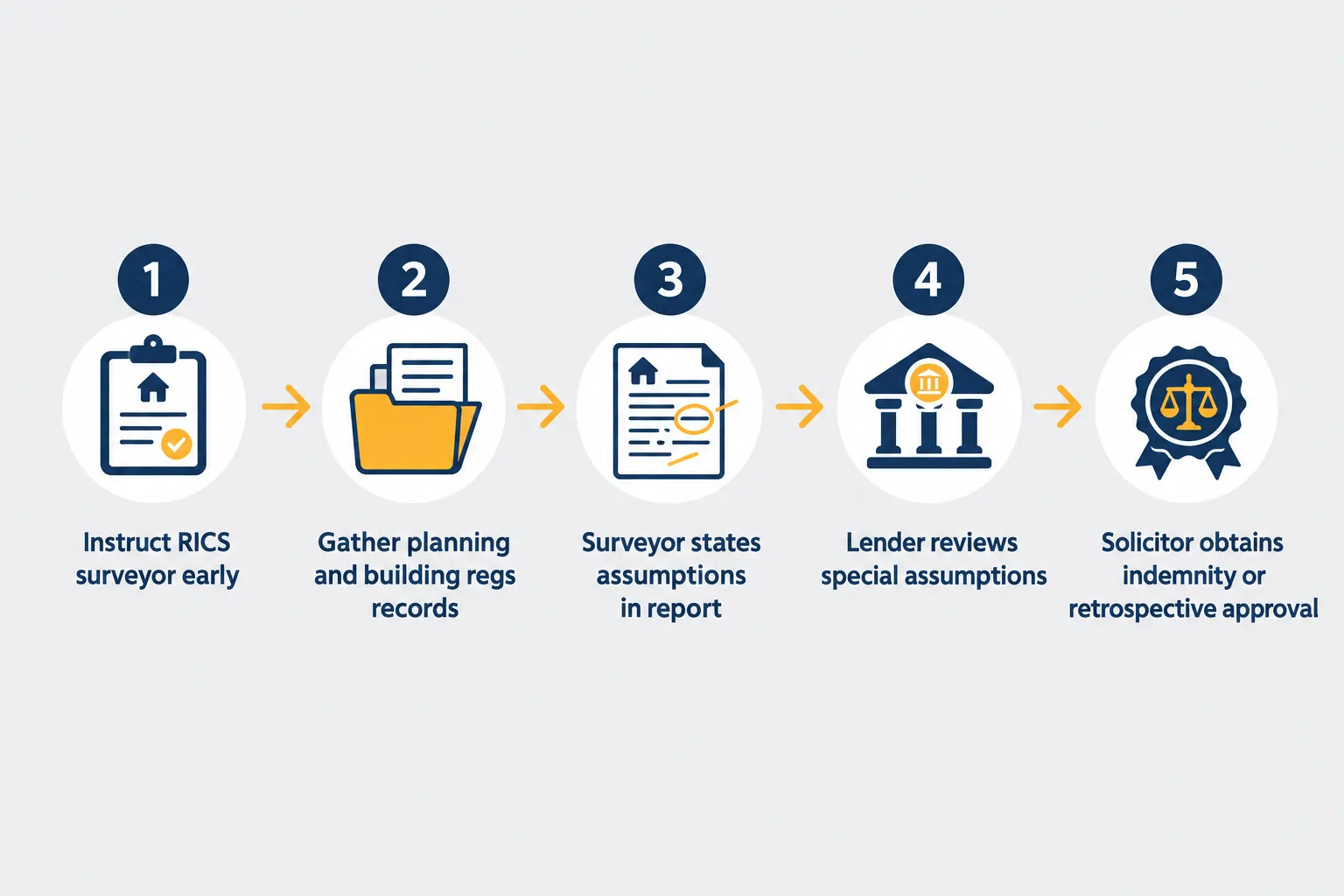
Sellers, agents and buyers' solicitors can take practical steps to reduce the risk of a down-valuation or abortive transaction.
Before marketing:
- Commission a retrospective building-regulations regularisation inspection through the local authority building control (LABC) body or an approved inspector. If the works pass, a regularisation certificate is issued.
- Obtain a lawful development certificate (LDC) from the local planning authority confirming the extension was permitted development or that the enforcement period has expired.
- Instruct a structural engineer to certify the foundation and structural adequacy of the extension, particularly where no original engineer's drawings exist.
During the sale process:
- Provide all available documentation to the surveyor before inspection, not after the report is issued. A surveyor who inspects without evidence will flag the gap; a surveyor who inspects with a regularisation certificate in hand can value on a more straightforward basis.
- Ensure the solicitor's property information form (TA6) accurately discloses the extension's planning and building-regulation history. Misrepresentation at this stage carries legal consequences.
Where regularisation is not possible:
- Consider indemnity insurance, but confirm with the target lender that their panel instructions accept it before incurring the cost.
- Adjust the asking price to reflect the risk premium that buyers and their lenders will apply.
For a room-by-room breakdown of what a surveyor checks during a building survey, including extensions, see what a surveyor actually checks in a building survey.
Frequently Asked Questions
Will a surveyor refuse to value a property with an unregistered extension?
Rarely. A RICS surveyor will usually proceed but will state explicit assumptions or apply a discount. Refusal is more likely where the extension is structurally dangerous or where the documentation gap makes any reliable valuation impossible.
Does an unregistered extension always reduce the value?
Not always. If the extension is well-built, appears compliant, and the documentation gap is minor, for example, an older extension where the enforcement period has clearly expired, the surveyor may value it close to full market value under a special assumption. The discount depends on the severity of the risk.
Can a buyer get a mortgage on a property with an unregistered extension?
Yes, but the lender may impose conditions. Retentions, specialist reports and indemnity insurance requirements are common. Some lenders will decline the security entirely.
What is a regularisation certificate and how does it help?
A regularisation certificate is issued by a building control body after a retrospective inspection confirms that existing works comply with building regulations. It provides documentary evidence that the extension meets the required standards, which significantly improves lender confidence and the surveyor's ability to value on a straightforward basis.
Does indemnity insurance solve the problem?
It mitigates the financial risk of enforcement but does not confirm structural safety or regulatory compliance. Not all lenders accept it. It is a risk-transfer tool, not a remedy.
Should the extension appear on the Land Registry title plan?
If the extension materially changes the property's footprint, the title plan should reflect it. A discrepancy between the plan and the physical property will be noted by the surveyor and the buyer's solicitor.
What if the extension was built under permitted development, does it still need a completion certificate?
Planning permission and building regulations are separate regimes. An extension can be lawful under permitted development and still require building-regulations approval. The completion certificate relates to building regulations, not planning.
Conclusion
A surveyor can value a property with an unregistered extension, but the process is more involved than a standard valuation. The surveyor must examine the available evidence, state explicit assumptions about the extension's compliance status, and disclose the limitations of the figure to the client and lender.
Missing completion certificates, absent planning records and undocumented structural work each raise the risk of a down-valuation, a lender retention or a declined mortgage application. The most effective way to manage that risk is to front-load the evidence, obtain regularisation certificates, lawful development certificates and structural engineer's reports before the property is marketed or a surveyor is instructed.
Practical next steps:
- Check whether the extension has a completion certificate and planning permission or permitted development confirmation before listing or making an offer.
- If records are missing, contact the local authority building control body about a regularisation inspection.
- Instruct a RICS surveyor early, before exchange, so that any documentation gaps are identified while there is still time to address them.
- Brief your solicitor fully on the extension's history so the TA6 form is accurate and any indemnity insurance is arranged on the correct basis.
For broader guidance on choosing the right survey for your property, see what survey do you need and for a full comparison of survey and valuation types, see the building survey vs valuation survey UK buyers guide.
References
[1] Valuing Change 1st Edition – rics.org
[4] Change Control And Management 1st Edition Amended – rics.org
[6] Valuation Of Individual New Build Homes – rics.org
[7] Valuation Standards – rics.org
[8] Home Survey Standards – rics.org
[10] Valuation of Residential Leasehold Properties for Secured Lending Purposes – rics.org