

The housing market recovery of 2026 has triggered an unprecedented surge in high-rise retrofit projects across urban centers. As developers and property owners rush to capitalize on renewed demand, Party Wall Surveying for High-Rise Retrofit Projects: 2026 Compliance Amid Housing Recovery has emerged as a critical concern for maintaining legal compliance while managing complex vertical extensions and structural modifications. With labor shortages and scope creep threatening project timelines, understanding the proper party wall procedures has never been more essential.
This comprehensive guide provides step-by-step guidance on navigating party wall notices and awards for vertical extensions in recovering markets, featuring RICS-compliant clauses specifically designed for complex urban retrofits.
Key Takeaways
- Party wall notices must be served 2 months before work begins on high-rise retrofit projects involving shared walls, ensuring legal compliance and neighbor protection
- RICS-compliant party wall awards provide essential frameworks for managing scope creep, labor shortages, and unexpected structural issues during vertical extensions
- Professional party wall surveyors serve as neutral third parties who protect both building owners and adjoining owners throughout complex retrofit processes
- Proper documentation and condition surveys conducted before work begins protect all parties from future disputes and liability claims
- 2026 compliance requirements emphasize enhanced structural assessments and ongoing monitoring protocols for high-rise retrofit projects
Understanding Party Wall Surveying for High-Rise Retrofit Projects in 2026
What Makes High-Rise Retrofits Different?
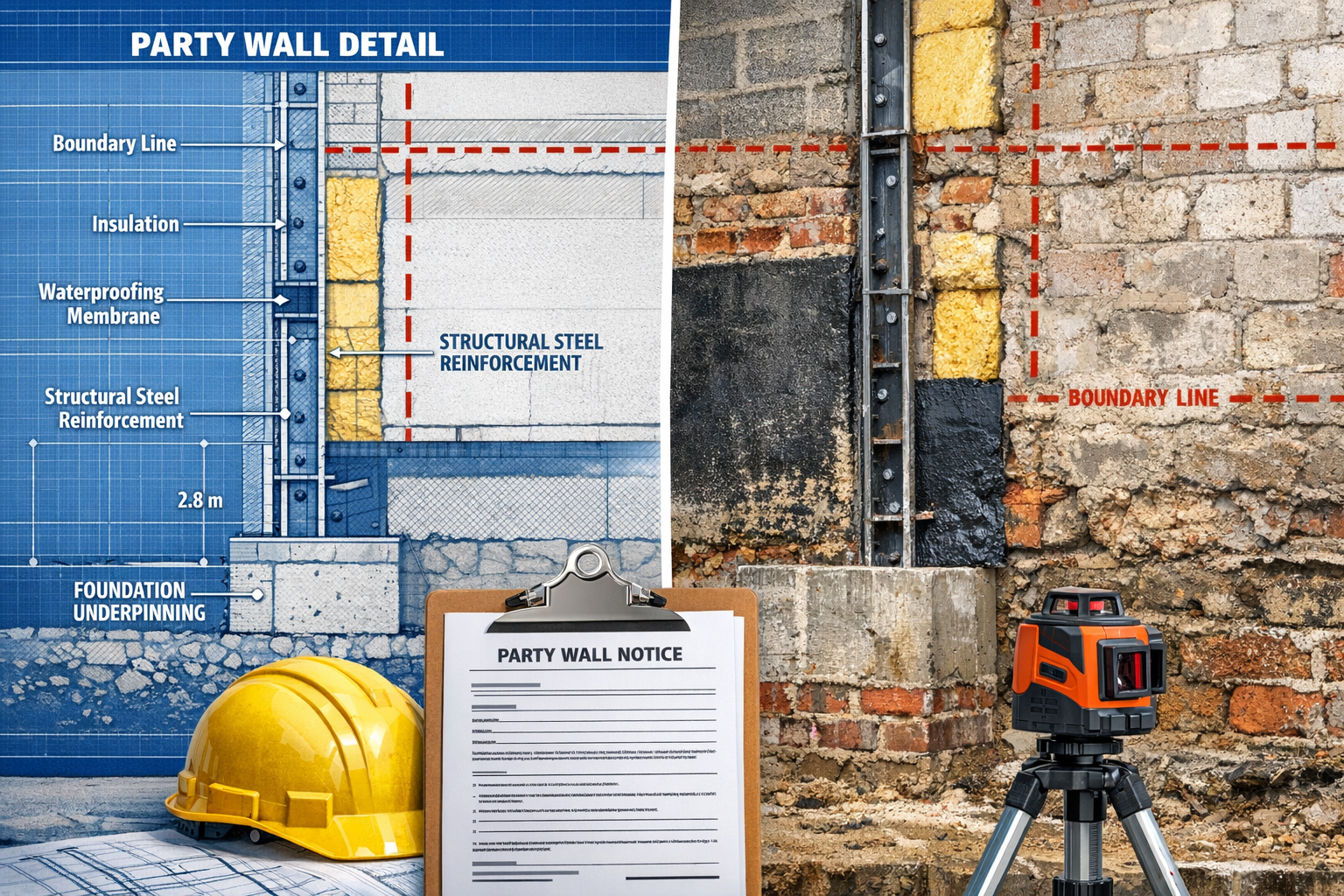
High-rise retrofit projects present unique challenges that distinguish them from standard residential extensions. These projects typically involve vertical extensions, structural reinforcement, and foundation modifications that directly impact shared party walls between adjacent properties.
The complexity increases exponentially when working with:
- 🏗️ Multi-story buildings with multiple adjoining owners
- 🔧 Aging infrastructure requiring extensive structural assessment
- 📋 Complex ownership structures including leaseholds and freeholds
- ⚖️ Stringent regulatory requirements for urban high-density areas
According to recent industry analysis, party wall surveying demand has increased significantly in 2026 as the housing market recovers and property owners seek to maximize their investments through vertical expansion [2].
The Legal Framework: Party Wall Act Compliance
The Party Wall etc. Act 1996 governs all work affecting shared walls, boundaries, and excavations near neighboring properties. For high-rise retrofit projects, this legislation becomes particularly critical when:
- Building up to or astride the boundary line
- Undertaking structural work to existing party walls
- Excavating within 3 or 6 meters of neighboring foundations
- Installing new beams or structural supports
Proper party wall notice procedures must be followed to avoid costly delays, legal disputes, and potential injunctions that could halt construction entirely.
Why Professional Party Wall Surveyors Are Essential
In the context of Party Wall Surveying for High-Rise Retrofit Projects: 2026 Compliance Amid Housing Recovery, professional surveyors serve multiple critical functions:
Protection for Building Owners:
- Navigate complex legal requirements
- Draft comprehensive party wall awards
- Manage neighbor relations professionally
- Minimize project delays and disputes
Protection for Adjoining Owners:
- Ensure proper condition surveys document pre-existing issues
- Monitor construction to prevent damage
- Secure appropriate compensation if damage occurs
- Provide independent expert assessment
"Party wall awards protect both parties and provide a clear framework for the retrofit work to proceed legally and safely" [2]
The role of an agreed surveyor becomes particularly valuable when both parties can work with a single neutral professional, reducing costs while maintaining impartiality.
Step-by-Step Guide: Party Wall Notices for Vertical Extensions
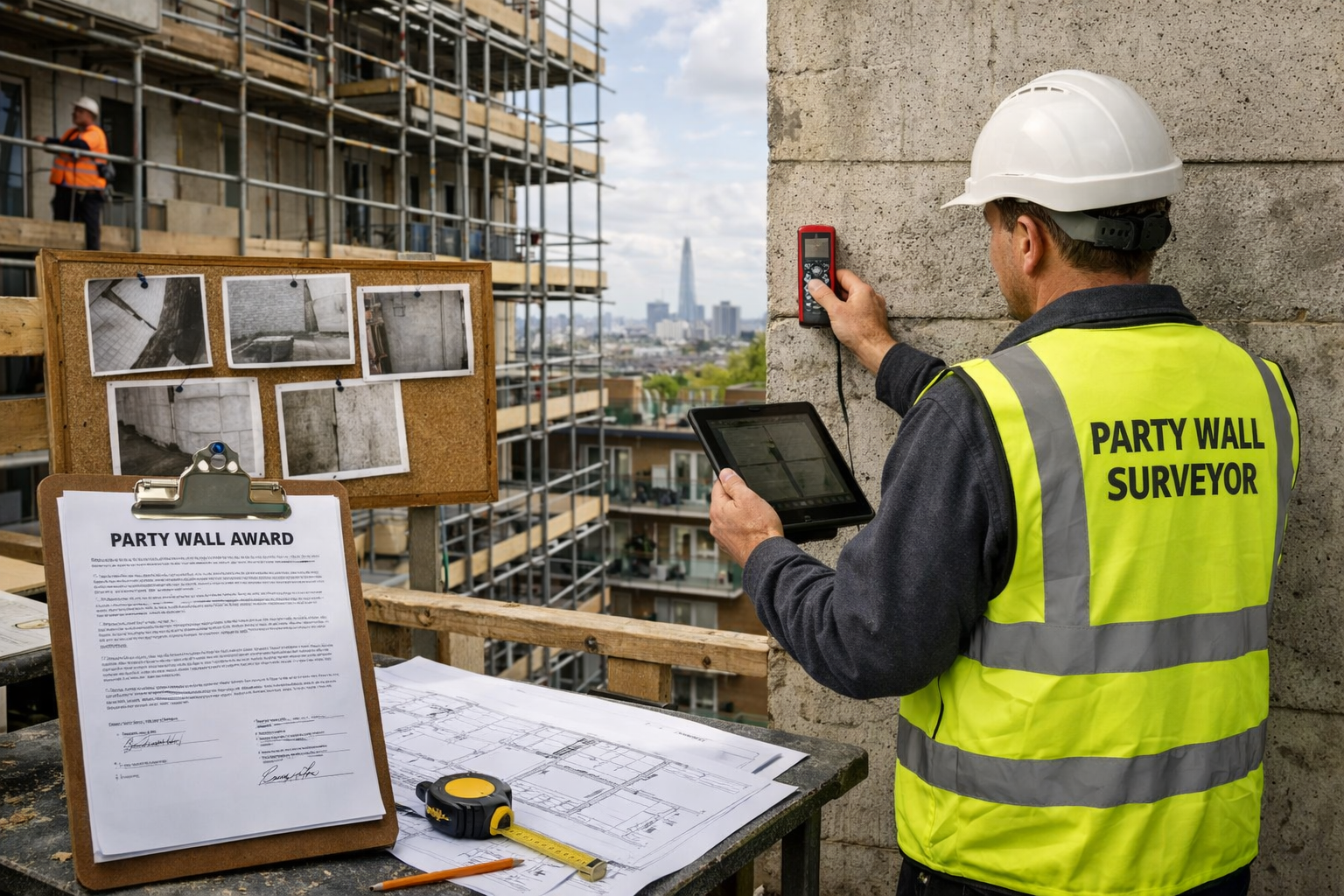
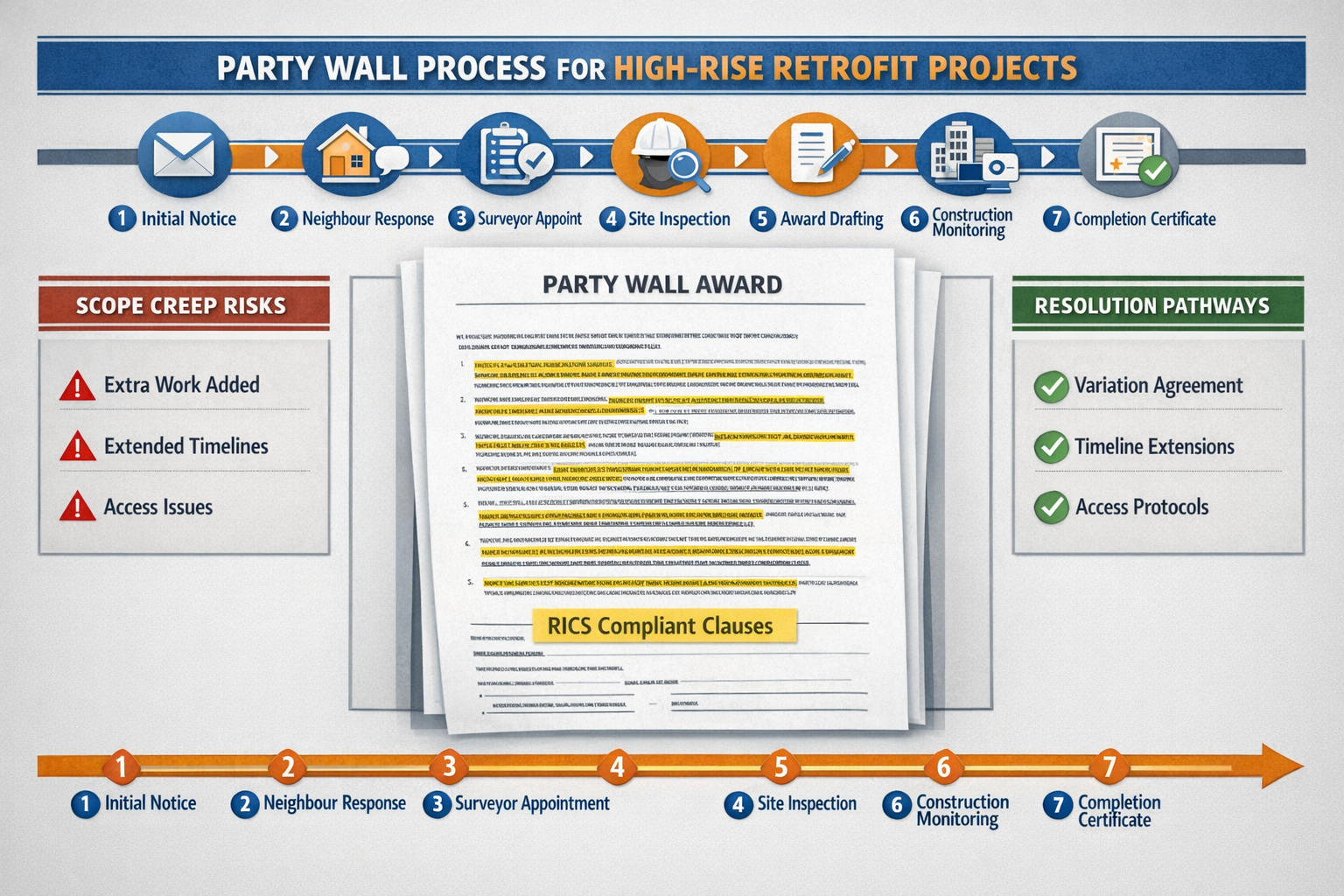
Step 1: Early Planning and Assessment (3-4 Months Before Construction)
Before serving any notices, conduct a thorough assessment of your retrofit project:
- Identify all affected party walls and boundaries
- Determine the scope of work that triggers party wall requirements
- Locate all adjoining owners (including upper-floor leaseholders in high-rises)
- Engage a qualified party wall surveyor early in the design phase
This early engagement helps identify potential complications before they become expensive problems. RICS guidance emphasizes the importance of adapting building surveys specifically for retrofit projects to address unique structural and compliance challenges [1].
Step 2: Prepare and Serve Party Wall Notices (2 Months Before Work)
The Party Wall Notice must be served at least 2 months before the intended start date for most work. The notice should include:
- ✅ Detailed description of proposed work
- ✅ Drawings and specifications showing impact on party walls
- ✅ Proposed start date
- ✅ Contact information for your appointed surveyor
- ✅ Explanation of adjoining owner's rights
For high-rise retrofits involving multiple types of work, you may need to serve different notice types:
| Notice Type | When Required | Notice Period |
|---|---|---|
| Party Structure Notice | Work directly to party walls | 2 months |
| Line of Junction Notice | Building new wall on boundary | 1 month |
| Adjacent Excavation Notice | Excavation within 3-6m of neighbor's foundation | 1 month |
Proper party wall consent procedures ensure all parties understand their rights and obligations.
Step 3: Neighbor Response and Surveyor Appointment (Within 14 Days)
Once notices are served, adjoining owners have 14 days to respond in one of three ways:
Option 1: Consent ✅
- Work can proceed as planned
- Still advisable to conduct condition survey
- Document consent in writing
Option 2: Dissent or No Response ⚠️
- Triggers party wall award process
- Adjoining owner appoints their own surveyor or agrees to use yours
- Two surveyors (or one agreed surveyor) prepare formal award
Option 3: Counter-Proposals 💬
- Neighbor suggests modifications
- Requires negotiation and potentially revised notices
In high-rise retrofit scenarios, dealing with multiple adjoining owners means managing several parallel processes simultaneously. Professional coordination becomes essential to avoid project delays.
Step 4: Condition Survey and Documentation
Before any work begins, comprehensive condition surveys must document the existing state of:
- All party walls and structures
- Adjoining owner's property (interior and exterior)
- Shared services and utilities
- Structural elements that could be affected
This documentation typically includes:
- 📸 Detailed photographs with timestamps
- 📏 Crack monitoring measurements
- 📝 Written descriptions of all defects
- 🎥 Video walkthroughs for complex properties
These surveys protect both parties by establishing a clear baseline. If party wall disputes arise later regarding damage, this evidence becomes invaluable.
Step 5: Drafting the Party Wall Award
The Party Wall Award is a legally binding document that sets out:
- Scope of work permitted under the Act
- Access arrangements for construction and inspection
- Working hours and noise restrictions
- Security measures and site management protocols
- Insurance requirements and liability provisions
- Dispute resolution procedures for scope changes
Step 6: Construction Monitoring and Compliance
Throughout the retrofit project, ongoing monitoring ensures compliance with the award terms:
- Regular site inspections by appointed surveyor(s)
- Documentation of any deviations from approved plans
- Immediate notification of unexpected structural issues
- Photographic evidence of work progression
This monitoring becomes particularly critical in 2026's environment of labor shortages and supply chain disruptions, which can lead to scope creep and timeline extensions.
Step 7: Completion and Final Inspection
Upon project completion:
- Final inspection compares current condition to pre-work surveys
- Damage assessment identifies any issues requiring remediation
- Completion certificate formally closes the party wall process
- Archive documentation for future reference (typically 6-12 years)
RICS-Compliant Clauses for Complex Urban Retrofits
Addressing Scope Creep in Party Wall Awards
Scope creep—the gradual expansion of work beyond original plans—poses significant risks in high-rise retrofit projects. RICS-compliant awards should include specific clauses addressing:
Clause 1: Variation Procedures
Should additional work to party structures become necessary during
construction, the Building Owner shall immediately notify all surveyors
and adjoining owners. No such additional work shall commence until
supplementary notices have been served and agreed, or a supplemental
award issued.
Clause 2: Unexpected Structural Issues
In the event that concealed structural defects are discovered during
works that require additional intervention to party walls, the Building
Owner's surveyor shall conduct immediate assessment and issue interim
recommendations within 48 hours.
Managing Labor Shortages and Timeline Extensions
The 2026 construction environment presents ongoing challenges with skilled labor availability. Party wall awards should anticipate potential delays:
Clause 3: Timeline Flexibility
While works are scheduled to commence on [DATE] and complete within
[X] months, reasonable extensions may be granted due to demonstrable
labor shortages, material delays, or unforeseen structural complications,
provided that adjoining owners receive 14 days written notice of any
extension exceeding 30 days.
Clause 4: Continuous Communication
The Building Owner shall provide monthly progress updates to all
adjoining owners and surveyors, including photographs, timeline
revisions, and notification of any issues affecting party structures.
Enhanced Structural Protection Clauses
High-rise retrofits require additional safeguards beyond standard party wall provisions:
Clause 5: Structural Monitoring
Continuous structural monitoring equipment shall be installed at key
locations on party walls and adjoining structures, with automated
alerts for movement exceeding 2mm. Weekly monitoring reports shall
be provided to all surveyors.
Clause 6: Temporary Support Requirements
Prior to any work that could compromise party wall stability, the
Building Owner shall install temporary structural support systems
designed by a chartered structural engineer and approved by all
appointed surveyors.
Insurance and Liability Provisions
Clause 7: Enhanced Insurance Coverage
The Building Owner shall maintain contractor's all-risk insurance
with minimum coverage of £[X] million, specifically including party
wall damage, structural failure, and consequential loss to adjoining
properties. Proof of coverage shall be provided to adjoining owners
before work commences.
Access and Security for High-Rise Projects
Clause 8: Secure Access Protocols
Access to party walls via adjoining properties shall be scheduled
with minimum 48 hours notice, limited to working hours of [TIME],
and supervised by the Building Owner's representative. All access
points shall be secured immediately after each visit.
Navigating 2026 Housing Recovery Challenges
The Current Market Context
The 2026 housing recovery has created a perfect storm of opportunity and challenge:
- 📈 Increased property values making vertical extensions financially attractive
- 🏘️ Urban density pressures driving demand for additional housing units
- 💰 Favorable lending conditions enabling retrofit investments
- ⚖️ Stricter building regulations requiring enhanced compliance
This environment has led to a surge in party wall surveying activity, particularly for loft conversions and high-rise extensions [2].
Common Pitfalls to Avoid
❌ Starting Work Without Proper Notices
The most costly mistake is beginning construction before serving notices or obtaining awards. Adjoining owners can seek injunctions that immediately halt all work, leading to:
- Legal costs exceeding £10,000-£50,000
- Project delays of 3-6 months
- Damaged neighbor relations
- Potential damages claims
❌ Inadequate Condition Surveys
Rushing through pre-construction documentation creates vulnerability to false damage claims. Invest in comprehensive structural surveys that document every detail.
❌ Poor Communication with Adjoining Owners
High-rise retrofits affect multiple neighbors simultaneously. Failure to maintain open, respectful communication escalates minor concerns into formal disputes.
❌ Underestimating Timeline Requirements
Party wall processes add minimum 2-3 months to project timelines. Factor this into financing, contractor scheduling, and occupancy planning.
Best Practices for 2026 Compliance
✅ Engage specialists early: Consult party wall surveyors during design phase
✅ Budget appropriately: Allocate 2-5% of project costs for party wall procedures
✅ Document everything: Maintain meticulous records of all communications and inspections
✅ Build buffer time: Add 20-30% contingency to construction schedules
✅ Maintain transparency: Proactively share information with all affected parties
✅ Consider agreed surveyors: Using a single neutral surveyor reduces costs and complexity
Special Considerations for Different Retrofit Types
Vertical Extensions and Roof Additions
Adding stories to existing high-rise buildings creates significant party wall implications:
- Increased load on party walls requiring structural assessment
- Potential underpinning or foundation reinforcement
- Modifications to shared chimneys and roof structures
- Impact on light, privacy, and amenity for neighbors
Professional roof surveys become essential for assessing feasibility and party wall impacts.
Facade Retention and Structural Modifications
Retrofit projects that retain historic facades while rebuilding interiors require:
- Careful assessment of party wall connections to existing facades
- Temporary support systems during construction
- Coordination with conservation requirements
- Enhanced monitoring during demolition and reconstruction phases
Basement Extensions and Underpinning
Excavating below existing foundations triggers the most stringent party wall requirements:
- Detailed structural calculations for adjacent properties
- Continuous monitoring during excavation
- Strict protocols for managing groundwater and soil stability
- Enhanced insurance coverage for subsidence risks
Energy Efficiency Retrofits
Even seemingly minor work like party wall insulation may require notices if it involves:
- Penetrating or modifying party walls
- Installing cavity wall insulation
- Adding external insulation systems that approach boundaries
- Upgrading shared services or utilities
Working with Professional Party Wall Surveyors
Qualifications to Look For
When selecting a party wall surveyor for high-rise retrofit projects, prioritize:
- RICS membership (Royal Institution of Chartered Surveyors)
- Specialist party wall experience with complex urban projects
- Structural engineering knowledge for high-rise assessments
- Local authority familiarity with building regulations and planning
- Professional indemnity insurance (minimum £1 million coverage)
Cost Considerations
Party wall surveying fees for high-rise retrofit projects typically include:
| Service Component | Typical Cost Range |
|---|---|
| Initial consultation and notice preparation | £500 – £1,500 |
| Condition survey (per property) | £400 – £1,200 |
| Party wall award drafting | £1,000 – £3,000 |
| Construction monitoring (monthly) | £300 – £800 |
| Dispute resolution (if required) | £2,000 – £10,000+ |
Important: Under the Party Wall Act, the building owner typically pays all reasonable surveyor fees, including the adjoining owner's surveyor costs. Budget accordingly.
The Agreed Surveyor Advantage
When both parties agree to appoint a single surveyor, benefits include:
- 💰 Reduced costs (one fee instead of two)
- ⏱️ Faster process (no surveyor coordination delays)
- 🤝 Simplified communication (single point of contact)
- ⚖️ Maintained impartiality (agreed surveyors have equal duty to both parties)
However, each party retains the right to appoint their own surveyor if they prefer independent representation.
Technology and Innovation in 2026 Party Wall Surveying
Digital Documentation and Monitoring
Modern party wall surveying increasingly incorporates:
- 3D laser scanning for precise condition documentation
- Drone surveys for high-rise exterior assessments
- Structural monitoring sensors providing real-time movement data
- Cloud-based documentation enabling instant access for all parties
- Digital signature platforms streamlining award execution
Building Information Modeling (BIM) Integration
Advanced retrofit projects now use BIM to:
- Visualize party wall impacts before construction
- Coordinate structural modifications with existing conditions
- Share detailed information with all surveyors and stakeholders
- Identify potential conflicts early in design phase
Regional Considerations and Local Expertise
Party wall procedures remain consistent across England and Wales, but local factors influence implementation:
- Urban density in areas like London creates more complex multi-party scenarios
- Historic building concentrations require enhanced conservation coordination
- Local authority requirements may add supplementary approval processes
- Regional construction practices influence typical timeline expectations
Working with chartered surveyors who understand local conditions provides significant advantages in navigating these regional nuances.
Conclusion
Party Wall Surveying for High-Rise Retrofit Projects: 2026 Compliance Amid Housing Recovery represents a critical intersection of legal requirements, technical complexity, and market opportunity. As the housing recovery continues to drive vertical extension demand, proper party wall procedures protect all stakeholders while enabling valuable urban densification.
Key Action Steps for Building Owners
- Start early: Engage party wall surveyors 3-4 months before planned construction
- Serve proper notices: Follow statutory requirements precisely, allowing full notice periods
- Document thoroughly: Invest in comprehensive condition surveys before work begins
- Include RICS-compliant clauses: Address scope creep, labor shortages, and monitoring requirements
- Maintain communication: Keep adjoining owners informed throughout the process
- Budget appropriately: Allocate sufficient funds for surveyor fees and potential delays
- Monitor continuously: Ensure ongoing compliance with party wall award terms
Key Action Steps for Adjoining Owners
- Respond promptly: Reply to party wall notices within the 14-day statutory period
- Appoint qualified surveyors: Select experienced professionals to protect your interests
- Attend condition surveys: Ensure thorough documentation of your property's pre-work condition
- Review awards carefully: Understand all terms before agreeing to construction
- Stay engaged: Monitor progress and report concerns immediately to your surveyor
- Know your rights: Understand that building owners must cover reasonable surveyor fees
Looking Ahead
The 2026 housing recovery shows no signs of slowing, and high-rise retrofit projects will continue proliferating across urban centers. Success requires balancing ambitious development goals with rigorous compliance, neighbor protection, and professional expertise.
By following the step-by-step guidance outlined in this article and incorporating RICS-compliant clauses designed for complex urban retrofits, both building owners and adjoining owners can navigate party wall procedures confidently. Professional party wall surveyors serve as essential partners in this process, providing the technical knowledge, legal expertise, and neutral oversight that enable projects to proceed safely, legally, and cooperatively.
Whether you're planning a vertical extension, structural retrofit, or comprehensive high-rise renovation, investing in proper party wall surveying from the outset protects your project, your neighbors, and your long-term property interests in this dynamic recovery market.
References
[1] Adapting Building Surveys For 2026 Retrofit Projects Rics Guidance Post Quality In Retrofit Summit – https://nottinghillsurveyors.com/blog/adapting-building-surveys-for-2026-retrofit-projects-rics-guidance-post-quality-in-retrofit-summit
[2] Party Wall Surveying Surge In 2026 Loft Conversions Navigating High Demand Compliance During Housing Uptick – https://nottinghillsurveyors.com/blog/party-wall-surveying-surge-in-2026-loft-conversions-navigating-high-demand-compliance-during-housing-uptick