The Renters' Rights Act 2026 has fundamentally transformed how surveyors approach rent valuations for periodic tenancies, introducing annual review mechanisms that place unprecedented scrutiny on valuation methodologies. With over 4.4 million households in the private rented sector facing potential rent adjustments, chartered surveyors must now provide bulletproof, evidence-based valuations that can withstand formal tenant challenges and tribunal scrutiny. Understanding Rent Review Challenges in Valuation Surveys: RICS Guidance Under Renters' Rights Act 2026 Periodic Tenancies has become essential for property professionals navigating this regulatory shift.
The landscape of rental valuations has shifted dramatically. Surveyors can no longer rely on simple market comparisons or landlord instructions alone. Instead, they must balance statutory requirements, RICS professional standards, and the new rights afforded to tenants under the 2026 legislation. This comprehensive guide explores the challenges, methodologies, and best practices for conducting rent review valuations in this transformed regulatory environment.
Key Takeaways
- 🏠 Annual rent reviews for periodic tenancies now require robust, defensible valuation evidence that can withstand tenant challenges and tribunal examination
- 📊 RICS guidance mandates comprehensive comparable evidence, market condition analysis, and property-specific adjustments for all rent review valuations
- ⚖️ Tenant challenge rights have expanded significantly, requiring surveyors to document methodology, assumptions, and evidence trails meticulously
- 📈 Market volatility in 2026 demands real-time data analysis, with RICS surveys showing fluctuating rental demand across different property types and regions
- 🔍 Professional liability increases as valuation reports become subject to greater legal scrutiny under the new tenancy framework

Understanding the Renters' Rights Act 2026 Framework for Periodic Tenancies
The Renters' Rights Act 2026 represents the most significant overhaul of private rental sector regulation in decades. At its core, the legislation abolishes fixed-term assured shorthold tenancies and transitions the entire sector to periodic tenancies with enhanced tenant protections.
Key Legislative Changes Affecting Valuations
The Act introduces several provisions that directly impact how RICS registered valuers conduct rent reviews:
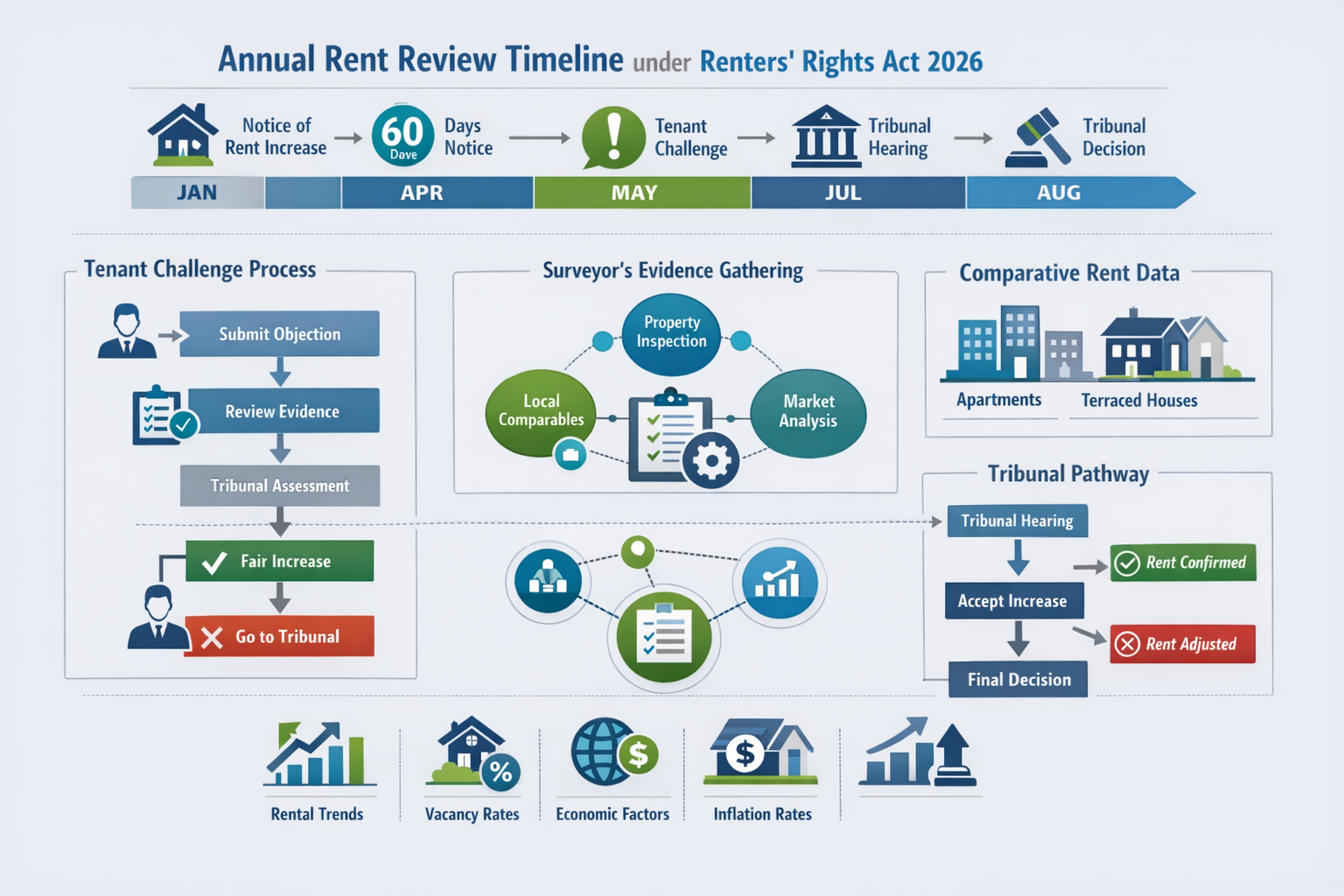
Statutory Rent Review Frequency: Landlords can now only increase rent once per year for periodic tenancies, creating a structured annual review cycle that requires formal valuation support.
Tenant Challenge Mechanisms: Tenants gain explicit rights to challenge proposed rent increases through the First-tier Tribunal (Property Chamber), which can determine market rent based on independent evidence.
Market Rent Definitions: The Act clarifies that rent increases must reflect genuine market conditions, not arbitrary landlord decisions, placing greater emphasis on comparable evidence.
Transparency Requirements: Landlords must provide clear justification for rent increases, often necessitating professional valuation reports to support their position.
Impact on Valuation Methodologies
These changes fundamentally alter the surveyor's role. Previously, rent reviews for assured shorthold tenancies often involved informal assessments or simple market checks. Under the 2026 framework, every rent review becomes a potential tribunal case, requiring:
- Comprehensive comparable evidence analysis
- Detailed property condition assessments
- Market trend documentation
- Adjustment calculations for property-specific factors
- Clear methodology statements
Professional chartered surveyors must now approach periodic tenancy valuations with the same rigor previously reserved for commercial rent reviews or lease renewal negotiations.
RICS Guidance on Rent Review Challenges in Valuation Surveys
The Royal Institution of Chartered Surveyors has responded to the Renters' Rights Act 2026 with updated guidance specifically addressing Rent Review Challenges in Valuation Surveys: RICS Guidance Under Renters' Rights Act 2026 Periodic Tenancies. This guidance establishes professional standards that balance statutory requirements with practical valuation principles.
Core RICS Principles for Periodic Tenancy Valuations
RICS guidance emphasizes several fundamental principles that surveyors must follow:
Market Evidence Primacy: Valuations must be grounded in verifiable market transactions, not theoretical models or landlord expectations. Surveyors should compile evidence from at least 5-10 comparable properties with similar characteristics.
Adjustment Transparency: Every adjustment made to comparable evidence must be documented and justified. This includes adjustments for:
- Property size and layout differences
- Condition and specification variations
- Location and amenity access
- Lease terms and tenant obligations
- Market timing differences
Professional Independence: Surveyors must maintain objectivity regardless of who instructs them. The guidance explicitly states that valuations should reflect market rent, not simply support the instructing party's position.
Documentation Standards: Valuation reports must include comprehensive evidence schedules, methodology explanations, and assumption statements that would satisfy tribunal scrutiny.
Comparable Evidence Requirements
The RICS guidance provides specific direction on selecting and analyzing comparable rental evidence:
| Evidence Factor | RICS Requirement | Practical Application |
|---|---|---|
| Transaction Date | Within 6 months preferred, 12 months maximum | Older comparables require market movement adjustments |
| Geographic Proximity | Same postcode district ideal, adjacent areas acceptable | Document any location value differentials |
| Property Type Match | Same dwelling type (flat, house, maisonette) | Cross-type comparisons require substantial adjustment |
| Size Variance | ±20% floor area tolerance | Apply £/sqm or £/sqft normalization |
| Condition Alignment | Similar specification and repair standard | Quantify improvement or disrepair impacts |
According to recent RICS residential market surveys, rental demand patterns vary significantly across property types and regions [1][2]. Surveyors must account for these market dynamics when selecting comparables and applying adjustments.
Addressing Market Volatility in 2026
The 2026 rental market presents unique challenges for valuation professionals. RICS survey data from January 2026 indicates mixed market signals, with some regions showing early recovery while others continue softening [3]. This volatility requires surveyors to:
✅ Use the most recent data available rather than relying on historical averages
✅ Document market trends affecting the subject property's location and type
✅ Apply appropriate time adjustments when using older comparables
✅ Consider forward-looking indicators for annual review projections
✅ Acknowledge uncertainty where market conditions remain unclear
Professional valuation services in London must particularly account for localized market variations, as different boroughs show divergent rental trends.
Common Rent Review Challenges and How to Address Them
Surveyors conducting valuations under the Renters' Rights Act 2026 face several recurring challenges that require strategic responses. Understanding these challenges and implementing robust methodologies is essential for producing defensible valuations.
Challenge 1: Insufficient Comparable Evidence
The Problem: In some property types or locations, recent comparable lettings may be scarce, particularly for unique properties or niche markets.
RICS-Compliant Solutions:
- Expand geographic search parameters while documenting location adjustments
- Use older comparables with explicit market movement adjustments based on rental indices
- Consider asking rent data alongside achieved rents, noting any market discounting patterns
- Engage with local letting agents to verify market conditions and typical rental ranges
- Document the evidence scarcity and explain how conclusions were reached despite limitations
Professional surveyors should maintain relationships with letting agents and property managers to access market intelligence beyond publicly available data. This network becomes invaluable when formal comparable evidence proves limited.
Challenge 2: Property Condition Disputes
The Problem: Tenants may challenge valuations by claiming the property's condition justifies lower rent than comparables suggest.
RICS-Compliant Solutions:
- Conduct thorough on-site inspections documenting condition with photographs
- Apply specific percentage adjustments for disrepair or specification differences
- Reference industry-standard adjustment ranges for common defects
- Distinguish between tenant-caused wear and landlord maintenance obligations
- Consider obtaining a specific defect report for properties with significant condition issues
The valuation must clearly separate the property's inherent characteristics from temporary condition issues. For example, a property with outdated kitchen fittings requires different treatment than one with unrepaired water damage.
Challenge 3: Market Timing and Seasonality
The Problem: Rental markets exhibit seasonal variations, and the timing of comparable transactions may not align with the review date.
RICS-Compliant Solutions:
- Document known seasonal patterns in the local rental market
- Apply time adjustments using recognized rental indices (e.g., ONS rental price data)
- Weight more recent comparables more heavily in analysis
- Consider multiple valuation dates if market conditions changed significantly
- Explain any timing adjustments clearly in the report methodology section
Research from RICS residential market surveys consistently shows rental demand fluctuations throughout the year [2]. Surveyors must acknowledge these patterns when analyzing comparable evidence.
Challenge 4: Tenant Improvement Considerations
The Problem: Tenants may have made improvements to the property at their own expense, arguing that these should not justify rent increases.
RICS-Compliant Solutions:
- Review tenancy agreements for clauses addressing tenant improvements
- Distinguish between tenant-funded improvements and landlord-provided amenities
- Apply "disregard" principles similar to commercial lease renewals where appropriate
- Document the property's condition at tenancy commencement if records exist
- Consider the statutory framework's treatment of tenant improvements
This challenge requires careful legal interpretation alongside valuation judgment. Surveyors should recommend legal advice when tenant improvement disputes appear likely.
Challenge 5: Affordability Arguments
The Problem: Tenants may argue that proposed rent increases are unaffordable, even if market-justified.
RICS-Compliant Solutions:
Important Note: RICS valuation principles focus on market value, not affordability. However, surveyors should:
- Clearly explain that market rent reflects supply and demand, not individual tenant circumstances
- Acknowledge affordability pressures while maintaining professional independence
- Ensure comparables reflect actual market transactions, not aspirational pricing
- Document any market evidence of rental resistance or void periods
- Distinguish between market rent and rent that tenants wish to pay
Tribunals typically focus on market evidence rather than affordability when determining rent disputes. Surveyors must maintain this distinction while demonstrating empathy for tenant concerns.
Preparing Defensible Valuation Reports for Tribunal Scrutiny
Given the expanded tenant challenge rights under the Renters' Rights Act 2026, every rent review valuation should be prepared with the assumption it may face tribunal examination. This requires elevated documentation standards and methodological rigor.
Essential Report Components
A tribunal-ready valuation report for periodic tenancy rent reviews must include:
1. Executive Summary
- Clear statement of the market rent conclusion
- Brief summary of methodology and key evidence
- Confirmation of RICS standards compliance
2. Instructions and Scope
- Details of who instructed the valuation and for what purpose
- Confirmation of property inspection arrangements
- Statement of independence and conflicts of interest
- Limitations or assumptions affecting the valuation
3. Property Description
- Comprehensive description of accommodation and layout
- Specification details (heating, windows, kitchen, bathroom)
- Condition assessment with photographic evidence
- Location analysis and local amenities
- Parking, garden, and external features
4. Tenancy Terms Analysis
- Current rent and review history
- Tenancy commencement date and type
- Tenant obligations and landlord responsibilities
- Any unusual terms affecting rental value
5. Market Context
- Local rental market overview
- Supply and demand dynamics
- Recent market trends and indicators
- Relevant data from RICS surveys or other authoritative sources
6. Comparable Evidence Schedule
- Detailed schedule of comparable lettings with:
- Full addresses (or sufficient location detail)
- Letting dates and rent achieved
- Property descriptions and specifications
- Sources of information
- Adjustments applied with justifications
7. Valuation Analysis
- Explanation of adjustment methodology
- Calculation showing how comparables lead to conclusion
- Treatment of any special factors
- Sensitivity analysis if appropriate
8. Conclusion and Certification
- Clear statement of market rent opinion
- Effective date of valuation
- Professional signature and RICS designation
- Compliance statements
Common Tribunal Objections and Pre-emptive Responses
Understanding typical tribunal challenges allows surveyors to address potential objections proactively:
"The comparables aren't truly comparable"
- Pre-empt by explaining why each comparable was selected
- Document adjustment methodology clearly
- Include a range of comparables showing consistency
- Acknowledge any limitations in available evidence
"The surveyor didn't inspect the property properly"
- Conduct thorough inspections with comprehensive photographic records
- Document inspection date, duration, and areas accessed
- Note any areas not inspected and reasons why
- Include floor plans or measurements where relevant
"Market conditions have changed since the valuation"
- Use the most recent evidence available
- Include market trend analysis
- Consider providing a valuation date sensitivity
- Update reports if significant time passes before tribunal hearing
"The surveyor is biased toward the landlord"
- Maintain professional independence throughout
- Present balanced analysis acknowledging tenant perspectives
- Use objective, evidence-based reasoning
- Avoid advocacy language favoring either party
Professional commercial property surveyors experienced in rent review processes can apply similar rigorous approaches to residential periodic tenancy valuations.

Practical Workflow for Rent Review Valuations Under the 2026 Act
Implementing a systematic workflow ensures consistent quality and compliance with RICS guidance on Rent Review Challenges in Valuation Surveys: RICS Guidance Under Renters' Rights Act 2026 Periodic Tenancies.
Step 1: Initial Instructions and Conflict Checks (Day 1)
- Receive formal instructions from landlord or managing agent
- Conduct conflict of interest checks
- Confirm scope, purpose, and reporting requirements
- Request tenancy documentation and rent history
- Agree fee basis and timescales
- Issue terms of engagement
Step 2: Property Inspection (Days 2-5)
- Arrange inspection with tenant (minimum 24-hour notice)
- Conduct comprehensive property survey
- Photograph all rooms and key features
- Measure floor areas if not previously recorded
- Note condition issues, improvements, and defects
- Assess location, amenities, and external factors
- Document any tenant improvements or alterations
Step 3: Market Research and Evidence Gathering (Days 3-7)
- Search property portals for comparable lettings
- Contact local letting agents for market intelligence
- Review Land Registry rental data if available
- Analyze RICS market survey data for the region
- Compile evidence schedule with minimum 5-10 comparables
- Verify comparable details with letting agents where possible
- Document market trends and demand indicators
Step 4: Valuation Analysis (Days 7-10)
- Analyze comparables against subject property
- Apply adjustments for differences in size, condition, location
- Calculate adjusted rental values
- Consider market trend adjustments
- Determine market rent conclusion
- Perform sense-check against rental indices
- Consider sensitivity to key assumptions
Step 5: Report Preparation (Days 10-14)
- Draft comprehensive valuation report following RICS standards
- Include all required sections and supporting evidence
- Prepare comparable evidence schedule with photographs
- Add property photographs and location maps
- Review for clarity, completeness, and defensibility
- Conduct internal peer review if available
- Finalize and issue report to client
Step 6: Post-Report Support (Ongoing)
- Respond to client queries or clarification requests
- Provide tribunal support if tenant challenges the valuation
- Attend tribunal hearings as expert witness if required
- Update valuation if circumstances change materially
- Maintain file records for professional indemnity purposes
This workflow typically requires 10-14 working days for standard properties, though complex cases may need longer. The cost of RICS valuations reflects this detailed process and the professional expertise required.
Technology and Data Sources for Enhanced Valuation Accuracy
Modern valuation practice increasingly relies on technology platforms and data sources that enhance accuracy and efficiency while supporting RICS standards compliance.
Essential Data Sources for 2026 Rent Reviews
Property Portals: Rightmove, Zoopla, and OnTheMarket provide current asking rent data and historical letting information. While asking rents may exceed achieved rents, they indicate market positioning.
Land Registry Data: The Rental Price Index and private rental data offer regional trends and median rental values, though individual property data remains limited.
RICS Market Surveys: Regular residential market surveys provide demand indicators, rental growth forecasts, and regional market intelligence [1][2][3].
Local Authority Data: Some councils publish private rental sector statistics, including average rents by property type and area.
Letting Agent Networks: Direct relationships with active letting agents provide real-time market intelligence and achieved rent verification.
Specialist Valuation Platforms: Professional tools like PropertyData, EIG, or Hometrack offer comparable evidence databases and automated valuation models (AVMs) for benchmarking.
Technology Integration Best Practices
While technology enhances efficiency, surveyors must maintain professional judgment:
✅ Use AVMs as starting points, not final conclusions
✅ Verify automated data through independent sources
✅ Document technology limitations in valuation reports
✅ Apply professional judgment to adjust automated outputs
✅ Maintain human inspection as core valuation component
The RICS consumer guides emphasize that professional valuation requires surveyor expertise, not just data analysis [4].
Regional Variations and London Market Considerations
The UK rental market exhibits significant regional variations that affect valuation approaches and evidence interpretation. London presents particular challenges given its market complexity and diverse submarkets.
London-Specific Valuation Factors
Micro-Market Variations: Rental values can vary dramatically between adjacent postcodes based on transport links, school catchments, and neighborhood characteristics.
Property Type Premiums: Certain property types (e.g., period conversions, new-build apartments) command specific premiums or discounts in different London areas.
Transport Connectivity: Proximity to Underground, Overground, and rail stations significantly affects rental values, with quantifiable premiums for properties within walking distance.
Amenity Access: Parks, shopping districts, restaurants, and cultural venues influence rental demand and achievable rents.
Parking Availability: Off-street parking can add £50-200+ per month to rental values depending on location.
Surveyors conducting valuations across London must understand these localized factors and apply appropriate adjustments. The best London property valuation practices require deep local market knowledge.
Regional Market Dynamics
Outside London, different factors dominate:
Employment Centers: Proximity to major employers or business parks affects rental demand
University Towns: Student demand creates seasonal patterns and specific property type preferences
Commuter Locations: Rail connectivity to major cities drives rental values
Coastal and Rural Areas: Lifestyle factors and remote working trends influence demand patterns
RICS survey data from January 2026 shows varied regional performance, with some areas experiencing demand growth while others remain subdued [2][3]. Surveyors must incorporate these regional dynamics into their market analysis.
Professional Development and Continuing Competence
The introduction of the Renters' Rights Act 2026 and updated RICS guidance creates professional development obligations for surveyors conducting rent review valuations.
Required Knowledge Areas
Surveyors must maintain competence in:
- Legislative Framework: Understanding the Renters' Rights Act 2026 provisions affecting rent reviews
- RICS Standards: Current Red Book and sector-specific guidance on residential valuations
- Market Analysis: Techniques for gathering, analyzing, and adjusting comparable evidence
- Report Writing: Preparing tribunal-ready reports with appropriate documentation
- Expert Witness Skills: Presenting evidence effectively if tribunal attendance becomes necessary
Recommended CPD Activities
- RICS training courses on residential valuation and rent reviews
- Legal updates on landlord and tenant legislation
- Market briefings from property industry bodies
- Peer review sessions with experienced valuers
- Tribunal observation to understand challenge processes
- Technology training on valuation platforms and data sources
Professional surveyors should allocate minimum 10-15 hours annually to CPD specifically related to residential rent reviews and periodic tenancy valuations.
Risk Management and Professional Indemnity Considerations
Conducting rent review valuations under the 2026 Act carries professional liability risks that require proactive management.
Key Risk Areas
Negligent Valuation: Failing to identify or analyze relevant comparable evidence properly could result in materially incorrect market rent conclusions.
Inadequate Documentation: Insufficient evidence or methodology explanation may prove indefensible at tribunal, potentially exposing the surveyor to negligence claims.
Conflict of Interest: Failing to identify or manage conflicts could undermine the valuation's credibility and professional standing.
Scope Creep: Providing advice beyond the agreed instructions without appropriate terms of engagement creates unintended liability.
Risk Mitigation Strategies
🛡️ Maintain comprehensive professional indemnity insurance appropriate to valuation work scope
🛡️ Use robust terms of engagement clearly defining scope, limitations, and responsibilities
🛡️ Implement quality assurance processes including peer review for complex valuations
🛡️ Document everything – methodology, assumptions, evidence, and professional judgments
🛡️ Maintain continuing competence through regular CPD and technical updates
🛡️ Seek specialist advice when encountering unusual situations or legal complexities
🛡️ Preserve working files comprehensively for minimum six years post-instruction
Professional surveyors should view risk management as integral to valuation practice, not an administrative burden. The increased scrutiny under the Renters' Rights Act 2026 makes defensive documentation essential.
Future Developments and Emerging Trends
The rental valuation landscape continues evolving as the Renters' Rights Act 2026 provisions become fully operational and market participants adapt to the new framework.
Anticipated Developments
Tribunal Precedents: As rent review challenges progress through tribunals, case law will develop providing guidance on evidence standards, adjustment methodologies, and acceptable valuation approaches.
Technology Advancement: Valuation technology will increasingly incorporate AI-driven comparable analysis, though human professional judgment will remain essential for complex cases.
Market Data Transparency: Pressure for greater rental market transparency may lead to improved data availability, potentially including mandatory reporting of achieved rents.
Professional Standards Evolution: RICS guidance will likely be refined based on practical experience implementing the 2026 Act provisions and tribunal feedback.
Alternative Dispute Resolution: Mediation and arbitration mechanisms may develop as alternatives to tribunal proceedings for rent review disputes.
Preparing for Change
Surveyors should:
- Monitor tribunal decisions and emerging case law
- Participate in professional forums discussing practical implementation challenges
- Provide feedback to RICS on guidance effectiveness
- Invest in technology and data sources supporting evidence-based valuations
- Build networks with legal professionals specializing in landlord-tenant matters
The rental valuation profession faces a period of significant change requiring adaptability and continuous learning.
Conclusion
The Renters' Rights Act 2026 has fundamentally transformed rent review valuations for periodic tenancies, elevating professional standards and accountability for chartered surveyors. Understanding Rent Review Challenges in Valuation Surveys: RICS Guidance Under Renters' Rights Act 2026 Periodic Tenancies is no longer optional—it's essential for competent practice in the residential rental sector.
Surveyors must now approach every rent review with tribunal-level rigor, providing comprehensive comparable evidence, transparent methodology, and defensible conclusions. The expanded tenant challenge rights mean that inadequate valuations will face scrutiny, potentially exposing both landlords and surveyors to adverse outcomes.
Success in this new environment requires:
✅ Methodological rigor following RICS guidance precisely
✅ Comprehensive evidence gathering from multiple reliable sources
✅ Transparent documentation explaining every assumption and adjustment
✅ Professional independence regardless of instructing party
✅ Continuous competence development keeping pace with legislative and market changes
✅ Technology integration enhancing efficiency without replacing professional judgment
For landlords and property managers, engaging qualified RICS valuers experienced in the 2026 Act framework provides essential protection against tenant challenges and ensures rent reviews comply with statutory requirements.
For tenants, understanding the valuation process enables informed assessment of proposed rent increases and evidence-based challenges when appropriate.
The rental market in 2026 presents both challenges and opportunities. Market volatility, as evidenced by recent RICS surveys [1][2][3], requires surveyors to remain agile and data-driven. However, the professionalization of rent review processes ultimately benefits all stakeholders by promoting fair, evidence-based rental determinations.
Next Steps
For Surveyors:
- Review current rent review valuation procedures against RICS guidance
- Invest in CPD focused on periodic tenancy valuations
- Update report templates to ensure tribunal-ready documentation
- Build relationships with letting agents and data providers
- Consider specialist training in expert witness skills
For Landlords and Agents:
- Engage qualified surveyors for all significant rent reviews
- Maintain comprehensive property and tenancy records
- Budget for professional valuation costs as standard practice
- Understand tenant challenge rights and tribunal processes
- Consider market conditions before initiating rent reviews
For Tenants:
- Request detailed justification for proposed rent increases
- Research comparable rents independently before accepting increases
- Understand tribunal challenge procedures and timeframes
- Consider obtaining independent valuation advice for significant increases
- Engage constructively with landlords before escalating to formal challenges
The Renters' Rights Act 2026 represents a maturation of the private rental sector, bringing greater professionalism and accountability to rent determination processes. Surveyors who embrace these elevated standards will find themselves well-positioned to serve this evolving market effectively.
References
[1] Valuation Adjustments For March 2026 Rics Survey Navigating Softer House Prices And Middle East Conflict Impacts – https://nottinghillsurveyors.com/blog/valuation-adjustments-for-march-2026-rics-survey-navigating-softer-house-prices-and-middle-east-conflict-impacts
[2] Uk Residential Market Survey January 2026 – https://www.rics.org/content/dam/ricsglobal/documents/market-surveys/uk-residential-market-survey/UK-Residential-Market-Survey_January-2026.pdf
[3] Valuation Strategies Amid January 2026 Rics Residential Survey Spotting Early Market Recovery Signals – https://nottinghillsurveyors.com/blog/valuation-strategies-amid-january-2026-rics-residential-survey-spotting-early-market-recovery-signals
[4] Consumer Guides – https://www.rics.org/consumer-guides