
Recent legislative changes have fundamentally altered how surveyors must prepare evidence for right to light litigation. Under the 2026 planning reforms, expert witnesses now face stricter CPR Part 35 compliance requirements, with courts demanding precise light loss calculations that meet enhanced RICS professional standards. A single miscalculation or procedural error can invalidate months of technical work and cost clients hundreds of thousands in legal fees.
The intersection of ancient common law rights and modern development pressures has created a complex battlefield where Expert Witness Roles in Right to Light Disputes Post-2026 Planning Reforms: Surveyor Evidence Standards for Courtroom Success determine the outcome of high-stakes property disputes. Surveyors must now navigate updated compensation frameworks, revised assessment methodologies, and heightened scrutiny from judges increasingly skeptical of inadequately supported technical claims.
This comprehensive guide examines the critical standards and procedures that separate successful expert testimony from rejected evidence in 2026's reformed legal landscape.
Key Takeaways
- CPR Part 35 compliance now requires enhanced documentation of light loss calculations, with courts rejecting reports lacking transparent methodology and peer-reviewed validation
- Post-2026 reforms have modified Section 203 compensation thresholds and introduced new daylight assessment criteria that supersede traditional VSC measurements alone
- RICS professional standards mandate specific ethical boundaries for expert witnesses, including strict prohibitions on success-based fees and requirements for independent technical opinions
- Evidence preparation must include 3D modeling outputs, site-specific lux measurements, and comprehensive analysis of alternative development scenarios to withstand cross-examination
- Courtroom presentation skills have become equally important as technical competence, with judges favoring clear, jargon-free explanations supported by visual evidence
Understanding the 2026 Planning Reform Framework and Its Impact on Expert Witness Roles
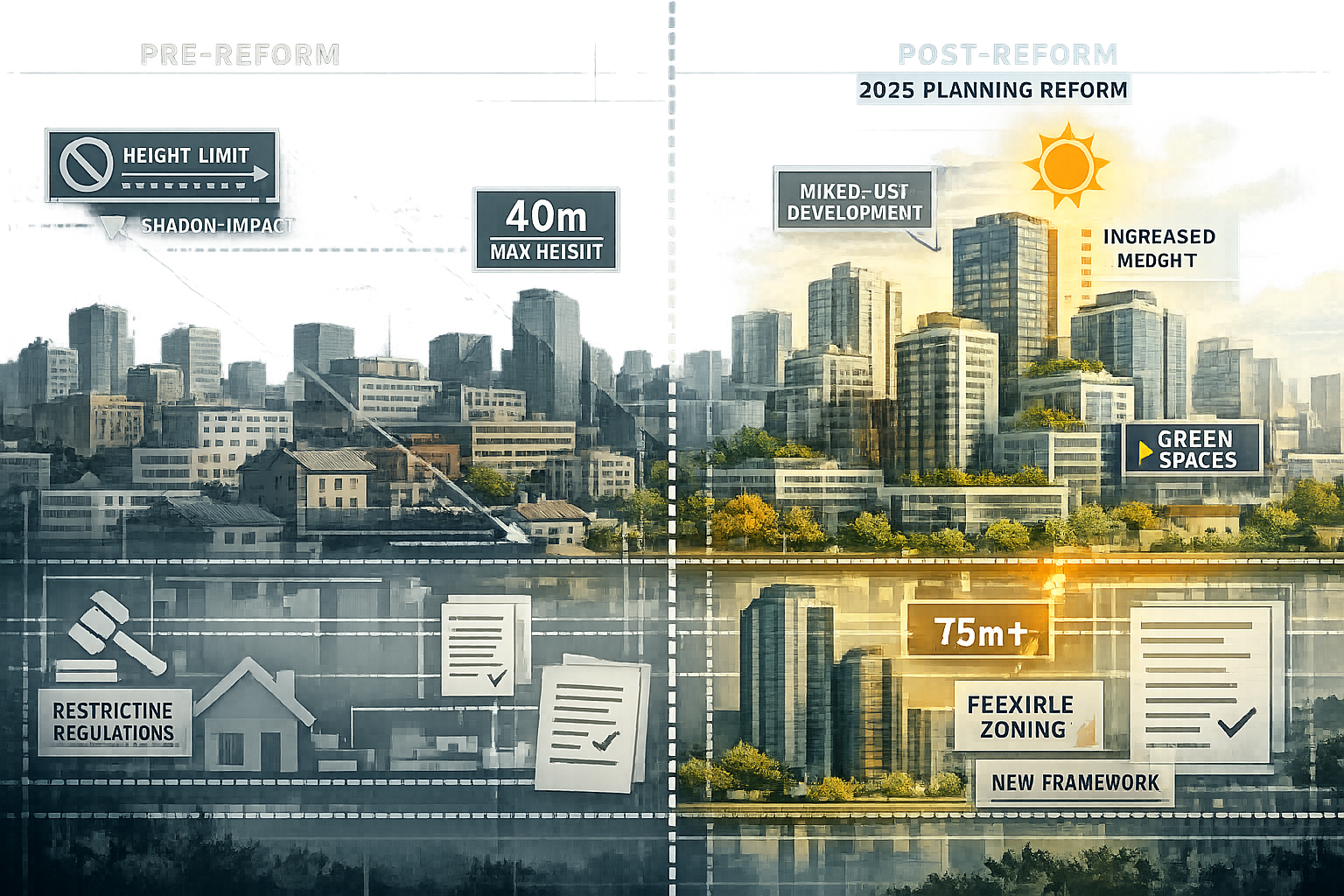
The 2026 planning reforms represent the most significant legislative changes to right to light law since the Housing and Planning Act 2016. These updates have fundamentally reshaped how expert witnesses must approach evidence preparation and courtroom testimony.
Legislative Changes Affecting Right to Light Claims
The original Section 203 framework established that developers could convert rights to injunctions into rights to compensation claims under specific circumstances[1]. However, the 2026 reforms have introduced stricter qualification criteria for when this conversion applies, creating new challenges for both claimants and defendants.
Key changes include:
- Enhanced compensation thresholds that require more substantial proof of light loss impact
- Modified tribunal procedures for dispute resolution before litigation
- Updated assessment standards that incorporate modern building science research
- Strengthened enforcement mechanisms for non-compliant developments
These reforms demand that surveyors acting as expert witnesses maintain current knowledge of both traditional common law principles and evolving statutory frameworks. The "ancient lights" rule—which allows homeowners to claim compensation if building work reduces natural light to an established room by over 50% after 20 years of uninterrupted light access[2]—remains foundational, but now operates within a more complex regulatory environment.
The Evolving Role of Chartered Surveyors in Litigation
Chartered surveyors have transitioned from purely technical consultants to sophisticated legal witnesses who must balance scientific precision with courtroom advocacy. The 2026 reforms have elevated expectations for expert witness report preparation, requiring:
✅ Comprehensive technical analysis using validated software tools
✅ Clear communication of complex concepts to non-technical audiences
✅ Rigorous documentation of all assumptions and limitations
✅ Independent professional judgment free from client influence
Professional surveyors must now demonstrate not only technical competence in daylight analysis but also deep understanding of legal procedures, evidence rules, and courtroom protocols. This dual expertise distinguishes successful expert witnesses from technically skilled surveyors who lack litigation experience.
Integration with Broader Property Dispute Resolution
Right to light disputes rarely exist in isolation. They frequently intersect with party wall disputes, boundary disagreements, and construction dispute resolution matters. The 2026 reforms recognize these interconnections by:
- Requiring holistic assessment of development impacts
- Encouraging early dispute resolution through mediation
- Mandating consideration of alternative development scenarios
- Establishing clearer pathways for consolidated claims
Expert witnesses must therefore approach right to light cases with broader contextual awareness, understanding how their technical opinions may influence related disputes and settlement negotiations.
RICS Professional Standards and CPR Part 35 Compliance Requirements
The credibility of expert witness testimony depends entirely on adherence to professional standards and legal procedural rules. In 2026, these requirements have become more stringent, with courts increasingly willing to exclude evidence that fails to meet established criteria.
Core RICS Ethical Requirements for Expert Witnesses
RICS members serving as expert witnesses face detailed professional requirements that extend beyond general surveying competence. As noted in recent professional guidance, these include strict prohibitions on success fees tied to dispute outcomes[3], ensuring that expert opinions remain independent and unbiased.
The fundamental ethical principles include:
| Ethical Requirement | Practical Application | Consequences of Violation |
|---|---|---|
| Independence | Opinions must be formed without client pressure or financial incentive | Disqualification as expert witness |
| Transparency | All assumptions, limitations, and uncertainties must be disclosed | Evidence deemed unreliable |
| Competence | Only accept instructions within areas of demonstrated expertise | Professional disciplinary action |
| Objectivity | Present balanced analysis including evidence unfavorable to instructing party | Loss of professional credibility |
These standards apply regardless of whether the surveyor practices in London, Surrey, or other jurisdictions throughout England and Wales.
CPR Part 35 Compliance in 2026
The Civil Procedure Rules Part 35 govern expert evidence in civil litigation. Recent case law has reinforced that expert witnesses owe their primary duty to the court, not to the party instructing them. This principle has profound implications for how surveyors must prepare and present right to light evidence.
Key CPR Part 35 requirements include:
🔍 Statement of Truth: Every expert report must include a signed declaration that the expert understands their duty to the court and has complied with it
📊 Methodology Transparency: Complete documentation of analytical methods, software tools, input parameters, and calculation procedures
⚖️ Range of Opinion: Where professional judgment involves subjective elements, experts must explain the range of reasonable opinions and why they selected their particular position
📝 Material Facts: Disclosure of all material facts, including those that might undermine the expert's opinion
💼 Qualifications: Clear statement of relevant qualifications, experience, and any limitations on expertise
Courts in 2026 have shown increased willingness to exclude expert evidence that fails these standards, making compliance non-negotiable for successful testimony.
Documentation Standards for Light Loss Analysis
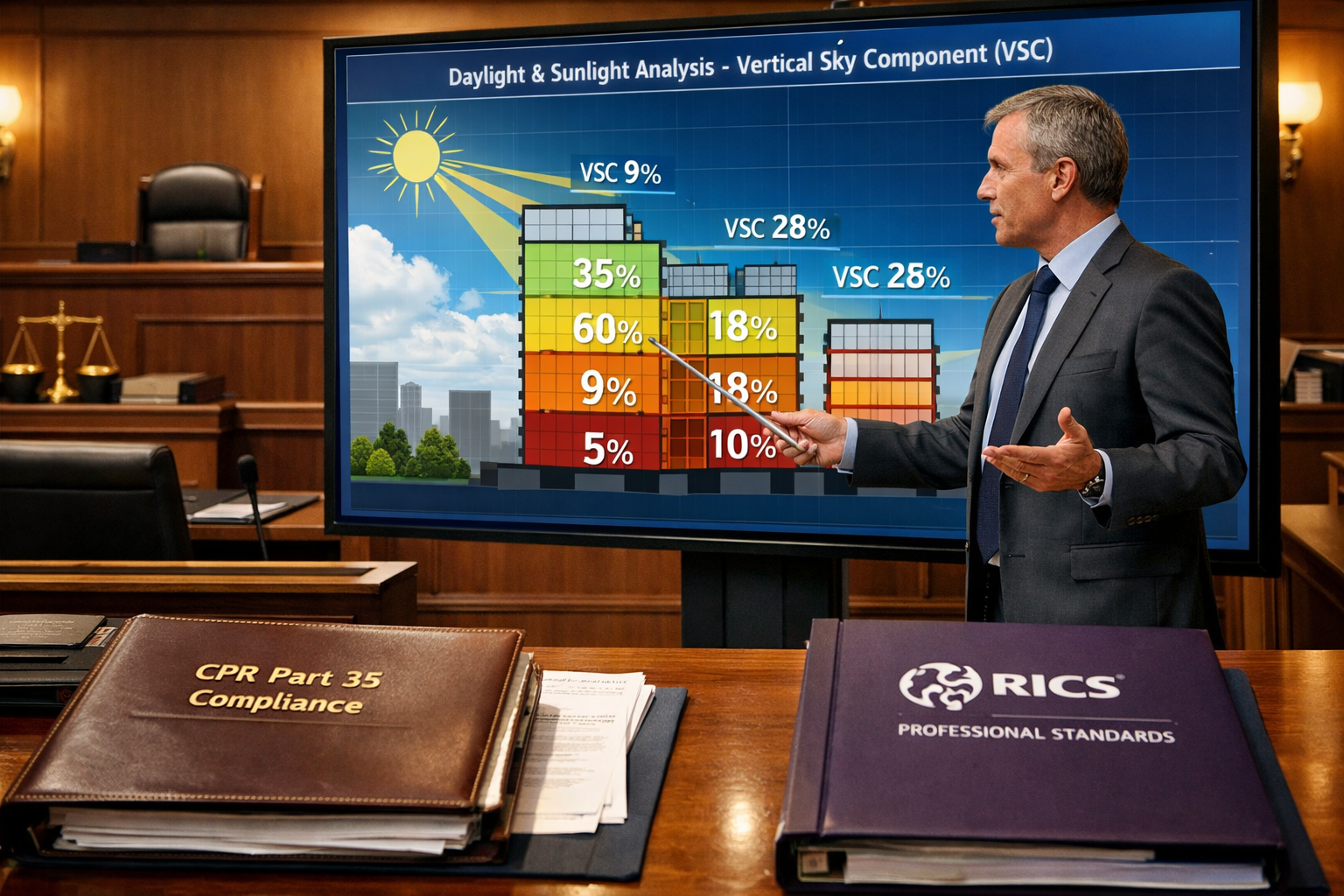
The technical heart of right to light expert evidence lies in daylight analysis methodology. Post-2026 reforms have established enhanced documentation requirements that go beyond traditional Vertical Sky Component (VSC) calculations.
Minimum documentation standards now include:
- Site Survey Data: Detailed measurements of existing conditions, including room dimensions, window specifications, and surrounding obstructions
- 3D Modeling Outputs: Computer-generated models showing existing and proposed conditions with transparent input assumptions
- Calculation Methodology: Step-by-step explanation of how light loss percentages were derived, including any software-specific algorithms
- Validation Procedures: Evidence that calculations have been checked through independent methods or peer review
- Sensitivity Analysis: Assessment of how results change with variations in key assumptions
- Photographic Evidence: Site photographs showing current light conditions and visual context
Expert witnesses must be prepared to defend every aspect of their analysis under cross-examination. The days of presenting conclusory opinions without detailed supporting documentation have definitively ended.
Continuing Professional Development Requirements
The rapid evolution of right to light law and assessment technology demands ongoing professional education. RICS now requires expert witnesses to demonstrate:
- Annual training in legal procedures and evidence rules
- Technical updates on new assessment methodologies and software tools
- Case law awareness of recent judicial decisions affecting right to light disputes
- Peer engagement through professional forums and technical working groups
Surveyors who fail to maintain current knowledge risk providing outdated advice that courts may reject as insufficiently reliable for decision-making purposes.
Preparing Courtroom-Ready Evidence: Technical Standards and Best Practices
The difference between technically accurate analysis and courtroom-ready evidence lies in presentation, documentation, and anticipation of challenges. Expert witnesses must think like both scientists and advocates, preparing evidence that withstands the adversarial litigation process.
Daylight Assessment Methodologies for 2026
Modern right to light analysis has evolved far beyond simple VSC calculations. Courts now expect comprehensive assessment using multiple complementary methodologies:
Primary Assessment Tools:
- Vertical Sky Component (VSC): Measures percentage of sky visible from a reference point on a window facade
- No-Sky Line (NSL): Determines the area within a room from which sky is visible through windows
- Average Daylight Factor (ADF): Calculates average daylight illumination as a percentage of exterior light levels
- Annual Probable Sunlight Hours (APSH): Assesses direct sunlight availability for relevant windows
Each methodology provides different insights, and robust expert evidence typically employs multiple approaches to create a comprehensive picture of light impact. The 50% reduction threshold mentioned in homeowner guidance[2] typically refers to VSC measurements, but courts increasingly expect analysis of actual room usability through NSL and ADF calculations.
Software Tools and Validation Requirements
Expert witnesses must demonstrate not only competence in using daylight analysis software but also understanding of underlying algorithms and potential limitations. Commonly accepted tools include:
- Waldram diagrams: Traditional graphical method for right to light analysis
- IES software: Industry-standard 3D modeling and daylight simulation
- Radiance: Open-source lighting simulation for validation
- Custom calculation spreadsheets: For transparent demonstration of mathematical processes
Critical validation requirements:
✓ Software version documentation and calibration records
✓ Comparison of results across multiple tools
✓ Manual calculation verification for key measurements
✓ Peer review by independent qualified surveyors
Courts have rejected expert evidence where witnesses could not adequately explain software calculations or demonstrate that results had been independently verified.
Site Investigation and Data Collection Standards
The foundation of credible expert testimony begins with thorough site investigation. Post-2026 standards require:
Essential site data collection:
- Precise measurements: Room dimensions, ceiling heights, window sizes and positions using calibrated equipment
- Obstruction mapping: Documentation of all existing structures affecting light access
- Photographic record: Time-stamped images showing current conditions from multiple angles and times of day
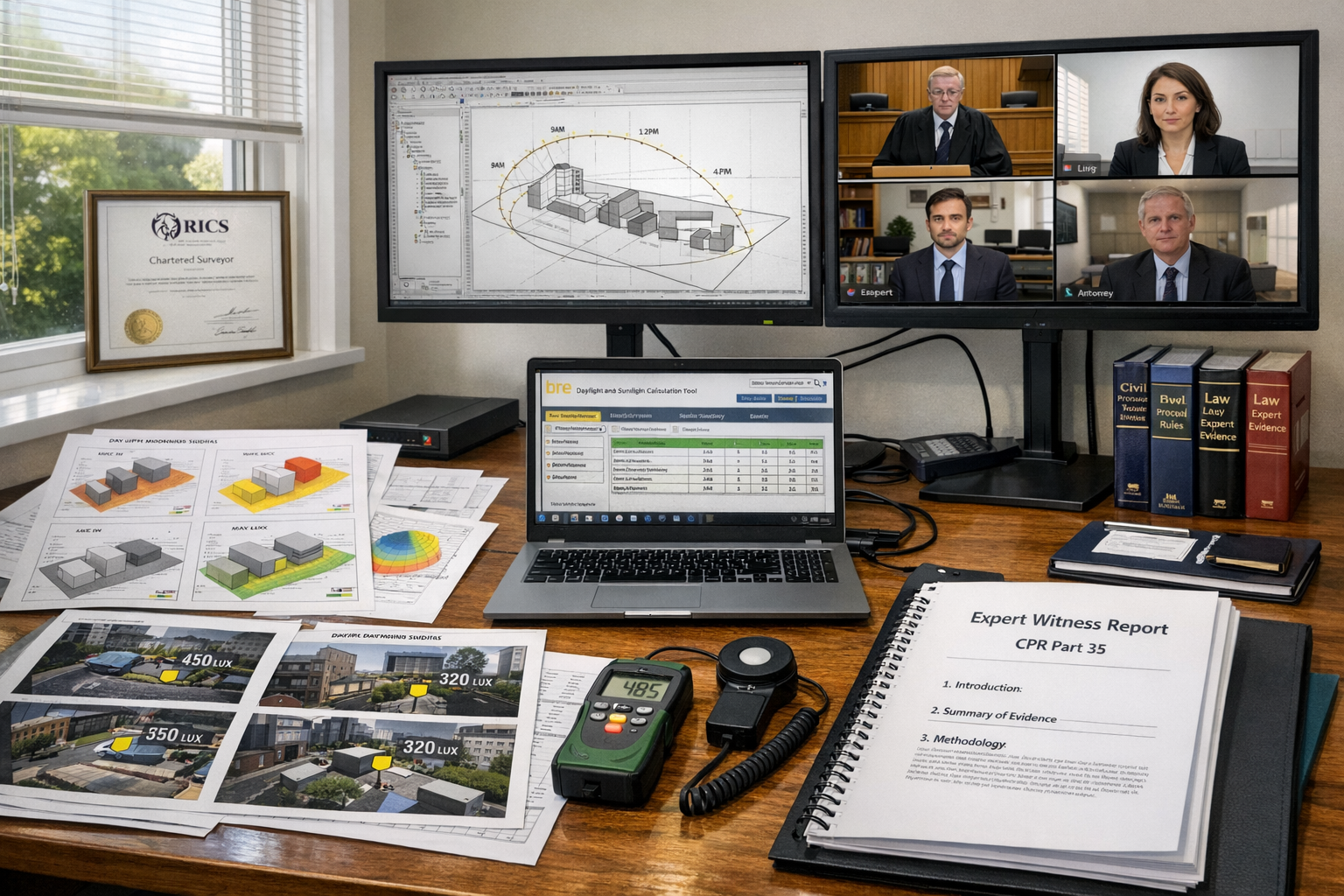
- Lux measurements: Actual light readings using calibrated light meters at representative points
- Orientation data: Accurate compass bearings and geographic coordinates
For properties across West London, Surrey, and surrounding areas, site conditions can vary dramatically based on urban density, building age, and local topography. Expert witnesses must account for these location-specific factors in their analysis.
Report Structure and Content Requirements
A courtroom-ready expert report follows a standardized structure that facilitates judicial review and cross-examination preparation:
Recommended report structure:
1. Executive Summary
Concise overview of key findings and conclusions (maximum 2 pages)
2. Instructions and Scope
Clear statement of questions posed and limitations on investigation
3. Qualifications and Experience
Detailed CV focusing on relevant right to light expertise
4. Methodology
Comprehensive explanation of analytical approach and tools used
5. Site Investigation Findings
Documentation of existing conditions with supporting photographs and measurements
6. Technical Analysis
Detailed presentation of calculations, models, and results
7. Impact Assessment
Evaluation of light loss significance and practical consequences
8. Alternative Scenarios
Analysis of modified development options if applicable
9. Conclusions
Clear answers to instructed questions with supporting reasoning
10. Appendices
Supporting documentation, calculations, and reference materials
Each section must be written in clear, accessible language that non-technical readers can understand while maintaining technical rigor for peer review.
Addressing Common Challenges and Objections
Experienced expert witnesses anticipate likely challenges and address them proactively in their reports and testimony. Common areas of attack include:
Assumption Validity: Opposing counsel frequently challenges input assumptions. Document the basis for every assumption and explain why alternatives were rejected.
Measurement Accuracy: Be prepared to defend measurement precision and explain acceptable tolerances. Bring calibration certificates for equipment used.
Software Reliability: Understand software limitations and be ready to explain how results were validated through alternative methods.
Professional Bias: Demonstrate independence by acknowledging evidence favorable to opposing parties and explaining why it doesn't change your conclusions.
Alternative Interpretations: Present the range of reasonable professional opinions and justify your position within that spectrum.
Cross-Examination Preparation Strategies
Technical competence alone does not guarantee successful testimony. Expert witnesses must develop courtroom skills including:
🎯 Clear communication: Translate technical concepts into plain language without oversimplification
🎯 Composure under pressure: Remain professional and objective when challenged aggressively
🎯 Concise responses: Answer questions directly without unnecessary elaboration
🎯 Visual aids: Use diagrams, photographs, and models to illustrate complex points
🎯 Admitting limitations: Acknowledge uncertainties honestly rather than overreaching expertise
Mock cross-examination practice with legal teams helps identify weaknesses in analysis and presentation before actual testimony. This preparation often reveals gaps in documentation or analysis that can be addressed before trial.
Coordination with Legal Teams
Successful expert witnesses work collaboratively with solicitors and barristers while maintaining professional independence. This relationship requires:
- Early engagement: Involvement in case strategy from initial instruction
- Regular communication: Updates on analysis progress and emerging issues
- Educational role: Helping legal teams understand technical aspects and their implications
- Boundary maintenance: Clearly distinguishing between technical opinions and legal arguments
The expert's role is to provide technical evidence and opinions; legal teams determine how to use that evidence within litigation strategy. Maintaining this distinction protects professional independence and credibility.
Regional Considerations and Local Expertise
Right to light disputes often involve location-specific factors that require local knowledge. Surveyors with experience in specific areas—whether Hertfordshire, Sussex, Essex, or other regions—bring valuable contextual understanding of:
- Local planning authority approaches and precedents
- Regional building styles and typical window configurations
- Area-specific development pressures and patterns
- Historical rights established through local property records
While technical standards remain consistent across jurisdictions, local expertise enhances credibility and practical relevance of expert evidence.
Compensation Assessment and Damages Quantification
Beyond establishing light loss, expert witnesses frequently must quantify financial impacts for compensation claims. The 2026 reforms have introduced new frameworks for damages assessment that require economic analysis alongside technical evaluation.
Valuation Methodologies for Light Loss
Several approaches exist for quantifying the financial impact of reduced daylight:
Diminution in Value Method: Assesses the reduction in property market value caused by light loss, typically expressed as a percentage of pre-development value.
Loss of Amenity Method: Calculates compensation based on the practical impact on property enjoyment and usability, often using comparable settlement data.
Cost of Mitigation Method: Evaluates expenses required to offset light loss through artificial lighting, room reconfiguration, or other measures.
Expert witnesses must justify their chosen methodology and demonstrate that calculations reflect actual market conditions and property-specific circumstances. This often requires collaboration with commercial property valuation specialists who can provide market evidence.
Section 203 and the Compensation Framework
The Section 203 framework continues to provide the statutory basis for converting injunction rights into compensation claims[1]. However, post-2026 reforms have modified how courts assess whether this conversion is appropriate and how compensation levels are determined.
Expert witnesses must understand the legal tests for Section 203 application and provide technical evidence that supports or challenges its invocation. This requires analysis of:
- Whether light loss is substantial enough to warrant injunctive relief
- Whether compensation would adequately remedy the harm
- Whether development provides sufficient public benefit to justify overriding private rights
- What compensation amount would fairly reflect the impact
These assessments blend technical analysis with policy considerations, requiring expert witnesses to work closely with legal teams to ensure evidence addresses relevant legal criteria.
Documentation for Compensation Claims
Supporting compensation claims requires comprehensive documentation including:
📋 Property valuation reports before and after development
📋 Comparable transaction evidence showing light impact on values
📋 Expert opinions on property marketability and desirability
📋 Evidence of practical impacts on room usability
📋 Photographic documentation of affected spaces
The quality of this documentation often determines whether compensation claims succeed and at what level courts set awards.
Emerging Trends and Future Developments in Right to Light Litigation
The legal landscape surrounding right to light continues to evolve, with several emerging trends likely to shape expert witness roles in coming years.
Technology Advances in Daylight Analysis
Artificial intelligence and machine learning are beginning to influence daylight assessment, with new tools offering:
- Automated 3D modeling from photographic surveys
- Predictive analytics for settlement value estimation
- Real-time impact visualization for mediation and negotiation
- Enhanced accuracy in complex urban environments
Expert witnesses must stay current with these technological developments while maintaining ability to validate results through traditional methods. Courts will expect explanation of how AI-assisted analysis was verified and what limitations these tools may have.
Climate Change and Daylight Rights
Increasing focus on building sustainability and energy efficiency is creating new intersections between right to light law and environmental policy. Expert witnesses may need to address:
- How daylight access affects building energy consumption
- The relationship between natural light and occupant health
- Trade-offs between development density and light preservation
- Integration of right to light principles with green building standards
These considerations may influence how courts balance competing interests in future disputes.
Alternative Dispute Resolution Emphasis
The 2026 reforms encourage early dispute resolution through mediation and negotiation. Expert witnesses increasingly participate in:
- Pre-action protocols: Providing technical opinions before litigation commences
- Joint expert appointments: Working with opposing experts to narrow technical disputes
- Mediation support: Helping parties understand technical issues and evaluate settlement options
- Tribunal proceedings: Presenting evidence in less formal administrative hearings
These roles require different skills than traditional courtroom testimony, emphasizing collaboration and problem-solving over adversarial advocacy.
Professional Development Resources
Surveyors seeking to develop or maintain expert witness competence can access various resources:
- RICS expert witness training programs: Formal courses on legal procedures and evidence standards
- Professional indemnity insurance: Specialized coverage for expert witness activities
- Peer review networks: Professional forums for discussing complex cases and methodologies
- Legal updates: Subscriptions to services tracking relevant case law and legislative changes
Continuous professional development ensures expert witnesses remain current with evolving standards and best practices.
Conclusion
Expert Witness Roles in Right to Light Disputes Post-2026 Planning Reforms: Surveyor Evidence Standards for Courtroom Success demand a sophisticated blend of technical expertise, legal knowledge, and professional integrity. The 2026 reforms have elevated expectations for evidence quality, requiring surveyors to demonstrate not only accurate daylight analysis but also rigorous compliance with CPR Part 35 and RICS professional standards.
Success in this specialized field requires:
✅ Comprehensive technical competence in multiple daylight assessment methodologies
✅ Rigorous documentation of all assumptions, calculations, and limitations
✅ Independent professional judgment free from client influence or financial incentive
✅ Clear communication skills for presenting complex concepts to non-technical audiences
✅ Ongoing professional development to maintain currency with legal and technical developments
The stakes in right to light litigation continue to rise as urban development pressures intensify and property values increase. Expert witnesses who meet these enhanced standards provide invaluable service to clients, courts, and the broader property industry by ensuring disputes are resolved based on reliable technical evidence and sound professional judgment.
Actionable Next Steps
For surveyors seeking to develop expert witness capabilities:
- Pursue specialized training in CPR Part 35 compliance and courtroom procedures
- Develop proficiency with industry-standard daylight analysis software and validation methodologies
- Build experience through mentorship with established expert witnesses
- Maintain professional development records demonstrating ongoing competence
- Consider professional indemnity insurance specifically covering expert witness activities
- Engage with professional networks to stay current with emerging trends and case law
For property owners and developers facing right to light disputes:
- Engage qualified expert witnesses early in development planning to identify potential issues
- Ensure instructed experts hold appropriate RICS qualifications and demonstrable litigation experience
- Provide complete instructions and all relevant documentation to support thorough analysis
- Understand the distinction between technical advice and expert witness evidence
- Consider alternative dispute resolution before committing to costly litigation
The future of right to light litigation will be shaped by surveyors who combine technical excellence with professional integrity, providing courts with reliable evidence that serves justice while advancing the property industry's legitimate interests.
References
[1] Can Developers Override Your Right To Light The Truth About Section 203 – https://daylightprotect.com/insights/can-developers-override-your-right-to-light-the-truth-about-section-203
[2] Let There Be Light New Guidance For Homeowners Left In The Shadows – https://www.rics.org/news-insights/let-there-be-light-new-guidance-for-homeowners-left-in-the-shadows
[3] The Only Way Is Ethics What Is The Role Of The Professional Witness – https://simonicity.com/2025/09/13/the-only-way-is-ethics-what-is-the-role-of-the-professional-witness/
[4] Keeping It Real Estate Rights To Light Update – https://www.hoganlovells.com/en/publications/keeping-it-real-estate-rights-to-light-update
[5] The Role Of Rights Of Light In Modern Development A Personal Perspective – https://lichfields.uk/blog/2025/february/19/the-role-of-rights-of-light-in-modern-development-a-personal-perspective