{"cover":"Professional landscape format (1536×1024) hero image with bold text overlay: 'Expert Witness Preparation for Party Wall Disputes: CPR Part 35 Compliance & Court Credibility 2026' in extra large 72pt white bold sans-serif font with dark semi-transparent overlay box, centered upper-third composition. Background shows a split scene: left side a brick party wall with visible crack damage and surveyor measuring equipment, right side a formal courtroom interior with wooden bench and legal documents. Color palette: deep navy blue, white, gold accents. High contrast, magazine cover aesthetic, editorial quality, dramatic lighting.","content":["Landscape format (1536×1024) editorial illustration showing a professional chartered surveyor in hard hat and hi-vis vest standing at a party wall boundary, transitioning visually into a suited expert witness at a courtroom podium. The split-scene composition uses a diagonal divide with construction site on the left and formal court setting on the right. Documents labeled 'CPR Part 35' and 'Party Wall Act 1996' visible on both sides. Color scheme: slate grey, navy, amber highlights. Realistic, professional photographic style.","Landscape format (1536×1024) close-up overhead shot of a structured expert witness report document on a mahogany desk, pages spread open showing sections labeled 'Expert Qualifications', 'Statement of Truth', 'Facts and Assumptions', 'Expert Opinion'. A fountain pen rests on the document. Beside it, a CPR Part 35 compliance checklist on a clipboard with green checkmarks. Soft natural light, shallow depth of field, professional editorial photography style. Color palette: warm cream, deep green, black ink. No people visible, document-focused composition.","Landscape format (1536×1024) dramatic courtroom scene showing two expert witnesses seated at opposite sides of a conference table engaged in a joint statement discussion, documents and architectural drawings of a party wall spread between them. A judge's bench visible in the blurred background. One expert points to a structural diagram while the other takes notes. Professional attire, formal setting. Color scheme: dark oak browns, white documents, cool blue ambient lighting. Realistic editorial photography quality, wide-angle perspective from above."]
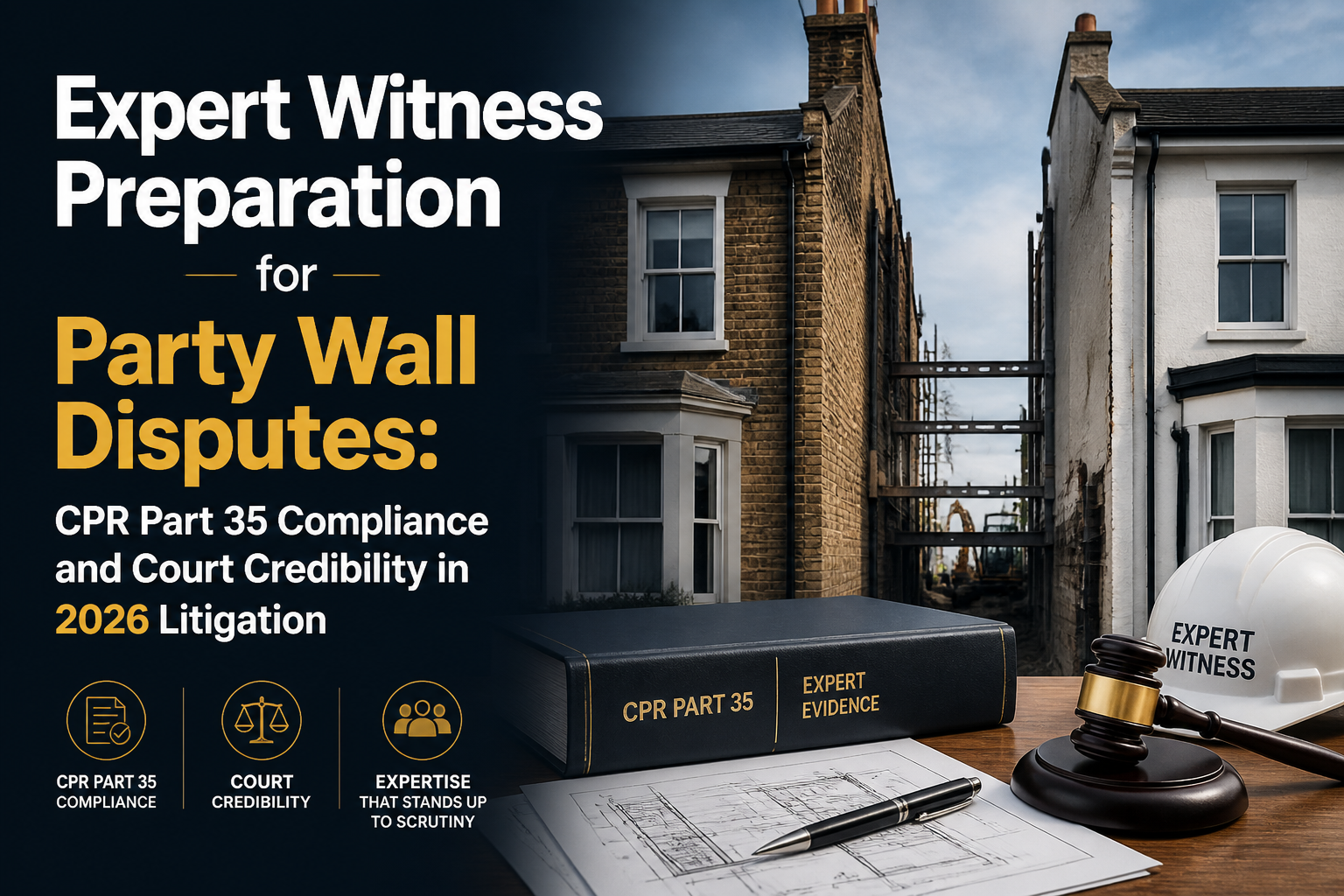
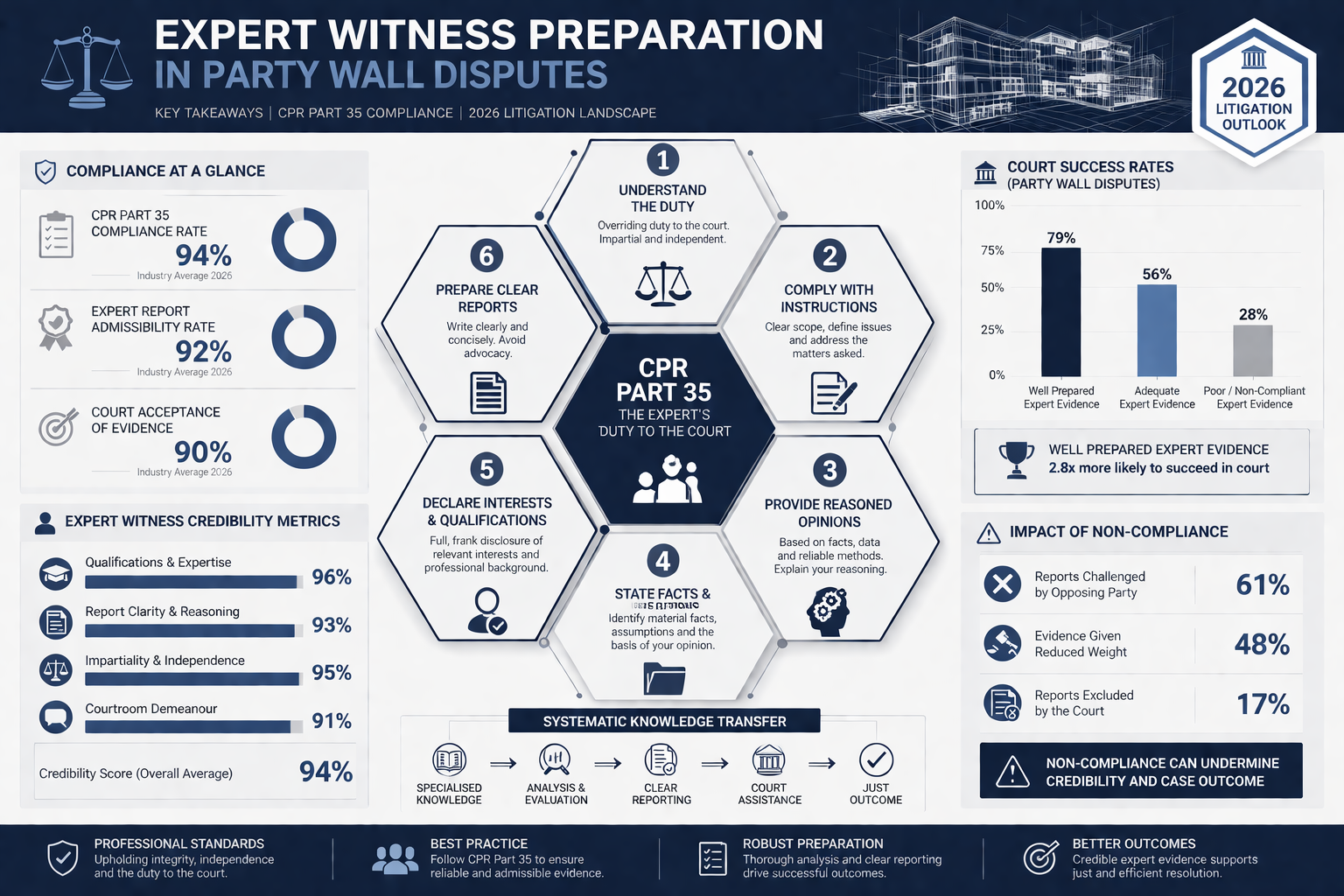
Only 34% of expert witnesses in construction-related civil cases are reported to fully comply with all mandatory CPR Part 35 requirements on first submission — a striking failure rate that costs parties time, money, and credibility in court. For surveyors who routinely handle party wall matters, the transition from acting as a party wall surveyor to serving as a court-appointed expert witness is far from automatic. The skills overlap, but the obligations are fundamentally different.
This guide addresses Expert Witness Preparation for Party Wall Disputes: CPR Part 35 Compliance and Court Credibility in 2026 Litigation directly — equipping surveyors, legal teams, and property professionals with a clear, practical roadmap for producing expert evidence that stands up to judicial scrutiny.
Key Takeaways 📌
- An expert witness's primary duty is to the court, not to the instructing party — this overrides all other obligations under CPR 35.3 [1]
- Every CPR Part 35-compliant report must include a Statement of Truth, expert qualifications, clearly stated opinions, and acknowledged limitations [1]
- Court permission must be obtained before expert evidence is served or used — this is a mandatory gatekeeping step [2]
- Surveyors transitioning from party wall dispute roles to expert witness roles must consciously shift from advocate to impartial adviser
- Contingency fee arrangements are strictly prohibited and can result in full disqualification of evidence [1]
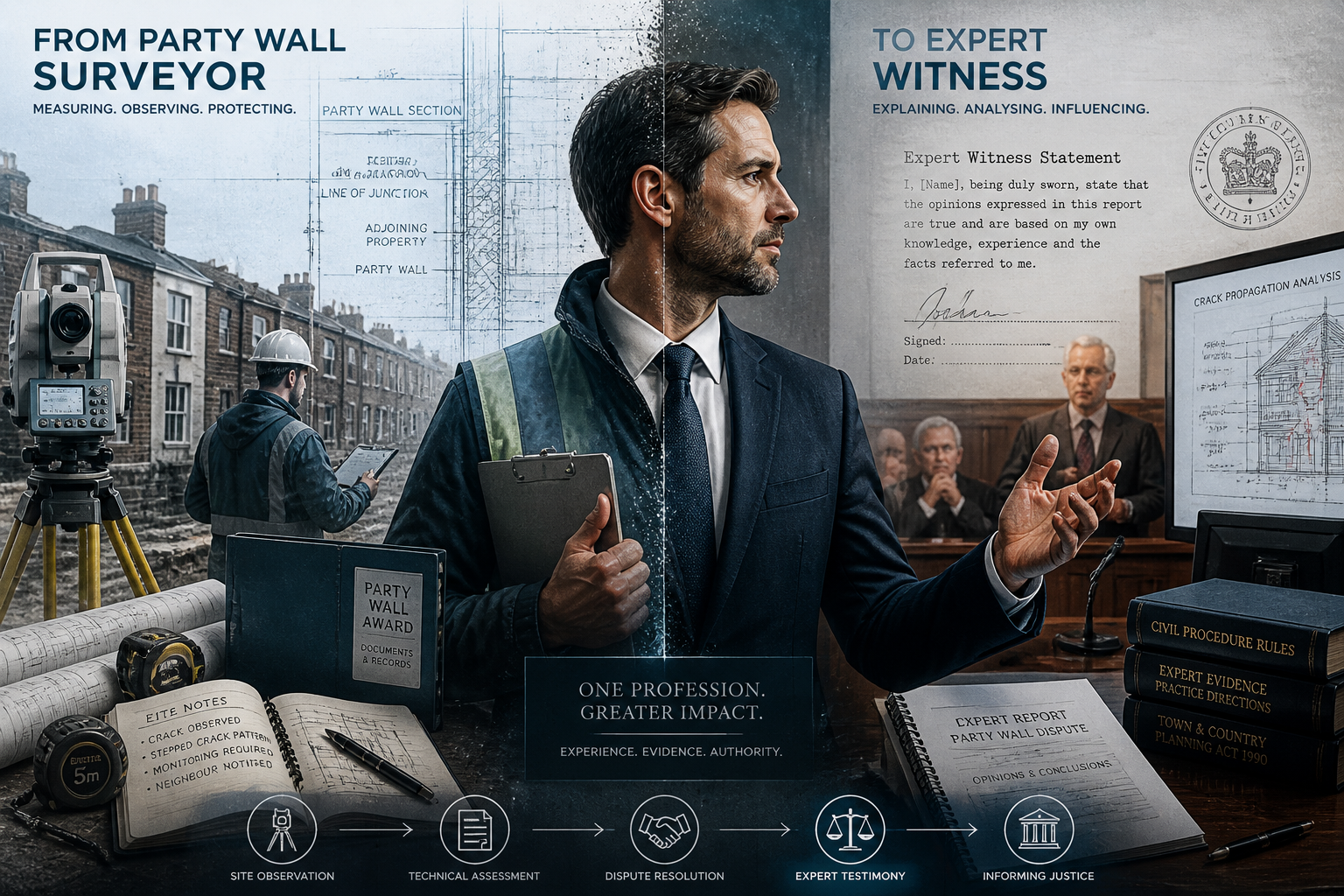
From Party Wall Surveyor to Expert Witness: Understanding the Critical Role Shift
Many surveyors first encounter litigation through party wall matters — serving notices, preparing schedules of condition, and resolving disputes between neighbours. These roles build deep technical knowledge. But they also carry an inherent risk: surveyors can develop a habit of advocacy, naturally leaning toward the party who instructed them.
When that same surveyor is asked to act as an expert witness in court proceedings arising from a party wall dispute, the rules change entirely.
"An expert's duty to the court overrides any obligation to the person from whom they have received instructions or by whom they are paid." — CPR 35.3 [1]
This is not a procedural nicety. It is the foundational principle of expert witness work. A surveyor who continues to frame their report as a defence of their client's position — rather than an objective analysis of the technical facts — risks having their evidence dismissed, their professional credibility damaged, and the case weakened irreparably.
What Changes When You Become an Expert Witness?
| Role | Party Wall Surveyor | Expert Witness |
|---|---|---|
| Primary duty | To the appointing party | To the court |
| Report purpose | Facilitate agreement / award | Inform judicial decision-making |
| Tone | Negotiation-oriented | Objective, analytical |
| Fee structure | Standard professional fees | Time-based only — no contingency [1] |
| Scope of opinion | Practical resolution | Technical facts and expert opinion |
The Party Wall Act 1996 creates its own dispute resolution framework, which operates in parallel to civil litigation. When matters escalate to court, surveyors must understand that their CPR Part 35 obligations now govern — and those obligations are stricter [4].
CPR Part 35 Compliance: The Non-Negotiable Framework for Expert Witness Preparation for Party Wall Disputes
Expert Witness Preparation for Party Wall Disputes: CPR Part 35 Compliance and Court Credibility in 2026 Litigation rests on a clear statutory framework. Understanding each element is essential before drafting a single line of an expert report.
🔐 Step 1: Obtain Court Permission First
Under CPR 35.4, no expert report can be served or used without prior court permission [2]. This is a gatekeeping mechanism that many surveyors overlook, particularly those accustomed to the more flexible process of party wall awards. Before investing time in a detailed report, confirm that permission has been granted and understand the scope of that permission — including which issues the expert is authorised to address.
📋 Step 2: Structure the Report Correctly Under CPR 35.10
A compliant expert report must include all of the following elements [1][3]:
- Expert qualifications — relevant credentials, experience, and professional memberships
- Materials and literature relied upon — every source, inspection, document, and assumption
- Clearly stated opinions — marked as provisional where evidence is incomplete
- Facts, instructions, and assumptions — transparently separated from opinion
- Acknowledgment of limitations — where matters fall outside the expert's expertise
- Statement of Truth — confirming the expert understands and accepts their duty to the court
⚠️ Red flag: Absence of the Statement of Truth is one of the most common grounds for evidence rejection in 2026 litigation. It signals non-compliance immediately [5].
🔍 Step 3: Separate Facts from Opinion
One of the most frequent failures in party wall expert reports is the blurring of facts and opinion. Courts require a clear analytical chain:
- Relevant facts (what was observed, measured, documented)
- Assumptions relied upon (what has been taken as given)
- Analysis undertaken (how the expert processed the information)
- Expert opinion with its basis (the conclusion and why it is reached) [3]
This structure is not just procedural — it is what allows a judge to follow the expert's reasoning, test it under cross-examination, and give it appropriate weight.
📝 Step 4: Write in Plain Language
Expert reports in party wall disputes must be written for a lay audience — judges, not engineers [1]. Technical terms must be explained. Jargon must be avoided or defined. A report that reads like an internal surveying memo will not serve its purpose in court.
This is particularly relevant when addressing complex issues such as the Party Wall Act 3-metre rule, structural loading calculations, or the interpretation of a party wall schedule of condition. Each concept must be made accessible.
💰 Step 5: Confirm Fee Arrangements Are Compliant
Contingency fees — where payment depends on the outcome of the case — are explicitly prohibited under CPR Part 35 [1]. Experts must be paid for their time and expertise, regardless of the result. Any arrangement that ties remuneration to a favourable outcome compromises independence and can result in the complete disqualification of evidence.
CPR Part 35 Compliance Checklist ✅
| Requirement | Compliant? |
|---|---|
| Court permission obtained before report served | ☐ |
| Expert qualifications clearly stated | ☐ |
| All materials and sources listed | ☐ |
| Facts separated from opinion | ☐ |
| Provisional opinions clearly marked | ☐ |
| Limitations of expertise acknowledged | ☐ |
| Plain language used throughout | ☐ |
| Statement of Truth included at end | ☐ |
| Fee arrangement is time-based only | ☐ |
| Court deadlines identified and met | ☐ |
Building Court Credibility: Report Quality, Joint Statements, and Cross-Examination Resilience
Strong Expert Witness Preparation for Party Wall Disputes: CPR Part 35 Compliance and Court Credibility in 2026 Litigation does not end with a well-structured report. Court credibility is built — and lost — across three distinct stages: the written report, the joint statement process, and live cross-examination.
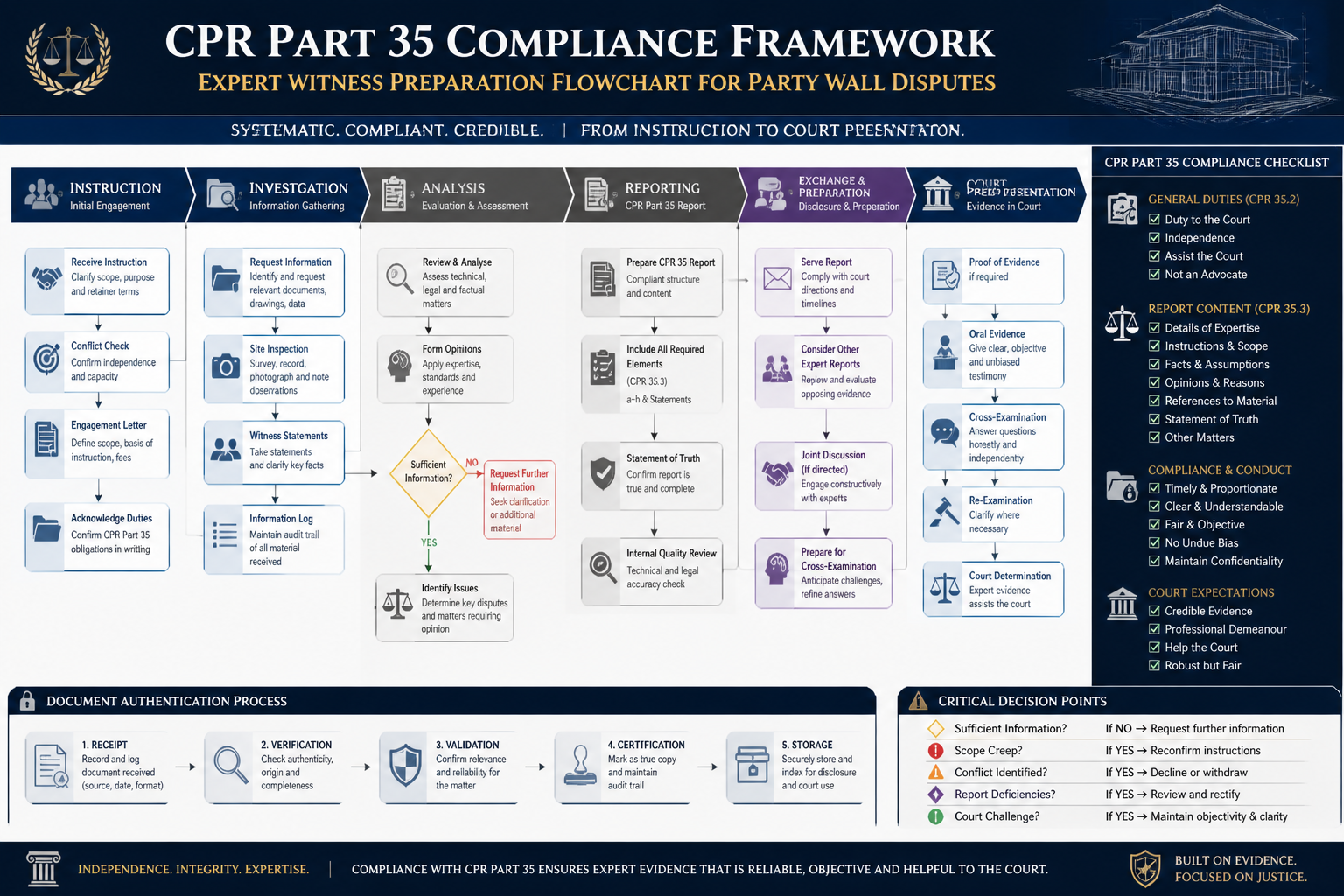
Writing for Credibility, Not Victory
The most credible expert reports acknowledge uncertainty. Statements such as "This opinion is given on the basis of limited records and may be subject to revision with further evidence" are not signs of weakness — they are expected, professional, and actually strengthen credibility in the eyes of the court [1].
Surveyors who have spent years advocating for clients in party wall agreement negotiations may find this counterintuitive. But judges are experienced at identifying partisan experts. An overly confident, one-sided report raises immediate suspicion.
Key credibility markers in a party wall expert report include:
- 🏗️ Photographic evidence from site inspections, cross-referenced to specific report sections
- 📐 Measured data — not estimates — for structural assessments
- 📚 Referenced standards — British Standards, RICS guidance, and relevant case law
- 🔄 Consideration of alternative explanations — and why they were rejected
- 🗓️ Clear timeline of events, notices, and alleged damage
For surveyors providing expert witness reports in London, this level of rigour is increasingly expected as courts in 2026 apply greater scrutiny to technical evidence in property disputes.
The Joint Statement Process 🤝
When both parties instruct experts in the same discipline, the court may direct those experts to meet and prepare a joint statement [1]. This is not a negotiation — experts are not expected to abandon their views. It is a structured process to:
- Identify areas of agreement
- Clearly define areas of disagreement
- Narrow the issues the court must decide
For party wall disputes, joint statements often focus on causation (did the building works cause the alleged damage?), the adequacy of the party wall notice process, or the scope of remedial works required.
Surveyors must approach joint statements with professional objectivity. Refusing to engage constructively, or treating the process as another opportunity to advocate, can damage credibility significantly.
Surviving Cross-Examination 🎯
Cross-examination is where expert credibility is truly tested. Common attack lines in party wall litigation include:
- "You were instructed by the building owner — how can you be impartial?" — The answer lies in demonstrating that the report acknowledges contrary evidence and limitations.
- "Your report doesn't address [specific issue]." — Gaps in scope undermine credibility. Comprehensive reports anticipate likely challenges.
- "You've changed your opinion since your initial report." — Consistency matters. If opinions evolve, the reasons must be documented and defensible.
- "You're not a structural engineer — why are you commenting on load-bearing capacity?" — Acknowledging the limits of expertise, as required by CPR 35.10, is the correct response [1].
Preparation for cross-examination should include a thorough review of the opposing expert's report, identification of weaknesses in one's own analysis, and a clear understanding of the factual timeline.
💡 Pro tip: Courts respond well to experts who say "I don't know" or "that falls outside my expertise" when it is genuinely true. Overreaching destroys credibility far more effectively than any opposing counsel.
Common Mistakes That Undermine Court Credibility
| Mistake | Impact |
|---|---|
| Adopting client's position uncritically | Immediate credibility loss |
| Missing Statement of Truth | Evidence may be rejected |
| Using technical jargon without explanation | Report loses persuasive value |
| Failing to acknowledge limitations | Appears partisan or incompetent |
| Missing court deadlines | Evidence excluded; professional damage [1] |
| Contingency fee arrangement | Full disqualification of evidence [1] |
| Inconsistency between report and oral evidence | Severe credibility damage under cross-examination |
Practical Preparation: From Instruction to Court
Effective preparation for expert witness work in party wall disputes follows a structured sequence:
🗂️ Phase 1 — Pre-Instruction Checks
- Confirm court permission is in place [2]
- Check for conflicts of interest (prior involvement with either party)
- Confirm fee arrangements are time-based only [1]
- Clarify the precise scope of expert opinion required
🔎 Phase 2 — Investigation and Evidence Gathering
- Conduct thorough site inspection with photographic record
- Review all relevant documents: party wall notices, awards, schedules of condition, correspondence
- Identify applicable standards and legislation, including party wall legislation
- Note any gaps in evidence and document assumptions
✍️ Phase 3 — Report Drafting
- Follow the CPR 35.10 structure rigorously [1][3]
- Separate facts, assumptions, analysis, and opinion clearly
- Write in plain language throughout
- Include the Statement of Truth as the final element
📅 Phase 4 — Pre-Trial Obligations
- Comply with all court deadlines for report submission [1]
- Engage constructively in the joint statement process if directed
- Review the opposing expert's report carefully
- Prepare for cross-examination by stress-testing your own analysis
Conclusion: Actionable Next Steps for Surveyors in 2026
The gap between being a competent party wall surveyor and a credible expert witness is real — but it is bridgeable with the right preparation. Expert Witness Preparation for Party Wall Disputes: CPR Part 35 Compliance and Court Credibility in 2026 Litigation demands a fundamental shift in mindset: from problem-solver for a client, to impartial technical adviser for the court.
Here are the most important actions to take right now:
- Audit your current report templates against the CPR 35.10 checklist — every mandatory element must be present
- Review your fee arrangements — eliminate any contingency or outcome-linked elements immediately
- Invest in plain language training — technical expertise means nothing if a judge cannot follow the reasoning
- Practise acknowledging limitations — this strengthens, not weakens, your credibility
- Engage proactively with joint statement processes — professional dialogue with opposing experts is a court-directed obligation, not an optional courtesy
- Seek specialist guidance from expert surveyor advisers who understand both the Party Wall Act framework and CPR Part 35 obligations
The courts in 2026 are applying increasing scrutiny to expert evidence in property disputes. Surveyors who invest in proper preparation will not only protect their professional reputation — they will provide genuinely valuable service to the judicial process and to the clients who depend on their expertise.
References
[1] The Responsibilities Of An Expert Witness Under Civil Procedure Rules Part 35 – https://paramedic-expert.com/the-responsibilities-of-an-expert-witness-under-civil-procedure-rules-part-35/
[2] What Is An Expert Witnesses Part 35 – https://www.jonathanlea.net/blog/what-is-an-expert-witnesses-part-35/
[3] Cpr 35 Reports – https://www.rosecrestgroupltd.co.uk/services/cpr-35-reports
[4] Expert Witness Valuations In Neighbour Dispute Settlements Mediation Evidence And Cpr Part 35 Compliance – https://nottinghillsurveyors.com/blog/expert-witness-valuations-in-neighbour-dispute-settlements-mediation-evidence-and-cpr-part-35-compliance
[5] Construction Dispute Resolution 101 – https://www.oseimc.com/construction-dispute-resolution-101