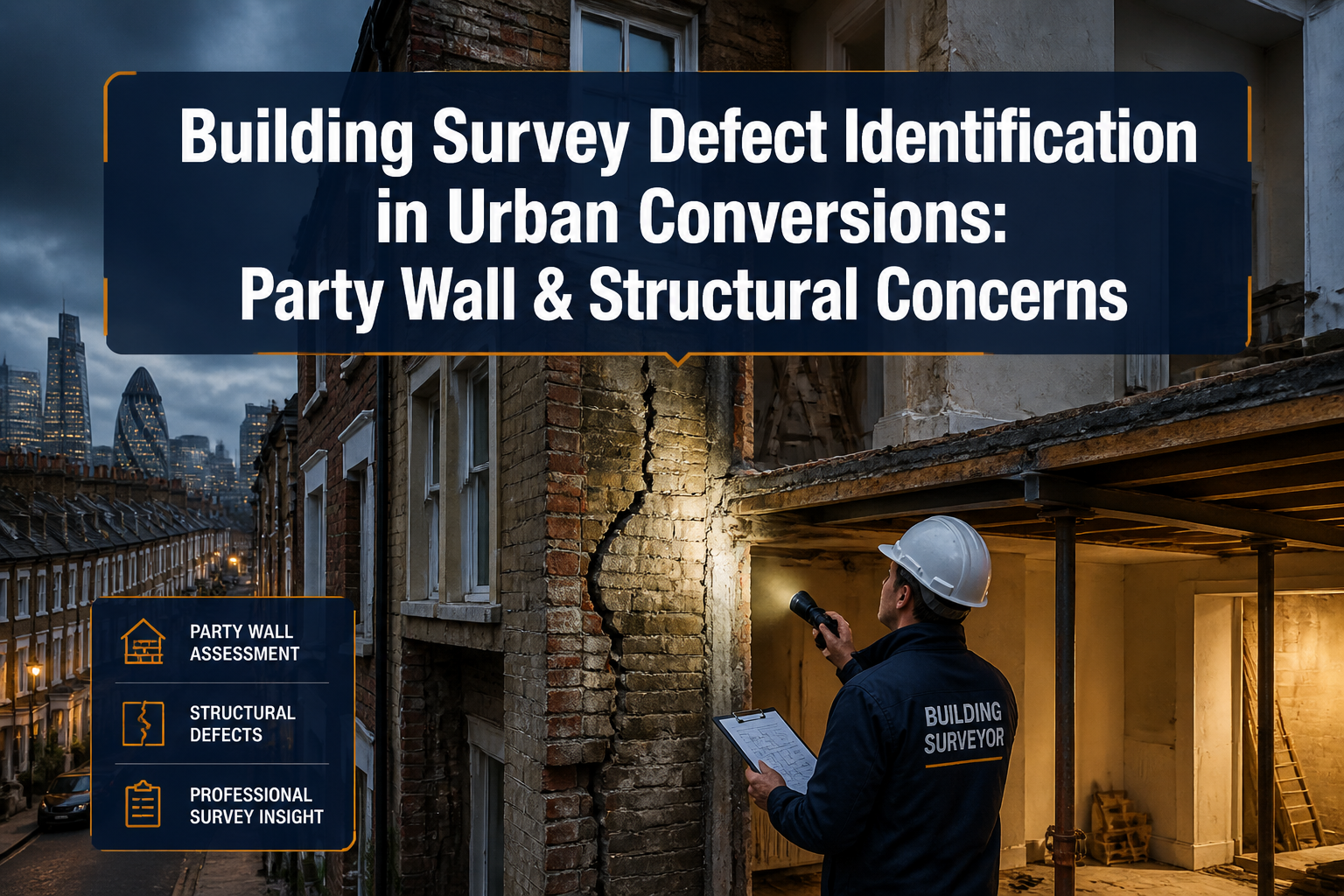

Over 60% of structural defect claims in London arise from properties that were converted from single dwellings into multiple units — yet the majority of buyers purchase these homes without a full structural survey. That gap between risk and due diligence sits at the heart of building survey defect identification in high-density urban conversions: party wall implications and structural concerns, a discipline that demands specialist knowledge, legal awareness, and sharp investigative instinct.
As urban areas continue to densify — driven by adaptive reuse policies and zoning reforms expanding across major cities [2][3] — the stock of converted properties grows. With it comes a rising tide of hidden defects, disputed boundaries, and structurally compromised shared walls. Understanding how to identify these issues before they become costly disputes is essential for buyers, owners, and surveyors alike.
Key Takeaways 📋
- Converted properties carry unique structural risks not found in purpose-built homes — especially where party walls have been altered without proper consent.
- Party wall legislation governs a wide range of works in urban conversions, and failure to comply can leave owners liable for neighbour damage.
- Defect identification requires a layered approach — combining visual inspection, moisture analysis, and structural assessment of shared elements.
- A schedule of condition is a critical protective tool before any neighbouring works begin.
- Early professional engagement with a chartered surveyor dramatically reduces legal and financial exposure.
Why High-Density Urban Conversions Present Unique Defect Risks
The conversion of Victorian and Edwardian terraces, former offices, and commercial buildings into flats is not a new phenomenon in British cities. However, the pace and scale of conversion activity has accelerated sharply. Zoning reforms and adaptive reuse ordinances — such as those seen in Los Angeles, where expanded policies are expected to generate approximately 4,400 new housing units [2] — reflect a global trend toward squeezing more residential use from existing urban fabric.
In the UK context, this means thousands of older buildings are being subdivided, reconfigured, and extended — often with minimal structural oversight. The result? A distinctive set of defect categories that standard homebuyer reports frequently miss.
The Structural Interdependency Problem
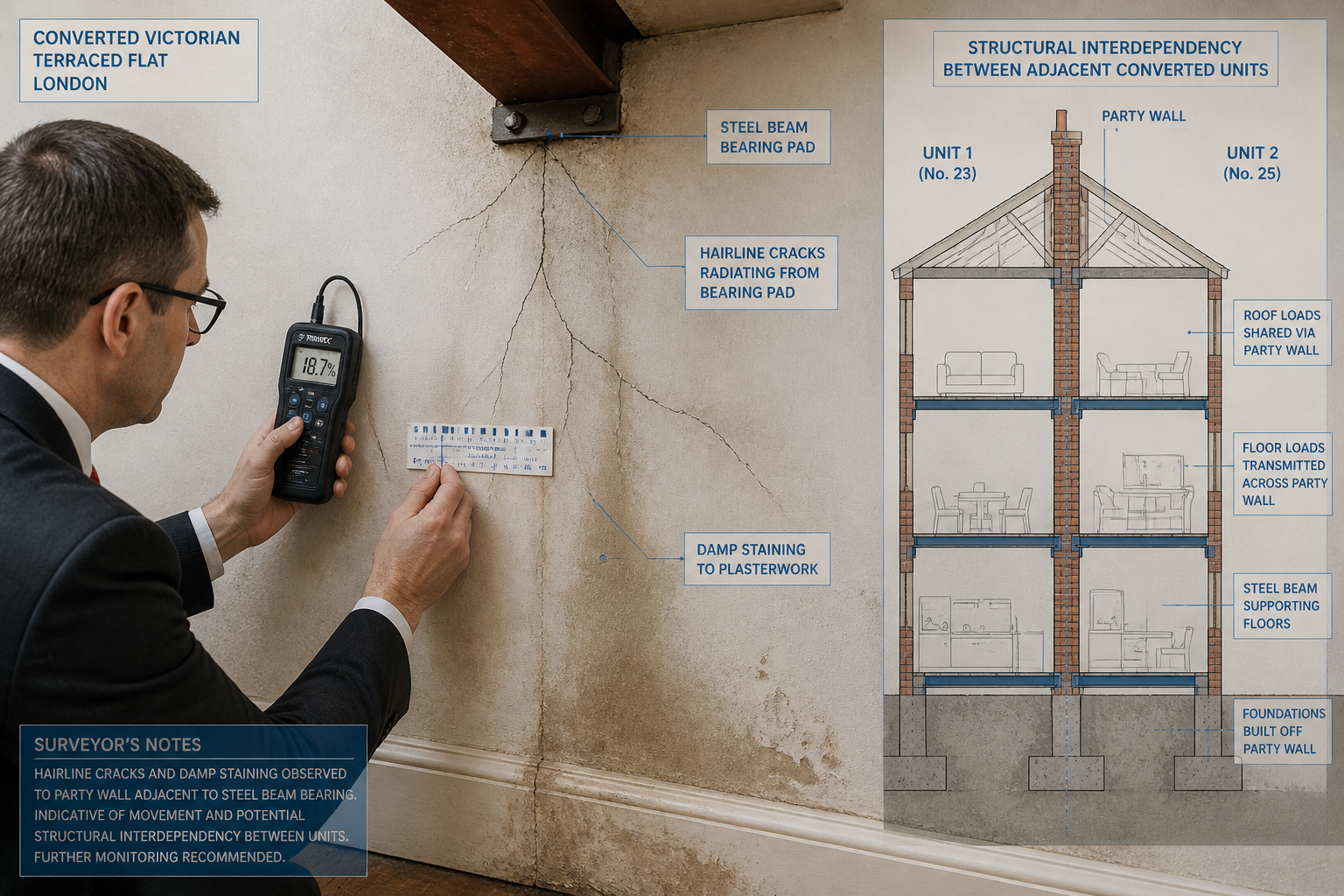
In a purpose-built flat, structural elements are designed with multi-occupancy in mind. In a conversion, they are not. When a Victorian terrace is split into three flats, the original floor joists — designed to carry domestic loads across a single household — may now support:
- Partition walls added during conversion
- Bathrooms and kitchens relocated to structurally unsuitable positions
- Heavy floor finishes (stone, concrete screed) added without engineering assessment
- Loft conversions adding load above already stressed timbers
Each of these changes affects the party wall, the floor/ceiling assembly between units, and the overall load path of the building. A surveyor assessing a ground-floor flat cannot ignore what is happening structurally in the flat above — yet the two are legally and physically interdependent.
Common Defects Found in Urban Conversions
| Defect Category | Typical Cause | Risk Level |
|---|---|---|
| Cracking at party wall junctions | Differential settlement, thermal movement | Medium–High |
| Deflected or bouncy floors | Notched/cut joists, overloading | High |
| Damp penetration through party walls | Failed DPC, missing cavity trays | Medium |
| Inadequate fire separation | Conversion shortcuts, missing fire stops | Very High |
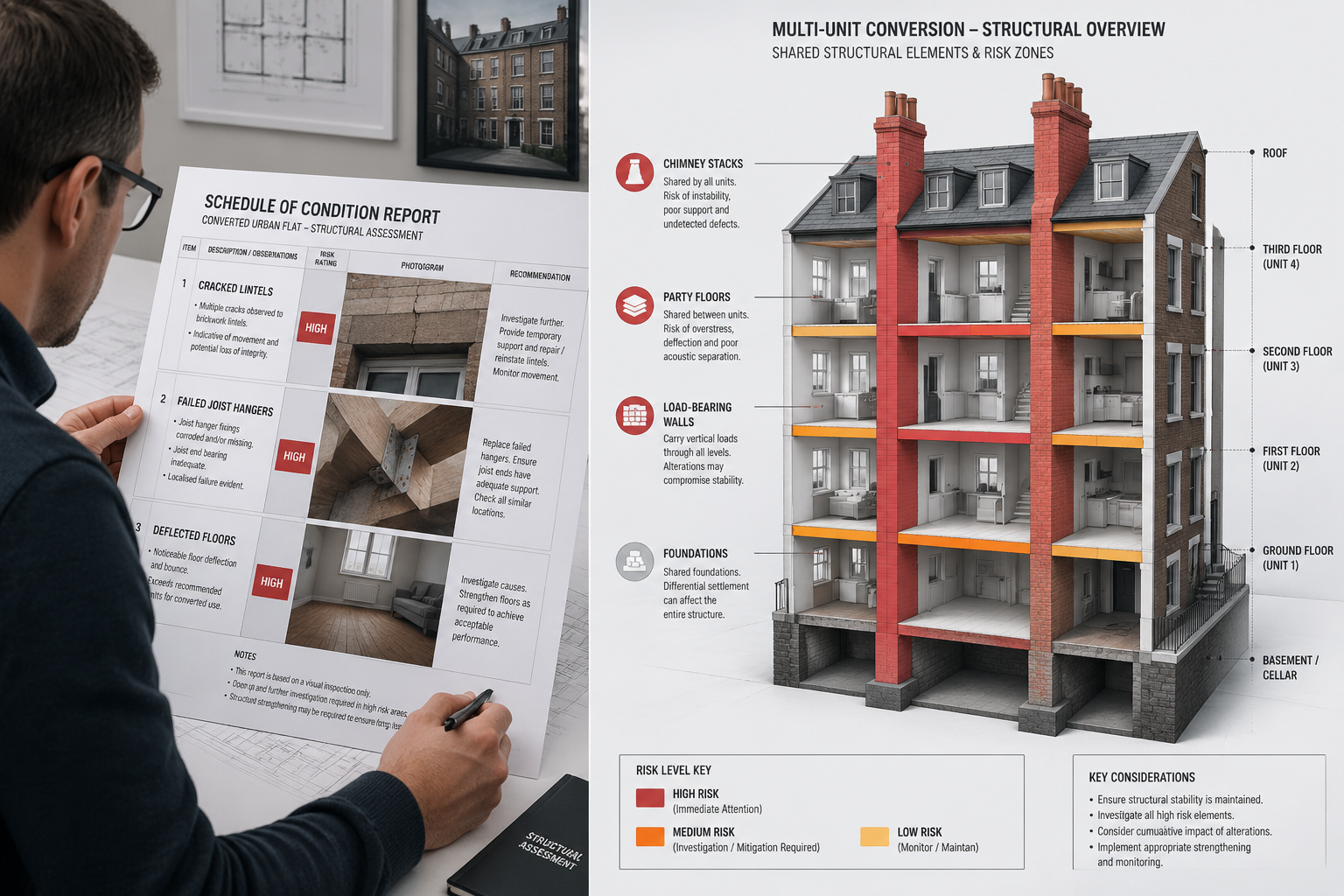
| Chimney stack instability | Shared stack between units, lack of maintenance | Medium |
| Failed lintels over openings | New openings cut without structural support | High |
| Inadequate sound insulation | Structural bypasses through shared elements | Medium |
💡 Pull Quote: "A converted property is not simply a smaller version of the original house — it is a structurally interdependent system where one unit's problem is almost always a neighbour's problem too."
Building Survey Defect Identification in High-Density Urban Conversions: Party Wall Implications and Structural Concerns — The Legal Framework
Understanding defects in converted properties is inseparable from understanding the Party Wall etc. Act 1996. This legislation governs works to shared walls, boundaries, and excavations near neighbouring structures — and it applies with particular frequency in dense urban environments where buildings sit cheek-by-jowl.
What Triggers Party Wall Obligations?
Party wall obligations are triggered in three main scenarios:
- Works to an existing party wall or structure — including cutting into, raising, or underpinning a shared wall
- New building at or astride the boundary line
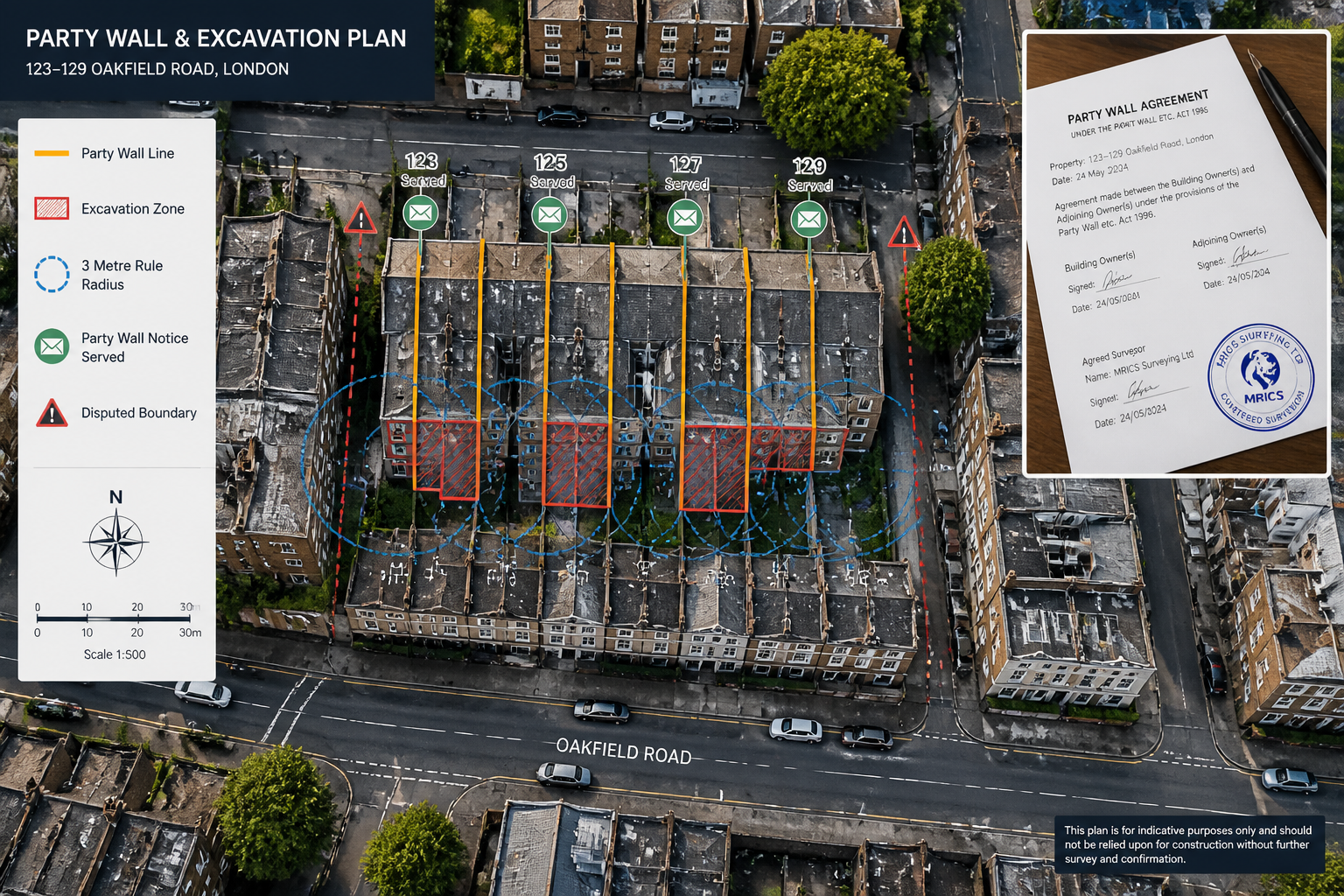
- Excavations within 3 or 6 metres of a neighbouring structure, depending on depth
The Party Wall Act 3-metre rule is particularly relevant in urban conversions where basement works, underpinning, or new foundations are common. Failure to serve the correct party wall notice before commencing such works is one of the most frequent legal errors found during building surveys.
Identifying Unauthorised Party Wall Works
One of the most valuable — and often overlooked — aspects of building survey defect identification in high-density urban conversions is spotting the aftermath of party wall works that were carried out without proper consent. Signs include:
- Patched or repointed masonry that doesn't match the surrounding material
- New steel beams or padstones inserted without visible structural calculations
- Disturbed ground levels adjacent to shared boundaries suggesting past excavation
- Asymmetric cracking patterns that follow the line of a party wall
- Mismatched floor levels between units indicating differential settlement
When these signs are present, a specific defect report may be warranted to investigate further before proceeding with a purchase or lease.
The Role of the Schedule of Condition
Before any neighbouring works begin, a party wall schedule of condition documents the existing state of an adjoining property. This photographic and written record becomes the baseline against which any damage to property in party wall situations are assessed.
In the context of a building survey, reviewing whether a schedule of condition was prepared prior to recent neighbouring works — and comparing its findings against current conditions — can reveal whether existing defects are pre-existing or caused by those works. This distinction has significant legal and financial implications.
Shared Chimneys and Party Walls
A frequently underestimated structural concern in urban conversions is the shared chimney stack. In a converted Victorian terrace, a single chimney stack may serve multiple flats, with each unit having its own flue. Structural movement, water ingress, or removal of a chimney breast in one flat can destabilise the entire stack — affecting all adjoining units.
Surveyors should check for party wall shared chimney issues, particularly where chimney breasts have been removed at lower levels while the stack above remains supported only by the upper floor structure. This is a classic conversion defect that creates serious structural risk.
Conducting a Structural Survey in Urban Conversion Properties
A standard Level 2 homebuyer report is rarely sufficient for a converted urban property. A full structural survey in London — or Level 3 Building Survey — is the appropriate tool for assessing the complex interdependencies found in these buildings.
What a Building Survey Must Cover in Conversions
🔍 Foundation and Substructure
- Evidence of differential settlement between the original structure and any extensions
- Signs of past or ongoing subsidence, particularly in clay-heavy London soils
- Proximity of trees to foundations (particularly relevant for Victorian properties)
- Evidence of basement conversion or underpinning works
🔍 Party Walls and Shared Structures
- Crack patterns, particularly diagonal cracks at wall junctions
- Evidence of past or current damp penetration through the party wall
- Adequacy of fire stopping at party wall junctions
- Structural integrity of shared elements (lintels, beams, padstones)
🔍 Floor and Ceiling Assemblies
- Deflection and bounce in timber floors (indicating notched or damaged joists)
- Evidence of overloading from heavy floor finishes or relocated wet rooms
- Adequacy of sound and fire separation between units
🔍 Roof and Upper Structure
- Condition of shared roof structure, particularly where a loft conversion has been added
- Evidence of roof spread or rafter spread affecting party walls
- Condition of shared gutters, downpipes, and flat roof areas
When to Engage a Structural Engineer
Some defects identified during a building survey require specialist structural engineering input. A residential structural engineer in London should be engaged when:
- Significant cracking is found at structural junctions
- Evidence of past underpinning or foundation works is discovered
- Steel beams have been installed without visible calculations or building control sign-off
- Chimney breast removal has occurred without evidence of adequate structural support
- The surveyor identifies deflection or movement beyond acceptable tolerances
Party Wall Disputes Arising from Defect Discovery
Discovering defects during a building survey sometimes reveals that those defects were caused — or worsened — by a neighbour's works. In such cases, a party wall dispute process may be the appropriate route to resolution.
The Party Wall etc. Act 1996 provides a structured mechanism for resolving such disputes through appointed surveyors, avoiding costly litigation. However, the process must be initiated correctly. Understanding the party wall agreement framework — including rights, obligations, and timelines — is essential for anyone facing this situation.
Practical Guidance for Buyers, Owners, and Surveyors in 2026
The landscape for urban conversions continues to evolve. Zoning reforms are reshaping what can be built, converted, and extended in dense urban areas [1][3], and the volume of party wall-related activity shows no sign of slowing. Here is practical, actionable guidance for each stakeholder group.
For Buyers of Converted Properties
✅ Always commission a Level 3 Building Survey — not a homebuyer report — for any converted flat or maisonette in an older building.
✅ Ask for evidence of party wall notices served and received for any recent works to the property or neighbouring properties.
✅ Request copies of building regulations completion certificates for any conversion or extension works.
✅ Check whether a licence to alter was required and obtained if the property is leasehold — this is a separate requirement from party wall compliance. See our guide on what a licence to alter involves.
✅ Investigate the history of neighbouring works — particularly basement conversions, loft conversions, and rear extensions — which may have affected shared structural elements.
For Owners Planning Works
✅ Serve the correct party wall notices well in advance of any works — typically two months for party wall works, one month for line of junction works.
✅ Commission a schedule of condition of all adjoining properties before works begin.
✅ Engage a chartered surveyor experienced in urban conversions to oversee the party wall process.
✅ Do not assume that planning permission or building regulations approval removes the need for party wall compliance — they are entirely separate legal requirements.
For Surveyors
✅ Treat every converted property as a system, not a standalone unit. Defects in one flat frequently have their origin — or their solution — in an adjacent unit.
✅ Look for the tell-tale signs of unauthorised works: mismatched materials, asymmetric cracking, and disturbed ground levels.
✅ Recommend specialist input early — a structural engineer's report costs far less than a party wall dispute or structural remediation.
✅ Document everything photographically and cross-reference current conditions against any available schedule of condition records.
Conclusion: Act Before the Cracks Appear
Building survey defect identification in high-density urban conversions: party wall implications and structural concerns is not a niche specialism — it is a core competency for anyone involved in buying, selling, or managing converted urban property in 2026. The structural interdependencies created by conversion, combined with the legal framework governing shared walls and boundaries, create a complex risk environment that demands professional expertise.
Actionable Next Steps
- Before buying a converted flat — commission a full Level 3 Building Survey from a RICS-chartered surveyor with experience in urban conversions.
- Before starting any works — identify whether party wall notices are required and serve them in the correct form and timeframe.
- If defects are discovered — obtain a specific defect report and, where structural concerns exist, engage a structural engineer.
- If a neighbour is carrying out works — understand your rights under the Party Wall etc. Act 1996 and consider appointing your own surveyor.
- If a dispute arises — engage the party wall dispute resolution process promptly, before defects worsen and costs escalate.
The cost of professional advice at the outset is always a fraction of the cost of remediation, litigation, or a failed property transaction. In dense urban environments where every wall may be shared and every foundation may affect a neighbour, that investment is not optional — it is essential.
References
[1] Zoning Reform – https://www.archistar.ai/blog/zoning-reform/
[2] La Expands Adaptive Reuse Ordinance Beyond High Density Hubs – https://www.bomaonthefrontline.com/2026/01/02/la-expands-adaptive-reuse-ordinance-beyond-high-density-hubs/
[3] Zoning Reform Impact On Developers What You Must Know In 2026 – https://jdj-consulting.com/zoning-reform-impact-on-developers-what-you-must-know-in-2026/
[4] Party Wall Implications Of Renters Rights Act 2026 Survey Protocols For Prs Database And Section 8 Notice Compliance – https://nottinghillsurveyors.com/blog/party-wall-implications-of-renters-rights-act-2026-survey-protocols-for-prs-database-and-section-8-notice-compliance