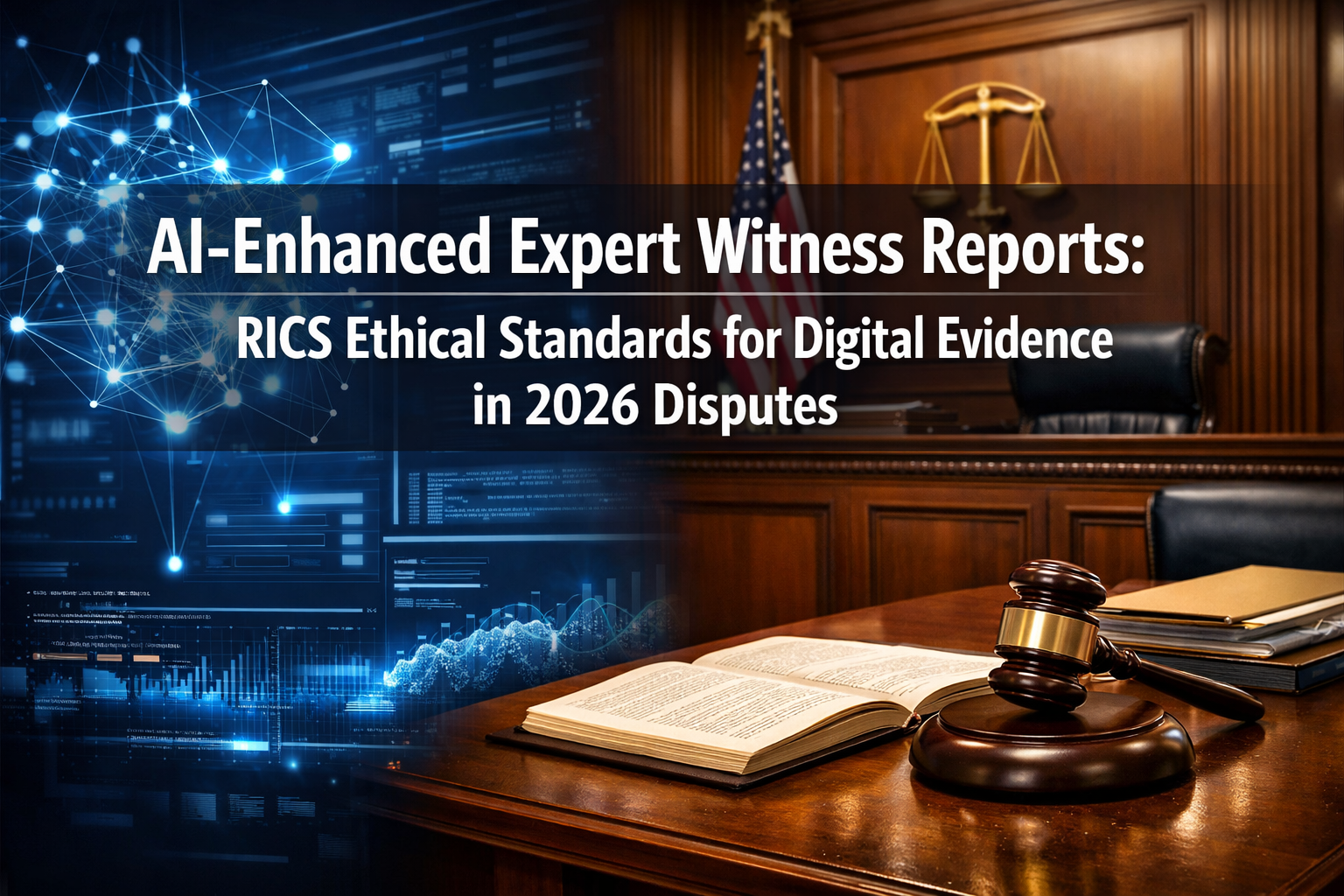

AI use among expert witnesses has doubled in just two years — yet 89% of those same professionals say they still lack the specific guidance needed to use it responsibly. [1] That gap between rapid adoption and clear ethical frameworks is precisely where disputes are won or lost in 2026. The arrival of the RICS "Responsible Use of AI in Surveying Practice" professional standard on 9 March 2026 has fundamentally changed the rules of engagement for building surveyors preparing expert witness reports. AI-Enhanced Expert Witness Reports: RICS Ethical Standards for Digital Evidence in 2026 Disputes is no longer a future-facing concept — it is the present reality for every RICS member involved in valuation and defect litigation.

Key Takeaways 📌
- The RICS mandatory AI standard, effective March 2026, applies directly to expert witness work and requires documented governance before any AI deployment.
- AI adoption among expert witnesses has doubled since 2024, but ethical frameworks have struggled to keep pace.
- Expert witnesses retain full personal accountability for all report content — AI cannot replace professional judgment.
- Confidential client data must never be uploaded to external AI tools without explicit written consent.
- Surveyors must be ready to defend AI use under cross-examination, making transparency and documentation non-negotiable.
Why 2026 Is a Turning Point for AI in Expert Witness Work
The March 2026 RICS standard did not arrive in a vacuum. It responded to a profession already in motion. In 2024, just 9.3% of expert witnesses reported using AI in their role. By 2026, that figure had risen to 20% — a shift that reflects genuine enthusiasm for AI tools in tasks like data analysis, comparable research, and report drafting. [1]
But enthusiasm without structure creates liability. In litigation, every word in an expert witness report can be challenged. Courts expect opinions to reflect the expert's own knowledge and reasoning, not the output of a language model. The RICS standard addresses this head-on: expert witnesses must not submit AI-written substantive content in reports without comprehensive personal review. [1]
💬 "AI must serve as a tool to support expert judgment — it cannot replace the expert witness's knowledge and decision-making authority." — RICS Professional Standard, 2026
This principle is not merely advisory. It is now a mandatory compliance requirement for all RICS members and regulated firms. For building surveyors working on party wall disputes, structural defect claims, or contested valuation reports, the implications are immediate and practical.
Understanding the RICS Mandatory AI Standard: Core Compliance Requirements
What the Standard Actually Demands
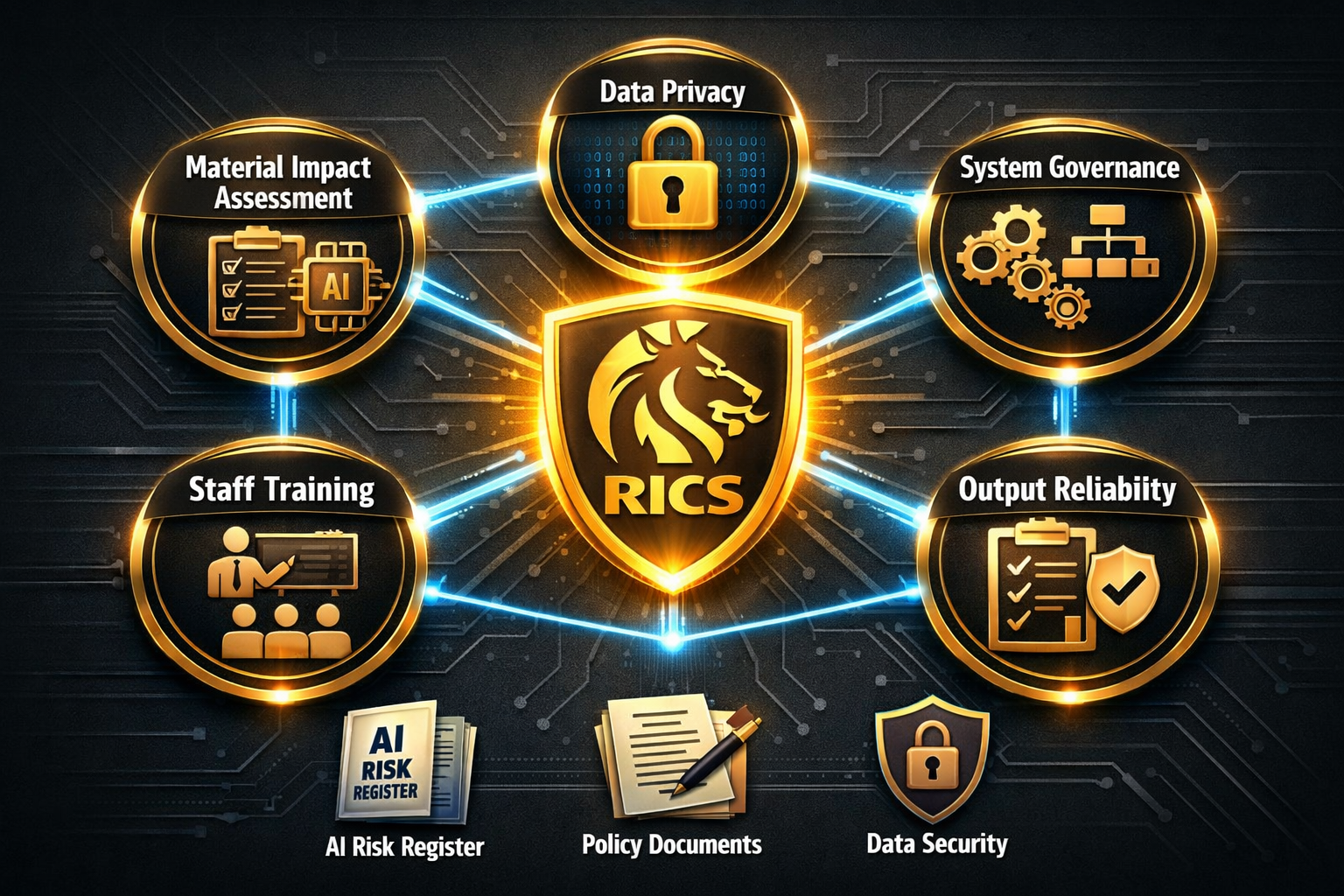
The RICS "Responsible Use of AI in Surveying Practice" professional standard establishes a layered compliance framework. It is not enough to simply use AI carefully — firms must document their governance processes before a single AI tool is deployed in a professional context. [2]
Here is a breakdown of the key obligations:
| Requirement | What It Means in Practice |
|---|---|
| Material Impact Assessment | Formally determine whether AI use will have material consequences on service delivery. Record both the finding and the reasoning in writing. |
| System Governance Assessment | Complete and document a governance review before AI use begins. Develop a responsible AI policy supported by a risk register. |
| Data Privacy Controls | Never upload private or confidential data to external AI systems without express written consent from all affected parties. |
| Staff Training | Provide regular training on AI-related risks. Restrict AI data access to personnel who genuinely need it. |
| Output Reliability Assessment | Evaluate and document how reliable the AI system's outputs are before relying on them in professional work. |
[2] [3]
The Hallucination Problem 🚨
One of the most significant risks the standard addresses is AI "hallucinations" — instances where an AI system generates plausible-sounding but entirely false information. [2] In an expert witness report, a hallucinated case reference, a fabricated comparable sale, or an invented building regulation could be catastrophic. Courts do not forgive errors that undermine the credibility of expert testimony.
RICS members must develop genuine competency in understanding AI limitations, including:
- How different AI types operate
- Where and why they fail
- How embedded bias in training data can skew outputs
- How to verify AI-generated content against authoritative sources
For surveyors preparing specific defect reports or schedule of condition reports, this means AI-assisted analysis must always be cross-checked against physical inspection findings and established professional standards.
AI-Enhanced Expert Witness Reports: RICS Ethical Standards for Digital Evidence in 2026 Disputes — Practical Application
Building the Compliant AI Workflow
Translating the RICS standard into a working process for expert witness preparation requires a structured approach. The following workflow reflects current best practice for RICS-regulated firms in 2026:
Step 1: Pre-Deployment Governance
Before using any AI tool on a matter, complete a written material impact assessment. Ask: will this AI use affect the quality, impartiality, or reliability of the expert opinion? Document the answer. [2]
Step 2: Risk Register Development
Create a firm-level risk register that identifies specific AI tools in use, their known limitations, data handling practices, and mitigation strategies. This document must be updated as tools evolve. [2]
Step 3: Data Handling Protocols
Establish clear rules about what data can and cannot enter AI systems. For expert witness work, this typically means:
- ✅ Using AI to analyse anonymised market data
- ✅ Using AI to structure report templates
- ❌ Never uploading client-identifiable information to external AI platforms without written consent
- ❌ Never using AI output as a substitute for personal site inspection findings [2]
Step 4: Review and Verification
Every AI-generated section of a report must undergo comprehensive personal review by the expert witness. The standard is clear: the expert's signature on a report means the expert personally endorses every conclusion. [1]
Step 5: Documentation for Disclosure
RICS-regulated firms must be prepared to provide written documentation on request, detailing: the AI system type, how it functions, its limitations, due diligence conducted before deployment, risk identification approaches, and assessments of output reliability. [3]
Specific Applications in Valuation and Defect Disputes
In valuation disputes — including matrimonial proceedings, probate matters, and capital gains tax valuations — AI tools can legitimately assist with:
- Rapid comparable sales analysis across large datasets
- Identification of market trend patterns
- Drafting of factual background sections (subject to full review)
In defect litigation — including subsidence claims and dilapidation disputes — AI can support:
- Pattern recognition in photographic evidence
- Cross-referencing defect descriptions against building pathology databases
- Structuring technical appendices
What AI cannot do in either context is form the professional opinion itself. The expert's duty to the court overrides any efficiency gains from automation. [1] [4]
Courtroom Credibility: Defending AI Use Under Cross-Examination
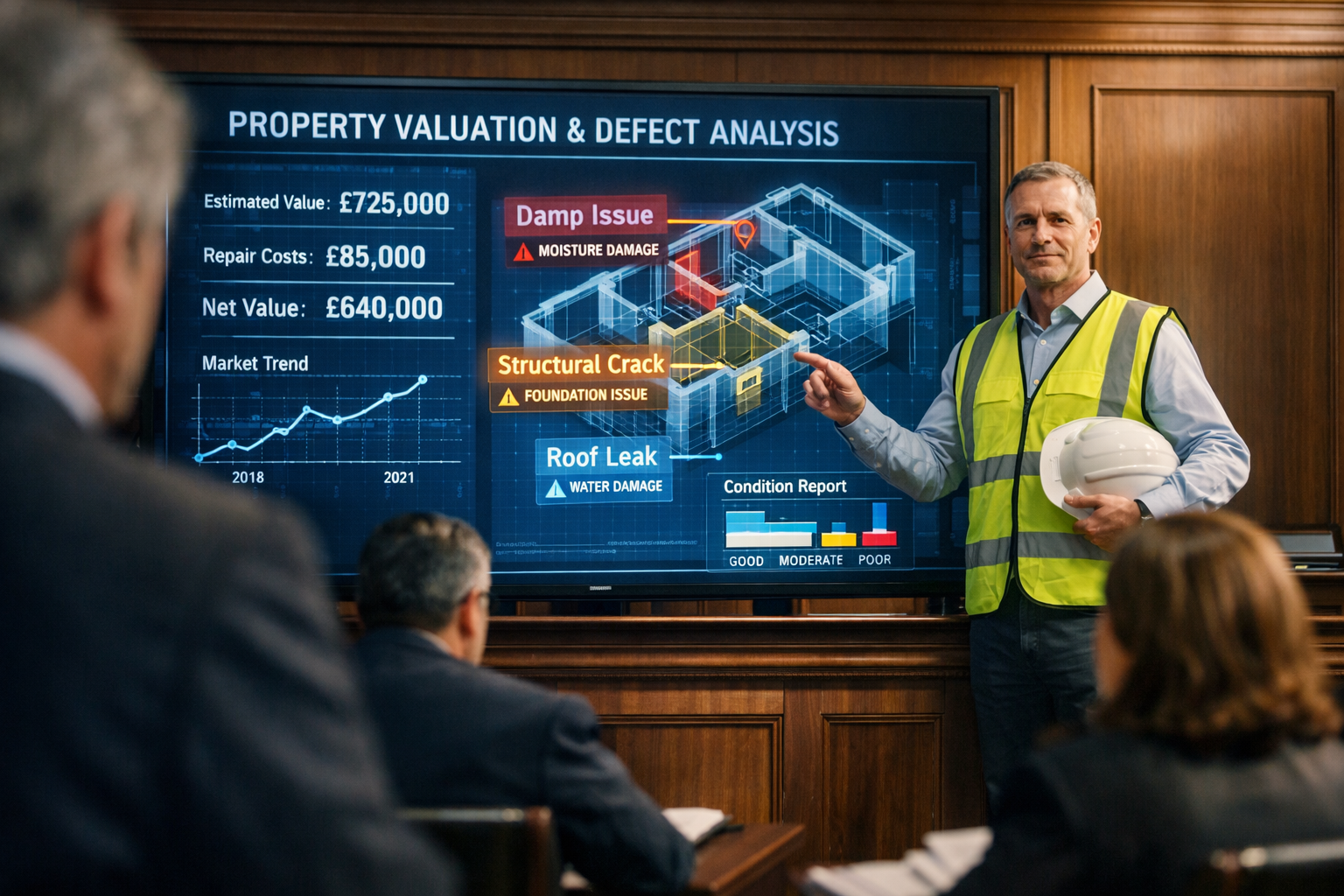
AI-Enhanced Expert Witness Reports: RICS Ethical Standards for Digital Evidence in 2026 Disputes in the Witness Box
The courtroom is the ultimate test of any expert witness report. In 2026, opposing counsel is increasingly aware of AI's role in report preparation — and is prepared to probe it. Expert witnesses must be ready to defend their use of AI under cross-examination, maintaining confidence that they can justify both the decision to use AI and the substantive conclusions reached. [1]
Typical cross-examination challenges may include:
- "Did an AI write this section?" — The expert must be able to confirm personal review and endorsement of every line.
- "What AI system was used, and what are its known limitations?" — Requires genuine technical competency, not just familiarity.
- "Was confidential client data processed by an external AI platform?" — Data governance records must be immediately available.
- "How did you verify the AI's output?" — The expert must describe a specific, documented verification process.
Preparation is everything. Surveyors who have followed the RICS governance framework will have written records to support every answer. Those who have not face significant professional and legal exposure.
The Transparency Obligation
The RICS standard creates a transparency obligation that extends beyond internal documentation. When courts or opposing parties request information about AI use, firms must be able to produce clear written explanations of:
- Which AI systems were used
- What functions they performed
- What limitations apply
- How outputs were validated [3]
This is not a burden — it is a framework for building credibility. An expert witness who can clearly explain their AI-assisted methodology, demonstrate its limitations, and show how professional judgment was applied throughout will carry far more weight than one who either avoids AI entirely or uses it without governance.
For surveyors providing RICS Red Book valuations or acting as expert witnesses in party wall award proceedings, this transparency framework aligns with existing duties of impartiality and objectivity.
Data Security and Privacy: The Non-Negotiable Boundaries
Protecting Client Data in AI-Assisted Work
Data protection is perhaps the most immediate practical challenge the RICS standard creates. The rules are unambiguous: private and confidential data cannot be uploaded to external AI systems without express written consent from all affected stakeholders. [2]
For expert witnesses, "confidential data" typically includes:
- Client identity and contact information
- Property addresses and ownership details
- Financial information used in valuation calculations
- Correspondence and instructions from solicitors
- Photographs and inspection records tied to identifiable properties
Firms must take reasonable steps to verify that uploading data to any AI system does not pose unacceptable privacy or security risks. This requires understanding where AI-processed data is stored, how long it is retained, and whether it is used to train the AI model further. [2]
Organisational Controls Required
The standard requires organisations to implement specific structural controls:
- 🔒 Restrict AI data access to personnel who genuinely require it for their role
- 📚 Provide regular staff training on AI-related risks and data handling obligations
- 🛡️ Implement strict data storage security protocols specific to AI tool use
- 📝 Maintain written records of all governance decisions and risk assessments [2]
These are not one-time tasks. AI tools evolve rapidly, and governance frameworks must evolve with them. A risk register completed in January 2026 may be outdated by June if the underlying AI system has been updated or replaced.
Conclusion: Actionable Steps for RICS Surveyors in 2026
The convergence of rapid AI adoption and mandatory RICS compliance standards has created both a challenge and an opportunity for building surveyors in 2026. Those who treat the March 2026 standard as a compliance burden will struggle. Those who treat it as a framework for professional excellence will find that AI genuinely enhances the quality, consistency, and defensibility of their expert witness work.
Immediate Actions for RICS Members 🎯
- Audit current AI use — Identify every AI tool currently used in expert witness preparation and assess whether governance documentation exists.
- Complete material impact assessments — For each AI tool with material impact on service delivery, create a written assessment and file it.
- Build a risk register — Document known limitations, data handling practices, and mitigation strategies for each AI system.
- Establish data handling protocols — Create clear written rules about what data can enter AI systems and obtain necessary consents.
- Train your team — Ensure all staff involved in expert witness work understand AI limitations, hallucination risks, and data privacy obligations.
- Practise cross-examination readiness — Simulate courtroom challenges to AI use and ensure every team member can answer confidently.
- Review and update regularly — Schedule quarterly governance reviews to keep pace with AI tool evolution.
The RICS standard does not prohibit AI — it professionalises it. For surveyors committed to delivering credible, court-ready expert witness reports, that is exactly the framework the profession needs.
References
[1] Ai Expert Witness – https://ww3.rics.org/uk/en/modus/technology-and-data/surveying-tools/ai-expert-witness.html
[2] Ai Responsible Use Standard – https://ww3.rics.org/uk/en/journals/construction-journal/ai-responsible-use-standard.html
[3] Responsible Use Of Artificial Intelligence In Surveying Practice September 2025 – https://www.rics.org/content/dam/ricsglobal/documents/standards/Responsible-use-of-artificial-intelligence-in-surveying-practice_September-2025.pdf
[4] Implementing Rics Responsible Ai Standards In 2026 Building Surveys Ethical Tools For Defect Detection And Reporting – https://nottinghillsurveyors.com/blog/implementing-rics-responsible-ai-standards-in-2026-building-surveys-ethical-tools-for-defect-detection-and-reporting