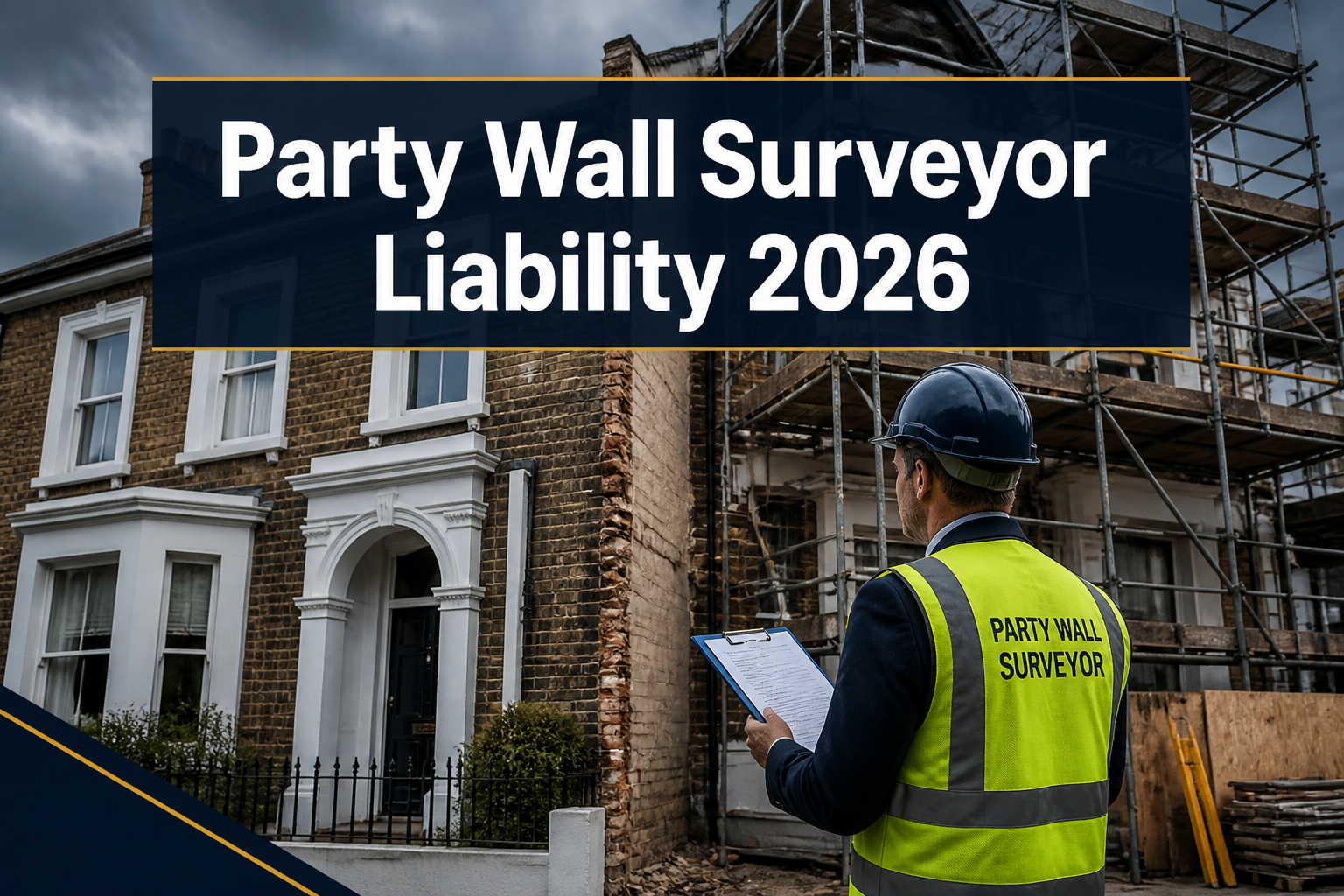
Nearly one in three party wall disputes in the UK now results in some form of formal complaint or legal challenge — a figure that has climbed steadily as construction activity accelerates and property owners become increasingly aware of their rights. For party wall surveyors, this shifting landscape makes understanding Party Wall Surveyor Liability in 2026: Managing Professional Indemnity Claims When Adjoining Owner Disputes Escalate not just a professional courtesy, but a matter of financial survival.
This article examines the specific liability risks surveyors face in 2026, how professional indemnity (PI) insurance responds when disputes turn litigious, and what practical steps surveyors can take to protect themselves before a claim ever lands on their desk.
Key Takeaways 📌
- PI insurance is non-negotiable for party wall surveyors — RICS membership makes it a mandatory requirement, and personal exposure without it can run to tens of thousands of pounds.
- Documentation is the first line of defence — thorough schedules of condition, clear awards, and contemporaneous records dramatically reduce liability exposure.
- PI insurance has defined limits — it does not cover fraud, deliberate acts, known pre-existing claims, or bodily injury.
- The 2026 insurance market is hardening — higher claim costs and emerging exposures are driving rate increases for surveying professionals.
- Adjoining owner disputes are rising — construction activity in 2026 is amplifying neighbour conflicts, making proactive risk management essential.

Understanding the Liability Landscape for Party Wall Surveyors in 2026
The role of a party wall surveyor sits at a uniquely contentious intersection: between building owners who want work to proceed and adjoining owners who want their property protected. When something goes wrong — a cracked wall, a flooded basement, a botched award — the surveyor is often the first professional in the firing line.
What Triggers a Liability Claim?
Party wall surveyor liability typically arises from one or more of the following:
- Negligent preparation of a Party Wall Award — errors in the scope, conditions, or legal basis of the award
- Failure to serve valid notices — incorrect notice periods, wrong recipients, or procedurally defective documents
- Inadequate Schedule of Condition — missing or poorly documented pre-existing damage that later becomes disputed
- Conflict of interest — particularly where an agreed surveyor is perceived to favour the building owner
- Delay or inaction — failing to act within statutory timeframes, causing financial loss to either party
For a deeper understanding of what constitutes a formal party wall dispute, the guide to what is a party wall dispute provides essential context on how disagreements escalate and what triggers formal proceedings.
The 2026 Construction Uptick Effect
Party wall surveys and neighbour disputes are anticipated to escalate significantly during 2026's construction uptick [4]. As more homeowners pursue extensions, loft conversions, and basement projects, the volume of party wall notices — and the potential for disputes — rises proportionally. Surveyors working in high-density urban areas, particularly across London, face the highest exposure.
💬 "Courts, lenders, and regulators are tightening expectations on the professional indemnity market, even as the market feels softer, with claims continuing to evolve in nature." [5]
This tightening scrutiny means surveyors cannot rely on informal processes or verbal agreements. Every step must be documented, defensible, and compliant with current RICS guidance.
Professional Indemnity Insurance: What It Covers and What It Doesn't
Understanding PI insurance is central to managing party wall surveyor liability in 2026. Most surveyors in the UK need PI insurance if they hold RICS membership, as the professional body makes it a mandatory requirement [3]. But knowing that you need it is very different from knowing what it actually covers.
What PI Insurance Typically Covers ✅
A well-structured PI policy for party wall surveyors generally covers [1]:
| Coverage Area | Description |
|---|---|
| Negligent acts, errors & omissions | Core coverage for professional mistakes |
| Breach of confidentiality | Inadvertent disclosure of sensitive information |
| Defamation | Unintentional libel or slander in professional communications |
| Loss of documents or data | Physical or digital loss of client files |
| Sub-contractor negligence | Errors by professionals engaged on your behalf |
| Defence and court attendance costs | Legal fees even when a case is successfully defended |
| Intellectual property infringement | Unintentional use of protected materials |
Legal defence costs alone can run into thousands of pounds even when a case is won, making comprehensive coverage essential beyond compensation payouts [3]. Without PI insurance, surveyors could face personal liability for tens of thousands of pounds in expenses [3].
What PI Insurance Does NOT Cover ❌
Equally important is understanding the exclusions. PI insurance does not cover [3]:
- Fraud or deliberate dishonesty — intentional wrongdoing is excluded universally
- Bodily injury or property damage — these fall under Public Liability insurance, not PI
- Known claims before the policy start date — pre-existing disputes cannot be retrospectively insured
- Contractual penalties — fines or penalties arising from contract terms are excluded
- General wear and tear disputes — deterioration unrelated to professional acts is not covered
The Public Liability Distinction
A common point of confusion involves Public Liability (PL) insurance. PL insurance protects against liabilities for injury to third parties or their property, but adjoining owners are not parties to contractor policies and cannot benefit as claimants [2]. This matters because when a building owner's contractor damages an adjoining property, the adjoining owner may have no direct recourse against the contractor's insurer — making the surveyor's own PI coverage and the quality of the party wall award even more critical.
Notably, RICS removed mandatory insurance clauses from its 6th Edition Guidance Notes (now on the 7th Edition), having previously required building owners to maintain Public Liability insurance and provide evidence upon demand. The removal was deliberate — the panel agreed that party wall surveyors do not have authority to require building owners to insure against risks that might never occur [2].
For surveyors working across complex urban environments, understanding party wall legislation in its current form is essential to navigating these insurance boundaries correctly.
Managing Professional Indemnity Claims: Prevention, Documentation, and Response

The most effective strategy for managing party wall surveyor liability in 2026 is prevention. Once a PI claim is filed, the costs — financial and reputational — begin immediately. The following framework addresses risk at three stages: before work begins, during the project, and after a dispute arises.
Stage 1: Pre-Instruction Risk Management 🔍
Before accepting an instruction, surveyors should:
- Conduct a conflict of interest check — particularly critical when acting as an agreed surveyor, where impartiality is paramount
- Clarify the scope of appointment in writing, including what the surveyor is and is not responsible for
- Verify notice validity — confirm that the correct notices have been served under the Party Wall etc. Act 1996 before proceeding
- Check the adjoining owner's appointment — ensure any surveyor appointed by the adjoining owner has proper authority
Stage 2: During the Project — Documentation as Defence 📋
This is where most liability claims are won or lost. The quality of a surveyor's contemporaneous records determines whether a negligence allegation can be successfully defended.
Critical documentation checklist:
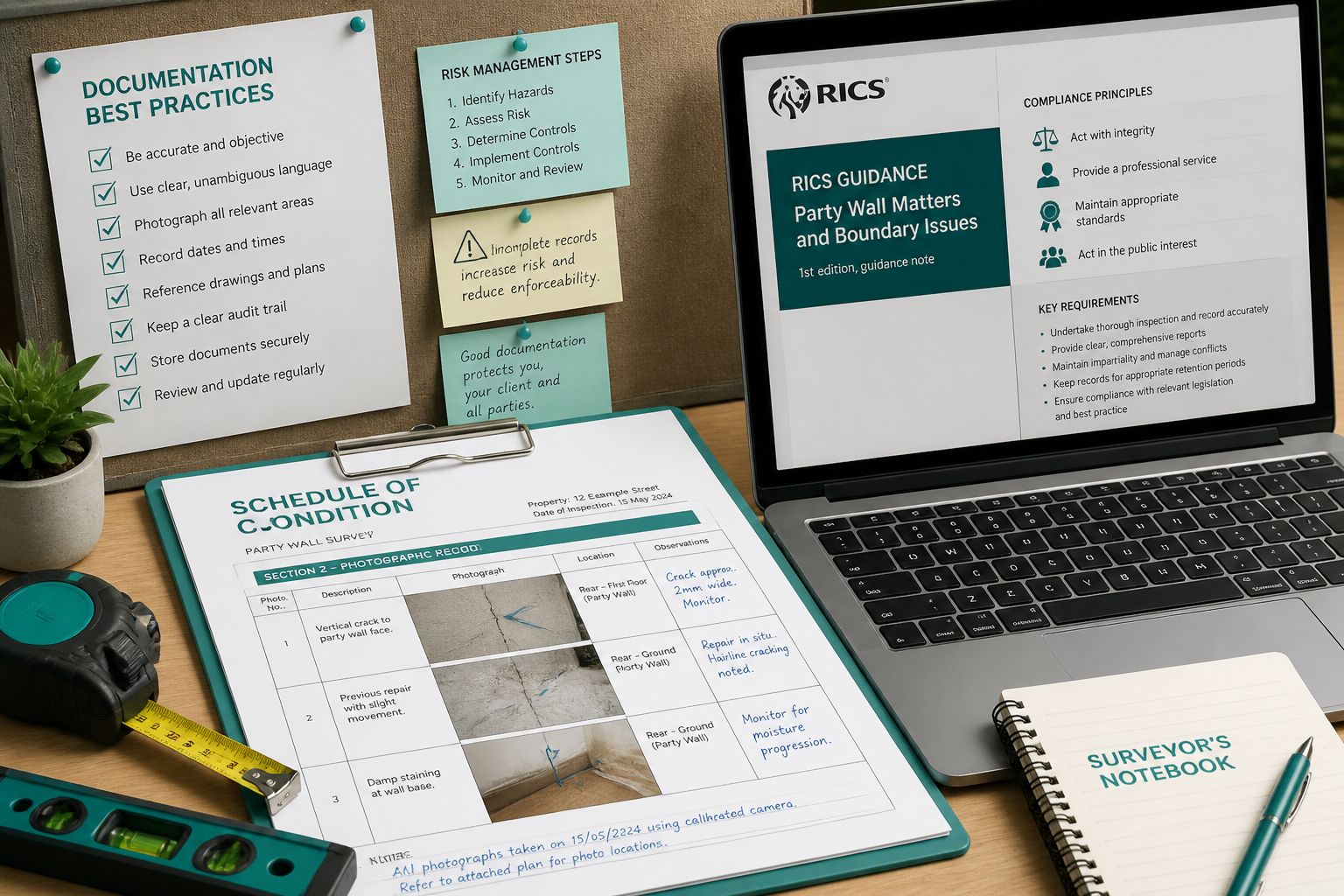
- ✅ Schedule of Condition — comprehensive photographic and written record of the adjoining property's pre-existing condition. For guidance on what this should contain, see what is a schedule of condition report
- ✅ Party Wall Award — clearly drafted, legally sound, and specific about permitted works, working hours, and protective measures
- ✅ Correspondence log — all communications with building owner, adjoining owner, and other surveyors retained in chronological order
- ✅ Site inspection notes — dated records of every site visit with observations about compliance with the award
- ✅ Photographic evidence — timestamped images taken at regular intervals throughout the works
💡 Pro Tip: A poorly drafted Schedule of Condition is one of the most common triggers for PI claims. If pre-existing damage is not documented, any damage discovered after works begin will be attributed to those works by default.
For projects involving excavation near a party wall, the risks are particularly acute. Understanding the specific requirements around party wall excavation notices can help surveyors ensure awards are properly scoped from the outset.
Stage 3: When a Dispute Escalates — Responding to a PI Claim 🚨
When a complaint or claim arises, the surveyor's response in the first 48–72 hours can significantly influence the outcome. Key steps include:
- Notify your PI insurer immediately — most policies require prompt notification; delay can jeopardise coverage
- Do not admit liability — even a well-intentioned apology can be construed as an admission
- Preserve all records — do not delete, amend, or reorganise any files related to the matter
- Engage your insurer's legal panel — use solicitors experienced in surveying negligence claims
- Cooperate with RICS complaints procedures — if the complainant pursues the professional body route, full cooperation is required
The 2026 Insurance Market: Harder Conditions Ahead
Higher claim costs, economic uncertainty, and emerging exposures are driving a new round of insurance rate hikes for surveyors in 2026 [7]. Surveyors should anticipate:
- Increased premiums — particularly for those with prior claims or working in high-risk areas
- Stricter underwriting — insurers scrutinising risk management practices more closely
- Broader policy exclusions — some insurers narrowing coverage in response to evolving claim types
For surveyors operating across London and the South East — areas with the highest concentration of party wall work — the combination of rising construction activity and a hardening insurance market creates a particularly challenging environment. Those working in areas such as Central London or South East London should review their PI coverage limits carefully against the scale and complexity of their current caseload.
Practical Risk Reduction: A Surveyor's Action Plan for 2026
The following table summarises the most impactful risk reduction measures available to party wall surveyors in 2026:
| Risk Area | Recommended Action | Priority |
|---|---|---|
| PI coverage adequacy | Review policy limits annually against current caseload value | 🔴 High |
| Schedule of Condition quality | Use structured templates with mandatory photo requirements | 🔴 High |
| Award drafting | Peer review complex awards before issue | 🔴 High |
| Conflict of interest | Formal written checks before every agreed surveyor appointment | 🔴 High |
| Notice validity | Checklist-based notice verification process | 🟡 Medium |
| Client communication | Written confirmation of all key decisions and advice | 🟡 Medium |
| CPD and RICS compliance | Stay current with 7th Edition Guidance Notes | 🟡 Medium |
| Sub-contractor oversight | Written agreements clarifying professional responsibility | 🟠 Medium-High |
For surveyors wanting to understand the full spectrum of party wall matters and their associated risks, a comprehensive review of current guidance is an essential starting point for any risk management programme.
Conclusion: Protecting Your Practice in an Increasingly Litigious Market
Party Wall Surveyor Liability in 2026: Managing Professional Indemnity Claims When Adjoining Owner Disputes Escalate is not a theoretical concern — it is an active and growing risk for every practitioner in the field. The combination of rising construction activity, more informed property owners, a hardening PI insurance market, and tightening regulatory expectations means that the margin for error is narrower than ever.
Actionable Next Steps for Party Wall Surveyors:
- Review your PI policy today — confirm coverage limits, exclusions, and notification requirements before your next instruction
- Audit your documentation practices — if your Schedule of Condition process is not systematic and photographic, upgrade it immediately
- Revisit your conflict of interest procedures — especially if you regularly act as an agreed surveyor
- Stay current with RICS 7th Edition Guidance Notes — the removal of mandatory PL insurance clauses has practical implications for how awards are drafted
- Build a pre-claim response plan — know exactly who to call and what not to say if a complaint arises
The surveyors who will navigate 2026's dispute landscape most successfully are those who treat risk management not as an afterthought, but as a core professional discipline — as integral to their practice as the surveys themselves.
References
[1] Professional Indemnity Insurance For Party Wall Surveyors – https://hensure.com/old/professional-indemnity-insurance-for-party-wall-surveyors/
[2] Insurance And The Party Wall Act – https://www.peterbarry.co.uk/blog/insurance-and-the-party-wall-act/
[3] Do Surveyors Need PI Insurance – https://goreport.com/do-surveyors-need-pi-insurance/
[4] Party Wall Surveys And Neighbour Disputes During 2026's Construction Uptick RICS Compliance Framework – https://nottinghillsurveyors.com/blog/party-wall-surveys-and-neighbour-disputes-during-2026s-construction-uptick-rics-compliance-framework
[5] Top 5 Claims Risks Facing Surveyors 2026 – https://www.howdengroup.com/uk-en/top-5-claims-risks-facing-surveyors-2026
[7] Ames Gough 2026 A E PL Survey Results – https://amesgough.com/ames-gough-2026-a-e-pl-survey-results/