
Valuation negligence now ranks among the top five claims risks facing UK surveyors in 2026 — a stark warning that the margin for error in expert witness work has never been smaller [2]. As property disputes flood courts and tribunals in a recovering market, the professionals who win cases are no longer those who rely solely on experience and comparable evidence. They are the ones harnessing Big Data Analytics for Expert Witness Valuations: Predicting Property Defects in 2026 UK Markets to deliver forensically precise, court-ready opinions that hold up under cross-examination.
This article explores how data-driven defect forecasting is reshaping expert witness practice across England and Wales — and what chartered surveyors must do right now to stay ahead.

Key Takeaways 📌
- AI-powered valuation models now achieve over 96% accuracy, far outperforming traditional approaches that typically reach only 70–85% [1].
- Proactive defect forecasting using city analytics and RICS survey data strengthens expert witness reports in disputed property cases.
- Transparency and explainability in AI models are critical for court acceptance — black-box outputs are insufficient for high-stakes legal proceedings [1].
- Valuation negligence claims are rising sharply in 2026, making data-backed methodologies a professional risk management tool as much as a competitive advantage [2].
- Regional market data integration allows expert witnesses to build contextually robust valuation narratives that reflect localised price stabilisation trends [3].
Why Traditional Defect Assessment Falls Short in 2026
For decades, expert witness valuations in UK property disputes rested on three pillars: physical inspection, comparable sales evidence, and professional judgement. These remain essential. But they carry inherent limitations when applied to complex litigation.
A surveyor inspecting a Victorian terrace in South London for signs of subsidence relies on what is visible on the day. They cannot easily quantify the probability that a hairline crack will progress, or model how an undisclosed drainage defect will affect value over a five-year period. Courts, however, increasingly demand exactly that kind of forward-looking, evidence-based opinion.
The 2026 UK property market adds further complexity. After several years of correction and stabilisation, regional price behaviour has become highly fragmented. A property defect that would reduce value by 8% in one postcode may have a 15% impact three streets away, depending on buyer demand, stock levels, and infrastructure investment. Static comparable evidence struggles to capture this granularity.
💬 "The shift is from describing what a defect is, to predicting what it will cost — financially, legally, and structurally — over time."
This is precisely where big data analytics changes the game.
How Big Data Analytics for Expert Witness Valuations Works in Practice
The Data Sources Powering Defect Prediction
Modern expert witness valuations in 2026 draw on a far richer dataset than Land Registry transactions alone. The most effective practitioners integrate:
| Data Source | Application in Expert Witness Work |
|---|---|
| RICS survey condition ratings | Benchmarking defect severity against national norms |
| Local authority planning portals | Identifying historic structural interventions |
| Environmental Agency flood risk data | Quantifying latent defect risk at site level |
| Energy Performance Certificate databases | Correlating fabric defects with thermal performance |
| Drone roof survey imagery | Providing photographic evidence of hidden defects |
| Insurance claims databases | Establishing defect frequency by property type and age |
| City analytics platforms | Modelling neighbourhood-level value trajectories |
When these sources are combined and processed through machine learning models, patterns emerge that no individual inspection could reveal. For example, a cluster of properties built between 1960 and 1975 in a specific postcode may show a statistically significant correlation between flat-roof construction and recurring water ingress claims — a finding that directly informs an expert witness's opinion on diminution of value.
For cases involving structural damage adjacent to construction works, party wall damage assessments benefit enormously from this kind of predictive modelling, particularly where the extent of hidden damage is contested.
From Description to Prediction: The Analytical Leap
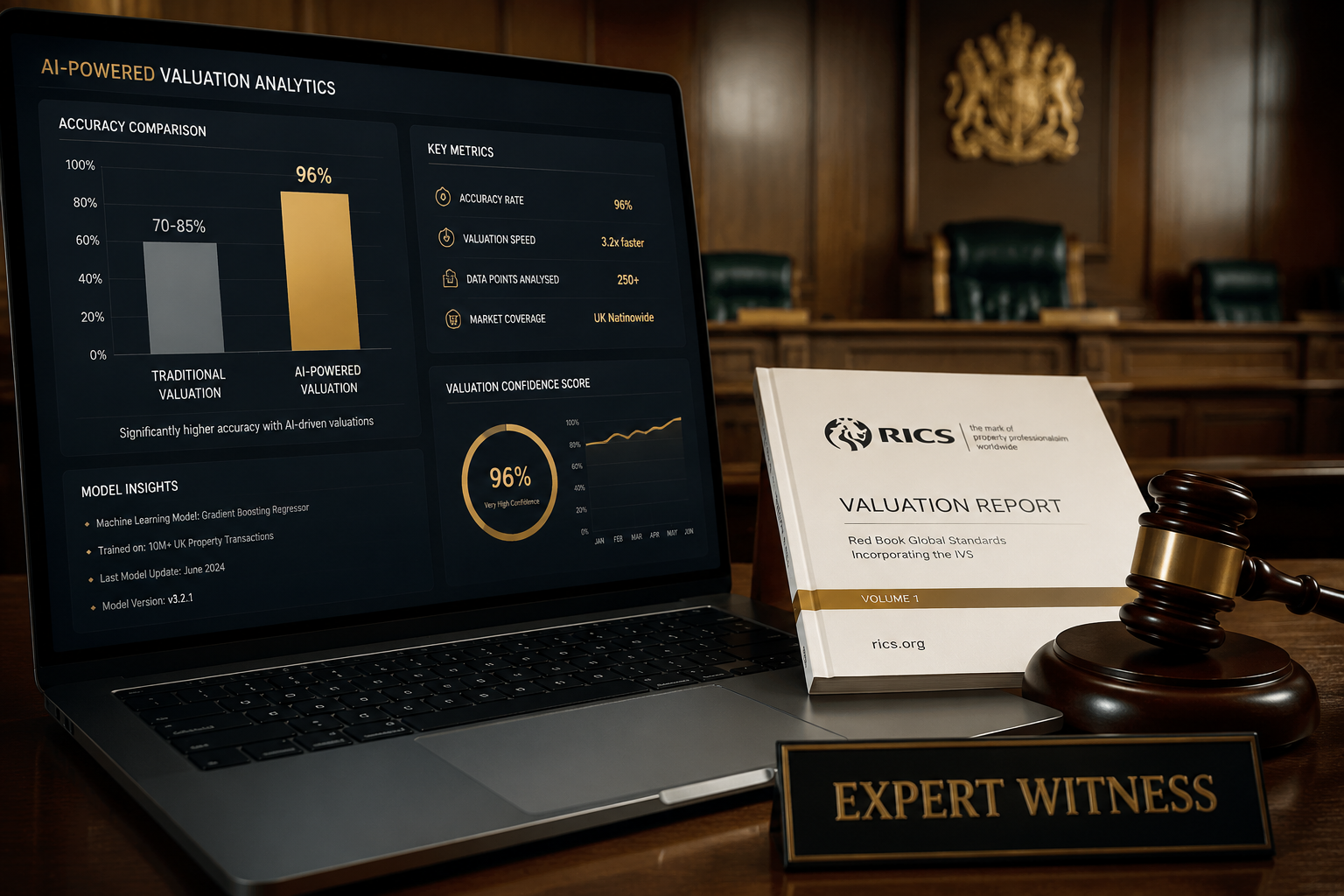
The University of Manchester's research team, led by Dr. Yishuang Xu, has developed an AI valuation system achieving over 96% accuracy — compared to the 70–85% typical of traditional approaches [1]. Critically, the team's focus is not speed but transparency: ensuring that AI-generated valuations can be explained, challenged, and trusted in high-stakes decision-making contexts [1].
This distinction matters enormously in expert witness work. A court will not accept an opinion that simply states "the algorithm said so." The expert must be able to articulate:
- What data inputs were used
- How the model weighted each variable
- What assumptions underpin the output
- How the prediction compares to manual assessment
The best-practice approach in 2026 treats AI and big data as a validation and enhancement layer over professional judgement — not a replacement for it.
Building Court-Ready Reports: Integrating Big Data Analytics for Expert Witness Valuations
Structuring the Analytical Narrative
Expert witness reports that successfully leverage big data share a common structural approach. They move from macro-market context to micro-level defect evidence, with each layer supported by quantifiable data.
Step 1 — Regional Market Context 🏙️
Begin with city-level analytics showing price trends, transaction volumes, and demand indicators for the subject property's postcode. In recovering 2026 markets, this contextualises why a defect's impact on value may differ from historical precedents [3]. A retrospective valuation may also be required to establish the property's condition and value at a specific past date — a common requirement in negligence and boundary dispute cases.
Step 2 — Property-Specific Defect Probability Scoring
Using construction age, type, and local environmental data, assign a probability score to identified defects. This transforms subjective observations ("there appears to be some movement") into defensible quantitative statements ("properties of this construction type in this postcode show a 34% incidence of foundation movement within 20 years of construction").
Step 3 — Comparable Defect Impact Analysis
Cross-reference defect-adjusted sale prices from comparable properties to establish a statistically supported diminution of value range. This is more robust than selecting three or four comparables manually.
Step 4 — Forward-Looking Cost Projection
Integrate building cost indices and contractor pricing data to project remediation costs over a realistic timeframe. Courts find this particularly compelling in cases involving commercial dilapidation disputes where landlord and tenant disagree on the scope and cost of required works.
Step 5 — Sensitivity Analysis
Present best-case, mid-case, and worst-case valuation outcomes. This demonstrates analytical rigour and pre-empts challenges from opposing experts.
The Transparency Imperative
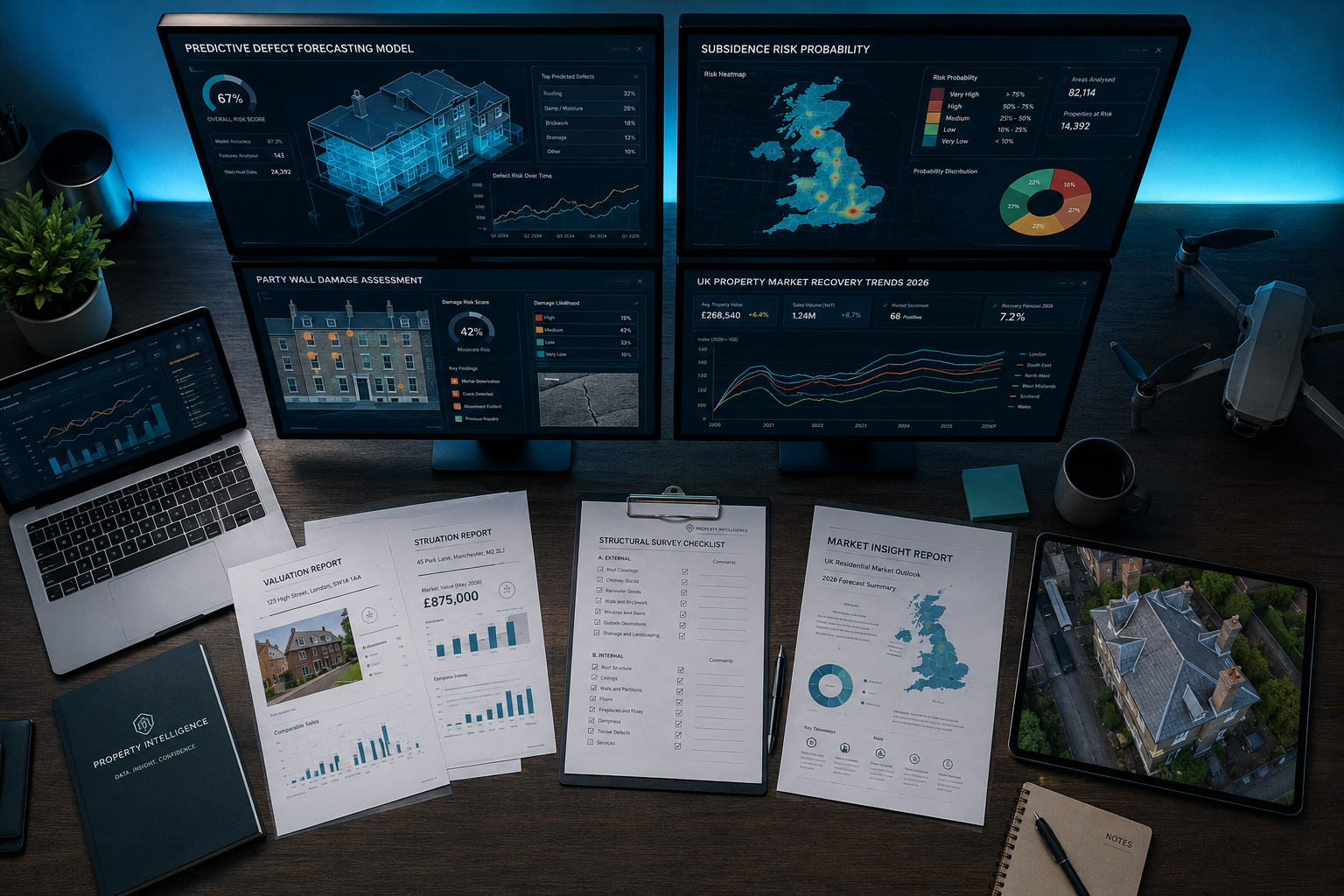
Augmented reality and data visualisation tools are increasingly used to present complex defect evidence to courts and tribunals [4]. A heat map showing defect probability across a building's elevation, or an interactive timeline of structural movement, communicates far more effectively than pages of technical description.
For valuation reports prepared for London courts and tribunals, this visual layer is becoming an expected component of high-quality expert witness submissions.
Specific Defect Categories Where Predictive Analytics Adds Most Value
🔍 Subsidence and Ground Movement
Ground movement claims are among the most contested in UK property litigation. Predictive analytics draws on:
- British Geological Survey soil classification data
- Historic mining and infrastructure records
- Tree root proximity mapping
- Seasonal shrink-swell clay indices
A specialist subsidence survey combined with big data modelling can establish whether observed cracking is progressive or historic — a distinction worth tens of thousands of pounds in disputed claims.
🔍 Roof and Envelope Defects
Drone roof surveys in London now generate high-resolution thermal and photographic imagery that feeds directly into defect prediction models. By comparing a property's roof condition against age-adjusted deterioration curves for its construction type, experts can quantify residual life and replacement cost with far greater precision than visual inspection alone permits.
🔍 Party Wall and Boundary Damage
In cases involving party wall disputes, big data analytics helps establish causation — arguably the hardest element to prove. By modelling structural behaviour before and after neighbouring works, and comparing outcomes against a dataset of similar construction scenarios, experts can produce probability-weighted causation opinions that courts find compelling.
🔍 Latent Defects in Newly Built Properties
Snagging and latent defect claims against developers are rising in 2026. Analytics platforms that aggregate defect reports from properties built by the same developer, using the same subcontractors, in the same period, can establish systemic failure patterns — transforming an individual claim into a statistically supported argument.
Risk Management: Why Data-Backed Valuations Protect Surveyors Too
Valuation negligence is explicitly identified as a top claims risk for UK surveyors in 2026 [2]. The professional exposure is significant: a surveyor whose expert witness opinion is successfully challenged faces not only reputational damage but potential indemnity claims.
Big data analytics provides a documented, reproducible methodology that is far easier to defend than a purely judgement-based opinion. When a solicitor asks "how did you arrive at this figure?", a data-backed expert can point to:
- Named datasets and their sources
- Documented analytical methodology
- Statistical confidence intervals
- Peer-reviewed research supporting the model
This is equally important for surveyors providing matrimonial valuations or probate valuations, where disputed figures can trigger HMRC scrutiny or family court challenges. A data-supported valuation is simply harder to attack.
Practical Steps for Surveyors Adopting Big Data in Expert Witness Work
Transitioning to a data-enhanced practice does not require a complete overhaul of existing methodology. The following phased approach is realistic for most chartered surveying firms in 2026:
Phase 1 — Data Literacy 📊
Invest in training to understand the key datasets available: Land Registry price paid data, EPC registers, Environment Agency APIs, and RICS market surveys. Many are free or low-cost.
Phase 2 — Tool Integration
Adopt property analytics platforms (several UK-focused options emerged between 2023 and 2026) that aggregate and visualise these datasets. Ensure any AI tool used can produce explainable outputs.
Phase 3 — Report Restructuring
Revise expert witness report templates to include a dedicated data evidence section, with clearly labelled sources, methodology notes, and statistical outputs.
Phase 4 — Peer Review
Before submitting data-enhanced reports to court, have the analytical methodology reviewed by a colleague with quantitative expertise. Courts are increasingly sophisticated in identifying methodological weaknesses.
Phase 5 — CPD and Compliance
Ensure that all data practices comply with GDPR and RICS professional standards. Document data handling procedures as part of the firm's quality management system.
Conclusion: The Competitive Edge in 2026 Disputes
The UK property dispute landscape in 2026 rewards precision. Courts expect expert witnesses to do more than describe — they expect them to explain, quantify, and predict. Big Data Analytics for Expert Witness Valuations: Predicting Property Defects in 2026 UK Markets is no longer a niche specialism; it is rapidly becoming the baseline standard for credible, defensible expert opinion.
Surveyors who integrate city analytics, predictive defect modelling, and AI-assisted valuation tools into their practice will produce reports that are harder to challenge, more persuasive to tribunals, and better protected against negligence claims. Those who do not risk being outmanoeuvred by opposing experts who do.
✅ Actionable Next Steps
- Audit your current data sources — identify gaps between what you currently use and what is available.
- Pilot one analytics platform on your next expert witness instruction and document the process.
- Restructure one report template to include a formal data evidence section with methodology notes.
- Book CPD training in AI-assisted valuation and property analytics before the end of 2026.
- Consult your PI insurer about how documented, data-backed methodology affects your risk profile.
The surveyors who master this shift will not just win more cases — they will define what expert witness excellence looks like for the next decade.
References
[1] How AI Is Transforming Property Valuations in 2026 – https://tkpg.co.uk/how-ai-is-transforming-property-valuations-in-2026/
[2] Top 5 Claims Risks Facing Surveyors 2026 – https://www.howdengroup.com/uk-en/top-5-claims-risks-facing-surveyors-2026
[3] Expert Witness Valuations In Recovering 2026 Markets Building Robust Cases With Regional Data And Stabilising Prices – https://nottinghillsurveyors.com/blog/expert-witness-valuations-in-recovering-2026-markets-building-robust-cases-with-regional-data-and-stabilising-prices
[4] Augmented Reality In Expert Witness Reports Visualizing Party Wall Disputes For 2026 Courtroom Impact – https://nottinghillsurveyors.com/blog/augmented-reality-in-expert-witness-reports-visualizing-party-wall-disputes-for-2026-courtroom-impact