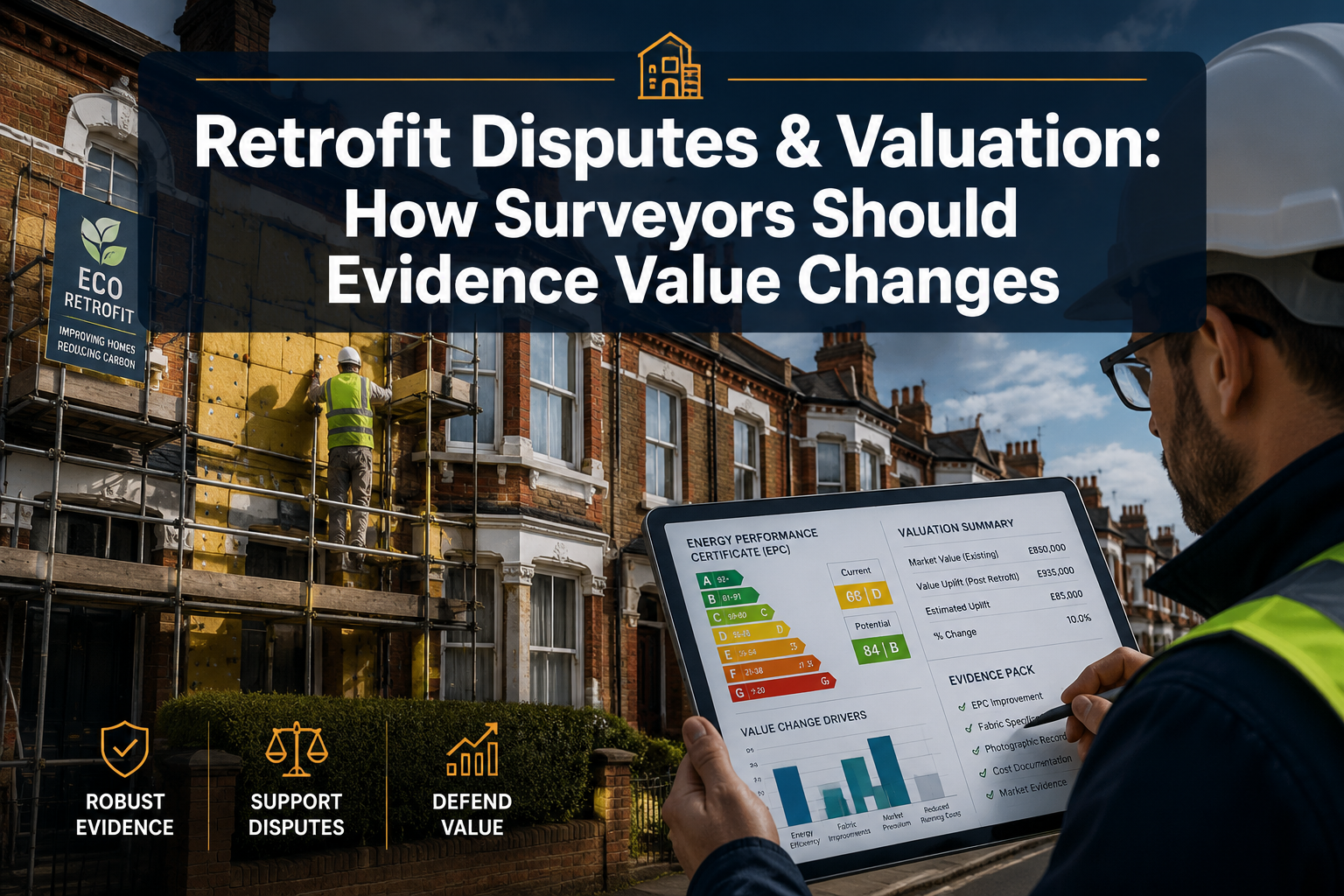
Energy upgrades can add tens of thousands of pounds to a property's market value — or spark a costly legal dispute that wipes out those gains entirely. In 2026, retrofit disputes and valuation challenges are rising sharply as whole-house energy improvement programmes accelerate across the UK, yet the evidentiary standards surveyors must meet remain poorly understood. This article unpacks exactly what Retrofit Disputes and Valuation: How Surveyors Should Evidence Value Changes After Energy Efficiency Works means in practice — and how surveyors can build defensible, court-ready opinions.
Key Takeaways 📋
- Pre- and post-works documentation is the single most important factor in defending a retrofit valuation in dispute.
- Surveyors must link value changes to measured performance data (EPC bands, SAP scores, heating demand) — not just a list of works completed.
- Stale cost evidence is legally vulnerable: contemporary contractor bids and trade-specific pricing are now expected by courts and tribunals.
- A clear causal chain from retrofit measure → performance outcome → market value uplift is essential for expert witness credibility.
- Mandatory upfront surveys under 2026 homebuying reforms mean retrofit reports will be scrutinised as primary evidence in future disputes.
Why Retrofit Disputes Are Escalating in 2026
The UK government's push toward net zero has accelerated whole-house retrofit programmes at a pace the valuation profession has struggled to match. Insulation upgrades, heat pump installations, triple glazing, and fabric-first measures are now common across both the private and social housing sectors. Yet when buyers, lenders, or tenants challenge claimed value uplifts, surveyors frequently find their reports lack the granular evidence needed to withstand scrutiny.
RICS retrofit leaders meeting at RICS HQ in early 2026 identified "quality and competence" in evidencing retrofit outcomes as essential to "underpin better risk management and confident funding" — language that points directly at valuation and lending decisions [5]. The message is clear: listing works completed is no longer sufficient.
💬 "Surveyors who rely on generic statements like 'new insulation installed' are exposed. Courts and lenders want to see measured outcomes, not intentions."
Several factors are driving the surge in disputes:
- Lender challenges: Mortgage lenders are increasingly questioning whether EPC uplifts genuinely support higher loan-to-value ratios.
- Buyer recourse: Purchasers who paid a premium for a "retrofitted" property are pursuing claims when promised energy savings fail to materialise.
- Landlord compliance disputes: Landlords upgrading to meet minimum energy efficiency standards are disputing contractor costs and rent premium calculations.
- Funding accountability: Housing associations and local authorities face scrutiny over whether retrofit capital expenditure has delivered the modelled performance improvements.
Understanding the key valuation factors that underpin any property assessment is the essential starting point before tackling the specific complexities that retrofit works introduce.
The Evidential Framework: What Surveyors Must Document
Pre-Works Condition: The Foundation of Any Retrofit Dispute Defence
No retrofit valuation dispute can be properly defended without a robust record of the property's condition before works began. Under 2026 homebuying reforms, mandatory upfront building surveys are creating a richer paper trail — but that trail can help or harm parties depending on how carefully it was assembled [6].
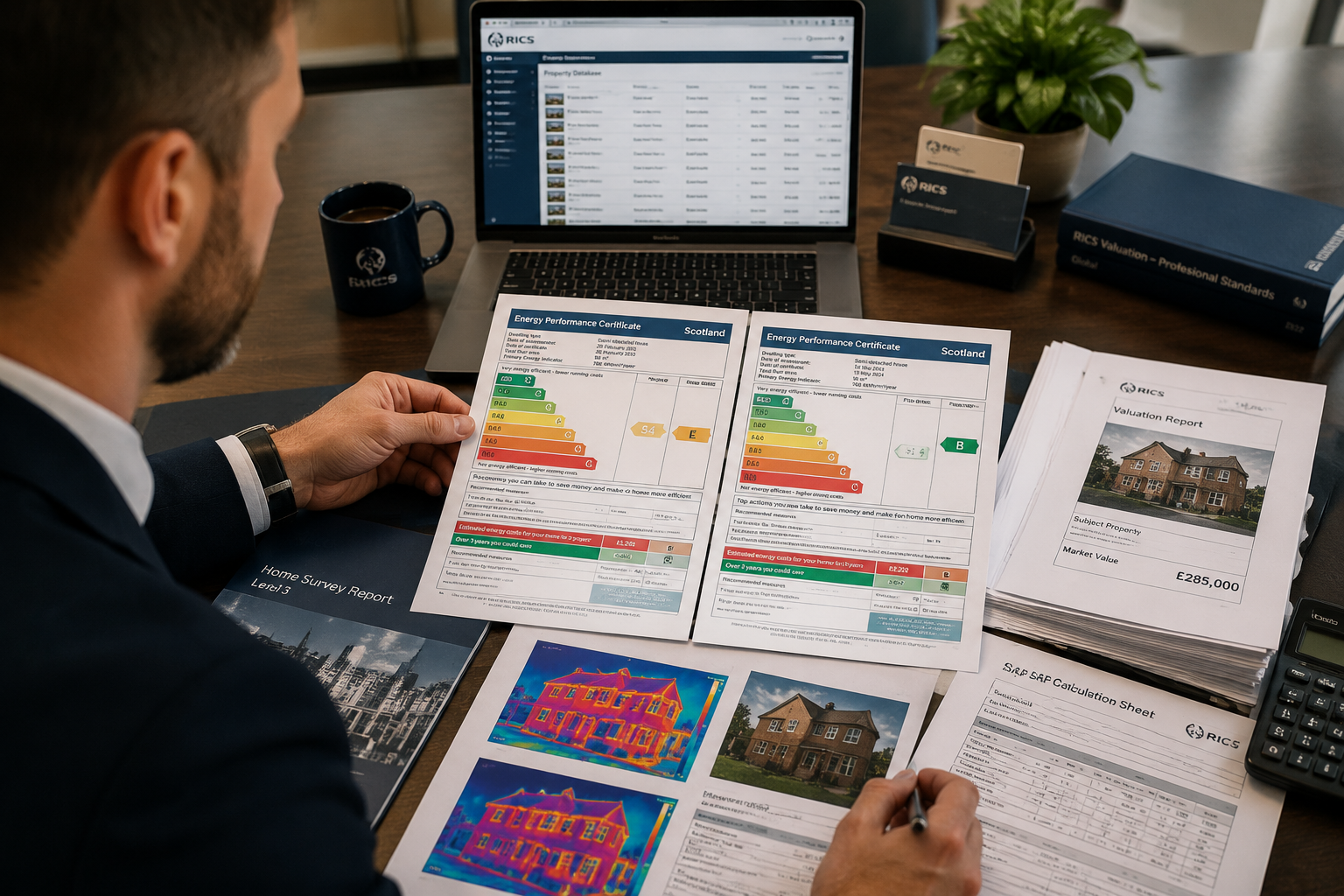
A pre-works condition record should include:
| Document | Purpose |
|---|---|
| Schedule of Condition | Baseline record of fabric, defects, and thermal performance |
| Pre-works EPC / SAP score | Quantified starting point for energy performance |
| Thermal imaging survey | Visual evidence of cold bridges, air leakage, and insulation gaps |
| Photographic evidence | Room-by-room documentation of existing fabric |
| Damp and ventilation assessment | Critical for identifying retrofit risks (condensation, mould) |
Surveyors who skip this stage leave themselves exposed. If a buyer later claims that promised EPC improvements were not achieved, the absence of a credible pre-works baseline makes it almost impossible to demonstrate what changed — and why.
A structural survey conducted before retrofit works can also identify underlying defects (such as rising damp or structural movement) that could undermine the effectiveness of energy improvements and affect the final valuation.
Post-Works Evidence: Linking Performance to Value
Once retrofit works are complete, the surveyor's task is to construct a clear, documented link between the physical improvements and any claimed value change. This is where most retrofit valuations currently fall short.
RICS guidance emerging from 2026 retrofit discussions stresses that surveyors should evidence [5]:
- Pre- and post-works EPC/SAP data — showing the actual band improvement achieved
- Modelled energy savings — expressed in £ per annum, not just kWh
- Alignment with recognised retrofit pathways — demonstrating works meet an established standard
- Risk assessment outcomes — confirming damp, mould, and ventilation risks have been addressed, not created
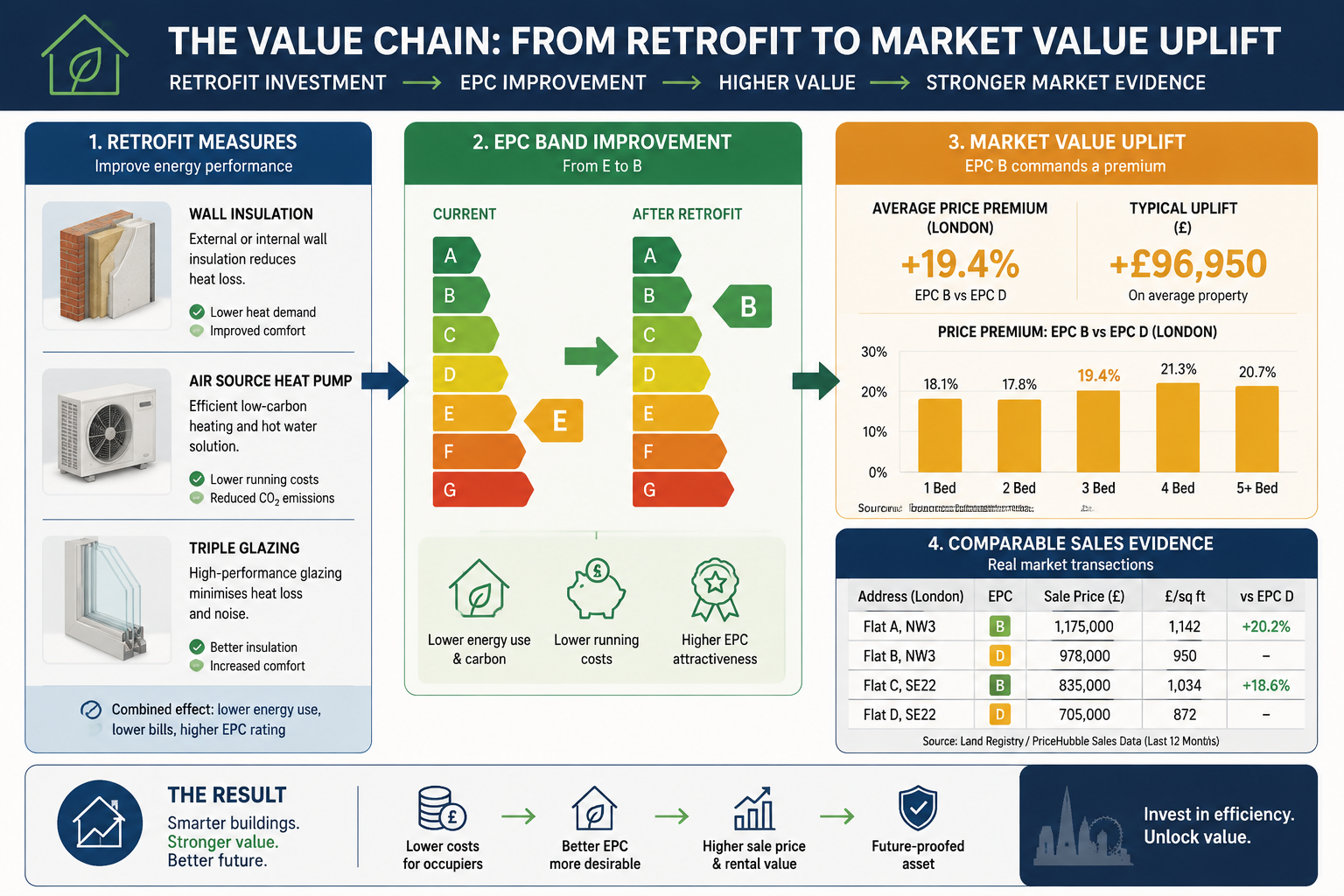
💡 Pro tip: An EPC band improvement from E to B is meaningless in a dispute unless the surveyor can show how that improvement was achieved, what it cost, and what comparable properties with similar ratings are selling for in that micro-market.
Retrofit Disputes and Valuation: How Surveyors Should Evidence Value Changes After Energy Efficiency Works in Practice
Building the Causal Chain: From Works to Market Value
Tribunals and courts in 2026 are demanding a clear, logical chain of causation from retrofit measures through to proven market value impacts [8]. Surveyors acting as expert witnesses are advised to document three specific elements:
1. Buyer willingness-to-pay evidence
This means analysing comparable sales data in the specific micro-market to identify price differentials between properties with improved EPC ratings and those without. A green premium in one London borough may not exist in another. Generic national statistics are insufficient — local evidence is required.
2. Rent premia for compliant stock
Where landlords have upgraded properties to meet or exceed minimum energy efficiency standards, surveyors should document the rental premium achieved versus non-compliant comparable stock. This is particularly relevant in disputes involving Houses in Multiple Occupation (HMOs) and the private rented sector.
3. Discounts applied to non-compliant stock
Equally important is evidence of the discount the market applies to properties that failed to achieve the required EPC rating. This negative evidence strengthens the positive case for a value uplift on compliant stock.
Without these three elements, any claimed "green value uplift" is vulnerable to challenge as speculative [8]. RICS Registered Valuers are best placed to assemble this evidence in a format that meets professional standards.
The Cost Evidence Problem: Why Stale Estimates Fail
One of the most significant — and underappreciated — risks in retrofit valuation disputes is the use of outdated cost evidence. In 2026, construction inflation has created a situation where expert reports prepared 18 months earlier are now "functionally obsolete" [1].
The principle is straightforward: if a software-generated cost model says a measure costs £80,000 but the lowest credible contractor bid is £115,000, the lower figure is legally insufficient because it cannot actually deliver the work [1]. Courts are increasingly rejecting generic price book estimates in favour of:
- Contemporary contractor bids — obtained within the relevant valuation period
- Trade-specific cost data — reflecting current labour and materials pricing in that region
- Signed or "ready-to-sign" contracts — demonstrating the cost is real and deliverable
This principle applies directly to retrofit disputes. A surveyor defending a post-retrofit valuation must be able to show that the cost of works was consistent with what the market would actually charge at the time — not what a national schedule suggested two years earlier.
Recognised Standards and Funding Frameworks
Funders and regulators are increasingly embedding energy performance outcomes into their oversight frameworks. HUD's 2026 Leading Edge housing guidance, for example, requires that retrofit scopes of work genuinely deliver modelled performance and achieve qualifying energy certifications — not simply that capital was spent [10].
UK housing associations and local authorities face similar scrutiny. Surveyors evidencing value changes after retrofit should therefore demonstrate that works align with a recognised standard or pathway, such as:
- PAS 2035 — the UK standard for whole-house retrofit
- TrustMark — quality assurance for retrofit installers
- EPC lodgement — mandatory post-works registration
Alignment with these frameworks strengthens the credibility of both the valuation and any dispute defence. It signals that the works were planned, executed, and verified to a professional standard — not simply carried out and invoiced.
Retrofit Disputes and Valuation: How Surveyors Should Evidence Value Changes After Energy Efficiency Works — Expert Witness Considerations
What Makes a Retrofit Valuation Court-Ready?
When a retrofit dispute reaches tribunal or court, the surveyor's report transforms into expert witness evidence. The standards applied are demanding. A court-ready retrofit valuation must demonstrate [8]:
✅ Independence — the expert's opinion is not influenced by the instructing party's desired outcome
✅ Reproducibility — another competent surveyor, given the same data, would reach a similar conclusion
✅ Currency — all cost and market data reflects conditions at the relevant valuation date
✅ Specificity — comparable evidence is drawn from the same micro-market, not national averages
✅ Transparency — all assumptions and adjustments are explicitly stated and justified
Surveyors who have prepared expert witness reports understand that the bar for admissible valuation evidence is considerably higher than for a standard mortgage valuation or HomeBuyer Report.
Common Weaknesses That Undermine Retrofit Valuations
The following are the most frequently exploited weaknesses in retrofit valuation reports when disputes arise:
- ❌ No pre-works EPC or SAP baseline — makes it impossible to quantify the improvement
- ❌ Generic comparable evidence — national or regional averages instead of local micro-market data
- ❌ Unverified contractor invoices — costs claimed without independent verification
- ❌ No assessment of retrofit risks — failure to address damp, condensation, or ventilation impacts
- ❌ Outdated cost schedules — price book rates that do not reflect current market conditions
- ❌ Missing lodged EPC — no post-works certificate to confirm the claimed band improvement
The Role of Upfront Surveys in Dispute Prevention
The 2026 homebuying reforms requiring mandatory upfront building surveys represent both an opportunity and a risk for surveyors involved in retrofit transactions [6]. On the positive side, detailed pre-marketing surveys create a contemporaneous record of condition that can anchor later valuations. On the risk side, if a surveyor's pre-sale report identifies retrofit potential that is subsequently not realised, that report may be used as evidence against the seller or their advisers.
The practical implication: surveyors should treat every pre-retrofit condition report as a potential exhibit in future litigation. Language should be precise, recommendations should be costed realistically, and any limitations on the inspection should be clearly stated.
For properties in complex ownership structures — such as shared ownership — the shared ownership valuation process adds another layer of complexity when retrofit works affect the staircasing value.
Practical Checklist: Evidencing Value Changes After Retrofit Works
Use this checklist to ensure retrofit valuations are defensible from the outset:
📁 Pre-Works Documentation
- Schedule of Condition completed and signed
- Pre-works EPC lodged and retained
- SAP calculation obtained
- Thermal imaging survey conducted
- Damp and ventilation baseline recorded
- Photographic record of all relevant fabric elements
🔧 During Works
- Signed contractor specification and contract retained
- Stage payment records and site inspection notes
- Any design changes documented with reasons
- TrustMark or equivalent quality assurance records
📊 Post-Works Valuation Evidence
- Post-works EPC lodged with Landmark (or equivalent)
- SAP score improvement quantified
- Modelled energy savings expressed in £/annum
- Local comparable sales analysed for EPC band premium
- Rent premium evidence gathered (if applicable)
- Contemporary contractor bids obtained to verify costs
- Alignment with PAS 2035 or recognised standard confirmed
Conclusion: Actionable Next Steps for Surveyors
Retrofit disputes and valuation challenges will only intensify as the UK's energy efficiency agenda accelerates. The surveyors who will successfully defend their opinions — whether in negotiations, tribunals, or court — are those who treat evidencing value changes after energy efficiency works as a rigorous, structured discipline rather than an afterthought.
Here are the key actions to take now:
-
Adopt a pre-works documentation protocol for every retrofit-related instruction. Treat the Schedule of Condition and pre-works EPC as non-negotiable.
-
Build local comparable databases that capture EPC band premiums and discounts in your specific market areas. National data will not hold up in a dispute.
-
Update cost evidence regularly. In a high-inflation environment, cost schedules older than six months should be treated with caution and verified against current contractor pricing.
-
Align reports with recognised standards. Reference PAS 2035, TrustMark, and lodged EPCs explicitly in valuation reports to demonstrate that works meet a professional benchmark.
-
Seek specialist training in retrofit valuation. RICS and industry bodies are developing guidance — staying current with this is now a professional obligation, not an optional extra.
Working with RICS-registered valuers in London who understand the specific evidential requirements of retrofit disputes ensures that valuations are prepared to the standard that lenders, courts, and regulators now expect. For complex cases, engaging a chartered surveyor with expert witness experience from the outset — not after a dispute has arisen — is the most effective risk management strategy available.

The energy transition is reshaping property values across the UK. Surveyors who master the art of evidencing those changes will be indispensable. Those who do not will find their reports challenged — and their professional reputations at risk.
References
[1] The 2026 Construction Inflation Tax Why Your Old Repair Estimates Are Legally Obsolete – https://naumannlegal.com/2026/05/08/the-2026-construction-inflation-tax-why-your-old-repair-estimates-are-legally-obsolete/
[2] Expert Witness Roles In 2026 Homebuying Reform Disputes Defending Survey Evidence Under New Upfront Standards – https://nottinghillsurveyors.com/blog/expert-witness-roles-in-2026-homebuying-reform-disputes-defending-survey-evidence-under-new-upfront-standards
[3] Expert Witness Challenges In 2026 Market Recovery Building Court Ready Cases For Valuation Disputes – https://wimbledonsurveyors.com/expert-witness-challenges-in-2026-market-recovery-building-court-ready-cases-for-valuation-disputes/
[4] Reconsideration Of Value Reality Check Heading Into 2026 – https://www.veros.com/reconsideration-of-value-reality-check-heading-into-2026
[5] Retrofit Leaders Meet Rics Hq Discuss Importance Transformative Projects – https://www.rics.org/news-insights/retrofit-leaders-meet-rics-hq-discuss-importance-transformative-projects
[6] Mandatory Upfront Building Surveys Under 2026 Homebuying Reforms What Surveyors And Buyers Need To Know – https://kingstonsurveyors.com/mandatory-upfront-building-surveys-under-2026-homebuying-reforms-what-surveyors-and-buyers-need-to-know/
[7] Detail – https://www.lexology.com/library/detail.aspx?g=7f16afea-03b3-46ab-83c4-9871af6e5605
[8] Expert Witness Testimonies In 2026 Valuation Disputes Rics Strategies Amid Stabilising House Prices And Regional Divides – https://nottinghillsurveyors.com/blog/expert-witness-testimonies-in-2026-valuation-disputes-rics-strategies-amid-stabilising-house-prices-and-regional-divides
[9] Expert Witness Valuations In Mortgage Disputes Leveraging 2026 Market Recovery Data For Credible Case Building – https://wimbledonsurveyors.com/expert-witness-valuations-in-mortgage-disputes-leveraging-2026-market-recovery-data-for-credible-case-building/
[10] 2026 01hsng – https://www.hud.gov/sites/dfiles/hudclips/documents/2026-01hsng.pdf