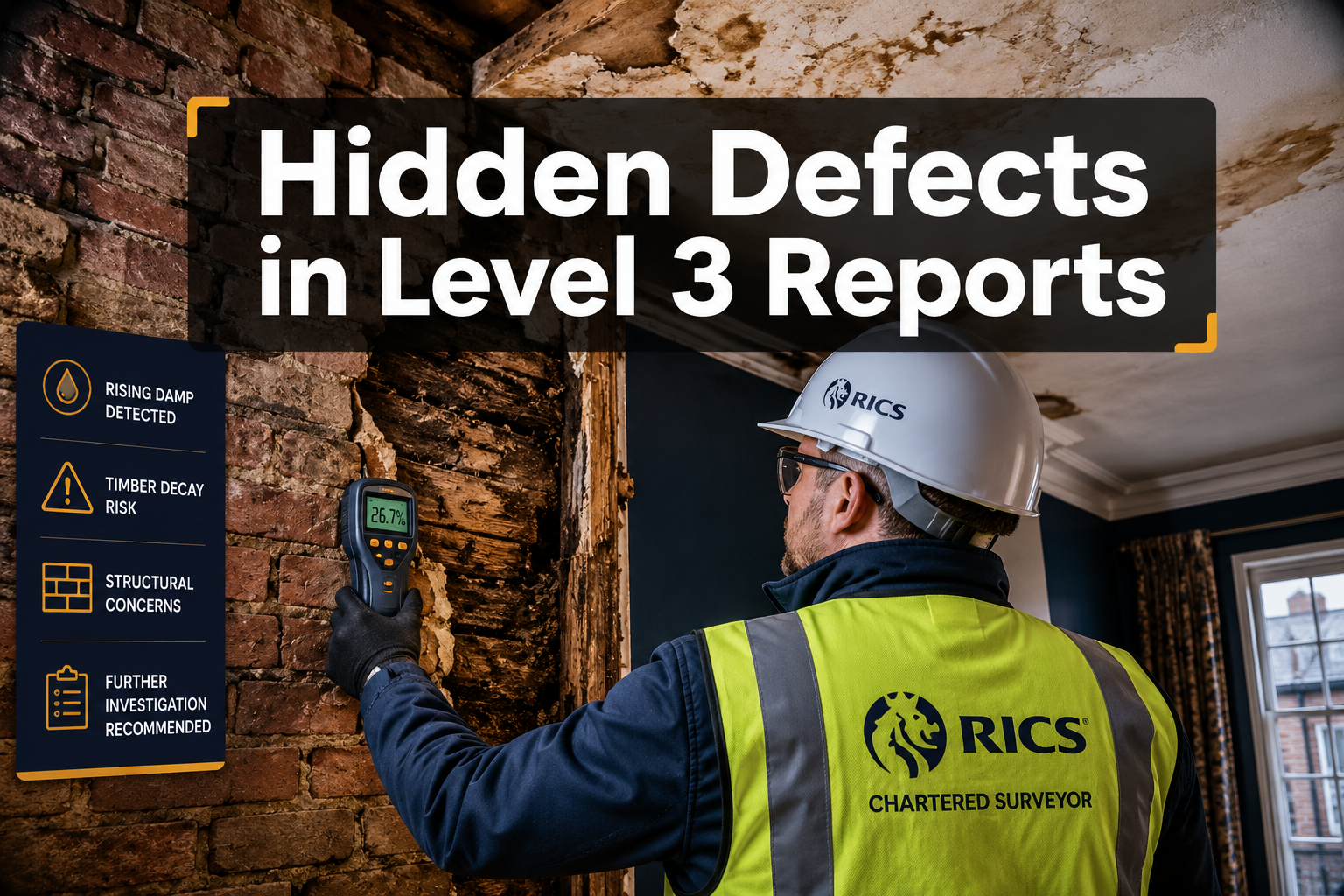
Nearly one in three homebuyers who commission a Level 3 Building Survey discover at least one significant hidden defect that was not visible during a standard viewing — yet many report feeling confused about what the surveyor's findings actually mean for them. Understanding how surveyors should handle hidden defects: damp, movement, timber decay, and roof failures in Level 3 reports is not just a technical matter — it directly affects negotiating power, repair budgets, and long-term safety. A well-written Level 3 report does more than list problems; it explains their likely cause, their severity, and what the buyer should do next.
Key Takeaways 📋
- A Level 3 Building Survey (formerly the Full Structural Survey) is the most thorough residential survey available and is specifically designed to uncover hidden defects.
- Surveyors must identify, describe, and prioritise defects without overstating certainty where further specialist investigation is needed.
- The four most commonly missed or misreported defects are damp, structural movement, timber decay, and roof failures.
- Good practice requires surveyors to give buyers clear condition ratings and actionable recommendations, not vague disclaimers.
- Buyers should always follow up on Condition 3 items with specialist reports before exchanging contracts.
What Is a Level 3 Building Survey and Why Does It Matter?
A Level 3 Building Survey — previously known as a Full Structural Survey or Full Building Survey — is the most comprehensive property inspection available to residential buyers in the UK. It is governed by RICS (Royal Institution of Chartered Surveyors) standards and is strongly recommended for:
- Older properties (pre-1900 construction)
- Properties with unusual construction methods (e.g., timber frame, concrete panel)
- Buildings that have been significantly altered or extended
- Properties in a visibly poor state of repair
💡 Pull Quote: "A Level 3 report is not simply a longer version of a Level 2 HomeBuyer Report — it is a fundamentally different investigation that requires the surveyor to assess concealed areas and provide reasoned professional opinion."
Unlike a Level 2 HomeBuyer Report, the Level 3 survey requires the surveyor to inspect roof spaces, underfloor voids (where accessible), and concealed areas. It must also comment on the construction method, materials, and any significant risks. For buyers uncertain about which survey they need, a comparison of HomeBuyer Report vs Building Survey can help clarify the right choice.
The Three Condition Ratings Explained
RICS-compliant Level 3 reports use a standardised condition rating system:
| Rating | Colour | Meaning |
|---|---|---|
| 1 | 🟢 Green | No repair currently needed |
| 2 | 🟡 Amber | Defects requiring attention but not urgent |
| 3 | 🔴 Red | Serious defects requiring urgent repair or further investigation |
Buyers must pay close attention to every Condition 3 item. These are the hidden defects that can cost tens of thousands of pounds to remedy if left unaddressed.
How Surveyors Should Handle Hidden Defects: Damp, Movement, Timber Decay, and Roof Failures in Level 3 Reports
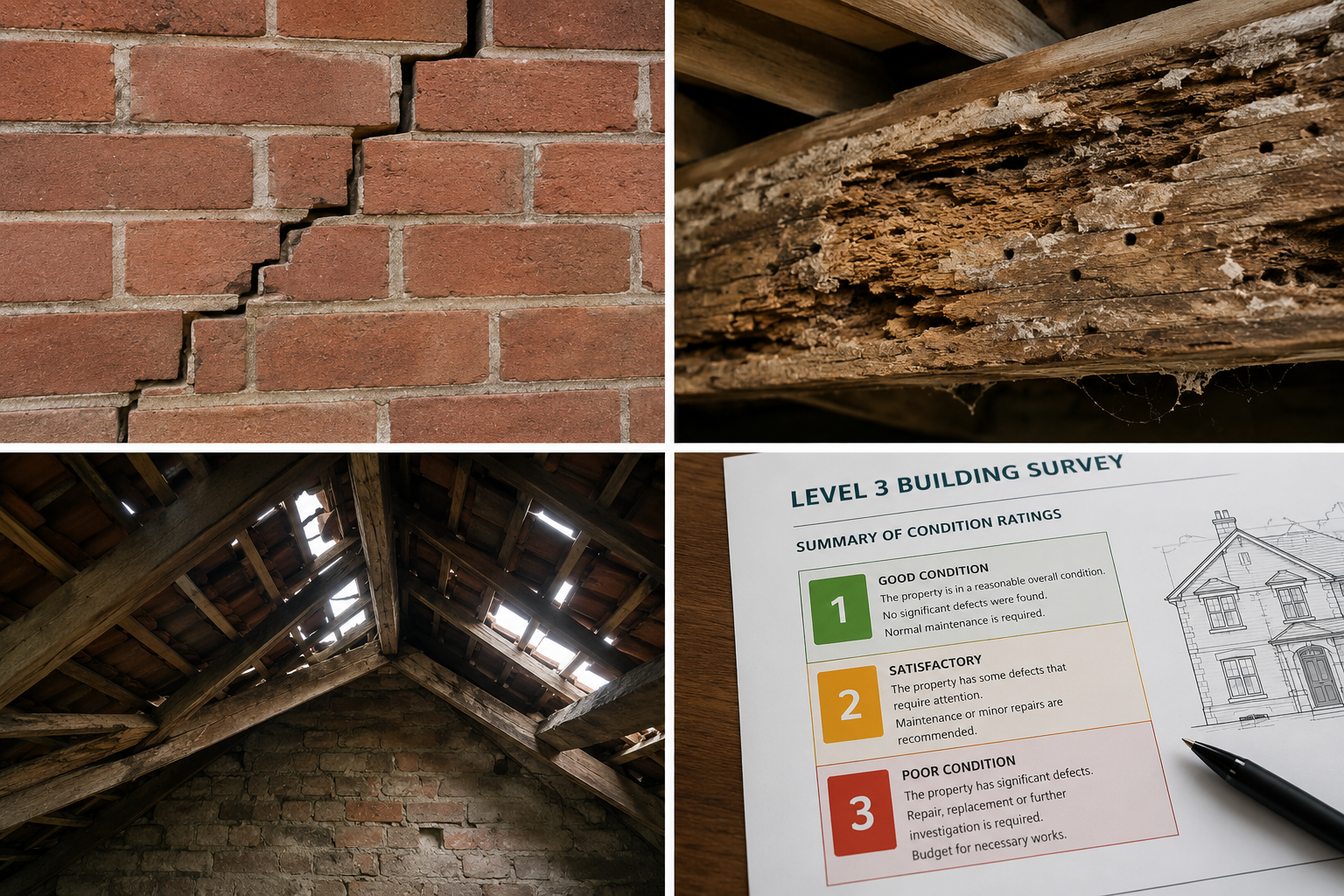
This is where professional skill and ethical responsibility intersect. Each of the four major hidden defect categories demands a specific inspection approach, a clear description in the report, and carefully worded recommendations.
🌧️ Damp: Identifying the Source Without Overreaching
Damp is the most frequently reported defect in UK residential surveys — and also the most frequently misdiagnosed. Surveyors must distinguish between three fundamentally different types:
- Rising damp — moisture travelling upward through masonry via capillary action, typically from a failed or absent damp-proof course (DPC)
- Penetrating damp — water entering through defective external elements such as pointing, flashings, or window seals
- Condensation — moisture from internal air settling on cold surfaces, often misidentified as structural damp
Best practice for surveyors:
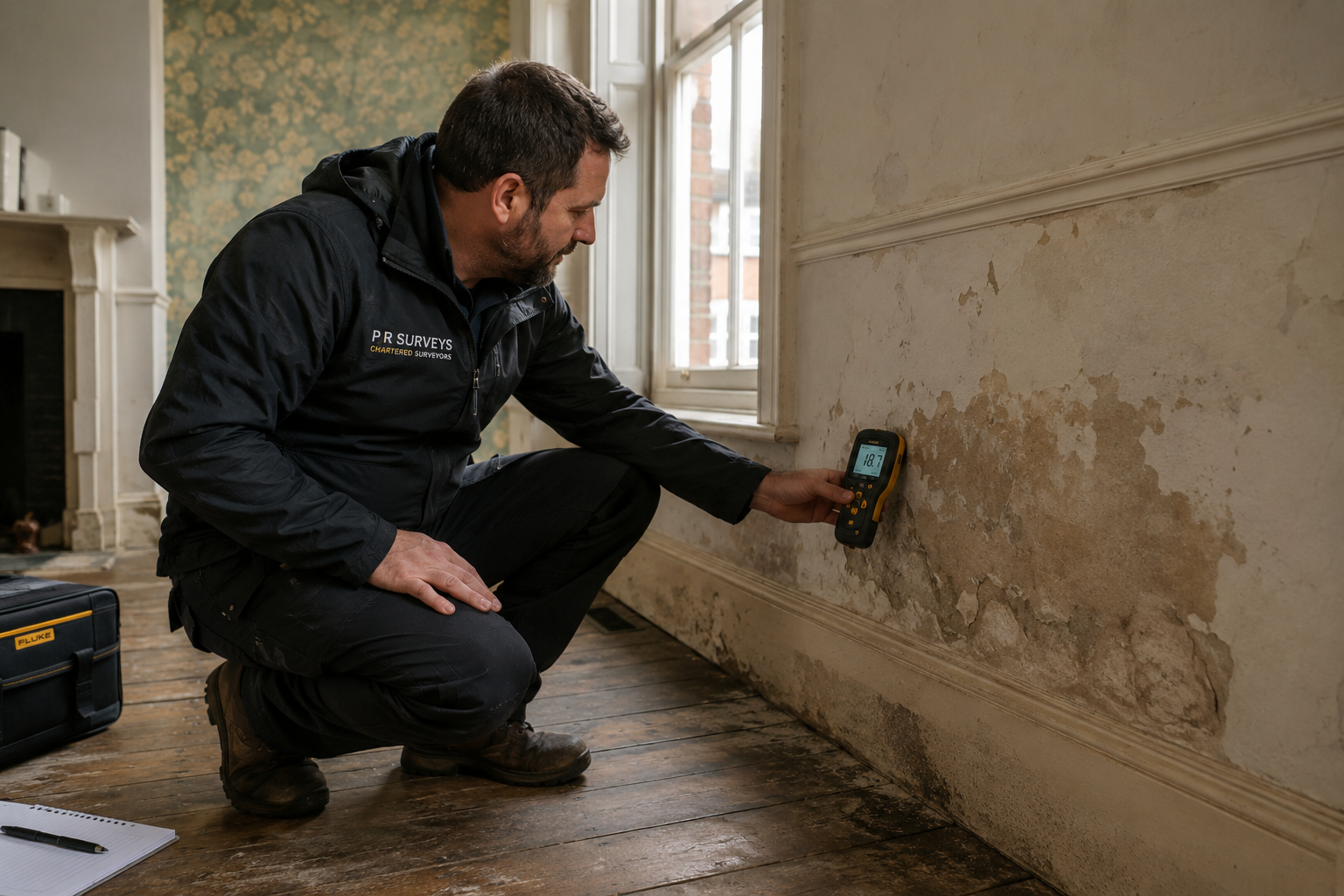
- Use a calibrated electronic moisture meter on multiple points across a wall, not just one reading
- Cross-reference meter readings with visual evidence (tide marks, salt crystallisation, plaster damage)
- Avoid diagnosing rising damp based solely on a meter reading — meters can produce false positives on dense masonry
- Clearly state in the report whether the cause is confirmed or suspected, and recommend a specialist damp survey where the cause is unclear
⚠️ A critical error many surveyors make is recommending chemical DPC injection without first ruling out penetrating damp or condensation. This can cost buyers thousands in unnecessary remediation.
The report should specify the location, extent, and probable cause of any damp, along with a condition rating and a clear recommendation — whether that is monitoring, immediate repair, or further specialist investigation.
🏗️ Structural Movement: Reading the Evidence Correctly
Cracks in walls, sloping floors, and sticking doors can all indicate structural movement — but not all movement is dangerous. Surveyors must assess whether movement is:
- Historic and stable (the building has settled and movement has ceased)
- Active and progressive (movement is ongoing and potentially serious)
- Superficial (cosmetic cracking in plaster or render with no structural implication)
Key indicators surveyors should document:
| Evidence | Likely Implication |
|---|---|
| Tapered cracks wider at top | Differential settlement |
| Horizontal cracks in brick courses | Wall tie failure or lateral pressure |
| Diagonal stair-step cracking | Foundation movement or subsidence |
| Cracks with fresh edges, no dust | Recent or active movement |
| Cracks with stained, weathered edges | Historic, likely stable |
For properties showing signs of active movement, surveyors should recommend a structural survey by a qualified specialist before exchange of contracts. It is not within the Level 3 surveyor's remit to provide a definitive structural engineering opinion — but it is absolutely within their duty to flag the risk clearly and urgently.
Subsidence is a particular concern in areas with clay-rich soils, especially across London and the South East. Buyers in these regions should be aware that subsidence surveys may be recommended as a follow-up to a Level 3 report.
🪵 Timber Decay: The Invisible Threat
Timber defects are among the most dangerous hidden defects because they can be structurally critical while remaining completely invisible to the naked eye. Surveyors must actively probe and test timber elements rather than simply observing them visually.
Two primary timber defects:
1. Wet Rot
- Caused by prolonged moisture exposure
- Timber appears soft, spongy, or cracked along the grain
- Typically localised to the area of moisture ingress
- Treatment: remove source of moisture, replace affected timber
2. Dry Rot (Serpula lacrymans)
- A fungal infection that can spread through masonry and across dry areas
- Characterised by white mycelium strands, a mushroom-like smell, and cuboidal cracking of timber
- Far more serious than wet rot — can spread rapidly through a building
- Requires specialist treatment and may involve significant structural repair
🚨 Dry rot is a Condition 3 defect without exception. Any surveyor who rates confirmed dry rot below Condition 3 is failing in their professional duty.
Woodworm (wood-boring beetles) should also be documented. Active infestations (indicated by fresh bore dust around exit holes) require treatment; old, inactive infestations in structurally sound timber may only warrant monitoring.
Surveyors should use a probe or bradawl to test the integrity of accessible timbers — particularly floor joists, roof timbers, and lintels. Where timbers are concealed, the report must clearly note the limitation and recommend further investigation if there is any surrounding evidence of moisture or decay.
🏠 Roof Failures: The Most Commonly Missed Defect
Roof defects are frequently underreported in surveys — partly because full roof access is rarely possible, and partly because surveyors sometimes rely too heavily on binocular inspection from ground level. A thorough Level 3 survey requires:
- Inspection of the roof void (loft space) where access exists
- Binocular inspection of the external roof covering from ground level or from a safe vantage point
- Inspection of internal roof timbers for signs of deflection, decay, or inadequate support
Common roof defects to document:
- 🔴 Missing, slipped, or cracked tiles/slates
- 🔴 Failed or absent flashings at abutments, valleys, and chimney stacks
- 🔴 Sagging or deflected roof structure indicating rafter or purlin failure
- 🟡 Deteriorated pointing to chimney stacks
- 🟡 Blocked or damaged gutters causing water ingress at eaves
- 🟡 Inadequate or absent insulation (energy efficiency issue)
For complex or inaccessible roofs — particularly flat roofs, large commercial-style roofs, or those with multiple pitches — surveyors should recommend a dedicated roof survey carried out by a roofing specialist. This is not a failure of the Level 3 process; it is responsible professional practice.
The report must clearly state:
- What was inspected and how
- What limitations existed (e.g., no loft hatch, roof too steep to walk)
- What was found
- What the recommended next step is
Writing the Report: Balancing Clarity With Professional Caution
How surveyors should handle hidden defects: damp, movement, timber decay, and roof failures in Level 3 reports is not only about what is found — it is equally about how findings are communicated. A technically accurate report that is poorly written can leave buyers either panicked unnecessarily or dangerously under-informed.
The Language of Professional Opinion
Surveyors must use language that is:
- Precise — "Evidence of active penetrating damp was noted to the north-facing elevation at first floor level, likely attributable to failed pointing" is better than "there is some damp"
- Appropriately qualified — "The cause cannot be confirmed without opening up works; a specialist damp survey is recommended prior to exchange"
- Action-oriented — every Condition 2 and Condition 3 item should have a clear recommended next step
Avoid these common report-writing failures:
| Poor Practice | Better Practice |
|---|---|
| "Some cracking noted" | "Diagonal stair-step cracking to the rear elevation, up to 5mm wide, consistent with differential settlement — recommend structural engineer's report" |
| "Roof appears generally satisfactory" | "Roof inspected by binoculars from ground level only — three slipped slates noted to the rear pitch; loft inspection confirmed no daylight ingress at time of inspection" |
| "Timber treatment may be required" | "Evidence of active woodworm infestation noted to floor joists in front bedroom — specialist timber treatment survey recommended" |
Recommending Specialists Without Overstepping
A Level 3 surveyor is not a structural engineer, a damp specialist, or a roofing contractor. The report must clearly distinguish between:
- What the surveyor has observed and assessed
- What requires further specialist investigation before a full opinion can be given
- What is clearly within the surveyor's competence to recommend as a course of action
This balance protects both the buyer and the surveyor. Buyers who receive expert surveyor advice that is clear and actionable are far better placed to negotiate on price, request repairs, or walk away from a problematic purchase.
What Buyers Should Do After Receiving a Level 3 Report
Receiving a Level 3 report packed with Condition 3 items can feel overwhelming. Here is a practical action framework:
Step 1: Triage the findings
- Separate Condition 3 items from Condition 1 and 2
- Focus immediate attention on structural movement, active damp, dry rot, and roof failures
Step 2: Commission specialist reports for Condition 3 items
- Structural engineer for movement/subsidence
- Independent damp specialist (not a remediation company with a commercial interest in finding problems)
- Roofing contractor or specialist for roof defects
- Timber specialist for suspected dry rot
Step 3: Use findings to renegotiate
- Obtain repair quotes before exchange
- Request a price reduction or ask the seller to carry out repairs as a condition of sale
Step 4: Do not rush to exchange
- Exchanging contracts before specialist reports are received is a significant financial risk
For buyers in London and the surrounding regions, working with chartered surveyors in Surrey, central London, or north London who have specific local knowledge of construction types and common regional defects adds significant value to the Level 3 process.
Common Limitations Surveyors Must Clearly Declare
Every Level 3 report must include a clear limitations section. Buyers are entitled to know exactly what the surveyor could and could not inspect. Standard limitations include:
- Concealed areas — beneath floor coverings, behind fitted furniture, inside wall cavities
- Inaccessible roofs — no loft hatch, unsafe roof pitch, or no ladder access
- Occupied properties — personal belongings obscuring walls, floors, or ceilings
- Specialist systems — electrical, gas, and drainage systems require specialist testing beyond the surveyor's remit
💡 A limitation is not an excuse — it is a professional declaration that triggers a recommendation for further investigation.
Surveyors who simply note a limitation and move on without recommending further action where defects are suspected are not fulfilling their duty of care.
Conclusion: Actionable Next Steps for Buyers and Surveyors in 2026
In 2026, the standard expected of RICS-registered surveyors producing Level 3 reports is higher than ever — and rightly so. Property prices mean that a missed defect can represent a six-figure financial error for a buyer who trusted the process.
For surveyors, the core obligations are clear:
✅ Inspect thoroughly, including all accessible concealed areas
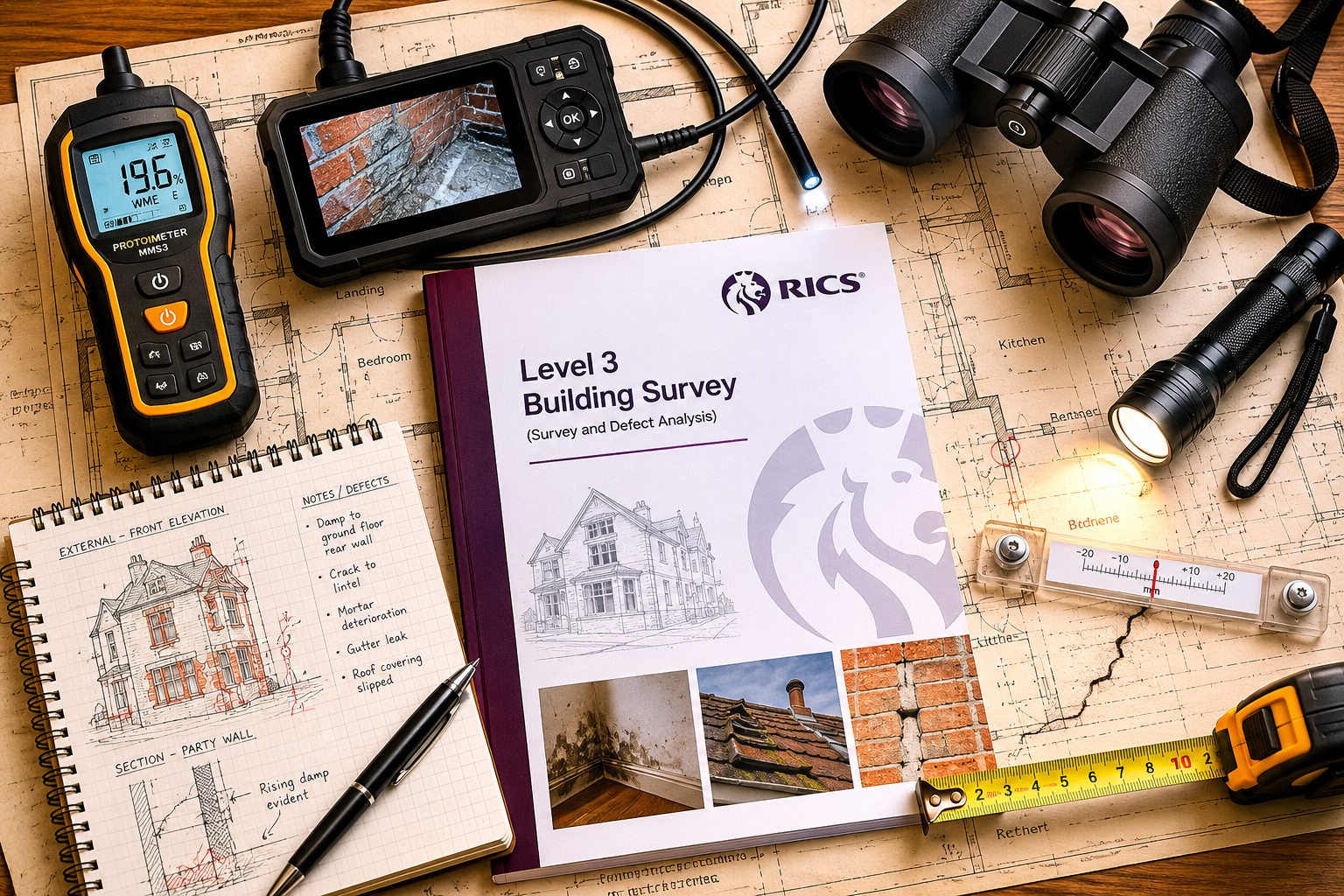
✅ Use appropriate tools (moisture meters, probes, binoculars, borescopes where needed)
✅ Write with precision — describe what was found, where, and what it likely means
✅ Rate every defect honestly using the Condition 1/2/3 system
✅ Recommend specialist follow-up wherever the evidence warrants it, without overstating certainty
For buyers, the actionable steps are equally clear:
✅ Always commission a Level 3 survey on older, unusual, or visibly deteriorated properties
✅ Read the report in full — do not rely on a summary alone
✅ Act on every Condition 3 item before exchanging contracts
✅ Use specialist reports to negotiate price reductions or repairs
Understanding how surveyors should handle hidden defects: damp, movement, timber decay, and roof failures in Level 3 reports empowers both professionals and property buyers to make better, safer decisions. The best Level 3 report is one that a buyer can act on with confidence — not one that leaves them guessing.
Not sure which survey is right for your property? Use our guide to what survey you need to find the best starting point before instructing a surveyor.