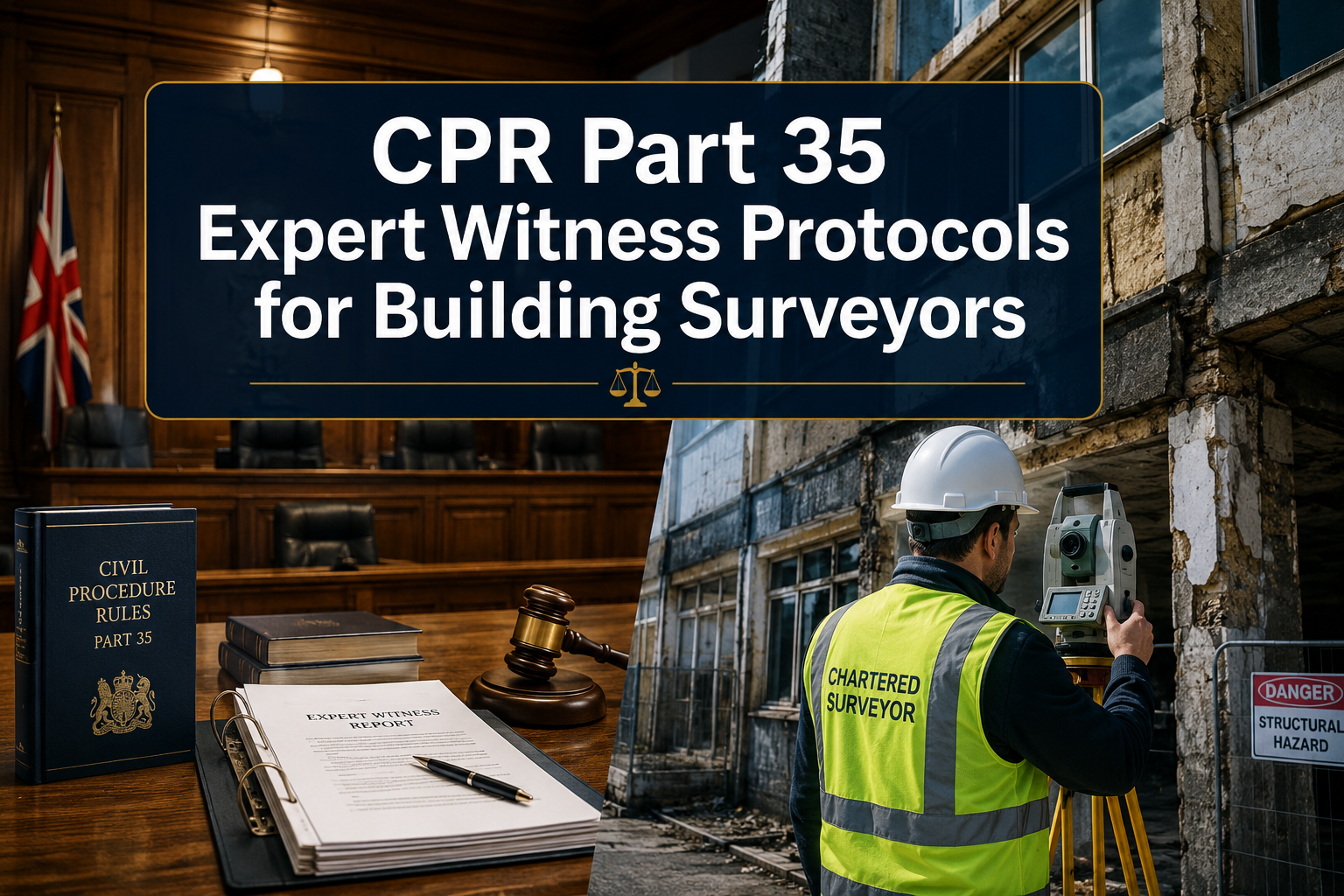
Fewer than 30% of expert witness reports submitted in property disputes fully comply with CPR Part 35 on first submission — a statistic that costs surveyors credibility, delays resolution, and in some cases leads to reports being struck out entirely. For building surveyors navigating neighbour disputes and dilapidations claims in 2026, mastering CPR Part 35 Expert Witness Protocols for Building Surveyors: Drafting Valuation Reports in Neighbour and Dilapidations Disputes is no longer optional. It is the foundation of admissible, persuasive expert evidence.
This guide breaks down every critical duty, structural requirement, and common pitfall — with real-world context drawn from the types of disputes that reach UK courts and tribunals today.
Key Takeaways 📋
- CPR Part 35 places the expert's primary duty to the court, not to the instructing party — this shapes every word of a valuation report.
- A non-compliant expert witness report can be excluded from proceedings, regardless of how technically sound the underlying valuation is.
- Dilapidations and neighbour dispute reports require specific structural elements to satisfy both CPR Part 35 and RICS professional standards.
- The Statement of Truth and Declaration of Independence are mandatory — omitting either is a fatal drafting error.
- Early engagement with a schedule of dilapidations and pre-action protocols significantly improves the quality and defensibility of expert evidence.
Understanding CPR Part 35: The Legal Framework Every Building Surveyor Must Know
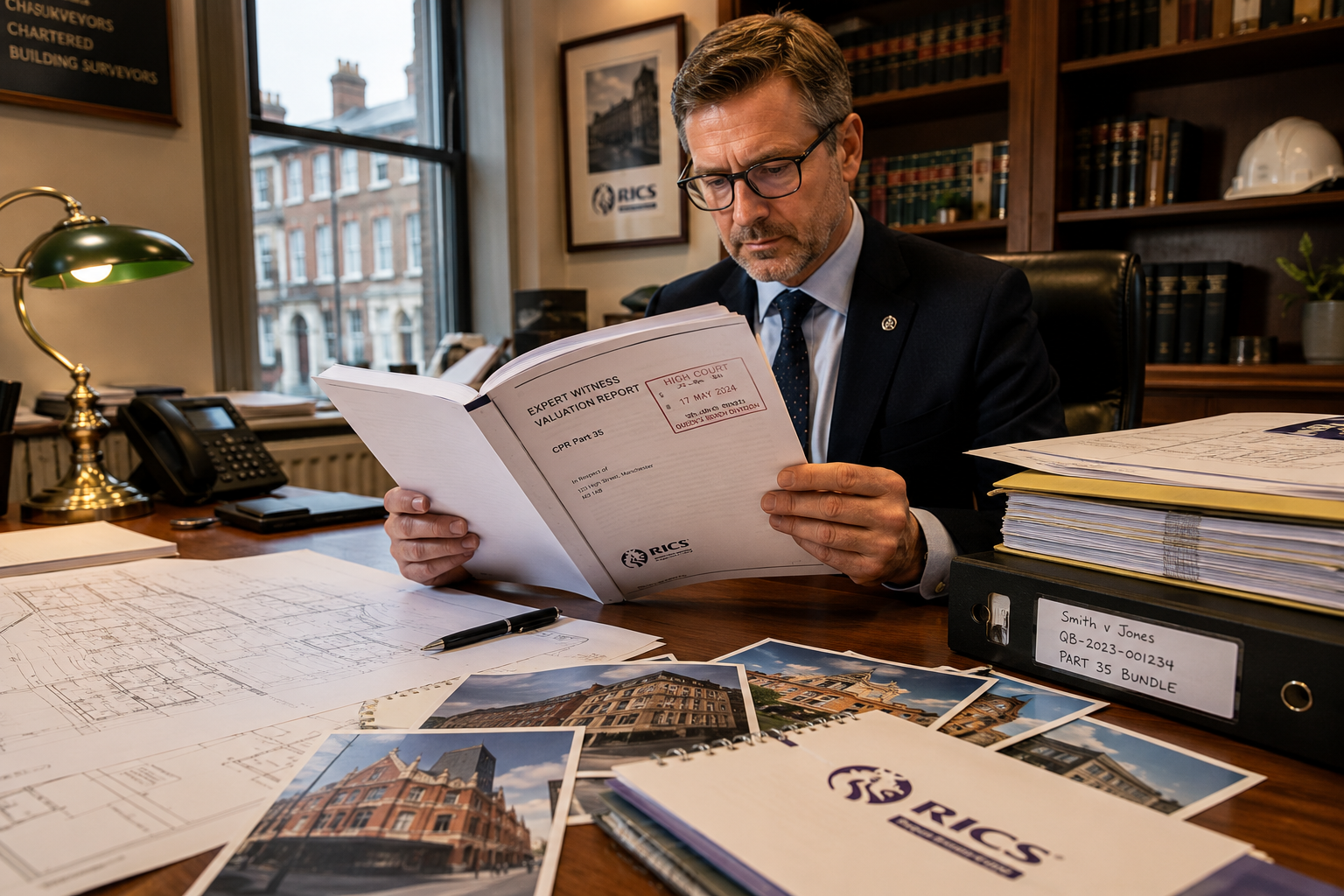
The Civil Procedure Rules (CPR) Part 35 governs the use of expert evidence in civil proceedings in England and Wales. For building surveyors appointed as expert witnesses, it establishes a clear hierarchy: the duty to the court overrides any obligation to the client.
This is not merely procedural language. It has direct consequences for how valuation reports are drafted, what opinions can be expressed, and how disagreements between opposing experts are handled.
The Core Duties Under CPR Part 35
| Duty | What It Means in Practice |
|---|---|
| Duty to the Court | Opinions must be independent and objective, even if they disadvantage the instructing party |
| Competence | The expert must only opine within their area of expertise |
| Full Disclosure | All material facts — including those that undermine the expert's opinion — must be disclosed |
| Clarity | Reports must be comprehensible to a non-specialist judge or tribunal member |
| Proportionality | The scope of the report must be proportionate to the value and complexity of the dispute |
Practice Direction 35 supplements the rules with specific requirements for report structure, while the RICS Guidance Note on Expert Witnesses (aligned with CPR Part 35) provides profession-specific direction for chartered surveyors.
💡 Pull Quote: "An expert witness who tailors their opinion to support their client's case is not an expert witness — they are an advocate. CPR Part 35 exists precisely to prevent that."
Why Compliance Failures Happen
In neighbour and dilapidations disputes, non-compliance typically stems from three sources:
- Advocacy creep — the surveyor unconsciously begins arguing for their client rather than advising the court.
- Structural omissions — missing mandatory sections such as the Statement of Truth or the basis of valuation.
- Inadequate comparable evidence — opinions unsupported by sufficient market data or comparable transactions.
Understanding these failure modes is the first step toward drafting reports that survive judicial scrutiny in 2026 tribunals.
CPR Part 35 Expert Witness Protocols for Building Surveyors: Drafting Valuation Reports in Neighbour Disputes
Neighbour disputes involving building surveyors most commonly arise from party wall matters, boundary disagreements, and damage caused by adjoining works. Each scenario demands a valuation report that is both technically rigorous and procedurally compliant.
Types of Neighbour Disputes Requiring Expert Valuation Evidence
Party Wall Disputes
When works under the Party Wall etc. Act 1996 cause damage or are disputed, surveyors are frequently called upon to quantify loss. A schedule of condition report prepared before works begin is critical evidence — it establishes the pre-works baseline against which damage claims are measured.
For guidance on navigating these situations as an adjoining owner, see what to do if your neighbour is carrying out party wall work on the boundary wall of your London property.
Boundary Disputes
Boundary disputes often require a surveyor to provide opinion evidence on the diminution in value caused by an encroachment, or on the cost of reinstatement. These reports must clearly distinguish between factual evidence (measurements, title plan analysis) and expert opinion (valuation impact).
Damage Claims
Claims for structural damage caused by neighbouring excavation or construction require the expert to quantify repair costs and any residual diminution in value. See the guide to boundary dispute and party wall surveyors in London for context on how these disputes typically develop.
Mandatory Structural Elements of a CPR Part 35-Compliant Neighbour Dispute Report
A compliant expert witness valuation report must include:
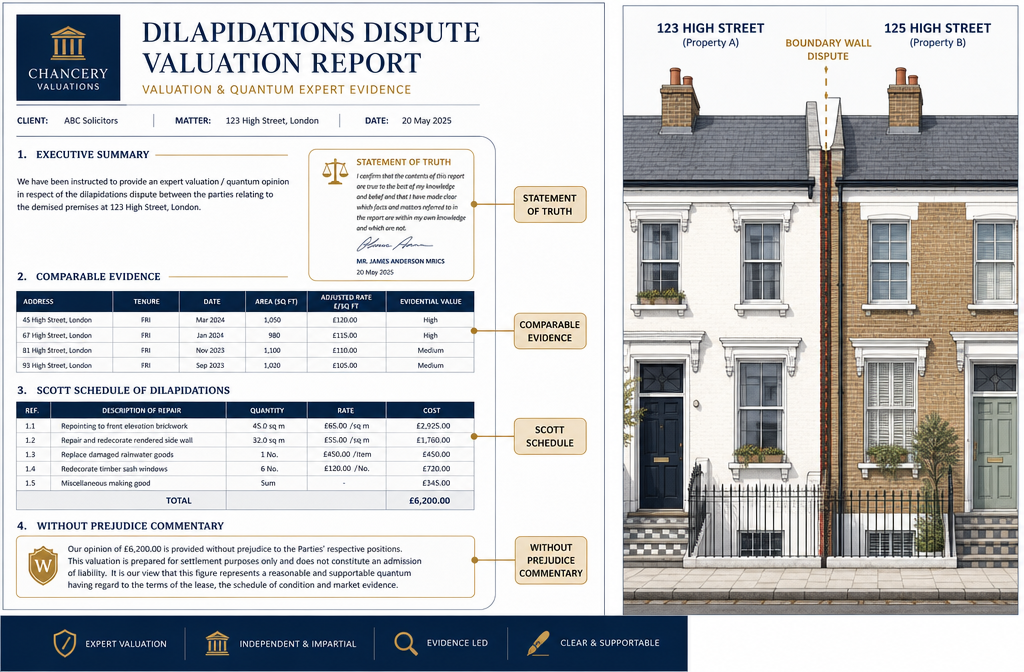
- ✅ Cover page with case name, court reference, and expert's name and qualifications
- ✅ Instructions received — a summary of the questions the expert has been asked to address
- ✅ Summary of opinion — a brief, plain-English summary of conclusions
- ✅ Facts and assumptions — clearly separated from opinion
- ✅ Methodology — how the valuation was conducted and why that method was chosen
- ✅ Comparable evidence — referenced transactions or data supporting the valuation
- ✅ Statement of Truth — the mandatory declaration required by CPR Part 35.3
- ✅ Declaration of Independence — confirming the expert understands their duty to the court
Omitting the Statement of Truth is among the most common — and most serious — drafting errors. Courts have excluded otherwise well-reasoned reports on this basis alone.
Comparable Evidence: The Backbone of Any Valuation Report
For neighbour dispute valuations, comparable evidence must be:
- Recent — ideally within 12 months of the valuation date, though 2026 market conditions may require commentary on post-pandemic price adjustments
- Geographically proximate — comparable sales or lettings from the same or similar submarkets
- Adjusted — with clear explanation of any adjustments made for differences in size, condition, or location
- Referenced — with source data cited (Land Registry, EPC registers, professional databases)
A professional valuation report prepared to RICS Red Book standards provides the strongest foundation for expert witness use, as it already incorporates many of the evidential requirements CPR Part 35 demands.
CPR Part 35 Expert Witness Protocols for Building Surveyors: Drafting Valuation Reports in Dilapidations Disputes
Dilapidations disputes — claims by landlords against tenants (or vice versa) for breach of repairing covenants — are among the most technically demanding valuation exercises a building surveyor will undertake. The intersection of lease law, building pathology, and market valuation creates multiple opportunities for expert evidence to be challenged.
The Legal Cap and Its Valuation Implications
Under Section 18(1) of the Landlord and Tenant Act 1927, a landlord's damages for dilapidations are capped at the diminution in the value of the reversion caused by the breach. This means the expert must provide two distinct valuations:
- The cost of works — what it would cost to remedy the breaches in the schedule of dilapidations
- The diminution in value — the actual reduction in the property's market value attributable to those breaches
Where the diminution in value is less than the cost of works, the Section 18(1) cap applies. This is a critical distinction that many non-specialist surveyors fail to address adequately in their reports.
For commercial property dilapidations matters, a commercial dilapidation survey in London conducted by a chartered surveyor provides the technical foundation for both limbs of this analysis.
Structuring the Dilapidations Expert Report
A CPR Part 35-compliant dilapidations valuation report should follow this structure:
Section 1: Introduction and Instructions
Identify the property, the lease, the relevant lease end date, and the specific questions posed by the instructing solicitors.
Section 2: The Schedule of Dilapidations — Analysis
The expert must engage with the schedule of dilapidations item by item, indicating which items are agreed, which are disputed, and the basis for any disagreement. This is not advocacy — it is the expert's independent assessment.
Section 3: Cost of Works
Provide itemised costs for remedying each breach, with reference to current (2026) building cost indices and contractor quotations where available.
Section 4: Section 18(1) Diminution Valuation
This is the most technically demanding section. It requires:
- A "before" valuation — the property's value in its actual condition
- An "after" valuation — the property's hypothetical value if the dilapidations were remedied
- Commentary on whether a prospective purchaser would actually carry out the works or would redevelop/refurbish regardless
Section 5: Supersession
Where the landlord intends to redevelop or has already carried out works inconsistent with the schedule items, the expert must address supersession — the principle that a tenant cannot be liable for works the landlord never intended to carry out.
Section 6: Comparable Evidence and Market Commentary
For the diminution valuation, comparable investment transactions or lettings must be referenced. A Red Book valuation in London conducted by an RICS registered valuer provides the most defensible basis for this analysis.
Section 7: Statement of Truth and Declaration
The Scott Schedule: A Practical Tool for Disputed Items
In dilapidations disputes where multiple items are contested, courts frequently direct parties to produce a Scott Schedule — a tabular document setting out each item of claim, the claimant's position, the defendant's position, and the expert's independent assessment. This format:
- Forces clarity and precision
- Reduces the scope of genuine dispute
- Assists the court in identifying where expert views diverge and why
Building surveyors acting as expert witnesses should be comfortable preparing and responding to Scott Schedules, as they are a standard feature of dilapidations litigation in 2026.
Common Pitfalls and How to Avoid Them
Even experienced building surveyors make avoidable errors when stepping into the expert witness role. The following are the most frequently identified problems in 2026 tribunal proceedings:
❌ Pitfall 1: Conflating the Role of Expert and Advocate
The expert's job is to assist the court, not to win the case. Reports that read as advocacy — using language like "it is submitted" or "the claimant's position is correct" — undermine the expert's credibility and may lead to the report being given little weight.
❌ Pitfall 2: Failing to Address the Opposing Expert's Report
Where a joint statement of experts is ordered (as is common under CPR Part 35.12), the expert must engage honestly with points of agreement and disagreement. Refusing to concede any point — even where the opposing expert raises a valid issue — damages credibility.
❌ Pitfall 3: Inadequate Site Inspection Records
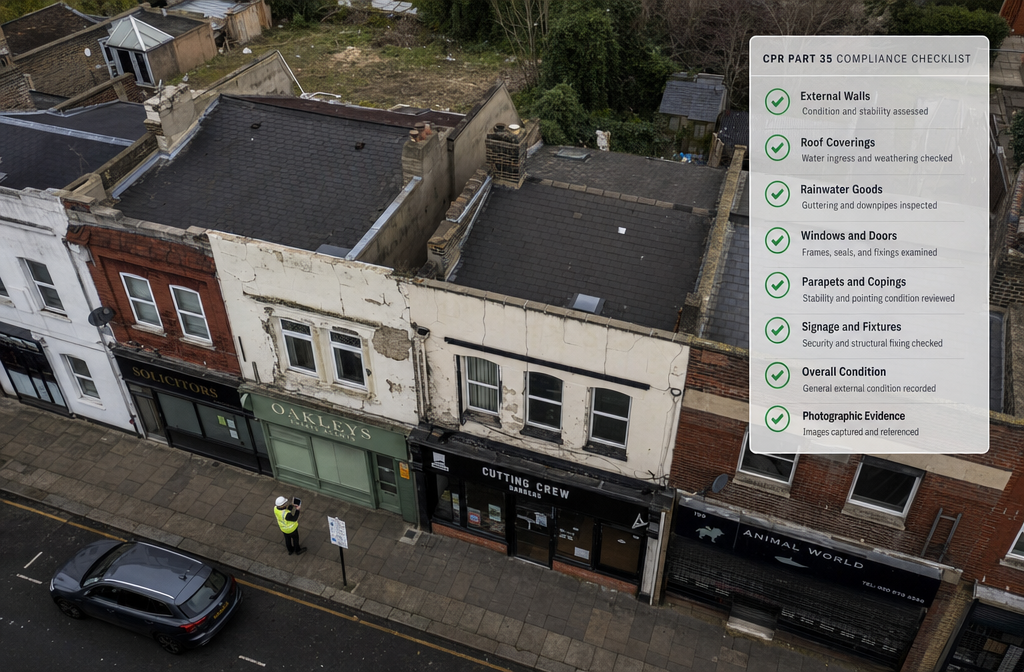
Valuation opinions must be grounded in a thorough inspection. Inspection notes, photographs, and measurements should be retained and, where relevant, exhibited to the report. Modern tools such as drone roof surveys can provide photographic evidence of defects that would otherwise be inaccessible.
❌ Pitfall 4: Ignoring the Valuation Date
In dilapidations disputes, the relevant valuation date is typically the lease end date, not the date of the report. In neighbour disputes involving damage, it may be the date of the damaging event. Using the wrong valuation date — or failing to state it clearly — is a fundamental error.
❌ Pitfall 5: Overstating Certainty
Expert opinions are opinions, not facts. Language such as "the value is £X" should be replaced with "in my opinion, the value is £X, based on the following evidence and reasoning." Courts expect calibrated uncertainty, not false precision.
Expert Meetings and Joint Statements: The Final Compliance Step
Under CPR Part 35.12, the court may direct experts to meet without their clients or legal representatives to identify areas of agreement and disagreement. These without prejudice meetings result in a joint statement that is filed with the court.
Key points for building surveyors attending these meetings:
- Prepare thoroughly — review the opposing expert's report in detail before the meeting
- Be willing to concede points where the evidence supports the opposing view
- Document every agreed and disagreed item clearly in the joint statement
- Never allow the instructing solicitor to draft or materially influence the joint statement
The joint statement is often the most influential document in the entire proceedings. A surveyor who engages constructively and concedes appropriate points will be viewed as more credible — and their remaining opinions will carry greater weight — than one who refuses to move on any issue.
Conclusion: Actionable Steps for Building Surveyors in 2026
Mastering CPR Part 35 Expert Witness Protocols for Building Surveyors: Drafting Valuation Reports in Neighbour and Dilapidations Disputes requires both technical valuation expertise and a clear understanding of procedural obligations. The courts in 2026 are increasingly sophisticated in identifying non-compliant reports, and the consequences of getting it wrong — exclusion of evidence, adverse costs orders, reputational damage — are significant.
Actionable Next Steps ✅
- Audit your current report template against the mandatory structural requirements of CPR Part 35 and Practice Direction 35 — update it before accepting the next instruction.
- Separate facts from opinions clearly throughout every report, using consistent language markers.
- Commission a pre-works schedule of condition in every neighbour dispute matter to establish a defensible baseline.
- Engage with the Section 18(1) cap proactively in all dilapidations instructions — address both the cost of works and the diminution in value as a matter of course.
- Prepare for expert meetings as rigorously as for the report itself — the joint statement can make or break a case.
- Work with RICS registered valuers to ensure the valuation methodology underpinning your expert opinion meets the highest professional standards.
Building surveyors who invest in understanding and applying these protocols will not only produce better expert evidence — they will build a reputation as expert witnesses whose opinions courts can rely on.