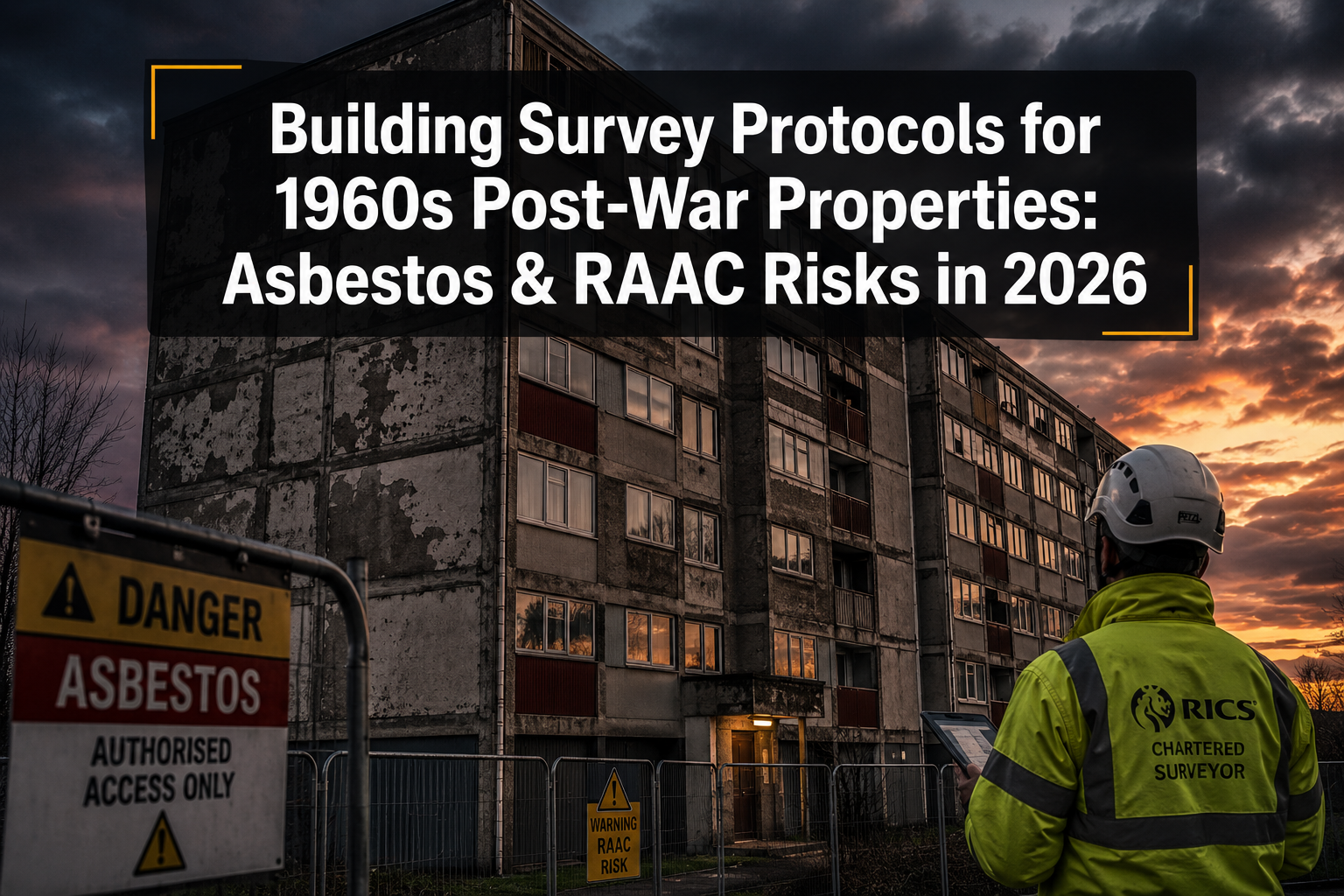

Over 4 million UK homes were built between 1945 and 1970 — and a significant proportion of them are now changing hands in a market where buyers are more cautious, lenders are more demanding, and the regulatory environment around hazardous materials has never been more scrutinised. For anyone involved in buying, selling, or financing these properties in 2026, understanding building survey protocols for 1960s post-war properties: asbestos and RAAC risks in 2026 transactions is no longer optional. It is a fundamental part of due diligence.
Key Takeaways
- 🏚️ 1960s post-war properties carry a dual hazard profile: both asbestos-containing materials (ACMs) and Reinforced Autoclaved Aerated Concrete (RAAC) may be present simultaneously.
- 🔬 The HSE confirmed in May 2026 that the asbestos control limit of 0.1 f/ml remains unchanged, reinforcing the need for professional management rather than removal in many cases.
- 🧱 RAAC panels are identifiable by their V-shaped grooves and bubbly interior texture — but only a qualified surveyor can confirm their presence and condition.
- 💷 Remediation costs can be significant and must be factored into RICS-compliant valuations to protect buyers and lenders alike.
- 📋 A Level 3 Building Survey (formerly Full Structural Survey) is the minimum appropriate survey type for any 1960s post-war property transaction.
Why 1960s Post-War Properties Demand Specialist Survey Attention
The post-war building boom produced housing at speed. Between 1945 and the early 1970s, local authorities and private developers relied heavily on non-traditional construction methods, prefabricated systems, and materials that were later found to pose serious health and structural risks.
Two hazards stand out above all others in this era's building stock:
- Asbestos-containing materials (ACMs) — used extensively in insulation, floor tiles, ceiling tiles, textured coatings (Artex), pipe lagging, and roofing products.
- Reinforced Autoclaved Aerated Concrete (RAAC) — a lightweight concrete product used in flat roofs, floors, and walls, now known to have a design lifespan of approximately 30 years.
Both hazards are invisible to the untrained eye, both carry serious legal and financial implications for property transactions, and both require specialist detection protocols.
💬 "The combination of asbestos and RAAC in a single property is not unusual for 1960s stock — it is, in fact, a predictable risk profile that surveyors must be equipped to address systematically."
For buyers and their advisors, the starting point is always choosing the right level of professional assessment. A homebuyer report vs building survey comparison makes clear that only a Level 3 Building Survey provides the depth of inspection these properties require.
Understanding Asbestos Risks in Post-War Properties
Where Asbestos Hides in 1960s Buildings
Asbestos was used in over 3,000 different building products in the UK before its full ban in 1999. In 1960s residential and commercial properties, the most common locations include:
| Location | Common ACM Type | Risk Level if Disturbed |
|---|---|---|
| Ceiling tiles | Amosite (brown asbestos) | High |
| Textured coatings (Artex) | Chrysotile (white asbestos) | Moderate–High |
| Floor tiles and adhesives | Chrysotile | Moderate |
| Pipe lagging | Amosite / Crocidolite | Very High |
| Roof sheets | Chrysotile | Moderate |
| Boiler/flue insulation | Amosite | Very High |
| Partition walls | Chrysotile | Moderate |
The EPA advises that asbestos in good condition and left undisturbed is unlikely to present an immediate health risk [10]. However, damaged or disturbed ACMs release fibres into the air, creating a significant inhalation hazard that is linked to mesothelioma, asbestosis, and lung cancer.
The 2026 Regulatory Landscape for Asbestos
In May 2026, the HSE confirmed that the asbestos control limit of 0.1 fibres per millilitre (f/ml) will remain unchanged following a comprehensive review. The HSE found no clear scientific evidence that reducing this threshold would improve health outcomes [1][2]. This is a critical data point for surveyors and property professionals: the regulatory framework is stable, but compliance obligations remain stringent.
During Global Asbestos Awareness Week in April 2026, HSE inspectors identified two recurring failures across commercial and residential properties: the absence of asbestos management plans and inadequate training for those responsible for managing ACMs [3]. These are precisely the issues that surface during property transactions when due diligence is inadequate.
Asbestos Survey Protocol: What a Proper Inspection Covers
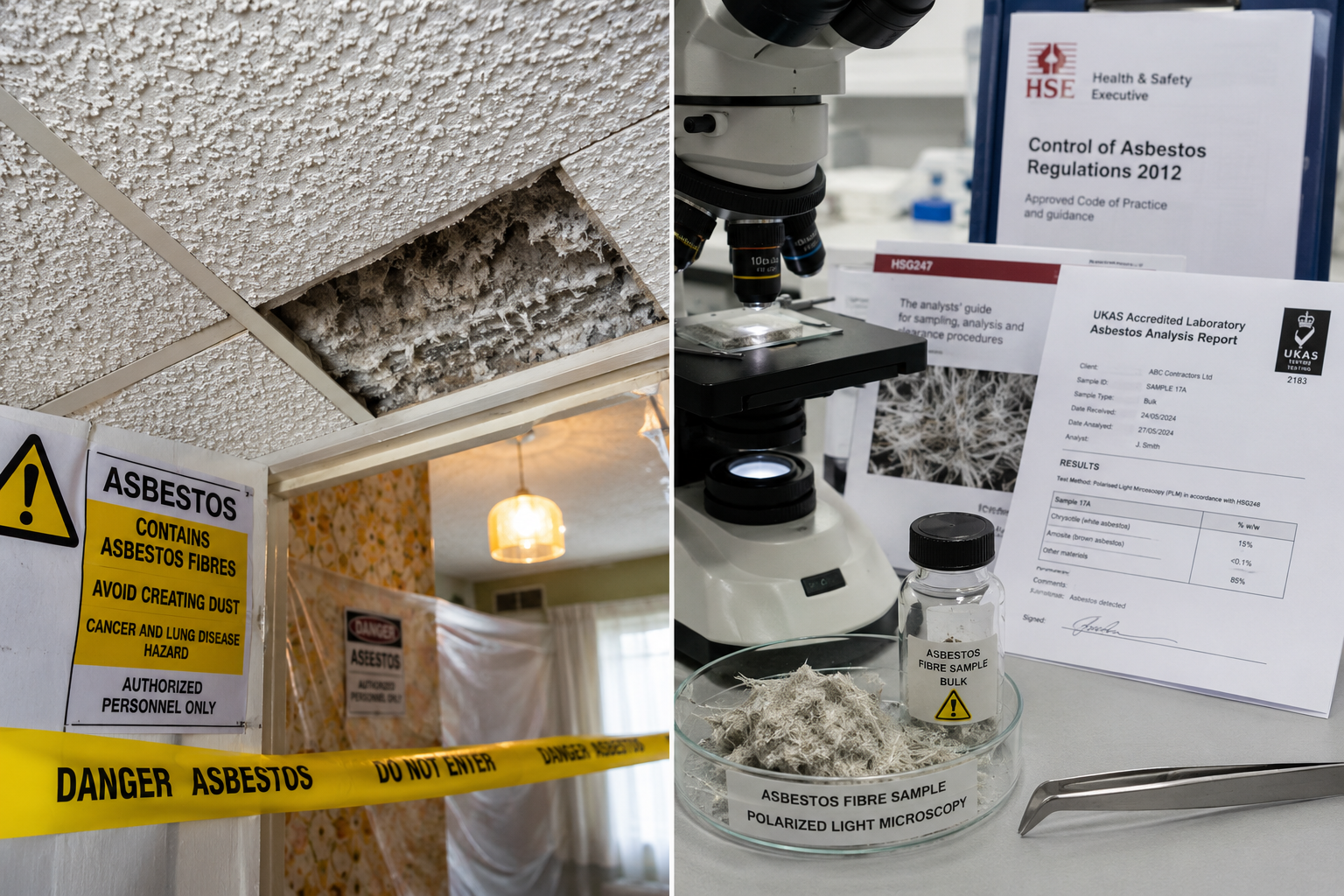
A compliant asbestos survey for a 1960s property should follow the HSG264 guidance and include:
- ✅ Management Survey — identifies ACMs that could be disturbed during normal occupancy
- ✅ Refurbishment/Demolition Survey — required before any renovation work; involves destructive inspection
- ✅ Bulk sampling and laboratory analysis — physical samples sent to UKAS-accredited laboratories
- ✅ Risk assessment scoring — condition, accessibility, and likelihood of disturbance
- ✅ Asbestos Register — a written record of all identified or presumed ACMs
For properties undergoing renovation — a common scenario when buyers purchase 1960s stock — the EPA specifically recommends that materials suspected of containing asbestos be sampled by a trained, accredited professional before any work begins [10].
A structural survey in London conducted by a RICS-accredited surveyor will flag asbestos risk areas and recommend specialist asbestos surveys where appropriate, ensuring buyers have a complete picture before exchange.
RAAC: The Structural Time Bomb in Post-War Flat Roofs
What Is RAAC and Why Is It Dangerous?
Reinforced Autoclaved Aerated Concrete was manufactured and installed extensively in UK buildings between the 1960s and 1990s. It was lightweight, cheap, and easy to work with — making it a popular choice for flat roofs, floors, and external wall panels in schools, hospitals, and residential blocks.
According to RICS guidance, RAAC panels are typically 600mm wide with distinctive V-shaped grooves on their surface and a bubbly, porous interior texture [6]. These visual identifiers are important, but confirmation requires professional assessment.
The core problem with RAAC is structural degradation:
- Its design lifespan was approximately 30 years — meaning panels installed in the 1960s are now 30 to 40 years beyond their intended service life
- Moisture ingress causes the steel reinforcement to corrode, expanding and cracking the surrounding concrete
- Degraded RAAC can fail suddenly and without warning, causing roof or floor collapse
- The material is not repairable in most cases — replacement is the only safe long-term solution
RAAC in 2026: The Scale of the Problem
The scale of RAAC remediation in the public sector alone illustrates the challenge. As of September 2025, seven NHS hospitals in England had completed RAAC removal, with a further 12 hospitals on track to finish by March 2026 — supported by up to £440 million in government funding [5]. Legal challenges related to RAAC continue to grow across both public and private estates as of early 2026 [7].
For private residential and commercial properties, there is no equivalent government funding programme. Buyers and owners bear the full cost of remediation.
Identifying RAAC During a Building Survey
Surveyors assessing 1960s post-war properties should follow a structured RAAC identification protocol:
- Visual inspection of flat roof structures — look for V-groove panels, sagging, cracking, or water staining
- Loft space inspection — examine the underside of roof panels for the characteristic bubbly texture
- Probe testing — a sharp probe can test for the soft, friable nature of degraded RAAC
- Borescope or drone inspection — useful where direct access is restricted; a drone roof survey can identify surface deformation and water pooling without scaffolding
- Structural engineer referral — any suspected RAAC should trigger a specialist structural engineering assessment
For complex cases involving suspected structural failure, a residential structural engineer in London can provide load-bearing assessments and remediation specifications that are essential for both lender requirements and insurance purposes.
Building Survey Protocols for 1960s Post-War Properties: Asbestos and RAAC Risks in 2026 Transactions — The Practical Framework
Choosing the Right Survey Type
Not all surveys are created equal. For 1960s post-war properties, the survey hierarchy matters enormously:
| Survey Level | What It Covers | Suitable for 1960s Stock? |
|---|---|---|
| Level 1 (Condition Report) | Basic visual condition only | ❌ Insufficient |
| Level 2 (Homebuyer Report) | Standard visual inspection | ⚠️ Borderline — risky |
| Level 3 (Building Survey) | Comprehensive, including hidden defects | ✅ Minimum recommended |
| Specialist Surveys (Asbestos, RAAC, Structural) | Targeted hazard-specific assessment | ✅ Often required alongside Level 3 |
A full building survey by a RICS-accredited professional provides the foundation. Specialist asbestos and RAAC surveys are then commissioned as separate, targeted investigations when the building survey identifies risk indicators.
RICS-Compliant Remediation Costing for Valuations
One of the most commercially significant aspects of building survey protocols for 1960s post-war properties — asbestos and RAAC risks in 2026 transactions — is the impact on property valuation.
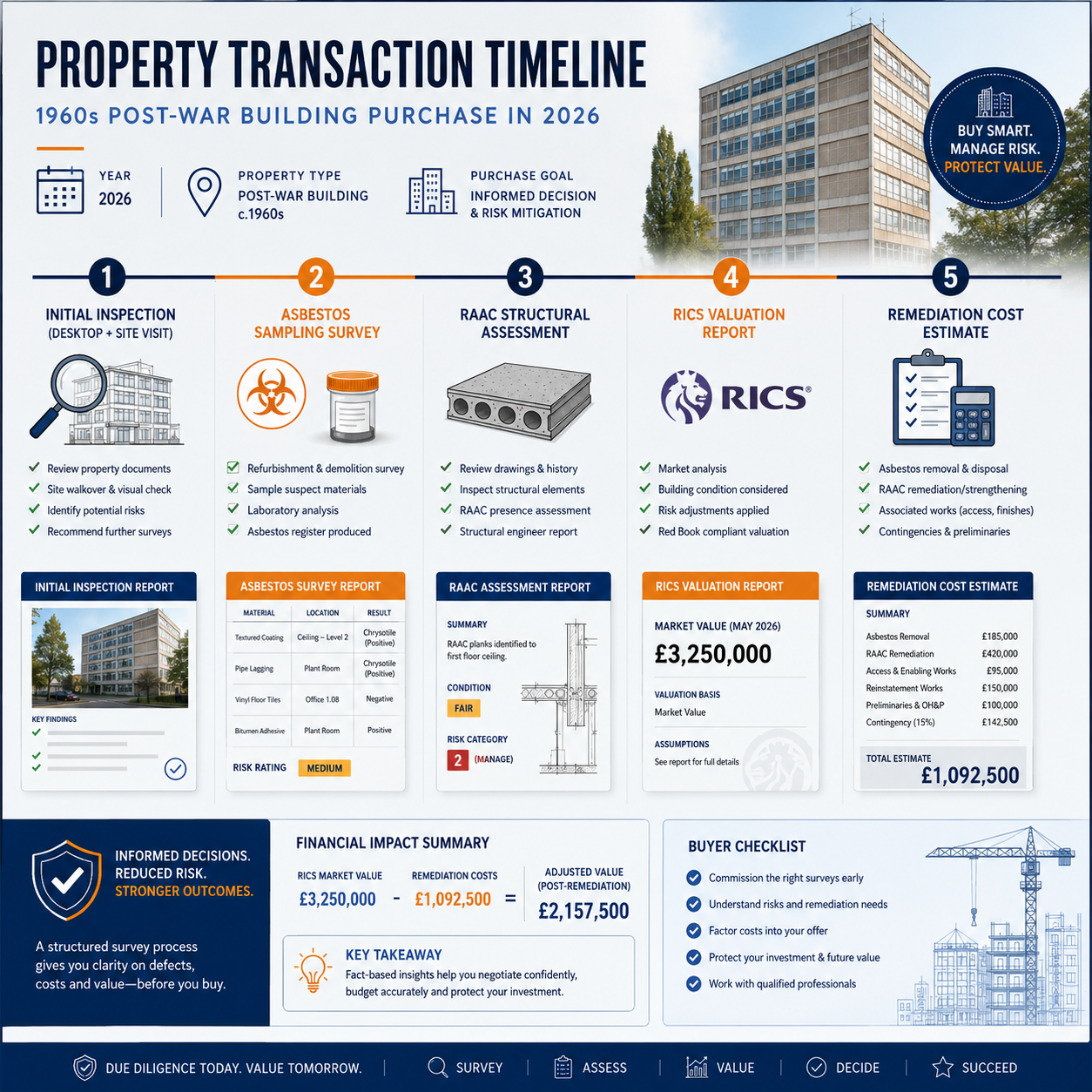
RICS Red Book valuation standards require that valuers reflect all known material defects in their assessments. This means:
- Asbestos remediation costs must be estimated and deducted from open market value where ACMs are in poor condition or where planned works would disturb them
- RAAC replacement costs — which can range from £15,000 to £80,000+ for a residential flat roof depending on size and access — must be reflected in the valuation
- Lender requirements increasingly include asbestos and RAAC risk as conditions of mortgage offer
For commercial properties, the stakes are even higher. A commercial building survey in London will typically include a more extensive schedule of condition and defect analysis, with remediation cost schedules forming part of the transaction documentation.
💬 "Buyers who proceed without specialist surveys on 1960s properties are not just taking a health risk — they are potentially acquiring a liability that could cost tens of thousands of pounds and make the property unmortgageable."
The Regulatory Context: Building Safety in 2026
The broader regulatory environment in 2026 reinforces the importance of rigorous survey protocols. In February 2026, the UK government published major proposals to strengthen the safety and regulation of building products, directly responding to the Grenfell Tower Inquiry findings [8]. In May 2026, further updates were announced to create a more consistent and accountable building safety system, with a new Building Professions Strategy expected in 2027 [9].
These developments signal a direction of travel: greater accountability, stricter compliance, and higher professional standards across the surveying and construction sectors. Buyers and their advisors who commission thorough surveys now are ahead of a regulatory curve that is only moving in one direction.
Practical Checklist: What to Demand from Your Surveyor
When commissioning a survey on a 1960s post-war property in 2026, buyers and their solicitors should confirm the following:
- Survey type confirmed as Level 3 Building Survey minimum
- Surveyor holds RICS accreditation and has demonstrable experience with non-traditional construction
- Asbestos risk areas identified and specialist survey recommended where appropriate
- RAAC assessment included — flat roofs, floors, and wall panels specifically examined
- Drone or borescope inspection offered where roof access is restricted
- Remediation cost estimates provided for all identified defects
- Valuation reflects all material defects in accordance with RICS Red Book standards
- Written report includes specific recommendations for further specialist investigations
For properties in London and the South East — where 1960s post-war stock is particularly concentrated — chartered surveyors in East London and chartered surveyors in South East London with specific expertise in this building era are well-placed to deliver the specialist assessments these properties demand.
Conclusion: Protecting Buyers in a Cautious Market
The surge in demand for surveys on ageing post-war stock reflects a market that is becoming better informed — and rightly so. Building survey protocols for 1960s post-war properties, covering asbestos and RAAC risks in 2026 transactions, represent the intersection of public health, structural safety, legal compliance, and financial prudence.
Actionable next steps for buyers and advisors:
- Always commission a Level 3 Building Survey on any 1960s property — no exceptions.
- Request specialist asbestos and RAAC assessments as standalone commissions when risk indicators are present.
- Ensure the valuation reflects remediation costs in full, in line with RICS Red Book standards.
- Review the asbestos management plan (if one exists) and confirm it meets current HSE requirements.
- Factor remediation timelines into transaction planning — RAAC replacement in particular can take months to procure and complete.
- Engage a RICS-accredited surveyor with proven experience in non-traditional and post-war construction.
The regulatory environment is tightening, lender scrutiny is increasing, and the physical condition of 1960s stock is deteriorating with every passing year. Buyers who invest in thorough, specialist survey protocols are not just protecting themselves — they are making a sound commercial decision in a market where knowledge is the most valuable asset of all.
References
[1] Asbestos Control Limit Review Published – https://press.hse.gov.uk/2026/05/18/asbestos-control-limit-review-published/?utm_source=openai
[2] HSE's Policy Position on Great Britain's Asbestos Control Limit – https://press.hse.gov.uk/2026/05/18/hses-policy-position-on-great-britains-asbestos-control-limit/?utm_source=openai
[3] HSE Inspectors Checking Asbestos Management – https://press.hse.gov.uk/2026/04/01/hse-inspectors-checking-asbestos-management/?utm_source=openai
[4] Government Rejects Call for National Asbestos Register in Schools Citing Duplication of Work – https://www.britsafe.org/safety-management/2026/government-rejects-call-for-national-asbestos-register-in-schools-citing-duplication-of-work?utm_source=openai
[5] RAAC Removed from Seven More NHS Hospitals – https://www.gov.uk/government/news/raac-removed-from-seven-more-nhs-hospitals?utm_source=openai
[6] Locating RAAC: Reinforced Autoclaved Aerated Concrete – https://ww3.rics.org/uk/en/journals/built-environment-journal/locating-raac-reinforced-autoclaved-aerated-concrete.html?utm_source=openai
[7] Reinforced Autoclaved Aerated Concrete (RAAC) – https://www.brownejacobson.com/insights/2026-horizon-scanning-in-construction/reinforced-autoclaved-aerated-concrete-raac?utm_source=openai
[8] Government Cracks Down on Unsafe and Unregulated Building Products in Response to Grenfell Tower Tragedy – https://www.gov.uk/government/news/government-cracks-down-on-unsafe-and-unregulated-building-products-in-response-to-grenfell-tower-tragedy?utm_source=openai
[9] Stronger Standards and Training to Improve Building Safety – https://www.gov.uk/government/news/strongerstandardsand-training-toimprovebuilding-safety?utm_source=openai
[10] What Are the Health Risks if I Have Asbestos in My Home, Building, Apartment, or School? – https://www.epa.gov/asbestos/what-are-health-risks-if-i-have-asbestos-my-home-building-apartment-or-school?utm_source=openai