

}

A net balance of -26% of surveyors reported a sharp decline in buyer enquiries in February 2026 — the steepest single-month drop since mid-2023 [5]. For buyers still active in this cautious market, that statistic is not a reason to pause. It is a reason to survey smarter. Understanding the right survey types for 2026 buyers — choosing RICS Level 3, Party Wall, or Valuation Services pre-purchase — can mean the difference between a confident purchase and a costly mistake.
This guide cuts through the confusion, explaining exactly which survey fits which situation, what each costs, and how to avoid the boundary risks and structural surprises that catch unprepared buyers off guard.
Key Takeaways 📋
- RICS Level 3 Building Surveys are the gold standard for older, larger, or unusual properties — essential for pre-1950 homes.
- Party Wall Agreements are a legal requirement when construction work affects a shared wall or boundary, protecting both buyer and neighbour.
- Valuation Services serve specific financial and legal purposes — mortgage, tax, matrimonial, or probate — and are distinct from structural surveys.
- In a recovering 2026 market with softening demand, getting the right survey early reduces negotiation risk and prevents late-stage deal collapses.
- Always use a RICS-accredited surveyor to ensure reports meet lender, legal, and regulatory standards.
Understanding the Survey Landscape for 2026 Buyers
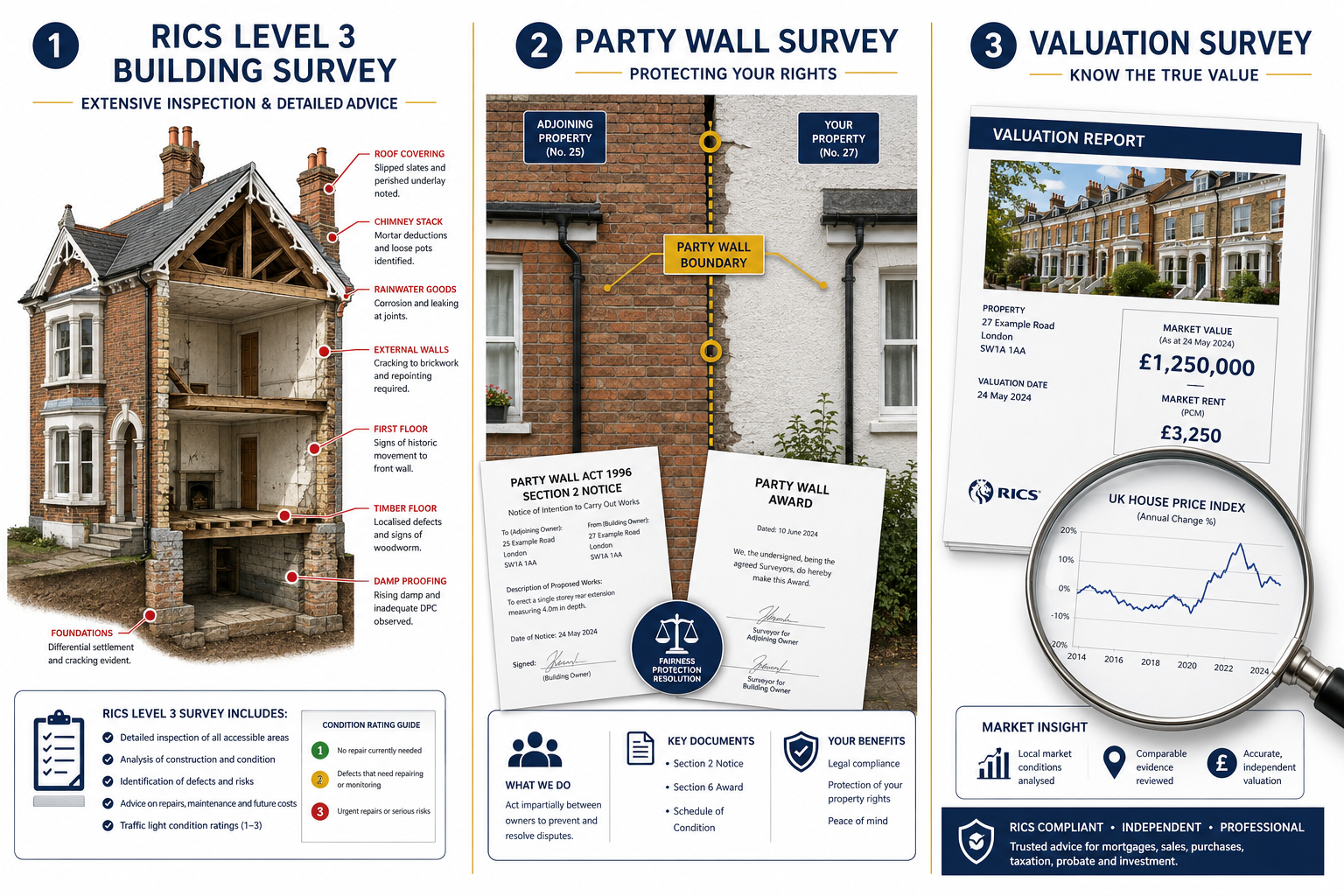
The UK property survey market offers three distinct service categories that buyers frequently confuse. Each serves a fundamentally different purpose, and selecting the wrong one — or skipping one entirely — creates real financial exposure.
The Three Core Survey Types at a Glance
| Survey Type | Primary Purpose | Best For | Typical Cost (2026) |
|---|---|---|---|
| RICS Level 1 | Basic condition overview | New builds, modern flats | £250–£400 |
| RICS Level 2 (HomeBuyer) | Condition + market valuation | Standard modern homes | £400–£600 |
| RICS Level 3 (Building Survey) | Full structural assessment | Pre-1950, unusual, or large properties | £574–£894 [2] |
| Party Wall Survey | Legal compliance + condition record | Properties with shared walls or planned works | £150–£1,000+ |
| RICS Valuation | Financial/legal value assessment | Mortgage, tax, probate, matrimonial | £250–£600+ |
For a deeper comparison of survey levels, the HomeBuyer Report vs Building Survey guide is an excellent starting point. Buyers who are unsure which tier suits their property can also consult a what survey do you need resource before commissioning anything.
Why Survey Timing Matters More Than Ever in 2026
Traditionally, surveys happen after an offer is accepted. But with buyer enquiries weakening and sellers increasingly open to negotiation, getting survey intelligence earlier gives buyers real leverage [6].
💡 Pull Quote: "In a softening market, a well-timed survey is not just due diligence — it is a negotiating tool."
Pre-offer property checks are growing in popularity because they allow buyers to identify deal-breakers before emotional and financial investment deepens [6]. In a market where every pound of negotiation counts, this shift is significant.
RICS Level 3 Building Survey: The Right Choice for Complex Properties
The RICS Level 3 Survey — formerly called a Full Structural Survey or Building Survey — is the most thorough assessment available to residential buyers [1]. It covers the full fabric of a building: structure, roof, walls, floors, windows, drainage, and services. Both minor and major defects are recorded, with clear guidance on urgency and likely remediation costs.
When Is a Level 3 Survey the Right Survey Type for 2026 Buyers?
A Level 3 survey is strongly recommended in these situations:
- 🏚️ Properties built before 1950 — Victorian, Edwardian, and interwar homes carry higher risk of hidden defects [1]
- 🏗️ Properties with visible defects — cracks, damp patches, sagging roofs, or uneven floors
- 🏠 Unusual construction — timber frame, thatched roofs, listed buildings, or converted properties
- 📐 Large properties — the more square footage, the more there is to miss with a lighter survey
- 💷 High-value purchases — the cost of a Level 3 survey is negligible against the risk of an undiscovered £30,000 structural problem
The average cost of a RICS Level 3 Building Survey in the UK is approximately £656, ranging from £574 to £894 depending on property size, age, value, and location [2]. London and South East properties typically sit at the higher end of that range.
What a Level 3 Survey Covers
A thorough Level 3 report will assess:
- Structural integrity — foundations, load-bearing walls, roof structure
- Dampness and water ingress — rising damp, penetrating damp, condensation
- Roof condition — tiles, flashings, gutters, chimneys
- Services overview — heating, plumbing, electrics (visual inspection only)
- External elements — boundaries, outbuildings, drainage
- Legal considerations — notes on items requiring further investigation
For properties with suspected roof issues, a specialist drone roof survey can complement a Level 3 report by providing detailed imagery of inaccessible areas.
Surveyors providing RICS Level 3 assessments must be members of professional bodies such as RICS, ensuring adherence to rigorous industry standards [7]. Working with chartered surveyors in London guarantees that reports meet lender and legal requirements.
Party Wall Surveys: Protecting Buyers and Neighbours in 2026
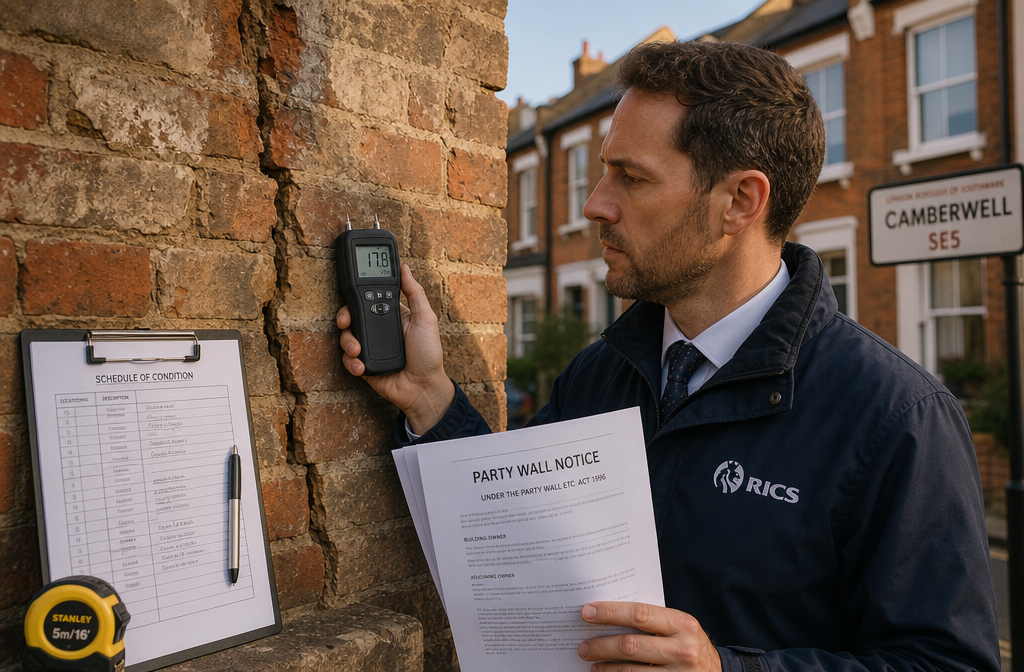
The Party Wall etc. Act 1996 is one of the most misunderstood pieces of legislation in UK property law. Many buyers do not realise that it affects them — not just the person doing the building work. Understanding party wall matters before exchange is essential, particularly in urban areas where terraced and semi-detached properties dominate.
What Is a Party Wall and When Does It Matter?
A party wall is any wall, floor, or structure shared between two properties. This includes:
- Walls on the boundary between two properties
- Walls that form part of one building but sit on the boundary
- Garden walls built on or near a boundary
- Floors and ceilings between flats
The Act requires that a Party Wall Notice be served on adjoining owners before specific types of work begin. Failure to serve notice can result in injunctions, disputes, and significant legal costs.
The Party Wall Act 3 Metre Rule Explained
One of the most commonly triggered provisions is the 3-metre rule: if any excavation is planned within 3 metres of a neighbouring building and goes deeper than the neighbour's foundations, a notice must be served. This catches many basement conversions, extension footings, and drainage works.
Key Party Wall Services Buyers Should Know
| Service | Purpose |
|---|---|
| Party Wall Notice | Legal notification to adjoining owners before work begins |
| Party Wall Agreement | Formal document recording consent or award between parties |
| Schedule of Condition | Pre-work photographic record of neighbouring property condition |
| Party Wall Award | Legally binding document resolving disputes between surveyors |
A Schedule of Condition is particularly valuable for buyers purchasing a property adjacent to a site where works are already planned or underway. It creates a baseline record that protects against false damage to property claims after construction completes.
Understanding party wall consent requirements before exchange prevents nasty surprises — especially in London, where loft conversions, rear extensions, and basement digs are commonplace.
What Does a Party Wall Survey Cost?
Party wall surveyor costs vary considerably depending on the complexity of the work and whether both parties agree to use a single agreed surveyor or appoint separate surveyors. Simple notices with consent can cost as little as £150–£300. Disputed awards involving separate surveyors can run to £1,000 or more per party.
⚠️ Important: If a buyer is purchasing a property where the seller has already commenced notifiable works without serving proper notice, this is a red flag that should be investigated before exchange.
Valuation Services: When Financial Accuracy Matters More Than Structural Detail
A property valuation is not a survey. This distinction confuses many buyers, particularly first-time purchasers who assume a mortgage valuation tells them everything they need to know about a property's condition. It does not.
A mortgage valuation is a brief assessment carried out for the lender's benefit — confirming the property is worth the loan amount. It offers the buyer almost no protection against structural defects or hidden problems.
Types of Valuation Services in 2026
RICS registered valuers provide a range of specialist valuation reports for purposes that go well beyond mortgage applications:
- 📊 Red Book Valuation — the RICS standard for formal, regulated valuations used for legal and financial purposes
- 🏠 Help to Buy Valuation — required when repaying or staircasing a Help to Buy equity loan
- ⚖️ Matrimonial Valuation — used in divorce proceedings to establish a fair property value
- 🧾 Capital Gains Tax Valuation — establishes base value for CGT calculations on disposal
- 📜 Probate Valuation — required for inheritance tax purposes when a property owner dies
- 🔄 Retrospective Valuation — establishes historic property value for tax or legal disputes
Each of these serves a specific financial or legal purpose and requires a qualified, RICS-accredited professional to produce a defensible, compliant report [4].
The 2026 Market Context: Why Valuations Are Under Pressure
The February 2026 RICS data showing a -26% net balance in buyer enquiries has real implications for valuations [5]. In a market where demand is softening, valuers face greater scrutiny when justifying asking prices. Comparable evidence is thinner, and the risk of over-valuation — or under-valuation — increases.
For buyers, this means:
- Mortgage valuations may be more conservative — lenders are cautious in uncertain markets
- Independent valuations carry more weight — a buyer-commissioned valuation provides a second opinion that can support price negotiations
- Expert witness valuations are increasingly important in disputes where market movement has affected agreed prices [5]

Choosing the Right Valuation for Your Situation
| Situation | Recommended Valuation Type |
|---|---|
| Buying with a mortgage | Lender's mortgage valuation (minimum) |
| Buying with cash | Independent RICS Red Book valuation |
| Selling shared ownership | Help to Buy / Shared Ownership valuation |
| Divorce settlement | Matrimonial valuation |
| Inherited property | Probate valuation |
| Selling investment property | Capital Gains Tax valuation |
For buyers wanting to understand valuation factors that influence a property's assessed worth — including location, condition, comparable sales, and tenure — a pre-purchase consultation with a RICS valuer is a worthwhile investment.
How to Choose the Right Survey Type for 2026 Buyers: A Decision Framework
Selecting the right survey types for 2026 buyers — choosing RICS Level 3, Party Wall, or Valuation Services pre-purchase — depends on three key factors: property type, transaction context, and planned works.
Step-by-Step Decision Guide
Step 1: Assess the property's age and condition
- Built after 2000, standard construction, no visible defects → Level 2 HomeBuyer Report
- Built before 1950, unusual construction, visible defects, or high value → RICS Level 3 Building Survey ✅
Step 2: Check for shared walls or planned works
- Terraced, semi-detached, or flat with neighbours above/below → Check Party Wall Act obligations
- Seller or adjacent owner has planned extensions, loft conversions, or excavations → Party Wall Survey + Schedule of Condition ✅
Step 3: Identify your financial or legal purpose
- Buying with a mortgage → Lender's valuation (minimum); consider independent valuation for cash buyers
- Tax, legal, or matrimonial purpose → Specialist RICS Valuation ✅
Step 4: Consider timing
- Post-offer is standard, but pre-offer checks reduce late-stage risk [6]
- In a softening 2026 market, early survey intelligence supports stronger price negotiations
🔑 Can Multiple Surveys Be Needed?
Absolutely — and this is common. A buyer purchasing a Victorian terraced house in London who plans a rear extension may legitimately need:
- A RICS Level 3 Building Survey to assess the property's condition
- A Party Wall Schedule of Condition if the neighbour's property is at risk from the planned works
- A RICS Red Book Valuation if purchasing with cash or for tax purposes
These are complementary, not competing services. Each answers a different question.
Conclusion: Surveying Smarter in a Recovering 2026 Market
The right survey types for 2026 buyers — choosing RICS Level 3, Party Wall, or Valuation Services pre-purchase — are not interchangeable. Each serves a precise purpose, and the cost of commissioning the wrong one (or none at all) far exceeds the modest fee of getting it right.
In a market where buyer confidence is fragile and demand is recovering slowly [5], surveys are no longer just a formality. They are a strategic asset. A comprehensive Level 3 report can justify a price reduction. A Party Wall Schedule of Condition protects against future neighbour disputes. An independent valuation gives cash buyers and investors a defensible position in negotiations and tax filings.
Actionable Next Steps for 2026 Buyers ✅
- Identify your property type — age, construction, and condition determine the minimum survey level needed.
- Check party wall obligations early — before exchange, not after. Speak to a party wall surveyor if the property is terraced, semi-detached, or has any planned works nearby.
- Do not rely on a mortgage valuation for structural assurance — commission a Level 2 or Level 3 survey separately.
- Use a RICS-accredited firm — this ensures reports are legally defensible and accepted by lenders, courts, and HMRC.
- Consider survey timing — in 2026's cautious market, earlier survey intelligence means stronger negotiating power.
Engaging a qualified chartered surveyor early in the buying process is one of the highest-return investments a property buyer can make.
References
[1] Rics Home Survey Level 3 – https://www.rellimsurveyors.co.uk/rics-home-survey-level-3?utm_source=openai
[2] Level 3 Survey Cost – https://www.comparemymove.com/guides/surveying/level-3-survey-cost?utm_source=openai
[3] southendsurveyor – https://www.southendsurveyor.com/?utm_source=openai
[4] Bartley West Limited – https://www.ricsfirms.com/office/656940/Bartley-West-Limited?utm_source=openai
[5] Valuation Challenges From Rics February 2026 Survey Expert Witness Strategies For 26 Buyer Enquiry Dip Disputes – https://wimbledonsurveyors.com/valuation-challenges-from-rics-february-2026-survey-expert-witness-strategies-for-26-buyer-enquiry-dip-disputes/?utm_source=openai
[6] Property Survey Alternative – https://www.getkeywise.com/property-survey-alternative?utm_source=openai
[7] simplesurvey.co.uk – https://www.simplesurvey.co.uk/?utm_source=openai
[8] rellimsurveyors.co.uk – https://www.rellimsurveyors.co.uk/?utm_source=openai
[9] iamsurveyors.co.uk – https://www.iamsurveyors.co.uk/?utm_source=openai