London homeowners spend an estimated £700 to £2,500 or more on party wall surveying for a typical extension or loft conversion, yet many receive their first invoice with no clear idea of what each line item actually covers. Understanding how much does a party wall survey cost in London, including itemised fees, common extras and money-saving tips, before work begins can prevent budget overruns and disputes with neighbours.
This guide breaks down every component of a party wall surveyor's bill, from the initial notice fee to post-construction inspections, and shows where savings are genuinely achievable.
Key Takeaways
- Party wall surveyor fees in London typically range from £700 to £2,500 per project, depending on complexity and the number of adjoining owners involved.
- Core costs include serving notices, drafting the Party Wall Award, and preparing a Schedule of Condition, each charged separately by most surveyors.
- Choosing an agreed surveyor (one surveyor acting for both parties) is the single most effective way to reduce total costs.
- Always request a fixed-fee quote that itemises every stage; hourly-rate arrangements can escalate quickly on complex projects.
- The building owner (the person carrying out the works) normally pays all surveying fees, including those of the adjoining owner's surveyor.
What the Party Wall Act Requires and Why Fees Arise
Before any cost can be understood, it helps to know what triggers the expense. The Party Wall Act 1996 requires a building owner to serve formal notice on any adjoining owner before carrying out certain works. These include building on or near a boundary, excavating within three or six metres of a neighbour's foundations, and altering a shared wall.
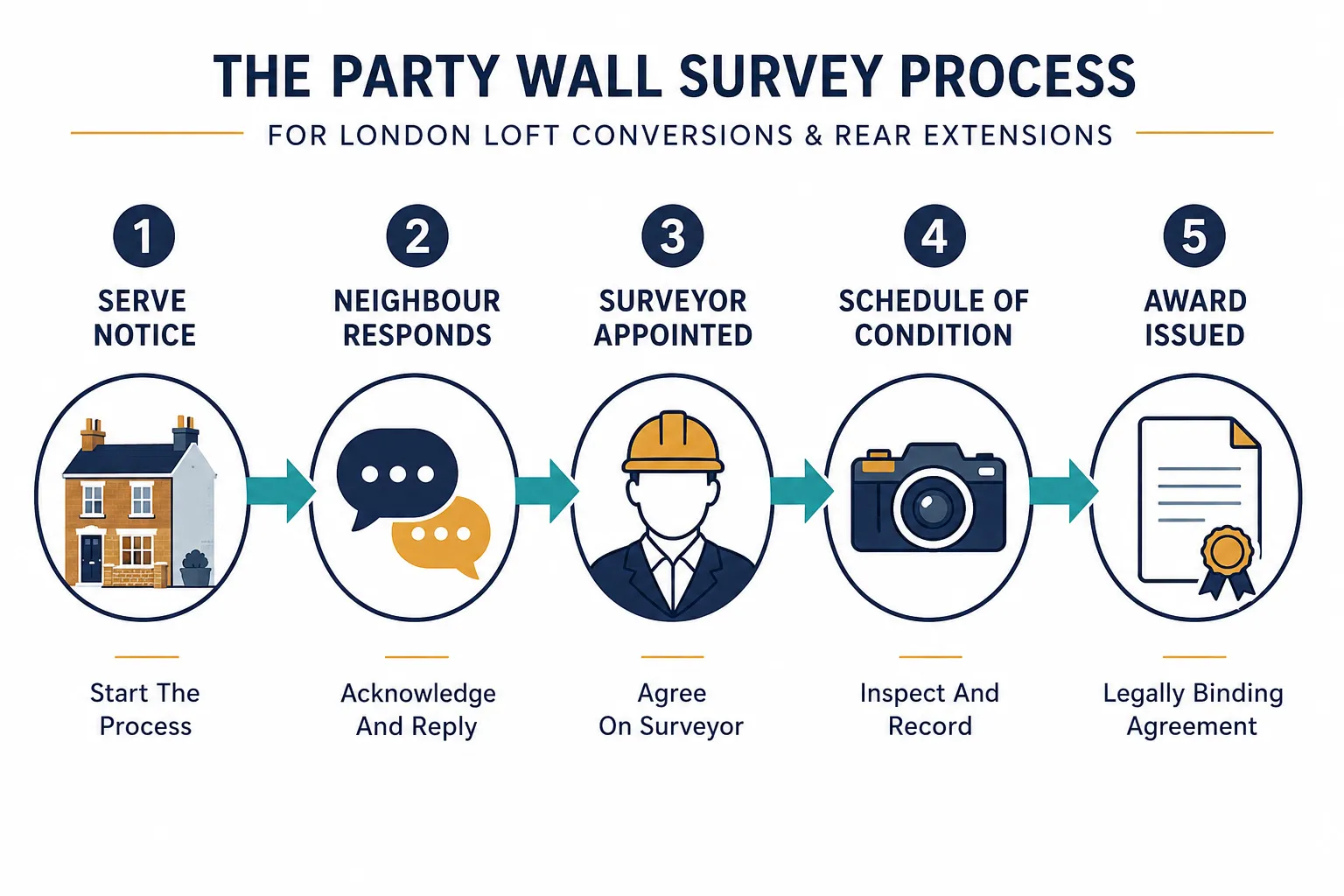
When a neighbour dissents, or simply does not respond within 14 days, a dispute is deemed to exist by statute. At that point, both parties must appoint surveyors to agree a Party Wall Award, a legally binding document that governs how the work proceeds. It is the professional time involved in drafting, negotiating and finalising that Award which generates the bulk of the cost.
For projects such as rear extensions and loft conversions in London, it is common for two or three adjoining owners to be involved simultaneously, multiplying the fee exposure.
Itemised Fees: What You Are Actually Paying For
Understanding the individual components is the clearest way to answer how much does a party wall survey cost in London, with itemised fees, common extras and money-saving tips forming the backbone of any accurate budget.
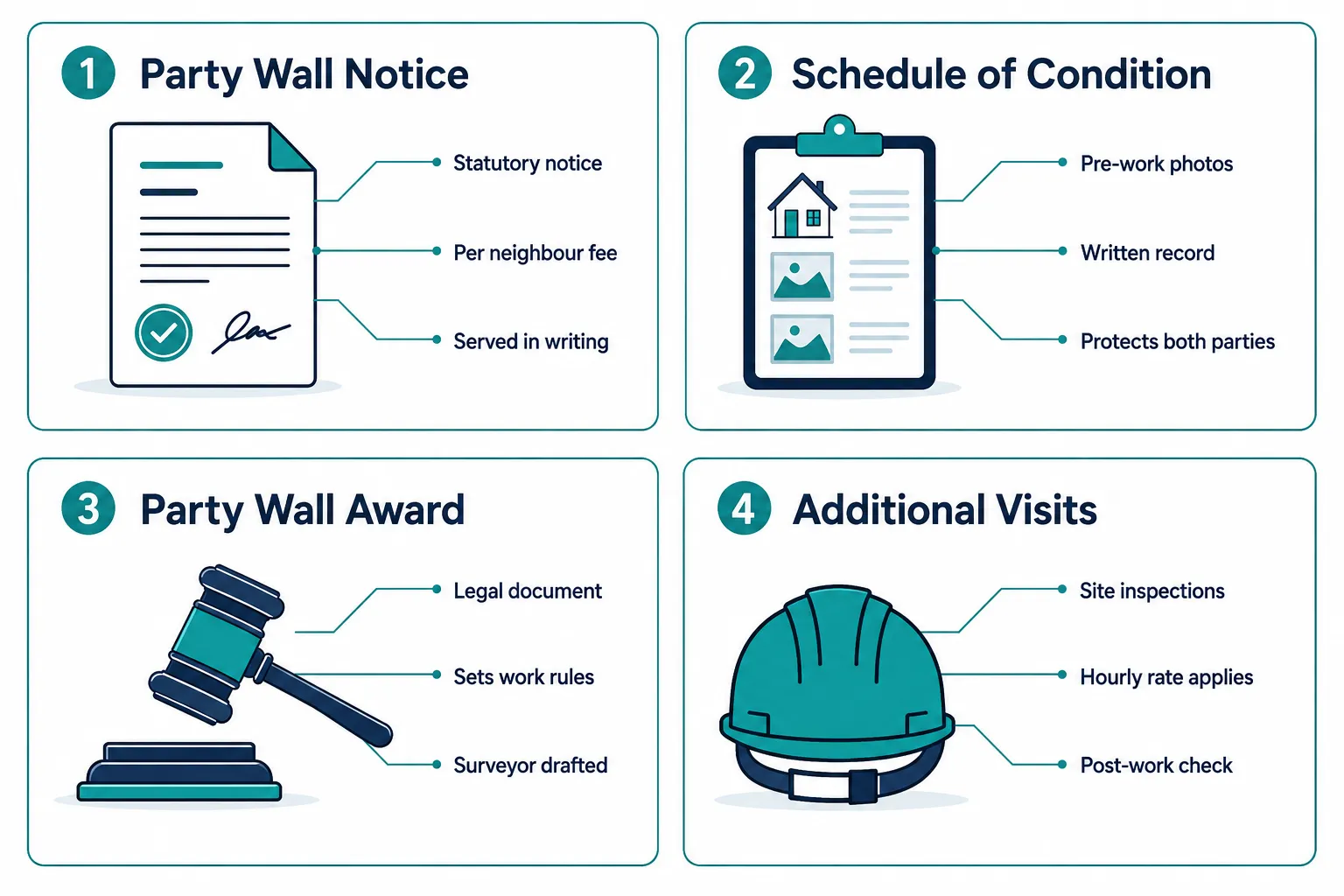
Party Wall Notice Fee
Most London surveyors charge a flat fee to prepare and serve the statutory notices on your behalf. Expect to pay between £150 and £300 per notice [1]. Where multiple neighbours are affected, for example, a semi-detached loft conversion touching both the adjoining house and the flat above, each notice is typically charged separately.
Some firms include notice preparation within a bundled fixed fee; others charge it as a standalone disbursement. Always confirm which applies before signing an engagement letter.
Schedule of Condition
A Party Wall Schedule of Condition is a photographic and written record of the adjoining owner's property before construction begins. It is arguably the most important document in the process: without it, proving whether any crack or damage existed before the works becomes almost impossible.
In London, a Schedule of Condition typically costs £200 to £500 depending on the size of the property and the number of rooms inspected [2][3]. For a basement conversion beneath a terrace, surveyors may need to inspect multiple floors and an adjoining garden, pushing the fee toward the upper end.
Party Wall Award
The Party Wall Award is the core legal document. It sets out the permitted works, working hours, protection measures, and the process for making good any damage. Drafting and agreeing the Award is the most time-intensive part of the process.
Typical Award fees in London range from £700 to £1,500 per surveyor [4][5]. Where two surveyors are appointed (one for each party), the building owner pays both fees. Where a single agreed surveyor is used, only one Award fee is payable, a significant saving discussed further below.
Additional Site Visits and Inspections
Many surveyors charge separately for visits beyond the initial inspection. These may include:
- A mid-construction inspection to check compliance with the Award
- A post-construction inspection to confirm works are complete
- An emergency visit if the neighbour reports damage during construction
Additional visits are commonly charged at an hourly rate of £150 to £250 per hour in London, or as a fixed fee of £150 to £350 per visit [1][8]. On a project lasting several months, these costs can accumulate substantially if not capped in the original agreement.
Common Extras and Disbursements to Watch
Even a well-structured fixed-fee quote can carry additional charges that are easy to overlook.
Third surveyor appointment: If the two appointed surveyors cannot agree on a matter, either party can refer the dispute to a third surveyor. The third surveyor's fee, typically £200 to £500 per hour, is usually paid by the losing party [8].
Counter-notices: If an adjoining owner wishes to request additional works under the Act (for example, asking the building owner to build up the party wall at the same time), a counter-notice triggers further drafting work and additional fees [10].
Structural engineer liaison: On basement or underpinning projects, the surveyor may need to review structural drawings and liaise with engineers. Some firms charge this as a separate disbursement.
Travel and administration: A minority of London surveyors still charge travel time or document printing costs. These should be questioned and, where possible, excluded from the engagement.
Abortive fees: If a project is cancelled after the Award has been drafted but before works begin, some surveyors charge a partial or full abortive fee. Confirm the cancellation policy in writing before instruction.
A fixed-fee quote that itemises every stage, notice, Schedule of Condition, Award, and visits, is far easier to budget against than an open-ended hourly arrangement.
Costs by Project Type: Extensions, Loft Conversions and Basements
Different project types carry materially different fee profiles. The table below summarises typical all-in costs for London projects in 2026 [1][2][3][9]:
| Project Type | Typical Fee Range (London) | Key Cost Drivers |
|---|---|---|
| Rear extension (single storey) | £700, £1,400 | 1-2 adjoining owners, excavation notice likely |
| Loft conversion | £900, £1,800 | Party wall raised, possible flank wall works |
| Side extension / infill | £800, £1,600 | Boundary proximity, new wall on line of junction |
| Basement / underpinning | £1,500, £3,500+ | Multiple notices, structural complexity, monitoring |
| Flat (mid-terrace) | £1,200, £2,500 | Multiple adjoining owners above, below and beside |
For a loft conversion on a mid-terrace property, a building owner may face notices to the properties on both sides, each potentially requiring a separate Award and Schedule of Condition. It is not unusual for total fees to reach £2,500 to £3,500 in that scenario [3][5].
If your project involves excavation near a neighbour's foundations, a Party Wall Excavation Notice will be required in addition to any party structure notice, adding a further layer of professional fees.
One Surveyor or Two? The Agreed Surveyor Option Explained
The question of surveyor appointment structure is one of the most important cost decisions a building owner faces.
Two surveyors: When a neighbour dissents and appoints their own surveyor, two professionals are involved. The building owner pays both fees. On a straightforward loft conversion, this can mean paying two Award fees totalling £1,400 to £3,000 [2][4].
Agreed surveyor: Under Section 10(1)(b) of the Party Wall Act, both parties can jointly appoint a single agreed surveyor to act impartially for both sides. This typically reduces total fees by 30 to 50 percent, since only one Award fee is payable [6][7].
The agreed surveyor option works best where the project is relatively straightforward and the relationship between neighbours is cooperative. It is less suitable where there is significant distrust or where the adjoining owner has complex concerns about the works.
Who pays? In almost all circumstances, the building owner (the person doing the work) pays all party wall surveying fees, including those of the adjoining owner's appointed surveyor. The only exception is where the adjoining owner has acted unreasonably, in which case the third surveyor may apportion costs differently [8].
If a neighbour is currently carrying out work that affects your property, it is worth understanding what to do if a neighbour is carrying out party wall work on your boundary wall, as the cost implications can run in both directions.
Money-Saving Tips: How to Reduce Party Wall Survey Costs in London
Reducing costs does not mean cutting corners. The following strategies are practical, legitimate and widely used by experienced London homeowners.
1. Obtain at Least Three Fixed-Fee Quotes
The market for party wall surveying in London is competitive. Fees for identical scopes of work can vary by 40 percent or more between firms [2][9]. Always request itemised fixed-fee quotes, not hourly estimates, and compare like for like. Check that each quote covers notices, the Schedule of Condition, the Award, and at least one site visit.
For a detailed breakdown of current fee benchmarks, the Party Wall Surveyor Cost and Agreement Fees 2026 guide provides a useful reference point.
2. Propose the Agreed Surveyor Arrangement to Your Neighbour
As noted above, a jointly appointed agreed surveyor can reduce the total bill by a third or more. Approach your neighbour early, explain the process, and suggest a reputable RICS-registered firm that both parties can agree on. Many neighbours are receptive once they understand that the building owner bears all costs regardless.
3. Serve Notices Early and Correctly
Errors in notices, wrong dates, missing descriptions of works, incorrect addresses, can invalidate the notice and require it to be re-served, delaying the project and adding cost. Using a qualified surveyor to draft and serve notices from the outset is cheaper than correcting mistakes later. If no party wall notice has been served when work begins, the legal and financial consequences can be considerably more expensive than the original fee.
4. Consolidate Notices Where Possible
If your project triggers both a party structure notice and an excavation notice to the same neighbour, instruct your surveyor to handle both simultaneously. Bundling notices reduces mobilisation costs and avoids duplicate Schedule of Condition visits to the same property.
5. Cap Additional Visit Fees in the Engagement Letter
Before instructing a surveyor, negotiate a cap on additional visit fees or agree a fixed all-inclusive fee that covers the full project lifecycle. Some London firms now offer online fixed-fee packages that include all stages for a single price [6][7]. These can represent good value on straightforward projects, provided the scope is clearly defined.
6. Avoid Disputes with Your Neighbour
The single largest cost escalator in party wall matters is a breakdown in relations between the building owner and the adjoining owner. Disputes that escalate to third surveyor referrals, legal proceedings or injunctions can cost tens of thousands of pounds. Maintaining open communication, keeping neighbours informed of the programme, and responding promptly to concerns is the most cost-effective risk management available.
What to Check Before Signing a Party Wall Surveyor Engagement
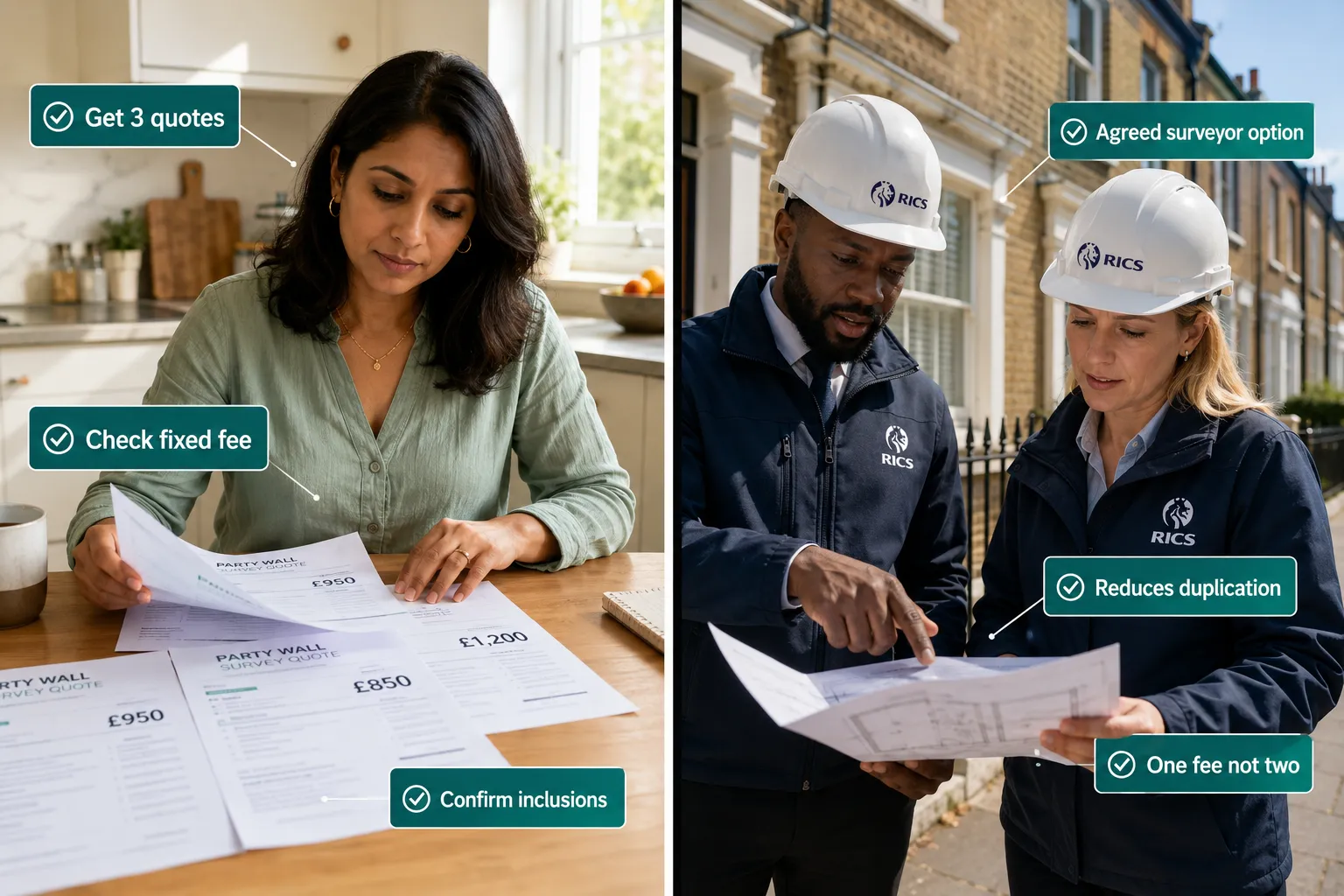
Not all quotes are equal. Before instructing any surveyor, verify the following:
- RICS membership or equivalent: The surveyor should be a member of the Royal Institution of Chartered Surveyors or the Faculty of Party Wall Surveyors.
- Fixed fee vs hourly rate: Confirm in writing which model applies and what triggers any additional charges.
- Inclusions and exclusions: Does the fee cover the Schedule of Condition, or is that charged separately? How many site visits are included?
- VAT: Most quoted fees are exclusive of VAT. Confirm whether VAT applies to the total.
- Disbursements: Are postage, printing, or travel costs included or billed separately?
- Cancellation policy: What is the abortive fee if the project does not proceed?
For projects in North London specifically, Party Wall Surveyors North London offers local expertise across the notices and awards process.
Conclusion
Understanding how much does a party wall survey cost in London, with itemised fees, common extras and money-saving tips, is not merely an academic exercise. It directly affects project budgets, neighbour relationships and the legal protection available to both sides of a shared wall.
Actionable next steps for London homeowners in 2026:
- Identify all adjoining owners affected by the planned works before instructing a surveyor.
- Request at least three itemised fixed-fee quotes from RICS-registered surveyors.
- Discuss the agreed surveyor option with your neighbour before either party appoints separately.
- Confirm that the Schedule of Condition is included in the quoted fee, do not allow this to be omitted.
- Serve notices at the earliest opportunity to avoid programme delays and abortive costs.
- Keep communication with neighbours open throughout the construction period.
A well-managed party wall process protects the building owner, the adjoining owner, and the structural integrity of both properties. The cost, when properly understood and planned for, is a proportionate investment in a legally sound project.
References
[1] Cost Of A Party Wall Surveyor – partywallsurveyorlondon.uk
[2] Party Wall Surveyor Cost – checkatrade.com
[3] Party Wall Survey Cost – christopheranthony.org.uk
[4] Our Fees – partywall-surveyors.com
[5] Party Wall Awards London – houricanassociates.com
[6] expresspartywall – expresspartywall.com
[7] Pricing – partywallnotices.org
[8] Costs Of Party Wall The Process – partywallsurveyorlondon.uk
[9] Fees – partywallworks.co.uk
[10] Party Wall Notices And Agreements Costs And Process – beamsrenovation.com