Over 200,000 households in England currently live in shared ownership properties, yet fewer than one in five fully understands how the price of buying additional equity is actually determined. That gap in knowledge can cost buyers thousands of pounds. Shared Ownership Staircasing Valuations: How Surveyors Calculate Your Increased Equity Step-by-Step is not just a procedural formality, it is the mechanism that sets the exact price you pay to own more of your home, and every figure in that calculation flows from a formal RICS assessment of full market value. [1]
Understanding how surveyors arrive at that number, what factors they weigh, and how the final purchase price is derived from their report gives shared ownership leaseholders a genuine advantage when planning their next staircase step.
Key Takeaways
- The cost of each staircasing step equals the percentage of extra equity being purchased multiplied by the surveyor's full open-market valuation of the property.
- Standard staircasing requires a fresh RICS valuation; the newer 1% annual staircasing option uses a House Price Index (HPI) adjustment instead of a new inspection.
- Surveyors value the property on an "unimproved basis," meaning leaseholder-funded improvements are excluded so buyers do not pay twice for equity they already created.
- RICS valuations for staircasing are typically valid for only three months, so timing matters when planning a purchase.
- Transaction costs, including the valuation fee, legal fees, and potential mortgage arrangement costs, apply to every staircasing event regardless of the share size being purchased.
What Is Shared Ownership Staircasing and Why Does the Valuation Matter So Much
Shared ownership allows buyers to purchase a percentage of a property, typically between 10% and 75%, and pay rent on the remainder, which is retained by a housing association or registered provider. Staircasing is the process of buying additional shares over time, eventually reaching 100% ownership (known as "final staircasing") or a higher intermediate level.
The valuation sits at the heart of every staircasing transaction because the price of the additional share is not fixed at the original purchase price. It is recalculated at the point of each new staircase step, based on what the whole property is worth on the open market at that moment. [1] In a rising London market, this means a property bought for £250,000 five years ago may now be valued at £320,000, and every percentage point purchased today is priced against that higher figure.
For leaseholders in areas covered by chartered surveyors in West London or chartered surveyors in South West London, where property values have historically grown faster than the national average, the difference between a well-informed and a poorly-informed approach to staircasing timing can be substantial.
"The price of every extra share of a shared ownership property is anchored to one number: the independent RICS valuation of its full market value at the point of staircasing."
The Step-by-Step Process: How Shared Ownership Staircasing Valuations Work in Practice
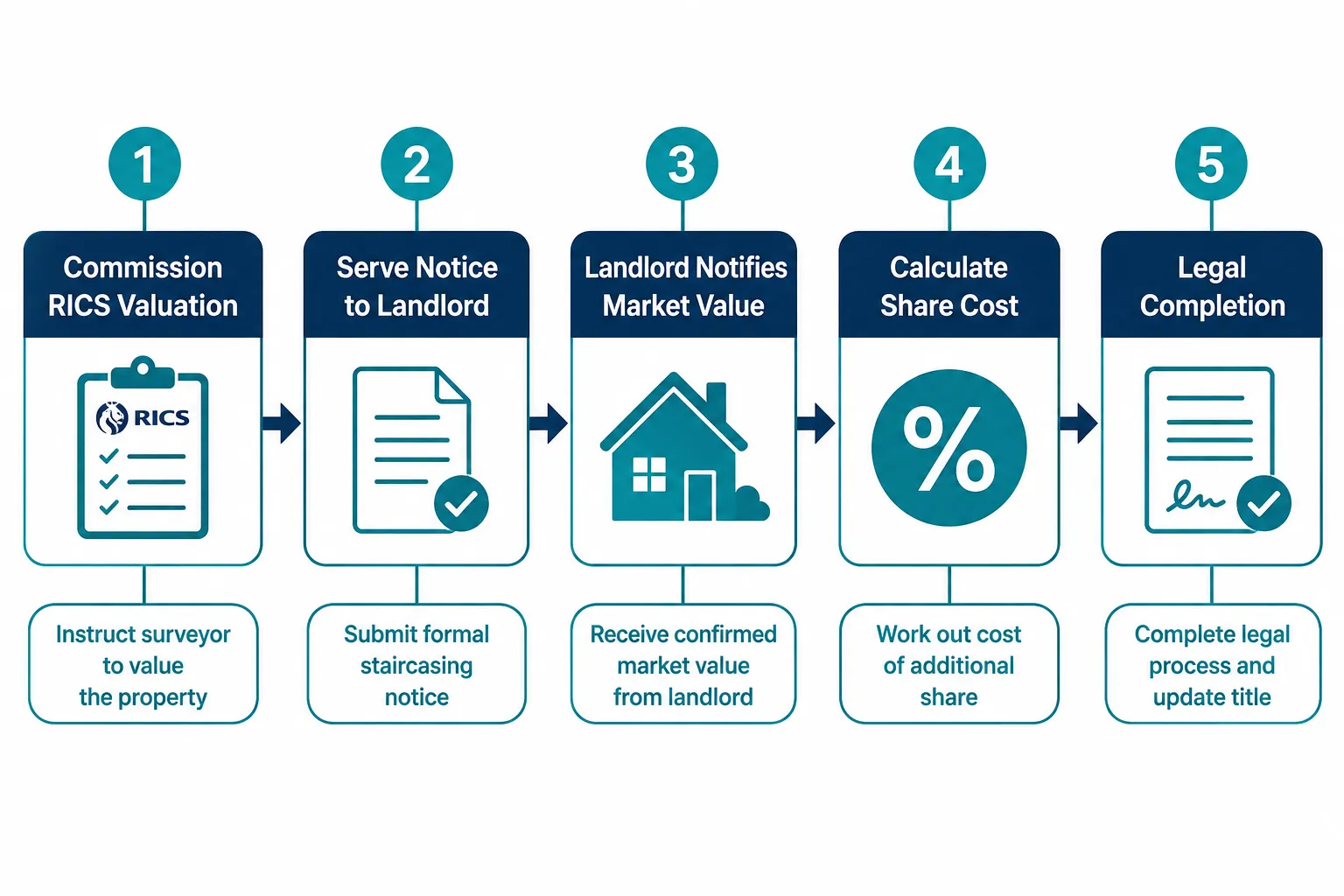
The process for standard staircasing, buying more than the 1% annual increment, follows a defined sequence embedded in the shared ownership lease and reinforced by Homes England's Capital Funding Guide. [1] Here is how it works from start to finish.
Step 1: The Leaseholder Commissions a RICS Valuation
The leaseholder is responsible for commissioning and paying for the RICS valuation. This is not a mortgage valuation or a desktop estimate, it must be a formal Red Book valuation carried out by a RICS Registered Valuer who inspects the property in person. [1]
For guidance on what a formal valuation involves, the Red Book Valuation London service page explains the standards that apply. Typical fees for a shared ownership staircasing valuation in the London market range from approximately £200 to £500, depending on property size and location. [3]
Step 2: The Leaseholder Serves Notice to the Landlord
Once the valuation is in hand, the leaseholder formally notifies the housing association of their intention to staircase. This notice triggers the landlord's obligations under the lease, including the requirement to respond within fixed time limits. [1]
Step 3: The Landlord Confirms Market Value and Calculates the Purchase Price
Under the Homes England model lease, the landlord must notify the leaseholder of the determined market value within 14 days of the application and within seven days of receiving the valuation report. [1] The landlord may appoint their own valuer to review or confirm the figure, and in some cases this leads to a different number than the leaseholder's own report, a situation discussed in more detail below.
Step 4: The Share Cost Is Calculated
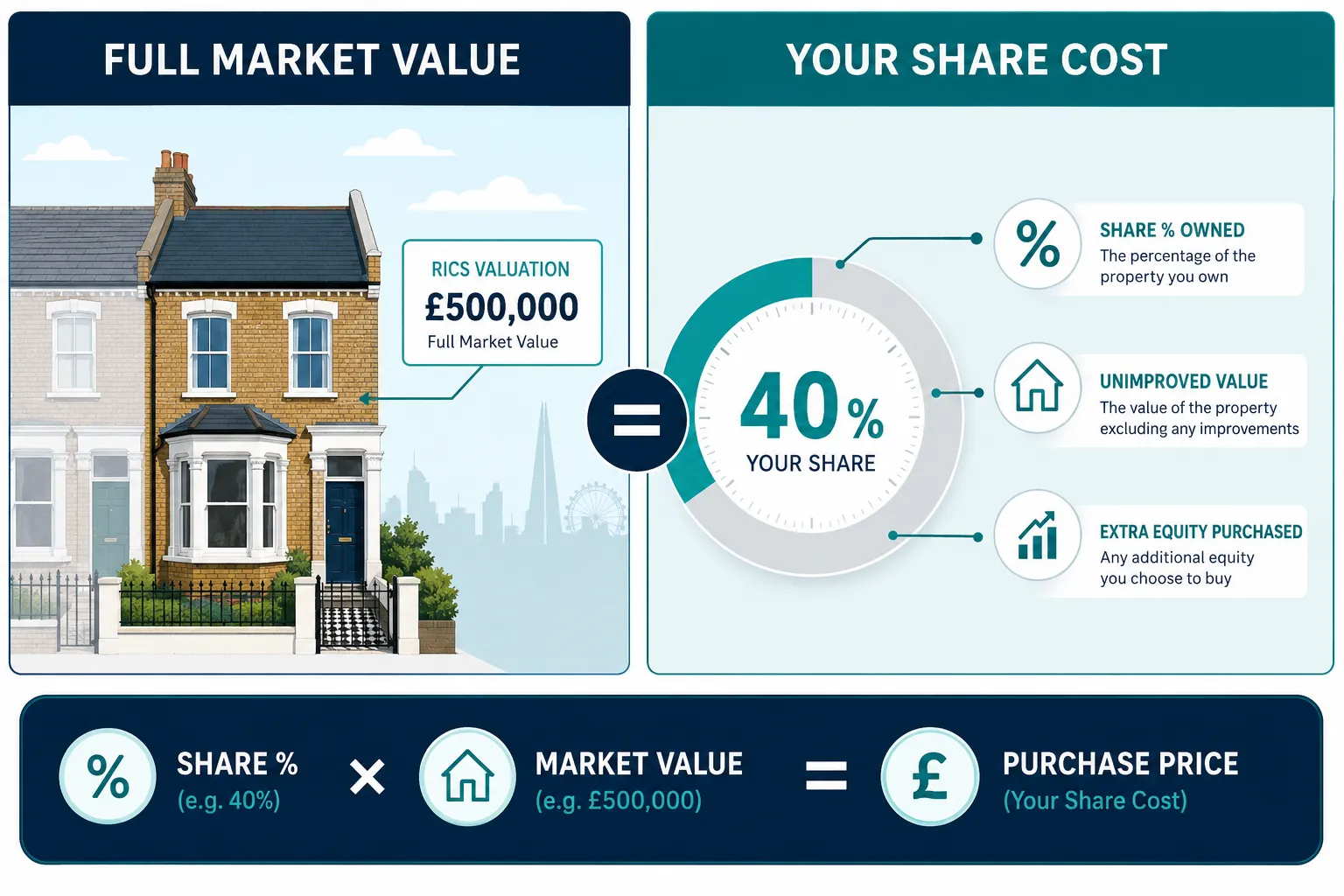
The formula is straightforward:
Cost of additional share = Percentage being purchased x Full market valuation
For example, if a leaseholder currently owns 40% of a London flat and wishes to staircase to 60%, they are purchasing an additional 20% share. If the surveyor's valuation of the whole property is £350,000, the cost of that 20% is:
20% x £350,000 = £70,000
This formula is confirmed in housing association staircasing policies and national guidance. [6][9][3]
Step 5: Legal Completion
The leaseholder arranges mortgage finance (if needed), instructs a solicitor, and completes the legal transfer of the additional share. Legal fees for each staircasing event typically range from £500 to £1,500. [3] Each step is a separate legal transaction, regardless of how small the share being purchased.
How Surveyors Assess Market Value: The Methodology Behind Shared Ownership Staircasing Valuations
Understanding how a RICS valuer arrives at the market value figure is essential for any leaseholder planning to staircase. The methodology is not arbitrary, it follows a defined definition and draws on specific evidence.
The Legal Definition of Market Value
For shared ownership staircasing, "market value" has a precise meaning: the price the property would achieve on the open market if sold by a willing seller, assuming the buyer acquires a 100% interest in the lease. [1] This is important because it means the valuer is not assessing the value of just the share currently held, they are valuing the whole property as if it were being sold outright.
Comparable Sales Evidence
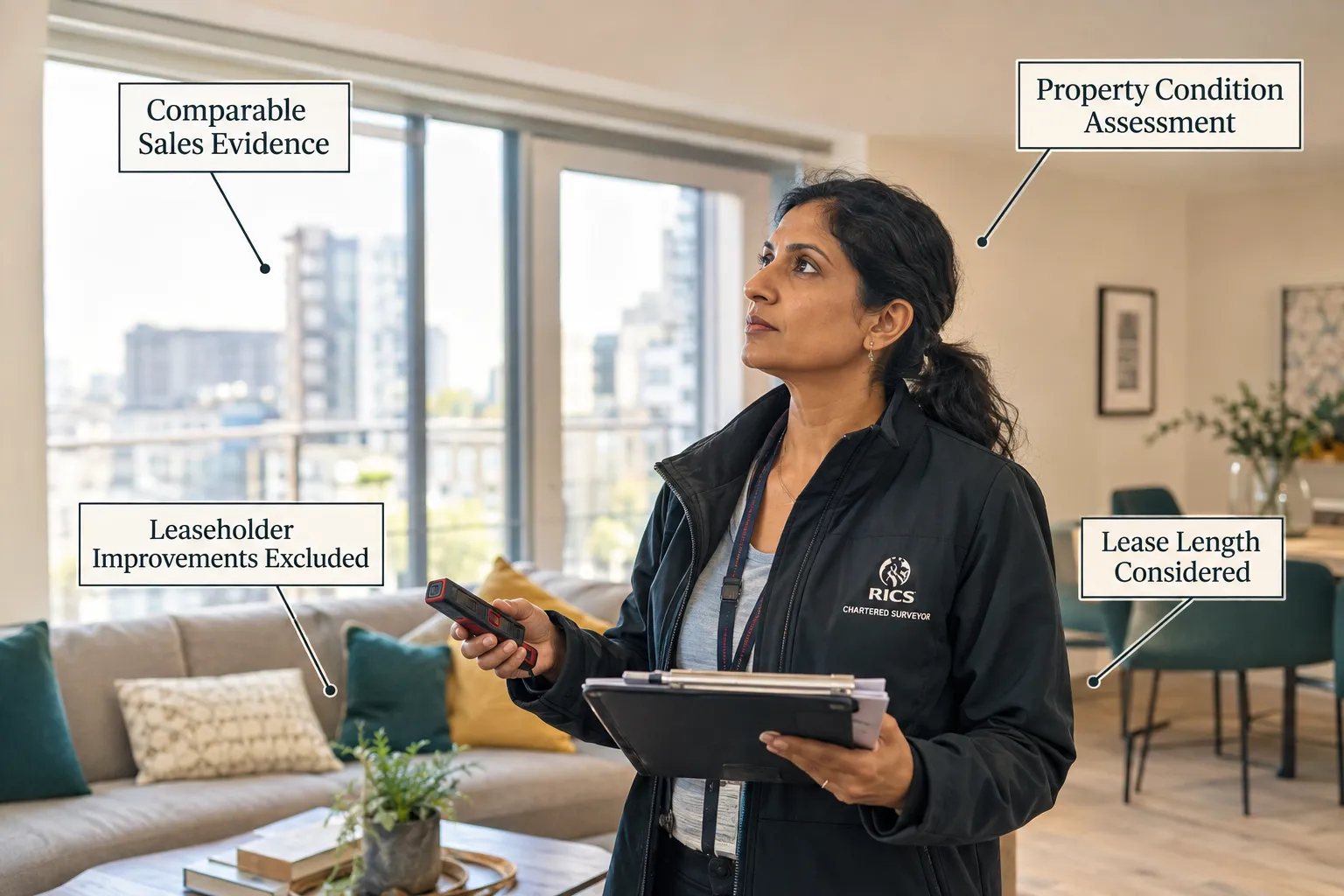
The primary method used by RICS valuers for residential property is the comparable sales approach. The surveyor identifies recent sales of similar properties in the same area, ideally within the last three to six months, and adjusts for differences in size, condition, floor level, lease length, and location. In active London markets, comparable evidence is usually available, but in less liquid submarkets the valuer may need to draw on a wider geographic area or older sales data, applying appropriate adjustments.
The Unimproved Value Rule: A Critical Protection for Leaseholders
One of the most important, and least understood, aspects of shared ownership staircasing valuations is the treatment of leaseholder-funded improvements. Government guidance is clear: the staircasing price is normally based on the unimproved value of the property, meaning the valuer must exclude any uplift in value that results from improvements the leaseholder has paid for themselves. [11][12]
This protection prevents a leaseholder from effectively paying twice, once for the cost of the improvement and again for the higher equity value it creates. For example, if a leaseholder fitted a new kitchen worth £15,000 that added £20,000 to the property's market value, the staircasing valuation should reflect the property's value without that kitchen improvement.
In practice, the leaseholder should inform the valuer of all improvements made since the original purchase and provide evidence (receipts, planning permissions, etc.) to support the unimproved basis of assessment.
Lease Length Considerations
Shared ownership properties are typically held on long leases, but as the lease shortens, its impact on value increases. A valuer will consider the remaining lease term and, where relevant, whether a lease extension is pending. Leaseholders planning to staircase on a property with a shorter lease should be aware that the lease extension valuation process may interact with their staircasing plans.
Property Condition
The surveyor will inspect the property and note its physical condition. Unlike a structural survey or a HomeBuyers Report vs Building Survey comparison exercise, a staircasing valuation is focused on value rather than defects, but significant disrepair will be reflected in the market value figure.
The 1% Annual Staircasing Option: A Different Valuation Approach
For shared ownership leases granted under post-2021 Homes England programmes, a new 1% annual staircasing option was introduced. This route uses a fundamentally different valuation methodology. [1][8][12]
Instead of commissioning a new RICS inspection, the price of the 1% share is calculated by adjusting the original purchase price of the home in line with the Land Registry House Price Index (HPI). [1][8] This means:
- No surveyor inspection is required for each 1% step
- The calculation is formula-based and more predictable
- Some housing associations mirror this approach using the original valuation plus annual HPI movement [15]
| Staircasing Type | Valuation Method | Surveyor Required | Typical Frequency |
|---|---|---|---|
| Standard (5%+ steps) | Fresh RICS Red Book valuation | Yes | Each step |
| 1% Annual Option | Original price x HPI adjustment | No | Annually |
| Final Staircasing to 100% | Fresh RICS Red Book valuation | Yes | Once |
The 1% route offers lower transaction costs and greater certainty, but it is only available on qualifying new leases and does not eliminate the need for a full RICS valuation when purchasing larger increments or completing to 100%. [1][8]
Valuation Disputes and the Tolerance Rule
Valuation disputes are one of the most contentious areas in shared ownership staircasing. Because the landlord often appoints their own valuer, and because the leaseholder also obtains their own report, two competent RICS valuers can legitimately arrive at different figures. [7]
RICS guidance acknowledges a tolerance of approximately 15% between two competent residential valuations. A difference within this range does not in itself indicate an error or misconduct by either valuer. [3][7] However, campaign groups and leaseholder advocates have raised concerns about perceived systematic over-valuations by landlord-appointed surveyors, and there are growing calls for greater transparency in how valuation evidence is shared with leaseholders. [7]
If a leaseholder believes the landlord's valuation is significantly higher than the market evidence supports, they have several options:
- Request a copy of the valuation report and supporting comparables
- Commission a second independent RICS valuation
- Refer the dispute to the First-tier Tribunal (Property Chamber) for a determination
- Seek advice from the Housing Ombudsman or a specialist shared ownership solicitor
Valuation Validity Period
RICS valuations for staircasing are typically valid for three months from the date of inspection. [3][7] If the transaction does not complete within that window, a fresh valuation will be required, at additional cost. This makes timing critical, particularly in a fast-moving market where values may change significantly between the valuation date and completion.
Practical Guidance for London Shared Ownership Leaseholders
London's property market presents specific considerations for leaseholders planning to staircase. Values vary enormously across boroughs, and the availability of comparable sales evidence differs between inner and outer London.
Leaseholders across the capital can access qualified RICS valuers through local chartered surveyor services. Whether a property is in North London, South East London, Ealing, or Richmond, using a surveyor with genuine local market knowledge improves the accuracy and defensibility of the valuation.
Practical Steps Before Commissioning a Valuation
- Check the lease terms, confirm the minimum staircase increment permitted and whether the 1% annual option applies.
- Gather improvement records, compile all receipts, planning approvals, and completion certificates for works carried out since the original purchase.
- Research local comparables, check Rightmove Sold Prices and the Land Registry for recent sales of similar properties to form a realistic expectation of value.
- Confirm the landlord's process, ask the housing association for their staircasing policy document, which should set out timelines and their approach to valuation. [6][9]
- Budget for all transaction costs, in addition to the RICS valuation fee (£200,£500), allow for solicitor fees (£500,£1,500) and any mortgage arrangement costs. [3]
Downward Staircasing
It is worth noting that downward staircasing, selling shares back to the landlord, uses the same valuation methodology as upward staircasing. The amount refunded to the leaseholder is the relevant percentage of the current open-market value as determined by an independent RICS valuer. [10] This symmetry ensures that the same rules apply whether equity is being gained or reduced.
For a broader understanding of property valuation services relevant to London leaseholders, the property valuation in London overview provides useful context on the range of RICS valuation types available.
Conclusion
Shared Ownership Staircasing Valuations: How Surveyors Calculate Your Increased Equity Step-by-Step is a process that rewards preparation. The core formula, share percentage multiplied by full market value, is simple, but the accuracy of the market value figure depends entirely on the quality of the RICS valuation underpinning it.
Key actions for any leaseholder planning to staircase in 2026:
- Commission a RICS Red Book valuation from a surveyor with demonstrable local market knowledge, not simply the cheapest option available.
- Assert the unimproved value rule by documenting all leaseholder-funded improvements before the valuation inspection takes place.
- Act within the three-month validity window to avoid the cost and delay of a second valuation.
- Review the landlord's valuation report and do not hesitate to seek a second opinion or formal dispute resolution if the figures diverge significantly.
- Factor in all transaction costs, valuation, legal, and mortgage fees, when calculating the true cost of each staircasing step.
Buying additional equity in a shared ownership property is one of the most significant financial decisions a leaseholder will make. A clear understanding of how surveyors calculate that equity, step by step, is the foundation for making that decision confidently.
References
[1] 1 Shared Ownership – gov.uk
[2] Shared Ownership Valuation 2025 – andrewbaum.com
[3] UK Shared Ownership Staircasing – calchub.uk
[4] Help To Buy Valuation What You Need To Know – surveymerchant.com
[5] Valuation HTB – spi-surveyors.com
[6] Staircasing Policy September 2025 – assets-eu-01.kc-usercontent.com
[7] Staircasing Valuation Disputes Homes England – sharedownershipresources.org
[8] CFG Chapter 4 Shared Ownership – london.gov.uk
[9] Staircasing Policy August 2025 – assets-eu-01.kc-usercontent.com
[10] Shared Ownership Joint Guidance – assets.publishing.service.gov.uk