
Dilapidations claims against commercial tenants in England and Wales regularly run into tens of thousands of pounds, sometimes hundreds of thousands for larger London offices and retail units. Yet a significant proportion of those disputes could be avoided entirely if one straightforward document had been prepared on the day the lease was signed: a schedule of condition.
A commercial dilapidation survey, and specifically the production of a schedule of condition at lease commencement, is one of the most cost-effective risk-management tools available to both landlords and tenants. This guide explains how schedules of condition work, why the RICS professional framework supports their use, and what landlords and tenants in London and beyond should do right now to protect their positions before lease-end disputes arise.
Key Takeaways
- A schedule of condition records the exact state of a commercial property at lease start, creating an agreed baseline that limits tenant liability at lease end.
- Without a schedule of condition, landlords can claim repair costs based on a theoretical "fully repaired" standard, regardless of the property's actual condition when the tenant moved in.
- RICS guidance, most recently updated in 2024, sets professional standards for how dilapidations services, including schedules of condition, should be delivered.
- The RICS Dilapidations Dispute Resolution Scheme provides a structured, cost-effective alternative to litigation when lease-end disagreements do arise.
- Commissioning a schedule of condition from a qualified chartered surveyor at lease start is a proportionate, affordable step that can save both parties significant time and legal costs.
What Is a Commercial Dilapidation Survey and Why Does It Matter
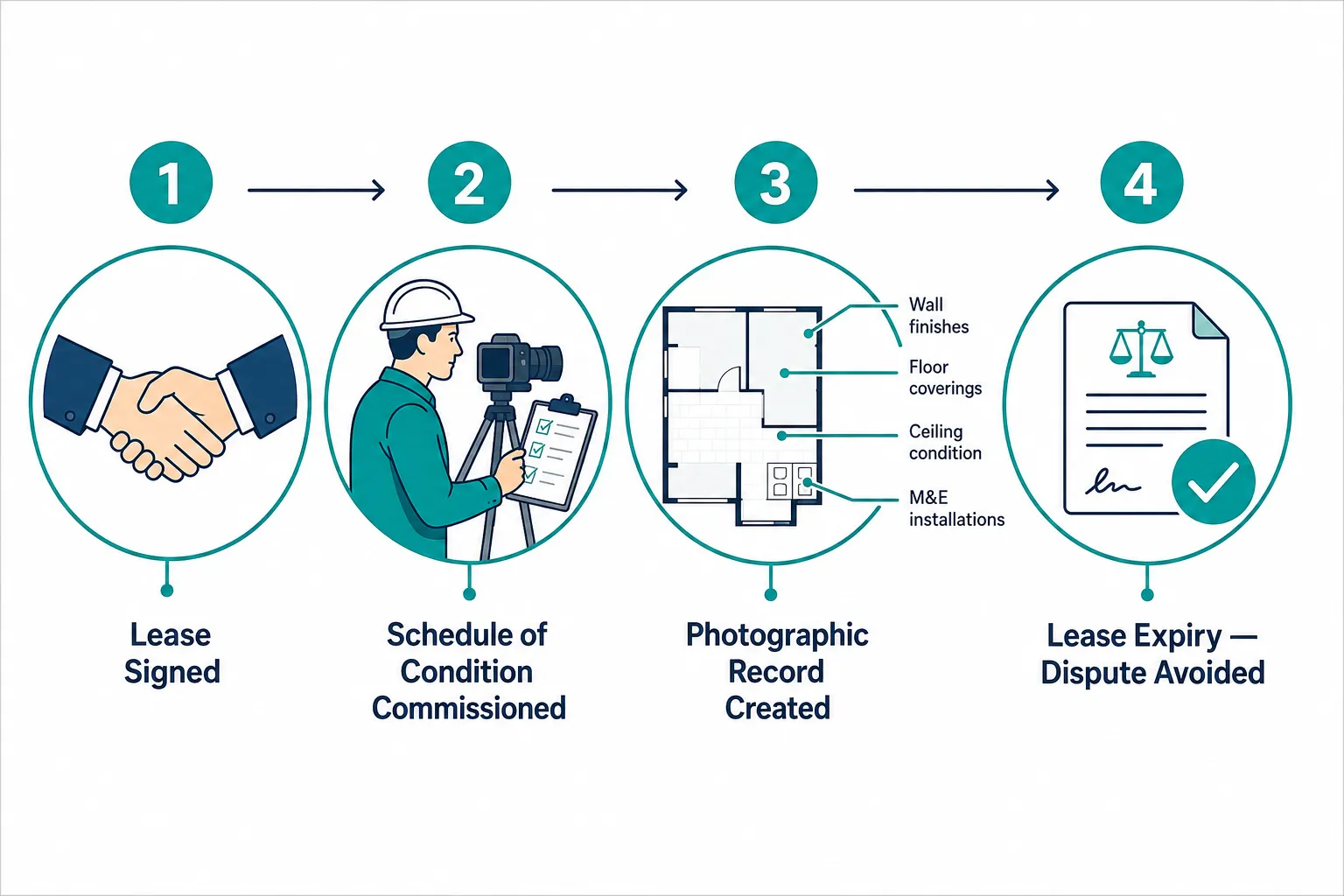
A commercial dilapidation survey is a formal inspection of a commercial property, an office, retail unit, warehouse, or other business premises, carried out to assess its physical condition in relation to the repairing obligations set out in the lease. These surveys are most commonly associated with the end of a lease, when a landlord serves a schedule of dilapidations on the outgoing tenant, setting out the repairs, reinstatement works, and redecoration they claim are required.
However, the most strategically valuable form of commercial dilapidation survey is the one carried out at the beginning of a lease, not the end. This is the schedule of condition.
What is a schedule of condition?
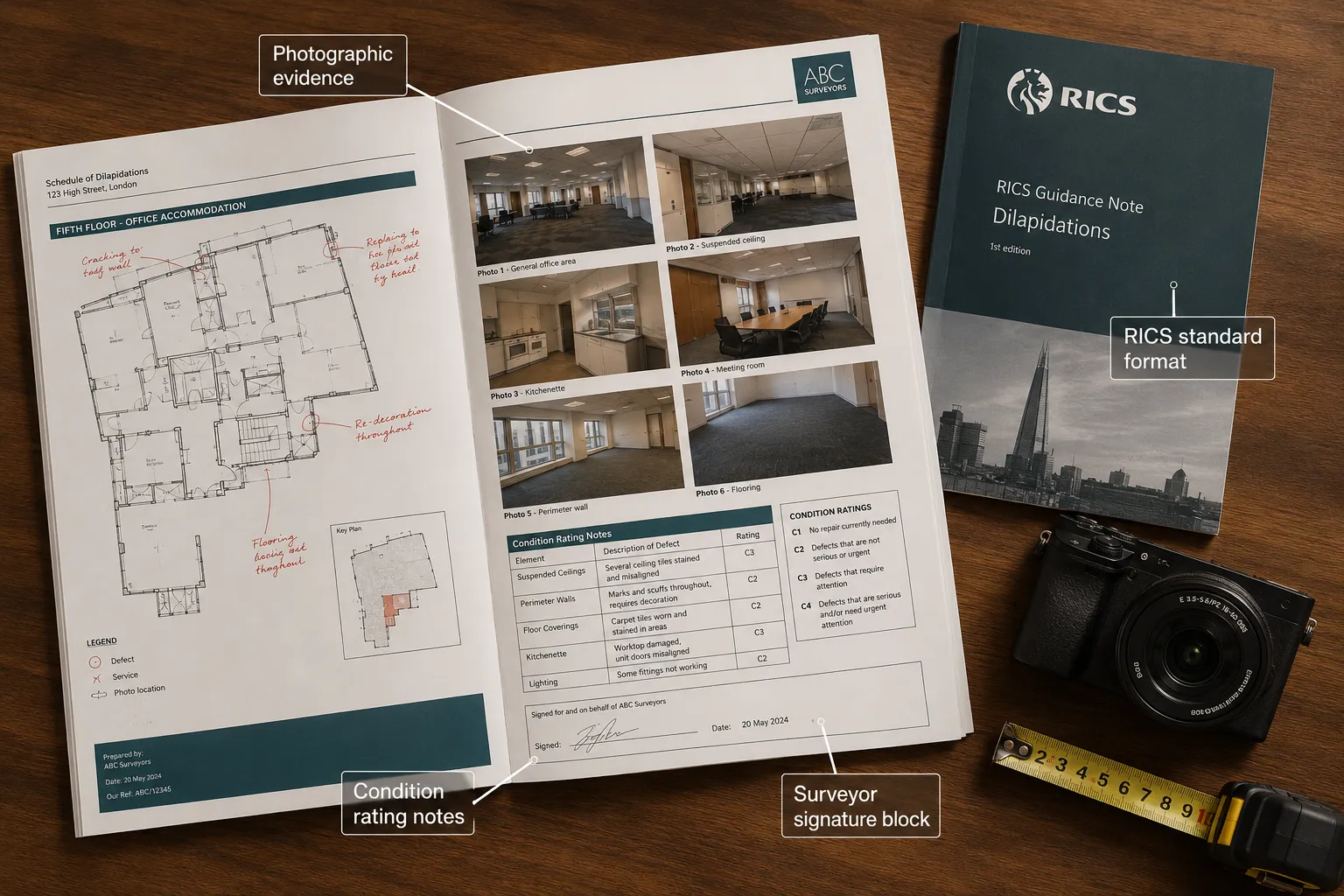
A schedule of condition is a detailed, photographic and written record of the state of a property at a specific point in time, typically the date a lease is granted or shortly before. It documents every element of the building fabric: walls, floors, ceilings, windows, doors, roof, mechanical and electrical installations, and external areas. The record is then appended to the lease, so that the tenant's repairing obligations are qualified by the condition of the property at the outset.
In practical terms, this means a tenant is only required to hand back the property in the same condition it was in when they took it, not in a better condition. Without this protection, standard full repairing and insuring (FRI) lease terms can expose tenants to claims for repairs that were never their responsibility to begin with.
RICS guidance confirms that schedules of condition form a recognised part of professional dilapidations services [1]. The RICS professional standard for dilapidations in England and Wales sets out the obligations of surveyors when preparing these records, including requirements around objectivity, photographic evidence, and the format of written descriptions [3].
For London commercial properties, where lease premiums are high and building conditions vary enormously between older Victorian stock and modern fit-out spaces, the schedule of condition is not a luxury. It is a fundamental safeguard.
Those seeking specialist support for commercial properties in the capital can explore Commercial Dilapidation Survey London services to understand the scope of professional inspections available.
The RICS Framework: Standards That Govern Commercial Dilapidation Surveys
The professional standards governing dilapidations work in England and Wales are published by the Royal Institution of Chartered Surveyors. The core document, the RICS professional standard on dilapidations, has been through multiple editions, with the most recent substantive edition being the 7th, originally published in 2016 [1]. A rebranded version was released in 2024, updating the document's presentation while preserving its substantive requirements [5].
What the RICS standard requires
The RICS standard defines "Dilapidations Services" broadly to include the preparation of schedules of condition, interim schedules of dilapidations, terminal schedules of dilapidations, and Scott Schedules used in dispute resolution [1]. For each service, the standard sets out:
- The obligations of the instructed surveyor
- The level of inspection required
- The standard of evidence that must be produced
- The professional conduct expected when acting for landlord or tenant
The guidance is mandatory for RICS members in private practice and has direct implications for the quality and reliability of any schedule of condition produced [3].
Scotland: a separate framework
It is important to note that dilapidations law and practice in Scotland differs materially from England and Wales. RICS publishes separate guidance for Scotland, currently in its 2nd edition, which reflects the distinct legal framework north of the border [6]. Practitioners and property occupiers in Scotland should refer to that jurisdiction-specific guidance rather than the England and Wales standard [9].
The RICS Dilapidations Dispute Resolution Scheme
When lease-end disputes do arise despite best efforts, the RICS Dilapidations Dispute Resolution Scheme provides a structured, expert-led process for resolving disagreements without resorting to the courts [10]. The scheme uses independent RICS-appointed experts or arbitrators to determine contested dilapidations claims. It is generally faster and less expensive than litigation, and its existence reflects RICS's broader emphasis on resolution over conflict.
For landlords and tenants engaged with Commercial Property Surveyors London, understanding this dispute resolution pathway is as important as understanding the survey process itself.
How a Schedule of Condition Prevents Lease-End Disputes in Practice
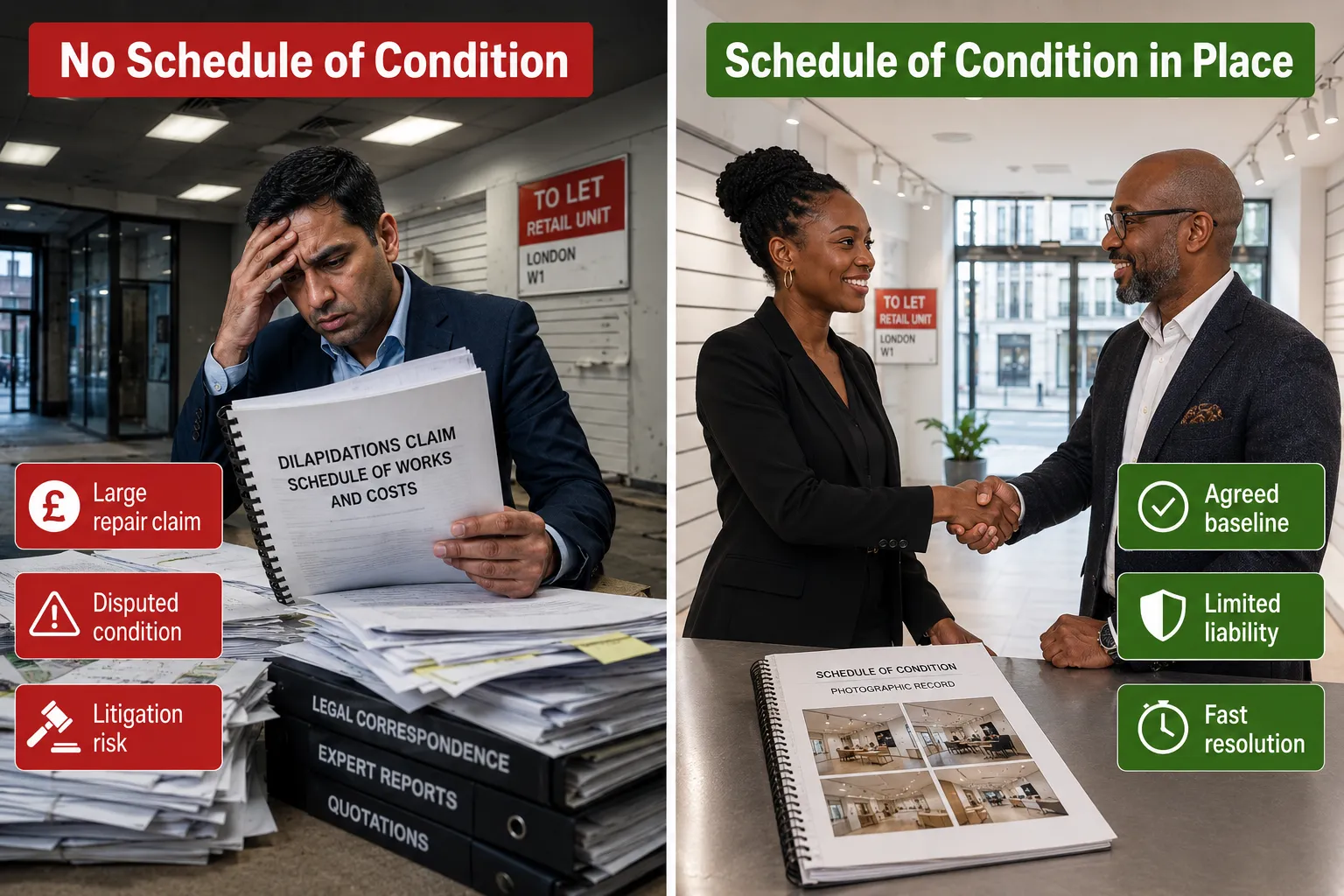
The mechanism by which a schedule of condition reduces lease-end disputes is straightforward, but its impact is significant. Consider two scenarios drawn from typical London commercial property situations.
Scenario 1: London office unit, no schedule of condition
A tenant takes a 10-year lease on a 3,000 sq ft office in an Edwardian building in the City of London. The building has pre-existing cracks in the plasterwork, dated decorations, and aging mechanical plant. No schedule of condition is prepared. At lease end, the landlord serves a terminal schedule of dilapidations claiming full redecoration, plaster repairs, and replacement of the mechanical plant. The total claim exceeds £120,000. The tenant argues that much of the claimed work relates to pre-existing defects, but without documentary evidence, the dispute becomes a protracted and expensive legal argument.
Scenario 2: London retail unit, schedule of condition in place
A tenant takes a 5-year lease on a retail unit in a South London high street. Before the lease is signed, a RICS-qualified surveyor carries out a commercial dilapidation survey and produces a detailed schedule of condition, with annotated photographs of every surface and element. The schedule is appended to the lease. At lease end, the landlord's surveyor prepares a dilapidations claim, but the tenant's surveyor can demonstrate, using the schedule, that several claimed items were already in poor condition at lease start. The claim is reduced substantially, and the matter is resolved by negotiation within weeks.
These scenarios are not hypothetical extremes. They reflect the everyday reality of commercial lease-end negotiations across London and the wider UK market.
Key elements of an effective schedule of condition
| Element | Purpose |
|---|---|
| Dated, annotated photographs | Provide irrefutable visual evidence of condition at lease start |
| Written condition descriptions | Supplement photographs with precise language for each element |
| Floor plan cross-references | Link written and photographic records to specific locations |
| Surveyor's signature and RICS credentials | Confirm professional standard and admissibility in dispute |
| Lease annexure confirmation | Ensure the schedule is legally incorporated into the lease |
"A schedule of condition is only as useful as the care taken in producing it. A superficial record prepared without professional rigour will offer limited protection when a substantial claim is made."
The RICS consumer guidance on dilapidations confirms that tenants should seek professional advice before signing a lease, and that understanding repairing obligations, including the value of a schedule of condition, is a key part of that process [7].
For those who want to understand the broader scope of professional property inspections, the Commercial Building Surveys London service page provides useful context on what a thorough commercial survey covers.
Practical Steps: Commissioning a Schedule of Condition
Commissioning a schedule of condition is not a complex process, but it must be done at the right time and by the right professional. The following steps outline the process for both landlords and tenants.
Step 1: Instruct a RICS-qualified surveyor before the lease is signed
The schedule of condition must be prepared before, or at the very latest, simultaneously with, lease execution. A schedule prepared after the lease is signed has no legal effect as a qualifier on the repairing obligations. Instruction should be given as soon as heads of terms are agreed.
Step 2: Define the scope of the inspection
The surveyor should inspect all areas covered by the tenant's repairing obligations. For a full repairing and insuring lease, this will typically mean the entire demise, including the structure and exterior. For an internal repairing lease, the scope may be limited to internal finishes and fittings. The scope must match the lease obligations precisely.
Step 3: Ensure the record is comprehensive
A professional schedule of condition will include:
- High-resolution, dated photographs of every surface, element, and installation
- Written descriptions using recognised condition terminology
- A floor plan or site plan cross-referencing the photographic record
- Notes on any pre-existing defects, including cracks, damp, or mechanical wear
Those concerned about specific issues such as damp should note that a schedule of condition will record existing damp evidence, but a separate specialist investigation may be warranted. The Damp Survey Cost Guide provides useful background on what damp investigations involve and cost.
Step 4: Incorporate the schedule into the lease
The schedule must be formally annexed to the lease agreement and expressly referenced in the repairing covenants. This is a legal step that requires coordination between the surveyor and the solicitor acting on the transaction. Without formal incorporation, the schedule has no binding effect on the lease obligations.
Step 5: Retain copies securely
Both parties should retain certified copies of the schedule throughout the lease term. Digital copies should be stored in multiple locations. A schedule that cannot be produced at lease end is of no practical value.
Costs and proportionality
The cost of a schedule of condition is modest relative to the potential value of a dilapidations claim. For a typical London office or retail unit, professional fees for a schedule of condition will generally be a small fraction of the annual rent, and a very small fraction of the dilapidations liability it may prevent. Those wanting to benchmark professional survey costs more broadly can refer to the How Much Does a Building Survey Cost? guide for context.
Tenant and Landlord Obligations: Understanding the Repairing Covenant
A commercial dilapidation survey at lease end is ultimately a test of whether the tenant has complied with the repairing covenant in the lease. Understanding what that covenant requires, and how a schedule of condition modifies it, is essential for both parties.
Standard repairing obligations
Under a typical FRI lease, the tenant is obliged to:
- Keep the property in good and substantial repair throughout the lease term
- Redecorate at specified intervals and at lease end
- Reinstate any alterations made during the term
- Yield up the property in the condition required by the lease at expiry
Without a schedule of condition, the standard against which the tenant's compliance is measured is a theoretical "fully repaired" standard, not the actual condition of the property when the tenant took it. This is a critical distinction. A tenant who takes a building in poor condition and maintains it in the same condition throughout the lease may still face a substantial dilapidations claim, because the "fully repaired" standard requires the building to be in a condition it was never in during the tenant's occupation.
How the schedule of condition changes the equation
When a schedule of condition is properly incorporated into the lease, the repairing covenant is qualified. The tenant is only required to keep the property in no worse condition than that recorded in the schedule. This does not eliminate the repairing obligation, the tenant must still maintain the property and prevent deterioration, but it removes the liability for pre-existing defects and pre-existing wear.
Interim dilapidations
Landlords should also be aware that they are entitled to serve an interim schedule of dilapidations during the lease term if the property falls into disrepair. A schedule of condition is equally useful in this context, as it establishes the baseline against which any deterioration is measured. The RICS professional standard addresses interim schedules as a distinct service within the broader dilapidations framework [1].
For those involved in commercial lease negotiations or disputes, the Construction Disputes Resolution resource provides additional context on how property-related disputes are managed professionally.
Common Mistakes That Lead to Lease-End Disputes
Even where parties intend to use a schedule of condition, errors in the process can undermine its effectiveness. The following are the most common mistakes seen in practice.
Mistake 1: Preparing the schedule after the lease is signed
As noted above, a schedule prepared after lease execution cannot qualify the repairing obligations retrospectively. This is the single most common and costly error.
Mistake 2: Using a superficial or incomplete record
A schedule that omits significant areas of the property, uses low-quality photographs, or fails to describe pre-existing defects with sufficient precision will provide limited protection. Courts and dispute resolution panels will scrutinise the quality of the evidence.
Mistake 3: Failing to incorporate the schedule into the lease
A schedule of condition that is not formally annexed to the lease and referenced in the repairing covenants is legally ineffective. This is a solicitor's responsibility, but the surveyor and client should both confirm it has been done.
Mistake 4: Not retaining the schedule for the full lease term
Leases of 10, 15, or 25 years are common in the commercial sector. A schedule prepared at lease start must be retained and accessible for the entire term.
Mistake 5: Relying on a schedule without professional input at lease end
A schedule of condition is a starting point, not a complete solution. At lease end, a qualified surveyor should review both the schedule and the current condition of the property to advise on the scope of any legitimate dilapidations claim or defence. The Commercial Property Surveyors London team can assist with both initial schedules and lease-end dilapidations advice.
Forward-Looking Considerations for 2026 and Beyond
The commercial property market in 2026 continues to evolve, with shorter lease terms, increased use of break clauses, and growing tenant demand for flexibility. These trends have implications for dilapidations practice.
Shorter leases, more frequent dilapidations events
As average commercial lease lengths shorten, the frequency of lease-end dilapidations events increases. This places greater pressure on both landlords and tenants to have robust documentation in place from the outset. A schedule of condition becomes even more valuable when a lease is only three or five years long, as there is less time for the parties to negotiate informally.
Predicted increase in RICS dispute resolution use
It is reasonable to expect, though not yet established as fact, that the RICS Dilapidations Dispute Resolution Scheme will see increased use as more leases expire in a market where both landlords and tenants are under financial pressure [10]. The scheme's cost-effectiveness relative to litigation makes it an attractive option for resolving disputes where a schedule of condition has narrowed but not eliminated the area of disagreement.
Environmental and fit-out considerations
Increasing emphasis on environmental performance and tenant fit-out works means that reinstatement obligations are becoming more complex. Schedules of condition should document the pre-existing state of mechanical and electrical plant, energy systems, and any landlord-installed fit-out elements with particular care.
Those managing commercial properties alongside leasehold interests may also find the Lease Extension Estimate and FAQs resource useful for understanding how lease terms interact with property value and obligations more broadly.
Conclusion
A commercial dilapidation survey that includes a professionally prepared schedule of condition at lease commencement is one of the most effective and proportionate steps a landlord or tenant can take to prevent costly lease-end disputes. The evidence is clear: disputes that reach formal resolution, whether through the RICS Dilapidations Dispute Resolution Scheme or the courts, are expensive, time-consuming, and damaging to commercial relationships. A well-prepared schedule of condition, properly incorporated into the lease, removes the ambiguity that drives those disputes.
Actionable next steps:
- If you are about to sign a commercial lease, instruct a RICS-qualified surveyor to prepare a schedule of condition before exchange. Confirm with your solicitor that it will be formally annexed to the lease.
- If you are a landlord granting a new lease, consider whether a schedule of condition serves your interests by providing an agreed baseline for future dilapidations claims.
- If your lease is approaching expiry, instruct a surveyor to review the original schedule of condition alongside the current property condition before any dilapidations schedule is served or received.
- If a dispute has already arisen, explore the RICS Dilapidations Dispute Resolution Scheme as an alternative to litigation [10].
- If you are in London, seek advice from surveyors with specific experience of London commercial property, where building stock, lease structures, and claim values present distinct challenges.
The RICS professional standard makes clear that the goal of dilapidations practice is fair resolution, not adversarial conflict [3]. A schedule of condition is the most practical tool available to support that goal from the very first day of a tenancy.
References
[1] September 2016 Dilapidations In England And Wales 7th Edition – rics.org
[2] Details – thenbs.com
[3] Dilapidations In England And Wales – rics.org
[4] Building Surveying Standards – rics.org
[5] Dilapidations Rebrand 2024 – rics.org
[6] Dilapidations In Scotland 2nd Edition – rics.org
[7] Dilapidations England Wales – rics.org
[9] Dilapidations In Scotland – rics.org
[10] Dilapidation Disputes – rics.org