Last updated: September 17, 2026
Quick Answer
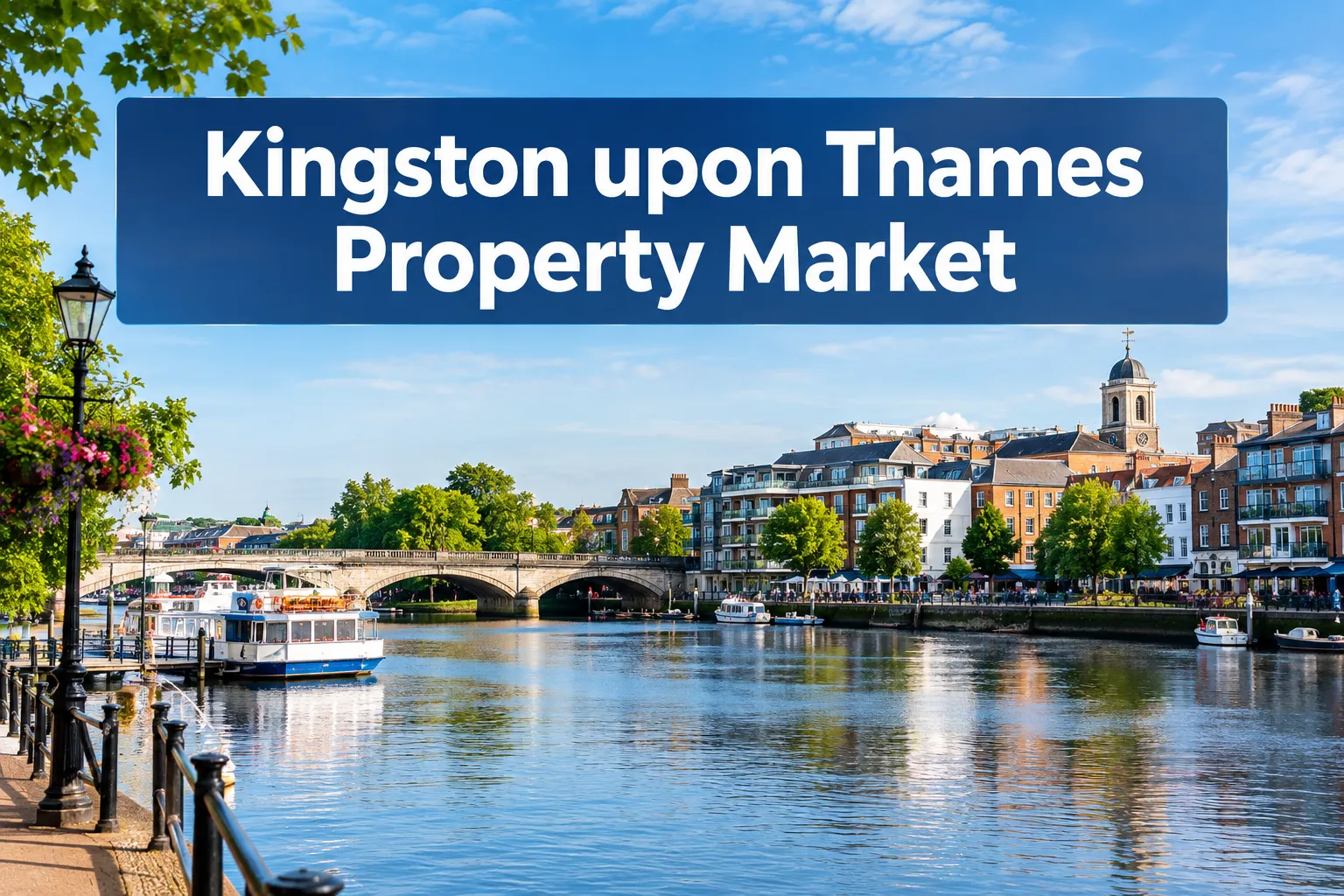
The Bank of England held Bank Rate at 4% on 17 September 2026, with the best five-year fixed mortgage deals sitting around 4.38%. Kingston upon Thames continues to outperform the wider London market, with official and index data placing the borough average between roughly £567,000 and £649,000, well above the national averages reported by Halifax (£306,000), Nationwide (£278,500) and Zoopla (£272,800). Buyers in Kingston are reacting cautiously rather than rushing back in, with longer selling times, more price reductions and hard-nosed negotiation over asking prices.
Key Takeaways
- Bank Rate held at 4% on 17 September 2026; best five-year fixes are around 4.38%, still well above pre-2022 norms.
- Kingston upon Thames average prices sit between roughly £553,000 and £649,000 depending on the index used, far above UK-wide averages from Halifax, Nationwide and Zoopla.
- Detached and terraced houses in Kingston are growing faster in value than flats, which remain the most price-sensitive segment.[1][2]
- Kingston is currently a balanced-to-buyer's market: high stock, roughly 71-304 days to sell depending on the measure, and frequent price reductions.[3][9]
- SW London as a whole averages far above England and Wales norms, and Kingston sits mid-to-upper range within that premium postcode belt.[10]
- Rate holds do not guarantee falling mortgage costs; fixed rates can still drift upward on funding pressures even when Bank Rate stays flat.
- Level 3 Building Surveys are in high demand for Kingston's Victorian terraces and older riverside stock, where structural risk is harder to spot at a glance.
- First-time buyers face the toughest affordability squeeze, though price-to-income ratios have eased from around 15.8x in 2018 to about 12.7x now.[4]
What Does the Bank of England Rate Hold Mean for House Prices?
A Bank Rate hold means the cost of new borrowing does not change overnight, but it does not automatically bring mortgage rates down either. Tracker mortgages move in step with Bank Rate, so holders saw no change in their monthly payment today. Fixed-rate mortgages are priced off swap rates and lender funding costs, which can rise even during a hold, and that has been the pattern through much of 2026.
For house prices specifically, a hold tends to steady buyer confidence without triggering a rush of new demand. Sellers get a predictable backdrop to price against, but buyers who were already stretched on affordability stay stretched. The practical effect in markets like Kingston is a slower, more negotiated sale process rather than a sudden price swing in either direction.
Kingston Upon Thames Property Market September 2026: How Did Buyers React to the BoE Rate Hold?
Buyer reaction in Kingston to the 17 September hold has been muted rather than euphoric, with agents reporting steady enquiry levels but continued pressure on asking prices. Local transaction data from July 2026 shows the pattern clearly: 76 new instructions came to market, but only 36 sales were agreed, and 71 separate price reductions were recorded in the same month.[9]
That gap between instructions and agreed sales tells its own story. Sellers are listing at ambitious prices, buyers are pushing back, and roughly two in three new listings end up needing a price cut before a sale sticks. Properties are taking an average of 71 days from listing to completion, and final sale prices land about 2% below the original asking figure, a discount of roughly £17,155 on a typical Kingston property.[9] For anyone with a chain-dependent purchase, that slower pace means completions are taking longer to line up than during the faster markets of 2021 to 2023.
What's the Average House Price in Kingston Upon Thames in 2026?
Kingston upon Thames prices sit well above UK averages, with figures ranging from roughly £553,000 to £649,000 depending on the index and time period used. Official ONS data put the provisional average at £592,000 in July 2026, up 3.3% year-on-year from £572,000 in July 2025.[1]
A closer look shows how much the "average" depends on property type:
| Metric | Figure | Source |
|---|---|---|
| ONS average, July 2026 | £592,000 (+3.3% YoY) | [1] |
| Mix-adjusted average, June 2026 | £594,498 (+2.9% YoY) | [6] |
| Median sold price, 12 months to July 2026 | £553,350 (mean £648,769) | [5] |
| Median transaction price, last 12 months | £587,500 across 426 sales | [2] |
| Detached homes | Up ~4.9% annually | [1] |
| Flats and maisonettes | Up ~1.1% annually; median around £370,000,£378,000 | [1][2][5] |
The gap between median (£553,350) and mean (£648,769) in the ward-level data is largely down to a small cluster of very high-value sales in areas such as Coombe, which pull the average upward without reflecting what a typical buyer actually pays.[5]
SW London House Prices in September 2026: Is Kingston More Expensive Than Other SW London Areas?
Kingston sits in the middle of the SW London pricing spread rather than at the very top. The wider South West London postcode area averaged around £918,000 with a median of about £630,000 across August 2025 to July 2026, well above England and Wales averages of roughly £350,000 and £280,000 respectively.[10]
Within that regional picture, KT postcode transactions (which include Kingston) show a lower median of £526,000 across 1,739 sales in 2026, roughly flat versus 2021 but about 14% higher than a decade ago.[7] KT1 specifically posted a median of £539,000 from 87 sales, with a mean of £642,000 and an average value of around £7,270 per square metre over the past five years.[8] The takeaway: Kingston is expensive by national standards but sits below the SW London average pulled up by areas like Richmond and Wimbledon, where a handful of very high-value transactions distort the headline figures.
Is It a Buyer's or Seller's Market in Kingston Upon Thames Right Now?
Kingston is currently best described as a balanced market tilting toward buyers, driven by high stock levels and long selling times. One market-condition tracker classifies it as "high stock, strong buyer conditions," with around 198 properties on sale and only about 20 completed sales a month, against an average of 304 days to sell.[3]
Choose a buyer's-market mindset if: you're purchasing a flat, since flats have the slowest price growth and the most stock competing for attention.[1][5]
Expect more competition if: you're chasing a detached family house in a top school catchment, where demand has held up better and price growth is running closer to 5% annually.[1]
Are prices actually falling? Not broadly. Official and index data show modest annual growth of roughly 1% to 3% depending on the measure, though some estate-agency sold-price series describe average figures sitting around 8% below the 2023 peak, reflecting the gap between resilient official indices and the reality of individual negotiated sales.
How Does the Rate Hold Affect Mortgage Affordability in SW London?
The rate hold keeps existing tracker payments unchanged, but it does not reverse the higher fixed rates buyers have faced through 2026. With best five-year fixes near 4.38%, monthly repayments on a typical Kingston or SW London mortgage remain significantly above the levels seen in 2021, even though headline Bank Rate has not moved.
Affordability has actually improved slightly on paper: the local price-to-income ratio has eased from about 15.8x in 2018 to around 12.7x now, as wage growth and modest price stagnation narrow the gap.[4] In practice, most buyers are budgeting to the monthly payment they can afford rather than the headline mortgage rate, which shapes how much they're willing to offer and how quickly they walk away from a stretched asking price.
Should You Buy in Kingston Now or Wait for Rate Cuts?
There is no universally right answer, but waiting purely for rate cuts carries its own risk if prices firm up once cuts arrive. Historically, Bank Rate holds can last anywhere from a few months to well over a year, and the Bank of England has given no firm signal on timing for the next cut as of September 2026.
Buy now if: you've found a property that fits your budget on today's rates, you're not depending on a rate cut to make the numbers work, and you value negotiating power in a market where sellers are already cutting prices.
Wait if: your affordability only works with a materially lower rate, or you're purchasing a flat in a segment still showing weak price growth.
Common mistake: assuming a rate hold means mortgage costs will fall soon. Fixed rates are priced off swap markets, not Bank Rate alone, and several have edged upward even during hold periods.
Best Neighbourhoods in Kingston Upon Thames for Property Investment
Kingston's strongest long-term investment case rests on transport access, school catchments and river frontage, which together keep demand steady even in a cautious market. Kingston station and Norbiton offer direct South Western Railway services into London Waterloo in around 25 to 30 minutes, making these areas magnets for commuters despite hybrid working trends.
Families weigh school catchments heavily, particularly proximity to Tiffin School and Kingston Grammar School (KGS), both of which support premiums on nearby Victorian terraces in areas like Norbiton and Fairfield. Coombe, with its larger detached houses, continues to pull the borough's mean price upward and remains the highest-value pocket.[5] Riverside apartment developments near Kingston Bridge and Canbury offer lower entry prices but slower capital growth, reflecting the wider trend of flats underperforming houses across the borough.[1][2]
What Mistakes Are Buyers Making in the Kingston Property Market Now?
The most common mistake is treating a rate hold as a green light for aggressive offers without checking actual borrowing costs first. Several other patterns are showing up locally:
- Overlooking that best-buy five-year fixes near 4.38% still require a meaningful deposit and strong credit profile.
- Skipping a Level 3 Building Survey on period terraces to save money, then discovering structural or damp issues after exchange.
- Underestimating chain delays; with average completion times around 71 days, buyers in a hurry often lose out to cash or chain-free purchasers.[9]
- Assuming all Kingston property is equally expensive, when flats and houses show very different price trends.[1][2][5]
How Does Rate Uncertainty Affect First-Time Buyers in Kingston?
Rate uncertainty hits first-time buyers hardest because they typically have the smallest deposits and the least flexibility to absorb a higher monthly payment. Many are being pushed toward flats or outer Kingston wards where entry prices sit closer to the £370,000,£400,000 range rather than the borough's higher-value terraced and detached segments.[2][5]
Improved affordability ratios help at the margins, but a first-time buyer relying on a five-year fix near 4.38% still needs a materially higher income than someone buying the same property in 2021. Building in a rate buffer, and getting a mortgage broker to stress-test the deal against a slightly higher rate, is now standard advice from local advisers.
Kingston's Property Stock and the Rise in Level 3 Building Survey Demand
Kingston's housing stock is dominated by Victorian and Edwardian terraces, interwar semis, and riverside apartment blocks, and this mix is driving strong demand for Level 3 Building Surveys ahead of purchase. Period terraces around Fairfield, Norbiton and Canbury often hide issues behind attractive facades: outdated wiring, roof timber decay, or subsidence risk near the river.
Surveyors report growing buyer appetite for the more detailed Level 3 survey over the lighter Level 2 HomeBuyer Report, especially on pre-1930s stock and riverside flats where flood risk and cladding checks matter. In a market where average sale prices sit close to £630,000, spending on a proper survey is a small percentage of the purchase price but can prevent a costly post-completion surprise.
Practical Next Steps for Buyers, Sellers and Remortgagers
Different positions call for different actions this month. Use this checklist as a starting point, then confirm specifics with a mortgage broker or conveyancer.
Buyers:
- Get a mortgage in principle at today's rates before viewing, since best five-year fixes near 4.38% change weekly.
- Order a Level 3 Building Survey on any pre-1950s Kingston property before exchange.
- Factor in the average 71-day listing-to-completion window when planning a chain-dependent move.[9]
Sellers:
- Price realistically against the £553,000 to £649,000 borough range for your property type, not last year's peak figures.[5]
- Expect buyers to negotiate; budget for a discount of roughly 2% off asking.[9]
- Be transparent about survey-flagged issues upfront to avoid late renegotiation.
Remortgagers:
- Compare five-year fixes around 4.38% against your current deal well before it expires.
- Ask your lender whether a tracker still makes sense given today's hold, versus locking in a fix.
FAQ
Did the Bank of England cut rates in September 2026?
No. The Bank of England held Bank Rate at 4% on 17 September 2026, meaning tracker mortgage payments stayed the same, though fixed-rate deals can still move independently.
What is the average house price in Kingston upon Thames right now?
Depending on the index, Kingston's average sits between roughly £553,000 and £649,000, with ONS data showing a provisional average of £592,000 in July 2026.[1][5]
Is Kingston upon Thames a buyer's market or a seller's market in 2026?
It leans toward buyers, with high stock, average selling times of several months, and frequent price reductions reported through mid-2026.[3][9]
Are house prices falling in Kingston upon Thames?
Not broadly. Official indices show modest annual growth of around 1% to 3%, though some estate-agency figures show current sale prices sitting below the 2023 peak.[1][6]
Should first-time buyers wait for a rate cut before buying in Kingston?
Only if their budget genuinely depends on a lower rate. Rate holds can last many months with no guaranteed cut, so waiting carries its own risk if prices firm up later.
Do I need a Level 3 Building Survey for a Kingston Victorian terrace?
Most surveyors recommend it. Period terraces commonly hide structural, damp or electrical issues that a lighter Level 2 report may miss, and the extra cost is small relative to typical Kingston purchase prices.
Conclusion
Kingston upon Thames enters autumn 2026 as a resilient but cautious market: prices comfortably above the national picture, but buyers negotiating hard and sellers adjusting expectations after the latest rate hold. The Bank of England's decision to hold Bank Rate at 4% has not sparked a rush of demand, and with best five-year fixes still near 4.38%, affordability remains the deciding factor for most transactions.
Anyone buying, selling or remortgaging in Kingston this month should get mortgage terms confirmed early, commission a proper survey on period stock, and price realistically against the borough's actual sold-price range rather than headline peaks. Those steps, more than guessing the timing of the next rate cut, will decide who completes smoothly and who gets stuck in a longer chain this autumn.
body{font-family:Arial,Helvetica,sans-serif;background:#f4f6f8;margin:0;padding:16px;}
.cg-wrap{max-width:520px;margin:0 auto;background:#fff;border-radius:10px;padding:18px 20px;box-shadow:0 2px 8px rgba(0,0,0,0.08);}
.cg-wrap h2{font-size:18px;color:#12314f;margin:0 0 6px;}
.cg-wrap p.cg-sub{font-size:13px;color:#555;margin:0 0 14px;}
.cg-row{margin-bottom:12px;}
.cg-row label{display:block;font-size:13px;color:#12314f;margin-bottom:4px;font-weight:bold;}
.cg-row input[type=range]{width:100%;}
.cg-row output{font-size:13px;color:#0a6b4a;font-weight:bold;}
.cg-result{background:#eef6f2;border-radius:8px;padding:12px 14px;margin-top:10px;}
.cg-result strong{color:#0a6b4a;font-size:20px;}
.cg-note{font-size:11px;color:#777;margin-top:10px;}
Kingston Mortgage Payment Estimator
See how the Bank Rate hold and mortgage rate changes affect monthly repayments on a typical Kingston-sized loan.
function cgCalc(){
var loan=parseFloat(document.getElementById(‘cg-loan’).value);
var rate=parseFloat(document.getElementById(‘cg-rate’).value);
var term=parseFloat(document.getElementById(‘cg-term’).value);
document.getElementById(‘cg-loanVal’).textContent=loan.toLocaleString();
document.getElementById(‘cg-rateVal’).textContent=rate.toFixed(2);
document.getElementById(‘cg-termVal’).textContent=term;
var r=(rate/100)/12;
var n=term*12;
var payment=loan*r/(1-Math.pow(1+r,-n));
document.getElementById(‘cg-payment’).textContent=’£’+Math.round(payment).toLocaleString();
}
[‘cg-loan’,’cg-rate’,’cg-term’].forEach(function(id){
document.getElementById(id).addEventListener(‘input’,cgCalc);
});
cgCalc();
References
[1] E09000021 – ons.gov.uk
[2] Kingston Upon Thames – offrly.co.uk
[3] Kingston Upon Thames – appraised.uk
[4] Kingston Upon Thames – pdoutlook.com
[5] Kingston House Prices – kingstonwire.co.uk
[6] Kingston House Prices June 2026 – kingstonwire.co.uk
[7] homesindex.co.uk – homesindex.co.uk
[8] homesindex.co.uk – homesindex.co.uk
[9] Kingston Upon Thames – propertysolvers.co.uk
[10] South West London House Prices – plumplot.co.uk