
Nearly one in five UK property transactions involves a buyer who later discovers a significant defect that a proper survey would have flagged, yet thousands of purchasers still rely on a basic mortgage valuation and assume it protects their interests. This Building Survey vs Valuation Survey: UK Buyer's Guide to Choosing the Right Report in 2026 cuts through the confusion by placing both report types side by side, using real buyer scenarios and current RICS standards to show exactly which service you need and why.
Key Takeaways
- A building survey and a valuation survey serve fundamentally different purposes: one assesses physical condition, the other establishes market value.
- A mortgage valuation protects the lender, not the buyer, it is not a substitute for an independent condition report.
- RICS is in the process of updating its Home Survey Standard to a second edition, with a proposed move from Levels 1-3 to descriptive "Basic, Intermediate and Advanced" products, expected to take effect by the end of 2027. [1][6]
- Under proposed changes, valuation will become optional at all survey levels, making it easier to combine condition and value assessments in a single instruction. [7]
- Choosing the wrong report type can cost buyers thousands of pounds in unexpected repair bills after completion.
What Are the Two Report Types?
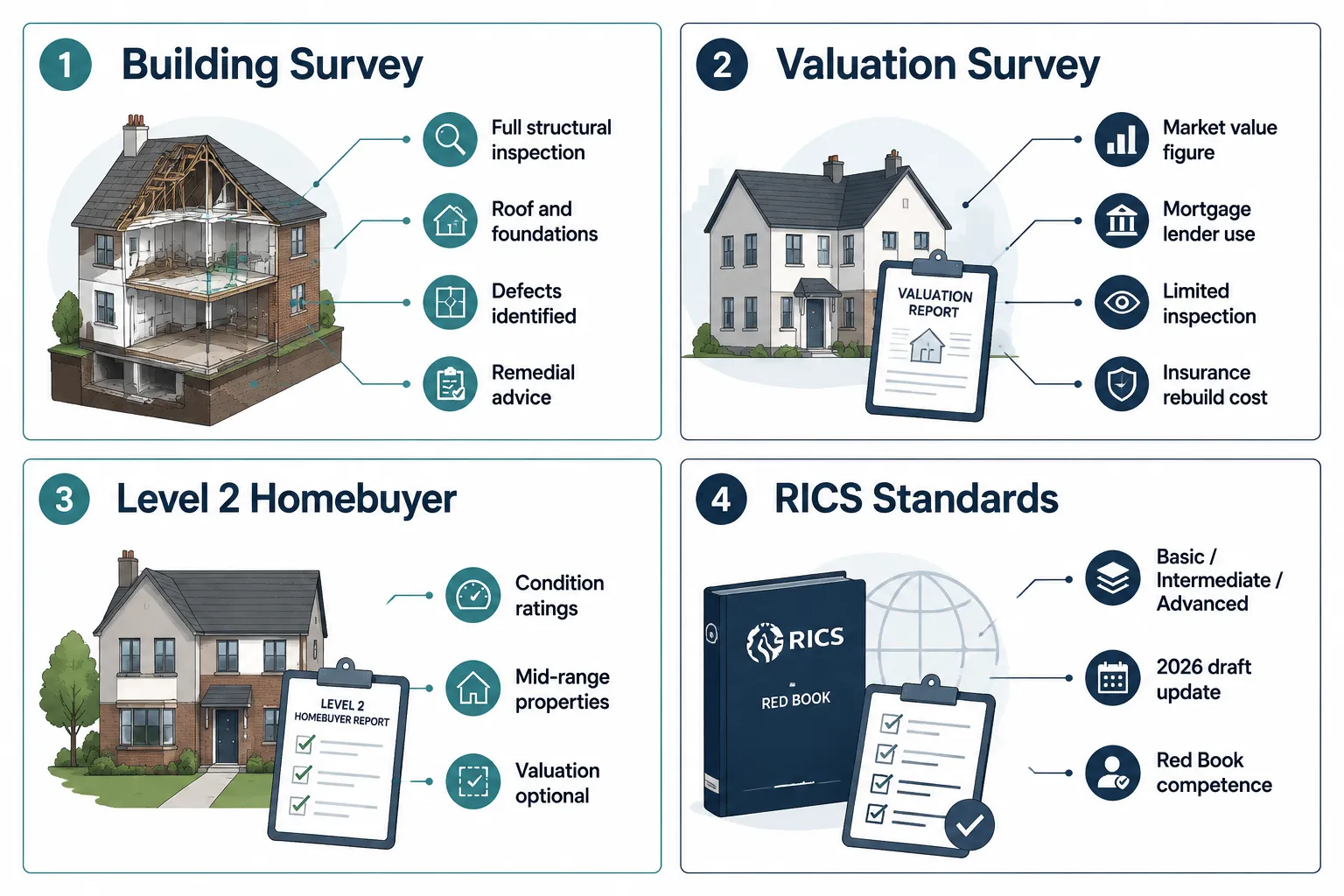
Understanding the distinction between a building survey and a valuation survey is the essential starting point for any UK property buyer in 2026.
Building Survey (Condition Report)
A building survey, currently classified under the RICS framework as a Level 3 survey, is a detailed, independent assessment of a property's physical condition. A chartered surveyor inspects accessible structural elements, roofs, walls, floors, drainage, and services. The output is a written report that identifies defects, explains their likely cause, assesses their severity, and recommends remedial action. [3]
For buyers of older, larger, or unusual properties, a building survey in London and across the UK is the most thorough protection available. It does not automatically include a market value figure, though that can be added if the surveyor holds the appropriate RICS valuation competence.
Valuation Survey
A valuation survey establishes the monetary worth of a property at a specific point in time. Lenders commission a mortgage valuation to confirm that the property provides adequate security for the loan, a process that typically involves a brief inspection or, increasingly, a desktop assessment using comparable sales data. [2]
A standalone RICS valuation, sometimes called a Red Book valuation, follows the RICS Valuation, Global Standards and produces a formal, defensible opinion of market value. This type of report is used for mortgage purposes, shared ownership staircasing, Help to Buy redemptions, and legal proceedings. [9]
The critical point: a mortgage valuation is not a survey. It will not tell a buyer whether the roof needs replacing or whether there is active subsidence.
The Level 2 Middle Ground
Between the two sits the RICS Level 2 survey, currently marketed as the "Homebuyer Report" or "Survey and Valuation." This mid-tier product combines a condition assessment using a traffic-light rating system with an optional market value and insurance reinstatement figure. It suits modern, conventionally constructed properties in reasonable condition. [9]
For buyers seeking a homebuyer survey in London, the Level 2 product offers a practical balance of detail and cost for properties built after approximately 1900 that show no obvious signs of serious defect.
How RICS Standards Are Changing in 2026 and Beyond
The regulatory landscape for home surveys is in active transition, and buyers commissioning reports in 2026 should understand what is changing and why.
RICS launched a public consultation on its Home Survey Standard second edition between 19 August and 14 October 2025. [1] A February 2026 progress update confirmed that consultation responses are being worked through by member-led panels and that the draft standard is passing through regulatory approval channels. [6] The guidance paper accompanying the consultation indicates that RICS aims to publish the second edition around March 2026, with the new standard coming into effect by the end of 2027. [10]
From Levels to Descriptive Names
One of the most significant proposed changes is the replacement of purely numerical labels, Level 1, Level 2, Level 3, with descriptive terms: Basic, Intermediate and Advanced. [7] The "Advanced" product explicitly aligns with what is currently known as the Level 3 building survey, reinforcing its role as the most comprehensive condition report available. [14]
This rename is designed to make the products more intuitive for consumers who may not understand what "Level 2" means in practice.
Valuation Becoming Optional at All Levels
Under the current framework, valuation is primarily associated with the Level 2 product. The proposed second edition would make valuation optional at all survey levels, meaning a buyer could request a valuation to be added to a Basic, Intermediate, or Advanced inspection, provided the surveyor holds the appropriate RICS Red Book valuation competence. [7]
This is a meaningful shift. Once implemented, it will blur the traditional product boundary between a "building survey" and a "survey plus valuation," while keeping a clear distinction in purpose between a condition-focused inspection and a standalone mortgage or market valuation. [7]
The draft also introduces expanded frameworks for historic buildings, new-build properties, and retrofit assessments, areas where the choice between a detailed building survey and a lighter valuation-only instruction has always been particularly consequential. [7]
Real Buyer Scenarios: Which Report Do You Actually Need?
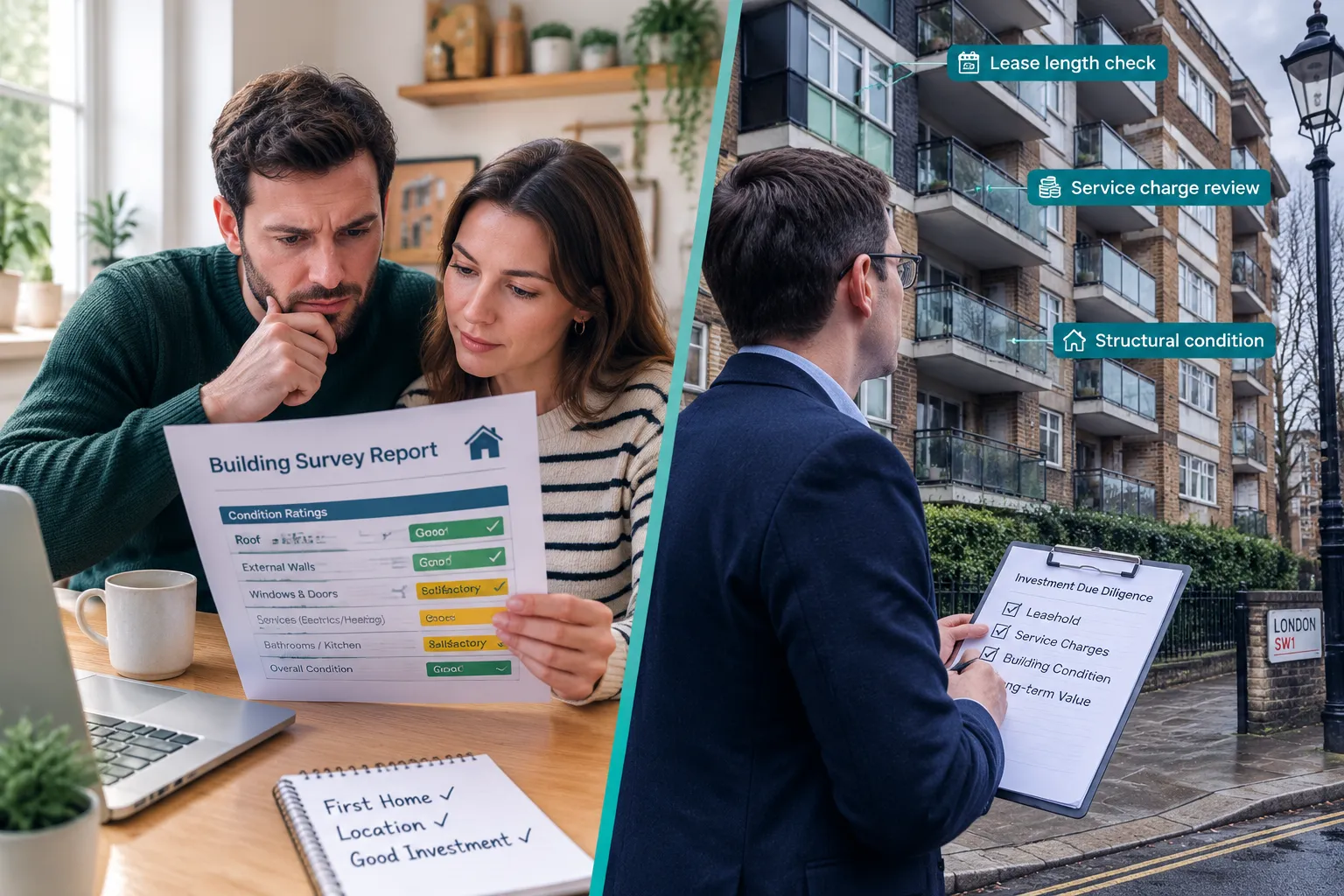
Abstract definitions only go so far. The following scenarios show how the building survey vs valuation survey decision plays out in practice for different buyer types in 2026.
Scenario 1: First-Time Buyer Purchasing a 1930s Semi-Detached
The situation: A first-time buyer in outer London is purchasing a 1930s semi-detached house for £420,000. The property looks well-presented but has not been significantly updated. The mortgage lender has already commissioned a valuation.
The risk: 1930s properties commonly present issues including original single-leaf brickwork with inadequate cavity insulation, ageing timber floors with woodworm, outdated electrical wiring, and roof structures approaching the end of their serviceable life. The 10 most common property defects found in building surveys on London properties include many that are invisible to the untrained eye.
The right choice: A Level 2 survey with valuation at minimum; a Level 3 building survey if the property shows any signs of damp, cracking, or structural movement. The mortgage valuation alone provides zero protection against structural defects.
Approximate cost guidance: Level 2 surveys for a property of this value typically range from £400 to £700; a full Level 3 building survey from £600 to £1,200, depending on location and surveyor. These are approximations, always obtain a written quote.
Scenario 2: Experienced Investor Buying a Victorian Terrace for Renovation
The situation: A property investor is purchasing a Victorian terraced house at auction for £280,000. The property is vacant, partially stripped, and clearly requires significant work.
The risk: Victorian properties can present serious structural issues including subsidence, failed lintels, penetrating damp, and inadequate foundations. Buying at auction means the purchase is typically unconditional once the hammer falls.
The right choice: A full Level 3 building survey, commissioned before the auction date. A valuation may also be useful for financing purposes, but the condition report is the priority. The investor may also benefit from a specific defect report if there is a known area of concern, such as roof condition, before committing to a price.
Key point: For a property requiring renovation, a market valuation based on current condition is less useful than a detailed schedule of defects that informs the renovation budget.
Scenario 3: Leasehold Flat Buyer in Central London
The situation: A buyer is purchasing a leasehold flat in a purpose-built 1970s block for £350,000. The lease has 85 years remaining.
The risk: Leasehold flats present a different risk profile. Structural defects in the flat itself may be limited, but service charge history, cladding compliance, building safety certificates, and the financial health of the freeholder or management company are all material concerns.
The right choice: A Level 2 survey is often sufficient for the physical condition of a modern flat in good order. However, a formal RICS valuation, particularly if the buyer is using a Help to Buy or shared ownership scheme, may be required separately. Buyers should also review the lease carefully alongside the survey. For specialist valuation needs, the best London property valuation guide provides further context on instructing the right type of report.
Scenario 4: Right to Buy Applicant
The situation: A council tenant is exercising their Right to Buy and needs to understand the property's value to assess whether the discount offered is fair.
The right choice: A formal RICS Red Book valuation is the appropriate instrument here. A building survey may also be prudent to understand the property's condition before committing to purchase. For Right to Buy situations specifically, a Right to Buy valuation from a RICS-registered surveyor provides the defensible market value opinion needed.
Side-by-Side Comparison: Building Survey vs Valuation Survey
| Feature | Building Survey (Level 3) | Valuation Survey |
|---|---|---|
| Primary purpose | Assess physical condition and defects | Establish market value |
| Who it protects | The buyer | The lender (mortgage valuation) or buyer (independent valuation) |
| Depth of inspection | Comprehensive, all accessible elements | Limited or desktop-based |
| Includes market value? | Not by default (optional under proposed 2nd edition) [7] | Yes, this is its core output |
| Best for | Older, larger, unusual, or visibly defective properties | Mortgage applications, legal proceedings, shared ownership |
| RICS standard | Home Survey Standard (Level 3 / proposed Advanced) [1] | RICS Valuation, Global Standards (Red Book) [2] |
How to Choose: A Practical Decision Framework
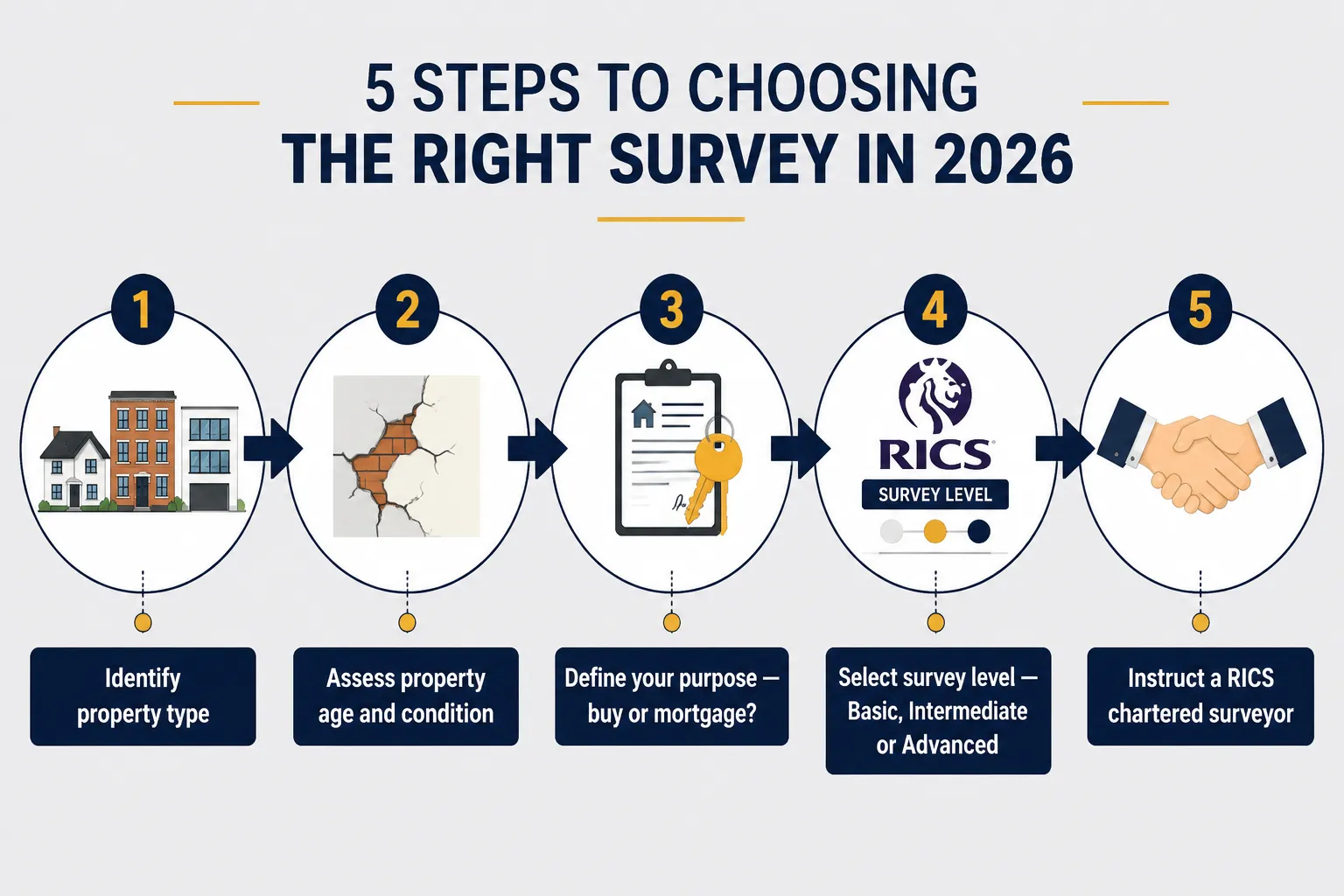
Working through the following questions will point most buyers to the correct report type.
Step 1, What is the property's age and construction type?
Pre-1919 properties, those with non-standard construction (timber frame, concrete panel, thatched roof), or any property that has been significantly extended warrant a full Level 3 building survey. Modern properties in good condition may be adequately covered by a Level 2 survey.
Step 2, What is the purpose of the report?
If the report is needed to satisfy a mortgage lender, a formal RICS valuation is required. If the purpose is to understand what you are buying before exchanging contracts, a condition survey is the priority. If both are needed, a Level 2 or Level 3 survey with an added valuation element may be the most efficient option, particularly once the proposed RICS second edition changes come into force. [7]
Step 3, Is there a specific area of concern?
If a visual inspection has already raised a specific concern, a crack in a gable wall, signs of damp in a cellar, or a roof that appears to be sagging, a specific defect report may be commissioned alongside or instead of a full building survey. For roof-specific concerns, a drone roof survey can provide detailed imagery of areas that are otherwise inaccessible.
Step 4, What is the buyer's risk tolerance and budget?
A building survey costs more than a valuation but can save multiples of that fee by identifying defects that justify a price reduction or, in serious cases, a decision not to proceed. The RICS valuation cost guide provides a useful reference for understanding what a formal valuation should cost relative to the property value.
"The cost of a building survey is almost always smaller than the cost of the first major repair bill on a property bought without one."
For buyers who remain unsure which level of survey is appropriate, the Level 2 vs Level 3 survey comparison provides a detailed breakdown of when each product is the right choice.
Common Misconceptions Addressed
"My mortgage lender's valuation means the property is in good condition."
This is the most persistent and costly misconception in UK property buying. A mortgage valuation confirms that the property is worth at least the loan amount, nothing more. It is not a structural inspection and will not identify damp, subsidence, or roof defects. [9]
"A building survey will kill my purchase."
A survey that identifies defects does not end a transaction, it creates an informed negotiating position. Buyers can use survey findings to renegotiate the purchase price, request repairs before completion, or budget accurately for post-purchase works.
"I only need a valuation because the property is new-build."
New-build properties have their own defect risks, including snagging issues, incomplete works, and drainage problems. The proposed RICS second edition specifically introduces expanded guidance for new-build assessments, reflecting the fact that "new" does not mean "defect-free." [7]
"Desktop valuations are unreliable."
A desktop house valuation using automated valuation models and comparable sales data can be accurate for standard properties in active markets. However, it is not appropriate for unusual properties, those in poor condition, or situations requiring a formal Red Book opinion. [2]
Conclusion
The choice between a building survey and a valuation survey is not a matter of preference, it is a matter of purpose. A valuation tells a buyer what a property is worth in the market. A building survey tells a buyer what condition that property is actually in. For most purchasers, both questions matter, and the good news is that the forthcoming RICS Home Survey Standard second edition will make it easier to commission both from a single instruction. [7][6]
Actionable next steps for buyers in 2026:
- Never rely on a mortgage lender's valuation as a substitute for an independent condition survey.
- Match the survey level to the property: use a Level 3 building survey for any property built before 1919, any non-standard construction, or any property showing visible defects.
- If a formal market value is also needed, for mortgage, legal, or scheme-related purposes, instruct a RICS-registered surveyor with Red Book valuation competence and request both outputs in a single report.
- Commission surveys before exchange of contracts, not after, findings cannot be used to renegotiate once contracts are exchanged.
- For specialist situations (leasehold, Right to Buy, shared ownership, Help to Buy redemption), seek a surveyor with specific experience in that product type.
Buyers who take the time to instruct the right report for their specific property and purpose are far better placed to complete a transaction with confidence, and to avoid the expensive surprises that come with choosing the wrong one.
References
[1] Home Survey Standards – rics.org
[2] Residential Valuations – rics.org
[3] Building Surveying Standards – rics.org
[6] Home Survey Standard 2nd Edition A Progress Update – rics.org
[7] Rics 2nd Edition Home Survey Standard 2025 Key Updates And Implementation Roadmap For Building Surveyors In 2026 – princesurveyors.co.uk
[9] House Surveys Uk The Costs Types And Benefits Of An Rics Home Survey – rics.org
[10] 250922 The Home Survey Standard And Regulatory Scheme A Guide To The Rics Consultations – hqnetwork.co.uk