Around 4.98 million leasehold dwellings exist in England alone — and the majority are flats. If you own, rent, or are buying a flat in Kingston upon Thames, the Leasehold Commonhold Reform Bill 2026 is arguably the most significant piece of property legislation to affect you in a generation. On 27 January 2026, the government published the draft Bill for pre-legislative scrutiny, setting out a sweeping overhaul of how flats are owned, managed, and valued across England and Wales.
This article explains what the Bill means for you, how it interacts with earlier reforms, and why getting a professional RICS valuation right now could save you thousands of pounds.
Key Takeaways 📋
- 🏛️ The draft Leasehold Commonhold Reform Bill 2026 proposes banning new leasehold flats, potentially from 2029.
- 💷 Ground rents on existing leases will be capped at £250 per year, converting to zero after 40 years.
- 🔄 Existing leaseholders can convert to commonhold with just 50% of residents agreeing — down from 100%.
- ⚖️ A High Court ruling in October 2025 dismissed a freeholder challenge to the Leasehold and Freehold Reform Act 2024, though an appeal is pending.
- 📐 A RICS-accredited chartered surveyor valuation remains essential for lease extensions and pre-purchase decisions right now, regardless of future reforms.
What Is the Leasehold Commonhold Reform Bill 2026?
The draft Bill, published on 27 January 2026 by Housing Minister Matthew Pennycook, represents the most ambitious attempt yet to dismantle England's feudal leasehold system. It builds on the Leasehold and Freehold Reform Act 2024 and goes considerably further.
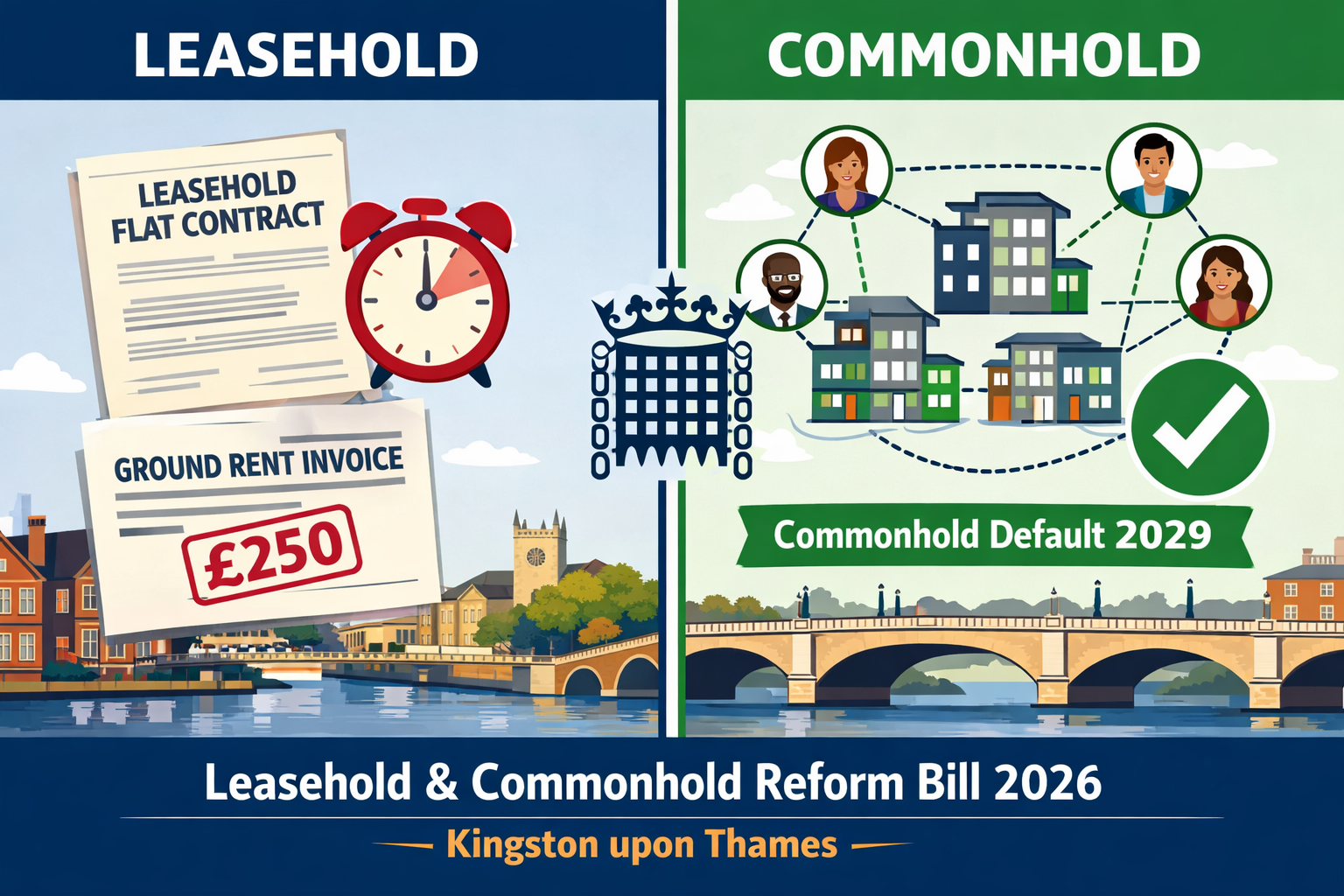
Here are the headline proposals:
| Proposal | Detail |
|---|---|
| Ban on new leasehold flats | No new long residential leases (over 21 years) for flats; ban potentially from 2029 |
| Ground rent cap | Existing ground rents capped at £250/year; zero after 40 years |
| Commonhold as default | New flats must be sold as commonhold |
| Conversion threshold | Existing blocks can convert with 50% leaseholder consent (down from 100%) |
| Forfeiture abolished | Landlords cannot terminate leases for breach; court-supervised process replaces it |
| Service charge reform | Standardised service charge demands and accounts introduced |
The government consultation on banning leasehold for new flats closed on 24 April 2026, and the Housing, Communities and Local Government Committee held evidence sessions on 10 March 2026, scrutinising how commonhold will work in practice.
Leasehold vs Commonhold: A Plain-English Guide for Flat Buyers
If you are buying a flat in Kingston upon Thames and find these terms confusing, you are not alone. Here is the clearest way to think about it:
Leasehold means you own the right to occupy a property for a fixed number of years — often 99, 125, or 999 years — but the building and land remain owned by a freeholder. You pay ground rent and service charges, and the freeholder controls major decisions about the building.
Commonhold means you own your flat outright (freehold), and all flat owners jointly own and manage the shared areas through a Commonhold Association — a democratic body where every owner has a vote.
"Commonhold puts residents in charge of their own building. Under leasehold, you are essentially a long-term tenant paying for the privilege of owning nothing permanently."
The Bill introduces a "sectional" commonhold mechanism for mixed-use developments — for example, a block with ground-floor shops and upper-floor flats — allowing different sections to have separate voting rights and cost obligations. This addresses one of the main practical objections to commonhold in complex urban developments like those found across south-west London.
Exemptions do exist. The Bill permits certain long residential leases within commonhold structures, including shared ownership, older persons shared ownership, home purchase plans (including Islamic finance products), and equity release schemes.
Existing leasehold flats will not automatically convert. They continue to be bought and sold as leasehold unless residents voluntarily opt to convert under the new 50% threshold rule.
The October 2025 High Court Ruling and the Pending Appeal
Before the draft Bill even arrived, the legal landscape shifted significantly. In October 2025, the High Court dismissed a judicial review brought by prominent freeholders — including the Duke of Westminster and the Earl of Cadogan — challenging the Leasehold and Freehold Reform Act 2024. The freeholders argued the Act was incompatible with their human rights, particularly regarding property rights and compensation.
The court rejected those arguments. However, the freeholders have lodged an appeal, which remains pending. This matters for Kingston leaseholders because:
- The 2024 Act already improved lease extension rights and reduced the premium calculation in many cases.
- If the appeal succeeds, some of those improvements could be challenged or delayed.
- If it fails, the 2024 Act's provisions will be fully embedded, and the 2026 Bill will build on solid legal foundations.
Matthew Pennycook, speaking in March 2026, reaffirmed the government's commitment to pressing ahead regardless of the appeal's outcome, describing the reform as a matter of basic fairness for millions of leaseholders.
Why You Still Need a RICS Valuation Right Now
It is tempting to think: "If leasehold is being abolished for new flats, why bother extending my lease or buying the freehold now?"
Here is why that thinking is risky:
- Existing leases are not automatically reformed. The Bill does not convert your current lease into commonhold. You remain a leaseholder until you act.
- Short leases lose value fast. A lease below 80 years triggers marriage value — an additional cost in lease extension premiums that can run into tens of thousands of pounds.
- Mortgage lenders have strict requirements. Most lenders will not offer a mortgage on a flat with fewer than 70–85 years remaining. If you are selling, this shrinks your buyer pool dramatically.
- The 2024 Act improvements are live now. You can benefit from improved lease extension terms today — but only with a proper RICS valuation.
Our lease extension valuation service in London provides RICS-compliant reports that give you a defensible, accurate premium figure — whether you are negotiating informally with your freeholder or pursuing the statutory route through the First-tier Tribunal.
For those considering a collective purchase of the freehold with neighbours, our freehold valuation service for London properties sets out exactly what you should pay, based on current market evidence and the relevant legislation.
Leasehold Commonhold Reform Bill 2026: What It Means for Buyers in Kingston upon Thames
If you are purchasing a leasehold flat in Kingston upon Thames right now, the Bill does not yet protect you — it is still in draft form. Here is your practical checklist:
✅ Check the lease length — aim for 90+ years remaining at completion.
✅ Review the ground rent — under the Bill, existing ground rents above £250/year will eventually be capped, but that is not law yet.
✅ Commission a pre-purchase survey — structural issues, damp, cladding, and service charge arrears can all affect value and saleability.
✅ Understand the service charge history — ask for three years of accounts before exchanging.
✅ Get a RICS valuation — especially if the lease is below 85 years.
Our FAQ on lease extensions answers the most common questions we hear from buyers and owners in south-west London, including how long the process takes and what the statutory route involves.
If you want to understand the full cost of buying a leasehold flat — including valuation fees — our guide to RICS valuation costs breaks it down clearly.
For buyers concerned about the physical condition of a property, our structural survey service for London provides a thorough assessment by a chartered building surveyor — essential for older mansion blocks and purpose-built flats common throughout Kingston upon Thames.
How the Leasehold Commonhold Reform Bill 2026 Affects Ground Rents
The ground rent cap is one of the most immediately practical elements of the Bill. Currently, many leaseholders in Kingston pay ground rents ranging from a nominal peppercorn to several hundred — or even thousands — of pounds per year, sometimes doubling every ten or twenty-five years.
Under the Bill:
- Ground rents will be capped at £250 per year per property.
- After 40 years, the ground rent automatically converts to a peppercorn (effectively zero) with no compensation payable to freeholders.
- Ground rent arrears will be excluded from enforcement proceedings.
- Non-payment breaches will only trigger enforcement if the amount owed exceeds a threshold, likely between £500 and £5,000.
This is a significant financial protection for leaseholders — but it is not yet law. Until Royal Assent, your existing ground rent clause remains enforceable.
Conclusion: Act Now, Plan Ahead
The Leasehold Commonhold Reform Bill 2026 marks a genuine turning point for flat ownership in England. For Kingston upon Thames leaseholders and buyers, the message is clear: the system is changing, but the change is not instant.
Your actionable next steps:
- 📋 Check your lease length today — if it is below 85 years, start the extension process immediately.
- 💷 Commission a RICS lease extension valuation before negotiating with your freeholder.
- 🏗️ Book a pre-purchase survey if you are buying a flat — do not rely on the mortgage valuation alone.
- ⚖️ Monitor the freeholder appeal — the outcome will shape how quickly 2024 Act improvements bed in.
- 🔄 Talk to neighbours about collective enfranchisement — the 50% conversion threshold makes commonhold conversion more achievable than ever once the Bill passes.
Our team of RICS-registered chartered surveyors covers Kingston upon Thames and the wider south-west London area. Whether you need a lease extension valuation, a freehold purchase valuation, or a full structural survey, we are here to give you the independent, expert advice you need to navigate these historic reforms with confidence.
Contact Kingston Surveyors today to book your valuation or pre-purchase survey — and make sure you are protected whatever shape the final legislation takes.
Meta Title: Leasehold Commonhold Reform Bill 2026: Guide for Flat Owners
Meta Description: The Leasehold Commonhold Reform Bill 2026 explained for Kingston flat owners. Ground rent caps, commonhold default, lease extensions & why a RICS valuation matters now.
Tags: Leasehold Commonhold Reform Bill 2026, leasehold reform, commonhold, ground rent cap, lease extension, RICS valuation, Kingston upon Thames property, flat ownership, leasehold to commonhold conversion, Leasehold and Freehold Reform Act 2024, chartered surveyor, pre-purchase survey