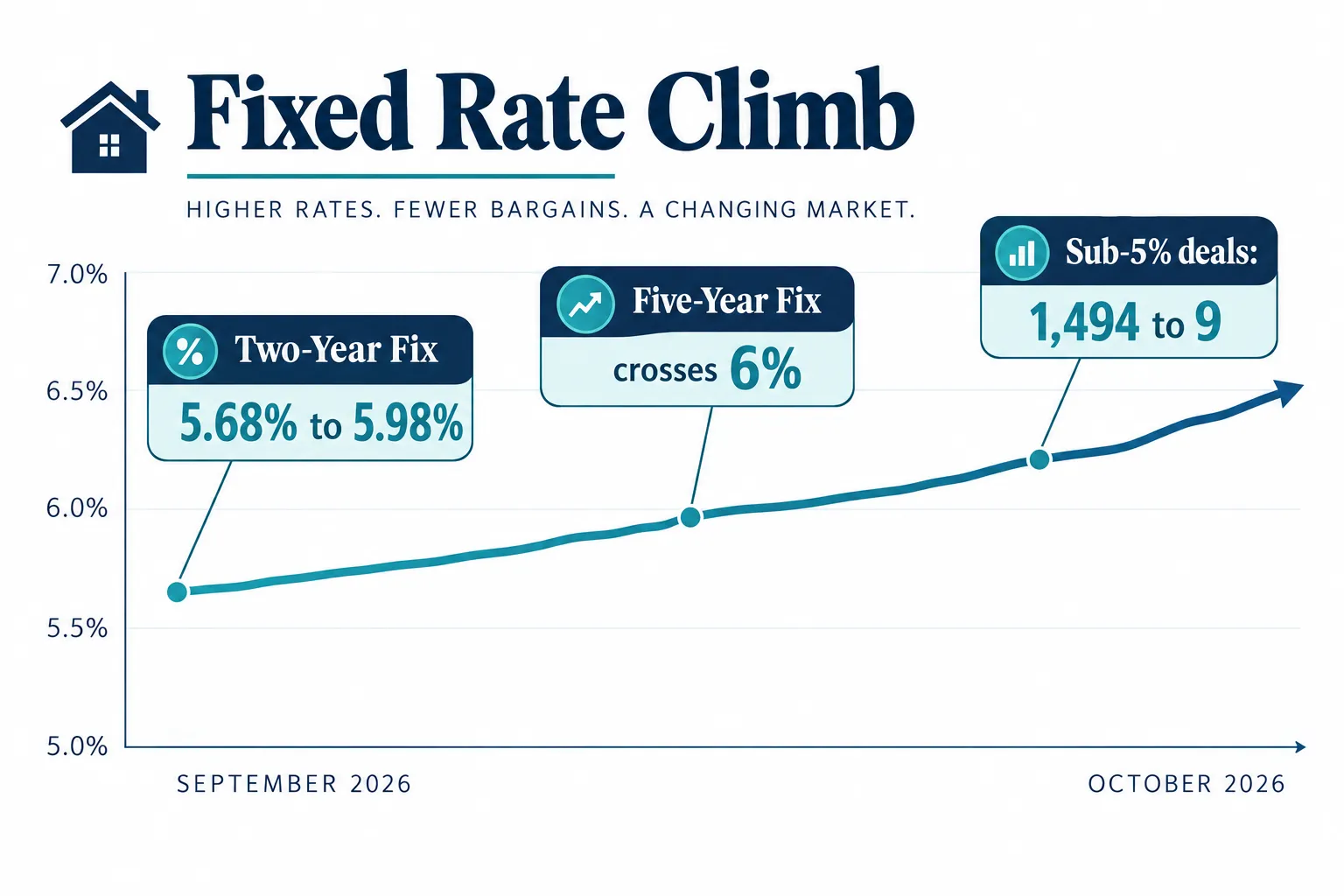
Nine. That is how many mortgage deals in the entire UK market were priced below 5% as of early October 2026, down from 1,494 just a month earlier. For anyone tracking mortgage rates October 2026 Kingston buyers face, that single statistic tells the story better than any headline: the cheap-rate window has slammed shut, and it happened fast.
Moneyfacts data published on 5 October 2026 confirmed the average five-year fixed rate reached 6.00% for the first time in three years. The average two-year fix sits close behind at 5.98%. For Kingston upon Thames households weighing a purchase, a remortgage, or a rate lock before the Autumn Budget, the numbers now demand a different strategy than the one that worked even eight weeks ago.
Key Takeaways
- Average five-year fixed mortgage rate hit 6.00% on 5 October 2026, the highest in three years; average two-year fix is 5.98%.
- Sub-5% mortgage deals collapsed from 1,494 in early September to just 9 by early October 2026.
- Rightmove/Tembo data (15 October) shows two-year fixes at 5.97% and five-year fixes at 5.99%, with lower-LTV borrowers (60-75%) still accessing rates around 5.1-5.4%.
- HSBC and NatWest trimmed selected fixed rates from 15 October; NatWest's lowest deals now sit at 5.04% (two-year) and 4.98% (five-year), reserved for strong-equity borrowers.
- Bank Rate is 3.75%, held narrowly on 17 September; the next decision lands 5 November 2026, with markets pricing roughly a two-in-three chance of a quarter-point rise.
Why Mortgage Rates October 2026 Kingston Buyers See Are Rising So Fast
Lenders reprice in waves, and this wave arrived quickly. Rightmove data cited via Tembo's Market Watch showed the average two-year fix climbing from 5.68% a month earlier to 5.97% by 15 October. Five-year fixes briefly broke above 6% earlier in the month before settling at 5.99%. Moneyfacts' independent snapshot, taken ten days earlier, put the average five-year fix at exactly 6.00%, the two data sets tell the same tightening story from slightly different angles.
The driver is a mix of swap-rate pressure and policy uncertainty. The Bank of England held Bank Rate at 3.75% on 17 September, but the vote was close: six members in favour of holding, three pushing for a rise to 4%. That split matters because it signals the committee is genuinely divided, not comfortably settled. With the next decision due Thursday, 5 November 2026, and markets pricing around a two-in-three probability of a quarter-point increase, lenders have been pricing in that risk ahead of time rather than waiting for confirmation.
Loan-to-Value Still Makes a Big Difference
Not every borrower is facing a 6% headline rate. The gap between a cash-rich remortgagor and a first-time buyer with a small deposit has widened sharply.
| LTV band | Average 2-year fix | Average 5-year fix |
|---|---|---|
| 95% | 6.03% | 6.02% |
| 90% | 5.66% | 5.61% |
| 75% | 5.41% | 5.39% |
| 60% | 5.10% | 5.08% |
Borrowers with 40% equity or deposit are still seeing rates in the low 5% range. Those stretching to 95% LTV are now firmly above 6% on both two- and five-year terms. This is precisely why mortgage rates October 2026 Kingston buyers encounter depend heavily on how much deposit or equity they bring to the table, not just the headline average.
Some lenders are also quietly undercutting the market average. From 15 October, HSBC and NatWest cut selected fixed deals, with NatWest now offering a two-year fix at 5.04% and a five-year fix at 4.98% for borrowers who meet strict equity and fee criteria. These deals are not widely available, but they prove sub-5% pricing has not disappeared entirely, it has simply become exclusive.
What This Means for Kingston Buyers and Remortgagers Right Now
Kingston sits within a South East market that is already softening. Lloyds' House Price Index for September 2026 put the UK average house price at £298,441, flat on both the month and the year. Greater London fell 2.2% to £531,548, and the South East dropped 2.1% to £380,829. Meanwhile RICS' September 2026 survey recorded new buyer enquiries at a net balance of -22% and agreed sales at -18%, though new instructions rose 6%, the first positive reading since mid-2025, suggesting more sellers are testing the market even as demand cools.
"A rate rise of even a quarter point changes affordability math on every Kingston mortgage application sitting in a pipeline right now."
That combination, rising rates, falling average prices, and more homes coming to market, creates real risk of overpaying or facing a down-valuation. Lenders' own surveyors are becoming more cautious in a falling market, and a property that looked fairly priced in August can be re-assessed lower by November.
The Monthly Payment Reality
On a £200,000 mortgage over 25 years, the gap between today's typical rate and last year's cheaper deals is substantial:
- At 5.98% (today's average two-year fix): roughly £1,286 per month
- At 4.90% (a typical rate from a year earlier): roughly £1,158 per month
- Difference: approximately £129 per month, or over £1,500 a year
A further quarter-point rise, taking a rate from 5.98% to 6.23% if the Bank of England moves on 5 November, would add roughly £31 a month on the same £200,000 loan. Multiply that across a larger Kingston-sized mortgage and the Autumn Budget on 28 October 2026 becomes a date worth watching closely, since fiscal announcements can move swap rates and lender pricing within days.
Practical Steps Before the Next Rate Decision
Buyers and remortgagers in Kingston upon Thames should consider the following before 5 November:
- Lock a rate early. Most lenders allow rate reservations six months ahead at no cost; locking now protects against another jump.
- Check real affordability headroom, not just the advertised rate, since a quarter-point move changes monthly costs immediately.
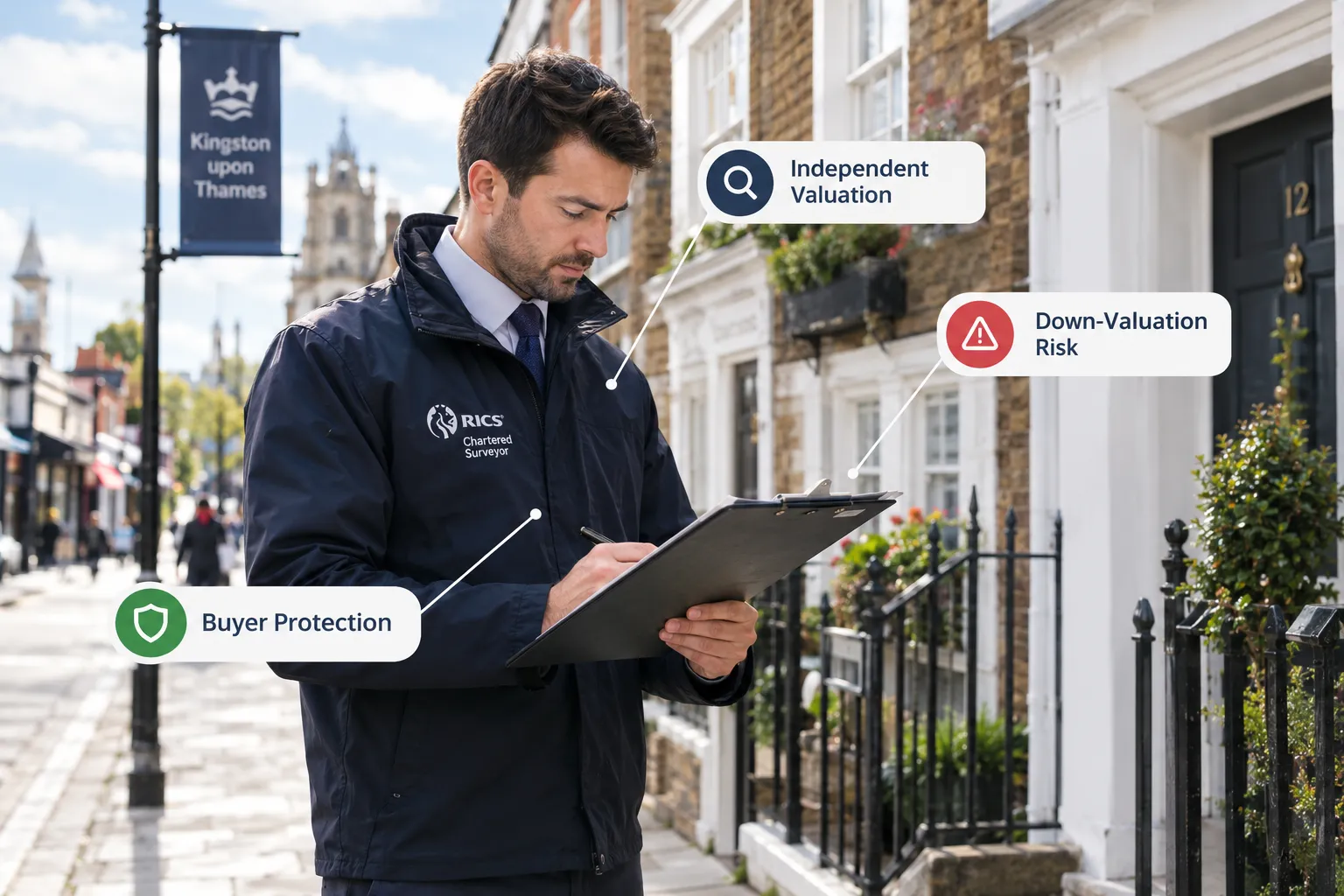
- Commission an independent RICS survey and valuation before exchanging, especially in a market where Greater London and South East prices are falling, this guards against overpaying and against a lender's own valuer applying a tougher, down-valued figure late in the process.
- Compare LTV bands carefully, since moving from 90% to 85% LTV can shift the rate by half a point or more.
- Watch the Autumn Budget on 28 October for any announcements affecting stamp duty, lending rules, or fiscal policy that could move rates again.
An independent valuation is not a formality in this market, it is a financial safeguard. With agreed sales down 18% and prices softening across the South East, a professional survey can catch structural issues or an inflated asking price before they become a costly surprise after completion.
FAQ: Mortgage Rates October 2026 Kingston Buyers Are Asking About
Is 6% the highest mortgage rates will go in 2026?
No one can guarantee a ceiling, but the Bank of England's narrow 6-3 vote and the two-in-three market pricing for a November rise suggest further upward pressure is possible, though not certain.
Are there still any mortgages below 5%?
Yes, but very few. Moneyfacts counted only 9 such deals nationally in early October, down from 1,494 a month before, and most require strong equity positions of 40% or more.
Should Kingston buyers wait for rates to fall before buying?
Waiting carries its own risk, since prices in the South East are already softening. Locking a rate now while negotiating on price may offset future rate increases.
How much does loan-to-value affect my rate?
Significantly. Borrowers at 60% LTV are seeing rates around 5.1%, while 95% LTV borrowers face rates above 6%, a difference of roughly one full percentage point.
Why does an independent valuation matter in a falling market?
When average prices are dropping, as seen in Greater London and the South East, lender valuers become more conservative. An independent RICS survey helps buyers avoid overpaying and spot down-valuation risk early.
When is the next Bank of England decision?
Thursday, 5 November 2026, shortly after the Autumn Budget on 28 October, both dates could move mortgage pricing further.
Conclusion
The shift in mortgage rates October 2026 Kingston buyers are navigating is not a minor fluctuation, it is a structural repricing. Five-year fixes crossing 6%, two-year fixes close behind, and sub-5% deals falling from 1,494 to 9 in a single month signal that the cheap borrowing era has paused, at least for now. Combined with softening prices across Greater London and the South East, the smartest move is not to panic but to act with precision: lock a rate early, stress-test affordability against a possible November rise, and commission an independent RICS valuation before committing. In a market this unsettled, professional advice and an accurate survey are not optional extras, they are the difference between a sound purchase and a costly mistake.
mortgage rates October 2026, Kingston buyers, five-year fixed mortgage, Bank of England rate decision, UK mortgage market, RICS survey, property valuation, Kingston upon Thames housing, remortgage 2026, loan-to-value rates, Autumn Budget 2026, South East house prices