Nearly 40% of UK terraced and semi-detached homeowners who attempt shared solar installations hit a legal wall before a single panel is fitted — and that wall is almost always a party wall. Navigating Party Wall Awards for Shared Solar Installations: Cost Recovery and RICS Strategies in Community Projects requires a precise understanding of the Party Wall etc. Act 1996, RICS professional guidance, and the emerging body of practice around green energy disputes between adjoining owners.
As community solar projects grow in ambition — from two neighbours sharing a roof array to multi-property schemes across entire terraces — the legal and financial frameworks governing shared installations are becoming more complex, more contested, and more consequential. This guide breaks down award structures, cost allocation models, negotiation tactics, and the critical role of the third surveyor in green energy disputes.
Key Takeaways 📌
- A Party Wall Award is legally binding and must be obtained before shared solar work begins on or near a party wall or party structure.
- Cost recovery in shared solar projects depends on how the award apportions responsibility — this is negotiable and must be explicitly stated.
- RICS-qualified surveyors bring standardised valuation and dispute resolution expertise that is essential for fair cost allocation.
- The third surveyor acts as a neutral arbitrator when appointed surveyors disagree — a role that is increasingly common in renewable energy disputes.
- Community solar projects involving multiple adjoining owners require layered award structures and clear legal agreements from the outset.
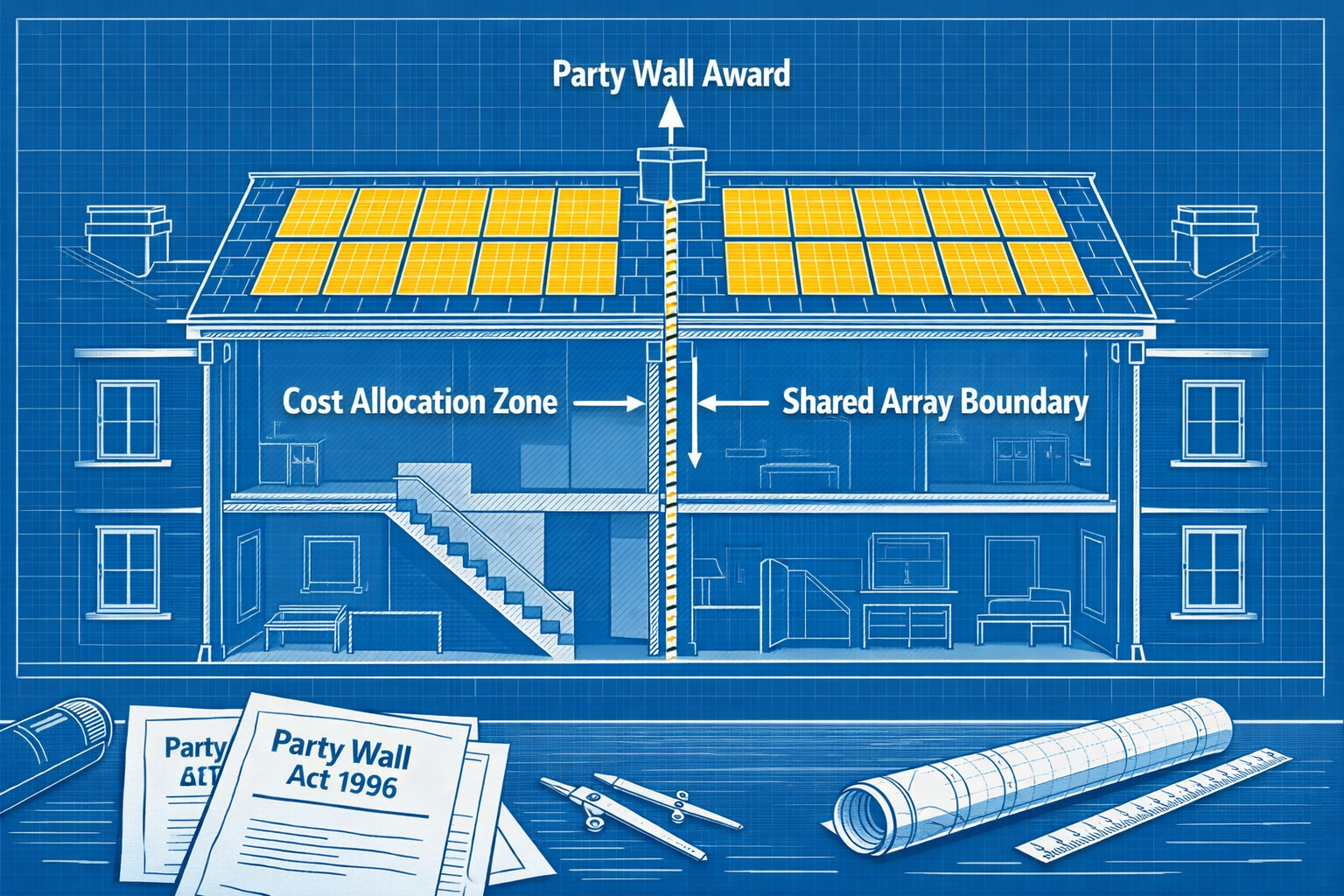
Understanding Party Wall Awards in the Context of Shared Solar Installations
What Is a Party Wall Award?
A Party Wall Award (also called a party wall agreement) is a legal document produced under the Party Wall etc. Act 1996. It sets out the rights and responsibilities of both the building owner (the person carrying out the work) and the adjoining owner (the neighbour). For a full overview of how these awards work, the Party Wall Award process in London and Surrey is a useful starting point.
When solar panels are to be mounted on a shared or party roof, or when installation work involves drilling, fixing, or penetrating a party wall or party structure, the Act is triggered. The award must be in place before work starts.
When Does Solar Work Trigger the Party Wall Act?
Not every solar installation requires a party wall award. The key triggers are:
| Scenario | Party Wall Act Triggered? |
|---|---|
| Panels on your own roof only, no shared structure | ❌ No |
| Panels spanning a shared party roof | ✅ Yes |
| Fixing brackets into a party wall | ✅ Yes |
| Running cables through a party structure | ✅ Yes |
| Ground-mounted array near boundary (within 3m) | ✅ Possibly |
Understanding party wall legal requirements is essential before any installation begins. Failure to serve the correct party wall notice can expose the building owner to injunctions, damages, and forced removal of installed panels.
The Award Structure for Roof and Array Shares
For shared solar installations, the Party Wall Award must address several specific elements:
- Scope of works — exact description of panels, fixings, inverters, and cable routes
- Access rights — when and how the building owner can access the adjoining property for installation and maintenance
- Structural safeguards — confirmation that the party roof or wall can bear the load
- Reinstatement obligations — what happens if panels are removed or the property is sold
- Cost apportionment — who pays for what, and in what proportions
💡 "The award is only as strong as the detail it contains. Vague cost clauses in shared solar awards are the single biggest source of post-installation disputes." — Common guidance from RICS-qualified party wall surveyors
Cost Recovery and RICS Strategies in Shared Solar Community Projects
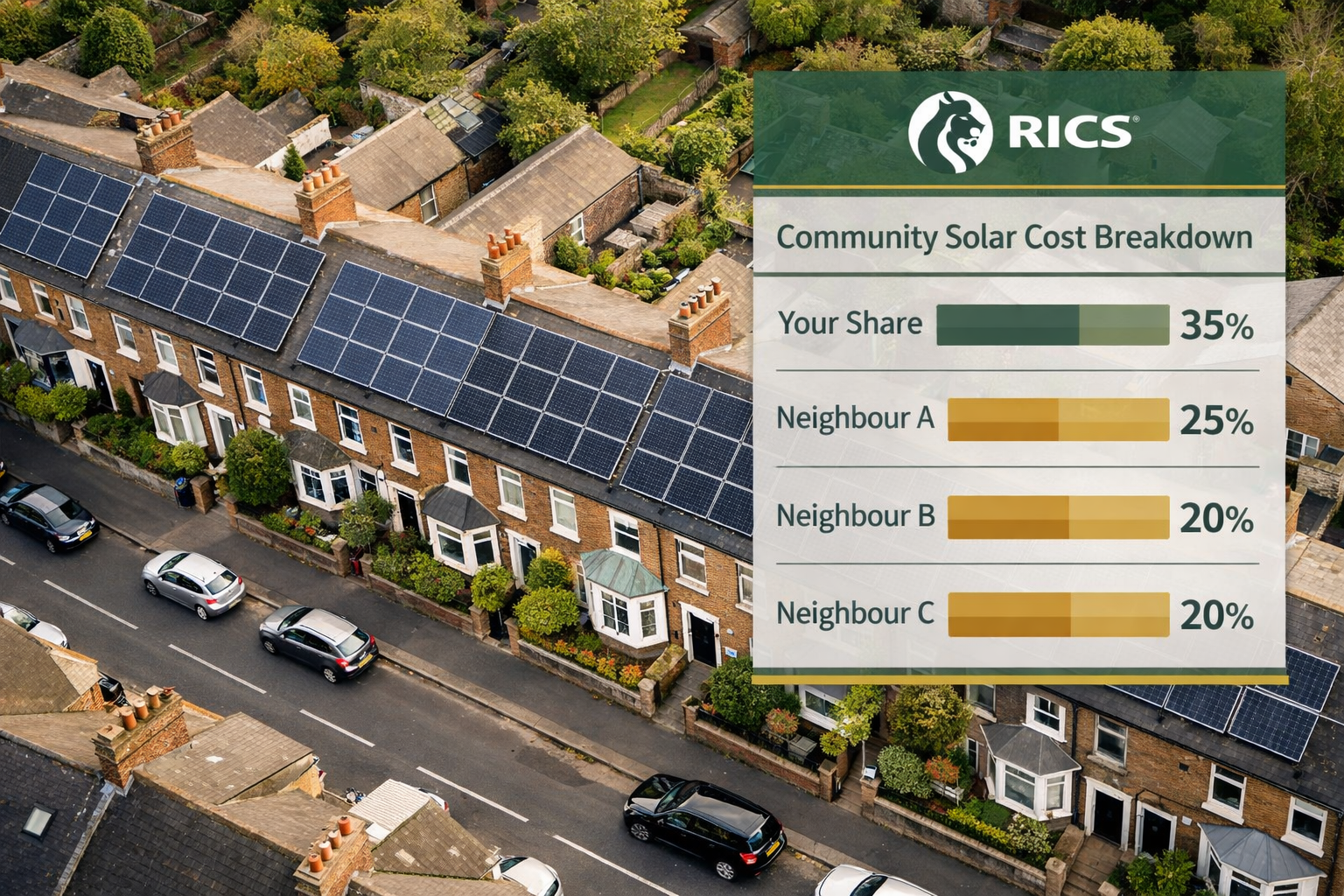
Why Cost Recovery Is the Central Challenge
Community solar projects — whether across two adjoining terraced houses or a larger multi-property scheme — generate significant upfront costs. These include:
- Structural surveys and roof surveys to confirm load-bearing capacity
- Party wall surveyor fees for both parties
- Installation costs for panels, inverters, and wiring
- Grid connection and metering costs
- Ongoing maintenance and insurance
The question of who pays what is rarely straightforward. The Party Wall etc. Act 1996 provides a framework, but it does not prescribe a formula. This is where RICS guidance and professional negotiation become essential.
RICS Cost Allocation Models
The Royal Institution of Chartered Surveyors (RICS) recommends that cost allocation in shared solar party wall awards follow a proportionality principle — costs should reflect the benefit each party derives from the installation.
Common models used in practice include:
1. Proportional Roof Area Model
Each owner pays in proportion to the roof area their panels occupy. Simple and transparent, but ignores differences in energy generation or consumption.
2. Energy Output Share Model
Costs are split according to the percentage of total energy output each party will receive. More equitable where panel arrays are unequal in size.
3. Benefit-in-Kind Valuation Model
A RICS-qualified valuer assesses the added property value each owner gains from the installation. This is particularly relevant for RICS-registered valuers working on shared ownership or leasehold properties.
4. Fixed Split Agreement
Parties agree a fixed percentage split (e.g., 60/40) regardless of roof area or output. Fast and simple, but requires mutual trust and clear documentation.
📊 Example: Two semi-detached homeowners share a party roof. Owner A installs 8 panels, Owner B installs 4 panels. Under the Energy Output Share Model, Owner A bears approximately 67% of shared costs (scaffolding, structural survey, party wall surveyor fees), and Owner B bears 33%.
Surveyor Fee Recovery: Who Pays the Party Wall Surveyor?
Under the Party Wall etc. Act 1996, the building owner (the person initiating the solar installation) is generally responsible for the reasonable costs of the party wall process — including the adjoining owner's surveyor fees. This is a non-negotiable default position.
However, the award can modify this where:
- Both parties are jointly initiating the shared solar project
- The adjoining owner has made unreasonable demands that inflated costs
- A single agreed surveyor has been appointed by both parties, reducing overall fees
For guidance on typical costs, reviewing party wall surveyor cost guidance helps both parties set realistic expectations before negotiations begin.
Community Solar Projects: Layered Award Structures
When Party Wall Awards for Shared Solar Installations: Cost Recovery and RICS Strategies in Community Projects involve more than two properties — such as a terrace of six or eight houses — the legal complexity multiplies. Each pair of adjoining owners technically requires a separate award, but in practice, surveyors often develop a master award framework that:
- Establishes consistent terms across all adjoining pairs
- Creates a shared maintenance fund with agreed contribution levels
- Appoints a single management entity (such as a residents' association) to oversee the installation
- Includes a dispute escalation mechanism referencing the third surveyor
This mirrors approaches used in community solar programmes internationally. Virginia's expanded shared solar capacity — set at 525 MW for Dominion Energy territory by July 1, 2026 — demonstrates how structured frameworks can enable large-scale community participation [1][3]. Illinois Shines similarly provides programme guidebooks that establish clear cost-sharing protocols across multiple participants [6].
Negotiation Tactics and the Third Surveyor's Role in Green Energy Disputes
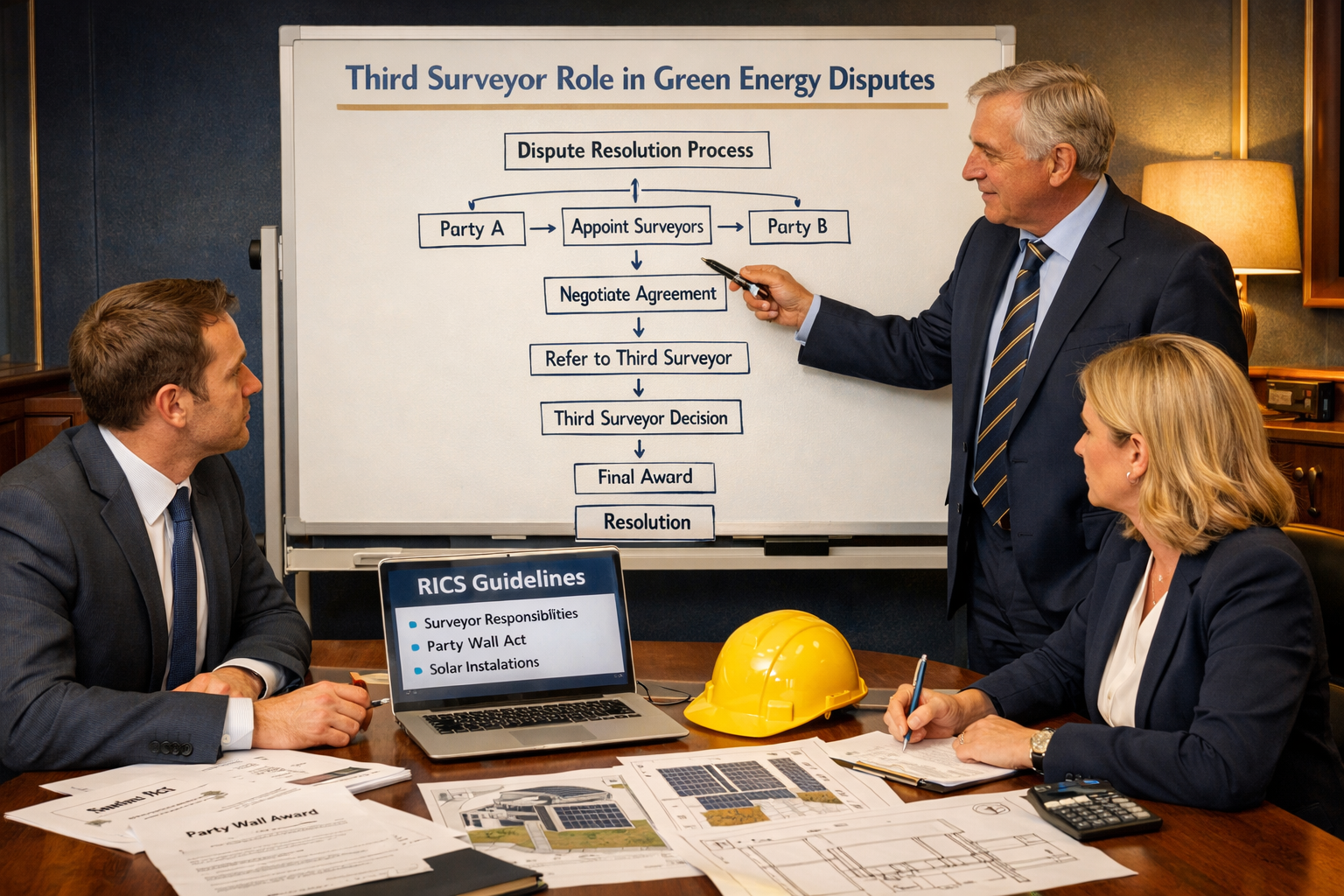
Effective Negotiation Tactics for Shared Solar Awards
Securing a fair Party Wall Award for Shared Solar Installations requires more than legal compliance — it demands skilled negotiation. The following tactics are used by experienced RICS surveyors:
🔍 Early Engagement
Contact the adjoining owner before serving the formal party wall notice. Informal discussions reduce resistance and often lead to a party wall consent without the need for a formal award.
📋 Detailed Proposals
Present a full technical specification — panel layout, structural calculations, cable routes, and maintenance schedule — before negotiations begin. Adjoining owners are far more likely to agree when they can see exactly what is being proposed.
💰 Transparent Cost Modelling
Share the cost allocation model openly. Hidden costs or vague apportionment clauses are the most common trigger for disputes. Use a RICS-prepared cost schedule where possible.
🤝 Shared Benefit Framing
Emphasise the mutual benefits: reduced energy bills, increased property value, and environmental credentials. Where adjoining owners can see a direct financial benefit, agreement is significantly more likely [7].
⏱️ Realistic Timelines
Allow adequate time for the party wall process. Rushing a shared solar award — particularly in a community project — almost always leads to errors that become expensive to correct.
The Third Surveyor: Neutral Arbitrator in Green Energy Disputes
When the two appointed surveyors cannot agree on the terms of a Party Wall Award, the third surveyor is called upon. This role is defined under Section 10 of the Party Wall etc. Act 1996 and is one of the most important — and least understood — mechanisms in the entire party wall process.
In the context of shared solar installations, third surveyor referrals most commonly arise over:
- Disputed cost apportionment — particularly where one party believes they are subsidising the other's installation
- Structural adequacy — disagreements about whether the party roof can safely bear the proposed panel load
- Access terms — disputes about maintenance access rights and their impact on the adjoining owner's use of their property
- Reinstatement obligations — what happens when one party wants to remove their panels but the other does not
The third surveyor's determination is binding on both parties (subject to appeal to the County Court). Selecting a third surveyor with specific experience in renewable energy installations is strongly advisable — this is a specialist area where generic party wall expertise may not be sufficient.
For complex disputes, an expert witness report prepared by a RICS-qualified surveyor can provide the technical foundation the third surveyor needs to make a well-informed determination.
Legal Developments and Case Precedents
The intersection of party wall law and renewable energy is a relatively new area of legal practice, and formal case law remains limited. However, several important principles are emerging:
- Courts have confirmed that solar installations on party structures are "works" under the Act and cannot proceed without a valid award
- The reasonableness standard applies to cost recovery — a building owner cannot recover costs that were unnecessarily inflated
- Where a party wall agreement is silent on renewable energy modifications, courts have generally held that subsequent solar installations require a fresh notice and award
In the United States, parallel developments are instructive. Connecticut legislation has made it easier for condo owners to install solar by limiting HOA restrictions [4], and Virginia's landmark clean energy legislation has expanded shared solar access while establishing clear cost-sharing frameworks [5]. These international examples demonstrate that the direction of travel is firmly towards enabling shared solar while protecting adjoining owners' rights — a balance that UK party wall law is well-positioned to achieve.
Practical Steps for Building Owners and Community Projects in 2026
Bringing together the legal, financial, and practical dimensions of Party Wall Awards for Shared Solar Installations: Cost Recovery and RICS Strategies in Community Projects, the following step-by-step process is recommended for 2026 projects:
Step-by-Step Process ✅
- Commission a structural survey of the shared roof or party structure before any planning
- Engage a RICS-qualified party wall surveyor with renewable energy experience
- Serve the correct party wall notice — typically a Party Structure Notice for roof work
- Negotiate cost allocation using a transparent RICS-approved model
- Draft the award with explicit provisions for maintenance, access, and reinstatement
- Appoint a third surveyor by agreement at the outset (not after a dispute arises)
- Execute a supplementary legal agreement for ongoing cost-sharing if the project involves multiple properties
- Register the award with Land Registry where appropriate for long-term enforceability
For projects in London and the South East, working with chartered surveyors in South West London or West London surveyors who specialise in party wall matters ensures local expertise is applied to what are often locally specific structural and planning considerations.
Conclusion: Actionable Next Steps
The growing demand for community solar in the UK is colliding with a legal framework — the Party Wall etc. Act 1996 — that was never designed with renewable energy in mind. Yet with the right expertise, that framework is entirely capable of supporting shared solar installations fairly and efficiently.
The most important actions for anyone planning a shared solar installation in 2026 are:
- ✅ Do not start work without a valid Party Wall Award — the legal and financial consequences are severe
- ✅ Engage a RICS-qualified surveyor early — before serving notice, not after a dispute arises
- ✅ Choose a cost allocation model that reflects actual benefit — transparency prevents disputes
- ✅ Build third surveyor appointment into the process from day one — do not wait for disagreement
- ✅ For community projects, use a master award framework — consistency across multiple properties reduces cost and conflict
The intersection of party wall law and green energy is one of the most dynamic areas of property practice in 2026. Surveyors, lawyers, and property owners who understand both domains will be best placed to deliver community solar projects that are legally sound, financially fair, and genuinely sustainable.
For expert guidance on party wall matters, RICS valuations, and community project strategies, explore the full range of party wall services available from qualified chartered surveyors.
References
[1] Governor Spanberger Signs Landmark Clean Energy Legislation Expanding Shared Solar And Energy Affordability For Virginians – https://communitysolaraccess.org/news/governor-spanberger-signs-landmark-clean-energy-legislation-expanding-shared-solar-and-energy-affordability-for-virginians
[2] Solar Energy Systems – https://www.davis-stirling.com/HOME/S/Solar-Energy-Systems
[3] Virginia Greenlights Landmark Grid Reform Expands Community Solar Program – https://www.renewableenergyworld.com/solar/community-solar/virginia-greenlights-landmark-grid-reform-expands-community-solar-program/
[4] House Passes Bill Making It Easier For Condo Owners To Install Solar – https://insideinvestigator.org/house-passes-bill-making-it-easier-for-condo-owners-to-install-solar/
[5] Newly Passed Legislation Will Expand Shared Solar Lower Energy Bills For Virginians – https://communitysolaraccess.org/news/newly-passed-legislation-will-expand-shared-solar-lower-energy-bills-for-virginians
[6] 2026-27 Illinois Shines Program Guidebook Feedback Joint Solar Parties – https://illinoisshines.com/wp-content/uploads/2026/03/2026-27-Illinois-Shines-Program-Guidebook-Feedback-Joint-Solar-Parties.pdf
[7] Nonprofits Guide To Solar Energy – https://8msolar.com/nonprofits-guide-to-solar-energy/