
}
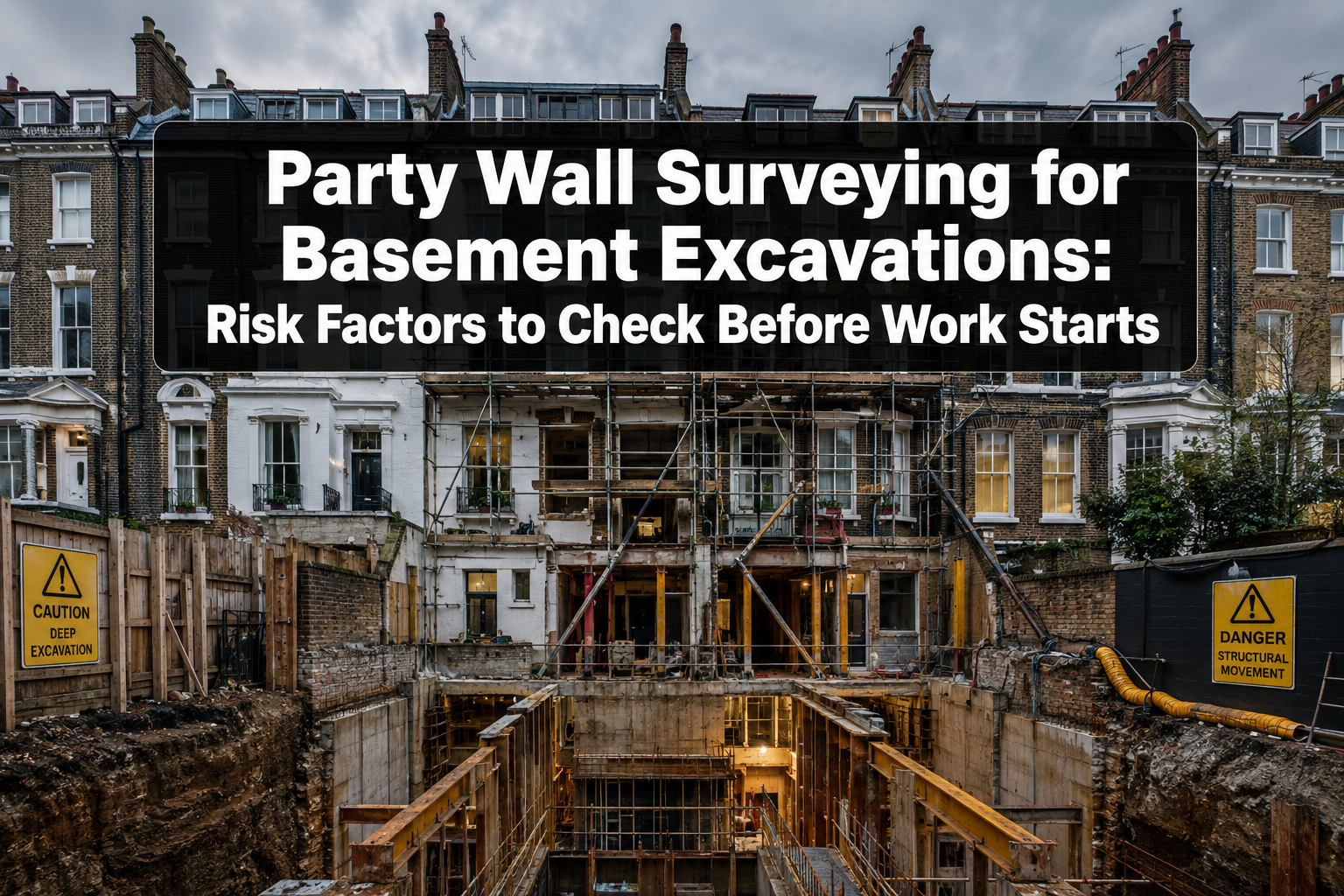
Nearly 40% of all party wall disputes in urban areas now stem from basement extension projects, driven largely by inadequate notice procedures and insufficient protective documentation before work begins [1]. That figure alone should prompt any building owner, contractor, or surveyor to treat basement excavation as a fundamentally different category of risk compared with above-ground works. The structural forces involved, the proximity to neighbouring foundations, and the complexity of urban subsoil conditions make party wall surveying for basement excavations in dense urban areas one of the most technically demanding disciplines in the built environment.
This article takes a risk-first approach to the subject. It examines the specific hazards that must be identified and assessed before a single cubic metre of soil is removed, and explains why thorough pre-work scrutiny protects every party involved.
Key Takeaways
- Basement excavations trigger specific notice obligations under the Party Wall etc. Act 1996, including the 3-metre and 6-metre excavation rules.
- A comprehensive Schedule of Condition, including thermal imaging and crack width measurements, is now required under updated RICS guidance.
- London Clay and other reactive subsoils create heightened structural risks that must be assessed before work starts.
- Proceeding without a formal Party Wall Award exposes building owners to injunctions, forced work stoppages, and significant financial liability.
- Selecting a surveyor with verified basement conversion experience is essential, not optional.
Why Basement Excavations Carry Exceptional Party Wall Risk
Above-ground extensions typically affect shared walls at or near ground level. Basement excavations are different. They alter the load paths beneath neighbouring structures, disturb the soil that supports adjacent foundations, and introduce groundwater and drainage variables that can destabilise buildings over time. In dense urban areas, where Victorian terraces, semi-detached houses, and converted flats sit shoulder to shoulder, the margin for error is extremely narrow.
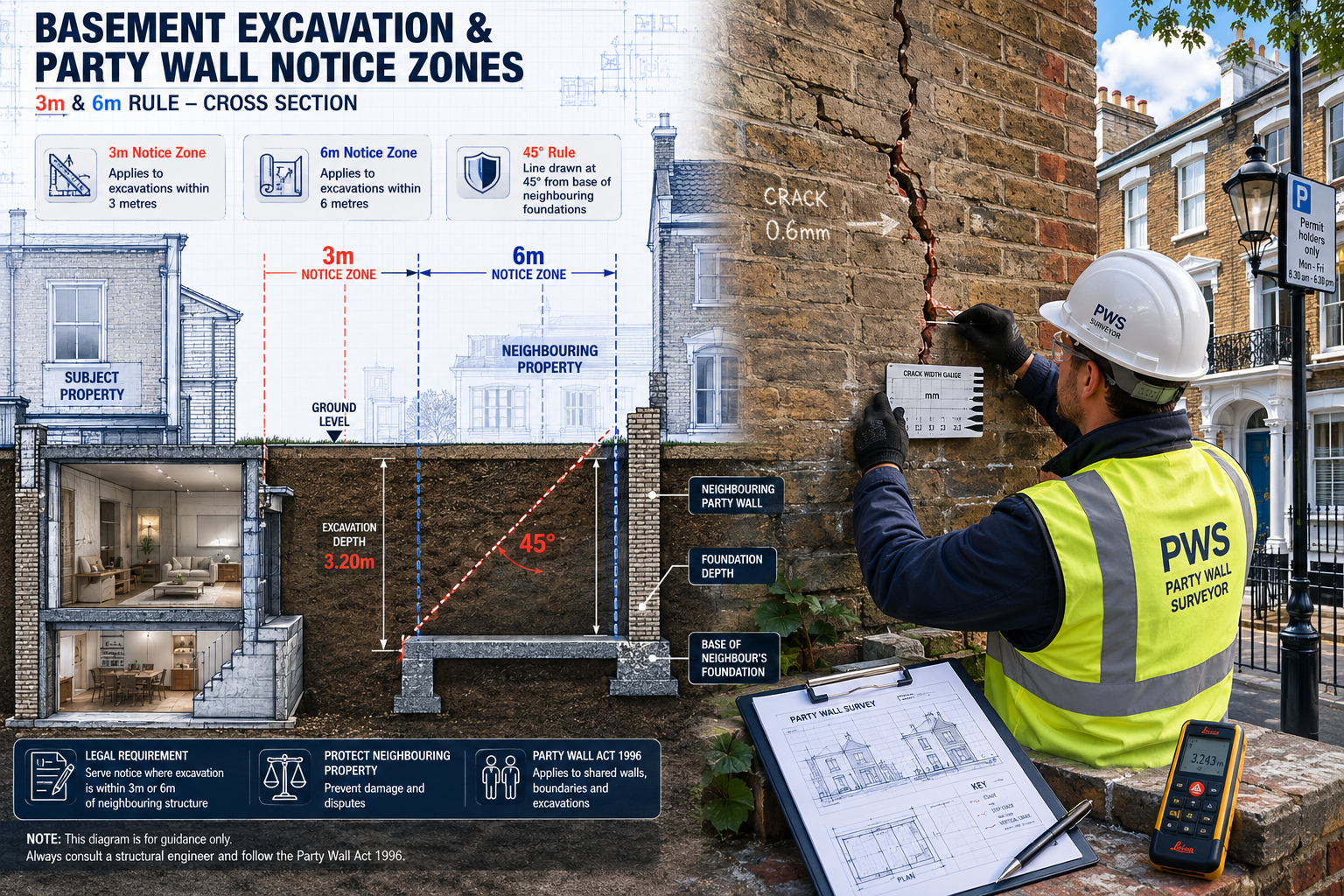
The Party Wall etc. Act 1996 exists precisely to manage these risks. For basement projects, it imposes two distinct excavation notice triggers [4]:
| Scenario | Notice Trigger |
|---|---|
| Excavation within 3 metres of a neighbouring structure | Deeper than that structure's foundations |
| Excavation within 6 metres of a neighbouring structure | Deeper than a line drawn at 45 degrees downward from the bottom of the neighbour's foundations |
Both scenarios are common in urban terraced settings. A basement dug beneath a Victorian house in London will almost always fall within 3 metres of the party wall, and the depth of excavation required to create usable headroom will typically exceed the shallow strip foundations typical of 19th-century construction.
Understanding party wall matters in this context is not simply a legal formality. It is a structural safeguard.
The 3-Metre Rule in Practice
The Party Wall Act 3-metre rule is one of the most frequently misunderstood provisions in residential construction. Many building owners assume it applies only to works directly on the boundary. In fact, it applies to any excavation that comes within 3 metres of a neighbouring building and goes deeper than its foundations, regardless of whether the excavation touches the party wall itself.
In practice, this means that even a basement dug entirely within the building owner's own footprint will almost certainly trigger notice obligations. The surveyor's first task is to establish the depth and position of the neighbouring foundations, which requires either historical records, trial pits, or ground investigation data.
The Pre-Work Risk Assessment: What Must Be Checked
Effective party wall surveying for basement excavations in dense urban areas requires a structured pre-work risk assessment that goes well beyond a standard inspection. The following risk categories must each be addressed before a Party Wall Award is drawn up and before any excavation begins.
1. Adjoining Structure Condition
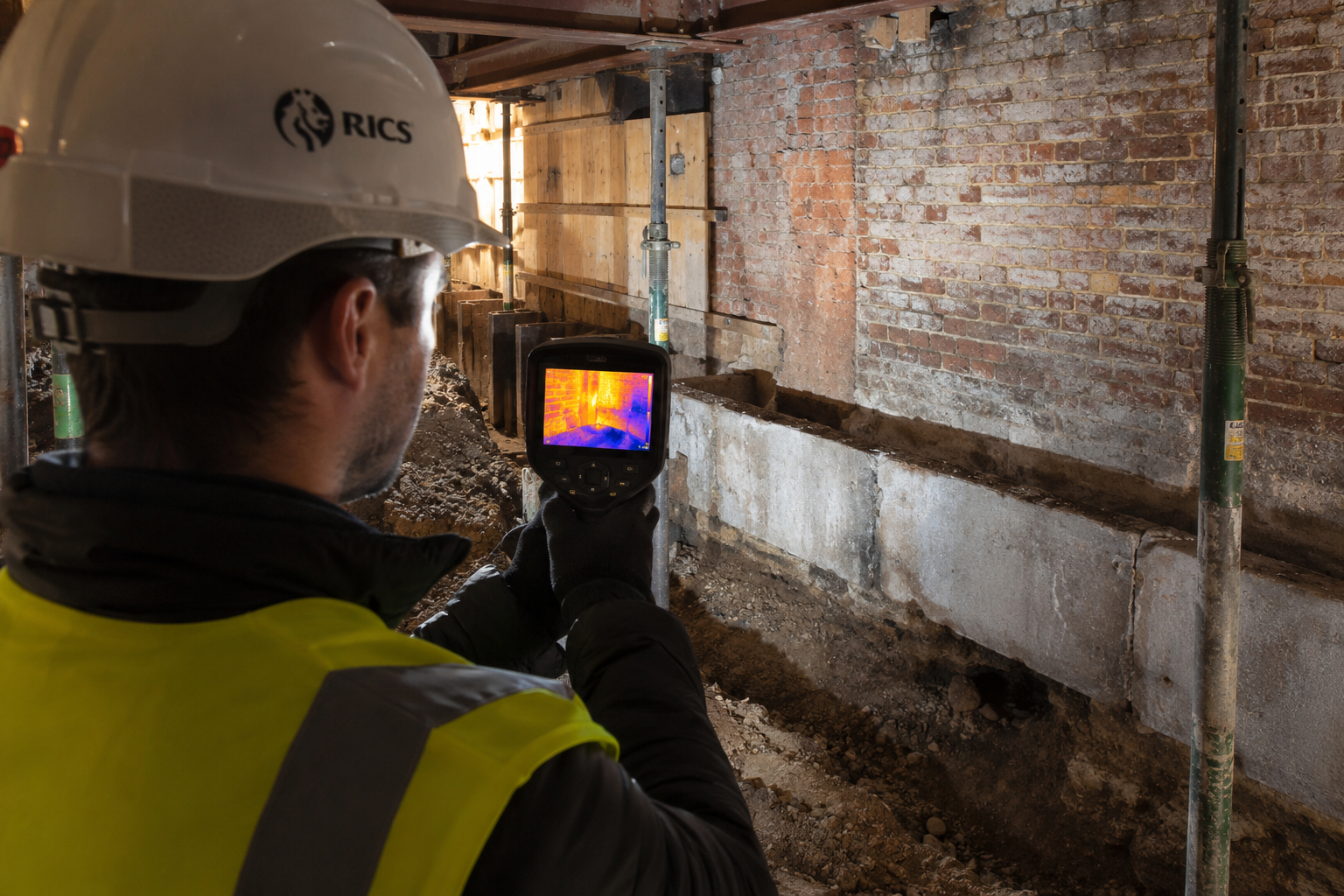
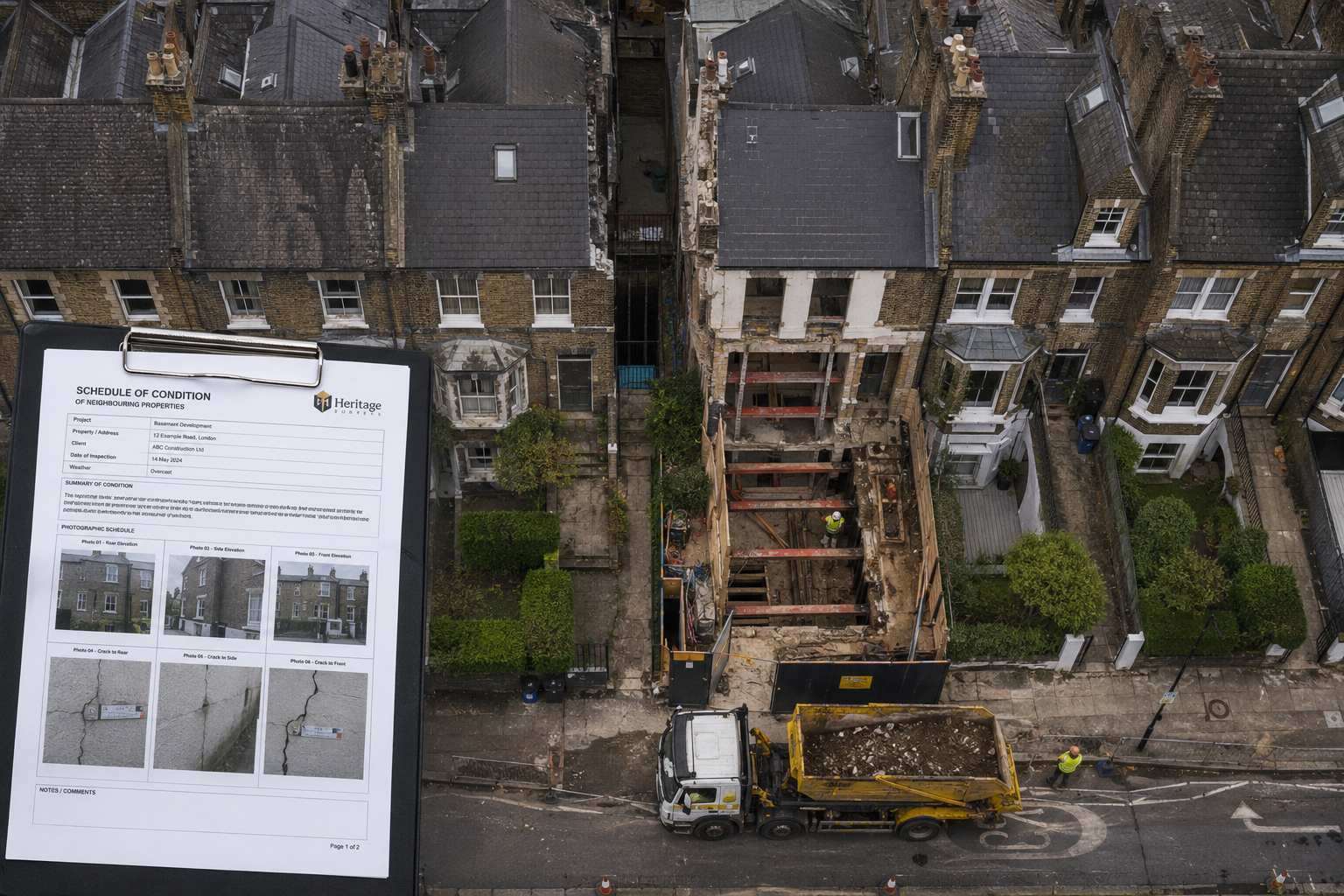
The condition of the neighbouring property must be documented in detail before work starts. Under updated RICS 8th edition guidance formalised in 2026, this documentation must include a minimum of 200 high-resolution photographs per property, crack width measurements, and thermal imaging scans to detect hidden structural defects [2].
A party wall schedule of condition serves as the baseline record against which any post-excavation damage claims will be assessed. Without it, the building owner has no defence against inflated or spurious claims, and the adjoining owner has no reliable evidence to support a legitimate one.
Thermal imaging is particularly valuable in this context. It can reveal hidden voids, moisture ingress, and areas of previous repair that are invisible to the naked eye. The RICS 8th edition guidance mandates its use specifically because basement excavations can cause differential settlement that manifests in ways not visible during a standard visual inspection [2].
2. Subsoil and Foundation Type
The subsoil beneath a site determines how excavation will affect neighbouring foundations. In much of south and central London, the dominant subsoil is London Clay, a material with specific and well-documented risks [5]:
- Shrinkage and swelling: London Clay shrinks significantly during dry periods and swells when wet, creating cyclical movement in foundations.
- Deep underpinning requirements: Shallow Victorian foundations in London Clay often need underpinning before or during basement excavation to prevent differential settlement.
- Slow drainage: The low permeability of London Clay means that groundwater changes caused by excavation take time to manifest, delaying the appearance of damage.
The surveyor must obtain or commission a ground investigation report before the Party Wall Award is finalised. Where London Clay or other reactive subsoils are present, the structural engineer's temporary works design and the party wall surveyor's protective conditions must reflect the specific behaviour of that soil type.
3. Temporary Works and Sequencing
Temporary works — the propping, shoring, and underpinning systems used during excavation — are a critical risk factor that party wall surveyors must scrutinise carefully. Poorly sequenced temporary works are a leading cause of party wall damage during basement projects.
Key questions the surveyor must ask include:
- Has a temporary works designer been appointed, and are they independent of the main contractor?
- Does the underpinning sequence proceed in bays of no more than 1 metre at a time, as is standard practice for party wall underpinning?
- Are the propping loads on the party wall calculated and within the wall's structural capacity?
- Is there a monitoring protocol for wall movement during excavation?
The Party Wall Award should specify the approved temporary works methodology and require the building owner to notify the adjoining owner's surveyor before each stage of underpinning commences.
4. Drainage and Waterproofing
Basement excavations inevitably interact with existing drainage systems. In Victorian terraces, shared or combined drainage runs are common, and their exact routes are often unknown until excavation begins. Severing a shared drain without prior agreement is both a practical emergency and a legal liability.
Pre-work checks must include:
- A CCTV drainage survey of all drains within the zone of influence
- Identification of any shared drainage infrastructure that may require diversion
- Assessment of the proposed waterproofing system's impact on groundwater levels adjacent to the party wall
Where drainage diversions are necessary, these should be agreed in advance and incorporated into the Party Wall Award conditions.
5. Access and Logistics
Dense urban areas present access challenges that directly affect party wall risk. If the only practical access route for excavated material runs across or adjacent to the neighbouring property, this must be addressed in the Party Wall Award.
The Royal Borough of Kensington and Chelsea, which has adopted some of the most restrictive basement development policies in the country, requires Construction Traffic Management Plans as a condition of basement development approval [6]. These plans must address the movement of heavy plant and excavated material through narrow streets where vibration from lorries can itself cause damage to neighbouring structures.
Even where local planning policy does not mandate a traffic management plan, the party wall surveyor should consider whether vibration from construction traffic is a material risk and, if so, whether monitoring is required.
6. Neighbour Protection Measures
The Party Wall Act provides several mechanisms for protecting the adjoining owner beyond the basic Award. Two deserve particular attention in basement projects:
Security for Expenses (Section 12): Adjoining owners are increasingly requesting security for expenses under Section 12 of the Party Wall etc. Act 1996, particularly on high-value projects [5]. This provision allows the adjoining owner to require the building owner to deposit a sum of money as security against potential damage costs before work begins. In a basement project where the potential for significant structural damage is real, this is a reasonable and enforceable request.
Monitoring conditions: The Award should specify the type and frequency of structural monitoring during excavation. This typically includes crack monitoring gauges on the party wall, inclinometer readings on any retaining structure, and regular visual inspections by the party wall surveyor.
For adjoining owners who are concerned about their rights, understanding what to do if a neighbour is carrying out party wall work is an important first step.
Legal Consequences of Getting It Wrong
Proceeding with basement excavation without a formal Party Wall Award is not a minor procedural oversight. It exposes the building owner to injunctions that can halt work entirely, forced cessation of works, and full liability for any damage caused to neighbouring structures [5]. Courts have consistently upheld the rights of adjoining owners in these circumstances, and the cost of remediation — including underpinning, crack repair, and consequential losses — can dwarf the cost of proper compliance.
"Basement works are among the most technically demanding disciplines in the built environment. Selecting a surveyor with verified experience in basement conversions is not a preference — it is a necessity."
The RICS 8th edition guidance, updated in April 2026, goes further than minimum legal requirements. It emphasises that compliance with the Party Wall etc. Act 1996 should be treated as a floor, not a ceiling, and that surveyors have a professional duty to identify and mitigate risks that the Act does not explicitly address [3].
For building owners who are uncertain about their obligations, a detailed review of party wall act questions can clarify the notice process and the rights of all parties.
Choosing the Right Surveyor
Not all party wall surveyors have the technical background to assess basement excavation risk competently. The surveyor appointed for a basement project should be able to demonstrate:
- Familiarity with geotechnical reports and foundation types common in the local area
- Experience reviewing and approving temporary works designs
- Knowledge of the specific RICS guidance applicable to basement conversions in 2026
- A track record of producing detailed Schedules of Condition that have withstood legal scrutiny
For projects in London, working with chartered surveyors in central London or other urban specialists ensures access to professionals who understand the specific subsoil, planning, and structural conditions of dense city environments.
The option of an agreed surveyor — a single surveyor appointed by both parties — can reduce costs and streamline the process, but only where both parties have confidence in that surveyor's independence and technical competence.
Borough-Specific Policies and Their Impact on Party Wall Surveying
Local planning policy can significantly affect the scope of party wall surveying for basement excavations in dense urban areas. The Royal Borough of Kensington and Chelsea provides the clearest example: its basement policy limits excavation to a single storey beneath the original building footprint and imposes conditions including Construction Traffic Management Plans and independent monitoring [6].
These planning conditions interact directly with party wall obligations. A surveyor working in RBKC must ensure that the Party Wall Award conditions are consistent with the planning consent, and that any monitoring required by the planning authority is coordinated with the party wall monitoring regime.
Similar, if less prescriptive, policies exist in other London boroughs and in dense urban areas outside the capital. The party wall surveyor must review the planning consent as part of the pre-work risk assessment, not in isolation from it.
Conclusion
Party wall surveying for basement excavations in dense urban areas demands a level of technical rigour that goes far beyond standard party wall practice. The risks — to adjoining structures, to drainage systems, to temporary works stability, and to the legal position of all parties — are real, substantial, and foreseeable. They can be managed, but only if they are identified and addressed before work starts.
Actionable next steps for building owners and surveyors:
- Serve party wall notices at least two months before the planned start date for basement works, and ensure the notices correctly identify all excavation notice triggers under the 3-metre and 6-metre rules.
- Commission a ground investigation report and CCTV drainage survey before the Party Wall Award is finalised.
- Appoint a temporary works designer who is independent of the main contractor, and ensure the Award specifies the approved underpinning sequence.
- Produce a Schedule of Condition that meets the RICS 8th edition standard, including thermal imaging and crack width measurements.
- Consider whether security for expenses under Section 12 is appropriate given the scale and risk profile of the project.
- Select a party wall surveyor with verified basement conversion experience and knowledge of local subsoil conditions.
For those dealing with damage to property in a party wall context, or facing a party wall dispute, early professional advice is the most effective way to protect both the project and the relationship with neighbouring owners.
References
[1] Avoiding Party Wall Disputes In Basement Extensions 2026 Notice Timelines And Protective Measures – https://partywallsurveyorlondon.uk/blogs/avoiding-party-wall-disputes-in-basement-extensions-2026-notice-timelines-and-protective-measures/?utm_source=openai
[2] Party Wall Surveys For Basement Excavations Structural Risk Assessment And Neighbour Protection Under Rics 8th Edition – https://nottinghillsurveyors.com/blog/party-wall-surveys-for-basement-excavations-structural-risk-assessment-and-neighbour-protection-under-rics-8th-edition?utm_source=openai
[3] Party Wall Surveys For Basement Conversions In 2026 Rics Protocols Amid Rising Urban Demand – https://princesurveyors.co.uk/blog/party-wall-surveys-for-basement-conversions-in-2026-rics-protocols-amid-rising-urban-demand/?utm_source=openai
[4] Party Walls – https://www.rbkc.gov.uk/environment/advice-builders/party-walls?utm_source=openai
[5] Party Wall Surveying For Basement Conversions Navigating Deeper Excavations In Stabilising Southern Markets – https://www.canterburysurveyors.com/blog/party-wall-surveying-for-basement-conversions-navigating-deeper-excavations-in-stabilising-southern-markets/?utm_source=openai
[6] Party Wall Advice For Kensington Basement Projects – https://www.hampsteadcharteredsurveyors.co.uk/insights/party-wall-advice-for-kensington-basement-projects?utm_source=openai