Fewer than one in three homeowners outside London know that party wall surveyor fees can vary by up to 40% depending on where in the UK they live, yet that gap can mean hundreds of pounds on a single extension project. Understanding Party Wall Surveyor Fees Beyond London: Typical Costs Across the UK and How Awards Affect Your Budget is essential reading for anyone planning a loft conversion, rear extension, or basement dig in 2026, wherever their property sits.
The Party Wall etc. Act 1996 applies across England and Wales, meaning the legal obligations are the same whether you live in Bristol, Birmingham, or Bradford. What changes significantly is how much surveyors charge, how many you may need, and how the resulting party wall award allocates those costs between you and your neighbours.
Key Takeaways
- Party wall surveyor fees outside London typically run 20-40% lower than equivalent London rates, though complexity can close that gap quickly.
- A straightforward agreed surveyor appointment for a simple job can cost around £700,£1,200 in regional markets; disputed cases with two surveyors can reach £2,500,£4,500 or more per side.
- The party wall award is a legally binding document that determines not just what work is permitted, but who pays for the surveying costs.
- Additional line items, notices, schedules of condition, and third surveyor referrals, each add to the final bill and must be budgeted for separately.
- VAT and disbursements can increase the headline fee by 20-30% in real-world spend.
Understanding the Regional Fee Landscape
The most important thing to grasp about party wall surveyor fees beyond London is that the market is not regulated. Unlike some professional services, there is no fixed fee schedule set by statute or by RICS. Surveyors set their own rates, and those rates respond to local demand, travel costs, and the complexity of the work involved [5].
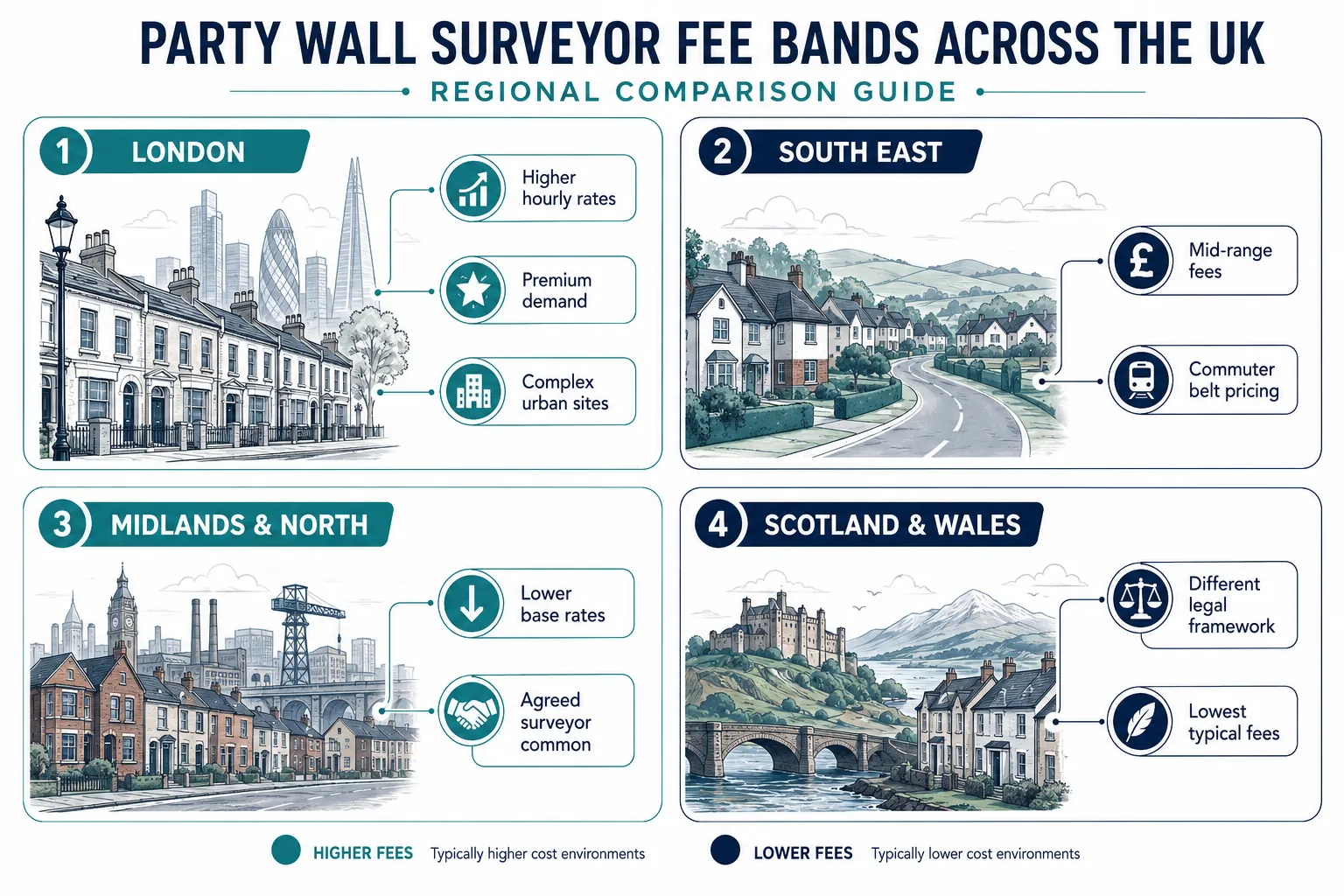
In London, hourly rates for experienced party wall surveyors commonly range from £150 to £250 per hour, with some central London specialists charging above that band. Outside the capital, the equivalent range typically falls between £90 and £175 per hour, with the lower end of that scale more common in the North of England, Wales, and the Midlands [1][4].
Typical regional fee bands for a straightforward party wall matter in 2026:
| Region | Agreed Surveyor (simple) | Two-Surveyor Scenario (each) |
|---|---|---|
| London | £1,000, £2,000 | £1,200, £2,500 |
| South East & East | £800, £1,500 | £900, £2,000 |
| Midlands | £650, £1,200 | £750, £1,600 |
| North of England | £600, £1,100 | £700, £1,500 |
| Wales | £550, £1,000 | £650, £1,400 |
These figures reflect the surveyor's fee for producing the party wall award on a relatively simple project, a single-storey rear extension affecting one adjoining owner. They do not include VAT, disbursements, or additional line items discussed below [1][9].
One regional 2025 example cited in current guidance placed the building owner's surveyor fee for a straightforward award at around £699 + VAT, broadly consistent with the lower end of the £700,£1,200 band reported across regional markets in 2025-2026 [9].
"The absence of a statutory fee scale means regional variation is real and significant. Homeowners who obtain at least three quotes before appointing a surveyor consistently report better outcomes."
For a detailed overview of how the process works in a major urban centre, the Party Wall Surveyors London notices, awards and costs guide provides a useful benchmark against which regional quotes can be compared.
How Complexity, Neighbour Numbers and Work Type Drive Costs
The headline surveyor fee is only the starting point. The final bill is shaped by four key variables: the number of adjoining owners affected, the type of notifiable work, whether an agreed surveyor can be appointed, and the depth of documentation required.
Number of Adjoining Owners
Each adjoining owner is a separate party wall matter. A mid-terrace house has two neighbours; a corner plot may have three or four. Each additional neighbour means an additional notice, an additional schedule of condition, and potentially an additional award. Costs can multiply quickly.
Party wall notice service (served on your behalf by a surveyor) typically costs £50,£150 per adjoining owner [9][14]. That is a relatively modest sum, but it is the first of several line items that accumulate.
If you are unsure whether your project triggers the Act at all, the guide on when the Party Wall Act applies and whether you need a party wall agreement is a practical starting point.
Type of Notifiable Work
Three categories of work trigger the Act, each with different fee implications:
- Line of junction works, building a new wall at or astride the boundary. Generally the simplest and least expensive to document.
- Party structure works, cutting into, underpinning, or raising a shared wall. More complex; awards are lengthier and take more surveyor time.
- Excavation near foundations, digging within 3 or 6 metres of a neighbour's structure, depending on depth. Often the most document-intensive category, particularly where structural engineers are also involved.
For excavation matters specifically, the party wall excavation notice guide explains the notice requirements and the additional documentation typically required, which directly affects surveyor time and therefore fees. Similarly, understanding the 3 metre rule under the Party Wall Act helps homeowners anticipate whether their project falls into this more complex, and more costly, category.
Agreed Surveyor vs Two Surveyors
The most significant cost lever available to homeowners is the choice of surveyor structure. Where both the building owner and the adjoining owner consent, a single agreed surveyor acts impartially for both parties. This eliminates the need for a third surveyor and cuts total fees, often by 30-50% compared with a two-surveyor appointment [7].
The agreed surveyor party wall complete guide sets out the conditions under which this arrangement works well and where it may not be appropriate, particularly where there is already a dispute between neighbours.
If a neighbour dissents and appoints their own surveyor, both surveyors' fees are typically paid by the building owner (the person carrying out the work), unless the award specifies otherwise. In contested matters outside London, total two-surveyor costs for a moderately complex project commonly reach £2,500,£4,500 [4][9].
Itemised Costs: Notices, Schedules of Condition and the Award Itself
Breaking down the total bill into its component parts helps homeowners budget more accurately and challenge any items that appear disproportionate.
Party Wall Notices
Serving the notice is the first formal step. While a building owner can serve notices themselves, many appoint their surveyor to do so to ensure accuracy. The typical charge is £50,£150 per adjoining owner [9]. On a project with three neighbours, that alone adds £150,£450 before any substantive survey work begins.
Errors in notices can invalidate the process entirely, so professional service is generally worthwhile. The party wall notice guide explains the content requirements and timing rules that determine whether a notice is valid.
Schedule of Condition
A schedule of condition is a photographic and written record of the adjoining property's condition before work begins. It is not always legally mandatory, but it is strongly advisable, and in practice, most surveyors include it as standard.
In London examples, schedules of condition typically cost £300,£600 per neighbouring property [10]. Regional rates are often slightly lower, commonly in the £200,£450 range, but this depends on the size and complexity of the neighbouring property and the number of rooms accessible for inspection.
The schedule serves a critical protective function: if damage occurs during construction, it establishes the pre-existing baseline. Without it, disputes about causation are far harder to resolve. For more on what this document covers and why it matters, see the party wall schedule of condition guide.
The Party Wall Award
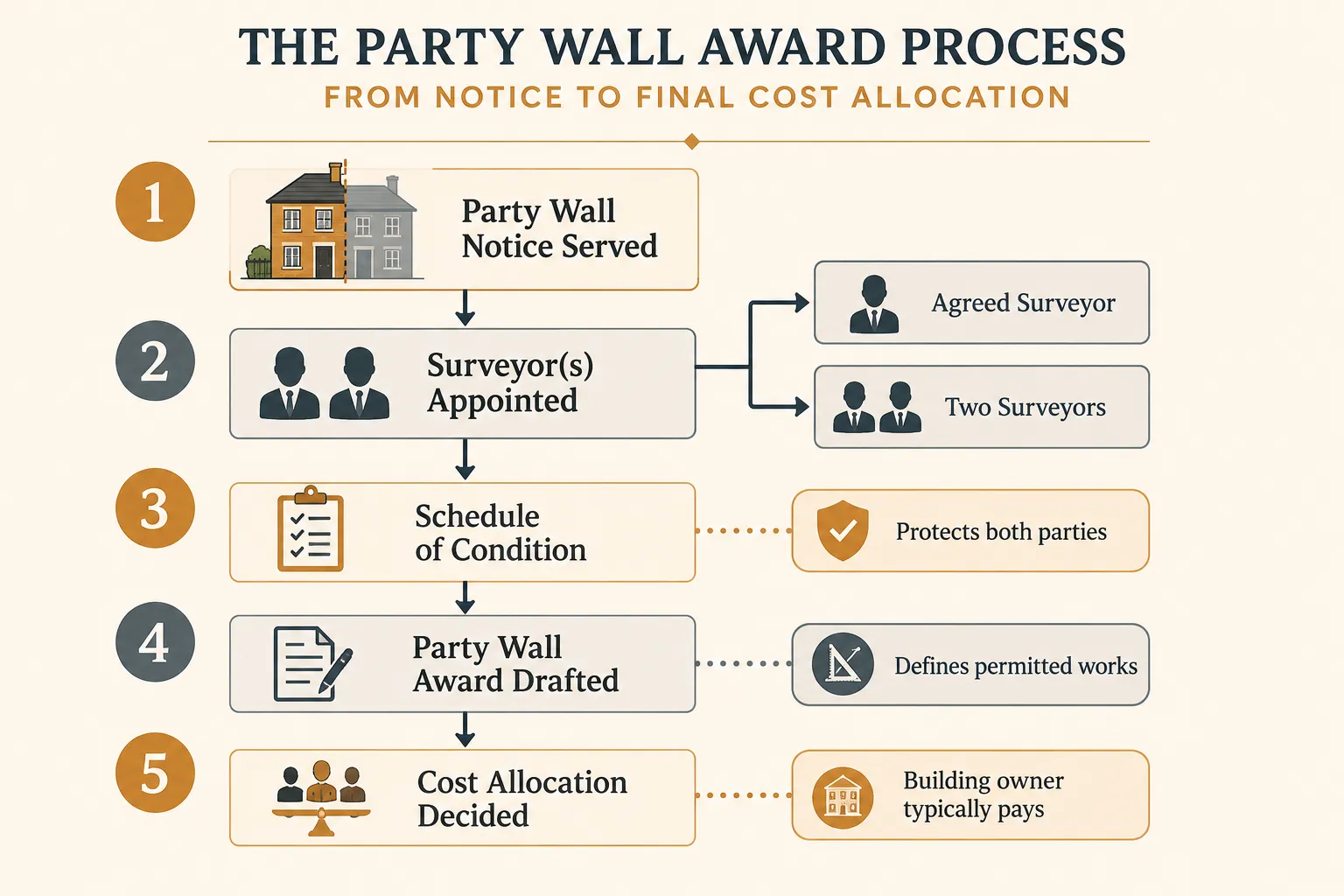
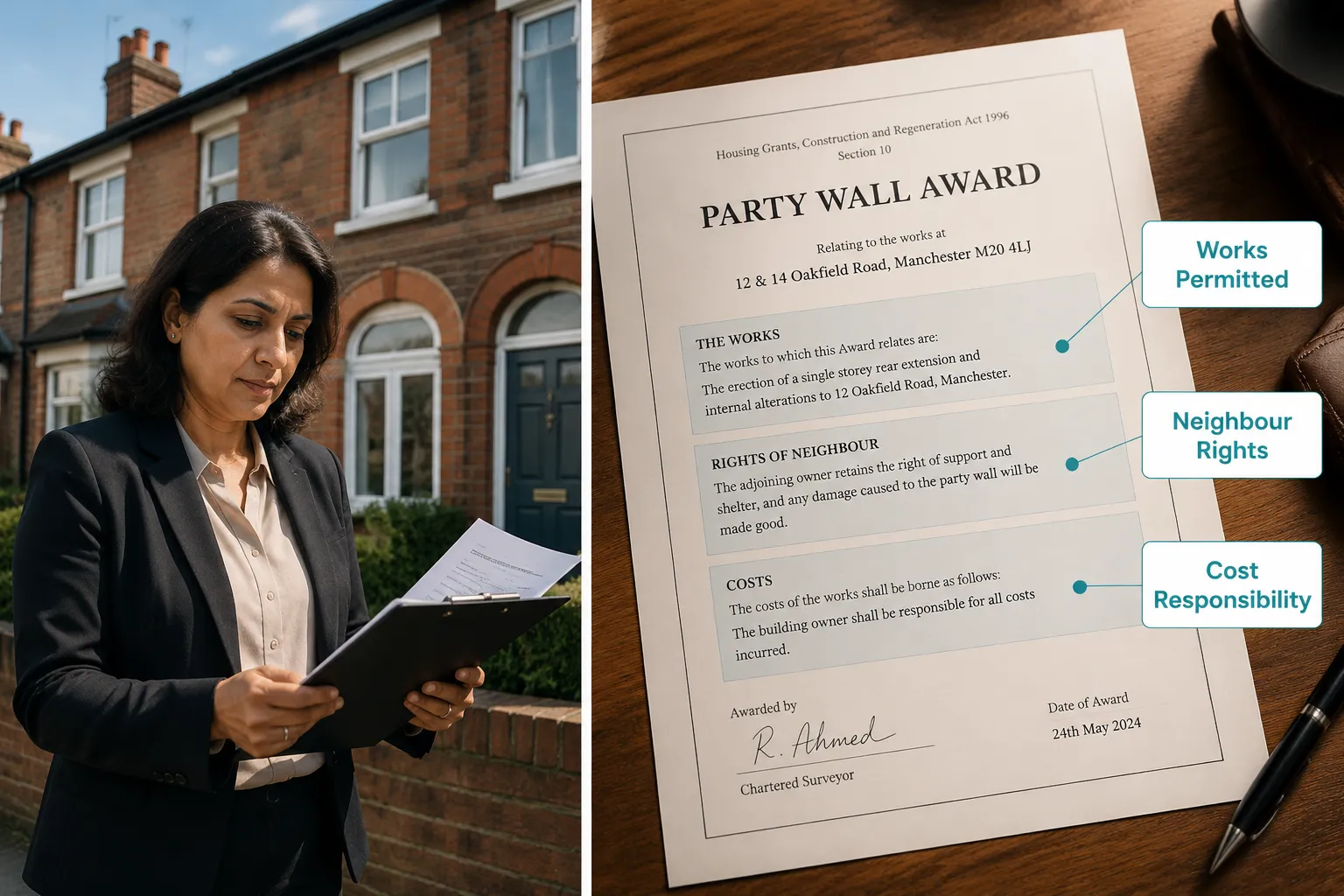
The award itself, the formal document that sets out the rights and obligations of both parties, the permitted works, the method of working, and the allocation of costs, is where the largest portion of surveyor time is spent.
For a straightforward single-storey extension with one adjoining owner and an agreed surveyor, regional fees for producing the award typically fall in the £500,£900 range (excluding VAT). More complex projects, loft conversions affecting a shared wall, basement excavations, or works requiring structural engineer input, can push the award fee to £1,200,£2,500 even in regional markets [1][4][9].
VAT and Disbursements
VAT at 20% applies to surveyor fees. Disbursements, travel, printing, postage, and any specialist reports commissioned, are charged on top. In practice, the all-in cost including VAT and disbursements is typically 20-30% higher than the headline fee quoted [4].
A project quoted at £800 + VAT with £120 in disbursements will cost £1,080 in total. Homeowners should always request a fee estimate that explicitly separates the professional fee, disbursements, and VAT.
How the Party Wall Award Affects Your Budget
The party wall award does more than document the permitted works. It is the mechanism through which costs are formally allocated, and understanding that allocation is critical to budgeting accurately.
Who Pays the Surveyor Fees?
The default position under the Party Wall etc. Act 1996 is that the building owner (the person carrying out the works) pays the reasonable costs of the party wall process, including the adjoining owner's surveyor's fees where a second surveyor has been appointed [5][8].
This means that if your neighbour dissents and appoints their own surveyor, you will almost certainly pay both surveyors' fees. In regional markets, that can mean paying two fees of £700,£1,500 each, a total of £1,400,£3,000, before the award has even been produced.
There are exceptions. Where the adjoining owner has made unreasonable demands or caused unnecessary delay, the award can direct that the adjoining owner bears some or all of the additional costs. However, this outcome requires a surveyor willing to make that finding and a clear factual basis for it [5][8].
Challenging Unreasonable Fees
RICS guidance emphasises that surveyor fees must be reasonable and proportionate to the work involved [2][5]. A surveyor charging £3,000 for a straightforward single-storey extension award in a regional market would face legitimate challenge. The award itself can be appealed to the County Court within 14 days of service, though this is rarely the most cost-effective route.
The more practical approach is to raise concerns directly with the surveyor, or, where a two-surveyor structure is in place, to have the two appointed surveyors agree on a reasonable fee for the third surveyor if one is called upon. RICS launched a consultation on updated party wall practice guidance in 2024, with increased emphasis on fee transparency and proportionality [2].
Complexity Multipliers in Practice
The table below illustrates how total costs can escalate on a project with multiple neighbours and complex works:
| Scenario | Adjoining Owners | Surveyor Structure | Typical Total (Regional, excl. VAT) |
|---|---|---|---|
| Simple rear extension | 1 | Agreed surveyor | £700, £1,200 |
| Simple rear extension | 1 | Two surveyors | £1,400, £2,500 |
| Loft conversion (mid-terrace) | 2 | Two surveyors each | £3,000, £5,500 |
| Basement with excavation | 2 | Two surveyors each | £4,000, £8,000+ |
These ranges are for regional (non-London) projects in 2026. London projects typically sit 20-40% above these figures [1][4][9].
Practical Steps to Control Your Party Wall Budget
Knowing the cost landscape is useful; acting on it is what protects your budget. The following steps are consistently recommended by practitioners and homeowners who have navigated the process successfully.
1. Obtain multiple quotes before appointing. There is no obligation to use the first surveyor you contact. Three quotes from RICS-regulated surveyors give a reliable sense of the local market rate [5].
2. Explore the agreed surveyor route early. Speaking with your neighbour before serving notice, and proposing a jointly appointed agreed surveyor, can halve the total fee bill. The key is to raise this before the neighbour appoints their own surveyor independently.
3. Request an itemised fee estimate. Ask for the professional fee, disbursements, VAT, and any likely additional charges (third surveyor, additional site visits) to be set out separately. Surprises in the final invoice are almost always traceable to items that were not discussed upfront.
4. Budget for the schedule of condition. Many homeowners focus on the award fee and overlook the schedule of condition. At £200,£450 per neighbouring property in regional markets, this can add £400,£900 to a project with two neighbours.
5. Understand what triggers additional fees. Amendments to the award, additional site visits after work begins, and damage claims all generate additional surveyor time. The party wall disputes resolution costs and rights guide explains what happens when things go wrong and what the financial implications are.
6. Check whether notice has been properly served. Proceeding without a valid notice exposes the building owner to injunctions and significantly higher costs. The guide on what happens when no party wall notice has been served outlines the risks and remedies.
Conclusion
Party wall surveyor fees beyond London follow a clear regional pattern: lower base rates, the same legal framework, and the same cost multipliers when complexity or neighbour disputes arise. In 2026, a straightforward regional project with a single agreed surveyor can be managed for £700,£1,200 excluding VAT; a contested multi-neighbour basement project can comfortably exceed £8,000 in total surveying costs.
Actionable next steps for homeowners:
- Before serving any notice, establish how many adjoining owners your project affects and whether the agreed surveyor route is viable.
- Request itemised quotes from at least three RICS-regulated surveyors, ensuring VAT and disbursements are shown separately.
- Commission a schedule of condition for every affected neighbouring property, regardless of whether it is strictly required, it is the most cost-effective protection against post-construction disputes.
- Read the party wall award carefully when it is issued. The cost allocation clause determines your financial exposure, and you have 14 days to appeal if the terms are unreasonable.
- If a neighbour has already dissented and appointed their own surveyor, focus on keeping the process efficient: prompt responses, access for inspections, and clear communication all reduce billable surveyor hours.
The party wall process does not have to be expensive. With the right preparation, the right surveyor structure, and a clear understanding of where costs come from, most homeowners can complete the process well within a manageable budget, wherever in the UK they happen to live.
References
[1] Party Wall Surveyor Cost – checkatrade.com
[2] Rics Launches Consultation On Updated Party Wall Practice Guidance – rics.org
[3] Party Wall Dispute Surveyor Costs – reddit.com
[4] Party Wall Surveyor Cost – hoa.org.uk
[5] Party Walls – rics.org
[6] Viewtopic – nappyvalleynet.com
[7] Party Wall Fee Calculator – partywallhelp.co.uk
[8] Jan 22 Party Wall Legislation And Procedure 7th Edition – rics.org
[9] Party Wall Surveyor Cost Uk – bestbuilders.co.uk
[10] How Much Does A Party Wall Surveyor Cost In London – iconsurveyors.co.uk