A probate executor recently submitted a desktop figure to HMRC only to have the valuation rejected outright, triggering a formal dispute and months of costly delays. That single decision, choosing a cheaper, quicker estimate over a full RICS-compliant report, illustrates exactly why understanding the difference between a Red Book valuation vs desktop estimate is not merely academic for UK property owners. It is a distinction with real legal, financial and tax consequences.
This article examines both valuation types in depth, explains the updated standards framework that governs them in 2026, and sets out precisely when a full RICS Red Book valuation is not just preferable but mandatory.
Key Takeaways
- A Red Book valuation is a formal, RICS-regulated report produced by a Registered Valuer following mandatory global and UK national standards; a desktop estimate is a lighter-touch opinion produced without physical inspection.
- The RICS Valuation Global Standards (Red Book) were updated in December 2024, effective 31 January 2025, raising the bar for data governance, methodology transparency and compliance wording on all valuation reports. [1][2]
- Desktop estimates are appropriate for low-risk lending checkpoints, initial investment screening and internal decisions, but are generally insufficient for probate, Capital Gains Tax, matrimonial proceedings and court evidence.
- Under the revised standards, a valuer who relies on a desktop or remote assessment must now provide robust justification for not inspecting the property. [3]
- Cost and speed differ significantly: desktop valuations typically cost £95,£200 and take one to three days, while full Red Book valuations commonly range from £350 to £2,500 or more and take three to ten working days.
What Is a Red Book Valuation and What Does RICS Compliance Actually Mean
The term "Red Book" refers to the RICS Valuation, Global Standards, the professional rulebook that RICS-regulated valuers must follow worldwide. A new edition was published in December 2024 and became effective on 31 January 2025, aligning with the latest International Valuation Standards (IVS) and updating mandatory rules on data quality, technology use and ESG factors. [1][2]
For UK property owners, the Red Book operates alongside the UK National Supplement, which applies to all UK valuations where the valuation date is on or after 1 May 2024. Together, these two documents form the complete compliance framework for a fully RICS-compliant "Red Book valuation." [5][6]
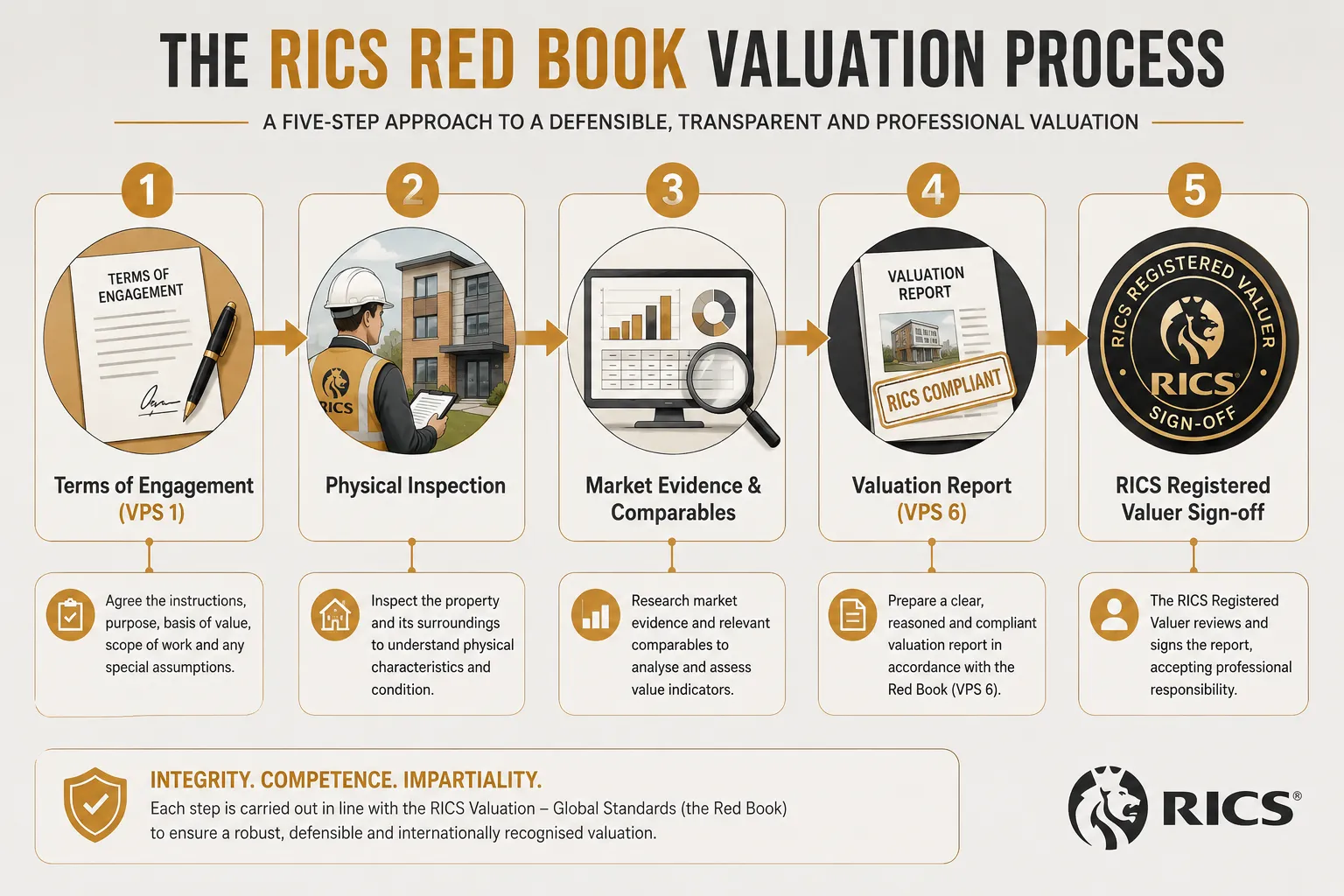
A Red Book valuation is not simply a surveyor's opinion. It is a formal, structured report that must include:
- Identification of the client and intended use, set out in Terms of Engagement under VPS 1
- A defined basis of value, most commonly "Market Value," a tightly regulated term under the standards [3][6]
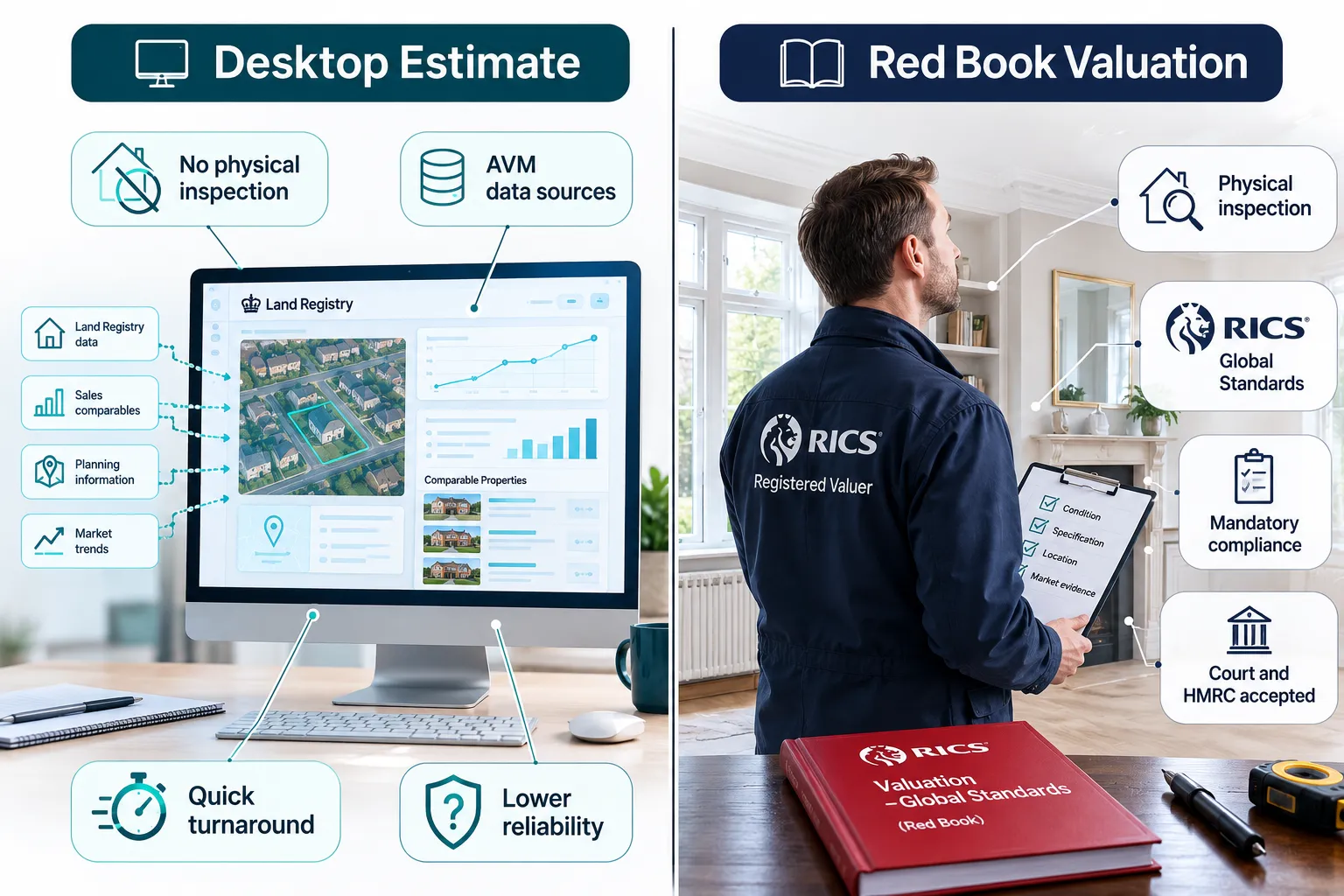
- A physical inspection of the property, both internally and externally, unless a robust written justification is provided for not doing so
- Comparable market evidence reviewed and documented
- A signed Valuation Report compliant with VPS 6, including explicit compliance statements
RICS issued refreshed 2025 templates for Terms of Engagement and Valuation Reports, updated further in mid-2026, which make it far clearer when a report qualifies as a full Red Book valuation versus a more restricted opinion such as a desktop estimate. [7]
For context on the range of professional property valuation services available, the property valuation services offered by Kingston Surveyors cover the full spectrum from formal Red Book reports to specialist assessments.
What Is a Desktop Estimate and How Does It Differ
A desktop valuation is an assessment of a property's value carried out without a physical visit to the premises. Instead, the valuer, or in many cases an automated system, draws on Land Registry sales records, estate agent listings, planning data, floor plans, photographs and other publicly available or digitally sourced information. [9][13]
There are broadly three tiers of desktop assessment:
| Type | Method | Typical Use Case |
|---|---|---|
| Automated Valuation Model (AVM) | Algorithm-driven, no human review | Quick lender screening, internal checks |
| Surveyor-led desktop valuation | Human analysis of remote data | Some bridging finance, investment appraisal |
| Full Red Book valuation | Physical inspection plus full RICS compliance | Probate, CGT, litigation, major lending |
The key limitation of any desktop approach is that it cannot detect what only an in-person inspection reveals: structural defects, unauthorised alterations, boundary encroachments, dampness, access issues or material changes in condition. [9][15] These factors can materially affect value, and a figure derived without checking them carries inherent risk.
"Market Value is a tightly defined term rather than a casual estimate, and for many formal tasks a full inspected Red Book valuation is now the default expectation." [3]
Desktop estimates are genuinely useful for:
- Initial investment screening before committing to due diligence costs
- Low loan-to-value lending checkpoints where lender risk is demonstrably low
- Internal portfolio monitoring by institutional investors
- Indicative figures for early-stage divorce or estate discussions before formal proceedings begin
For a clearer picture of the factors that any valuation, desktop or full, must weigh up, the guide on what affects a property valuation provides a useful foundation.
The Updated Standards Framework: What Changed in 2025 and 2026
The December 2024 revision to the Red Book Global Standards introduced structural and substantive changes that directly affect how desktop and model-driven estimates are treated. [2][8]
Key changes relevant to the Red Book valuation vs desktop estimate debate include:
Reorganised valuation methodology framework. VPS 3 now covers valuation approaches and methods, while the new VPS 5 focuses specifically on valuation models. This places greater scrutiny on any valuation that relies on modelling or data aggregation rather than direct inspection. [2][10]
Data quality and model governance. Valuers must now demonstrate robust data governance when providing any desktop or model-driven estimate. The casual use of Land Registry averages or AVM outputs without documented methodology is no longer consistent with the standards. [2][8]
Robust justification for non-inspection. Under the revised standards in force from 31 January 2025, a valuer who relies on a remote or desktop assessment must now provide a "robust justification" for not carrying out a physical inspection. [3] This is a significant tightening of the previous position.
ESG integration. The 2025 revision places greater emphasis on environmental, social and governance factors, including energy performance and flood risk, which are increasingly material to UK residential and commercial values. A desktop estimate drawing only on historical sales data may not adequately capture these factors.
Refreshed reporting templates. The updated VPS 1 and VPS 6 frameworks, revised again in mid-2026, include standard compliance wording that makes it immediately apparent whether a report is a full Red Book valuation or a restricted-scope opinion. [7] This matters because clients, lenders and courts can now more easily identify whether the report they hold meets the required standard.
When UK Property Owners Need a Full RICS-Compliant Report
The central question in any Red Book valuation vs desktop estimate decision is: who will rely on this figure, and for what purpose? The answer determines the required level of rigour.
Situations Where a Full Red Book Valuation Is Required or Strongly Expected
Probate and inheritance tax. HMRC expects valuations submitted for Inheritance Tax purposes to be carried out by a qualified valuer following recognised professional standards. A desktop estimate submitted for probate purposes risks rejection, as the earlier example illustrates. [3] A full Red Book report provides the documented basis and compliance statements that HMRC requires.
Capital Gains Tax disposals. Where a property is being sold and a CGT calculation depends on an earlier base-cost valuation, for example, a valuation at the date of acquisition or inheritance, HMRC expects a properly evidenced, inspection-based figure. [3] A retrospective property valuation carried out to Red Book standards provides the necessary audit trail.
Matrimonial and divorce proceedings. Courts dealing with financial remedy orders require valuations that meet professional standards and can withstand cross-examination. A desktop estimate, lacking inspection evidence, is vulnerable to challenge. An expert witness report prepared to Red Book standards carries the evidential weight that courts expect.
Mortgage lending on complex or higher-value properties. Most high-street lenders accept AVMs or desktop valuations for straightforward, low-risk residential remortgages. However, for higher loan-to-value ratios, unusual property types, HMOs, semi-commercial premises or development properties, lenders typically require a full Red Book valuation with internal inspection. [15]
Help to Buy equity loan redemption. The Homes England scheme has specific requirements for the valuation used when repaying or staircasing out of a Help to Buy equity loan. A Help to Buy valuation must be carried out by a RICS Registered Valuer to Red Book standards, a desktop estimate will not be accepted by the scheme administrator.
Shared ownership staircasing and resale. Similar requirements apply to shared ownership schemes. A shared ownership valuation for staircasing must follow Red Book standards, as the housing association relies on it to determine the price at which additional shares are sold.
Commercial property transactions and disputes. For commercial acquisitions, rent reviews, lease renewals and disputes, a full RICS-compliant report is the standard expectation. [4] Commercial property valuations involve additional complexity, use class, covenant strength, yield analysis, that a desktop estimate cannot reliably address.
Situations Where a Desktop Estimate May Be Sufficient
- Early-stage investment appraisal before committing to inspection costs
- Internal portfolio monitoring for institutional landlords
- Indicative figures for preliminary legal discussions where no formal filing is imminent
- Some straightforward residential remortgages at low loan-to-value ratios where the lender explicitly accepts a desktop assessment
The key test is whether the figure will be relied upon by a third party, HMRC, a court, a lender on a complex case, for a decision that carries legal or financial consequences. If yes, a full Red Book valuation is almost always the appropriate choice.
Cost, Timescales and the Real Price of Getting It Wrong
The cost differential between a desktop estimate and a full Red Book valuation is real but needs to be set against the cost of using the wrong report type.
Indicative costs in 2026:
- AVMs: approximately £10,£30, near-instant
- Surveyor-led desktop valuations: typically £95,£200, one to three days
- Full RICS Red Book valuations: commonly £350,£2,500 or more depending on property type and complexity, three to ten working days [11][15]
These figures reflect the additional time, liability and professional rigour that a Red Book report demands. The valuer must physically attend the property, document their inspection, review comparable evidence, apply the correct basis of value and produce a report that explicitly states its compliance with the applicable standards.
The cost of getting it wrong is considerably higher. A rejected probate valuation can delay estate administration by months and expose executors to HMRC interest and penalties. A desktop figure challenged in divorce proceedings can result in a costly re-valuation and adverse cost orders. A lender that discovers a desktop estimate was submitted where a full inspection was required may withdraw a mortgage offer entirely.
Choosing the Right Valuation: A Practical Decision Framework
When deciding between a Red Book valuation and a desktop estimate, work through the following questions:
- Who will rely on this figure? If the answer includes HMRC, a court, a lender on a complex case or a housing association, a full Red Book valuation is required.
- Is the property unusual, complex or potentially defective? Structural issues, unauthorised alterations, non-standard construction and boundary disputes all require physical inspection to value accurately.
- What is the financial consequence of an incorrect figure? The higher the stakes, the stronger the case for a full Red Book report.
- Does the intended use have a prescribed valuation standard? Help to Buy, shared ownership and certain regulated lending products specify Red Book compliance explicitly.
- Is speed the overriding priority and is risk genuinely low? Only if the answer to both parts is yes should a desktop estimate be considered for anything beyond internal decision-making.
For those considering a desktop valuation in London for appropriate low-risk purposes, understanding its limitations upfront avoids the risk of relying on it in a context where it will not be accepted.
Red Book Valuation vs Desktop Estimate: Common Misconceptions

"Any RICS surveyor's opinion is a Red Book valuation." This is incorrect. A RICS member can provide an informal opinion of value that does not comply with the Red Book standards. Only a report that explicitly states compliance with the Global Standards and relevant UK material, produced by a RICS Registered Valuer, qualifies as a Red Book valuation. [4][6]
"A desktop valuation is just a cheaper Red Book valuation." A desktop estimate is a fundamentally different product. It lacks physical inspection, and under the 2025 standards, a valuer must now provide robust written justification for omitting an inspection. [3] It cannot simply be described as a Red Book valuation with a reduced scope unless the specific conditions for that approach are met and documented.
"HMRC will accept any professional valuation." HMRC guidance on property valuations for tax purposes expects figures to be properly evidenced and professionally produced. While HMRC does not always specify the exact standard, a Red Book report provides the strongest defensible basis, particularly where the figure is challenged by the Valuation Office Agency.
"Desktop valuations are only for online lenders." Surveyor-led desktop valuations are used by a range of lenders and advisers. The issue is not the channel but the purpose: where condition, layout or legal issues could materially affect value, a desktop assessment is inherently limited regardless of who commissions it. [9][13]
Conclusion
The choice between a Red Book valuation and a desktop estimate is not simply a question of budget or convenience. It is a decision with direct implications for legal compliance, tax accuracy and the defensibility of a property figure in formal proceedings.
The 2025 update to the RICS Valuation Global Standards, effective from 31 January 2025, has raised the bar for all valuation work, including desktop assessments, by demanding greater transparency on methodology, data quality and the justification for non-inspection. [1][2] For UK property owners facing probate, CGT, divorce, regulated lending or any context where a third party will rely on the figure, a full RICS-compliant Red Book valuation is not optional: it is the expected standard.
Actionable next steps for UK property owners in 2026:
- Identify the purpose of the valuation before commissioning it, this single step determines which report type is appropriate.
- For probate, CGT, Help to Buy, shared ownership staircasing or any court-related matter, instruct a RICS Registered Valuer and confirm the report will be produced to Red Book standards.
- For investment appraisal or internal decision-making at low risk, a surveyor-led desktop valuation may be cost-effective, but document the rationale for that choice.
- When in doubt, consult a RICS-regulated practice directly. The cost of a full Red Book report is almost always lower than the cost of correcting a rejected or challenged desktop estimate.
References
[1] Valuation Standards – rics.org
[2] New Rics Global Red Book Updates Mandatory Standards Data Management Technology Esg Valuation – rics.org
[3] Rics Valuation Vs Desktop Valuation Which Is Right For Your Property In 2026 – winfieldssurveyors.co.uk
[4] Red Book – rics.org
[5] Rics Valuation Global Standards Uk National Supplement Oct23 Red Line – rics.org
[6] In Plain English Red Book Valuation – savills.co.uk
[7] Guidance On Use Of Red Book Terms Of Engagement Valuation Report Frameworks 2025 – rics.org
[8] Red Book 2024 Basis For Conclusions – rics.org
[9] Common Types Of Uk Property Investment Valuations – j3advisory.co.uk
[10] Red Book Global – rics.org