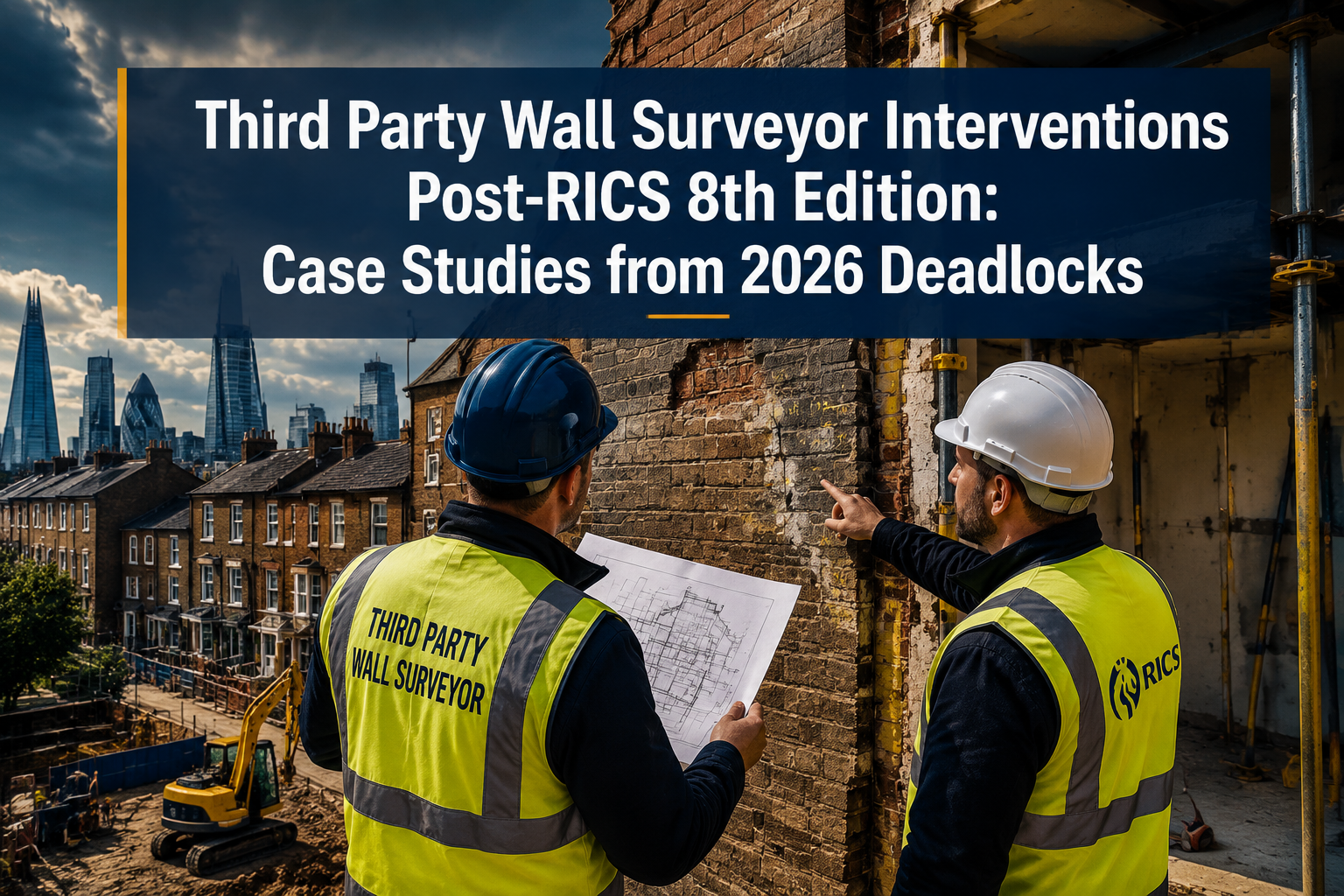

Fewer than one in five party wall disputes that reach a formal deadlock are resolved without third surveyor intervention — a figure that has sharpened the profession's focus on exactly when and how that intervention should be triggered. In 2026, following RICS's eight-week consultation on its updated Party Wall Legislation and Procedure guidance, the rules governing third party wall surveyor interventions have been substantially clarified. Third Party Wall Surveyor Interventions Post-RICS 8th Edition: Case Studies from 2026 Deadlocks now forms a critical area of study for any surveyor, property owner, or legal professional navigating the party wall process in England and Wales.
This article examines what has changed under the new guidance, why deadlocks occur, and how real 2026 cases — particularly excavation disputes and "not-for-right" disagreements — have been resolved efficiently under the revised framework.
Key Takeaways
- The RICS 8th Edition guidance, implemented immediately following the April–May 2026 consultation, provides clearer triggers and procedures for third surveyor appointments.
- Surveyors who fail to adopt the updated guidance risk professional conduct complaints, challenged awards, and personal liability.
- Surveyor independence is now more explicitly protected, reducing the risk of client-driven procedural shortcuts that cause deadlocks.
- Thermal imaging and robust schedules of condition are reducing the frequency of escalation to third surveyor stage.
- Cost recovery for third surveyor referrals is better defined, making the process less financially unpredictable for all parties.
What the RICS 8th Edition Changed About Third Surveyor Triggers
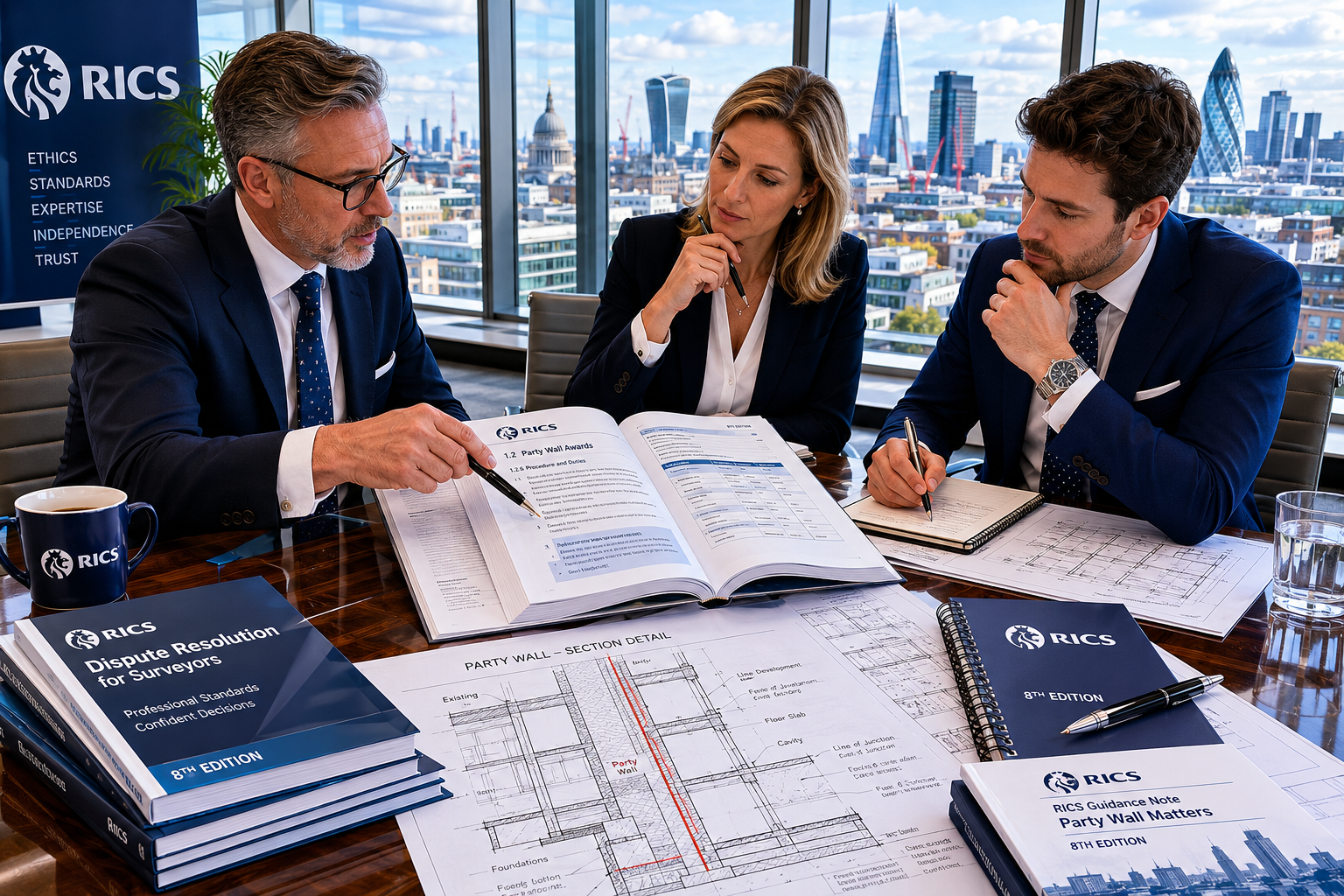
The third surveyor role under the Party Wall etc. Act 1996 has always existed as a backstop mechanism. When two appointed surveyors cannot agree, either surveyor may refer the matter to the third surveyor, who then makes a binding determination. What the RICS 8th Edition has done is sharpen the criteria for when that referral is not just permitted but expected. [1]
Clearer Criteria for Referral
Under previous guidance, the threshold for engaging the third surveyor was somewhat ambiguous. Surveyors sometimes delayed referral out of professional courtesy or a desire to avoid the perception of escalation. The 8th Edition addresses this directly by specifying that referral is appropriate when:
- The two appointed surveyors cannot agree within a reasonable timeframe (now more explicitly defined in the guidance).
- One surveyor believes the other is compromising the statutory process — for example, by acting on client instruction rather than professional judgment.
- A surveyor is acting outside their jurisdiction, making the award vulnerable to legal challenge. [2]
This clarity matters enormously in practice. In 2026, several London-based cases saw deadlocks broken within days of referral, precisely because both surveyors understood the updated threshold and acted on it without hesitation.
Jurisdiction Verification as a Pre-Condition
One of the more consequential updates in the 8th Edition is its explicit reinforcement of jurisdiction verification. Before accepting any appointment, a surveyor must confirm that the notice served was valid, that the correct statutory process was followed, and that the appointing party has standing under the Act. [5]
Acting outside jurisdiction does not merely expose the award to challenge — it can expose the surveyor personally to liability. The 8th Edition makes this risk explicit, and the 2026 case studies discussed below illustrate why this step cannot be treated as a formality.
For a thorough grounding in party wall disputes and how they arise, understanding jurisdiction is the essential first step before any appointment proceeds.
How Surveyor Independence Underpins the 2026 Framework
The 8th Edition's emphasis on surveyor independence is arguably its most significant cultural shift. A party wall surveyor's appointment is personal and statutory — it does not derive from the client, and it cannot be overridden by the client. [3]
This principle was already embedded in the Act, but the updated guidance addresses a pattern of real-world behaviour where surveyors, under commercial or relational pressure, allowed client preferences to shape procedural decisions. The consequences were predictable: awards challenged in court, delays, and costs escalating far beyond what a straightforward referral to the third surveyor would have cost.
The Developer Pressure Case Study — London, 2026
One of the most instructive 2026 examples involves a residential developer in South West London who instructed their appointed surveyor to issue an award within five days, without completing a full party wall schedule of condition. The developer's argument was that the adjoining owner had already verbally agreed to proceed and that a full condition survey was unnecessary.
The appointed surveyor declined. Under the 8th Edition's guidance on procedural integrity, issuing an award without a completed schedule of condition — particularly where basement excavation was involved — would have left the adjoining owner without a documented baseline. [6]
The adjoining owner's surveyor concurred that the award could not be issued in that form. The matter was referred to the third surveyor, who confirmed that the schedule of condition was a procedural necessity, not an optional step. The third surveyor's determination was issued within eight working days, and the project proceeded on a sound footing.
The lesson: Surveyor independence, properly exercised, actually accelerates resolution. The five-day shortcut would almost certainly have produced a disputed award and months of delay.
"A surveyor who acts on client instruction rather than statutory duty does not serve their client — they expose them."
Case Studies from 2026 Deadlocks: Excavation and Not-for-Right Disputes
The two categories of dispute that have generated the most third surveyor referrals in 2026 are excavation-related disagreements and "not-for-right" disputes — cases where one party contends that the works do not engage the Act at all.
Excavation Dispute — The 3-Metre Rule Deadlock
Under Section 6 of the Party Wall etc. Act 1996, a building owner who excavates within three metres of an adjoining structure, to a depth lower than the adjoining owner's foundations, must serve notice. The party wall Act 3-metre rule is a frequent source of dispute because foundation depths are not always immediately apparent, and engineers' assessments can differ.
In a 2026 case in North London, a building owner's surveyor and the adjoining owner's surveyor reached an impasse over whether the proposed excavation depth triggered Section 6. The building owner's engineer had assessed the adjoining structure's foundation depth at 900mm. The adjoining owner's engineer assessed it at 750mm — a difference that determined whether the Act applied.
The third surveyor's approach:
| Step | Action Taken |
|---|---|
| 1 | Reviewed both engineers' methodologies |
| 2 | Commissioned an independent trial pit |
| 3 | Determined foundation depth at 820mm |
| 4 | Confirmed Section 6 notice was required |
| 5 | Issued award with protective conditions |
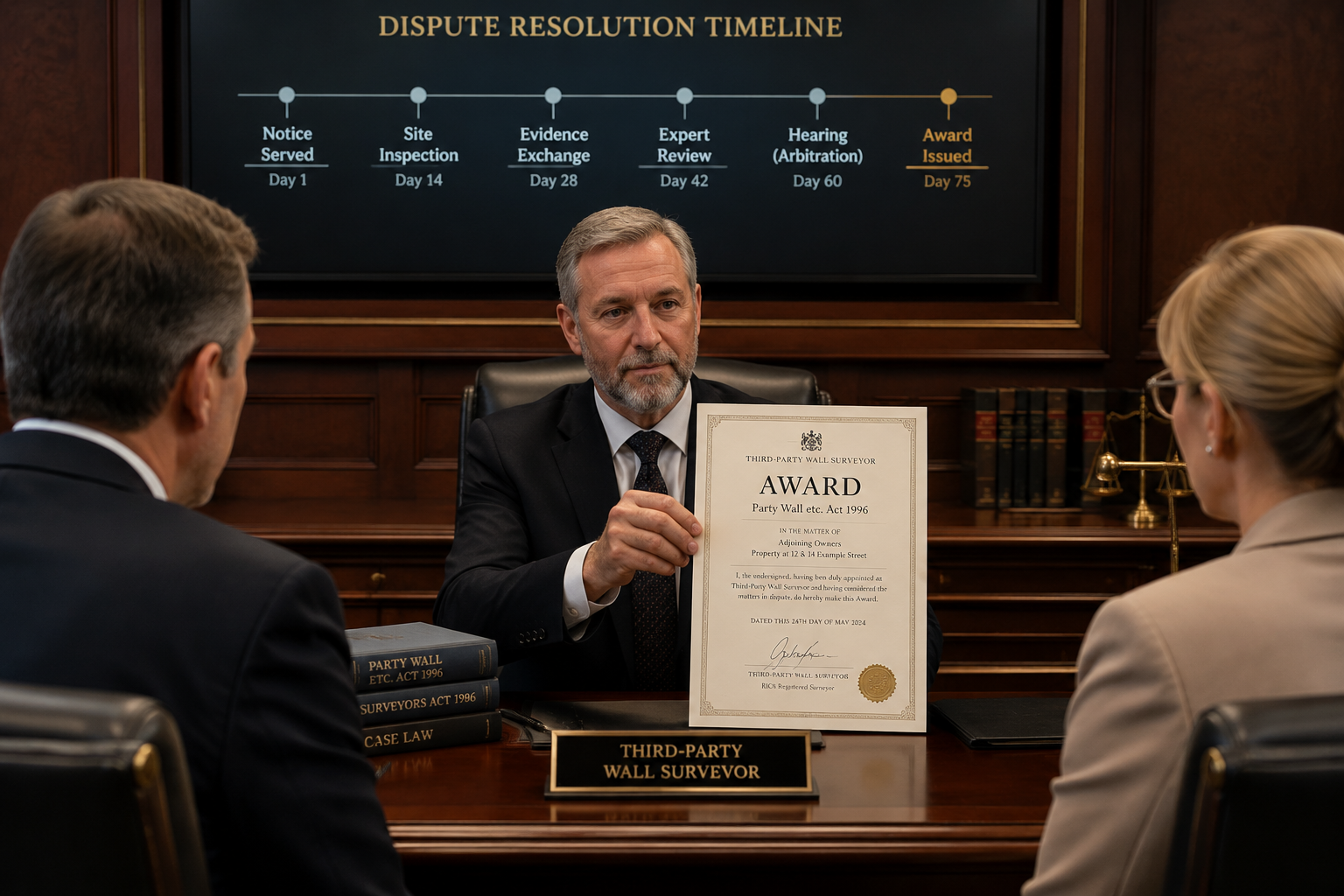
The third surveyor's determination was binding. The project proceeded within three weeks of referral. Without the 8th Edition's clearer referral criteria, this deadlock might have persisted for months while both sides sought legal advice.
Thermal Imaging and the Reduction of Escalation
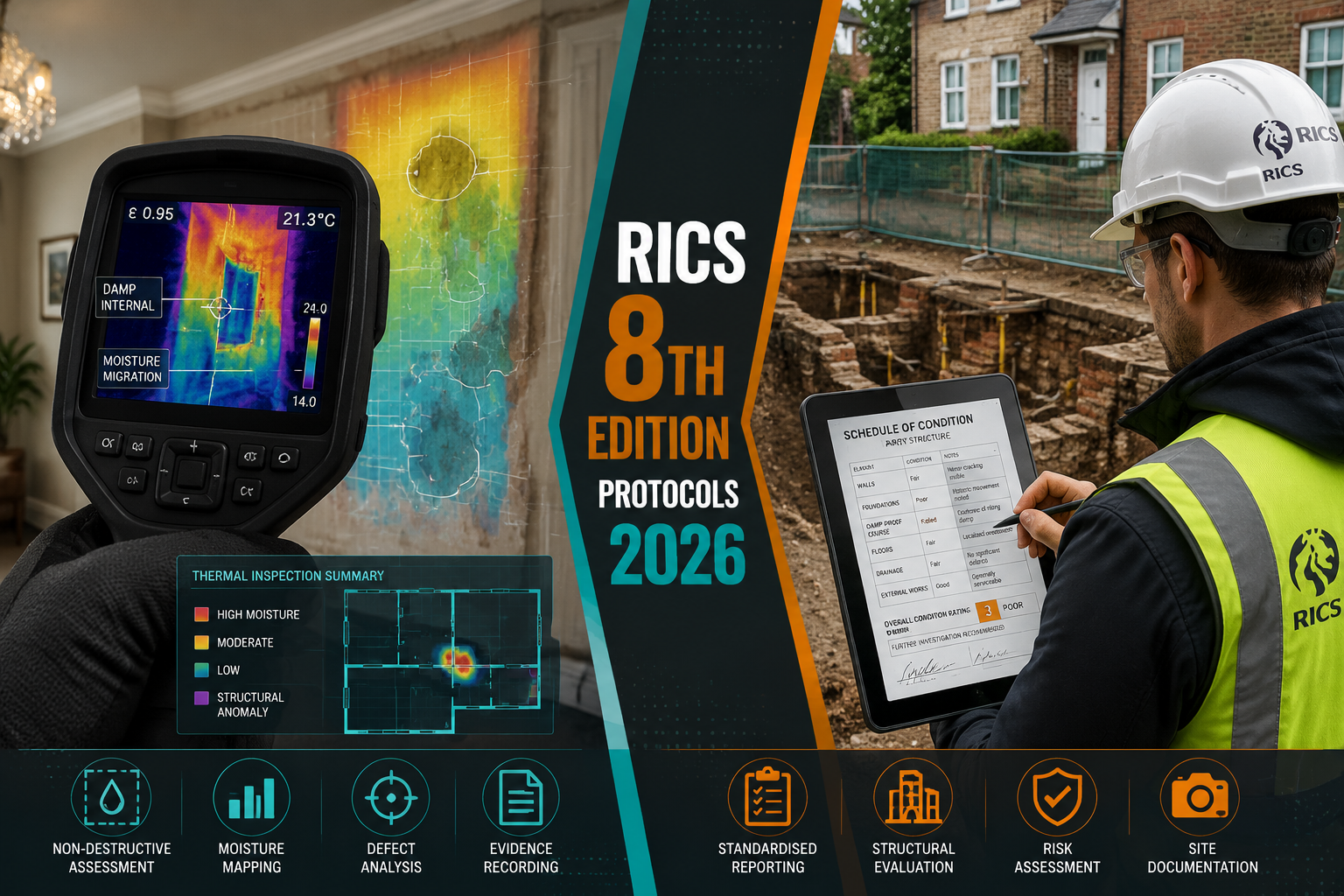
The 8th Edition introduces protocols for incorporating thermal imaging into party wall surveys — a development that is already reducing the frequency of escalation to third surveyor stage. [4]
Thermal imaging allows surveyors to identify hidden damp, voids, and structural anomalies without invasive investigation. In 2026, several cases that would previously have become disputes — because one party claimed pre-existing damage that the other denied — were resolved at the schedule of condition stage when thermal imaging provided objective, non-invasive evidence.
In one Surrey case, thermal imaging of a shared chimney breast (a common source of party wall shared chimney disputes) revealed pre-existing moisture ingress that had not been visible during the initial visual survey. This evidence was incorporated into the schedule of condition, removing the basis for a post-works dispute before it could arise.
Not-for-Right Disputes — The Jurisdiction Question in Practice
A "not-for-right" dispute occurs when a building owner serves notice and the adjoining owner's surveyor contends that the works do not engage the Act — meaning the notice was unnecessary and the statutory process does not apply. These disputes are particularly problematic because, if the third surveyor agrees that the Act does not apply, any award already made may be void.
In a 2026 case in Camden, a building owner proposed internal works that their surveyor argued engaged Section 2 of the Act (works to a party wall). The adjoining owner's surveyor disagreed, contending the wall in question was not a party wall within the Act's definition.
The third surveyor was appointed and, following a site inspection and review of title documents, determined that the wall was indeed a party wall. The award stood. [7]
This case underlines why the 8th Edition's emphasis on jurisdiction verification at the outset is so important. Had the building owner's surveyor verified the wall's status more rigorously before serving notice, the dispute might have been avoided entirely. For guidance on party wall notice requirements and how to serve them correctly, early professional advice is essential.
Cost Recovery and Procedural Efficiency Under the New Guidance
One concern that has historically discouraged parties from referring matters to the third surveyor is cost uncertainty. The 8th Edition addresses this by providing clearer guidance on how third surveyor costs are allocated. [7]
How Costs Are Typically Allocated
- Building owner pays where the deadlock arose from their surveyor's procedural failure or unreasonable position.
- Adjoining owner pays where the referral was unnecessary or the adjoining owner's surveyor took an unreasonable stance.
- Costs split where both surveyors contributed to the deadlock.
- Third surveyor determines the allocation in disputed cases, with reference to the conduct of both parties.
The 8th Edition's clearer cost framework has made referral a more predictable step. In the excavation case described above, the third surveyor determined that costs should be borne by the building owner, since the ambiguity arose from their engineer's initial assessment. This outcome was consistent with the Act's general principle that the building owner bears the cost of works and associated procedures.
Notice Service and Public Engagement Standards
The 8th Edition also updates best-practice protocols for serving notices, with a particular emphasis on ensuring that non-professional parties — adjoining owners who have no surveying background — genuinely understand what they are receiving and what their options are. [1]
This matters for third surveyor interventions because many deadlocks originate in a poorly served or misunderstood notice. An adjoining owner who does not understand that they have dissented, or who dissents without intending to trigger the formal process, can inadvertently create a procedural situation that leads to a third surveyor referral.
The new public engagement standards require surveyors to communicate in plain language and to confirm that the recipient has understood the notice and their rights. For property owners unfamiliar with the process, a comprehensive guide to party wall matters provides a useful starting point before any formal notice is served.
Practical Implications for Surveyors and Property Owners in 2026
The immediate implementation requirement following the 8th Edition consultation is not a procedural formality. RICS has made clear that surveyors continuing to use outdated procedures face professional conduct complaints, challenged awards, and personal liability exposure. [2]
For Surveyors
- Review all active appointments to confirm they comply with the 8th Edition's jurisdiction verification requirements.
- Update schedule of condition protocols to incorporate thermal imaging where appropriate.
- Document referral decisions carefully — the reasoning for referring to the third surveyor, or for not referring, should be recorded in writing.
- Do not accept client instruction as a basis for procedural shortcuts. The 8th Edition makes the personal and statutory nature of the appointment explicit.
For Building Owners
- Engage a qualified surveyor early — ideally before serving any notice — to confirm whether the works engage the Act and which sections apply.
- Understand that the party wall excavation notice process has specific requirements that, if not followed correctly, can delay projects significantly.
- Budget for the possibility of third surveyor referral. Under the 8th Edition, this is a defined, time-limited process — not an open-ended escalation.
For Adjoining Owners
- Respond to notices within the statutory timeframe. Failure to respond triggers a deemed dissent, which initiates the formal surveyor appointment process whether or not that was intended.
- Appoint a surveyor whose independence from the building owner is beyond question. The 8th Edition's strengthened independence provisions protect adjoining owners, but only if the appointed surveyor exercises that independence.
- Ensure a thorough schedule of condition is completed before works begin. This is the single most effective protection against post-works disputes.
Conclusion
Third Party Wall Surveyor Interventions Post-RICS 8th Edition: Case Studies from 2026 Deadlocks demonstrate that the updated guidance is already producing measurable improvements in how disputes are resolved. Clearer referral triggers, stronger independence protections, better cost allocation frameworks, and the integration of technology such as thermal imaging are collectively reducing both the frequency and duration of deadlocks.
The 2026 cases examined here — from excavation disputes in North London to not-for-right disagreements in Camden — show that when surveyors apply the 8th Edition's principles correctly, third surveyor referrals become efficient, time-bound resolution mechanisms rather than last-resort escalations.
Actionable next steps:
- If works are planned that may engage the Party Wall etc. Act 1996, seek professional advice before serving any notice to confirm the correct procedure.
- Appoint a surveyor who is fully conversant with the RICS 8th Edition guidance and can demonstrate compliance with its updated requirements.
- Insist on a thorough schedule of condition before works begin — this single document prevents more disputes than any other procedural step.
- If a deadlock arises, do not delay referral to the third surveyor. Under the 8th Edition, this is a defined process with clear timelines and cost allocation rules.
- For complex cases involving excavation, loft conversions, or shared structures, consult resources on party wall matters for loft conversions and related works to understand the full scope of obligations before proceeding.
The RICS 8th Edition is not merely a procedural update — it is a restatement of the fundamental principle that party wall law exists to protect all parties, and that the third surveyor mechanism, properly used, is its most powerful enforcement tool.
References
[1] Rics Launches Consultation On Updated Party Wall Practice Guidance – https://www.rics.org/news-insights/rics-launches-consultation-on-updated-party-wall-practice-guidance?utm_source=openai
[2] Rics 8th Edition Party Wall Guidance Post Consultation Changes And Immediate 2026 Implementation For Surveyors – https://www.canterburysurveyors.com/blog/rics-8th-edition-party-wall-guidance-post-consultation-changes-and-immediate-2026-implementation-for-surveyors/?utm_source=openai
[3] Rics 8th Edition Party Wall Guidance 2026 Implementation Challenges And Surveyor Compliance Strategies – https://wimbledonsurveyors.com/rics-8th-edition-party-wall-guidance-2026-implementation-challenges-and-surveyor-compliance-strategies/?utm_source=openai
[4] Thermal Imaging Applications In Party Wall Surveys Rics 8th Edition Protocols For Hidden Defect Detection – https://wimbledonsurveyors.com/thermal-imaging-applications-in-party-wall-surveys-rics-8th-edition-protocols-for-hidden-defect-detection/?utm_source=openai
[5] Rics 8th Edition Party Wall Guidance 2026 Whats Changed And How Surveyors Must Adapt – https://wimbledonsurveyors.com/rics-8th-edition-party-wall-guidance-2026-whats-changed-and-how-surveyors-must-adapt/?utm_source=openai
[6] Party Wall Surveyor Independence Under Rics 8th Edition Navigating Client Pressures And Statutory Duties In 2026 Projects – https://manchestersurveyors.com/party-wall-surveyor-independence-under-rics-8th-edition-navigating-client-pressures-and-statutory-duties-in-2026-projects/?utm_source=openai
[7] Third Surveyor Activation In Party Wall Deadlocks Rics 8th Edition Protocols And Cost Recovery Tactics For 2026 – https://manchestersurveyors.com/third-surveyor-activation-in-party-wall-deadlocks-rics-8th-edition-protocols-and-cost-recovery-tactics-for-2026/?utm_source=openai