Roughly one in three UK homeowners who used an online valuation tool before selling in 2025 received an estimate that differed from their eventual sale price by more than 10%. That gap can translate to tens of thousands of pounds on a typical London property. The debate around Professional vs DIY Valuation Tools: Why Chartered Surveyor Valuations Still Matter in UK Property Decisions is no longer theoretical, it has real financial and legal consequences for buyers, sellers, and owners navigating refinancing or disputes in 2026.
This article examines what automated valuation models (AVMs) and online calculators can and cannot do, why the RICS Red Book standard remains the regulatory benchmark, and precisely when a chartered surveyor's opinion is not just useful but essential.
Key Takeaways
- Online valuation tools and AVMs have improved significantly but cannot replicate a physical inspection or carry regulatory weight.
- The RICS Red Book (updated globally in January 2025 and reissued in the UK national supplement) sets the quality and independence standard that courts, lenders, and HMRC rely upon.
- Leasehold reform, capital gains tax calculations, shared ownership staircasing, and mortgage disputes all require a defensible, RICS-compliant valuation.
- A hybrid approach is emerging: data tools assist surveyors, but professional oversight remains mandatory in complex or high-stakes scenarios.
- The cost of a chartered surveyor valuation is typically modest relative to the financial risk of relying on an inaccurate automated estimate.
What DIY Valuation Tools Actually Do
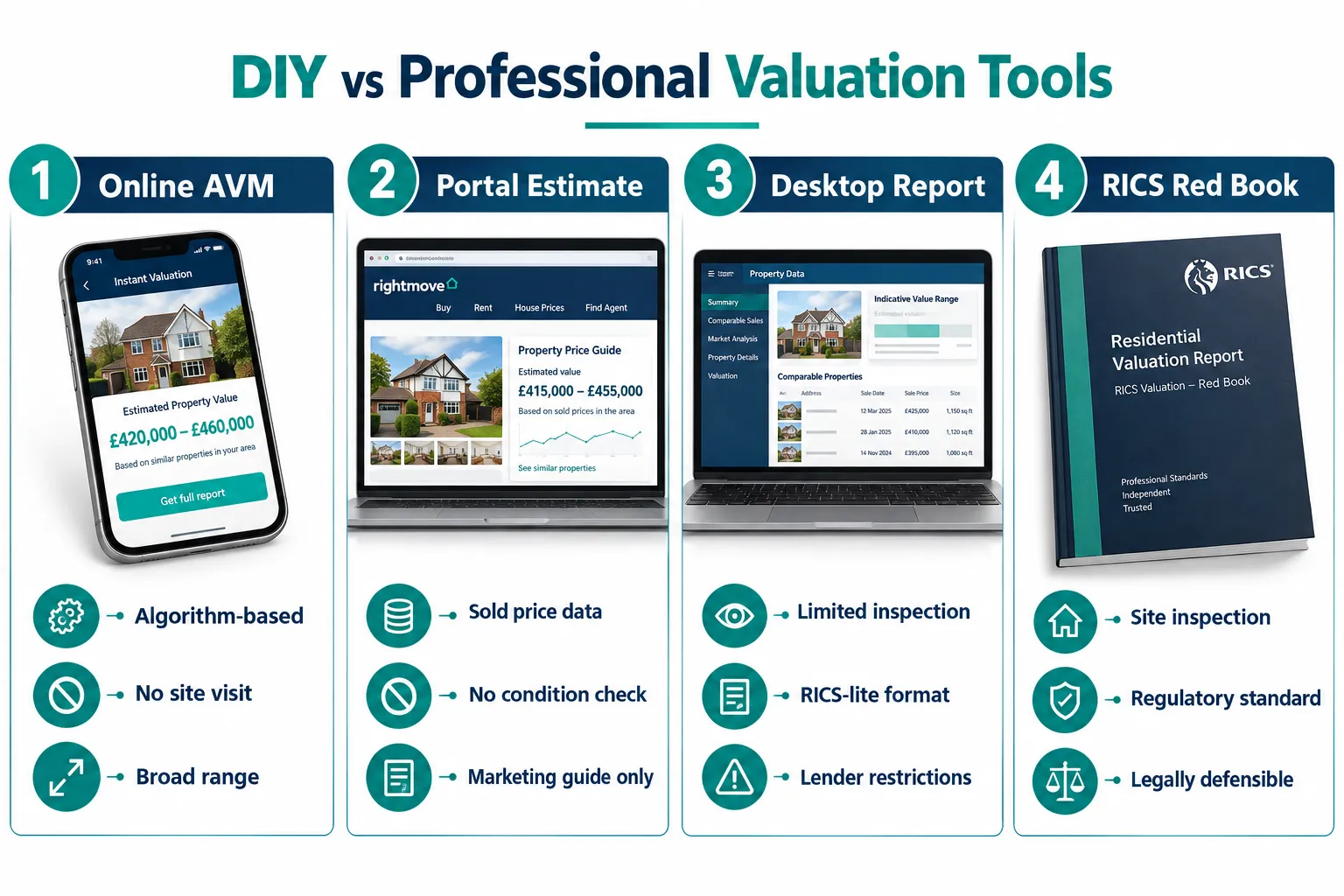
The UK property market in 2026 offers a wide menu of self-service valuation options. At the basic end, portals such as Rightmove provide instant house price estimates based on Land Registry sold data and local comparables [8]. More sophisticated platforms such as Realyse [5] and ValuIQ [7] layer in rental yields, planning data, and market trend analytics. AI-driven tools like MyPropertyAnalyst [9] go further still, combining machine learning with environmental and demographic datasets.
These tools share a common architecture: they aggregate publicly available transaction data and apply statistical models to generate a price range. They are fast, free or low-cost, and genuinely useful for a first-pass market orientation.
However, every leading platform is explicit about their limits. Rightmove's valuation page states clearly that its estimates are a starting point and directs users to a local agent for definitive pricing [8]. ValuIQ similarly positions its outputs as data-informed guides rather than regulated valuations [7]. Even institutional-grade platforms such as Realyse, which serves property professionals, frame their analytics as decision-support tools rather than replacements for professional assessment [5].
The core limitations of DIY tools fall into three categories:
| Limitation | Why It Matters |
|---|---|
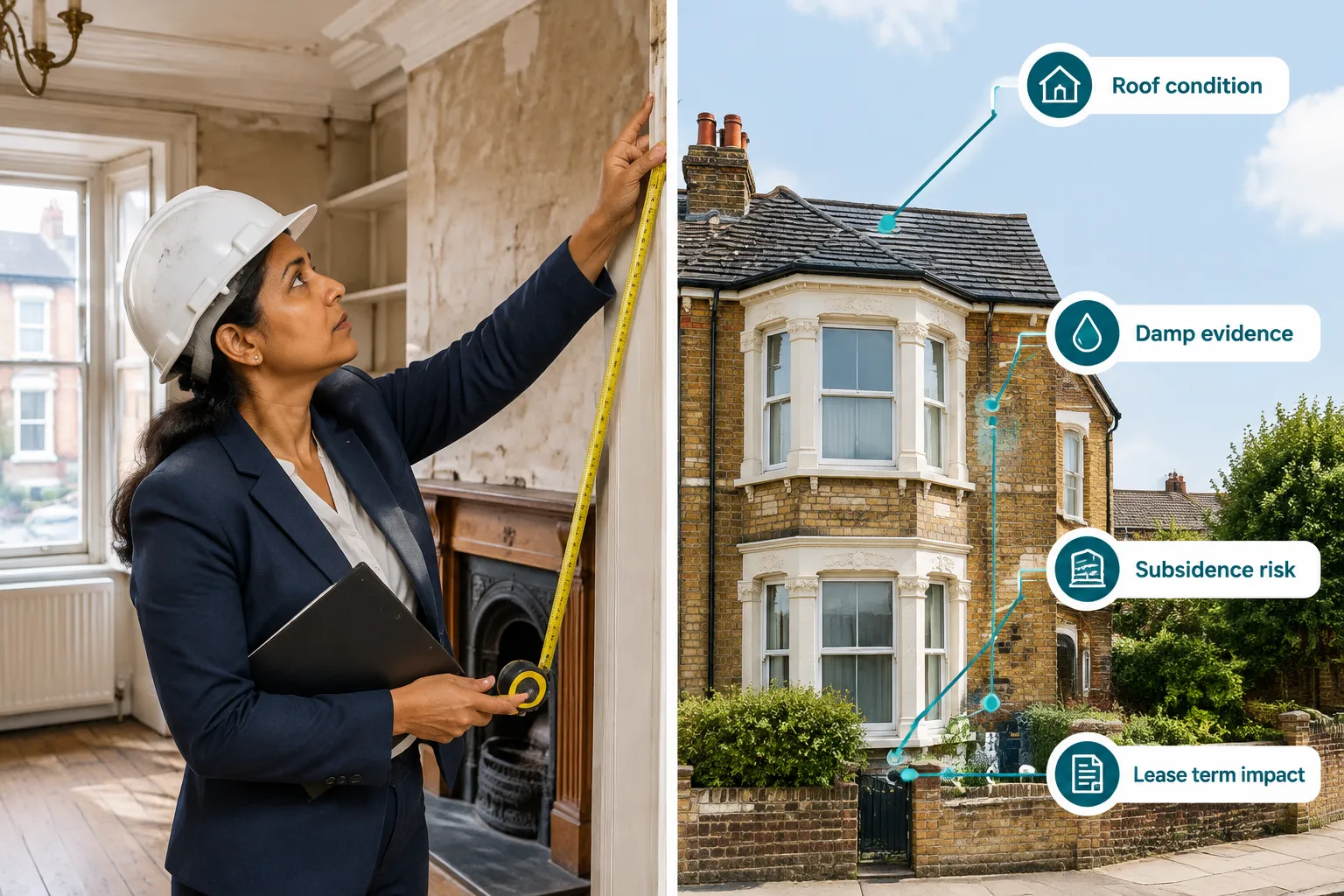
| No physical inspection | Structural defects, damp, subsidence, and condition issues are invisible to an algorithm |
| No lease analysis | Short leases, restrictive covenants, and service charge liabilities can dramatically affect value |
| No regulatory standing | Banks, HMRC, courts, and tribunals will not accept an AVM as a formal valuation |
For a deeper look at how physical defects affect property value, the 10 most common property defects found in a building survey illustrates precisely what automated tools miss.
The RICS Red Book Standard: Why It Remains the Benchmark
The RICS Valuation, Global Standards (the Red Book) underwent a significant update effective 31 January 2025, strengthening requirements around valuer independence, quality assurance, and the scope of professional judgement [6]. The UK national supplement was reissued in January 2025 to align domestic practice with these global standards, reinforcing that RICS valuations remain the regulatory reference point for UK property decisions [3].
Crucially, the 2025 update broadened the scope of residential valuation guidance beyond mortgage lending. Chartered surveyors are now expected to apply Red Book standards across a wider range of instructions, including tax, dispute resolution, and statutory processes [1]. This is not a minor administrative change. It signals that the professional and regulatory community sees expanding, not contracting, demand for qualified human oversight.
"The Red Book exists because property decisions carry financial and legal consequences that no algorithm can fully absorb. Independence, accountability, and professional indemnity insurance are not features you can download."
A Red Book Valuation in London produced by an RICS Registered Valuer carries professional indemnity insurance, a named responsible party, and a methodology that can be scrutinised and defended. An AVM output carries none of these.
What a Chartered Surveyor Assesses That an Algorithm Cannot
A qualified valuer conducting a Red Book inspection will consider:
- Physical condition: Roof, structure, damp, drainage, and any evidence of subsidence or movement
- Lease terms: Remaining lease length, ground rent escalation clauses, and service charge history, factors that significantly devalue a property with a short lease
- Planning and legal encumbrances: Restrictive covenants, rights of way, and pending planning applications
- Comparables with context: Adjusting for micro-location factors, aspect, and condition rather than applying a blanket per-square-foot rate
- Market sentiment: Professional judgement about buyer demand, days on market, and negotiating dynamics that no dataset fully captures
When Professional Valuation Is Not Optional
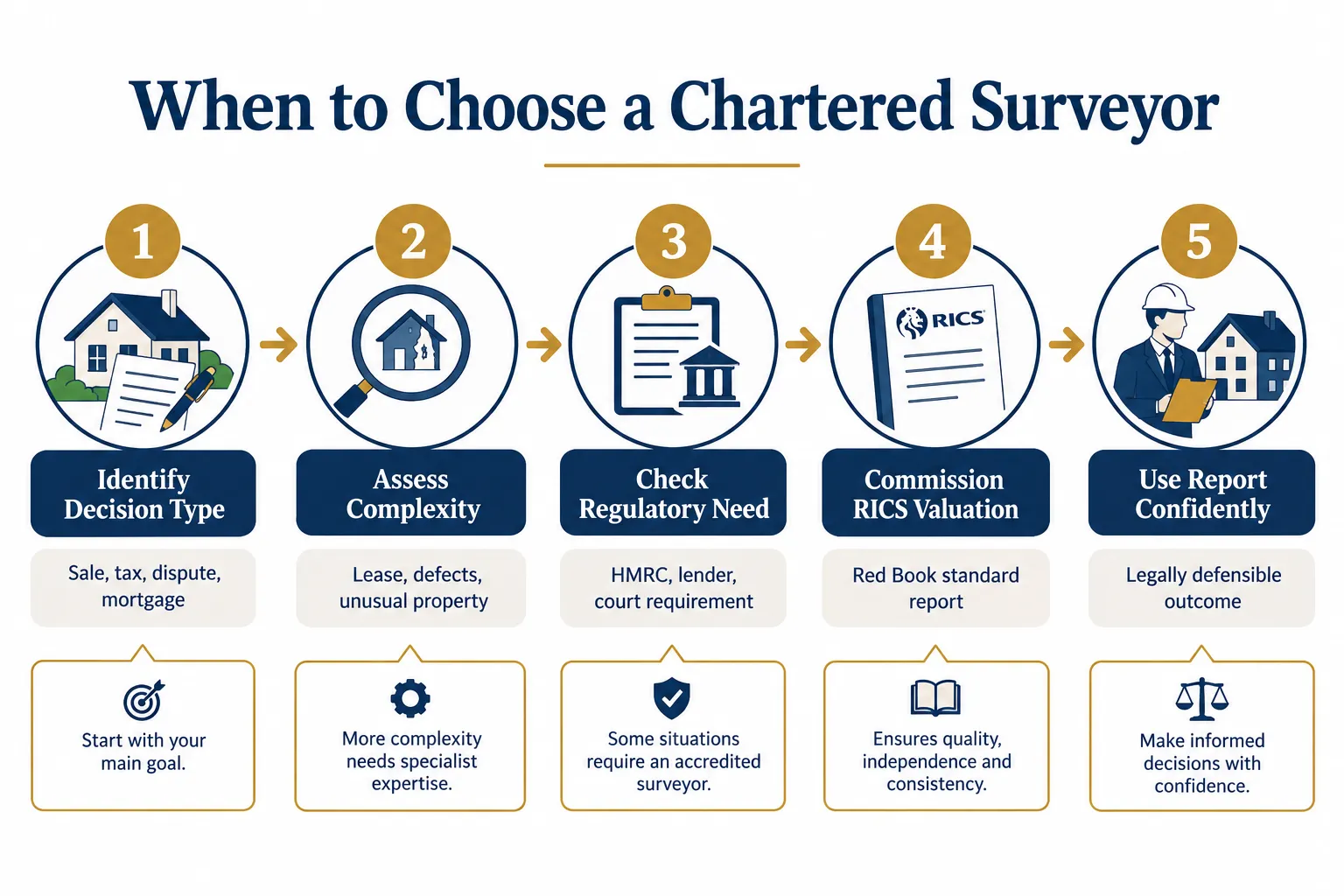
The question of Professional vs DIY Valuation Tools: Why Chartered Surveyor Valuations Still Matter in UK Property Decisions becomes most urgent when the stakes are highest. There are several scenarios in 2026 where a chartered surveyor valuation is not merely preferable, it is required or effectively mandatory.
Mortgage Lending
Lenders require a valuation that meets their internal standards, which invariably means an RICS-compliant report from a panel-approved surveyor. An online estimate will not satisfy a mortgage underwriter. For buyers, understanding RICS valuation costs upfront helps budget for this unavoidable professional fee.
Capital Gains Tax and Inheritance Tax
HMRC requires a defensible valuation at the relevant date for capital gains tax calculations. A CGT valuation must be prepared by a qualified professional and must be capable of withstanding scrutiny if challenged. Using an online estimate for tax purposes exposes the taxpayer to penalties and interest. A specialist Capital Gains Tax valuation from an RICS Registered Valuer provides the documented evidence HMRC expects.
Leasehold Reform and Shared Ownership
The ongoing leasehold reform programme has made professional valuation central to statutory calculations for lease extensions and freehold enfranchisement. The premium payable under the Leasehold Reform (Ground Rent) Act framework involves actuarial and valuation calculations that require expert input. Similarly, shared ownership staircasing and resale valuations must be conducted by an RICS Registered Valuer, housing associations will not accept any other format.
Right to Buy
Local authority tenants exercising the Right to Buy are entitled to an independent valuation if they dispute the council's offer. A Right to Buy valuation from a chartered surveyor provides the evidence base for any challenge and ensures the tenant is not disadvantaged by an inflated starting figure.
Disputes and Litigation
When a property valuation becomes the subject of a legal dispute, whether in a tribunal, county court, or arbitration, only a qualified expert can provide admissible evidence. The role of an expert witness in property and construction matters is a distinct professional function that requires RICS membership and adherence to court-compliant reporting standards.
Scenarios Requiring Professional Valuation
Always require a chartered surveyor:
- Mortgage applications and remortgaging
- Capital gains tax and inheritance tax returns
- Lease extension premium calculations
- Shared ownership staircasing
- Right to Buy disputes
- Court proceedings and tribunal hearings
- Matrimonial and probate settlements
DIY tools are appropriate for:
- Initial market research before instructing an agent
- Monitoring neighbourhood price trends
- Rough portfolio tracking (not for tax or lending purposes)
- Preparing questions before a professional consultation
The Hybrid Future: Data Tools Under Professional Oversight
The most accurate picture of Professional vs DIY Valuation Tools: Why Chartered Surveyor Valuations Still Matter in UK Property Decisions in 2026 is neither a simple endorsement of technology nor a rejection of it. The evidence points firmly toward a hybrid model.
Chartered surveyors increasingly use data platforms, including AVMs, comparable databases, and AI-assisted analytics, as part of their workflow. These tools accelerate research, surface comparables more efficiently, and help identify market anomalies. The surveyor's role shifts toward interpretation, judgement, and accountability rather than raw data collection.
What this means in practice is that the professional valuation of 2026 is faster and better-informed than it was a decade ago, but it is still a professional valuation. The human element provides what no algorithm can: a site visit, professional indemnity, regulatory compliance, and a named individual who stands behind the opinion of value.
For buyers and sellers in London and the South East, working with RICS Registered Valuers in London means accessing both the analytical rigour of modern data tools and the regulatory standing of a Red Book report.
A Note on Cost Versus Risk
A common reason people reach for a free online tool is cost. This is understandable, but the comparison is not straightforward. A professional RICS valuation typically costs between £300 and £1,500 depending on property type, location, and complexity [10]. Against the backdrop of a property transaction worth hundreds of thousands of pounds, or a tax liability that could run to five figures, this is a proportionate expenditure.
The risk of relying on an AVM in a high-stakes scenario is not just financial. An incorrect valuation used for tax purposes can trigger HMRC enquiries. An undisclosed defect missed by an algorithm can result in a purchase at an inflated price. A lease issue ignored because no one physically inspected the title documents can cost far more to resolve than the original survey fee.
For a comprehensive overview of the London market and what a professional valuation covers, the Best London Property Valuation Guide provides detailed context for buyers and sellers at every stage.
Conclusion
The proliferation of online valuation tools has genuinely improved access to property market data in the UK. Buyers can arrive at viewings better informed, sellers can set realistic expectations, and landlords can monitor portfolio values with greater ease. These are real benefits that the industry should acknowledge.
But the case for Professional vs DIY Valuation Tools: Why Chartered Surveyor Valuations Still Matter in UK Property Decisions rests on something more fundamental than data quality. It rests on accountability, regulatory standing, and the irreplaceable value of a trained professional who physically inspects a property and applies expert judgement to a specific set of circumstances.
The 2025 Red Book updates have reinforced, not weakened, this position. Leasehold reform, expanding HMRC scrutiny, and the growth of tribunal-based property disputes all point in the same direction: the demand for defensible, RICS-compliant valuations is increasing, not declining.
Actionable next steps for property owners, buyers, and sellers in 2026:
- Use online tools freely for market orientation and initial research, they are genuinely useful at that stage.
- Before any transaction, tax event, dispute, or financing decision, commission an RICS Red Book valuation from a qualified chartered surveyor.
- Check that the valuer is RICS Registered and carries professional indemnity insurance.
- If the property has unusual features, a short lease, shared ownership structure, or potential structural issues, instruct a specialist rather than a generalist.
- Treat the cost of a professional valuation as risk management, not an optional extra.
For those in London and the surrounding counties, property valuation reports in London in Red Book format provide the regulatory-grade documentation that protects your interests at every stage of a property decision.
References
[1] Red Book UK Supplement Updated Guidance – ww3.rics.org
[3] UK National Supplement Reissued Jan 25 – rics.org
[5] Realyse Pulse – pulse.realyse.com
[6] Global Red Book Updates – ww3.rics.org
[7] ValuIQ – valuiq.uk
[8] Rightmove House Value – rightmove.co.uk
[9] MyPropertyAnalyst – mypropertyanalyst.com
[10] Compare My Move Surveying – comparemymove.com