{"cover":"Professional landscape format (1536×1024) hero image with bold text overlay (≤42 chars): 'Unmortgageable Property Survey: How', crisp white sans-serif on a deep navy semi-transparent overlay panel, centered with 8% safe margins from every edge, no character touches the edge. Background: bright daylight editorial photograph of a Victorian terraced house in disrepair, cracked render, boarded window, overgrown garden, with a RICS-branded clipboard and survey report held by a suited surveyor in the foreground, shallow depth of field, professional magazine-cover aesthetic, navy and amber color palette, high contrast.","content":["Annotated documentary-style landscape image (1536×1024) showing a four-panel labelled infographic titled 'Why Lenders Refuse a Mortgage'. Panel 1: illustrated cross-section of a house with spray foam insulation callout label 'Spray Foam, Obscures Timbers'. Panel 2: short-lease flat icon with label 'Lease Under 80 Years'. Panel 3: non-standard construction wall section with label 'Steel Frame / Concrete'. Panel 4: derelict interior with label 'No Kitchen or Bathroom'. Thin callout lines, clean white background, teal and navy palette, editorial infographic polish, 5% safe margins on all labels.","Numbered step-by-step process flow diagram (1536×1024) titled 'How a Surveyor Rescues an Unmortgageable Home', five horizontal stages left to right: Stage 1 'Initial Inspection', surveyor with clipboard at front door; Stage 2 'Defect Identification', magnified crack and damp meter reading; Stage 3 'RICS Level 3 Report', open report document with traffic-light ratings; Stage 4 'Remediation Plan', contractor repairing roof with scaffolding; Stage 5 'Lender Reconsideration', bank building with green tick. Bold numbered circles, short captions under each stage, warm amber and slate-grey palette, clean editorial diagram style, fully inside 5% safe margins.","Split-screen editorial landscape image (1536×1024): left half shows a 'Before' scene, a damp-stained, structurally cracked interior room with peeling wallpaper, moody low light, red warning label overlay reading 'Unmortgageable'; right half shows an 'After' scene, the same room fully renovated, bright natural daylight, fresh plaster, modern fittings, green approval label overlay reading 'Mortgage Ready'. Bold dividing line down the centre, short panel headings at top of each half, high-contrast before-and-after magazine composition, teal and charcoal palette, editorial quality."]
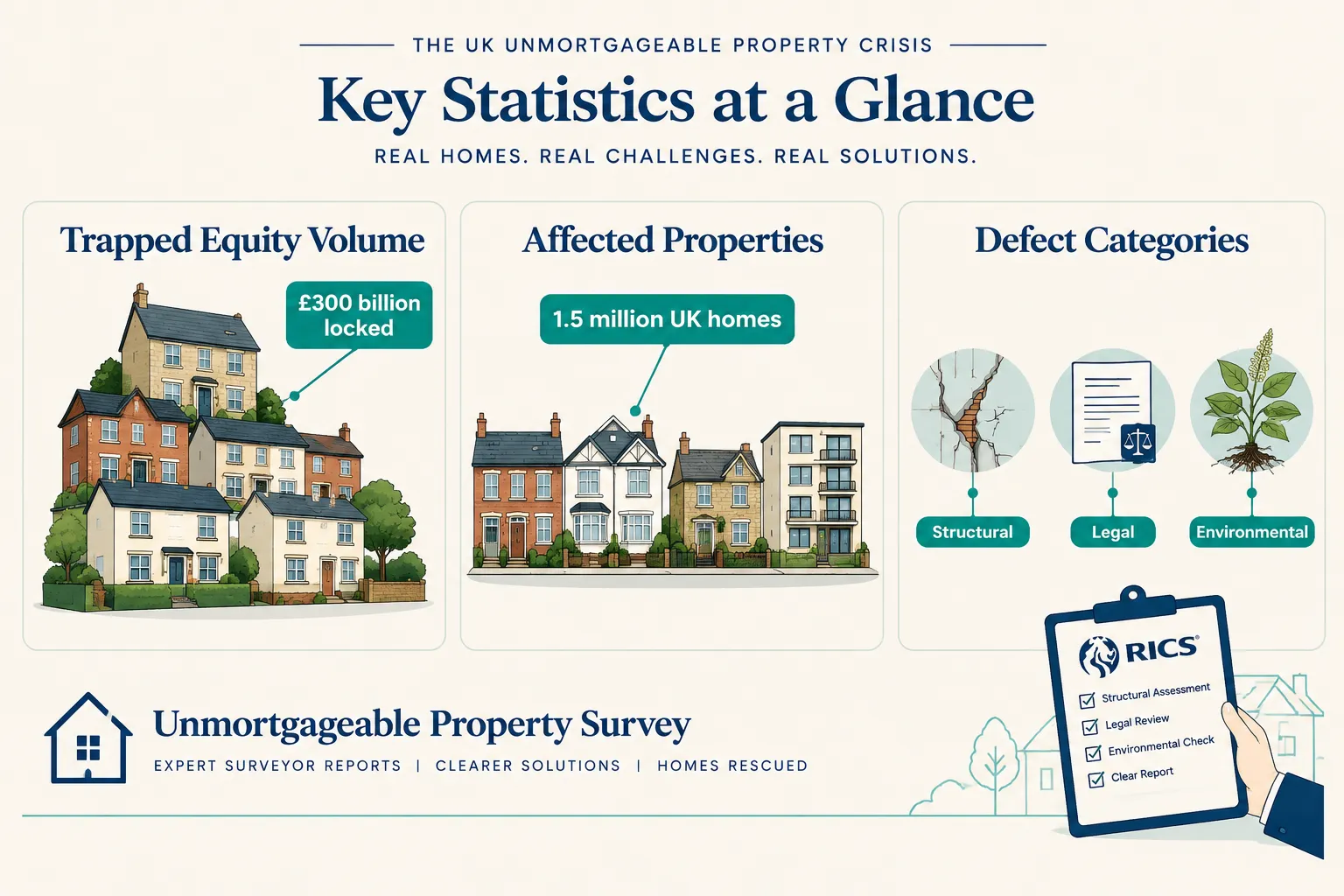
Roughly 1.5 million UK homes, approximately 6% of the entire residential housing stock, currently fall outside mainstream lending criteria, locking an estimated £300 billion of equity inside properties that high-street banks simply will not touch. [4] That figure, drawn from 2026 research by specialist lender Together, is a striking reminder that the label "unmortgageable" is far more common than most buyers and sellers realise. Yet the term is frequently misunderstood. A property being flagged as unmortgageable does not mean it is permanently unsaleable or beyond rescue. In the vast majority of cases, the real barrier is a surveyor's report that has identified risks a standard lender cannot accept, and that same report contains the roadmap to resolving them. This article explains the Unmortgageable Property Survey: How Surveyor Reports Help Rescue Problem Homes process in full: what triggers a refusal, how a RICS-regulated surveyor diagnoses the problem, and what targeted action can restore a property's lending status.
Key Takeaways
- Around 1.5 million UK homes are currently unmortgageable, trapping roughly £300 billion in equity. [4]
- Most properties are not permanently unmortgageable, the barrier is usually a specific, identifiable defect or legal issue that a surveyor's report can quantify and guide owners to resolve. [1][7]
- RICS Level 2 and Level 3 survey reports use traffic-light condition ratings that tell lenders, and owners, exactly what must be addressed before lending can proceed. [3][5]
- Spray foam insulation, non-standard construction, short leases, and severe structural defects are among the most common triggers for mortgage refusal in 2026. [2][4]
- Specialist surveyors can act as problem-solvers and, where necessary, expert witnesses, providing the evidence lenders need to reconsider a previously declined application. [7][11]
What Makes a Property Unmortgageable in 2026
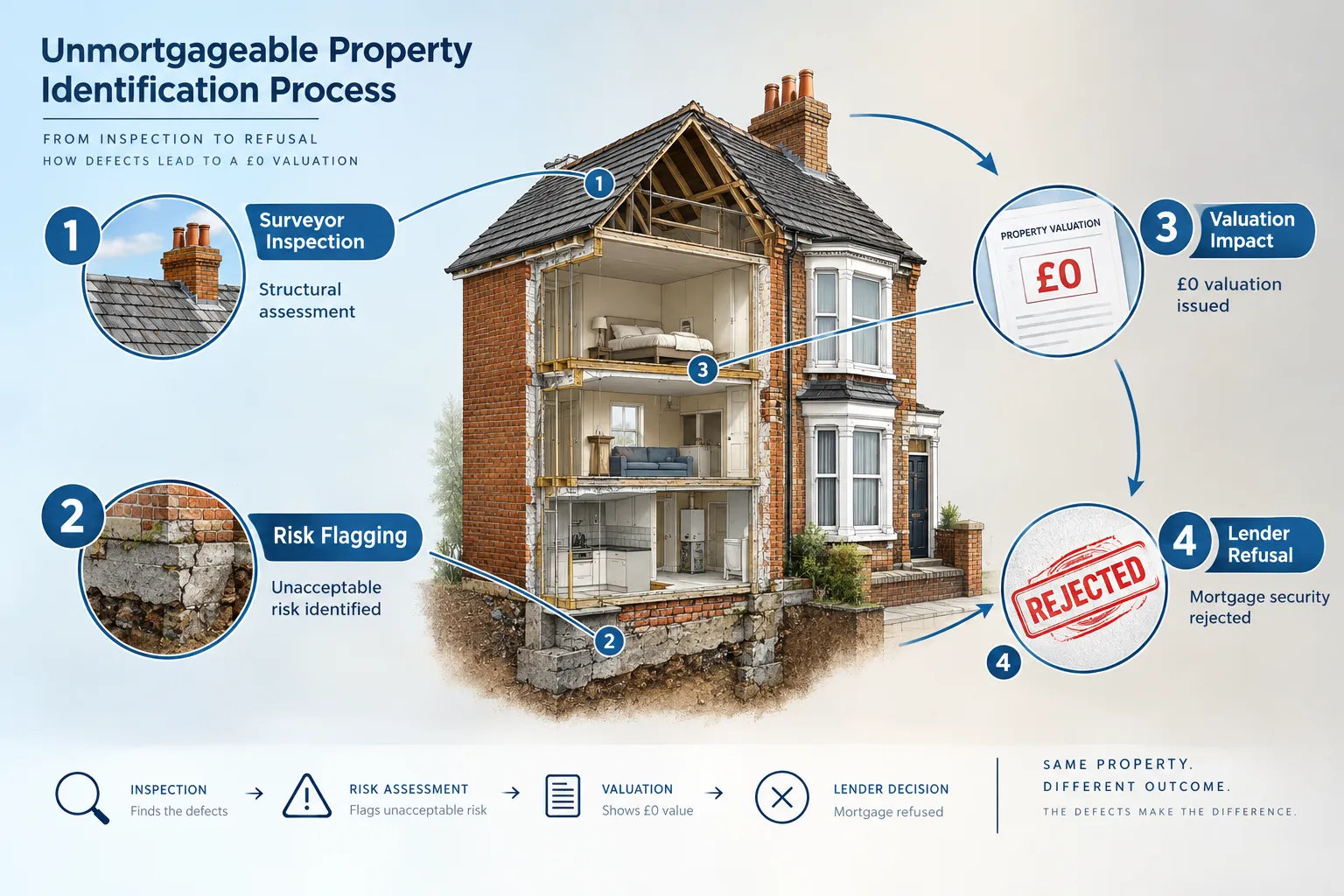
The working definition of an unmortgageable property in the UK is a home that mainstream lenders will not accept as security because a surveyor's valuation or report flags unacceptable risk, commonly resulting in a £0 valuation or an outright refusal to lend. [1][2][3] Understanding precisely why a lender refuses is the essential first step, and that understanding almost always begins with the survey.
Lenders rely on two parallel assessments: a mortgage valuation (confirming the property is worth what the buyer is paying) and, increasingly, a condition report (confirming the property is structurally sound enough to serve as security over the loan term). When either assessment raises a red flag, the lender may decline, reduce the loan amount, or impose retention conditions. [6]
The Most Common Triggers Identified in Survey Reports
Research and advisory guidance published in 2026 consistently identifies the following clusters of issues as the primary causes of unmortgageable status: [2][4][10]
| Category | Specific Issues |
|---|---|
| Construction type | Steel frame, prefabricated concrete, timber frame, thatched roofs |
| Structural condition | Active subsidence, severe cracking, failed foundations |
| Roof and fabric | Spray foam insulation, flat roofs in poor condition, missing roof covering |
| Habitable condition | No functioning kitchen or bathroom, dereliction |
| Tenure and legal | Short lease (under 70-80 years), defective title, boundary disputes |
| Environmental | Proximity to landfill, mining subsidence zones, flood risk |
| Location | High-rise flats, flats above certain commercial premises |
Spray foam insulation has become one of the most widely flagged issues in 2026. Because it bonds directly to roof timbers and can mask rot, moisture damage, and ventilation failures, many mainstream lenders now refuse to lend on any property where spray foam has been applied, regardless of when the installation took place. [2]
Short leases are equally problematic. Most high-street lenders will not offer a mortgage on a leasehold property with fewer than 70 to 85 years remaining on the lease at the end of the mortgage term. A flat with 75 years left on its lease today may already be borderline unmortgageable for a 25-year mortgage. [2][4]
"The label 'unmortgageable' is not a life sentence for a property, it is a diagnosis. And like any diagnosis, it is only useful if it leads to a treatment plan." [7]
The Unmortgageable Property Survey: How Surveyor Reports Help Rescue Problem Homes
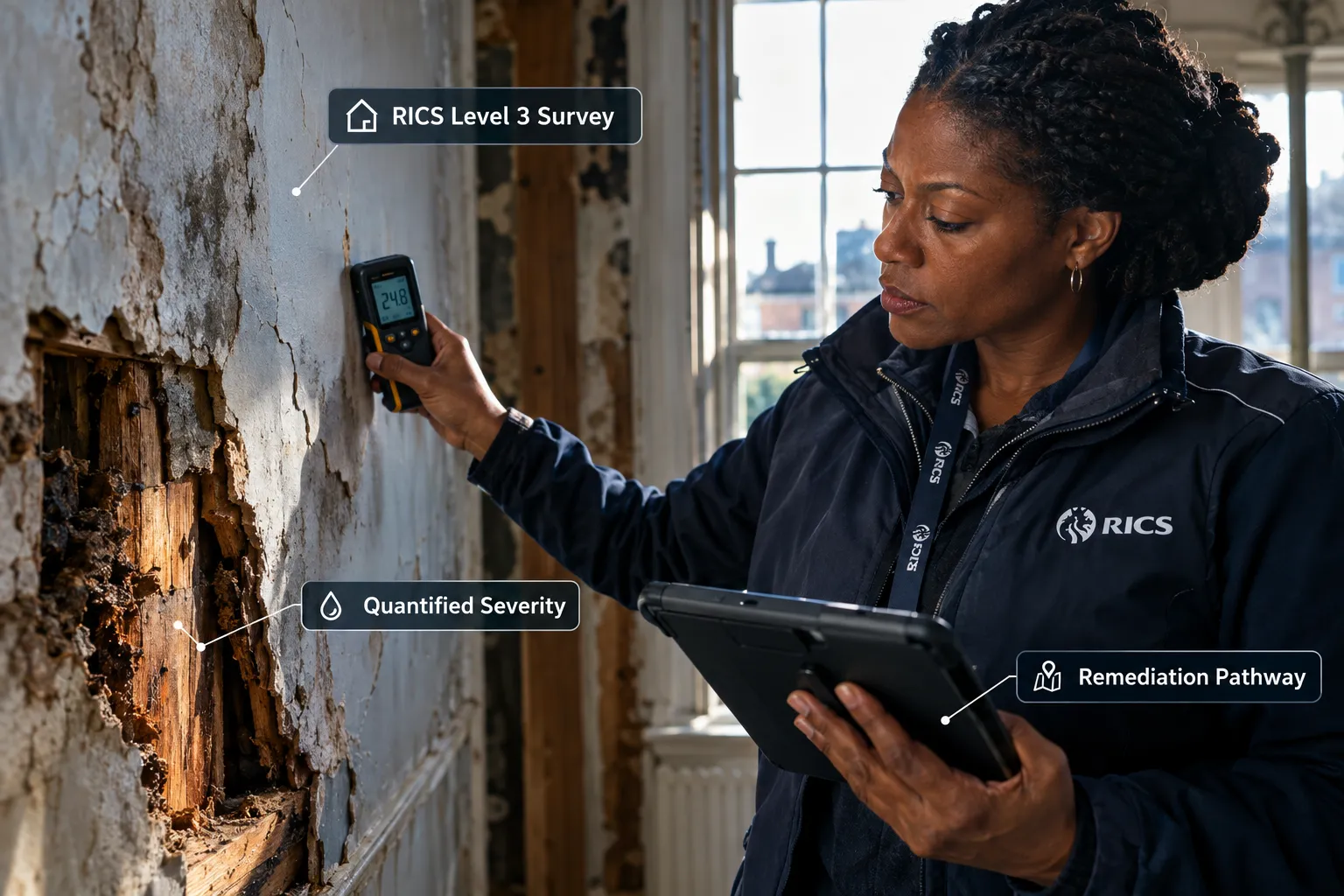
The RICS-regulated surveyor sits at the centre of both the problem and the solution. A surveyor's report does not simply confirm that a problem exists, it quantifies the severity, identifies the cause, and, crucially, sets out what remediation or further investigation is required. [3][5] This is why the Unmortgageable Property Survey: How Surveyor Reports Help Rescue Problem Homes process is best understood as a structured diagnostic and recovery pathway rather than a single event.
RICS Survey Levels and Their Role in Mortgage Decisions
There are three main RICS survey levels, and the choice of level matters enormously when a property has known or suspected defects:
- RICS Level 1 (Condition Report): A basic traffic-light overview. Rarely sufficient for complex or problem properties.
- RICS Level 2 (HomeBuyer Report): Includes a market valuation and condition ratings. Flags significant defects but does not always provide the depth of investigation lenders need for non-standard properties. [5]
- RICS Level 3 (Building Survey): The most comprehensive option. Provides detailed analysis of construction, condition, and defects, with specific recommendations for remediation. This is the report type most likely to give a specialist lender sufficient confidence to proceed. [5]
For properties with structural concerns, a building survey in London or elsewhere will typically include an assessment of load-bearing elements, drainage, roofing, and any non-standard construction materials. The surveyor's written opinion on the cause and likely progression of any defect is often the single most important document in a lender's reconsideration process.
How Traffic-Light Ratings Drive Lender Decisions
RICS Level 2 and Level 3 reports use a standardised condition rating system:
- Condition Rating 1 (Green): No repair currently needed.
- Condition Rating 2 (Amber): Defects that need attention but are not urgent.
- Condition Rating 3 (Red): Serious defects requiring immediate attention or further investigation.
A cluster of Condition Rating 3 items, particularly affecting the structure, roof, or habitable condition, will almost always trigger a mortgage refusal or a significant retention. [3] However, the same red-flag items that cause a refusal also provide a precise checklist of what must be addressed to restore mortgageability. This is where the surveyor's role shifts from gatekeeper to problem-solver.
Specialist Investigations That Support Mortgage Applications
For many unmortgageable properties, a single Level 3 survey is not the end of the process. Lenders may require specialist reports alongside the main survey:
- Structural engineer's report, for active subsidence, cracking, or foundation failure. See the guide on how to check for subsidence for an overview of what these inspections involve.
- Damp and timber report, for properties with evidence of rising damp, penetrating damp, or timber decay. A damp survey establishes whether moisture is active and what treatment is required.
- Roof survey, for properties with flat roofs, spray foam, or significant deterioration. A dedicated roof survey in London can provide the specific evidence a lender needs on remaining life expectancy and repair costs.
- Non-standard construction report, for steel-framed, concrete, or prefabricated homes, where a standard valuation is rarely sufficient and lenders increasingly expect construction-specific inspections. [5]
Understanding what chartered surveyors do in these contexts helps buyers and sellers appreciate the full range of evidence that can be assembled to support a mortgage application.
Rescuing Problem Homes: From Diagnosis to Lender Reconsideration
Once a surveyor's report has identified the specific issues making a property unmortgageable, the recovery process follows a logical sequence. The 2026 guidance from mortgage advisers and conveyancing specialists is consistent: do not re-apply to a lender immediately after a refusal. Instead, work systematically through the evidence. [6][8]
Step 1: Obtain and Analyse the Survey Report
If a mortgage has been declined following a lender's valuation, buyers are entitled to request a copy of the valuation report. [6] This document will usually indicate, at least in general terms, why the lender declined. A more detailed independent survey (RICS Level 2 or Level 3) should then be commissioned if one has not already been obtained. The 10 most common property defects found in building surveys provides useful context on what surveyors typically find and how serious each defect category tends to be.
Step 2: Prioritise Remediation by Severity
Not all defects need to be resolved before a mortgage can proceed. The surveyor's report will indicate which items are deal-breakers for lenders (typically Condition Rating 3 structural and habitable issues) and which are simply reflected in a reduced valuation. Addressing the highest-severity items first, and obtaining written confirmation from a qualified contractor or specialist that works have been completed to the required standard, is the most efficient route to restoring mortgageability.
Step 3: Challenge Errors Through the Correct Channel
Where a buyer believes a lender's valuation is factually incorrect, for example, because the surveyor has misidentified a construction type or overstated the severity of a defect, there is a formal process for challenging the assessment. [8] This typically involves:
- Obtaining a second independent RICS survey.
- Presenting the conflicting evidence to the lender in writing.
- Requesting a formal reconsideration, supported by the new report.
- If unresolved, raising a complaint through the lender's internal process or escalating to RICS.
Step 4: Explore Specialist Lending and Bridging Finance
For properties that cannot be quickly remediated, specialist lenders and bridging finance providers offer a growing range of products specifically designed for unmortgageable homes. [9] These lenders typically require a surveyor to document the property's current condition and "as is" value, alongside an assessment of the post-remediation value, the so-called "gross development value" or "end value". [9] This evidence package, assembled by a qualified surveyor, forms the basis of the loan offer.
For buyers and investors working in this space, understanding how much a structural survey costs is an important part of budgeting for the overall rescue process.
Step 5: Address Legal and Tenure Issues
Not all unmortgageable status stems from physical defects. Legal issues, including short leases, defective title, and unresolved boundary disputes, require different remediation routes. [1][3] For leasehold properties, a lease extension negotiation is often the most direct path to restoring mortgageability. For title defects, a specialist conveyancer and, where necessary, indemnity insurance may resolve the issue without physical works.
The Surveyor as Expert Witness and Problem-Solver
Expert opinion in 2026 increasingly frames the RICS surveyor not merely as a gatekeeper who identifies problems, but as an active participant in resolving them. [2][7] In complex cases, particularly those involving disputed valuations, insurance claims, or legal proceedings, a chartered surveyor can provide expert witness evidence that carries significant weight with lenders, courts, and arbitrators.
This shift in framing is practically important. When a property is labelled unmortgageable, the instinct of many owners and buyers is to look for a different lender rather than to engage more deeply with the survey evidence. The more effective approach is to treat the surveyor's report as a working document, a list of specific problems, each of which has a specific solution, and to commission the additional investigations and specialist reports needed to close each item on that list.
The common property defects identified in building surveys, from damp and rot to cracking and subsidence, all have established remediation pathways. A surveyor who understands both the technical requirements and the lender's decision-making criteria is best placed to guide owners through that process efficiently.
Conclusion
The Unmortgageable Property Survey: How Surveyor Reports Help Rescue Problem Homes is, at its core, a story about information. Lenders refuse mortgages because they lack confidence in a property's condition or value. Surveyor reports, particularly RICS Level 3 building surveys and specialist investigations, provide exactly the evidence needed to replace uncertainty with fact. [3][5]
Actionable next steps for anyone dealing with an unmortgageable property:
- Commission a full RICS Level 3 building survey if one has not already been obtained. This is the foundation of any rescue strategy.
- Request specialist reports for specific issues, damp, structural movement, roof condition, or non-standard construction, as identified in the main survey.
- Prioritise remediation based on the surveyor's condition ratings, focusing first on Condition Rating 3 items that represent deal-breakers for lenders.
- Document all completed works with contractor sign-off and photographic evidence, then request a re-inspection from the surveyor.
- Explore specialist lending options with a mortgage broker experienced in non-standard properties, presenting the full survey evidence package.
- Address legal and tenure issues, particularly short leases, in parallel with any physical remediation works.
A property that is unmortgageable today is not necessarily unmortgageable tomorrow. With the right survey evidence and a systematic remediation plan, the path from problem home to mortgage-ready asset is well-defined, and a qualified RICS surveyor is the most important guide on that journey.
References
[1] Unmortgageable Properties – mortgageaffordability.co.uk
[2] Is My House Unmortgageable What Lenders Refuse Uk 2026 – valuq.co.uk
[3] Unmortgageable – propertysolvers.co.uk
[4] Unmortgageable Properties – togethermoney.com
[5] Non Standard And Complex Property Mortgages – foxdavidson.co.uk
[6] Mortgage Declined At Valuation – onlinemortgageadvisor.co.uk
[7] What Makes Property Unmortgageable Uk – millionplus.com
[8] What Happens If I Disagree With A Valuation – reallymoving.com
[9] Bridging Loans For Unmortgageable Properties – westminsterfinance.uk
[10] What Makes A Property Unmortgageable – auctionhouse.co.uk