

Solar panel retrofits now command a £28,000 median value premium on UK properties in 2026, yet most surveyors lack standardized protocols to assess system integrity and quantify this uplift within RICS Red Book frameworks. As net zero mandates accelerate photovoltaic installations across residential portfolios, the disconnect between renewable energy assets and traditional valuation methodologies creates significant risk for lenders, buyers, and property professionals.
Understanding Valuing Properties with Solar Panel Retrofits in 2026: Building Survey Integration for RICS Green Valuation Adjustments requires surveyors to master both technical building assessment and emerging green valuation standards. This integration ensures accurate property valuations that reflect the true economic benefit of solar installations while identifying potential defects that could undermine both system performance and structural integrity.

Key Takeaways
- 🏡 Solar panels add 4.1% to 7% property value premium when properly documented through Green Addendums and Level 3 building surveys
- 📋 Owned systems deliver £15,000-£25,000 valuation uplift versus leased installations which provide minimal comparable evidence
- 🔍 Integrated building surveys must assess mounting integrity, roof membrane condition, and electrical compliance to validate green valuation adjustments
- 📊 RICS Red Book compliance requires standardized documentation including system wattage, age, ownership status, and historical production data
- ⚡ Per-watt valuation metrics (approximately £3.20/watt) provide comparable evidence for appraisers in 2026 property transactions
The Critical Role of Building Surveys in Solar Panel Valuation
The integration of solar panel assessment into comprehensive building surveys represents a fundamental shift in property inspection protocols. Traditional Level 3 surveys focused primarily on structural elements, damp penetration, and building fabric defects. In 2026, surveyors must expand their technical competence to evaluate photovoltaic system installations as both renewable energy assets and potential sources of building defects.
Structural Assessment Requirements
When conducting surveys on properties with solar panel retrofits, chartered surveyors must examine several critical structural interfaces:
Roof Loading and Structural Capacity 🏗️
- Assessment of roof truss adequacy for additional dead loads (typically 15-20 kg/m²)
- Verification of load distribution across mounting rails and attachment points
- Evaluation of historical roof deflection or sagging that may compromise panel alignment
- Documentation of any structural reinforcement undertaken during installation
Mounting System Integrity
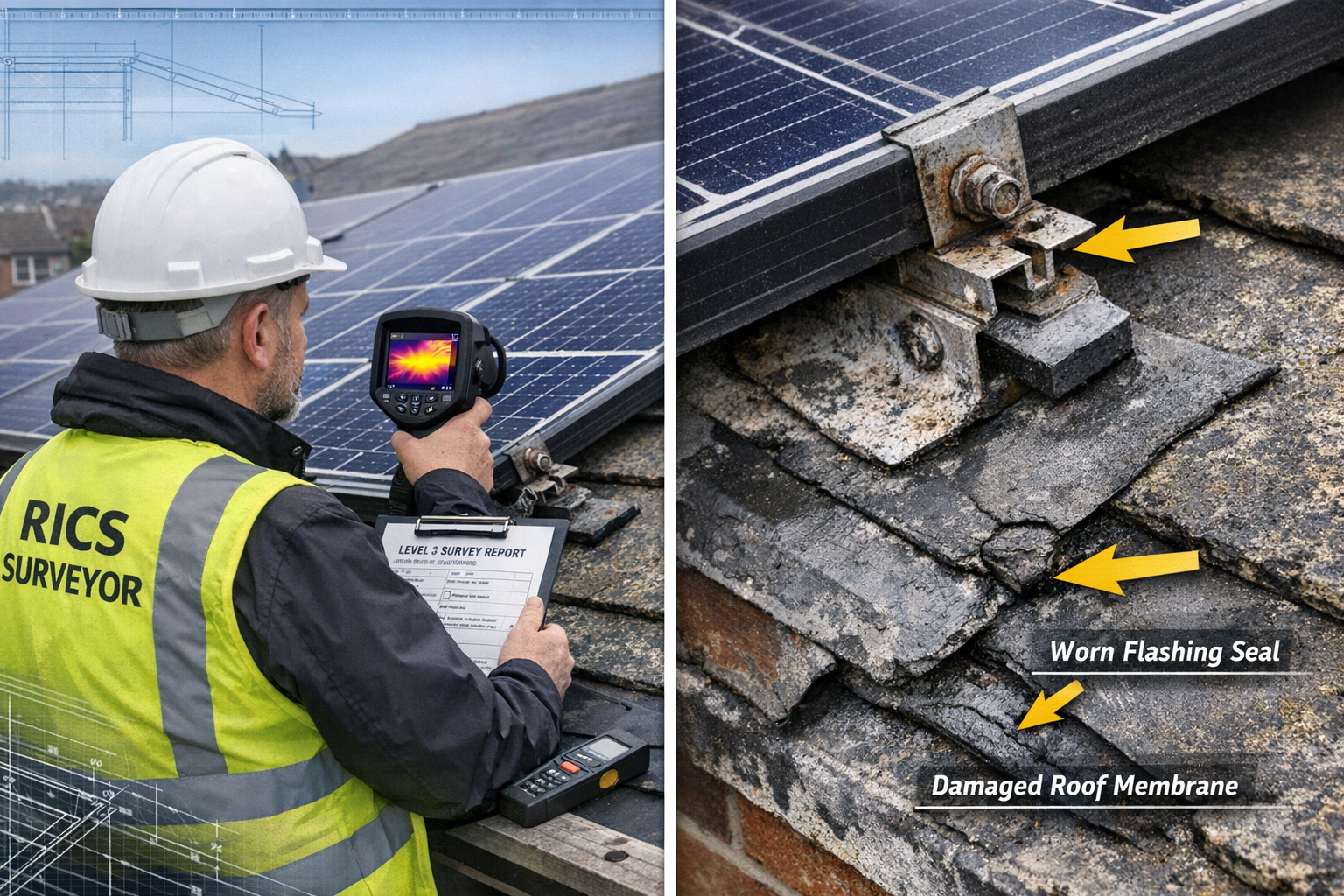
- Inspection of roof penetrations and flashing details around mounting brackets
- Assessment of sealant condition and weatherproofing at all penetration points
- Verification of appropriate mounting hardware for roof covering type
- Identification of potential water ingress pathways created by installation
Roof Covering Condition
- Evaluation of tile or slate condition beneath and surrounding panel arrays
- Assessment of whether installation caused damage to existing roof coverings
- Documentation of roof covering age and remaining service life
- Identification of deferred maintenance issues obscured by panel installation
A comprehensive building survey should include thermal imaging assessment where solar panels may conceal roof defects. Infrared thermography can identify moisture ingress, insulation deficiencies, and air leakage that traditional visual inspection cannot detect once panels are installed.
Electrical System Evaluation
Beyond structural considerations, surveyors must coordinate with qualified electrical engineers to verify:
- Compliance with BS 7671 (18th Edition) wiring regulations for solar PV installations
- Inverter location, condition, and accessibility for maintenance
- Integration with existing consumer unit and appropriate circuit protection
- Generation meter installation and export tariff documentation
- Emergency isolation procedures and signage compliance
The electrical assessment feeds directly into valuation adjustments, as non-compliant installations may require costly remediation that reduces net value contribution.
Valuing Properties with Solar Panel Retrofits in 2026: RICS Green Valuation Framework
The Royal Institution of Chartered Surveyors has progressively developed guidance on Environmental, Social, and Governance (ESG) criteria in property valuation. For residential properties with solar panel retrofits, this framework provides the methodological foundation for quantifying green premiums within RICS Red Book compliant valuations.
The Green Addendum Methodology
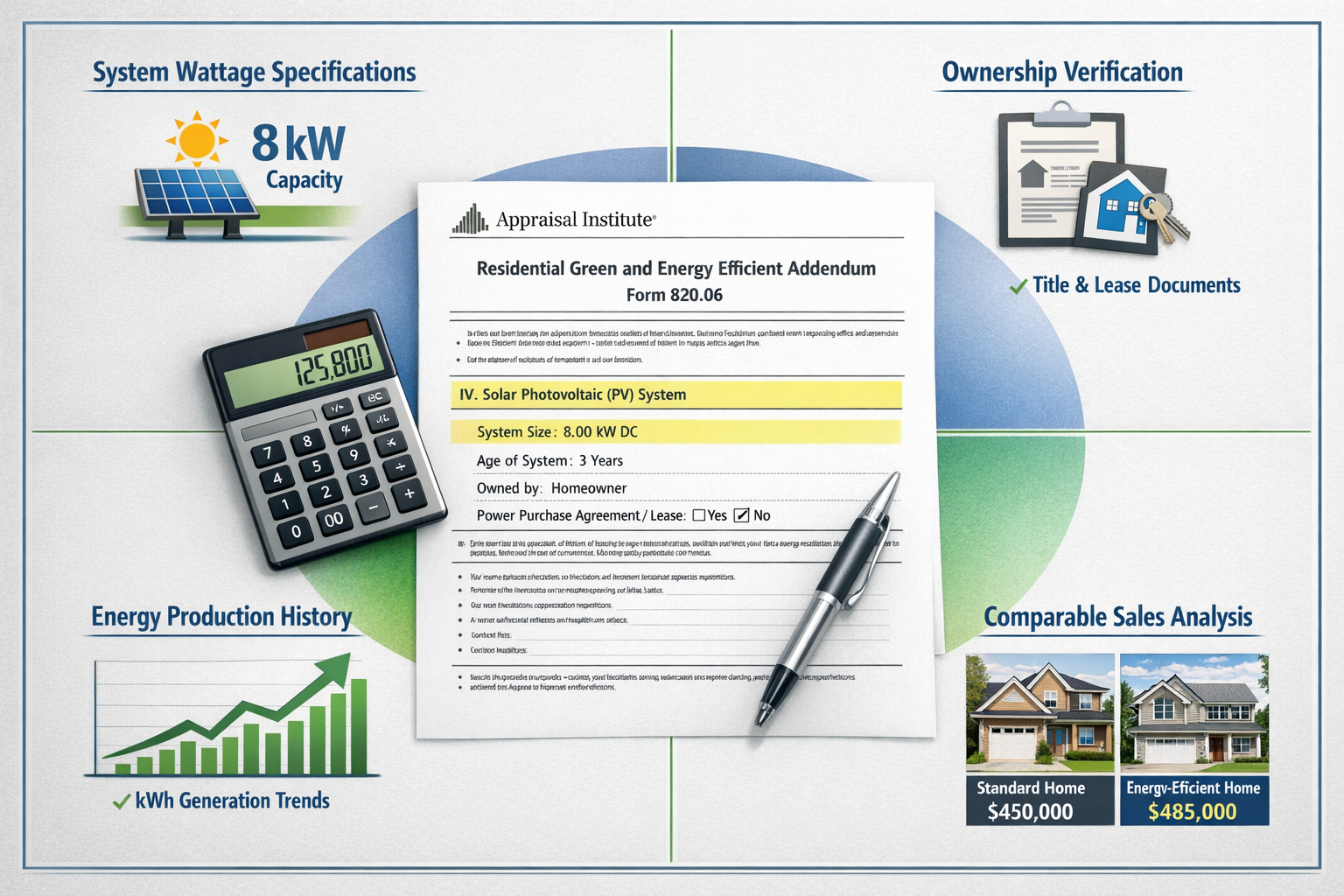
The Appraisal Institute's Form 820.06 has become the standard documentation tool for including solar photovoltaic value in property appraisals. This Green Addendum requires surveyors and valuers to document:
System Specifications ⚡
- Total system capacity in kilowatts (kW)
- Number and wattage of individual panels
- Inverter type, capacity, and manufacturer
- Installation date and expected system lifespan
- Warranty coverage remaining on panels and inverter
Ownership Structure
The distinction between owned and leased solar systems creates dramatically different valuation outcomes. Research demonstrates that owned solar systems add significantly more value than leased systems in property appraisals [2]. Leased systems often create complications in property transfers, as buyers must assume lease obligations that may include:
- Monthly lease payments that reduce net energy savings
- Restrictions on roof repairs or property modifications
- Complex transfer procedures requiring lessor approval
- Potential buyout costs if buyer prefers ownership
When conducting RICS valuations, surveyors must clearly document ownership status and obtain copies of purchase agreements, lease contracts, or power purchase agreements (PPAs).
Historical Performance Data 📊
- Annual energy generation figures (kWh produced)
- Export tariff rates and income generated
- Maintenance records and any repairs undertaken
- System monitoring data demonstrating consistent performance
- Utility bill comparisons showing energy cost savings
This documentation enables valuers to calculate the Net Present Value (NPV) of energy savings, which forms the economic foundation for green valuation adjustments [4].
Comparable Evidence and Market Analysis
Traditional property valuation relies heavily on comparable sales evidence. For properties with solar panel retrofits, valuers face the challenge of limited comparable data with similar green features. The 2026 market has improved in this regard, as solar adoption has increased substantially.
National Valuation Benchmarks
Research indicates solar panels add an average of 4.1% to home value nationally [2], though regional variations exist significantly. With the median UK home value at approximately £320,000 in 2026, this translates to a £13,120 baseline value addition.
However, more sophisticated analysis uses per-watt valuation metrics. Berkeley Lab research found buyers pay approximately $4 per watt (£3.20 per watt at 2026 exchange rates) for existing solar systems [2]. This means:
| System Size | Typical Value Addition |
|---|---|
| 4 kW | £12,800 – £16,000 |
| 6 kW | £19,200 – £24,000 |
| 8 kW | £25,600 – £32,000 |
| 10 kW | £32,000 – £40,000 |
Regional Premium Variations
In high-value markets with strong environmental awareness, properly documented solar assets can increase property value by 4% to 7% when the system is owned and documented through a Green Addendum [1]. Metropolitan areas with higher electricity costs and favorable feed-in tariff structures demonstrate stronger valuation premiums.
When conducting commercial building surveys or residential valuations, chartered surveyors should compile comparable evidence from properties with similar:
- Solar system capacity and age
- Roof orientation and shading conditions
- Property type and construction
- Local electricity rates and export tariff availability
- Neighborhood demographic and environmental priorities
Building Survey Integration for RICS Green Valuation Adjustments
The practical integration of solar panel assessment into building surveys requires systematic protocols that satisfy both technical inspection standards and valuation documentation requirements. This integration ensures that Valuing Properties with Solar Panel Retrofits in 2026: Building Survey Integration for RICS Green Valuation Adjustments delivers defensible, evidence-based property valuations.
Level 3 Survey Protocol for Solar Installations
A comprehensive Level 3 building survey (formerly known as a full structural survey) should incorporate the following solar-specific inspection elements:
Visual Inspection Checklist ✅
-
Panel Condition Assessment
- Surface cleanliness and soiling that reduces efficiency
- Physical damage (cracks, chips, delamination)
- Discoloration or "hot spots" indicating cell degradation
- Secure mounting and absence of movement
- Appropriate clearance beneath panels for ventilation
-
Roof Integration Examination
- Flashing condition at all penetration points
- Sealant integrity and signs of weathering
- Water staining on roof coverings near mounting points
- Adequate clearance from roof edges and valleys
- Bird deterrent measures (netting or guards)
-
System Component Review
- Inverter location, ventilation, and operating condition
- Cable routing, protection, and UV resistance
- Isolation switches accessibility and labeling
- Generation meter installation and functionality
- Battery storage integration (if applicable)
-
Documentation Verification
- MCS (Microgeneration Certification Scheme) certificate
- Electrical installation certificate (Part P compliance)
- Building control approval for structural alterations
- Warranty documentation for panels and inverter
- Insurance policy endorsement covering solar installation
Defect Diagnosis and Valuation Impact
Certain defects identified during building surveys directly impact the green valuation adjustment that can be applied:
Critical Defects (Significant Value Reduction) ⚠️
- Roof membrane damage from installation: Water ingress pathways that compromise building fabric may require panel removal, roof repairs, and reinstallation (£5,000-£15,000 remediation cost)
- Non-compliant electrical installation: Systems not meeting BS 7671 standards require rewiring and certification (£2,000-£5,000)
- Structural inadequacy: Roof trusses insufficient for panel loading require reinforcement (£3,000-£8,000)
- Absent building control approval: Retrospective approval applications and potential remediation (£1,500-£4,000)
Moderate Defects (Reduced Performance Value)
- Significant shading: Trees or structures causing >20% shading reduce generation by 30-50%, lowering NPV of energy savings
- Panel degradation: Systems >15 years old with visible degradation may have reduced output (10-20% below rated capacity)
- Inverter near end-of-life: Inverters typically last 10-15 years; replacement costs £1,000-£2,500 should be factored into valuation
Minor Issues (Maintenance Items)
- Soiling and debris: Cleaning required but minimal cost impact
- Bird nesting: Deterrent installation (£300-£800)
- Monitoring system failure: Replacement of generation meter or monitoring equipment (£200-£500)
When preparing valuation reports, surveyors must clearly document these defects and their impact on the green valuation adjustment. A system with critical defects may add zero value or even represent a liability requiring disclosure.
Financial Modeling for Green Valuation Adjustments
The economic justification for green valuation adjustments relies on calculating the present value of future energy savings. This financial modeling requires:
Energy Savings Calculation 💰
- Annual Generation Estimate: System capacity (kW) × local solar irradiance × performance ratio (typically 0.75-0.85)
- Energy Cost Savings: Annual generation (kWh) × electricity rate (£/kWh)
- Export Income: Excess generation exported × export tariff rate
- Total Annual Benefit: Energy savings + export income – maintenance costs
Net Present Value Analysis
The NPV calculation discounts future energy savings to present value using an appropriate discount rate (typically 3-5% for residential property):
NPV = Σ (Annual Benefit / (1 + discount rate)^year) for remaining system life
For example, an 8 kW system generating £1,200 annual benefit with 20 years remaining life, discounted at 4%, yields an NPV of approximately £16,350.
Valuation Adjustment Reconciliation
The final green valuation adjustment should reconcile three approaches:
- Cost approach: Installation cost less depreciation (age-based)
- Income approach: NPV of energy savings calculated above
- Market approach: Comparable sales evidence and per-watt metrics
Professional valuers typically weight these approaches based on data availability and market conditions. In strong markets with robust comparable evidence, the market approach receives 50-60% weighting, with income approach at 30-40% and cost approach at 10-20%.
RICS Red Book Compliance and Professional Standards
RICS registered valuers must ensure that solar panel valuation adjustments comply with the RICS Valuation – Global Standards (Red Book) requirements. This compliance framework ensures consistency, transparency, and professional accountability in green valuations.
Mandatory Disclosure Requirements
The Red Book requires valuers to disclose:
- Assumptions made regarding system performance, remaining life, and energy prices
- Special assumptions if valuation assumes repairs or improvements
- Limitations on inspection scope (e.g., inability to access roof or test electrical systems)
- Reliance on third-party information (installer specifications, energy generation data)
- Departure from standards if any Red Book requirements cannot be met
For properties with solar panel retrofits, valuers should explicitly state assumptions about:
- System continuing to operate at current efficiency levels
- No material changes to electricity pricing or export tariff structures
- Maintenance being undertaken in accordance with manufacturer recommendations
- Roof structure adequacy (unless structural engineer's report obtained)
Sustainability and ESG Integration
RICS has issued guidance on how ESG (Environmental, Social, Governance) criteria influence residential building valuations [6]. Solar panel retrofits represent a key environmental sustainability factor that contributes to:
Environmental Performance Metrics 🌱
- Reduced carbon emissions (typically 1.5-2.5 tonnes CO2 annually for residential systems)
- Improved Energy Performance Certificate (EPC) rating (often lifting properties to Band B or A)
- Contribution to net zero targets and climate resilience
- Reduced reliance on grid electricity from fossil fuel sources
Market Positioning Advantages
- Enhanced marketability to environmentally conscious buyers
- Compliance with emerging minimum energy efficiency standards
- Future-proofing against energy price volatility
- Differentiation in competitive property markets
The RICS guidance on sustainability in commercial valuation [7] provides frameworks that increasingly apply to residential properties as ESG considerations become mainstream in property investment decisions.
Professional Competency Requirements
Surveyors undertaking valuations of properties with solar panel retrofits should demonstrate competency in:
- Renewable energy technology fundamentals: Understanding of photovoltaic system components, operation, and performance factors
- Building integration assessment: Ability to identify installation quality and potential defects
- Financial modeling: Competence in NPV calculations and energy economics
- Green valuation methodologies: Familiarity with Green Addendum protocols and comparable evidence analysis
- RICS standards application: Red Book compliance for sustainability-enhanced properties
Continuing professional development (CPD) in these areas ensures that chartered surveyors maintain current knowledge as solar technology and valuation methodologies evolve.
Practical Implementation: Case Study Analysis
To illustrate the integration of building survey findings with green valuation adjustments, consider a typical 2026 residential property transaction:
Property Profile
- Semi-detached house, 1990s construction
- 4-bedroom, 150 m² floor area
- Market value (without solar): £380,000
- 6 kW solar panel system installed 2021 (5 years old)
- System owned outright (not leased)
- South-facing roof with minimal shading
Building Survey Findings
The Level 3 survey identified:
✅ Positive Observations
- MCS certificate and electrical installation certificate present
- Roof structure adequate for panel loading
- No evidence of water ingress at mounting points
- Inverter appropriately located with good ventilation
- System monitoring data shows consistent performance (5,200 kWh annual generation)
⚠️ Issues Requiring Attention
- Minor sealant degradation at two mounting bracket locations (£200 repair)
- Bird deterrent netting partially damaged (£400 replacement)
- Generation meter requires recalibration (£150)
Valuation Calculation
-
Annual Energy Benefit
- Generation: 5,200 kWh
- Self-consumption (70%): 3,640 kWh × £0.28/kWh = £1,019
- Export (30%): 1,560 kWh × £0.15/kWh = £234
- Total annual benefit: £1,253
- Less maintenance (£100): £1,153 net annual benefit
-
Net Present Value (20 years remaining, 4% discount)
- NPV = £15,680
-
Market Approach (per-watt method)
- 6,000 watts × £3.20/watt = £19,200
-
Cost Approach (depreciated replacement)
- Original installation cost: £9,000
- Less 5 years depreciation (2.5% annually): £8,000
- Less identified repairs: £7,250
-
Reconciled Valuation Adjustment
- Market approach (50% weight): £9,600
- Income approach (40% weight): £6,272
- Cost approach (10% weight): £725
- Total green valuation adjustment: £16,597
-
Final Property Valuation
- Base value: £380,000
- Solar premium: £16,597
- Total valuation: £396,597 (4.4% uplift)
This systematic approach, integrating building survey findings with multiple valuation methodologies, provides defensible evidence for the green valuation adjustment within RICS Red Book standards.
Future Trends and Emerging Considerations
The landscape of Valuing Properties with Solar Panel Retrofits in 2026: Building Survey Integration for RICS Green Valuation Adjustments continues to evolve rapidly as technology advances and regulatory frameworks develop.
Battery Storage Integration
Increasingly, solar panel retrofits include battery storage systems that enable:
- Energy independence: Storing excess generation for evening use
- Grid services revenue: Participating in demand response programs
- Resilience: Backup power during grid outages
- Enhanced value proposition: Batteries add £3,000-£8,000 to property values when properly documented [5]
Surveyors must expand assessment protocols to include battery system evaluation, including:
- Installation location and ventilation adequacy
- Electrical integration and safety compliance
- Warranty coverage and expected lifespan
- Monitoring and control system functionality
Smart Home Integration
Modern solar installations increasingly integrate with smart home energy management systems that optimize consumption patterns and maximize self-consumption rates. These systems can increase the effective value of solar installations by 10-15% through improved energy economics [3].
Regulatory Evolution
Several regulatory developments will impact solar panel valuation in coming years:
Minimum Energy Efficiency Standards 📋
- Proposed regulations requiring rental properties to achieve EPC Band C by 2028
- Solar installations as cost-effective pathway to compliance
- Enhanced valuation premiums for properties meeting future standards
Building Regulations Updates
- Increasing requirements for renewable energy in new construction and major renovations
- Implications for retrofit solar systems in planning and building control
- Enhanced documentation requirements for compliance verification
Grid Export Compensation
- Evolution of export tariff structures and time-of-use pricing
- Smart Export Guarantee (SEG) tariff variations between suppliers
- Impact on income approach valuation calculations
Risk Management and Professional Liability
Surveyors and valuers face professional liability risks when assessing properties with solar panel retrofits. Appropriate risk management strategies include:
Scope Limitation Documentation ⚠️
- Clear terms of engagement specifying extent of solar system assessment
- Explicit statements regarding electrical testing (typically requiring specialist)
- Disclaimer regarding system performance projections and energy price assumptions
- Recommendation for specialist reports when defects suspected
Professional Indemnity Insurance
- Verification that PI insurance covers green valuation adjustments
- Disclosure to insurers of renewable energy valuation activities
- Maintenance of appropriate cover levels for property values involved
Quality Assurance Procedures
- Peer review of complex green valuations
- Standardized checklists and documentation templates
- Regular CPD in renewable energy and sustainability valuation
- Membership in professional networks focused on green property assessment
Conclusion
Valuing Properties with Solar Panel Retrofits in 2026: Building Survey Integration for RICS Green Valuation Adjustments represents a critical competency for modern property professionals. As net zero mandates accelerate solar adoption across residential portfolios, surveyors must integrate technical building assessment with sophisticated green valuation methodologies to deliver accurate, defensible property valuations.
The evidence demonstrates that properly documented, owned solar panel systems add £15,000-£32,000 in property value depending on system size, condition, and local market factors. However, this value addition depends entirely on rigorous building survey protocols that identify system integrity, installation quality, and potential defects that could undermine performance or create structural risks.
Actionable Next Steps
For property professionals seeking to enhance their practice in this evolving field:
-
Develop Technical Competency 🎓
- Undertake CPD courses in photovoltaic technology and building integration
- Study RICS guidance on ESG criteria in property valuation [6]
- Review Appraisal Institute Green Addendum protocols [1]
- Consider specialist qualifications in renewable energy assessment
-
Implement Standardized Protocols
- Develop solar-specific inspection checklists for Level 3 surveys
- Create valuation templates incorporating NPV calculations and comparable evidence
- Establish relationships with electrical engineers for specialist assessments
- Build comparable evidence databases for local market solar premiums
-
Enhance Documentation Standards
- Obtain comprehensive system specifications and performance data
- Verify ownership status and obtain relevant agreements
- Document all assumptions and limitations clearly
- Maintain photographic records of system condition and integration
-
Stay Current with Market Evolution
- Monitor comparable sales evidence for solar-equipped properties
- Track changes to export tariff structures and energy pricing
- Follow regulatory developments affecting renewable energy installations
- Engage with professional networks focused on sustainable property
The integration of building survey excellence with sophisticated green valuation methodologies positions surveyors to deliver exceptional value to clients while contributing to the property sector's transition toward net zero emissions. As solar panel retrofits become increasingly ubiquitous in residential property portfolios, this integrated competency will transition from competitive advantage to essential professional standard.
For property professionals seeking expert guidance on RICS compliant valuations incorporating renewable energy assets, partnering with experienced chartered surveyors ensures that both technical building assessment and green valuation adjustments meet the highest professional standards.
References
[1] How To Include Solar Panel Value In A Green Addendum 5 Step Guide 2026 – https://www.bostonsolar.us/solar-blog-resource-center/blog/how-to-include-solar-panel-value-in-a-green-addendum-5-step-guide-2026/
[2] Solar Panels Home Value – https://nuwattenergy.com/en/blog/solar-panels-home-value
[3] Solar Panel Roi Explained 2026 – https://www.sunhub.com/blog/solar-panel-roi-explained-2026/
[4] New Appraisal Form Details Green And Solar Features – https://greenhomeinstitute.org/new-appraisal-form-details-green-and-solar-features/
[5] How Much Value Do Solar Panels Add Home 2026 – https://www.solartopps.com/blog/how-much-value-do-solar-panels-add-home-2026/
[6] Future Property Valuation Influence Esg Criteria Residential Buildings – https://www.rics.org/news-insights/future-property-valuation-influence-esg-criteria-residential-buildings
[7] Esg Sustainability Commercial Valuation 4th Edition – https://www.rics.org/content/dam/ricsglobal/documents/standards/esg-sustainability-commercial-valuation-4th-edition.pdf
[8] The Valuation Of Assets In The Commercial Renewable Energy Sector – https://www.rics.org/profession-standards/rics-standards-and-guidance/sector-standards/valuation-standards/the-valuation-of-assets-in-the-commercial-renewable-energy-sector