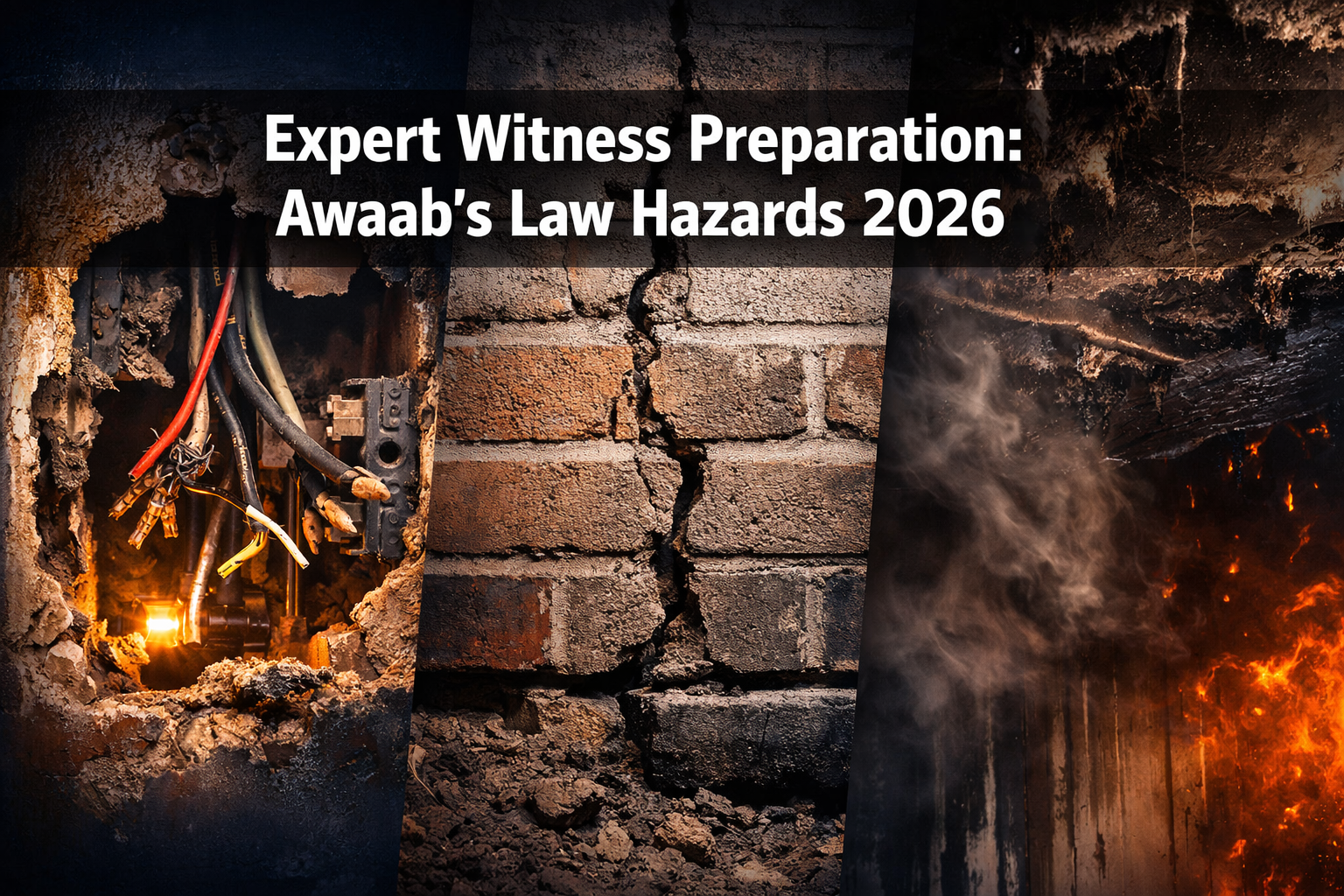

Only three years after the tragic death of two-year-old Awaab Ishak from mould exposure in a Rochdale housing association property, the law bearing his name has fundamentally changed what it means to be a private landlord in England — and what it demands of expert witnesses in court.
As of 2026, Expert Witness Preparation for New Awaab's Law Hazards: Electrical, Fire, and Structural Risks in 2026 PRS Disputes has become one of the most technically demanding areas in residential property litigation. The Renters' Rights Act 2025 extended Awaab's Law beyond social housing to the entire Private Rented Sector (PRS), and Phase 2 of the rollout now covers electrical faults, fire safety failures, and structural collapse risks — not just damp and mould [5]. For surveyors, engineers, and property professionals called as expert witnesses, the stakes have never been higher.
Key Takeaways 📋
- Awaab's Law now applies to all PRS landlords in 2026, covering electrical, fire, and structural hazards under Phase 2 of the rollout [5]
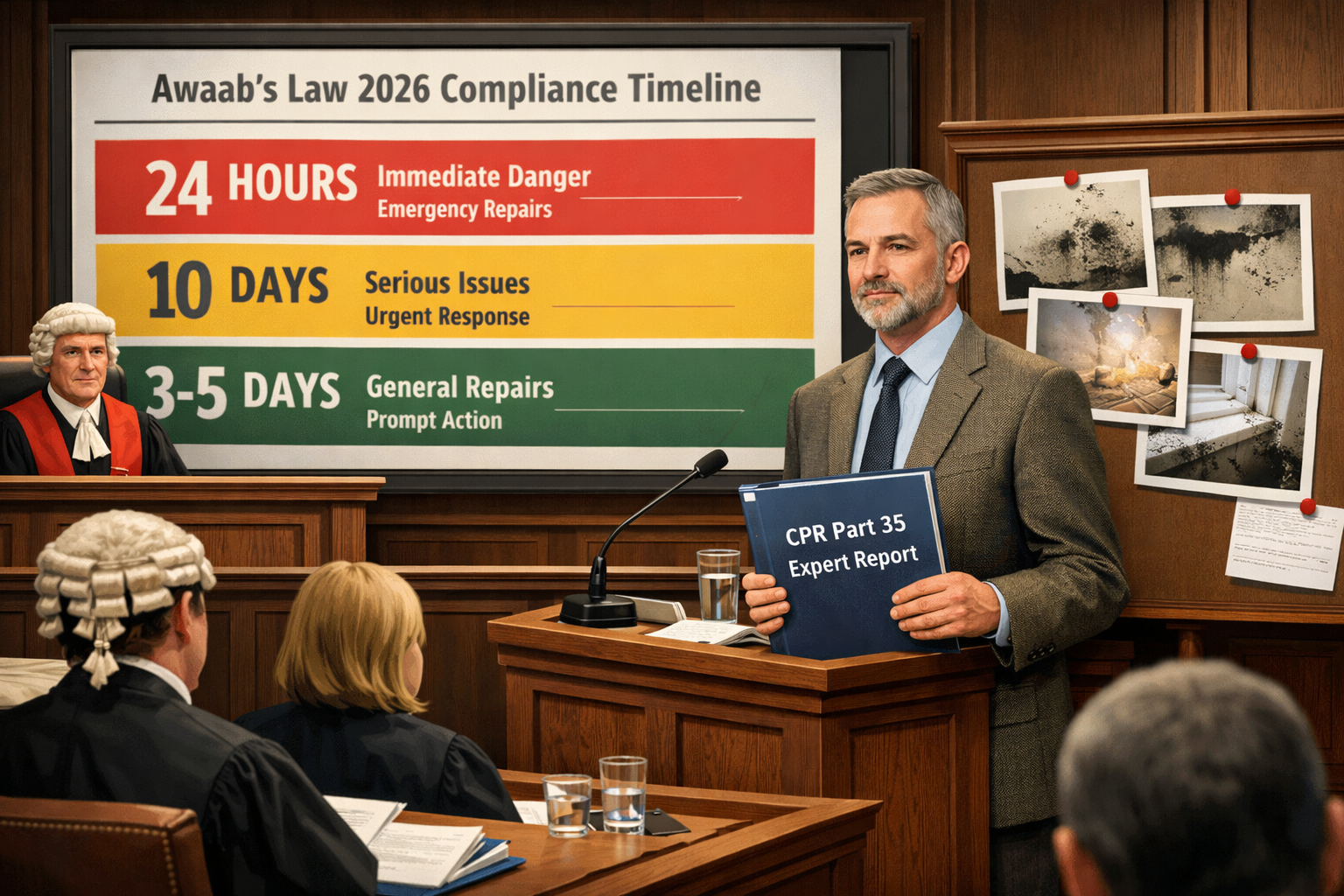
- The 24-10-3-5 compliance rule sets strict timelines: 24 hours to make safe, 10 days to investigate, 3–5 days to repair depending on severity [5]
- Maximum fines reach £40,000 for non-compliance, with immediate civil penalties up to £7,000 for serious failures [4]
- Expert witnesses must comply with CPR Part 35, producing impartial, court-ready reports that document hazard severity, causation, and landlord response failures
- Robust documentation is now a legal lifeline — landlords and tenants alike rely on professional defect reports in PRS dispute proceedings [3]
What Awaab's Law Phase 2 Actually Covers in 2026
From Mould to Multi-Hazard: The Expanded Scope
Awaab's Law originally targeted damp and mould in social housing. Phase 1 established the foundational compliance framework. Phase 2, now active in 2026, dramatically widens the net [5].
The following hazards are now covered under the expanded legislation:
| Hazard Category | Examples | Urgency Level |
|---|---|---|
| Electrical Safety | Faulty wiring, overloaded circuits, unsafe consumer units | 🔴 Emergency |
| Fire Safety | Missing alarms, blocked escape routes, fire door failures | 🔴 Emergency |
| Structural Risks | Subsidence, collapsed ceilings, unstable walls | 🔴 Emergency |
| Excess Cold | Inadequate heating systems, severe thermal bridging | 🟠 Urgent |
| Damp & Mould | Condensation, penetrating damp, rising damp | 🟠 Urgent |
By 2027, nearly all 29 Housing Health and Safety Rating System (HHSRS) hazards will fall under Awaab's Law [5]. This makes 2026 a pivotal transition year — and a period of intense litigation risk.
The 24-10-3-5 Compliance Rule Explained
"Landlords who cannot demonstrate timely action against a known hazard face not just financial penalties but potential criminal liability under the Renters' Rights Act 2025."
The compliance framework works in four stages [5]:
- 24 hours — Make safe any emergency hazard (e.g., exposed live wiring, gas leak, structural collapse risk)
- 10 days — Complete a formal investigation and provide a written report to the tenant
- 3 days — Complete repairs for the most serious Category 1 HHSRS hazards
- 5 days — Complete repairs for serious but non-emergency Category hazards
For expert witnesses, each of these timeframes becomes a forensic question: Did the landlord know? When did they know? What did they do?
Expert Witness Preparation for New Awaab's Law Hazards: Electrical, Fire, and Structural Risks in 2026 PRS Disputes — The Legal Framework
CPR Part 35: The Non-Negotiable Standard
Every expert witness operating in 2026 PRS disputes must anchor their work in Civil Procedure Rules (CPR) Part 35. This framework requires that expert evidence:
- Is independent and owes its primary duty to the court, not the instructing party
- Includes a signed declaration confirming the expert understands their overriding duty
- Provides a clear opinion on causation, severity, and the adequacy of the landlord's response
- Uses plain language accessible to a non-technical judge or tribunal member
Failing to meet CPR Part 35 standards is not merely a procedural issue — it can result in expert evidence being excluded entirely, leaving a case without its technical foundation.
What Makes an Awaab's Law Expert Report Court-Ready?
A court-ready expert witness report for a 2026 PRS hazard dispute should contain the following sections:
✅ Essential Report Components:
- Executive Summary — Hazard identified, severity classification (HHSRS Category 1 or 2), and key findings
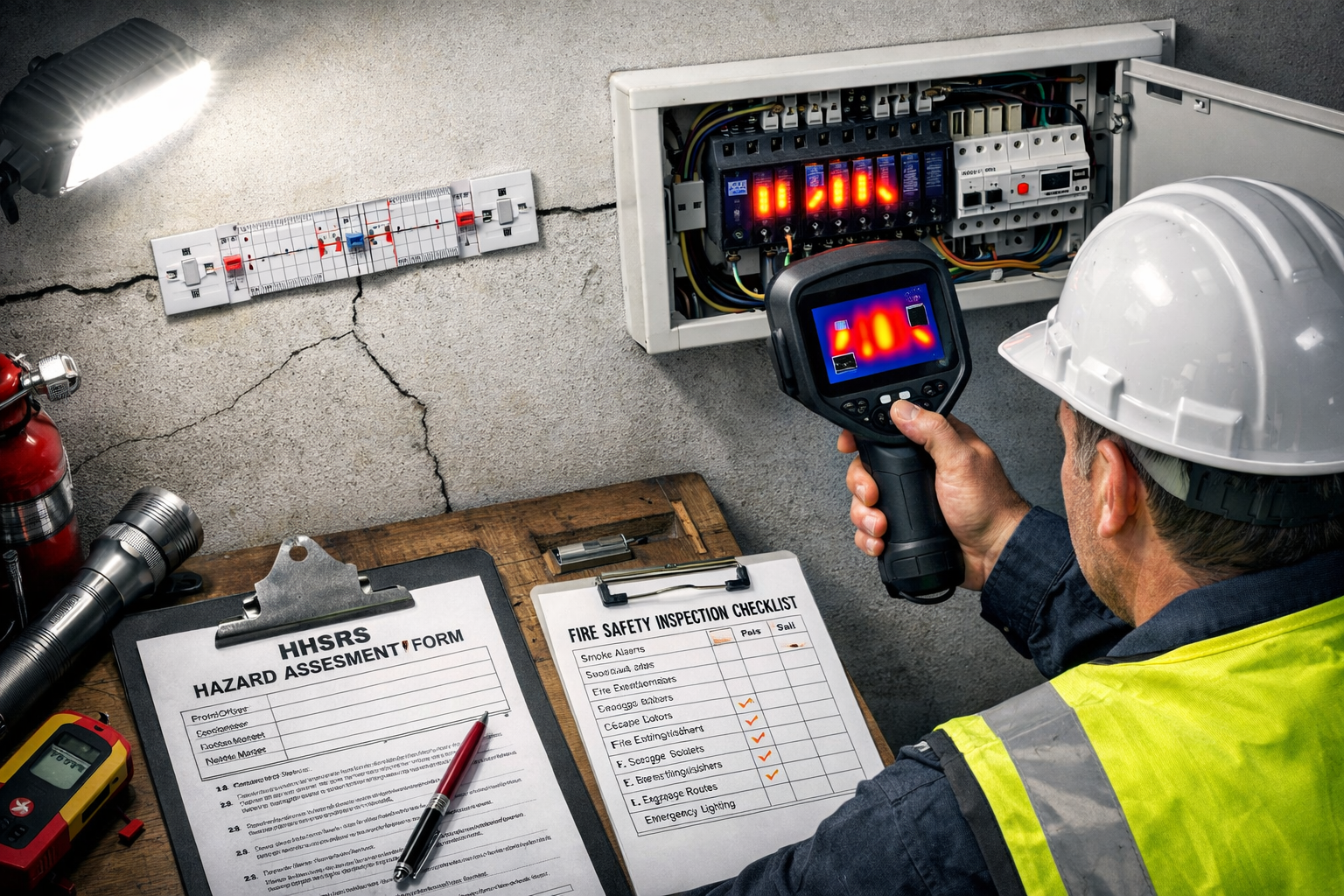
- Inspection Methodology — Tools used (thermal imaging, moisture meters, structural crack gauges), dates, access conditions
- Photographic Evidence — Timestamped, annotated, and cross-referenced to floor plans
- Hazard Causation Analysis — Was the hazard pre-existing? Did landlord action or inaction cause or worsen it?
- Compliance Timeline Assessment — Did the landlord meet the 24-10-3-5 deadlines?
- Remediation Opinion — What work is required, at what cost, and within what timeframe?
- Expert Declaration — CPR Part 35 compliant statement of independence
For expert witness reports in London and across the South East, the quality of this documentation directly determines litigation outcomes.
Penalties That Drive the Stakes
Non-compliance with Awaab's Law in 2026 carries serious financial consequences for PRS landlords [4]:
- Up to £40,000 in fines following enforcement action by local authorities
- Immediate civil penalties up to £7,000 for serious failures
- Local authorities now have a duty to act where serious hazards are identified — they cannot simply ignore complaints [4]
- A new PRS Ombudsman (expected to be fully operational by late 2026) will add a further dispute resolution channel beyond the courts [1]
These figures mean that a well-prepared expert witness report is not just a legal formality — it is a financial instrument that can save or cost a landlord tens of thousands of pounds.
Electrical, Fire, and Structural Hazards: Case Study Templates for 2026 Disputes
Case Study Template 1: Electrical Hazard — Faulty Consumer Unit 🔌
Scenario: A tenant reports sparking from a fuse board in a 1970s terraced rental property. The landlord takes no action for 12 days.
Expert Witness Tasks:
- Inspect and photograph the consumer unit, identifying non-RCD-protected circuits
- Obtain an Electrical Installation Condition Report (EICR) or conduct an equivalent assessment
- Document the date the landlord received the tenant's written complaint
- Map the 24-hour and 10-day compliance windows against the landlord's actual response timeline
- Classify the hazard under HHSRS: Electrical Hazards (Hazard 26)
- Provide a remediation cost estimate and confirm whether the landlord's delay constitutes a breach
Key Expert Opinion: The 12-day response gap directly breached the 24-hour emergency response requirement under Awaab's Law Phase 2. The hazard presented a foreseeable risk of electric shock or fire. Immediate isolation of the circuit was the required first step.
For properties with complex electrical or structural issues, a residential structural engineer in London may need to work alongside an electrical expert to assess whether structural modifications have compromised wiring routes.
Case Study Template 2: Fire Safety Failure — Compromised Escape Route 🔥
Scenario: A tenant in a converted Victorian flat discovers that the communal hallway fire door has been wedged open permanently, the smoke alarm battery is dead, and the landlord was notified in writing three weeks ago.
Expert Witness Tasks:
- Inspect and document all fire safety provisions: alarms, fire doors, escape routes, signage
- Reference BS 9991 (fire safety in residential buildings) and the Regulatory Reform (Fire Safety) Order 2005
- Confirm whether the property requires a Fire Risk Assessment and whether one exists
- Assess whether the landlord's 21-day non-response breaches the 24-hour emergency window
- Classify under HHSRS: Fire (Hazard 22)
Key Expert Opinion: A non-functioning smoke alarm in a converted flat with a compromised fire door constitutes an emergency hazard requiring a same-day response. The three-week delay represents a serious and demonstrable breach of Awaab's Law Phase 2 obligations.
Case Study Template 3: Structural Risk — Active Subsidence ⚠️
Scenario: A tenant reports a rapidly widening crack above a ground-floor window. The landlord dismisses it as "settlement." Six weeks later, the crack has grown from 3mm to 12mm.
Expert Witness Tasks:
- Inspect and measure crack widths using a crack gauge and photographic record
- Classify crack severity using the BRE Digest 251 scale (Categories 0–5)
- Commission or review a subsidence survey to determine causation (tree roots, drainage failure, foundation movement)
- Assess whether the landlord's "settlement" dismissal was reasonable given the rate of crack progression
- Confirm whether the hazard meets HHSRS Structural Collapse (Hazard 29) Category 1 threshold
- Provide a structural remediation opinion and cost range
Key Expert Opinion: A crack progressing from 3mm to 12mm over six weeks is not normal settlement — it indicates active movement requiring urgent structural investigation. The landlord's failure to commission a structural survey within 10 days of the initial report constitutes a breach of the investigation deadline under Awaab's Law.
A thorough structural survey forms the evidentiary backbone of any structural collapse claim in 2026 PRS proceedings.
Documentation, Record-Keeping, and the PRS Ombudsman
Why Documentation Is Now a Legal Lifeline
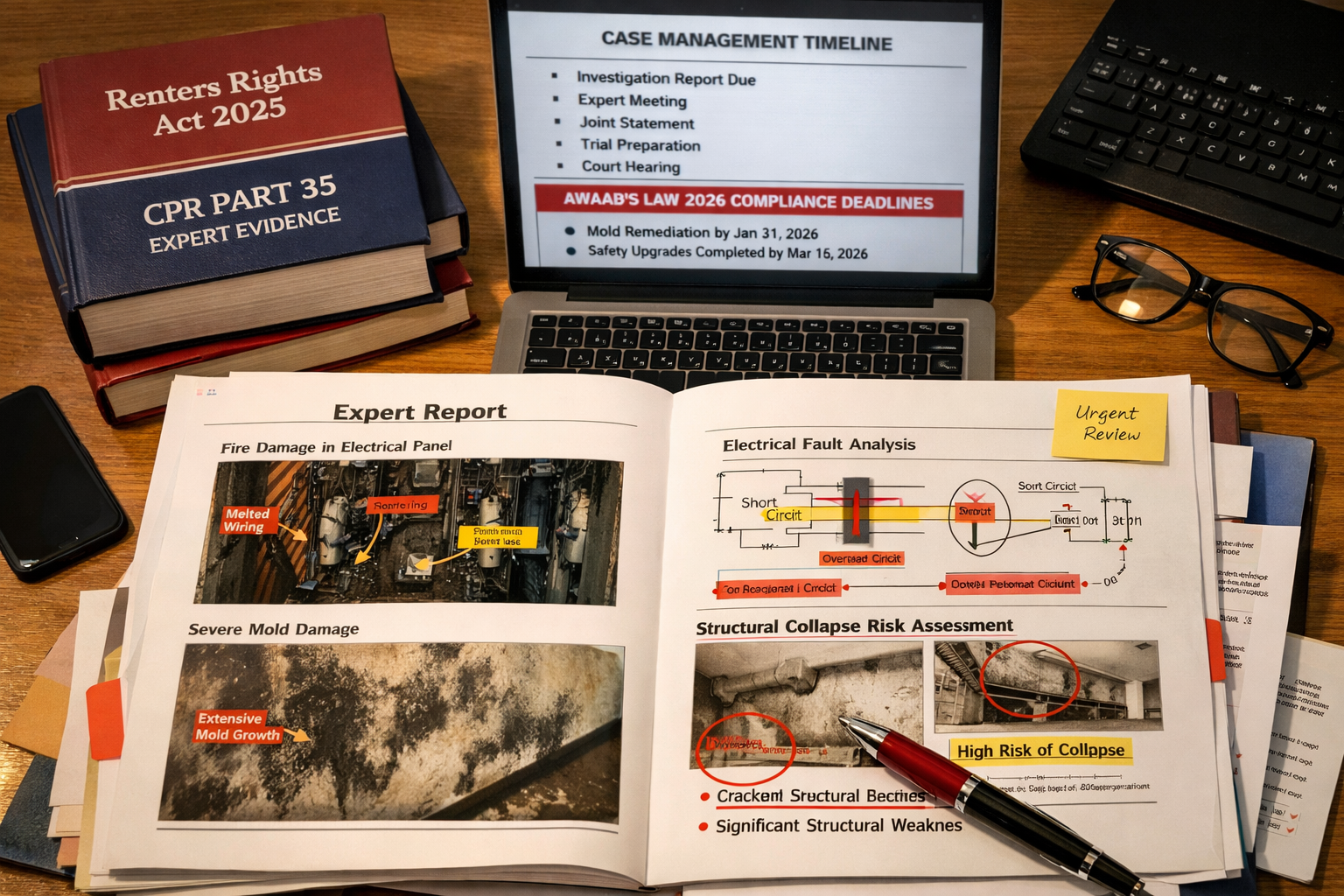
The Renters' Rights Act 2025 has made documentation requirements central to PRS dispute outcomes [3]. Landlords who cannot produce professional defect reports when challenged face significant legal consequences. Equally, tenants who can present a professionally prepared expert report hold a substantial evidential advantage.
Best practice documentation chain for landlords:
Tenant Complaint Received
        ↓
Timestamped Acknowledgement (within 24 hours)
        ↓
Professional Inspection Commissioned (within 10 days)
        ↓
Written Hazard Report Issued to Tenant
        ↓
Remediation Works Completed (within 3–5 days for urgent hazards)
        ↓
Completion Certificate / Photographic Record Filed
Maintaining this chain is not optional — it is the primary defence against enforcement action and tribunal claims [2].
The Role of the PRS Ombudsman in 2026 Disputes
A new Private Rented Sector Ombudsman is expected to be operational by late 2026, providing an alternative dispute resolution route outside the court system [1]. This means expert witnesses may increasingly be asked to prepare reports for Ombudsman proceedings as well as civil litigation.
Key differences for Ombudsman proceedings:
- Less formal than county court — but technical evidence still carries significant weight
- Faster resolution expected — reports must be concise and clearly structured
- Remedial recommendations are often more important than legal arguments
Expert witnesses should prepare reports that work effectively in both jurisdictions.
Dilapidations and Awaab's Law: An Emerging Overlap
An important emerging issue in 2026 is the overlap between Awaab's Law hazard claims and dilapidations surveys. Where a landlord argues that tenant misuse caused or worsened a hazard, the expert witness must carefully distinguish between:
- Inherent defects (landlord's responsibility under Awaab's Law)
- Tenant-caused damage (potentially recoverable as dilapidations)
- Normal wear and tear (neither party's liability)
This distinction is frequently contested in 2026 PRS disputes and requires expert witnesses with both building pathology expertise and a clear understanding of tenancy law.
Preparing for Cross-Examination: Practical Tips for Expert Witnesses
Strong report writing is only half the job. Expert witnesses in Awaab's Law disputes must also be prepared for robust cross-examination. Key preparation steps include:
🎯 Before the Hearing:
- Re-read the report in full and identify any areas of potential challenge
- Review the opposing expert's report and prepare reasoned responses
- Confirm that all photographic evidence is dated, geotagged where possible, and properly labelled
- Ensure the HHSRS hazard classification is defensible against the specific facts
🎯 During Cross-Examination:
- Answer only what is asked — do not volunteer additional information
- Acknowledge genuine uncertainty rather than overstating confidence
- Refer back to the CPR Part 35 declaration if independence is challenged
- Use plain language: avoid jargon that obscures rather than illuminates
"An expert who says 'I don't know, but here is how it could be determined' is far more credible than one who overreaches their expertise."
🎯 Common Pitfalls to Avoid:
- Failing to inspect the property in person before writing the report
- Relying solely on photographs provided by the instructing party
- Omitting the landlord's perspective entirely (courts expect balance)
- Confusing HHSRS Category 1 and Category 2 hazard thresholds
For complex multi-hazard cases, chartered surveyors in London with specific experience in HHSRS assessments and PRS litigation are best positioned to provide court-ready expert evidence.
Conclusion: Actionable Next Steps for 2026 PRS Expert Witness Work
Expert Witness Preparation for New Awaab's Law Hazards: Electrical, Fire, and Structural Risks in 2026 PRS Disputes demands a new level of technical rigour, legal awareness, and documentation discipline. The expansion of Awaab's Law to the entire PRS — combined with Phase 2's inclusion of electrical, fire, and structural hazards — has created a litigation landscape where the quality of expert evidence can determine outcomes worth tens of thousands of pounds.
Actionable next steps for property professionals in 2026:
- Audit your report templates — Ensure all expert witness reports meet CPR Part 35 requirements with the mandatory independence declaration
- Invest in specialist equipment — Thermal imaging cameras, crack gauges, and moisture meters are now essential inspection tools, not optional extras
- Build a compliance timeline into every report — Map the landlord's actual response against the 24-10-3-5 rule in every case
- Understand the HHSRS — Familiarise yourself with all 29 hazard categories, not just damp and mould
- Prepare for the PRS Ombudsman — Develop a concise report format suitable for both court and Ombudsman proceedings
- Collaborate across disciplines — Electrical, fire, and structural hazards often require multi-expert input; build professional networks accordingly
Whether acting for landlords defending enforcement action or tenants seeking remediation, the expert witness's role in 2026 PRS disputes has never been more consequential — or more technically demanding.
References
[1] On Your Radar 10 Real Estate Risk Areas 9475079 – https://www.jdsupra.com/legalnews/on-your-radar-10-real-estate-risk-areas-9475079/
[2] Navigating Awaabs Law What Private Landlords Need To Know And Do – https://www.hja.net/expert-comments/opinion/residential-property-disputes/navigating-awaabs-law-what-private-landlords-need-to-know-and-do/
[3] Building Survey Defect Documentation Under New Renters Rights Act 2026 Landlord Compliance Evidence For Section 8 Eviction Grounds – https://nottinghillsurveyors.com/blog/building-survey-defect-documentation-under-new-renters-rights-act-2026-landlord-compliance-evidence-for-section-8-eviction-grounds
[4] The New Decent Homes Standard What Landlords And Tenants Need To Know – https://gowlingwlg.com/en/insights-resources/articles/2026/the-new-decent-homes-standard-what-landlords-and-tenants-need-to-know
[5] Preparing For Awaabs Law A Practical Guide To Uk Social Housing Compliance – https://www.netcall.com/blog/preparing-for-awaabs-law-a-practical-guide-to-uk-social-housing-compliance/